Americans’ Political Persuasions ~ Based More on Myth than Fact

Like flies attracted to garbage, it seems that we Americans have less time for the real issues and for digging out the facts than we have for listening to unsubstantiated claims and political slogans… 
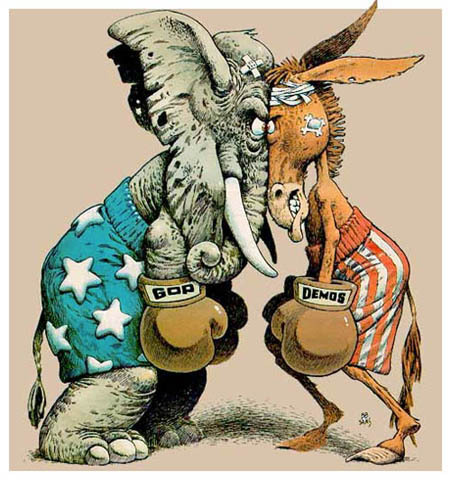
September 13, 2008  —  The latest hullabaloo over Barack Obama’s use of the “lipstick on a pig” phrase during a recent campaign speech is clear evidence to me that Americans are less interested in facts and issues and more impressed with myth and even outright lies told by the party of their particular persuasion.

Com’on, folks… Obama wasn’t alluding to Governor Sarah Palin and the pit-bull joke she made at the Republican national convention. Her’s was a great speech that resonated with millions of like-thinking voters and helped to give a significant “bounce” in the polls for the Republican ticket this year. There’s no denying that. But, if you listened to Obama’s speech, you would know that he was talking about Senator McCain’s proposed economic policy when he uttered this common phrase. He wasn’t talking about Governor Palin.  This same phrase, by the way, was used by Senator McCain no less than three different times in his campaign earlier this year when speaking about Senator Clinton’s proposals for a national health care program.

Like flies attracted to garbage, it seems that we Americans have less time for the real issues and for digging out the facts than we have for listening to unsubstantiated claims and political slogans like No Child Left Behind, Straight Talk Express, and Change Is Coming. Gee, that one sounds familiar.

Many of us, it seems to me, care more about wedge-issues like gun control, immigration, abortion, or the gender, race or religion of a candidate than we do about larger the issues like the economy and national security. We support whichever party claims to champion our heart-felt causes, usually the same party our parents have supported, then we believe unfailingly in whatever other claims our parties make. According to the Pew Research Center, social status and religious backgrounds influence American political persuasions more than reason.

I don’t often read articles in the ContinUUm, a magazine that my alma mater, the University of Utah, sends to me every month hoping that I will contribute to their Alumni Fund. But the most recent edition had some interesting articles in it about the state of our nation’s health care system. Thumbing through the pages one morning this week while sipping my first cup of coffee, one particular article just jumped out and grabbed me. It was written by a fellow alumnus, Carl R. Summers. Carl, who graduated ten years after me, is a scientist today working as a researcher with the Defense and Veterans Traumatic Brain Injury Center at Walter Reed Hospital. But his article wasn’t about brain injuries. It was about political myths. His hobby being statistics, he decided that a scientific look at real numbers might help to substantiate or debunk some of our two major parties’ basic claims… Interesting. Very interesting indeed.

You can find more on the actual numbers that Carl crunched and the methodologies he used on-line in a series of articles he has published at OutsidersDC (www.outsidersdc.com).

We are told that the Republican Party is the party of business and small government, lower taxes and reduced government regulation. The Democratic Party, we are reminded over and over  again by Republican Party politicians and right-wing pundits like Rush Limbaugh, is the party of big government, high taxes, big give-away spending, and bleeding-heart, wasteful social programs for the down and out. Right? Well, if this is true, would it not follow then that the nation’s growth in output of goods and services, the real (adjusted for inflation) Gross Domestic Product (GDP) would be higher year after successive year during Republican rather than Democratic administrations? Wouldn’t it also follow that average taxes paid would be lower during Republican administrations and in years that Congress was controlled by the Republican Party? After all, Congress, not the President, has the most to say about taxes and spending. Shouldn’t we also expect less government spending by conservative lawmakers?  In as much as every Republican administration since Reagan has embraced some form of the “trickle-down,” supply-side economic theory in formulating tax policies, shouldn’t everybody be better-off with more after-tax income to spend and shouldn’t there be more and better jobs?

Asking himself these questions, Carl looked at readily available data and scientifically compared the performance of Republicans and Democrats occupying the White House every year since 1950. He also looked at records on taxing and spending when each party had control of the Senate and House of Representatives. What he found was surprising, even to me, a “fiscal” conservative and teacher of economics.  He discovered that the average real increase in GDP for Republicans was 2.8 percent per year. The average increase for Democrats was 4.4 percent. So, despite claims to the contrary, business performed 57 percent better on average under Democratic administrations than under Republican administrations.

What about unemployment?  Remember, Democrats are supposed to be the party of the working class. Carl discovered that the average unemployment rate under Republican administrations has been 6.1 percent. That’s what the Bureau of Labor Statistics is currently reporting. Under Democratic administrations, the average was 5.1 percent. So, the Democratic claim is substantiated.

Carl asked himself — If the trickle-down theory has any validity, if lowering business taxes, capital gains, and individual income taxes on the wealthiest of Americans encourages investment and creates jobs (a rising tide lifting all boats), then shouldn’t this raise the value of corporations? Shouldn’t this be reflected by gains in broad stock indexes like the Dow Jones Industrial Average (DJIA) and the Standard and Poor’s 500? To answer this issue, he looked at respected business data over the years and concluded that the average change, or increase in stock prices grew 7.4 percent during Republican administrations. Not too shabby, you say?  Well, stock prices grew 10.4 during Democratic administrations. Furthermore, he noted that during Democratic years, the Dow showed relatively small, somewhat consistent ups and downs, what economists call normal business cycles.  During Republican years, the Dow was, in his words, “… like a roller coaster ride with large, unpredictable peaks and valleys.”

On the issue of which party favors low taxes and which party favors high, Carl normalized “federal receipt” data by comparing it over the years as a percentage of real GDP. He did this to compen- sate for variations in the economy like inflation, population growth and tax policies. What he found out was that when Republicans were in the White House, government taxed at the rate of 18.9 percent of real GDP while, when Democrats were in the White House, government taxed at 19.1 percent. Yes, Democratic administrations did tax at a slightly higher rate, but the two-tenths of one percent difference, he says, is statistically too close to call. But remember, it is Congress, more so than the President, that controls our nation’s purse strings. In the years that Republicans controlled the Senate, government collected 18.5 of real GDP compared to 17.7 percent when Democrats ruled. In the House of Representatives, when Republicans ruled, government collected 18.7 compared to the same 17.7 percent when Democrats were in control.  This difference is statistically relevant and it means that, after all these years of Republican claims about Democrats raising taxes, the reality is that taxes are almost exactly the same regardless of the President’s party, but they are actually higher when Republicans have control of the House and/or Senate.

Ok, you say, but what about spending? Well, treating expenditures the same way he did revenues, as a percent of our nation’s real GDP, Carl discovered that Republican administrations spent 20.2 percent while Democratic administrations spent significantly less, 19.2. This is a 5.2 percent difference, folks!

So, now you know. Based on fact rather than myth, the real tax-and-spend party has been… well, its mascot, like Pinocchio, has a prominent proboscis.

I invite your comments, pro or con.

Published in: on September 13, 2008 at 10:45 am  Comments (10)  

Energy Saving Ideas ~ Big and Small

Discouraging the BIG OIL and COAL industries from continuing business-as-usual/high profit operations at the expense of the environment and the health of the nation, just might motivate them to think more “out of the box” on energy alternatives.

Being a member of and contributor to environmental organizations, I get emails from them often, heightening my aware- ness of things, asking for donations, and encouraging me to send letters and emails to my representatives Washington asking them to support earth-friendly legis- lation.  I got one from the Environmental Defense Fund today asking for energy saving ideas, big and small (something different this time) – on how I, my family, and our country can rethink the way we live and work in this age of not-so-cheap oil. So I went to their weblog and found some interesting observations and perspectives already posted there. I left the following comment of my own:

On the home front, the wife and I are already limiting our trips, combining errands whenever possible. The wife is carpooling now 3 or 4 days a week, and I hope to find someone with whom to carpool too once school restarts this year (I teach high school economics, and so am off for the summer). When I drive my ’05 Dodge Magnum, I hypermile, which nets me about 4 to 5 extra miles per gallon. Hypermiling includes driving slower, accelerating gradually, and making sure my tires are properly inflated, a common sense thing Barack Obama advocates that we all do, which John McCain has made fun of lately. But, hey – every little bit helps — right? I’m riding a motorcycle when it’s not too hot and when it otherwise makes sense to do so. Our summer getaways this year were fewer and to closer destinations, and we don’t anticipate traveling as much in the future either, even if the price of gas comes down substantially. When next it is time to buy or lease, we plan to make mileage the number-one priority. And we are going GREEN in many other ways too… we have switched our electric company to Green Mountain Energy, which generates 100% of its power from renewable sources. Their price per kwh is very competitive, by the way.

At the local level where natural gas is plentiful like it is here in Texas, and becoming more plentiful all the time with drilling into the Barnett Shale, I would recommend public transit, and especially school buses, be converted to run on this fuel as an interim alternative to diesel until better, more environmentally friendly technologies become available, such as electric fuel cell hybrids. Near term cost benefits might be negligible for this, but there are health benefits to consider, and doing so would reduce our demand for foreign oil. Hopefully too, the growing demand for mass transit will stimulate the expansion of existing systems and the development of new ones. Suburban communities, larger cities and state governments really should welcome and encourage this.

At state and national levels, every effort to support the devel- opment of alternative energy sources should be promoted as a priority over new drilling — anywhere. More oil just perpetuates our addiction to it and continues pumping CO2 into the atmos- phere. Wind and solar farms should definitely be in the mix, and I would not rule-out new nuclear power plants where demand is highest and real estate is limited. New coal-fired plants should be discouraged, in my opinion, unless carbon sequestering technol- ogies are incorporated.  Discouraging the BIG OIL and COAL industries from continuing business-as-usual/high profit oper- ations at the expense of the environment and the health of the nation, just might motivate them to think more “out of the box” on energy alternatives. Although it would be competing with the private sector, I admit, i.e., the airlines, I believe that there should be government efforts to promote the return and update of passenger rail systems.

Finally, I would advocate and support the idea of governments offering individual tax credits and other incentives for people and businesses to weatherize and upgrade to new, “made in the U.S.A.,” highly efficient, environmental systems. Government should back T. Boone Pickens’ energy plan too, stimulating the manufacture of millions more state-of-the-art wind gener- ators. Not only would these things save energy, but they would generate jobs for people put out of work by offshoring and the decline in demand for new homes and American-made automo- biles. These would be jobs that could not be exported. With people going back to work, consumption would increase, as would the tax base. With more money spent on American-made items, the trade deficit would decline and our economy might just start to improve like a rising tide, “lifting all boats” this time, not just those of the rich. This, I think, would make a whole lot more sense as a fiscal policy for Washington than short-term stimulus checks and tax cuts for businesses that are already posting record profits.

I invite your comments, supportive or un, and ideas of your own.

Published in: on August 11, 2008 at 2:10 pm  Comments (2)  

Race and Age ~ Taboo Topics in Politics

Talk about controversial issues… Obama’s race and McCain’s age certainly are two. So, personally, I think the official moratorium on these topics should be lifted.

I think the two major party nominees apparent have been pretty good about steering clear of these topics. Don’t you agree? Except for Senator Obama’s major speech on race issues in America during the Democratic primary and vague references to race in speeches he made last month, i.e., not being from central casting or looking like all those Presidents on U.S. paper currency, I can’t recall either candidate violating their campaign pledges to avoid these topics. Of course, McCain’s campaign was quick to claim that Obama’s central casting/paper money comments was playing the so-called race card. But recall that McCain has responded to the age issue in the past, saying that he would only seek to serve one term because of it, claiming to be physically fit and mentally alert, promising to work hard. Tit for tat, I’d say.

Although Obama and McCain have both been playing pretty fair, at least in my opinion, it cannot be denied that supporters of both candidates, as well as the media, are not. Why, just last night I got another forwarded political email claiming, tongue-in-cheek, that Senator McCain’s age (71 by the time that he would be sworn-in as our forty-fourth president) is actually an advantage to American taxpayers. The argument goes like this:  A president’s pension currently is $191,300 per year. Assuming the next president lives to age 80. Senator McCain would receive no pension if he were to serve two terms since he would reach 80 shortly after the end of his second term. Senator Obama, who would take office as our youngest president ever, would be retired for 26 years after two terms and so would receive $4,973,800 in pension money from taxpayers.

So, a vote for John McCain is a vote for reducing the cost of government… POE-LEEEZ!  This makes about as much sense as McCain’s claim that he can balance the budget just by eliminating earmarks and other “wasteful” government spending. The Washington Post had a good article on this last month. $5M wouldn’t pay for 30 minutes of our current presence in Iraq.

About Senator Obama being African American — we can all fathom that this is why the polls still show the candidates in a statistical dead-heat even with over eighty percent of Americans saying that they think the nation is on the wrong track, socially, economically, militarily and diplomatically, and even with John McCain offering very little apparent change. Obama’s rallies and town hall meetings draw tens of thousands and McCain’s draw at best a few hundred. Why, McCain even has to schedule speeches at events where large numbers are already planning to gather such as this week’s gathering of Harley-Davison bikers in Sturgis, SD. Enthusiasm for Obama is high among likely voters, according to a recent Pew Research Center survey, and low among McCain’s supporters. Notwithstanding, CNN’s poll of polls shows Obama ahead by only a five percentage points. Why? Give a listen to what Richard Trumka, Secretary/Treasurer of the AFL-CIO has to say about this.

Given that they are serious issues people care about — rightly or wrongly — and that they are likely to affect the outcome of the presidential election this year, I personally think the moratorium on addressing Obama’s ethnicity/race and McCain’s age should be lifted. Instead of talking about these issues in hushed tones, making jokes and cartoons about them and having them alluded to by the likes of Senator Clinton and the former President, they should be exposed to the light of day. Should it take playing the race card and the age card to win, so be it.

If America must be denied the brightest, most articulate states- man to come along in decades to serve as our next President simply because of his race, then I will truly be ashamed of my country.

I invite your comments whether supportive or un.

Published in: on August 8, 2008 at 9:15 am  Comments (7)  

The Buffalo Theory ~ Feeling Smarter Than We Really Are

Herd members must keep up or else be left behind – no exceptions. Even new-born calves must keep pace. So, should we not treat people the same way?

Social-Darwinisis the belief that some are created more equal than others, which is obvious despite the famous words at the beginning of our Declaration of Independence: “We hold these truths to be self-evident… etc., etc.” This and other forms of social pseudo- science is the topic of Chapter Three in Susan Jacoby’s book, “The Age of American Unreason.” Better known today by the popular phrase, “Survival of the Fittest,” social-darwinism postulates that successful people and societies succeed because they are superior and so, by right, deserve to keep their spoils and rule over the rest of us. But Darwin never used the phrase, “Survival of the Fittest.” His science was about evolution, the origin of species, not about social ethics.

I find it curious that so many who find themselves on the political right today reject the “hard” science of Darwin but embrace the pseudoscience of Social-Darwinism, which was based loosely on Darwin’s work when popularized in the United States during the Gilded Age in America.

Diverting from the primary theme of this posting briefly, when political campaigns run out of new credible ideas to address the issues that concern voters, they become defensive, protecting their base support by attacking the opposition obliquely and by reaf- firming core party values. Recall the old adage: The best defense is a strong offense. They do this by going after individuals, raising doubts about their opponents’ “true” motives and qualifications for the job, and by fanning the flames of fear and doubt — sometimes under the guise of injecting a little “harmless” humor into the campaign.

Don’t you just love politics?

In light of the recent McCain campaign videos blaming Obama for the high price of gasoline and comparing him to Brittany Spears, Paris Hilton and Moses, this seems to be the strategy of the moment for the McCain team. The Obama team moved to counter this negative tactic with an attack of their own, not against McCain personally, but against his ideas for bringing down the price of gasoline by giving Big Oil more tax breaks and pledging to continue the business-friendly fiscal policies of George W. Bush.

Along similar lines, politically-motivated, freelance authors are using the Internet to circulate rumors and innuendos intended to help their party of choice prevail this year. For example, a close friend who leans sharply to the right recently shared one such example of “viral disinformation” with me. It was a Please-Forward-This-To-Everybody-You-Know email claiming that the Democratically-led Congress is planning to implement a “windfall profits” tax on retirement income. Perhaps you have received a version of this yourself… perhaps not. But rest assured; the claim is false. Check it out here on Snoops.com. If this or a similar com- munication resonated with you and added conviction to your resolve to vote for your party this year regardless of your feelings for or about your party’s presumptive nominee, then you have been made to feel smarter than you really are – not unlike after drinking a few beers. Bear with me, you’ll understand what I mean by this in a moment.

Another close friend, closer to the center politically but also leaning farther to the right than myself, shared the following allegory from an old episode of the once popular TV show, Cheers , which is also making the rounds on the Internet:

“Cliff is seated at the bar describing the Buffalo Theory to his buddy, Norm.

‘Well, you see, Norm, it’s like this… A herd of buffalo can only move as fast as the slowest buffalo. And when the herd is hunted, it is the slowest and weakest ones at the back that are killed first. This natural selection is good for the herd as a whole, because the general speed and health of the whole group keeps improving by the regular killing of the weakest members. In much the same way, the human brain can only operate as fast as the slowest brain cells. Now, as we know, excessive intake of alcohol kills brain cells. But naturally, it attacks the slowest and weakest brain cells first. In this way, regular consumption of beer eliminates the weaker brain cells, making the brain a faster and more efficient machine.  And that, Norm, is why you always feel smarter after a few beers.'”

For many, Cliff’s explanation for why we feel smarter after consuming a few beers might seem plausible, especially since so many people believe the premises… ONE: that “culling” herds in the wild of weak and infirm members is beneficial to the larger body because it makes the herd less vulnerable to predators, and TWO: that alcohol kills brain cells. But neither premise is true, not really.

In the wild, herd members must keep up or else they are left behind – no exceptions. Even new-born calves must keep pace. But studies have shown that herd speed does not reduce vulnerability to predation, mass behavior does. According to something called the selfish herd hypothesis, herds of various species move for the most part instinctively based on grazing preferences and seasonal changes, not anxiety caused by fear of predators. Individual herd members decrease predation risk by moving toward one another, which is called aggregation. Previous studies have shown that aggregation can form using simple movement rules designed to decrease each animal’s domain of danger.

As for alcohol destroying brain cells, taking out the weakest first — alcohol surely does affect the brain, as we all know, causing slurred speech, clumsiness, slowed reflexes, and a loss of inhibition. But alcohol doesn’t destroy the brain cells, per se, to cause these problems. Rather, alcohol dilates the channels in the cellular structure that regulates the flow of calcium. More calcium than normal flows into the cells and stimulates increased activity. It is this increased activity that, over time, if consumption is heavy enough and uninterrupted by periods of abstinence, causes a loss of nerve cell end segments, to include those found in the brain. But this effect has been shown in clinical studies to be general and gradual among heavy drinkers, affecting different people in different ways and at different rates.

So, even if you haven’t been drinking a beer while reading this, you should feel smarter now – right? The facts have been reveled and documented. But Cliff’s buffalo herd allegory isn’t really about feeling smarter after a few beers, is it? The subliminal message is about how society would be better off without laggards, a belief that I’ve found to be widely held by those on the political right.  The extension of this is, of course, why encourage them? They’re not worth our time and effort. Go far enough with this line of thinking and we find ourselves on the slippery slope of fascism.

I responded to the friend who sent me Cliff’s allegory by saying, “Would that it really worked that way, ___________ (name omitted here)… the beer drinking part of it at least. But the implication of this snippet from the old Cheers episode is really that society is not unlike a herd of buffalo wherein the less productive members slow the progress of the whole. Conclusion: either leave them behind for the wolves or drag ’em along with you. There’s possibly a third option though, one that mitigates the burden of the weak to society: nurture them from our excess so that many might be better able to contribute, which if I recall my Scripture correctly, is the Christian thing to do. Which option do you choose, my friend?”

Not that my friend isn’t a Christian and generous person, for I know him well enough to know beyond a doubt that he is — both, but in his response, after saying,  “Well, go ahead and contribute,” my friend deigned to change the subject. He doesn’t send me forwarded emails of a political nature anymore.

I invite your comments, supportive or un…

Published in: on August 4, 2008 at 1:39 pm  Comments (2)  

What’s the Difference Between a Town and a City — An Urban Area and a Rural Area?

Do you think you think you know the answer?

A friend recently challenged me with this question. He chose to ask it of me because he knew that I had taught geography for several years. Even so, I felt that I had to check my facts before responding and, in so doing, I broadened my own understanding on the subject a bit. He, like many Americans, thought that the official difference between a town and a city had to have something to do either with population size or with geographical area. Well, it doesn’t.

Strange as it may seem, geographers don’t classify more-densely populated areas as cities or towns. They are all called urban areas as opposed to rural areas. That’s because there is no universally accepted criteria based on either population size or square miles/ kilometers. Rural areas are less densely populated, offer fewer services, and are generally devoted to economic activities such as farming and ranching. In the U.S., according to About.com – geography, an urban area is one that has a population providing services that numbers at least 2,500. Smaller populations pro- viding services are called villages. This differs from country to country, of course. In Japan, an urban area must have a population of at least 30,000.

In England, from which we Americans originally adopted our sense of such things, a city was a town with a cathedral. All other densely populated areas were simply called towns. But they are all towns in today’s “United Kingdom,” including (in all Britishers’ eyes) the mother town of them all, London Town.

I think what most people in the U.S. understand to be a city today is a larger urbanized area that has government buildings like county seats do here in Texas. Cities in the U.S. usually have a university or two in lieu of community colleges. They very often have museums and other cultural centers too like zoos and the like. In the vernacular of a place, however, it is quite acceptable for people to refer to their urban area as either a town or a city. It’s all perception.

Metropolitan areas like Dallas, Texas are agglomerated urban areas with peripheral zones not themselves necessarily urban in character, but closely bound to the urban center by employment or commerce. A metroplex is when metropolitan areas grow large enough to merge, as in the Dallas/Ft. Worth Metroplex. A megolopolis is when many metropolitan areas merge, as on the east coast of the U.S. with BosWash, a huge urban area incorp- orating the cities of Boston, New York and New Jersey, Baltimore and Washington D.C.

My wife and I lived for several years in Springfield, VA — Virginia still calling itself a “Common Wealth” in the old English tradition.  Springfield had a population then of over 30,000, yet it was classified by Fairfax County not as a city or a town, but simply as a “populated place.” It had homes, churches, a post office, a county health department office, buildings housing police and fire depart- ments, and even a huge shopping mall containing a drivers’ licensing office for the county, but it had no government separate from Fairfax County. Vienna, also in Fairfax County, was char- tered and had an elected school board making decisions for a separate school district servicing its population. Therefore, it was considered a city.

DeSoto, Texas, with an estimated population in 2005 of 38,580, calls itself a city and even won national distinction in 2006 as an All-American City. Yet it is not a county seat. It has no zoo or museum that I know of, unless one considers my wife’s office in our home with all her nursing memorabilia a museum. Neither does DeSoto have a cathedral. But I won’t argue against its right to call itself a city. Round Top, Texas, with an estimated population of 25, considers itself to be the smallest city in Texas, being an incorporated township, but the “city fathers” of Impact, Texas disagree. They claim to be the smallest. Neither, however, even qualifies by official numbers to be an urban area. So, go figure — the answer you get pretty much seems to depend on where you are when you ask the question.

I invite your comments pro or con.

Published in: on July 23, 2008 at 3:20 pm  Comments (31)  

America ~ Is It Still a Land of Opportunity?

Obviously, it is getting more and more difficult for the vast majority of young people in America to achieve the same levels of success as their parents and grandparents, at least in terms of personal income.

July 18, 2008  —  We were delighted to learn recently that Stephanie, the oldest daughter of dear friends of ours back in Missouri, David and Nancy Israel, will be graduating from nursing school soon. Although she probably had some financial assistance based on merit, or need, or both, we suspect that her parents still had to dig pretty deep to see her through — her father being a Methodist minister and her mother a school teacher. Both careers are known to be rewarding, but not necessarily in the salary-way.

With the rising cost of higher education in this country outpacing pretty much everything except the cost of health care, more and more parents like David and Nancy are finding it more and more difficult to provide their sons and daughters with a college edu- cation — the “open doorway” to both personal and professional success in life.

To help pay for tax cuts that have primarily benefited the wealthy, President Bush reduced the size and cost of government when he became President in 2001. He stripped $12 billion from the federal student loan program as part of this reduction, and the previous level of funding for this has never been restored. Today, a Pell Grant covers only 33% of a student’s annual college costs. In1975, Pell Grants covered 84% of students’ costs. But this isn’t all the President’s fault. When Bush took office, the cost of tuition at a public four year institution was $3,501.The cost this year, 2008, is $6,185 – an increase of 56.7%. Over this same time period, median household incomes have decreased 2% despite an economy, as measured by the administration’s Gross Domestic Product (GDP), that has been expanding.  Because of this burdensome cost, the reduction in aid programs and the government’s favorable policies toward the $85 billion a year student loan industry, over 400,000 qualified high school graduates will not be able to attend college this year.

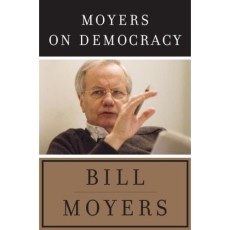
According to Bill Moyers’s new book, Moyers On Democracy, one-third of all college students graduated with debt in 1993. In 2004, two-thirds did. And, according to the College Board, the total volume of private student loans has grown by 27% since 2001, the year that George Bush became our President. Some of these “private” loans carry interest rates as high as 19%, and most undergraduate students finish with close to $20,000 in student loans whether he or she is able to find a good job or not. This is a 108% increase in just a decade. Compare this to the $11,100 in debt his/her counterpart graduate carried in 1975 paying just 6.8% interest when the government was still making these loans. This was before we started off-shoring many of our better-paying jobs for entry-level graduates. But Stephanie won’t have a problem finding a decent-paying job; nurses are in great and growing demand. Hopefully, she won’t be paying upwards of a third of her salary to retire student loans as some must.

So who has been making all this money in an expanding economy? Good question.

According to a PhD economist, Paul Robin Krugman, who is professor of economics and international affairs at Princeton University and also a columnist for The New York Times, if we were to equate the total population of Americans in the civilian labor force with 1,000 people and line them all up left-to-right according to how much they make, then equate their personal incomes with how tall they are, the person in the middle would be six feet eight inches tall. The person on the extreme left would be only 20 inches tall. But the person on the extreme right — wow!  He would be almost 600 feet tall — nearly 5 times taller than his counterpart back in the mid-seventies. The persons to the left of center would have all grown too, reflecting a growing economy, but they would only be about fourteen percent taller today.

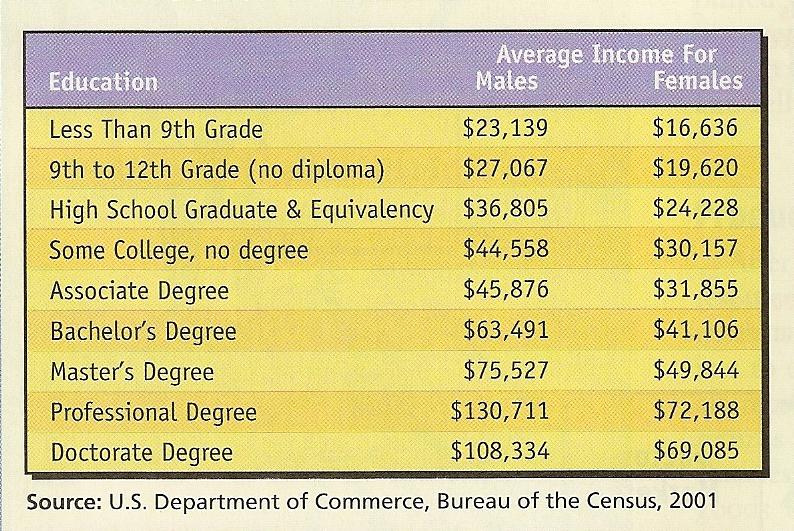
So, one might well ask, “Is America still a land of opportunity?” This, I realize, depends on how one defines success. But if income is part of one’s definition of success, the correlation between years of education and success could not be stronger. The following table is from the textbook that I use in my Economics Survey class published by Glenco/McGraw-Hill.


Obviously, it is getting more and more difficult for the vast majority of young people in America to achieve the same levels of success as their parents and grandparents, at least in terms of personal income. And the so-called gender-gap is still very real. But that doesn’t answer the question, “Is America still a land of opportunity?” In the abstract, it certainly is. Odds are now that Stephanie, with her college degree, will enjoy a measure of success, both personally and professionally. But what about those 400,000 otherwise qualified high school graduates that won’t be going to college because it has become too expensive?

As you can see, the ramp to success in this country is getting steeper — the social goal of equal opportunity, more elusive. So, out of curiosity, I decided to find out what people think about America still being a land opportunity. In a recent survey of The World According to Opa readers, I posed this question, “Do you believe that anybody in America can be successful in this day and age if they try hard enough?” Follow-up questions included, “how much do you believe money has to do with success, do you consider yourself to be more liberal or more conservative,” and, “how do you define success?” With 75 responses (more than half of them coming from persons self-identifying as being more con- servative than liberal) I got some very interesting results. From the numbers and correlations I was able to make, the results supported my hypothesis that conservative thinkers are more likely to believe that anyone can still make it in America, but not strongly. The correlation between conservatives and believing this was 82.5 percent. The correlation between liberals and believing was 17.5 percentage points less. Somewhat surprising to me, considering the rising costs of higher education, skyrocketing energy, food and medical costs, and the escalating number of home foreclosures, is that nearly three-fourths of all who responded still believe. So, despite it all, Americans remain an optimistic people.

All my data were from respondents who are affluent enough to have Internet access, mostly middle class, homeowners. So the survey was not entirely valid in that it did not include opinions from people in lower socio-economic circumstances. They, no doubt would be more pessimistic. But, if I included the same number of people from higher socio-economic circumstances too, they tending to be more optimistic, the more inclusive survey would probably balance-out with similar results to that which I already have from middle class homeowners.

Seventy percent of respondents said that they believed money was “somewhat” important as a measure of success, while only 7.5% said that it was “very” important. Twenty-two and a half percent said that money had very little to do with it. Surprise! But the most interesting result, I think, had to do with how respon- dents said they view success. Almost all said that being self-sufficient and able to provide basic needs and wants for loved ones is important. Most also included considerations of self-esteem and being happy with one’s lot in life in their definitions. About 80% included considerations of altruism…being able to give back to society in some way, while a small number said that success simply meant being able to do what one wants to do when one wants to do it. Sixty-nine point seven percent of conservatives included altruism in their definitions; a whopping 92.3% of liberals did the same.

So, I conclude that, for most Americans, equal opportunity has become less equal in recent years. Despite what we teach to our students in classrooms all across the land, and despite what most Americans still believe, America is not the land of opportunity that it was for us Baby Boomers and for our kids, the Generation Xers. I also conclude that, at least among those who read my blog, in addition to being optimistic, Americans are a generous people. But the most generous of Americans are those who call themselves liberal. It will be these voters who, I predict, if they are successful this year in restoring the White House and full-control of the Congress to Democrats, will begin to restore to us all to something closer to equal opportunity. And may God bless us all, rich and poor alike.

 I invite your comments, both pro and con.

Published in: on July 18, 2008 at 12:27 pm  Comments (4)  

A Comprehensive Energy Plan ~ Thinking Out of the Box

We must tighten our belts – we must evolve both socially and economically if we are going to survive.

One of the most serious limitations of economics, as every teacher of the subject is aware, is that the study defaults to using money as its bottom-line measure and storehouse of value. We can’t easily factor-in quality-of-life, happiness, or the environment and other so-called subjective considerations. It’s not that we can’t. It’s just that we find it easier to stick with dollars, pesos, renminbi, euros and yen. For these we have exchange rates, and it is for these that investors clamber. But how many Chinese renminbi is the life of a single child worth having succumbed to arsenism, fluorosis, or any number of respiratory illnesses that result from the combustion of low-grade coal? Who will compen- sate the family for this loss?

These questions are almost like asking how many angels can dance on the head of a pin. We may not be able to know, but we must be able to decide if the world as we know it will long survive.

All Presidents since Richard Nixon and the oil crisis of the 1970s have included energy considerations in administration policies. Nixon gave us the National Maximum Speed Limitof 55 mph. Carter deregulated domestic oil production and gave us the Federal Department of Energy, then pushed Congress to increase Corporate Average Fuel Economy (CAFÉ) standards. In 1978, the United States Strategic Petroleum Reserve was created and the National Energy Act was introduced. Ronald Regan, in 1983, pushing for more nuclear energy, attempted to get government out of the energy business by merging the Department of Energy with the Commerce Department, which Congress refused to go along with. He was, however, able to get Congress to approve initial steps in building the Yucca Mountain Nuclear Waste Storage Facility on Federal lands in Nevada. George H. W. Bush put together an impressive international force to drive Saddam Hussein out of Kuwait in 1990 – 91 and his son, George W. Bush, took us back to Iraq in 2003. Now, while one will still get some argument over this, most Americans are convinced today, as are the Iraqis, that Operations Desert Storm and Iraqi Freedom had/have more to do with the oil found in Kuwait and Iraq than they did with the freedom of Kuwaitis or with Weapons of Mass Destruction (WMD). What did Bill Clinton do for us? Overruling Treasury Department Antitrust concerns, his administration approved the merger of Exxon and Mobile oil companies, making it the single largest private corporation in the world at that time.

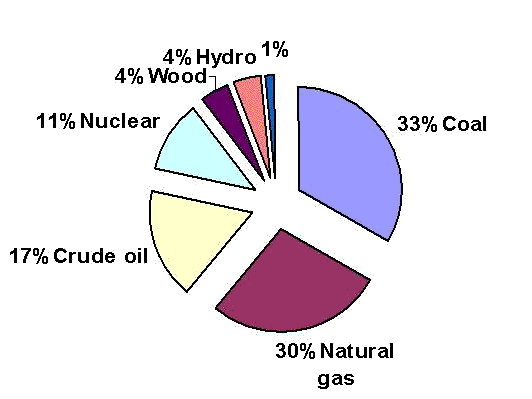
Why has so much of our energy policy emphasis been on oil? It’s because the United States gets approximately 80% of its energy from fossil fuels, and 17% of this is from oil, two-thirds of which is imported. In coal and natural gas, we are self-sufficient, but it’s not economically feasible to fuel cars, trucks and airplanes with coal and natural gas. That’s why most of the oil we use is consumed by the transportation sector.

Americans, who constitute less than 5% of the world’s population, consume 26% of the world’s energy. We account for about 25% of the world’s petroleum consumption, while producing only 6% of the world’s annual supply. So… increase U.S. oil production, right? Wrong, we have only 3% of the world’s known reserves. Even with ANWR and other coastal areas opened to drilling, we would still be dependent on foreign sources to sustain our current life styles.

A new, comprehensive energy policy is needed, one that has two goals:  1) the reduction/elimination of dependency on foreign sources of oil, especially sources other than North American, and; 2) avoidance of environmental calamity owing to Global Warming, a calamity the vast preponderance of climate scientists in the world are predicting. You’ve heard enough about this already and you’re either convinced this threat is real or you’re not. But I am convinced, and I am very much afraid for the future of mankind.  According to Dr. James Hansen, head of the NASAA Goddard Institute for Space Studies and the father of climate change research at that agency, we must reduce our atmospheric concen- tration of CO2 from its current 385 ppm (particles per million) to 350 ppm or less to avert disaster in our lifetimes. That means cutting way back on our consumption of fossil fuels, especially dirty coal and petroleum.

If we do not change our consumption habits, world demand for energy from all current sources will only increase as our populations grow and emerging economies become more affluent from free trade. Therefore, a comprehensive national policy will not be enough to address the second goal, that of avoiding a global warming catastrophe, which, in the long run, truly is the bigger problem. Accordingly, our new comprehensive energy policy must be coordinated with the rest of the world. This means returning to the negotiating table – revisiting the Kyoto Accords, which we could never satisfy now, or hammering out a more demanding protocol as part of a successor accord. For the U.S., this might mean committing to a 40% reduction in CO2 emissions by 2020 and an 80% reduction by 2050 as our “fair” share of the contri- bution. Can we afford to do this? Can we afford not to do this?

Pay me now or pay me later.

How do we get there? Well, I’m sorry folks – but policies aimed at bringing down the price of gasoline and other fuels so that we can continue on the same path we’ve been on since the end of WWII address neither goal of a “comprehensive” energy policy. They won’t make us any safer and they sure won’t make us any healthier. We must tighten our belts – we must evolve both socially and economically if we are going to survive.

Not indifference to Senator McCain’s thoughts on energy policy announced last week, here are my recommendation for the next administration to pursue with the American people through their representatives in Congress. First, convene a bipartisan panel for “long-term” energy policy that includes energy, environmental and economic experts who are not representatives of energy industries’ profit interests. Energy policy this time around should be motivated by the moral equivalency of survival rather than profit. Second, leave nothing off the table for consideration… nothing, not new nuclear power plants, not carbon cap ‘n trade regulations, not conservation or moratoriums on new coal-fired electric plants, not the drilling in ANWR and new coastal areas, and not even nationalization of energy production or considerations of eminent domain. Too much is at stake here: national survival — nay, even the survival of our civilization.

This new energy panel might consider the following: 

1. new tax subsidies for urban area mass transit systems and the expansion of interstate, rapid rail transportation systems;

2. Federally-funded alternative energy research with a national goal such as that established by President Kennedy in 1961 to put a man on the moon (industry seems to be more interested in exploiting current geo-political circumstances and lobbying Congress so that they can produce more oil for profit than in seriously considering alternatives);

3. backing-off subsidies for bio-fuels until technologies are available at a sufficient scale to make the production of ethanol and other bio-fuels from non-food sources practical;

4. the regulation or nationalization of energy and transpor- tation industries seeking cost containment and efficiencies (I know, I know, this smacks of socialism, but these things are working for other, mostly-market economies like our European and industrialized Asian friends);

5. tax incentives to help people transition from gas-guzzlers to hybrid and electric cars as they become more widely available, and the acceleration/expansion of CAFÉ requirements for new vehicles to discourage both production and demand for energy- wasting vehicles (certainly, pickup trucks and SUVs should not be excused from the same mileage and environmental standards as sedans);

6. “New Deal” style government work programs and tax incentives to insulate older homes, replace outdated, energy-hog appliances, and install decentralized, renewable energy sources such as wind generators and solar panels.

It is my personal belief that nothing short of an “all-court” press is going to salvage the energy situation that we find ourselves in today. This means that we’re all going to have to get on the same team, because the opposition is not China or OPEC. The opposition isn’t even al Qaeda. The opposition is inertia (resistance to change) and greed.

I invite your comments, pro or con, and would be very much interested in hearing of any ideas to expand my list for the next administration to consider (I don’t have all the answers; nobody does).

Published in: on June 30, 2008 at 12:00 pm  Comments (3)  

Normative Economics ~ Weighing-in On the Windfall Profits Debate

Politicians all want to do something for the economy in the worst way, and they usually do. Why?  They do so either because they want to get elected, get reelected, or make money for themselves and their friends. 

Perhaps a better title for this posting would be, Normative vs. Positive Economics ~ Why Politicians Aren’t Always the Best Deciders. But, because the windfall profits tax is a hot blog topic lately, I figured I’d get more hits on it with the title I chose.

Most economists, including those of us who, as teachers, just dabble at the edges of this “dismal science“, question the wisdom of imposing a windfall profits tax on big oil. We all teach that, ceteris paribus, when governments raise taxes on producers, much of that increased cost of production is simply passed-on to consumers. But if economics is only useful in the study of how things are (positive economics), then it truly is a dismal science. Fortunately, economics also involves consideration of the way things should be (normative economics).

Most Democrats in Congress, and the presumptive nominee of the Democratic Party for President, responding to the country’s desire for change, think that a windfall profits tax on big oil would be a “fair and reasonable” way to ease the pain and anxiety that Americans are feeling over rising fuel costs. They tend to believe that democracy should deliver the basics of life for all working Americans — normative economics.  Republicans, who are more resistant to change, tend to be more pragmatic. They believe in classic economics which teaches that government should get out of the way and let market forces do what they do — positive economics. 

I don’t recall for sure who said it first, but it certainly seems to be true: Politicians all want to do something for the economy in the worst way, and they usually do. Why?  They want to do so either so they can get elected, get reelected, or so they can make money for themselves and their friends. 

Here’s an interesting quote from the latest Sierra magazine: “Let us rid ourselves of the fiction that low oil prices are somehow good for the United States.” Who said this?  Then representative Dick Cheney in 1986 said this as he introduced a bill before Congress to impose a tax on imported oil. Gee – that was smart.

President Jimmy Carter, who has taken an awful lot of flak over the years from Republicans for the economic problems that persisted during his administration, may just be the exception to the rule for politicians. As President, responding to OPEC’s orchestrated reduction of output to punish the west for its support of Israel during the Yum Kippur War, Carter created the Depart- ment of Energy and established a national energy policy aimed at reducing our dependence on foreign oil. By personal example, he encouraged Americans to cut back on energy consumption and he removed price controls from domestic petroleum production.  As imports and oil company profits later began to grow, he tried a windfall profits tax anticipating big revenues. Instead, tax revenues declined and domestic oil production plummeted by an estimated 795 million barrels. So, we’ve been down this road before.

I personally believe that Carter was acting on the best advice of the economic advisors who had his ear at the time, and that he acted in the best interests of the nation as a whole. But one would think that we’d have learned our lesson by now.

Try as I may, I fail to find much convincing argument on the Internet currently to support Barack Obama’s pledge to impose a windfall profits tax on big oil. To the contrary, the blogosphere is filled with augments against it (good work McCain supporters). But Obama’s opponent this year isn’t making much economic sense either by advocating a federal gas tax holiday. So, why are they both making these kinds of promises? They are doing so because these things resonate with the voters, and the voters are very much in a populist mood this year. Only 47 percent of Americans are against nationalizing our oil companies, which most other nations have already done, oil being such a basic commodity to the livlihood and social welfare of a nation’s people.

A June 14th Rasmussen Report poll found that only 36 percent of voters believe that a windfall profits tax on big oil would cause fuel prices to go up. The rest, less 23 percent who said that they were not sure, said that prices would either go down or that they would stay the same. So, while the tax idea may be a loser in terms of offering a near-term solution to higher prices, it’s not necessary a looser politically, unless McCain supporters can successfully educate voters to the contrary before November.  Nor is the tax necessarily a looser in terms of contributing to a long-term solution. The same Rasmussen Report poll found that 76 percent of Americans believe that new energy technology developments are more likely to solve the problem than anything else, and the majority polled said that, given sufficient investment, private industry would be far more likely to succeed at this than government research programs.

Okay, you say, but you don’t believe in polls. Well, I do. I believe that, collectively, Americans are not dumb. It’s called, government of, by and for the people, not just for stockholders, but for people who must borrow from Peter to pay Paul on a monthly basis just to keep food on the table and their kids in school.

Now we get into the arguments about whether big oil’s profits are truly excessive and whether big oil is or is not already investing substantially in alternative energy technologies.

Exxon Mobil, the world’s largest oil company, reported last quarter a profit of $10.9 billion, up 17 percent from a year before. It was the second-most-lucrative quarter in the company’s history, after the record $11.7 billion pocketed in the previous three months. Chevron reported profit of $5.2 billion, up almost 10 percent from a year earlier. Europe’s Royal Dutch Shell said its quarterly profit jumped 25 percent to a record $9.1 billion, while British Petroleum said its profit soared 63 percent to a record $7.6 billion. Earlier, ConocoPhillips said its profit rose 17 percent to $4.1 billion, and Occidental Petroleum said its profit climbed 50 percent to a record $1.8 billion. But, is any of this excessive? What is a fair and reasonable profit? Should government ever set limits on how successful corporations can be in terms of profit, and should we not be able to compel businesses, by legislation, to act responsibly?  All these questions are in the realm of normative economics, so the answers tend to be subjective. 

Most of us would agree that 10 percent profit is fair and reason- able… but twice that much – seven times that much, especially when the average Joe can’t afford enough gas to just commute back and forth to work? Forget about that summer trip this year, kids. No wonder Americans are outraged. Even John McCain is outraged. On May 5, while campaigning in North Carolina, McCain said that he was willing to consider the windfall profits tax too. “I don’t like obscene profits being made anywhere,” McCain said, “I’d be glad to look not just at the windfall profits tax, that’s not what bothers me, but we should look at any incentives that we are giving to people – or industries or corporations – that are distorting the markets.”

On the score card for investments in alternative energy tech- nologies by U.S. oil companies, it seems to me that the picture is more objective. Speaking at a Houston energy conference last year, Exxon Mobil chairman and CEO Rex Tillerson said, “I don’t know much about farming, I’m not an expert on biofuels, and there’s not a lot of technology I can add to moonshine. There is really nothing we can bring to that whole issue. We don’t see a direct role for ourselves with today’s technology.” Obviously, he and the second largest corporation in the world after WalMart, are more interested in near term profits than into long term sustain- ability. Long term? Hey, that’s my grandkids we’re talking about now!

During their press conference last month, the founding family and self-billed longest continuous shareholders of Exxon Mobil, the Rockefellers, said that they think the oil giant should be investing more in clean energy — and that separating the chairman and CEO functions may put the company in a better position to face challenges in the future. Exxon Mobil’s competitors, they pointed out, like British Petroleum, Royal Dutch Shell, Conoco Phillips, and Chevron, have collectively invested billions of dollars in recent years in renewable, low carbon technology research to reduce emissions and integrate the cost of carbon into strategic planning and investments. But half of these companies are foreign, government-owned companies. So, no, I do not think that U.S. oil companies are adequately committed to the long term, best interests of the American people. They are concerned first and foremost about near term profit for their shareholders.

The problem of high fuel prices is basically an issue of supply and demand. The high and ever-growing global demand for oil and its limited supply, coupled with market uncertainty over the stability of its supply, is raising the price per barrel. At the same time, profit expectations of oil company stockholders stoke each company’s drive to seek ever higher profit margins. Obviously, these two factors are in tension. If economic theory holds, in time the market will find an equilibrium that suits both the consumer and the investor. But this begs the question:  will it happen soon enough?  As John Maynard Keynes said, “In the long run we are all dead.”

Fuel prices are less in the United States than they are in most of the rest of the world. However, Americans don’t care. Our economy and our standards of living, for as long as any of us can remember, have been based on the false assumptions of an unlimited and uninterrupted supply of oil. We complain about volatile prices for gas and diesel at the pump while, at the same time, we demand that our investments turn a profit.

A windfall profits tax, if implemented properly with incentives built-in to increase investment in capital to include new energy technologies, might help to regulate market volatility felt at the pump. But let me emphasize the underlined word, might; big oil moguls and large shareholders could just decide, as they have in the past, to just take their money and run. I’m sorry Barack, but I must conclude that it’s highly unlikely that a windfall profits tax will raise much revenue or ever bring prices down. To bring prices down, we must do some combination of the fallowing: reduce world demand for oil; restore the value of our dollar by reducing debt and the foreign exchange deficit; reduce or eliminate market anxieties concerning the flow of oil out of the Persian Gulf; and develop sustainable alternatives for it.

I invite your comments to this posting, whether pro or con.

Published in: on June 21, 2008 at 5:29 pm  Comments (6)  

Drilling for Oil in ANWR ~ Tell Me Again What it Solves

Once it becomes scarce enough, if we have not by then moved on to some other solution for our energy needs, it’s quite possible that we could see mankind destroy itself scrabbling over what’s left of it.

So that readers might know where I’m coming from, I wish to preface this posting with the following pronouncement: I am a fiscally conservative Democrat. This means that, while I have liberal leanings socially, I believe in balanced budgets, I believe in maintaining a strong national defense capa- bility, I believe in abiding by the rule of law, and I believe in protecting both the people and the environment from the ravages of corporate greed and in doing so with “measured”, reasonable restrictions on “free” markets.

I was watching MSNBC’s political host talk show, Hardball, with Chris Matthews one evening earlier this week. Chris was mediating (if that’s a good word for what he does) a discussion between an Obama supporter and a McCain supporter. I’m sorry, but I do not recall the names of the participants, one of whom, however, was a fireball of an outspoken lady on Republican policies (note that I do not use the term, conservative here as I believe the Republican Party has completely forgotten what it means to be conservative).

The discussion turned to energy policy, the rising price of gasoline, diesel and aviation fuels causing great consternation and economic impact for voters in America this year. Chris and the Obama supporter ganged-up on this lady over John McCain’s federal gas tax holiday proposal stating that no economist thinks that it is an idea worthy of serious debate, and certainly not a long-term solution to anything. In response, the lady very skillfully switched topics to that of drilling for oil in Alaska’s National Wildlife Reserve (ANWR).  She spoke as if this would be a long-term solution, freeing us from our addiction to foreign oil, most of which now comes from Canada (19%), Mexico (15%), Saudi Arabia (11.5%), Nigeria (10.5%) and Venezuela (10.5%).  These foreign imports amount to 66.5% of our total consumption of oil and are the biggest reason for our near trillion dollar annual trade deficit. But, typical of ANWR drilling proponents, she greatly overstated the facts, and I was disappointed that Chris and the other man didn’t counter her claims.  Perhaps they didn’t know enough to do so — neither seemed to know that the presumptive Republian nominee had sided with most Democrats on this issue in the past.

We talked quite a bit about the current “energy crisis” in my economics classes last school year. High school students are very much concerned about this, having waited years to be old enough to drive, and now not being able to make enough money from entry-level jobs to keep gas in anything bigger than a roller skate.  One of my AP Macro students spoke out one afternoon pro- claiming that the solution was simple. “All we have to do,” he said, “is open up ANWR to drilling. There’s enough oil up there to last us 200 years!”

“That’s good news, Aaron,” I responded. Then to the rest of the class I said, “Who else has heard about this… anyone?”  Three or four hands went up — cautiously, perhaps because they feared being rebuffed.

“Great!” I said. “Problem solved then… but wait, does hearing a claim like this make it so?”  Heads began to shake, slowly. “How many of you believe this?”  No one said they did, so I turned my attention back to Aaron.

“Aaron, don’t you believe it?”

“Yeah,” he said.

“How come?  I mean, sure… it sounds good and I’d like to believe it too, but maybe we oughtta check it out.  From whom or from what source did you get this information?

“My dad,” said Aaron.

“Oh.  Well, I don’t want to contradict your dad. Fact is, I don’t have enough information immediately available to do so anyway.  But I do think this sounds a bit too good to be true… Tell you what: you do some research over the weekend.  On Tuesday next week when we meet again, if you can bring me two credible, unbiased sources to support your claim, I’ll bump your last test grade up to an A+. And that goes for anyone else in class who wants to put in the effort.  Class dismissed.”

ANWR is a National Wildlife Refuge in northeastern Alaska. It consists of 19,049,236 acres (79,318 km²) in the Alaska North Slope region. Because this area is believed to contain a large supply of crude oil, the issue of drilling for oil there has been a debated topic in Congress since the end of World War II. The controversy has been a political football for every U.S. President since Jimmy Carter.

The refuge supports a greater variety of plant and animal life than any other protected area north of the Arctic Circle. A continuum of six different ecozones spans some 200 miles (300 km) north to south and there are presently no roads within or leading into the refuge.  There are a couple of Indian settlements there though. On the northern edge of the refuge is the Inupiat village of Kaktovik and, on the southern boundary is a Gwich’nsettlement of Arctic Village. Fearing that exploitation of the ANWR oil reserves would spell the end of their ancesrial way of life, these people do not want drilling to take place.

Tuesday came and I was anxious to hear what Aaron had to tell us.

“Aaron, did you do your homework?”

“Yes, sir,” he said. “I spent an hour on the Internet, but the only sources I could find were from oil companies, an old news item about President Bush scolding Congress for not allowing it, and pro-drilling statements on the websites of both of Alaska’s Senators. None of them, however, claimed to know how long the oil there might last.”

“Ahh… too bad,” I said. “Anybody else come up with something convincing?” Nobody did.

“Well, I came up with something,” I said. “I went to the U.S. Geological Survey’s website and found a study that was done in 1998 for Congress on the amount of oil that might possibly be recoverable from ANWR. The study indicated on the low end, with a statistical probability of 95%, that there’s at least 4.3 billion barrels there. On the high end, the report said that there might be as much as 11.8 billion barrels, but only with a statistical prob- ability of 5%. The mean value is 7.7 billion barrels, meaning that there’s a 50/50 chance of that much oil being there that’s technically recoverable, whether or not it is economically feasible to do so.  In addition, in the entire assessment area, which covers not only land under Federal jurisdiction, but also Native lands and adjacent state waters within three miles, technically recoverable oil is estimated to be 10.4 billion barrels. This again is the mean value. Now, understand, nobody knows for sure how much oil is up there — could be more, could be less. But let’s gamble. Let’s say that there is definitely 10.4 billion barrels there and that, with oil at $130+ a barrel, it’s all economically recoverable. If we could have it all tomorrow, or at least as fast as we could use it, how long would it last us?”

To this I got lots of blank stares.

“Hey, 10.4 billion barrels… that’s a lot of oil, right?” To this I got 100% agreement.

“Okay, let’s figure out how long it would last us. From the CIA’s World Factbook, I learned that Americans use, according to a 2005 estimate, 20.8 million barrels a day. Let’s be conservative and round that up to 21. Surely we are using a lot more than that now, three years later — but just to be fair, we’ll use the published number I was able to find. First one to tell me how long 10.4 billion barrels would last us at that rate gets an A on today’s daily assignment.”

One of my brighter students had his hand up in less than a minute. “That would be a little over a year and 4 months, Mr. Garry.”

“Great, thank you, Matt. That’s exactly what I got when I did the math — less than a year and a half worth. But that assumes that we can get it all and that we can get it all out of the ground as fast as we can transport it, refine it, and distribute it, right?” Heads nodded. “Truth is, once drilling starts, it’ll be 5 to 10 years, depending on who you want to believe, before any oil starts flowing out of ANWR and the surrounding areas, and oil companies will only bring out as much of it to market and as fast as it is profitable for them to do so. If they were to decide that it’s most profitable to use it at a rate so as to replace 5% of the supply we get from other countries, the oil there, using our mean figure of 10.4 billion barrels, would last approximately 22 years. But would we, the consumers, notice any difference at all in the price of gasoline at the pump? Who would stand to the gain most from the drilling? And would this much reduction in foreign oil dependence be sufficiently significant to warrant going ahead with it? Before you answer, understand that the native people who live there do not want the drilling to take place. Also, remember what happened in Prince William Sound off the coast of Alaska in 1989 — Exxon Valdez.” 

I got blank stares again… then, after a long quiet pause, “What should we do, Mr. Garry?” This was Aaron again.

“I don’t know, Aaron, but if you’re asking for my opinion, I think we ought to be conservative.  I think we ought to seize upon this moment in history to focus our efforts more on reducing our consumption of oil rather than on sustaining our current appetite for it. The transition to smaller, more fuel-efficient cars and mass transit alternatives will be costly and painful. Old habits do die hard. But within your lifetimes, world oil production will be well beyond its peak and, as world demand grows for it, it will only become more and more expensive. Once it becomes scarce enough, if we have not by then moved on to some other solution for our energy needs, it’s quite possible that we could see mankind destroy itself scrabbling over what’s left of it. In the mean time, we’ve got global warming with which to contend. I think it’s time to start thinking creatively and long-term.”

I invite your comments pro or con to this posting.

Published in: on June 13, 2008 at 4:11 pm  Comments (21)  

Responding to Four-dollar Gas ~ Thinking Like an Economist

What am I personally going to do about four-dollar a gallon gas? I’ve been thinking about buying a motorcycle. Whoa… Hold on. Let me explain.

I was 64 on my last birthday, and my wife tells me that I’ve become more pessimistic with each added year since she married me. Perhaps she’s right; I certainly don’t antici- pate the price of gasoline to come down by much anytime soon. But is this pessimism or am I just thinking like an economist?

 We’ve all heard the most commonly accepted reasons for the recent rise in the price of gasoline: growing world-wide demand for crude and the declining value of the dollar.  But have you heard this one: price speculation driven by fear of an imminent dis- ruption of thirty percent the world’s supply of oil caused by an expansion of the conflict in the Persian Gulf region? Even with China and India subsidizing the cost of gasoline for their citizens, world demand is currently being met. So the laws of supply and demand alone do not fully explain the rapid rise in cost.

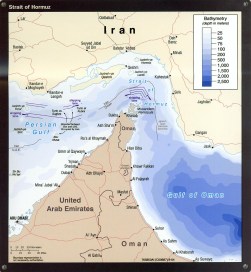
 The Strait of Hormuz is a 21 mile-wide choke point through which nearly a third of the world’s total supply oil must pass to get to world markets. Having just completed a two-day economic summit for educators at the Dallas Federal Reserve Bank, I’ve been left thinking about this quite a bit lately.

Osama Bin Laden has said, “Oil is the umbilical cord and lifeline of the crusader community.” Maybe al-Qaeda is winning this war and our current leadership doesn’t even recognize it.

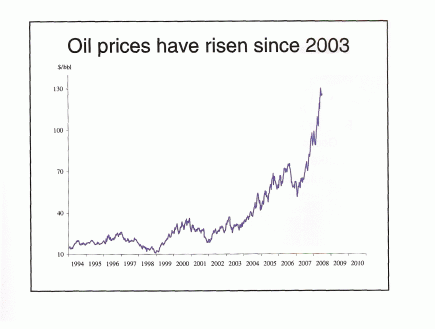
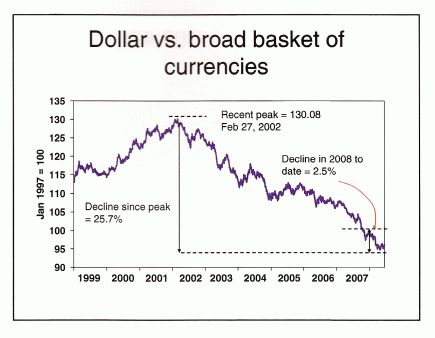
History may recall that our decision to invade Iraq, however noble our rationale for this may have seemed at the time, was the biggest economic blunder of all time. Consider the following two charts. The first one shows the rising price of oil since 2003, the year that we invaded Iraq. But on closer inspection, one can see the rapid increase really started soon after our 2001 invasion of Afghanistan.  The second chart shows the dollar’s decline against a broad basket of currencies over the same period. 

Interesting, hugh? 

Surely the war is not the only thing causing our economic woes, but the correlation of these two trends, the rising price of oil and the declining value of our dollar, to 911 and our declaration of war on terror cannot be just a coincidence. HELLO!?!?

So, what am I personally going to do about this? Well, for one thing, I’m certainly not going to vote in the upcoming national election for the same kind of thinking that got us into this mess.  Aside from that… I’ve been thinking about buying a motorcycle.  Yes… this will save me money on gas and help the economy, especially if I buy a Harley Davidson, the only motorcycle that’s still made by Americans right here in America.

My wife and I will be getting an economic stimulus check soon. I didn’t think we would owing to the amount of money that we had to claim on our 2007 income tax, but the IRS only prorated our $1200 downward based on the amount over the maximum for a couple filing jointly. Woo – woo! Now, we could do the smart thing and pay-down some of our remaining consumer credit we still owe – we’ve been trying in recent years to eliminate as much of this liability as we can. But the government is borrowing money, adding something like another $100 billion to the national debt this year on top of the separate resolutions to pay for the war in an attempt to jump-start our stalled economic engine – consumption. So the least we can do is our patriotic duty, right?

Let’s see now… the bike I want is a 1200 Sportster XL with an extension package for my longer legs and a passenger extended seat, just in case my wife overcomes her dread and decides to ride with me someday. Not counting finance charges, sales tax, an increased premium to my existing auto insurance, an increased premium for a greater amount of accidental death insurance, and safety gear — can’t forget the safety gear — that’ll run me $11,000, give or take, for a new one.  If I ride a little more than half of the time and drive a little less than half of the time, let’s say 6300 miles annually on the motorcycle and 5700 miles in my car, and the motorcycle gets 80 mpg, I’ll be saving $758.17 a year in gas assuming the long-term average price stabilizes at $4.25.

Wow!  At that rate the motorcycle will have paid for itself after just 15 years.  Of course, I could get rid of my car and only travel on my new motorcycle, assuming that I could find someone who wants to buy my 2004 Magnum.  I already know that it’s worth thousands less now than what I owe on it.  If I could get rid of it without having to take too much of a loss, the payoff time would be greatly reduced, of course. But the risk of having an accident would be greatly increased and I’d be sacrificing a whole lot of flexibility.

How many seventy-nine year-olds do you know who still ride Harley Davidsons?  Anticipating that I will live long enough to see my purchase pay for itself, or even that it might last that long, would be pretty optimistic, don’t you think?  But, hell, let’s say that I am an optimist rather than the pessimist my wife thinks I am — MISSION ACCOMPLISHED!

Hmmmm… where have we heard that before?

I guess there are some drawbacks to thinking like an economist after all. We can’t always justify everything we want. Even when we can, there are always trade-offs to consider.

I wonder if John McCain can follow this logic; it’s called cost-benefit analysis. We already know that George Bush can’t.

I invite your comments pro or con to this posting.

Published in: on June 12, 2008 at 10:14 am  Comments (6)  

America More Divided ~ The Gated Community Lifestyle

The major question I think that people should ask before buying into the gated community life style  is, “Do the gates really keep crime rates down?”

A little over ten years ago, my wife and I moved into a gated community here in DeSoto, north-central Texas — The Enclave at ThornTree.  It wasn’t that we were necessarily attracted to this community by of a sense of security that the gate would provide; we were attracted here because of the location next to a golf course and the promise of freedom from outside maintenance of the townhome property that we felt we could afford. Back then I thought I could enjoy a regular regimen of golf and was toying with the idea of an early retirement.  I planned to join the ThornTree Country Club when I got good enough at the game.  But I never did get good enough and I soon got bored not working.  So I started substitute teaching and went back to school to earn a social studies composite certification.  I’ve been teaching full time ever since, summer vacations being all the retirement I can tolerate. Teaching gives me a sense of self-worth for community involvement and I do so enjoy working with my students… seeing them grow and mature in their under- standing of the way things really work. They challenge me to stay sharp.

I wonder now at the wisdom of buying where we did. We could have had more home outside a gated community without homeowner association dues, or with lower dues because we wouldn’t have to be helping to pay the high maintenance cost of the gates. I’ve come to consider this expense to be a waste. We wouldn’t be replacing so many windows or filling-in golf ball pock marks in our simulated stucco EFIS siding either.  But what’s done is done.  The economy being what it is and with home values backsliding, we are probably here to stay.  Well enough, I guess – it’s about equal distance to my wife’s job in Dallas and mine in Waxahachie.  Besides, we have great neighbors.

Gated communities like ours are growing in popularity for home buyers, especially for those who, like us, are baby boomers and nearing retirement. These enclaves range in size from a few dozen homes to a thousand or more, with or without additional amenities within the gates. Most of these gated enclaves are found here in the south and southwest where couples who have earned at least a measure of the American dream tend to want to retire.

By some estimates, gated communities comprise ten percent of the new home market and, a according to the US Census Bureau, in 2004, gated communities like ours house an estimated sixteen million Americans, about six percent of all households. In major metropolitan areas, encouraged by city planners, fifty percent of new housing developments are being built as gated communities because private developments allow local municipalities to receive property taxes without cities having to provide services such as street maintenance and traffic enforcement.

The overwhelming reason that home buyers purchase in a gated community is for a sense of security. Fenced or walled and with gated entrances, enclaves do provide some privacy and peace of mind.  But, and I know that this will not please my neighbors for me to say, this is really a false sense of security. The reality is that gated, unless there is a 24/7 guard posted at the entrance, only means “limited access”.  Unauthorized persons can easily gain access by tailgating a vehicle driven by an authorized driver. I see this happening all the time at the entrance to our enclave.

Home buyers also buy in a gated community because of a desire for exclusivity. Gates keep out the “riffraff”, which I do not mean to say in a judgmental way. For the sake of the community, this can be viewed from the positive aspect of homeowners having shared values and similar economic levels that encourage people to stay rooted in their homes for longer periods. Among the golfers, at least, who live in our enclave, there is a true sense of cama- raderie, a feeling of extended family for couples whose children are long grown and long gone to other cities and states in this modern, more mobile society of ours.

But there is a downside to this attitude of exclusivity and concentration of relative wealth too. Here in DeSoto, which is a highly diverse city, both racially and socio-economically, over forty-seven percent of the children attending public schools qualify for free lunches owing to the income levels of parents.  I learned this the other night from the superintendant of the DeSoto Independent School District who participated in a Dining and Dialogue evening my wife and I hosted.  This, I fear, makes us a mighty big target right in the middle of a growing community of have-nots as our nation’s economy declines. A recent series of burglaries in our enclave bares whiteness to this fact.

Some, including me, believe that gated communities may be affecting our society in a negative way. Urban geographers and sociologists are saying that when people wall themselves off from others, they are cutting themselves off from the mixed, open society that is needed for a social and political democracy. Worth pondering are the words of Edward J. Blakely, Ph.D., “The thing that is most worrisome for me is this kind of ‘forting up,’ turning our backs on what I think is the nation’s civic destiny — a more heterogeneous, open society” (Tucker, 1998, p. 1)1.

The Declaration of Independence claims that everyone is equal, which is hardly true. We all know this. But a central goal of our democracy, in giving everyone equal justice, ought to be giving everyone equal opportunity too.  I sincerely believe this. There- fore, should we not want all races and cultures to be able to live and work together in harmony? Should we not want everyone to at least have a shot at the American Dream, however each person may define it? But this gated trend, according to doctor Blakely, “is moving us in the opposite direction. Rather than being involved in an open society, gated communities tend to foster segregation. They also promote privatization, replacing public government with private organizations. As more private communities provide their own security, maintenance, parks, recreation, and other services, the poor and less well-to-do are left more dependent on the ever reduced services of the city and county governments” (Tucker, 1998, p. 2).

According to a study conducted by the city of San Antonio “such economic segregation could divide the community in ways similar to the racial divisions caused by segregation in recent years” (Diamond, 1997, p. 4 )2. There are also many legal ramifications of closing off streets to the public. In 1991, a group called Citizens Against Gated Enclaves sued the city of Los Angeles for allowing residents of prominent Whitley Heights to gate public streets against outsiders. The superior court ruled in favor of the plaintiffs, stating that “the city owes a duty to the public not to allow gates on public streets” (Dillon, 1994, p. 7)3. Of course, that happened in California.  This is Texas, and the streets of our enclave are not public since no thoroughfare yet exists.  But a planned, new addition to the north of our existing enclave may just change this fact.

The major question I think that people should ask before buying into the gated community life style  is, “Do the gates really keep crime rates down?” The answer, according to Edward J. Blakley, Dean of New York’s Graduate School of Management and Urban Planning, seems to be yes, but only by very little. The city of Miami, according to the dean, “reports that some forms of crime such as car theft are reduced, at least immediately after the streets are closed. However, data indicate that long-term crime rates are at best only marginally altered (Blakely, 1995, p.)4.

In gated communities, the trend is that crimes against the person go down and stay down in “controlled” not “limited” access developments like ours. This occurs because perpetrators do not want to go into an area that they are unfamiliar with and where it might be hard for them to make an escape. “According to preliminary research, crimes such as burglary drop in the first year or so after gating, but then rise back to the level of the areas outside” (Diamond 4).

So, what am I suggesting?  Of my enclave neighbors, I am suggesting that we consider suspending our gate maintenance contract and leave the gates open.  The money we spend on this only buys us an illusion of security. I anticipate, however, that most of my neighbors will reject this proposal.  I’m also suggesting that more of my neighbors get outside the enclave and off the golf course, volunteering for church and other community programs like my good friend, Nancy Coleman does. There is a great opportunity for this, communicating to the rest of DeSoto’s citizens that we are not the elitists they may think we are, by joining the annual Great Days of Service movement.  You may check with me, if you’re interested, for a registration form or you may register on-line at the last hyperlink. For others who may be reading this blog posting because they are thinking about buying into the gated community life style, I am suggesting that you think long and hard about the decision. Consider what message you are communicating to others with respect to how you think.

I invite your comments pro or con.


1  Tucker, C. (1998). Gated communities: Barriers go up. Public Management, 80, 1-3.
2  Diamond, D. (1997). Behind closed gates. USA Today, 1, 1-3.
3  Dillon, D. (1994). Fortress America: more and more of us living behind locked gates. Planning, 60, 2-8.
4  Blakely, E. (1995). Fortress communities: The walling and gating of American suburbs. Land Lines, 7, 1,3.


Published in: on June 9, 2008 at 11:07 am  Comments (5)  

Roe vs. Wade ~ The Mother of All Political Issues

There is perhaps no other “wedge” issue today that so divides the American people.  Almost all Republicans are vehemently opposed to abortion while almost all Democrats side with a woman’s right to choose.

I stopped to chat with my neighbor the other day after taking our dog out for a walk. He, a much younger man than me, was outside cultivating his rose bushes. Roses seem to be a passion with him. He grows some real beauties. I, on the other hand, prefer air-conditioned comfort and a good book or my computer.

Immediately after we had answered each other’s query about how we have been doing lately, my neighbor asked me where Barack Obama stands on abortion.  Obviously, he had noticed the Obama signs that are posted prominently in both the front and back of our townhome. Caution, I thought, This is a trap.

There is perhaps no other “wedge” issue today that so divides the American people.  Almost all Republicans are vehemently opposed to abortion while almost all Democrats side with a woman’s right to choose. Many will cast their votes on this one issue alone in the fall, even over concerns that they may have about the economy or the war in Iraq.  So I prefaced my response with, “I’m no expert on this, nor am I a spokesman for Senator Obama, but I do remember him saying that he personally thinks it is wrong and that there are way too many abortions each year in America.”

I did not say, although I probably should have, that I am neither pro-life nor pro-choice. I can come down on either side of the argument, which makes me something of a rare bird. Even though my mother once told me that I would not be alive had abortions been safe and legal when she first realized that she was pregnant with me, I can understand and respect the problems inherent in imposing an outright ban.

“Really!” my neighbor reacted. “So, he would favor overturning Roe vs. Wade.”

“No, I don’t think so,” I said.  “Obama has said that he favors reducing the social and economic factors that are behind women opting for abortion to terminate unwanted pregnancies.”

A long discussion ensued. He stressed the moral side of the issue, while I tried to steer the debate to the secular/societal consequences of criminalizing abortion. This had been done in most of America from the mid-1800s until1973. It was in 1973 that the U.S. Supreme Court ruled in Roe v. Wade. The court held that during the first trimester, a woman has the right to decide what happens to her body. This landmark decision rested on the “right to privacy,” which was introduced in 1965. In addition, the Court ruled that the state could intervene in the second trimester and could ban abortions in the third trimester. However, a central issue, which the Court declined to address, is whether human life begins at conception, at birth, or at some point in between.

“Y’know, outlawing abortion in America for years,” I said, “did nothing to prevent unwanted pregnancies, and some estimates put the number of illegal abortions before Roe vs. Wade at over a million each year. Besides, almost every man and woman in prison today was an unwanted child.”

My neighbor countered with his knowledge of Scripture, which he believes is quite literally the Word of God.

“Yes,” I said, “you and I are both Christians, and you and I both deplore the taking of life, especially innocent life.  But we’ve been down this road before.  Banning abortion will not stop abortion.  It will merely drive it underground, into back alleys and sleazy, unsanitary motel rooms.”

I was running late and would already have to leave unprepared for a committee meeting that I was in charge of at my church, so I bid my neighbor goodbye.  I explained my reason for having to cut our discussion short, suggesting that we might continue it when next we meet. However, this was disingenuous of me. I actually hoped to avoid a second round as I now know that reason cannot prevail where passions run so deep.  I do hope though, perhaps in vain, that our discussion planted the seed of reason in my neighbor’s mind. There are many different ways to look at problems like this, and many different consequences to consider for the choices that we might make.

This election year, I am hoping that Americans won’t neglect the bigger picture for the sake of a single issue, be it the abortion issue, the tax cut issue, the gun control issue, or even the issue of how and when to bring our forces home from Iraq. I believe that it’s alright to feel passionately about things, I do… But I also believe that we must begin to act rationally and start pulling the oars of progress in unison again or else this wonderful nation of ours will continue its decline from greatness.

I invite your comments, pro or con.

Published in: on June 4, 2008 at 12:48 pm  Comments (7)  

Liberal Thinking vs. Conservative Thinking This Election Year

Recognizing the benefits of both kinds of thinking, I think it is safe to say that we need both from those who represent us…

June 2, 2008  —  Liberal thinking is rational, creative and compassionate.  Driven by the right side of our brains, it sees the big picture first, then fills-in the details.  It inspired a new and promising form of government 232 years ago – the United States of America.  It secured freedom and opportunity for millions, most of whom were immigrants and former slaves. It brought about new technologies that revo- lutionized agriculture, communication, transportation, and medicine.  It gave us a second chance when the Industrial Revolution ran out of steam and capitalism alone wasn’t working for most Americans.  It promoted “progressive” reforms that gave women the right to vote, made discrimination in schools and the workplace illegal, and committed society to providing for citizens who are unable, whether because of disability or age, to provide for themselves.  It was liberal thinking that challenged our physical and mental limitations and put men on the moon.

Conservative thinking is guarded, cautious, protective and resistant to change.  Driven by the left side of our brains, it processes information in a linear manner, arranging parts in a step-by-step process before arriving at conclusions.  It too played an important role in the building of this great nation.  Conservative thinking by the Founding Fathers protected us from excesses of power by providing for checks and balances in the Constitution.  Conservative thinkers in state governments then forced the fledgling national government to add the Bill of Rights to the Constitution so that basic, individual rights would be protected under a stronger, “federal” government. These kinds of thinkers, our first President among them, cautioned us against foreign wars and economic entanglements, insisted on fiscal responsibility, built a strong Navy to protect the nation as a whole, and established national preserves to protect the environment and our national resources. But the party that claims the conservative moniker today seems to have forgotten its roots.

Recognizing the benefits of both kinds of thinking, I think it is safe to say that we need both by those who represent us if they are to make good decisions… and, yes, it is possible for the same person to employ both kinds of thinking, although we each do have a dominant style.  Hence, Republicans are capable of liberal thought, though some might be loath to admit to it, and Democrats are capable of conservative thought.  Imagine that…  Science on the subject tells us that the learning and thinking processes are enhanced when both sides of the brain participate in a balanced manner.

We are all also prone to reptilian thinking, but this is not the kind of thinking we need governing us or even in selecting those who do. What, you may ask, is reptilian thinking?  It is basic, instinctive, and emotional thinking.  It is the kind of thinking that causes us sometimes to act without thoroughly considering the consequences, or to act even without thinking at all. The basic ruling emotions of love, hate, fear, lust, and contentment emanate from this, the first stage of our brains. When we are out of control with rage, it is our reptilian, basic brain that overrides the rational parts of our brain. So, if someone says that they have reacted with their heart instead of their head, what they really mean is that they have conceded a decision to their primitive emotions, their reptilian brain.

If Americans concede to their primitive emotions this election year and vote with their heart rather than their head, they may well be voting for a four-year extension of fiscal policies (taxing, borrowing and spending) that have brought us to the precipice of depression.  I say this because:  the national debt is nearly twice what it is was when George Bush first took office; our roads and our bridges are falling apart; real jobs with decent pay and benefits have been lost to other nations; the dollar has lost 40 percent of its value; gas now costs twice as much as it did then, which is driving up the cost of everything else; our homes on a national average have lost 14 percent of their value, and; to sustain our efforts in Iraq, we must borrow ever more from China and Japan.  Sure, most of us have had a measly couple extra hundred dollars after taxes each year to spend, but that doesn’t buy much these days. The truth is that big business is more profitable than ever while small business is rapidly becoming extinct.  If you own preferred stock, you’re rolling in dough.  If you own common stock, you’ve either lost your shirt or you are barely breaking even.  Executive directors are making obscene salaries even as employees’ benefits are being sacrificed to the competition. Therefore, a small percentage of Americans have grown wealthier at the expense of all the rest of us. But our government doesn’t want us to know how bad things really are (see the below reference).

John McCain has committed to supporting the Bush tax cuts during his administration, although he opposed them as a Senator.  He has said too that he is committed to keeping our military in Iraq for “as long as it takes.” However, after nearly eight years of President Bush and his policies, most Americans (62 percent when I last checked) say that they think we’re on the wrong path, both in the War on Terror and on the economy. I believe that they are right. and I too believe that it is time for change. As Albert Einstein once said, “Insanity is doing the same thing over and over again expecting different results.”

I read a comment on-line last weekend in response to an ABC news article.  It was written by someone who said she is a great grandmother, older and wiser now, thinking about the mess we are leaving her grandchildren to clean up and to pay for.  She said, “I would not vote for Hillary Clinton just because she is a woman.  I would not vote against Barack Obama because he is young, black and has a funny sounding name. Neither would I vote against John McCain because of his age or for him because he is a decorated veteran. I will vote for the candidate whose convictions and advocated policies make the most sense for the nation as a whole.”

I plan to do the same.  I pray that you will do likewise.

Please feel free to respond pro or con to this posting.


[i] Kevin Phillips, Harper’s Magazine, “Numbers Racket ~ Why the Economy is Worse Than We Know,” page 43, May 2008


Published in: on June 2, 2008 at 2:26 pm  Comments (10)  

Moyers on Democracy ~ A Most Excellent Birthday Present

“Our Constitution is perilously close to being consigned to the valley of the shadow of death, betrayed by a powerful cabal of secrecy-obsessed authoritarians.”

For my birthday this week, a good friend gave me a Barnes and Noble gift card. Although this lady’s political persuasion is quite the opposite from that which my wife and I share, she is perhaps the best friend we have here in the Dallas/Ft. Worth metroplex. I know that she would rather I used her gift to buy some arty coffee-table book or even the latest John Grisham novel, but I think I’ll use it instead to purchase Bill Moyer’s new book, “Moyers on Democracy” (Doubleday, 2008), from which the following is an excerpt…

_______________________________________

“Democracy in America is a series of narrow escapes, and we may be running out of luck. The reigning presumption about the American experience, as the historian Lawrence Goodwyn has written, is grounded in the idea of progress, the conviction that the present is ‘better’ than the past and the future will bring even more improvement. For all of its shortcomings, we keep telling ourselves, ‘The system works.’

Now all bets are off. We have fallen under the spell of money, faction, and fear, and the great American experience in creating a different future together has been subjugated to individual cunning in the pursuit of wealth and power -and to the claims of empire, with its ravenous demands and stuporous distractions. A sense of political impotence pervades the country — a mass resignation defined by Goodwyn as ‘believing the dogma of democracy on a superficial public level but not believing it privately.’ We hold elections, knowing they are unlikely to bring the corporate state under popular control. There is considerable vigor at local levels, but it has not been translated into new vistas of social possibility or the political will to address our most intractable challenges. Hope no longer seems the operative dynamic of America, and without hope we lose the talent and drive to cooperate in the shaping of our destiny.

The earth we share as our common gift, to be passed on in good condition to our children’s children, is being despoiled. Private wealth is growing as public needs increase apace. Our Consti- tution is perilously close to being consigned to the valley of the shadow of death, betrayed by a powerful cabal of secrecy-obsessed authoritarians. Terms like ‘liberty’ and ‘individual freedom’ invoked by generations of Americans who battled to widen the 1787 promise to promote the general welfare have been perverted to create a government primarily dedicated to the welfare of the state and the political class that runs it. Yes, Virginia, there is a class war and ordinary people are losing it. It isn’t necessary to be a Jeremiah crying aloud to a sinful Jerusalem that the Lord is about to afflict them for their sins of idolatry, or Cassandra, making a nuisance of herself as she wanders around King Priam’s palace grounds wailing ‘The Greeks are coming.’ Or Socrates, the gadfly, stinging the rump of power with jabs of truth. Or even Paul Revere, if horses were still in fashion. You need only be a reporter with your eyes open to see what’s happening to our democracy. I have been lucky enough to spend my adult life as a journalist, acquiring a priceless education in the ways of the world, actually getting paid to practice one of my craft’s essential imperatives: connect the dots.

The conclusion that we are in trouble is unavoidable. I report the assault on nature evidenced in coal mining that tears the tops off mountains and dumps them into rivers, sacrificing the health and lives of those in the river valleys to short-term profit, and I see a link between that process and the stock-market frenzy which scorns long-term investments — genuine savings — in favor of quick turnovers and speculative bubbles whose inevitable bursting leaves insiders with stuffed pockets and millions of small stockholders, pensioners, and employees out of work, out of luck, and out of hope.

And then I see a connection between those disasters and the repeal of sixty-year-old banking and securities regulations designed during the Great Depression to prevent exactly that kind of human and economic damage. Who pushed for the removal of that firewall? An administration and Congress who are the political marionettes of the speculators, and who are well rewarded for their efforts with indispensable campaign contri- butions. Even honorable opponents of the practice get trapped in the web of an electoral system that effectively limits competition to those who can afford to spend millions in their run for office. Like it or not, candidates know that the largesse on which their political futures depend will last only as long as their votes are satisfactory to the sleek ‘bundlers’ who turn the spigots of cash on and off.

The property qualifications for federal office that the framers of the Constitution expressly chose to exclude for demonstrating an unseemly ‘veneration for wealth’ are now de facto in force and higher than the Founding Fathers could have imagined. ‘Money rules. Our laws are the output of a system which clothes rascals in robes and honesty in rags. The parties lie to us and the political speakers mislead us.’ Those words were spoken by Populist orator Mary Elizabeth Lease during the prairie revolt that swept the Great Plains slightly more than 120 years after the Consti- tution was signed. They are true today, and that too, spells trouble.

Then I draw a line to the statistics that show real wages lagging behind prices, the compensation of corporate barons soaring to heights unequaled anywhere among industrialized democracies, the relentless cheeseparing of federal funds devoted to public schools, to retraining for workers whose jobs have been exported, and to programs of food assistance and health care for poor children, all of which snatch away the ladder by which Americans with scant means but willing hands and hearts could work and save their way upward to middle-class independence. And I connect those numbers to our triumphant reactionaries’ campaigns against labor unions and higher minimum wages, and to their success in reframing the tax codes so as to strip them of their progressive character, laying the burdens of Atlas on a shrinking middle class awash in credit card debt as wage earners struggle to keep up with rising costs for health care, for college tuitions, for affordable housing — while huge inheritances go untouched, tax shelters abroad are legalized, rates on capital gains are slashed, and the rich get richer and with each increase in their wealth are able to buy themselves more influence over those who make and those who carry out the laws.

Edward R. Murrow told his generation of journalists: ‘No one can eliminate prejudices — just recognize them.’ Here is my bias: extremes of wealth and poverty cannot be reconciled with a genuinely democratic politics. When the state becomes the guardian of power and privilege to the neglect of justice for the people as a whole, it mocks the very concept of government as proclaimed in the preamble to our Constitution; mocks Lincoln’s sacred belief in ‘government of the people, by the people, and for the people’; mocks the democratic notion of government as ‘a voluntary union for the common good’ embodied in the great wave of reform that produced the Progressive Era and the two Roosevelts. In contrast, the philosophy popularized in the last quarter century that ‘freedom’ simply means freedom to choose among competing brands of consumer goods, that taxes are an unfair theft from the pockets of the successful to reward the incompetent, and that the market will meet all human needs while government itself becomes the enabler of privilege — the philosophy of an earlier social Darwinism and laissez-faire capitalism dressed in new togs — is as subversive as Benedict Arnold’s betrayal of the Revolution he had once served. Again, Mary Lease: ‘The great evils which are cursing American society and undermining the foundations of the republic flow not from the legitimate operation of the great human government which our fathers gave us, but they come from tramping its plain provisions underfoot.’

Our democracy has prospered most when it was firmly anchored in the idea that ‘We the People’ — not just a favored few — would identify and remedy common distempers and dilemmas and win the gamble our forebears undertook when they espoused the radical idea that people could govern themselves wisely. Whatever and whoever tries to supplant that with notions of a wholly privatized society of competitive consumers undermines a country that, as Gordon S. Wood puts it in his landmark book The Radicalism of the American Revolution, discovered its greatness ‘by creating a prosperous free society belonging to obscure people with their workaday concerns and their pecuniary pursuits of happiness’ — a democracy that changed the lives of ‘hitherto neglected and despised masses of common laboring people.’

I wish I could say that journalists in general are showing the same interest in uncovering the dangerous linkages thwarting this democracy. It is not for lack of honest and courageous individuals who would risk their careers to speak truth to power — a modest risk compared to those of some journalists in authoritarian countries who have been jailed or murdered for the identical ‘crime.’ But our journalists are not in control of the instruments they play. As conglomerates swallow up news- papers, magazines, publishing houses, and networks, and profit rather than product becomes the focus of corporate effort, news organizations — particularly in television — are folded into entertainment divisions. The ‘news hole’ in the print media shrinks to make room for advertisements, and stories needed by informed citizens working together are pulled in favor of the latest celebrity scandals because the media moguls have decided that uncovering the inner workings of public and private power is boring and will drive viewers and readers away to greener pastures of pabulum. Good reporters and editors confront walls of resistance in trying to place serious and informative reports over which they have long labored. Media owners who should be sounding the trumpets of alarm on the battlements of democracy instead blow popular ditties through tin horns, undercutting the basis for their existence and their First Amendment rights.”

_______________________________________

I read the above exerpt this morning before going to church.  It was posted just yesterday on AlterNet and brought to my attention in an email last night by another of my friends.  I was struck by its significance with respect to the current state of our Republic and the all but universal cry from the electorate this year for change.  Then, during worship, our congregation was led in the singing of, “Lord, You Give The Great Commission,” the fourth stanza of of which follows:

Lord, You show us love’s true measure:
“Father, what they do, forgive.”
Yet we hoard as private treasure all that You so freely give.
May Your care and mercy lead us to a just society.
With the Spirit’s gifts empower us for the work of ministry.

During worship and the singing of this hymn, I was double struck by the power of Bill Moyer’s latest work. It is social and political commentary at its very best!

I invite your comments, pro or con.
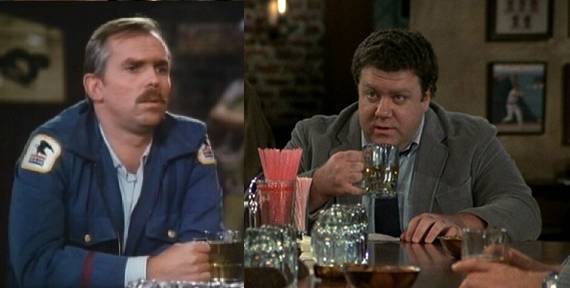
_______________________________________

Bill Moyers (born June 5, 1934, as William Donald “Billy Don” Moyers) is an American journalist and public commentator.  He served as White House Press Secretary from 1965-7 during the LBJ administration. He is President, since 1990, of The Schumann Center for Media and Democracy, also know as The Schumann Foundation or the Florence and John Schumann Foundation. He lives in New York City.


Published in: on May 18, 2008 at 6:22 am  Comments (2)  

Sowing the Seeds of Change ~ Setting New National Priorities

If ever there was a time for the immortal words of John F. Kennedy, “Ask not what your country can do for you — ask what you can do for your country,” it is now.

Human nature being what it is, people are adverse to change.  Change may be perceived as being arduous or even dangerous.  We resist it, even if we find ourselves at the bottom of the socio-economic pyramid. At least there we’ve got a lot of company.  Then too, there is comfort in knowing and living within our boundaries, especially if we think our needs are already being met, and some- times, even if they are not being fully met.  Consider the paradox of abused spouses who remain in relationship with those who abuse them.

This aversion to change is especially true of corporations, govern- ments, and hierarchal groups of all kinds since those in power tend to resist that which threatens the status quo. Notwithstanding, we are hearing a lot about change this election year.  It’s the “buzz word” du jour thanks to Barack Obama’s campaign, and it has struck a chord with many Americans, especially among the young and better-educated.  So there must be many who, in today’s economy, are not satisfied with things as they are or to where they see that trends may be leading us.  Bully! I say, Bravo! It’s about time.

Now, before we get into the specifics of what needs to be changed and how, let’s see if we can agree on this: there are no magic solutions to any of our problems today, which are all intercon- nected so that acting on one has an impact on all the others.  But one thing is certain – doing nothing about them in the near term will only make solutions more elusive and difficult later-on.

On the economic front, nothing short of an “all court press” or a miracle will bring back the many good, living-wage jobs that have been lost to foreign competition in recent years, stem inflation, restore real estate values, and solve the energy crisis.  Unfortun- ately, we have a war on our hands, one that does not fit into our annual budgets and for which we have had to borrow billions of dollars.  For it to continue, we will have to borrow many more billions of dollars or else raise taxes.  This is something that no one in Washington seems to want to talk about.  So miracles, just now, are in short supply.  At the same time, we are finally waking up to the fact that we have to deal with the environmental crisis of global warming if we are to avert what has been coined, The Greatest Market Collapse in History.  Reversing the effects of global warming will require great sacrifices of us all, innovation, and international cooperation.  In economic terms, There Is No Such Thing As A Free Lunch!

In the best of times, with an expanding economy, low inflation, a stable dollar, and our work force fully and gainfully employed to produce both goods and services, it would be difficult to deal with the many problems we have today on the domestic front.  Among them are immigration, education, health care, social security, drugs and crime.  All are likely to be issues in the upcoming Presidential debates this year, and they must all be dealt with, sooner or later — but these are not the best of times.  No matter what the President and all the President’s men are telling us (or not telling us), with consumer confidence at a thirty-year low, the American people know that we are in a resession already, they can feel it.

So, in the now-famous words of Bill Clinton’s 1992 campaign strategist, James Carville, “It’s the economy, stupid!” This, it seems most clear to me, must be our new national, Number One priority if we’re going to be successful addressing the other issues.  And, for every other issue, if change would result in a negative, near-term economic consequence, change should be subordinated, in my opinion, to the greater issue, which is the economy.

If you’ve read this far, you might be interested in the following video of a recent Bill Moyers interview with authors of the book, “Where Does The Money Go.”  Presented, I believe, in a politically balanced way, I felt that it would be okay to share it with my high school economics students.  After watching it, they praised it for being most enlightening. 

So, it seems as though there are, as I have said, no magic solutions.  Both liberals and conservatives are going to have to yield ground.  That is why we need someone this time around in the White House who can both ignite and unite.

If ever there was a time for the immortal words of John F. Kennedy, “Ask not what your country can do for you — ask what you can do for your country,” it is now.

I invite your comments, both pro and con.


Published in: on May 10, 2008 at 4:58 pm  Leave a Comment