The Republican Party is Still the Party of No, No Matter What They Say

What seems obvious to me is that most Republicans in Congress are disingenuous about wanting to provide solutions to the nation’s problems. They’re just playing bandwagon populist politics when it suits them by talking the talk that concerned citizens and independent voters want to hear.

Protesting that theirs is not the Party of No, Republican members of Congress declared victory Friday evening after an open and frank, hour-and-a-half exchange between themselves and the president, an exchange that was aired on national television networks. Their imagined victory was in having got the president to concede the fact that Republicans do have ideas on how to address the nation’s problems and, in the president’s own words, some being substantial ideas. But being substantial does not imply being workable.

“We are not obstructionists,” Republicans said while the president countered with, “I am not an ideologue (a zealous supporter of a particular ideology).”

Well, if you watched any of this exchange as I did, I think you’d almost have come to the same conclusion that I did: that the president got the better of more than a hundred of his political opponents. FoxNews seemed to come to the same conclusion I did since they cut away from the exchange early to air instead critics of the president’s agenda – or so it was reported by MSNBC news analysts, Rachael Maddow, Chris Matthews and Keith Olbermann.

So, is it fair to still call the Republican Party the Party of No, or have they proved themselves to be credible advocates of reasonable, workable ideas to address the nation’s problems? Here’s why I think they’re still the Party of No, the Party of No Good Ideas, the party of No intention whatsoever to cooperate with Democrats to get anything done: The Senate on Tuesday rejected legislation calling for a bi-partisan congressional commission to recommend reductions in the federal deficit spending. A group of 37 Democrats and 16 Republicans supported forming the commission, while 23 Republicans and 23 Democrats opposed it. The 53-46 vote fell seven votes shy of the necessary 60 votes required under an agreement that both parties had reached Monday night. Most telling about Congressional Republicans’ sincerity, of seven Republican Senators who had co-sponsored the bill, six backed away from it when it came to a vote and the seventh, according to a Politico.com story, http://www.politico.com/news/stories/0110/32048.html, wasn’t present to cast a vote.

Deficit spending this year by the Congress, in particular the $787 billion Economic Recovery and Stimulus Act, has been a major criticism of the Obama Administration by the Conservative propaganda machine, even though sixty-three percent of it had already been budgeted before the President was even sworn-in. Further, John McCain’s campaign was primarily about cutting wasteful spending and reducing the deficit. But now that the majority of Democrats are willing to come up with a bi-partisan solution, the majority of Republicans are saying, “No.” McCain reportedly voted against it because he feared the committee might, in addition to recommending spending cuts, come to the conclusion that the only way to meaningfully reduce the deficit would be to increase taxes on those who can most afford to contribute http://www.washingtonpost.com/wp-dyn/content/article/2010/01/28/AR2010012803729.html?hpid=topnews.

According to the non-partisan Congressional Budget Office (CBO), even if all non-security discretionary spending were to be cut from the nation’s budget, even if there would be no further stimulus spending after 2010 with no federal spending in the jobs bill that the president has asked Congress for, with the Bush tax cuts allowed to remain in-effect at the end of 2010, we would still have a half trillion dollar deficit with ten percent of the budget going to service interest on dollars we have already borrowed http://www.cbo.gov/ftpdocs/105xx/doc10521/2009BudgetUpdate_Summary.pdf. So, faced with this reality, what seems obvious to me is that most Republicans in Congress are disingenuous about providing solutions to their own criticisms of the Obama Administration. They’re just playing bandwagon populist politics when it suits them by talking the talk that concerned citizens and independent voters want to hear. They are not willing to walk the walk when public policy changes like raising taxes are on the table. That’s partisanship for you, and that’s the reason why Congressional Republicans still have a lower approval rating than Congressional Democrats.

It’s what politicians do that counts, folks, not what they say. And Republicans this year have done nothing but unite against anything and everything proposed by the majority in Congress.

Fellow Democrats, let’s all hope that independents get over their let’s-just-throw-the-incumbents-out mood before the mid-term elections this fall and that they will vote for representatives who are actually willing to roll-up their sleeves, take political risks, and get stuff done. For my money, that’s more a Democratic trait these days than a Republican one.

Please feel free to post a comment whether you agree with me or not.

Published in: on January 30, 2010 at 2:08 pm  Comments (2)  

Overcoming the Great Recession ~ Seven Things That We Need to Do

 George Santayana, philosopher, essayist, poet and novelist, famously said, “Those who cannot remember the past are condemned to repeat it.”

Thanksgiving Eve, November 25, 2009  In the wake of growing doubts about the President’s handling of the economy, doubts fomented by his political opposition, Treasury Secretary, Timothy Geithner, was grilled last week by Conservative members of the Joint Economic Committee, grilled and asked to resign over his “mishandling” of TARP and economic recovery funds.

To many Americans, this criticism would seem to be justified. Obviously, many bailed-out banks and Wall Street firms have not used tax payers’ dollars as intended, i.e, to make badly-need loans to struggling small businesses. Then too, despite the Treasury’s stated “strong dollar” policy, we have witnessed the dollar suffer historic declines against foreign currencies in recent weeks. Even though the stock market is soaring, the jobs picture grows worse day-by-day despite the holiday season’s temporary jobs. And just to make matters worse for the Administration, bogus jobs data were discovered last week on the White House’s Recovery Act website.

Welcome home from the Asia-Pacific Economic Cooperation summit in Singapore and your four-country Asian rim tour, Mr. President. Too bad you couldn’t get our biggest trading partners, China and Japan, to agree to more equitable terms. But, did you really think they would? Maybe they’ll grow softer after we grow more firm; afterall, we’re still their best customers.

Hmmm… it seems to me like there’s something wrong with this scenario, which is why I’m on the sidelines now with my brokerage account.

There can be little doubt that this economy, the worst since the Great Depression, isn’t going to turn around on a dime anytime soon. In fact, we likely won’t see any real improvement on the jobs front until after next year at best, and housing values may take a decade or more to recover to last year’s levels – if ever indeed they do. So, here we go again – no psycho talk here, folks, just history which has a funny way of repeating itself.

Herbert Hoover and a Congress controlled by Republicans got us into The Great Depression. Yes, despite conservative claims that New Deal program spending actually delayed recovery, things got worse in 1937 after Congress turned-off the money spicket. So  it took WWII to get us out of that economic money-pit. Then, after decades of economic expansion, Ronald Reagan put us on the path to this, The Great Recession, by reducing taxes and massively increasing spending. Yes, he did break the back of the Evil Empire with his spending, but we are paying the price in spades for this today. George H. W. Bush, too late, tried to increase revenues to curtail deficit spending and paid the ultimate political price for a Republican by failing to honor his promise not to increase taxes. Bill Clinton increased taxes and refused to let Congress spend more than the government collected. But he contributed in his own way to today’s recession by negotiating Free Trade agreements without “fair” trade protections for American industries.

Then came George W. Bush who, like Reagan before him, reduced revenues with promised tax cuts to get elected then allowed Congress to increase spending. Both acts were politically smart but economically foolish. To his credit, though he probably had no idea of what he was doing at the time, he started moving us away from recession by declaring the War on Terror. But rather than putting Americans back to work producing tanks, landing craft, airplanes and aircraft carriers, he mostly threw money at bankers by promoting an Alan Greenspan proposal that banks should make high-risk mortgage loans (adjustable rate mortgages) to marginally credit-worthy families. Rather than asking Americans to make sacrifices to pay for the war through higher taxes or with war bonds, he and Congress authorized unprecedented borrowing year after year.

Now, more than eight years later, we are in the middle of the worst economic slump since 1938 and we all better hope that Obama can fix it because, without aggressive employment of economic accelerators afforded by both fiscal and monetary policies, we could indeed experience depression-era conditions once again. Deficit spending is never desirable, but now it is unavoidable. Unfortunately, as in the Great Depression, Congressional Conservatives would rather see the economy crash and burn than see Democrats succeed.

George Santayana, philosopher, essayist, poet and novelist, famously said, “Those who cannot remember the past are condemned to repeat it.” How right he was. Unfortunately, they — those who cannot remember the past — could well drag the rest of us with them back to the worst of times.

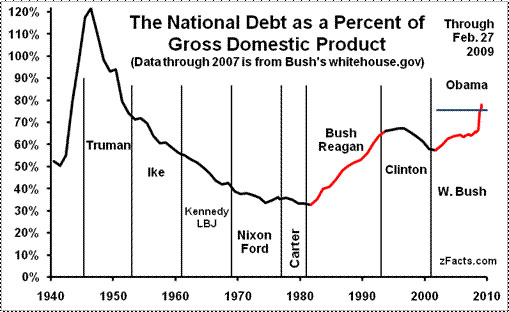
To illustrate the facts presented above, please consider the following graph provided by ZFacts.com:


Lesson planning for my AP Macro class and preparing my upcoming lesson assignment challenge for students on balancing the nation’s budget, I have researched on-line the actual, historical values for Gross Domestic Product (GDP) and our National Debt Outstanding by year from Treasury Department records. Calculating the ratio of national debt to GDP in Excel, looking just at values for every five (5) years from 1950 to the present, I was able to almost exactly duplicate the ZFacts graph. If you doubt my sincerity or my honesty, you may download my Excel spreadsheet to check data sources, my calculations and my conclusions by clicking this hyperlink.

Okay, so how do we get out of the mess that has been left for us by the trickle-down, buy-now/pay-me-later crowd? The main thing to remember is that, with consumer spending down, businesses are going to continue laying people off — not hiring them. You can’t blame businesses for doing this. It’s just a vicious cycle that the economy gets into. And you can’t blame consumers for not wanting to spend in bad times. So, the only way out of this, if we don’t want to wait forever for the “free market” to recover on its own, is for the government to spend, pay unemployment insurance, and/or give tax breaks to people who will spend, and this doesn’t include the rich; their propensity to save rather than spend is much higher than the majority of taxpayers. Additional recommended measures, the seven things I think we need to do, follow:

1) Stop bailing-out Wall Street and just take over failing banks, investment and insurance companies. Once they’re working again under reasonable oversight regulations and enforcement, they can be sold back to the private sector.
 
2) Don’t wait for the Bush tax cuts to expire after 2010. Roll them back now for those at the top who most benefited. This will help defray the cost of sending more troops to Afghanistan. While in the process, pass corporate tax reforms favoring companies that create jobs for Americans rather than doing business by exporting jobs to other countries.
 
3) Plan and work toward organized withdrawals from both Iraq and Afghanistan soonest. Money spent overseas in vain attempts to avert future terrorist attracts rather than spending it here at home on jobs and social goals for Americans just contributes to further weakening of the U.S. dollar and to al Qaeda’s goals. Dollars flowing overseas is “leakage” from our own economy.
 
4) Pass healthcare reform legislation this year, reform that improves the availability and quality of care while reducing future costs. Failing to do this will result in the government’s default on legislative safety net promises and fiscal bankruptcy in our lifetimes.
 
5) Pass Cap and Trade legislation mandating reductions in carbon emissions. This will generate new, good paying construction and manufacturing jobs for Americans, jobs that cannot be exported. This will bring down energy costs ultimately and reduce the trade deficit. We cannot continue borrowing from China to buy Canadian, Mexican and Saudi oil indefinitely. As a side benefit, this will inspire other nations to join with us in measures necessary to save the planet for posterity.
 
6) Prioritize educational reforms based on tried and proven solutions rather than on failed political priorities. Single-size curricula do not fit all and the fastest growing student demographics are poor inner-city blacks and Hispanics with limited English skills. These are tomorrow’s workers.
 
7) Pass new anti-trust legislation and begin the rigorous enforcement of regulations against excessive financial risk-taking and oligopolies’ (near monopolies) abilities to reduce free market competition through mergers that concentrate sector control over production and thereby prices.   

Once we’re out of this particular money-pit and the economy is once again expanding on its own, we’ve got to somehow find the resolve as a nation to stop spending more than we take in.

Pity the demise of Big Banking, Big Oil, Big Pharma, Big Retailer, and Big Insurance company’s profits if you wish, but they have been gorging themselves from the economic vitality of this nation, common men and women, for years. In 2004, according to the Federal Reserve Board,  the top 5 percent of this country controlled more wealth than the rest of the nation combined. After nearly nine years of tax cuts favoring the rich, surely this imbalance is even greater. This relentless capillary rise of wealth from those who do the work to those who direct the work cannot continue indefinitely. These are conditions that spawn revolution.

All seven of the above measures pose short-term economic and political costs since many Americans are entrenched in principle-based, what’s-in-it-for-me political thinking and have an unhealthy disregard for the lessons of history. They fail to see beyond the ends of their noses. However, failing to act in the long-term interests of this country risks the economic if not physical survival of future generations. Our national preeminence as a super power has already been substantially diminished.

In spite of it all, have a wonderful Thanksgiving . We still have much to be thankful for.

I invite your comments, pro or con.

Published in: on November 25, 2009 at 5:18 am  Leave a Comment  

Gay-Straight Alliance Clubs in Texas Schools ~ Like It or Not, They’re Here

 This isn’t the first time I’ve made a right/bad decision, and it probably won’t be the last either. I guess it’s just the way I’m made.

Opa_II“Well… it’s probably a good thing that you don’t plan on teaching too many more years.”

This was my wife’s response after I informed her recently of my decision to become the sponsor of a new club at the North-Central Texas high school where I teach. The club, unless the school board wants to try to stop it, will be an affiliate group of the national GSA organization (Gay-Straight Alliance). It’ll be a group of self-identified gay and lesbian students as well as any “straight” sexually-oriented students that might be supportive of the club’s purpose, which is: to promote tolerance, understanding, and acceptance through social aware- ness. The club will most definitely not be for the purpose of promoting behavior or persuasions considered to be deviant by many.

In Texas?!!

Yes, in Texas. We’re still part of the United States, you know, and according Center for Disease Control and Prevention (CDC & P) guidelines on preventing unintentional injuries and violence in public schools, published December 7, 2001 and never rescinded during the GWB years http://www.cdc.gov/mmwr/preview/mmwrhtml/rr5022a1.htm, school administrators are compelled to combat victimization of minority groups, and that’s what this club will be about — keeping kids safe.

“Regardless of a child’s ethnic, socioeconomic, religious, sexual orientation, or physical status, all children have a right to safety. When victimization through bullying, verbal abuse, and physical violence is prevalent in a school, the entire school community experiences the consequences. When abuse against a particular group is perceived as acceptable, intergroup hatreds can become established… Students who are different from the majority of their classmates because of their race, ethnicity, sexual orientation, religion, or other personal characteristics are at increased risk for being bullied. Gay, lesbian, or bisexual students, and students perceived to be gay by their peers are often victims of repeated verbal abuse and physical assault.”

Our principal has informed me that he thinks there would be no legal way, ultimately, for him to deny this group the right to organize and assemble on school property while allowing other groups the same right such as our conservative, faith-based group of students calling themselves, “Youth Alive”.  He said that, had I not said, “yes,” to the openly gay, purpose-driven young organizer who had approached me with the request to sponsor the club, he’d have probably had to find a sponsor for it, sponsor it himself, or else withdraw permission for all non-academic or athletic groups to have school-sponsored clubs.

Learning of this young organizer’s personal history of abuse (personal attacks, both verbal and physical) against which he finally defended himself and had spent time in reform school for having done so, I came to fully appreciate his passion for wanting to start a GSA club at our school. His story put a face on the many other stories that I had heard in the news over the years about gay-bashing and horrible atrocities.

Nation-wide, there are legal battles on-going over whether administrators and school boards can deny GSA clubs the right to organize and to meet on school property. Right here in Texas, the Lubbock Independent School District trustees have said that they will do all that they legally can do to prevent a gay group from meeting on school property http://www.democraticunderground.com/discuss/duboard.php?az=view_all&address=102×15804. So, the GSA group there has taken their case to federal court. Elsewhere in the nation, in Salt Lake City a high school settled out-of-court with a GSA group after a federal court ruled against the Okeechobee School District in Florida last summer for denying a GSA group the right to assemble. The court had ordered the Okeechobee School District to pay the group $300,000 in court and attorney fees http://psychescientia.blogspot.com/2008/08/federal-court-says-okeechobee-high.html. Our school district will probably not want to go down either of these routes, but they may just decide to wait and see what happens in the Lubbock School District case — buying some time. We’ll soon find out.

Now, before you start wondering – no, I am not gay myself and, yes, I am a Christian and I worship weekly. My wife and I have been married almost forty years; we have three grown sons, three grandchildren and one great-grandchild now. So, why did I so willingly agree to sponsor this club? I don’t know – it just seemed like the right thing to do – maybe not the smart thing, but definitely the right thing. This isn’t the first time I’ve made a right/bad decision, and it probably won’t be the last either. I guess it’s just the way I’m made. I could have said, “No,” claiming that I was too busy or even that I have a moral issue with gay and lesbian orientations and practices. But that would have been a lie. I believe that all God’s children have a right to be whom and whatever they are so long as their attitudes and behaviors do not harm others.

To offend someone is one thing, for the offence is in the perception of the offended. To abuse someone is something quite different. Abuse is intentional, it is harmful and it is hateful – certainly not Christian behavior – and abuse is what GSA is organized to combat.

I covet your prayers, for me, for our school, and for the community it serves.

Please feel free to post a comment, whether pro or con.

Published in: on October 17, 2009 at 10:42 am  Comments (17)  

Conservative Paranoia ~ The Lies and Exaggerations that Sustain the Status Quo

What are the rest of us to do, those of us who see torture and call it torture, those of us who see exploitation and call it exploitation, those of us who see injustice and call it injustice?

opaI received a forwarded electronic chain-mail message from a conservative friend Saturday evening. The message had been making the rounds all summer. I had heard about it, but this was the first time that someone had actually forwarded a copy to me.

The friend who sent it to me is a man with whom I have worshiped and have worked with shoulder-to-shoulder on local mission projects. Unlike me, however, he is a man who fears that President Obama’s social and economic agendas threaten the future welfare of Americans like himself and the very fabric of our country.

My friend’s message ended with the following appeal by the originating, anonymous author, which seems to me like a good way to start my own message: “Do yourself a long-term favor; send this to all who will listen to an intelligent assessment of the big picture. All our futures and children’s futures depend on our good understanding of what is really going on in DC!!!! And our action pursuant to that understanding! It really IS up to each of us to take individual action!!! Start with educating your friends and neighbors!!!”

Indeed, do yourself a long-term favor. Rather than accepting this kind of “viral” disinformation as fact, even if it resonates with your convictions and persuasions, educate yourself first with facts before passing it along to your friends and neighbors.

As a part of his forward, my friend provided the following endorsement: “Krauthammer is not only an M.D., but he’s a psychiatrist. (He has a page on Face Book.) So when he makes observations about one’s behavior he’s witnessed, I imagine he could qualify as an expert. His brain is massive and his conservative thoughts are important.  He is not as dramatic as Glenn Beck, but their visions are pretty parallel.”

After reading this, that the thinking of this person named Krauthammer with a “massive” brain runs parallel to Glen Beck’s, I nearly deleted the message without bothering to read the rest of it first; I know from where Glen Beck comes and I have no desire to visit that place — a murky void of angry conjecture, fabrication, and speculation. But I wanted to be fair and open-minded for my friend’s sake. I read the rest of it.

I was not impressed, neither by the content of the message nor by the language and grammar the anonymous original author employed. It contained no evidence and no references to substantiate the opinions attributed to Dr. Krauthammer. But if you would like to read it for yourself, a complete copy is available at http://www.snopes.com/politics/soapbox/krauthammer.asp. This site also contains Dr. Krauthammer’s personal retraction, his denial of the account’s authenticity, and links to articles that have actually been published by the good doctor.

This is the first paragraph of the forwarded message: “Dr. Krauthammer is on Fox News. He is an M.D. and he is paralyzed from the neck down. Be forewarned on what is happening. A friend went to hear Charles Krauthammer. He listened with 25 others in closed room. What he says here is NOT 2nd-hand but 1st. You would do well to read and pass this along to EVERYBODY that loves his country. This is VERY serious for the direction of our country. The ramifications are staggering for our children & us.”

Hmmm… “A friend went to hear Charles Krauthammer… What he says here is NOT 2nd-hand but first.” Obviously, the original author of the message doesn’t understand about primary and secondary sources of information. He is reporting what someone else told him he had heard, and doing so without so much as a closed quote or even naming the source. His first paragraph clearly establishes the fact that everything else in the message is hearsay.

According to a Wikipedia bio on Dr. Krauthammer, http://en.wikipedia.org/wiki/Charles_Krauthammer, he is generally considered to be a conservative on economic, international and defense issues. However, on domestic issues, Krauthammer is a supporter of legalized abortion, an opponent of the death penalty, an intelligent design critic and an advocate for the scientific consensus on evolution, calling the religion-science controversy a “false conflict.” He is a supporter of embryonic stem cell research using embryos discarded by fertility clinics with restrictions in its applications, and he is a longtime advocate of radically higher energy taxes to induce conservation.

Hmmm… being a psychiatrist, Dr. Krauthammer may be an expert on personality disorders. But this doesn’t make him an expert on economic issues, on international diplomacy, or on matters of national defense either. His opinions in these areas should carry no more weight with us than yours or mine – except that I teach economics and am a retired Army officer.

So, why are so many people willing to credit his views as being those of a “so called” conservative expert, especially since his views on social issues discount his credentials as a conservative in a social context? And why are so many publishing this kind of thing, distorting and exaggerating the views of credible thinkers? Further, why are so many willing to buy into this kind of thing, passing it along to others?

I blame what I call, conservative paranoia. Like mob violence, fear of change – the unknown, masked with anger – conservative paranoia spreads from person to person, sapping us of our better instincts. And the modern Conservative movement in America takes advantage of this fear, sustaining the status quo with dogma that they call, principle. This is worse than disingenuous — this is shameful!

The message claimed that Dr. Krauthammer labeled President Obama a narcissist. Well, so what if he did? We are all, to some degree, narcissistic, are we not? This is especially true for those of us who are driven to making significant achievements in life. This is a “healthy” kind of narcissism, and President Obama is truly driven to making significant achievements, but for the sake of the nation and for all of mankind. If any in Washington have unhealthy narcissistic tendencies, the self-serving kind, they are those in Congress who would scuttle health care reform for purely political purposes, denying future Americans access to affordable health care just to get reelected or to further their party’s chances of regaining seats in the House and/or the Senate.

And what are the rest of us to do, those who see torture and call it torture, those who see exploitation and call it exploitation, those who see injustice and call it injustice? We resist appeals like this to buy into the fear; we resist and let our Congressional representatives know what we really think, whether they are Republican or Democrat, and; we respond with measured logic and reason to viral disinformation like this. We persevere and we become the change that we voted for in the last election.

Please feel free to comment whether or not you agree.

Published in: on October 12, 2009 at 7:26 pm  Comments (2)  

Capitalism — The Good, The Bad and The Ugly ~ Teaching Students How to Think vs. Teaching Them What to Think

Sadly, when it gets to the point in Texas that teachers must teach the truth in “public” schools only as social conservatives in this state are privileged to know the truth, it will be time for me to retire or find something else to do until I do.

opaSeptember 7, 2009  —  From day-one in my high school economics classes, I assure my college-bound students that my goal is not to teach them what to think, but rather how to think. I tell them that, if we are to have the freedom and ability to make up our own minds about controversial subjects, we must be exposed to facts, theory and opinion from all sides — without prejudice. They, for the most part, seem to accept and respect this as a given.

Introducing the subject of an economics lesson to my high school seniors last week, Capitalism and Free Enterprise, I quoted an Anglican Priest, W. R. Inge, who said or wrote, “The enemies of freedom do not argue, they just shout and shoot.”

I gather what Reverend Inge was saying is that, for freedom to thrive, people must be willing to engage in “reasoned” argument – that when we refuse to consider others’ arguments or stop listening to facts and start making things up to distract others from real issues, we are obstructing the democratic process and are, therefore, enemies of freedom. Now, this I did not say to my classes, but we’ve seen a good deal of shouting taking place in town hall meetings all across the country this past month. Have we not? We’ve also seen individuals showing-up at these meetings with loaded weapons, weapons they insisted were not brought to intimidate people with whom they disagree. Awhhh… give a break!

Inge was a professor at Cambridge University and a prolific author who wrote scores of articles, lectures and sermons. He also wrote over 35 books but was best known for his works on Plotinus and neoplatonic philosophy, and on Christian mysticism. He was a believer in spiritual religion — faith based not upon coercive authority but on experience and individual inspiration. Obviously, he was a pragmatic person. I can’t find any reference to his political leanings though. If he had any, he probably kept them to himself because, as in the U. S., I assume religious leaders and educators in the U. K. are pretty much expected to be apolitical. But I’ll just bet that, if he ever did vote, he voted for candidates representing either the Social Democratic Party or the “old” Liberal Democratic Party of the U.K.

I shared none of my speculation about Inge’s politics with my students, if he had any politics. Teachers in Texas are expected to be apolitical too, especially if they lean at all to the left, don’t you know? But as I write this now, I’m struck by how I was teaching this lesson last week while some parents in Texas were calling school boards and principals to threaten keeping their students out of school if they were allowed to watch President Obama’s return-to-school address to students. Sadly, when it gets to the point in Texas that teachers must teach the truth in “public” schools only as social conservatives in this state are privileged to know the truth, it will be time for me to retire or to find something else to do until I do. With the Texas Education Agency (TEA) review committee, stacked as it is with like-thinking social conservatives to rewrite the Texas Essential Knowledge and Skills (TEKS) for social studies subjects according to right-wing, radical political philosophies and beliefs, that time may be upon me sooner than later.

No, my point in using Inge’s quote was not to indoctrinate my students with “liberal” ideas. It was to get my students to think beyond the limits of our textbook lesson on capitalism – to think on a higher level – to get them to understand why some living outside the developed world are reluctant to embrace western-style capitalism, why they view our system as just another form of imperialism, an economic form. Scholars of the Islamic faith and Southwest Asian history say that this is behind much of the hatred directed toward the U.S. and European countries — why some in the Islamic World have become so militant, choosing to shout and shoot rather than accept the possibility that they could be wrong.

After discussing current economic events, including the story that broke last week about the average annual compensation for CEOs of the twenty largest banks and financial institutions in the U.S. exceeding $13,700,000 each, we covered the characteristics and merits of capitalism. These CEOs, by the way, head-up the very businesses that received most of the tax-payer funded Troubled Asset Relief Program (TARP) money last year and this. The compensation of these CEOs is more than thirty-five times as much as our president makes and more than 400 times as much as the average tax-payer.

Although not included in our text book, it is true that the roots of capitalism can be traced back to the Golden Age of Islam and the Muslim Agricultural Revolution that took place between the 8th and 12th Centuries. Europe was still in transition from Feudalism to Mercantilism and would not begin to adopt “free market” concepts until after Adam Smith’s landmark book, The Wealth of Nations published in 1776. It is also true that capitalism, the American version of it, is based on the concept of economic freedom, the idea that we are free to pursue any business we choose anywhere in the country, or outside the country for that matter, that we choose to make whatever products and provide whatever services we wish – so long as our choices don’t harm others or at least aren’t illegal. It is also true that, in America, the concept of economic freedom implies that there should be a minimum of government restrictions on businesses, that we trust the market place to punish irresponsible behavior. But this tenet differs from other western market economies wherein governments have become more involved – more shared (socialized) since the end of WWII.

Some in America believe that economic freedom is a synonym for Free Enterprise, and that Free Enterprise is simply the English translation of Laissez-Faire (meaning no government involvement whatsoever). But, as we have learned from recent experience following the deregulation of financials in this country, Adam Smith’s Invisible Hand does need a measure of guidance and oversight by regulatory agencies, whether part of the government or not as is the case with the Federal Deposit Insurance Corporation. This is because business under capitalism is driven by self-interest, another characteristic of capitalism, and sometimes this motivating force can lead to greed, excesses, and violation of the public trust.

At this point, I had my students watch a brief video interview of Bill Gates, the most successful capitalist of our time, by the editor of Time Magazine. Mr. Gates spoke of how capitalism has worked well, better than anyone could have imagined, simulating innovation and advances in all manner of products and services. But he also made quite clear that capitalism has worked best for the well-off, increasing dramatically in recent years the gulf between the wealthy and the poor – rich nations and poor nations. Without offering ideas for how to incentivize businesses to do more to alleviate poverty and suffering in the world, using their great potential for profit in altruistic ways, he postulated that they should and that, magically, somehow they will. In support of this great hope, he suggested that the young today have an innate desire to work for socially-responsible businesses and that this will temper corporate greed.

After viewing this video, one of my students suggested that Mr. Gate’s vision for the future of capitalism without government encouragement is overly optimistic. This led to a brief discussion on whether the federal government has the authority under the Constitution to limit excessive compensation. I settled the argument so that we could move on by pointing out that Congress enacted minimum wage, thereby establishing a floor for wages, under the Fair Labor Standards Act of 1938. While people still argue for and against it for its positive and negative impacts on the economy, the law has been upheld by the Supreme Court. Therefore, there is no reason to disbelieve that Congress could not enact a law establishing a ceiling on salaries and other forms of corporate compensation.

Another characteristic of capitalism is that it includes the concept of voluntary exchange – the idea that buyers and sellers can freely and willingly engage in market transactions – that we don’t have to buy products and services offered by a particular business or made here in the U.S. Likewise, businesses are not prohibited from doing business in other countries, even exporting Americans’ jobs for foreign workers. We participate in transactions believing that both buyers and sellers are made better-off there from.

Capitalism, as envisioned by Adam Smith, cannot thrive where there is inadequate competition. When a particular industry becomes excessively concentrated as, for example, health insurance in the U.S. these days, the seller has an excessive advantage in the marketplace. Prices will outpace average inflation for all other goods and services.  That’s when, as our textbook points out, government as a regulator must step-in to somehow restore competition.

Finally, American-style capitalism depends on the concept of private property, to include “intellectual” property, as in copy rights and patents on new technologies. Unfortunately, other countries’ versions of capitalism, such as that which is practiced in China’s “mixed” economy, don’t recognize this as being so important, especially since most of the creative innovation still comes from the U.S. and other market-based economies.

The lesson concluded with the various roles played in capitalistic economies such as ours, the entrepreneur, the government and the consumer. As our textbook points out, when competition is adequate, the consumer is “sovereign,” or king in the economy. This is because the dollars we spend on goods and services act as if they were votes. The choices we make, expressed by the dollars we spend for what we buy and from whom we buy determine what gets produced. Were it not such a contentious political issue and if I could be free to express my personal opinion, I’d have pointed out that this is exactly why President Obama advocates a “public” option for health insurance in the legislative debate over health care reform. Americans these days, unless they are members of Congress or are well-off enough to shop for insurance independent of an employer, have no choice. Therefore, consumers are not sovereign in this particular market; corporations are.

With minimal government regulation and state and local governments’ support for business development, American-style capitalism has clearly made some in this country very rich. This economic formula has also led to miraculous advances in technologies that have improved our material lives and longevity. But there have been down-sides too. The gulf between the rich and the poor has grown and grown to the point that average citizens are worse-off today in terms of purchasing power. Americans’ take-home pay today buys thirty percent less than the average manufacturing wage after taxes did back in the 1970s. Also, with the elimination of most trade restrictions in American-style capitalism, many well-paying jobs have been off-shored to the developing world. So foreigners are benefiting from American-style capitalism right along with the wealthy in this country. So, capitalism is good. It’s also bad and it can be ugly, especially if you’re out of work, can’t afford health insurance, and you get sick. It all depends on your point of view or your political persuasion.

Please feel free to post a comment whether you agree or not.

Published in: on September 7, 2009 at 8:15 pm  Comments (9)  

Politics in the United States ~ Just When Did It Get So Dirty?

 Mirror, mirror on the wall, which political party is the dirtiest of all? To answer this question, we need to consider some history.

mirror-mirrorAccording to the WiseGeek website, dirty politics can occur at any level of public service. Political candidates often use financial records like tax returns to embarrass an opponent or a nominee for a political appointment. Family members and known political associates may also become fair game in dirty politics. A candidate’s mental stability may be challenged, especially if he or she offers up an emotional or overheated response to dirty politics as did Ed Muskie during his bid for the presidency in 1972 . A negative ad campaign, however, is not always the same as dirty politics, provided the charges in the ads are true and verifiable.

Controversy surrounding accusations that Senator Chris Dodd, as Chairman of the Senate’s Banking Committee, and Senator Kent Conrad have accepted bribes and other “sweet deals” from the likes of failed mortgage giant, CountryWide Bank, are making things tough for Dodd, a five-term veteran lawmaker from Connecticut. He’s trailing in the polls for reelection this year against his Republican rival, Rob Simmons. The Republican propaganda machine obviously smells blood (see my earlier posting, Dodd and Obama – Are They Really Corrupt Birds of a Feather?).

Whether the accusations against Senators Dodd and Conrad can be proven or not, we don’t know. But, if they can be, why has there not been action taken against Dodd and Conrad since secret testimony was given to Republican investigators for the House Oversight and Government Reform Committee last week? Are Democrats on the Reform Committee blocking action? Is that why was the testimony was “leaked,” or could it be that what is only rumored is more politically damaging to Dodd and Conrad that what can be proved? Ask me — I think this smacks of dirty politics.

According to a recent Gallup poll on what professions the American people most and least respect, nurses ranked highest (congratulations, dear). Politicians were fourth from the lowest, just ahead of lobbyists, telemarketers and used car salesmen. Why? Well, I suspect it’s because we all know that politicians lie and resort to all manner of dirty tricks, to include slander, libel, and forgery, to embarrass or discredit a political rival. Political campaigns are notoriously outcome-oriented, so rival candidates are both likely to engage in dirty politics. Even though we are repulsed by the use of dirty politics, we tend to overlook or minimize what our candidates do, then we damn the repugnant acts committed by the other guys. As in our watching of professional sports in America, especially football and ice hockey – we want referees to call foul on the other team, but we are happy if they’re looking the other way when our team fouls.

Once elected, Congressmen and women, as well as other elected and appointed “public servants” in the United States, take on the title, “The Honorable”. Really! How hypocritical can you get? No wonder so many Americans fail to go to the polls on election days.

According to her book, Dirty Politics: Deception, Distraction and Democracy, Kathleen Hall Jamieson asserts that dirty politics have always played a role in American elections — ever since the times of Washington, Adams and Jefferson. Jefferson, for example, is said to have used pamphlets filled with incriminating or embar- rassing information about his political opponents, and several presidential elections since may have been swayed by the use of such dirty tactics.

I, for one, was dismayed by the dirty tricks committed during the 2000 and 2004 presidential campaigns. Perhaps the worst example was Republican on Republican when, after losing badly to John McCain in New Hampshire, Bush operatives decided to “chop him up” in South Carolina. Flyers appeared saying that McCain had fathered an illegitimate child with a black woman (he and his wife have an adopted Bangladeshi girl), that his five years as a prisoner of war in Vietnam had made him mentally unstable, that his wife was a drug addict – rumors and innuendo. Mr. Bush and his chief strategist then, Karl Rove –always denied any involve- ment, but they did nothing to call their attack dogs off and McCain’s campaign never recovered.

The dirt got even deeper during the national election in 2000 between Bush and Gore. Whether it really mattered or not, the Gore camp was accused by the Bush camp of being “the John Wilkes Booth” of political assassinations for bring up such “trifling” things as George Bush’s arrest and fine for admitting to a DUI charge when he was 30 years old – worse for his record on support for education in Texas, 48th in the nation while he was governor here. The Bush camp retaliated with ridicule of Gore’s proposed tax initiatives for energy incentives, for his advocacy for the environment, and for claiming to have invented the Internet. The actual word Gore used in a CNN interview with Wolf Blitzer was “create”. True, he did not invent the information technology used. But as a Congressman and later a Senator, Gore did do important legislative work that lead to making the government’s ARPANET available for commercial use – what Gore had referred to in the bill he sponsored as the “Information Super Highway”. So, in an important way, Gore did take the initiative to “help” create the Internet. While Gore’s campaign did turn negative, it wasn’t necessarily dirty. Everything it said about Bush was true and verifiable.

Who can forget the “swift-boat” attack ads against John Kerry in 2004 by the 527 group, Swift Vets and  POWs for Truth? This was in retaliation for Kerry backers pushing the story about George Bush having gone AWOL from the Texas Air National Guard after completing Air Force flight training to avoid service in Vietnam. The charge cost Kerry’s campaign dearly when documentary evidence to support the claim turned out to have “likely” been forged – but forged by which side of the argument? We may never really know. Why Bush’s failure to graduate from flight training and to fly in combat in Vietnam didn’t come up during the 2000 election campaign, we don’t know. Some speculate, however, that Gore’s campaign was afraid that the Bush camp would counter with stories about Clinton’s draft dodging. In my judgment, while the Kerry campaign’s skirts weren’t completely clean, the skirts of the Bush camp were definitely soiled – badly.

Despite the ugly things said and the disreputable accusations made by the McCain/Palin attack dogs in last year’s national election, I was truly proud of John McCain when, during a town-hall style rally, he repudiated a supporter for calling Obama an “Arab”, implying that he was not truly American and not to be trusted with the security of our nation. But, for the life of me, I cannot think of anything said or implied to by the Obama campaign that was anything but truthful and respectful toward McCain – Obama himself praising McCain for his many years of dedicated service to his country.

But the Democratic Party has not always taken the high road in national politics. According to historian and author, Joseph Cummins, the 1960s was the era of Democratic dirty tricks. In a 2007 interview with the New York Times, Cummins said, “In 1964, Lyndon Johnson oversaw one of the most corrupt elections ever against his Republican rival, Barry Goldwater.  President Lyndon Johnson, seeking his first elective term after taking over for the assassinated JFK, set out not just to defeat Goldwater, but to destroy him and to create a huge mandate for himself.

Johnson created a top secret after-hours group known as the “anti-campaign” and “the five o’clock club.” These political operatives, in close contact with the White House, set out to influence the perception of Goldwater in America’s popular culture. They put out a Goldwater joke book entitled You Can Die Laughing. They even created a children’s coloring book, in which your little one could happily color pictures of Goldwater dressed in the robes of the Ku Klux Klan.”

So, mirror, mirror on the wall, which political party is more likely to resort to the use of “dirty” tricks?  Hmmm… you chose. But I think it has more to do with the candidate than with which party he or she claims. Like love and war. elections are always “end game” contests.

Feel free to comment, whether you agree or not.

Published in: on August 3, 2009 at 1:53 pm  Leave a Comment  

Religious Education in Texas “Public” Schools ~ Here We Go Again

The Texas State Board of Education (SBOE) is at it again, this time reviewing the U.S. History curriculum for Texas high school students with the goal of emphasizing what some claim were “Christian” ideals and beliefs that motivated our Founding Fathers.

opaScientists and educators alike were frustrated and disappointed all across the nation when, in March of this year (2009), the Texas State Board of Education (SBOE) cast its final vote on state science standards. Despite 54 different groups issuing an appeal to Texas lawmakers, House Bill 4224 was passed by our state legislature which is largely comprised of social conservatives. The bill put the “strengths and weaknesses” argument against evolution back into the science education laws.

“The final vote was a triumph of ideology and politics over science,” said Dr. Eugenie Scott, according to a report in Examiner.com. Dr. Scott is executive director of the National Center for Science Education (NCSE). “The board majority chose to satisfy creationist constituents and ignore the expertise of highly qualified Texas scientists and scientists across the country.”

House Bill 4224, and another “anti-evolution” bill, HB2800, which would have exempted institutions such as the Institute for Creation Research’s graduate school from Texas regulations governing degree-granting institutions, died on the Senate floor in June when the Texas legislature adjourned. But now the SBOE is at it again, reviewing the U.S. History curriculum for Texas high school students with the goal of emphasizing what some claim were “Christian” ideals and beliefs that motivated our Founding Fathers. ABC News on-line is currently featuring a story on this. You should check it out and read some of the comments people from all over the country are posting.

Why would the media, liberal-leaning or not, think the nation should be concerned or even interested in what Texas decides to teach to its high school students? Because Texas is the nation’s second-largest school system; it could very well influence the textbooks used by students in other parts of the country where there appears to be little or no lobbying for such religiously-oriented material. The debate about whether to teach religious-based social studies in Texas public schools has, according to ABC’s article, dominated a broader discussion about the state’s K-12 curriculum which is currently undergoing a review by state officials.

My personal view, and as a certified social studies teacher in Texas, I have a stake in this issue if not a say, is that the Religious-right in Texas seems to be more interesting in teaching students what to think (what they believe to be true) rather than how to think. But to get their message across, they would have to re-write history and that frightens me. The debate rages on among historians and pseudo-historians alike as to whether the Founders were Christian. Both Liberal revisionists and the Religious-right try to make the Founders fit their ideologies. But there is evidence in primary source historical documents only to support that, for the most part, the Founders were godly men. All could not respond, “Amen,” to the Apostle’s Creed. Yes, many had degrees in theology. But there were few institutions of higher learning in the colonies that were secular; most universities had presidents who were clergymen and most graduates went on to become Protestant ministers themselves.

A blogger who posted a comment this morning in response to ABC’s article, his “nom de plume” being, BubberDad, said that he was all for teaching religion in public schools. He said he thought it particularly important for students to understand what motivated people like Benjamin Franklin and Thomas Jefferson. Obviously, BubberDad thinks he knows what he was talking about. So I responded:

“BubblerDad – It’s interesting that you should mention Benjamin Franklin and Thomas Jefferson. Franklin was a Deist, you know, and history isn’t quite clear about Jefferson’s faith. From his writings, he seemed to teater between Deism and Christianity. We do know, however, that he fathered five children with his slave/concubine, Sally Hemmings — not exactly puritan behavior, right? So let’s be careful here, let’s not be rewriting history the way we wish it had happened.”

With respect to primary sources to support our beliefs about history, the following from James Madison, the principle architect of our Constitution, expresses well my concerns about the Religious-right’s attempt to characterize the United States as being a “Christian” nation:

“Who does not see that the same authority which can establish Christianity, in exclusion of all other religions, may establish with the same ease any particular sect of Christians in exclusion of all other Sects? That the same authority which can force a citizen to contribute threepence only from his property for the support of any one establishment may force him to conform to any other establishment in all cases whatsoever?”

James Madison – Memorial and Remonstrance Against
Religious Assessments, 1785

If the attitude and apparent political motivations of members of the Texas State Board of Education, to inject religious teachings and, in particular, “fundamentalist” Christian teachings, into science and history curriculums for Texas public schools is a concern to you, as it is to me, you might want to contact Governor Perry’s choice to chair this board, Ms. Gail Lowe. Her office phone number is (512) 556-6262. To address the board collectively on this or any other issue involving education in Texas, you may direct an e-mail to sboesupport@tea.state.tx.us.

I invite your comments.

Published in: on July 29, 2009 at 12:11 pm  Comments (3)  

How Canadians Really Feel About Their Health Care System ~ Should We Care?

Eighty-two percent of Canadians believe that their health care system is better than ours.

opa

I watched President Obama’s primetime news conference last night (July 22, 2009) on reforming our health care system. After the conference, a political ad sponsored and paid for by the Americans for Prosperity Foundation was aired on the same network, CNN. The ad featured a Canadian woman who tells of having to come to the U.S. for an operation to save her life because of long wait times for surgical procedures in Canada. Oooooooo… scary — but one woman? Is she one of thousands last year who had to do the same — hundreds, or maybe just a dozen or so? And did she really have to come here for her operation?

The ad got me to wondering how Canadians really feel about the system that they’ve had in-place now for over fifty years. I also wondered whether the ad was being aired on the Fox network too or only on networks patronized by viewers having more moderate political persuasions.

I got up this morning and, over a cup of coffee, did a little research. I found an interesting article on the subject recently published by the Canadian Press. Read the article for yourself if you wish, but to summarize, Canadians think we would be wise to consider their system as we grapple with what to do about our own. A recent survey conducted by Harris/Decima group in Canada has found that 70 percent of Canadians think their system is working well or very well and that 82 percent believe their system is better than ours. The poll, taken by telephone of 1,000 Canadians, was conducted from June 4 to 8 and has a margin of error of plus or minus 3.1 percentage points, 19 times out of 20.

On the whole then, Canadians obviously feel pretty satisfied with their system, but should we care about how Canadians feel? Maybe… A little more research came up with the following video program produced by a San Diego television station (KPBS) in cooperation with the Canadian Broadcasting Corporation (CBC). The program compares our system with Canada’s. Draw your own conclusions.

The Canadian health-care system has been in the spotlight for weeks at congressional hearings, where it has alternately been characterized as the gold standard and a troubled system plagued with problems and delays. Obviously, neither our privatized system nor their single-payer system (Canadians don’t consider it to be “socialized” medicine) is perfect. But considering comparative costs and healthcare outcomes, I think the majority of Canadians are right about which system is better. Perhaps the President’s plan, a blending of the two, would offer the best of both worlds to Americans. After watching the embedded video, let me know what you think.

I invite your comments.

Published in: on July 23, 2009 at 10:58 am  Comments (4)  

Media Political Bias ~ Time for the Return of Public Funding for Public Broadcasting

Should we be at all surprised that conservatives complain about “liberal” media bias while liberals complain about “conservative” bias on Fox?

opaI’m in the midst of an email debate with my Libertarian son over this media bias issue. He claims that FoxNews is fair and unbiased while all the other news sources are liberally biased. He has based his argument primarily on the fact that more people tune-in to Fox for their news and commentary than any other source. I, of course, disagree. I think that the Fox network is biased to the political right while most of the rest offer more balanced reporting. How- ever, MSNBC, in my opinion, is probably as far to the left as Fox is to the right. An April 22d 2009 Pew Research Center polling of public opinion on criticism of President Obama substantiates this view. But, should we be at all surprised that conservatives complain about “liberal” media bias while liberals complain about “conservative” bias on Fox?

Bias reporting by news media sources in the United States is inevitable, appealing as they do to their market share of the viewing/ reading public. This quote by Bill Moyers of Public Broadcasting fame speaks volumes to this.

“I’m going out telling the story that I think is the biggest story of our time: how the right-wing media has become a partisan propaganda arm of the Republican National Committee. We have an ideological press that’s interested in the election of Republicans and a mainstream press that’s interested in the bottom line. Therefore, we do not have a vigilant, independent press whose interest is the American people.”

The bottom line Bill Moyers was talking about is, of course, money. People buy and will pay for what confirms their already held biases. So I think Walter Cronkite would have endorsed Moyers’ perspective considering how news reporting has changed since he was in the business and set, along with the old, publicly funded Public Broadcasting System, high standards for honesty and objectivity. But is Fox really fair and unbiased as my son claims, or is it as Bill Moyers has suggested, an agent for Republican National Committee political propaganda?

Consider the following Cable News (only) ratings published by Nielsen for 15 July 2009.

FNC – 1,252,000 viewers
CNN – 720,000 viewers
MSNBC –419,000 viewers
CNBC – 230,000 viewers
HLN – 327,000 viewers

Okay, now let’s do the math. FNC (FoxNews) had 1,252,000 viewers whereas the total for the rest of the cable news group was 1,696,000, a difference of 444,000. Add to that difference the number of others who tuned-in to the broadcast stations, ABC, CBS, NBC, PBS, et al. However many more were the number of people watching all these other sources of news and comment, oh I don’t know, but for the sake of argument let’s say that they totaled approximately the same number that chose cable news networks other than Fox, those that I believe to be the more moderate to liberal. That means the totalnumber watching other than Fox news programing is maybe 3,392,000. So, 37 percent watched the only right-wing source of news and comment available while 63 percent preferred more liberal reporting. That figure tracks fairly close to the 32 percent who still consider themselves to be Republicans and 68 percent who are Democrats or Independents. Interesting, no?

Yes, as my Libertarian son has pointed out to me, Fox News gets high ratings from Nielson for the numbers of viewers compared to the other news sources. But this is because Republicans, Libertarians and right-leaning independents have nothing else to watch. All the rest of us are dividing our patronage between NBC, CBS, PBS, ABC and the more balanced to liberal cable news networks.

I have provided my son with a media bias report published by Professor Jeff Milyo of the Economics Department of Stanford University, a report the professor claims is scheduled for publication soon in the Economist magazine. Professor Milyo has concluded that there is media bias. No surprise here, right? But his study concludes that only the Fox network is biased to the right. All the rest are more moderate to liberal-leaning. Why? Well, perhaps the truth more often lies somewhere to the left of what Fox reports and most journalists want to get at the truth. You may download a copy of the professor’s report for yourselves at http://ideas.repec.org/p/umc/wpaper/0501.html. True, one can always find a “think tank” report that supports either side of an argument, and there is lots of “opinion” out there. So, perhaps a better measure of a news network might be the number of journalism awards they get. The National Headliner Awards in 2008 went to:

 Best Newscast

First Place: NBC Nightly News with Brian Williams
Second Place: CNN – Anderson Cooper 360
Third Place: NBC Nightly News with Brian Williams

 Coverage of a Major News Event

First Place: CNN
Second Place: CNN
Third Place: CNN

Continuing Coverage of a Major News Event

First Place: CNN
Second Place: NBC Nightly News with Brian Williams
Third Place: CNN

Notice that Fox got none, neither did my favorite, ABC. Maybe that was because Fox is as far to the right as ABC is to the left. Could it be? But if you’re still not convinced, here’s an interesting and entertaining little video about the FoxNews network and biased political reporting during the 2008 national election campaigns.

I watch a lot of CNN at home during the day when school is out for summer break, which drives my wife crazy on the weekends when she is also home. I listen to it via Sirius Radio in my car when my wife is not riding with me. In the evenings, if she is home from work in time, we both like to watch ABC News with Charles Gibson. We really like Charlie. Sunday after church, we always watch This Week with George Stephanopoulos together. But based on the number of awards that Brian Williams gets for his Nightly News program on NBC, perhaps we ought to alter our viewing habits a bit. But I am convinced that restoring public funding for PBS would be in the best interests of a well-informed public.

Please feel free to comment indicating your personal media preference.

Published in: on July 20, 2009 at 8:49 am  Comments (11)  

Our Economic Airplane ~ Why Decisive Action on Health Care Reform is Critical for Economic Recovery

Like an overloaded airplane at high density altitude, our economy is underpowered and burdened with unproductive drag.

opaYears ago, as a student pilot vying for a commercial fixed-wing license, my wife and I were flying cross country in a rented Piper Arrow. As a requirement for my new license, I had to log a number of solo cross country hours anyway, so we were taking advantage of the requirement to enjoy a little get-away. My VA educational benefits were paying for the flight hours. Thank you, Uncle Sam.

After three glorious days at South Shore Tahoe where the altitude above sea level is 6,237 feet, we were taking off again on the next leg of our trip. It was mid-afternoon, warmer and more humid than usual. A storm was approaching so the “density altitude” must have been at least 10,000 feet.

With us on this flight was another young couple, a full load of fuel, and at least one suitcase for each of us. We were too heavy and I should have known better. Cecil? Helen? If you’re reading this now, I’m sorry. I screwed up!

The stall horn started sounding almost immediately after breaking ground following a long take-off roll. I never should have rotated, but I was committed now. My wife asked, “What’s that noise?” At the same time, a tower operator advised me over the radio that there was a golf course to the right just off my nose if I needed it. With flaps and landing gear still down, I was struggling to gain altitude and ponderosa conifers at the base of Sierra Nevada mountains were coming up fast. Our couple friends in the back were oblivious to the looming disaster.

Zoom forward. It’s today. We’re still alive.

I recently responded to several comments posted by a reader of my blog who is skeptical about our nation’s need for healthcare reform. His major point is that we are in the midst of a serious recession and that healthcare reform will cost more than a trillion dollars over the next ten years. He, like many Americans, are fearful of the impact of a growing national debt on our already sick economy and he expressed an unwillingness to do his part to address the problem — arguably one of the biggest reasons our economy is struggling to gain altitude.

Like an overloaded airplane at high density altitude, our economy is underpowered and burdened with unproductive drag. The drag is our outmoded, out-of-date, managed care system for compensating doctors, hospitals and the rest of the health care community — or should I say “industry”. So our economic airplane is losing altitude even as a range of mountains looms ahead. I’m speaking of course of the baby-boom generation fast approaching retirement age. There are other sources of drag on our economy, like our dependency on foreign oil which may be as big a problem as health care. But that’s another issue. Minimizing the health care drag is something that we can do today without having to invent or perfect new technologies and replace much of our energy infrastructure.

SHOUTAmerica, a non-profit organization committed to culti- vating sustainable solutions and policies that address today’s healthcare crisis with a conscience for tomorrow, has created an excellent video designed to grab our attention about the need for healthcare reform. If you haven’t yet watched it, I think you’ll find it both informative and compelling.

Despite the serious nature of this crisis situation, the CPR (Conservatives for Patients’ Rights) is airing infomercials suggesting that the government’s plans for healthcare reform will actually raise costs and pit “government bureaucrat” gatekeepers between us and our doctors. Well, gee, don’t we already have gatekeepers employed by commercial insurance companies standing between us and our doctors (see Republican Arguments Against Health Care Reform ~ The Ammunition of Myths)? If we are lucky enough to still have insurance, and 46 million people living in America do not, whether we have opted for a lower cost HMO or a higher cost PPO, this is true. Notwithstanding, CPR’s efforts seem to be having their intended effect. Public support for reform and the political will to get it done, according to some independent polls, seem to be slipping. That’s why the President wants Congress to act swiftly. The politics of fear worked for private interests last time around with the Harry and Louise infomercials. Let’s not let it happen again.

I apologize for my own scare tactics… act decisively or crash ‘n burn. But sometimes one must fight fire with fire.

Oh yeah, you are wondering how we survived the looming disaster years ago at South Shore Tahoe. Well, I decisively risked a might more back pressure on the airplane’s yoke and started a slow, cautious bank to the right (I wish I could say to the left, my analogy falters here somewhat, but that’s not the geography at South Shore Tahoe). After barely clearing the trees, I pushed the yoke forward to gain enough airspeed over the clearing afforded by the golf course so that retracting the landing gear and flaps wouldn’t add too much more drag. We gained altitude, slowly but it was enough so that I could wind our way up the steep valleys ahead of us and eventually clear the mountain tops. The golf course proved to be our salvation and I learned several important lessons about flying that day:  plan a good flight considering all relevant factors, and then fly the plan; if the plan doesn’t work out, innovate smartly and decisively; get your head out of the cockpit and trust good advise from unbiased experts. The tower operator that day was not in the airplane with us that day, but he sure knew what he was talking about. Likewise… trust the good advise from unbiased experts on the need for health care reform. Who are the biased experts? Those whose ears are had by those who profit by the status quo.

Health care reform, as advocated by the President, like the golf course at South Shore Tahoe, will be our economy’s salvation. But we cannot hesitate to act decisively.

I invite your comments, whether you support the President’s plan or not.

Published in: on July 17, 2009 at 4:13 pm  Comments (2)  

Jumbo Calamari ~ More Evidence of Climate Change?

Could their sudden reappearance after decades in the Pacific Ocean off our west coast be more evidence of climate change and a harbinger of strange things yet to come as the earth adapts to humans’ activities?

opaPerhaps you saw the report on Good Morning America (GMA) this morning, July 17th 2009, about the Humbolt squid coming to the surface in great numbers off the west coast of North America. Fascinating! They’re offering fishermen a bonanza in a marketable game fish (not fish at all but rather an edible mollusca) but they are also depleting the catch of other, more traditional seafood and scaring people out of the surf and off the beaches in California. Could their sudden reappearance after decades be more evidence of climate change and a harbinger of strange things yet to come as the earth adapts to humans’ activities?

Watch the following video produced by KQED, a public television station for Northern California, then you decide. Bon appatit!

According to an article on TreeHugger.com, Rui Rosa at the University of Lisbon (calamari is a favorite dish/appetizer in Portugal) said that more acidic waters will also constrict the habitat of the Humboldt squid by making them less able to hunt for food at depth, or in surface waters, which could have serious knock-on effects for the wider marine ecosystem.

“These squid,” she said, “will probably have to migrate to find more suitable waters, and since they are the main prey for sperm whales. This could significantly alter the marine foodweb.”

Shish! What next, jaguars in British Colombia?

There are larger squid species, the Giant and the Colossal squids which are among the largest living animals today, some say measuring as much as 60 feet long. Let’s hope they stay where they belong, thousands of feet below sea level.

Please feel free to post a comment.

Published in: on July 17, 2009 at 8:23 am  Leave a Comment  

CO2 as Plant Food ~ The Latest Global Warming Deniers’ Crock

Pour enough salt in the beans and even the starving will turn away from them.

opaA perfectly reasonable gentleman engaging me in debate over the issue of global warming (See Fomenting Doubt ~ The Tactics and Motivations of Global Warming Deniers plus the post’s comment thread) has suggested that increased levels of carbon dioxide (CO2) in the atmosphere is actually good for the plant kingdom. This idea, the latest “crock” thrown out by global warming deniers to confuse us on the issue, asserts that, since CO2 is food for plants, more of it accelerates the growth of trees and food crops, thus absorbing more carbon fuel emissions through photosynthesis and providing more food for the world’s hungry. If this idea sounds perfectly reasonable to you, as it did to the gentleman sharing it with me, take a moment to watch the following video:

Global warming deniers are increasingly throwing out “viral disinformation” like this.  It’s not about questioning the science of climate change, not really. This is about partisan politics as usual — fear and doubt. Pour enough salt in the beans and even the starving will turn away from them. But fear and doubt are not what our nation needs just now, fear and doubt are not what the world needs. We need to have renewed confidence in the preponderance of scientists warning us that our actions have consequences. We need to have renewed confidence in the preponderance of economists telling us to give the latest round of economic stimulus spending a chance to work. We need to have renewed confidence in our democracy and communicate regularly with our elected representatives. Mostly, we need to stop being distracted by the vocal minority of special interest groups advocating tried and failed policies and start thinking for ourselves.

Please feel free to post a comment, pro or con.

Published in: on July 12, 2009 at 2:28 pm  Comments (32)  

Fomenting Doubt ~ The Tactics and Motivations of Global Warming Deniers

Fomenting doubt about the need to transition to a cleaner, greener environment and to reduce our dependency on foreign oil, whether for political and/or business reasons, is wrong.

opaNews junkie that I am, I was dismayed Friday (June 26th 2009) by all the media attention Michael Jackson’s untimely death the day before was getting. What with all that was and continues to be happening in the world — reaction to the election results in Iran, the saber-rattling of North Korea’s Kim Jung Il, world economic struggles and Congressional actions on important issues like healthcare reform, passage of a $680 billion defense spending bill for next year ignoring specific war fighting requests presented by the Secretary of Defense and endorsed by the White House, and House passage of the Waxman/Markey climate and energy bill by a narrow margin, news agencies were, or so it seemed, taking a holiday.

At ABC’s news website I read where John Stossel’s take on the healthcare debate, scheduled for Friday night’s 20/20 program, would be preempted by a special on Michael Jackson. As John himself might have said, I muttered under my breath, “Give me a break!” then I went to John’s blog to express my opinion about the media playing to the ratings rather than doing the job we need them to do,  keeping citizens informed. Oh for the good old days of Public Broadcasting prior to the age of “infotainment.”

At John’s blog, after posting my condolences, I found a thread of comments to a piece he had written about the International Panel on Climate Change (IPCC) referring to those not yet accepting of the majority view of scientists as “deniers.” John, a well-know skeptic of global warming theory, had attracted some interesting comments containing what I like to call, “disinformation.” I started reading and started responding, doing what I could to counter the attacks on reason. You can read the entire thread if you wish at http://blogs.abcnews.com/johnstossel/2009/06/global-warming.html#comments.

The first comment I responded to was posted by someone named, Ordean Pierce. Mr. Pierce posted:

WHERE WAS AL GORE WHEN THE LAST ICE AGE ENDED, AND THE WORLD WARMED UP? THAT MELTING OF THE ICE MADE OUR LAKES IN MINNESOTA AND THE MISSISSIPPI RIVER. I KNOW WHERE HE WAS, HE WAS INVENTING THE INTERNET.

My response was:  Mr. Pierce, we all know that Al Gore misspoke when he claimed more than justified credit for “inventing” the Internet. He has admitted as much. But this fact negates neither the work of “real” climate scientists nor the important work Mr. Gore has done to heighten world concern about the dangers we face because of climate change. Your comment is a crude appeal to ridicule. This fallacy or faulty logic is when mockery is substituted for evidence in an “argument.” Shame on you.

~~~~~~~~~~~~~~~~~~~~~~~~

The second comment I responded to was made by Monty. Monty posted:

Congress proposes to spend m(b)illions to reduce the man-made CO2 in greenhouse gases.

But 95% of greenhouse gases is water vapor. 4.85% is CO2, but 97% of that comes from trees and vegetation, oceans, and land surfaces. 3% of 4.85% is 0.15%. It is that small component of greenhouse gases that Congress will spend money on.

I responded with: You are correct, Monty, according to Wikipedia, http://en.wikipedia.org/wiki/Greenhouse_gas, water vapor is the most significant greenhouse gas, but it is not as significant as you claim. When ranked by their contributions to the greenhouse effect, the most important gases are:

Water vapor, which contributes 36–72%
Carbon dioxide, which contributes 9–26%
Methane, which contributes 4–9%
Ozone, which contributes 3–7%

The variances are attributable to the significance of these gases’ contributions to the greenhouse effect in different locations of the earth. Obviously, water vapor is not as prevalent in desert areas as it is in tropical areas. I can’t imagine from where you came up with the 95% contribution for water vapor — a little distortion of the real numbers, perhaps. Maybe you can provide us with a reference…

By the way, it is water vapor that comes from the oceans, lakes and rivers, trees and land surfaces, not carbon dioxide. I suggest too that you check your math again.

Atmospheric water vapor, as well as other greenhouse gases, has been shown to be increasing in recent years. However, the increase in water vapor is not the cause of atmospheric temperature increases. This increase is incidental to raising temperatures rather causal.

~~~~~~~~~~~~~~~~~~~~~~~~

Another comment I responded to was by someone identifying himself as, dimsdale. He listed a dozen or more, what he claimed were facts, but without referencing sources to back up any of them. At the end of his comment, he left a single URL hyperlink and signed off as “a proud anti-climatic infidel.” Curious, I clicked on his hyperlink, did a little research, then posted the following comment of my own.

Please, Mr. Dimsdale, admit that the “facts” you present are unsubstantiated and, at best, outdated. The URL you have given us leads to an undated letter from Christopher Monckton, 3rd Viscount of Brenchley, to an unidentified editorialist named Ms. Goodman. Readers should know that “Lord” Monckton is no scientist, although he has indeed waxed loudly and eloquently against those who are. Lord Monckton was a British politician, having run unsuccessfully for a seat in the House of Lords and serving as an advisor to Margaret Thatcher. Prior to this, and subsequently, he was a journalist. His greatest claim to fame has been to champion arguments against “main stream” scientists on what was once a climate change issue. Readers can learn more about him at

http://en.wikipedia.org/wiki/Christopher_Monckton,_3rd_Viscount_Monckton_of_Brenchley

Thank you, sir, but I prefer scientific arguments/discourse made by “real” scientists.

~~~~~~~~~~~~~~~~~~~~~~~~

While I was still reading and responding to disinformation comments posted at this site, Mr. Dimsdale responded to my comment with another of his own. His comment contained segments of publications by eight different professors and scientists in everything from atmospheric chemistry and botany to geophysics and mathematical physics, claiming that he himself had a PhD in neuroscience with minors in oceanography and paleogeology.

My response was: Okay “Dr.” Dimsdale, clearly you were well prepared to respond to my comment with material citing various individual “real” scientists’ claims that the majority view on climate change is wrong. Obviously I walked into a trap. But when I read recent articles published by NASA and NOAA on accelerating levels of carbon dioxide and methane (both greenhouse gases generated by or a consequence of human activities on earth), the IPCC’s climate conclusions seem reasonable and resonate loudly within me.

According to NOAA’s site at http://www.noaanews.noaa.gov/stories2009/20090421_carbon.html, “Researchers measured an additional 16.2 billion tons of carbon dioxide (CO2), a byproduct of fossil fuel burning — and 12.2 million tons of methane in the atmosphere in the year ending December 2008. This increase and the rate of increase are real and alarming despite the global economic downturn, with its decrease in a wide range of activities that depend on fossil fuel use.” This tells me, even though I am not a scientist myself, that we are at or near a dangerous tipping point.

Whom should we believe, sir, the few scientists who are skeptical about the human causes of climate change, which is measurable and has been measured, or the majority of scientists who say that we should be concerned, that we are the cause, and that we should be taking actions to minimize consequences? I choose to trust the majority.

According to Pieter Tans, a scientist with NOAA’s Earth System Research Laboratory in Boulder, CO, “Only by reducing our dependence on fossil fuels and increasing energy production from renewable resources will we start to see improvements and begin to lessen the effects of climate change,” said scientist. “At NOAA we have monitored carbon dioxide emissions and other greenhouses gases for decades and will continue to do so to help assess the situation and advise decision makers.”

I know not why you, sir, are such a vocal critic of the IPCC’s findings and recommendations. Perhaps you fear short run economic consequences of actions necessary to reduce carbon emissions. These consequences are of concern to us all. But fomenting doubt about the need to transition to a cleaner, greener environment and to reduce our dependency on foreign oil for a stronger economy in the long run, whether for political and/or business reasons, if these are what motivate you, is wrong. If even modest predictions about sea level rise are correct, and the icepacks feeding the major rivers of the world do disappear over the next few decades, this might well be mankind’s eleventh hour.

Gee, I hope I wasn’t too harsh.

I invite your comments whether you agree with my persuasions or not.

P.S. Yahoo Answers recently came up with the following “best” answer to the question: Why is it that AGW proponents reference NOAA, NASSA, NAS… and AGW skeptic/deniers reference Michael Savage? http://answers.yahoo.com/question/index?qid=20090605122216AAp1S62. For me, it explains a lot about global warming deniers’ movivations.

Published in: on June 28, 2009 at 3:01 pm  Comments (25)  

Legislating from the Bench ~ Why It’s Not Always Such a Bad Thing

Legislating from the bench is nothing new and all judges and justices do it. Furthermore, when ruling on issues of legal conflict and vagueness, judges do establish policy.

opaHere we go again, as the Senate undertakes the process to confirm or reject the nomi- nation of Sonia Sotomayor as only the third woman and first Hispanic ever to serve on the Supreme Court, we hear the same old Republican refrain, “We don’t want justices who legislate from the bench.” To my mind, this begs a question. No, not to whether Judge Sotomayor is an activist or even a prejudicial judge. Despite text from her 2001 speech addressing how judges truly do bring individual life experiences to decisions from the bench, her judicial record indicates that her many rulings over 17 years as a district and appeals court judge have been quite moderate. My question is this: do Republicans really reject all activist judges or just activist judges who are not conservative enough?

First of all, let’s define the terms?  In a general sense, an activist is one who believes in bringing about social, political, economic, and/or environmental change for the better. This means that yours truly is an activist. But don’t we all now recognize the need for change and want things changed for the better? So then, are we not all activists? The only difference is, as liberals, conservatives and moderates in between, which changes we want and in what form we want them to take.

By extension, judicial activism is a philosophy suggesting that judges should reach beyond the Constitution to achieve results that are consistent with contemporary conditions and values. The term is most often associated with the concept of liberalism, which includes the belief that a broad interpretation of the Constitution should be made which can then be applied to specific issues. The counterpart to judicial activism is judicial restraint which is advocated by those who believe that democracy will thrive best if judges stick to the letter of the law and refrain from policy debates, deferring to the legislature to clarify legal issues. Under certain conditions, however, judicial restraint is just another form of judicial activism — I call it reverse judicial activism.

Now, I do not have a degree in Constitutional Law, but doesn’t the Constitution compel/permit all three branches of the government to legislate? Yes, I know, Article I, Section 1 of the Constitution says, “All legislative powers herein granted shall be vested in a Congress of the United States…” However, Article III, Section 2 of the Constitution grants to the Supreme Court as follows: “The judicial power shall extend to all cases, in law and equity…” The key and operative word is here is “equity” which, in 18th Century terms, means righting wrongs that the strict letter of the law fails to address. Furthermore, although not specifically enumerated as a judicial power in Article III, “Judicial Review” has been a well established and controlling precedent since the “interest conflicting” dealings of John Marshall in the 1801 case of Marbury vs. Madison.

The Executive Branch legislates too when it establishes commission and agency rules and regulations that bind us just as much as do Congressional bills signed into law by the President — that is, until a subsequent administration overturns said rules and regulations. Consider the merits of cases in Executive reviews (issues involving Social Security, the IRS, military tribunals, and agencies such as the FEC, FDA, FTC, etc.). And does a President not legislate when vetoing a bill? Of course he does.

On the flip side of all this, Congress determines facts and passes “judgments” in Congressional hearings and contempt and impeachment proceedings? So it is true that all three branches have concurrent powers and overlapping checks and balances against the other. Therefore, legislating from the bench is nothing new and all judges and justices do it. Furthermore, when ruling on issues of legal conflict and vagueness, judges do establish policy. And it is altogether appropriate and fitting, in my opinion, that they should do so, assuming a court that is balanced or at least moderate in political persuasion. Judges get the law right — finally, by ultimately getting divisive issues out of the hands of untrust- worthy, disingenuous politicians who want, more than anything else, to be reelected.

Reverse judicial activism is, to my mind, the bigger problem. This is when courts rule not to interpret the law in light of contempo- rary issues and realities. Case in point — the infamous Dred Scott decision of 1857. More recently, reverse activism was demon- strated when the Supreme Court voted last June (2008) to overturn a 32-year old Washington D.C. hand gun law, ruling that it violated the Second Amendment. Obvious to me is that the defense of Washington D.C. does not rely on armed “militias” anymore if in fact it ever did. The U.S. Army, established in 1784, if not adequate to defend the nation’s capital then and when it was invaded by the British during the War of 1812, is surely adequate today.   Therefore, since the premise of the Second Amendment is no longer valid, that a well regulated militia is necessary for the security of a free state, the citizens of Washington D.C. no longer have the need nor the right to bear arms. Come to think of it, Washington D.C. isn’t even a state, so per the “letter of the law,” the Second Amendment should not even apply.

Reverse judicial activism would also be enacted should the recent California Supreme Court decision concerning gay marriage be appealed to the highest court in the land and be upheld by the heavily conservative court despite the Fourteenth Amendment guaranteeing equal treatment under the law and due process for all citizens. With six of the nine current justices being Republican and momentum for gay marriage gaining at the state level, gay rights advocates are not at all anxious for the California Supreme Court’s ruling on Proposition Eight to be appealed.

Feel free to post a comment whether you’re in agreement or not.

Published in: on June 4, 2009 at 2:53 pm  Comments (2)  

Petty… Petty… Petty

Republicans might be more effective in their opposition to Democrats if they saved their ammunition for the bigger battles ahead.

opaIt was reported by various news agencies this morning, May 31, 2009, that President Obama has kept yet another campaign promise, this one to his wife, Michael Obama. He reportedly told his wife before the election that when his campaign for the presidency was over, win or lose, he would take her out for dinner in the Big Apple and to a Broadway show. It has also been reported that the Republican National Committee (RNC), in response this presidential date, issued a news release chastising Obama for saying that he understands American’s troubles, but then hops up to New York for “a night on the town.” How petty!

The White House declined to say how much the trip was costing taxpayers, but I can’t imagine Mr. Obama not paying for the dinner out and the show tickets himself. And even if taxpayers did have to pay for their flight to New York in a smaller jet of the presidential fleet, it seems to me that the price was well worth it if only to demonstrate a little normalcy to the people amid these troubled economic times. Americans deserve a little “true” romance — and, according to reports, New Yorkers lined up eight-deep in places to catch a glimpse of the first couple as they drove by.  Surely, the First Couples’ endorsement of the West Village restaurant, Blue Hill, and Broadway’s Belasco Theater showing “Joe Turner’s Come and Gone,” has helped to stimulate a little business in the City of Light. And since the First Couple didn’t have to drag along the entire White House staff for a longer stay at the Camp David retreat center, I for one will not begrudge the President and First Lady a well-earned night off.

Having said that, neither do I begrudge anyone’s right to criticize, including the RNC and even Rush Limbaugh. After all, he’s got a living to make and he does have a following. But I have a right to think what I do too, and I think Republicans might be more effective in their opposition to Democrats if they saved their ammunition for the bigger battles ahead:  the confirmation of Sonia Sotomayor to the Supreme Court who, if confirmed (or should I say when), will be one of only three Democratic Supreme Court justices, the Waxman-Markey cap and trade bill, and Ted Kennedy’s new national health care plan.

The ugly rhetoric is surely turning-off many moderate Republicans and independents, and is certainly losing Republicans support among Hispanics. By the way, if you think that Sonia Sotomayor is a racist because some outspoken Republicans have said she is, know that the justification for this claim is based on an out-of-context statement taken from a 2001 argument about her ability to render better judgments in cases involving prejudice than a white, male judge might be. The entire text of her statement is available at CNN.com.

I invite your comments, whether supportive or not.

Published in: on May 31, 2009 at 12:09 pm  Comments (7)