Spiritual Maturity ~ What is it and Who Has it?

The foundation for subsequent spiritual growth has three layers: 1) discovering what we are; 2) learning who we are, and; 3) understanding whose we are.

October 27, 2010  —  In the Christian faith, according to New Testament Gospel authors, all who freely and sincerely profess Jesus Christ as Lord and Savior have at least some degree of spiritual maturity [Mark 16:16]. But what is spiritual maturity? How do we strengthen it?

I posed these questions to my adult Sunday school class recently. In response, the expressions on peoples’ faces varied. Most had to think hard about it, coming up no doubt with indicators of maturity like attending worship services regularly, paying a full and righteous tithe, and participating in missions and ministries. But one, even without having to think, quietly said, “It is a journey.”

“Yes,” I said. “It’s not a destination, at least not one to be found in this life, for we cannot hope to attain perfection [Romans 3:22-24]. So, it is a journey, yes… a journey toward perfection.” And the way is to be found by being and doing all that we can in service to one another [Matthew 25:35-41], using all gifts and graces that we have been given. But we are weak. We are lazy. We put ourselves first and we are plagued with doubt.

As I think about it now, this reminds me of the prayer offered by the father of a young boy suffering from convulsions (Mark 9:22-25). After Jesus proclaimed, “Everything is possible for him who believes,” Immediately the boy’s father exclaimed, “I do believe; help me overcome my unbelief!”

How often do we call out to the Lord in our times of need and fall back in times of ease and comfort into complacency? How many of us pray incessantly only when we have a personal need to pray about?

The Scriptures tell us that we love God in the person of Jesus because He first loved us [1 John 4:19-21]. Out of this love then comes our desire to serve Him, to become more like Him by serving others [John 13:14-15]. The more like Him we become the more spiritually mature we become. But some of us are satisfied with whom we are; we don’t want to change because change is hard. Some even proclaim that they cannot change.

To illustrate this, on the class whiteboard I drew a crude picture of the cartoon character, Popeye The Sailor Man. Popeye, as we seniors all recall, often proclaimed in classical cartoon shows, “I yam what I yam and that’s all what I yam!” We laughed in acknowledgement that this is indeed human nature, resistance to change. Notwithstanding, all my fellow class members agreed that change is both possible and necessary if we are to grow and mature spiritually.

I established, without dissent by anyone in the class, that the foundation for subsequent spiritual growth has three layers: 1) discovering what we are; 2) learning who we are, and; 3) understanding whose we are.

Discovering What We Are

Discovering what we are is not so difficult for some. Some are born into traditional families with parents and other adult role models who nurture them with authority and consistency. They are affirmed as good and worthy persons. They are praised for successes and appropriate social behaviors. As a result, they leave the identity crisis of adolescence, as described by modern-day psychologists, behind with relative ease. They claim emotional adulthood through moments of commitment in relationships. Others aren’t so lucky and struggle as I did for years with issues of legitimacy and sexual identity.

By the time I graduated from high school I knew that I was white, Anglo, male, heterosexual, artistic, non-academic, apolitical and agnostic. In time, after discovering who I am, the last three identifiers would change.

Discovering Who We Are

Once we know what we are, we can go on to discover who we are and to evolve. Who we are, by the way, has little to nothing to do with what we do for a living. Surprise!

Who we are has more to do with how we respond to day-to-day challenges – the aggregate of our personality traits. None of us, for example, are so well-balanced emotionally that we never exhibit neuroses or personality disorders. But the better balanced we are, the happier and more productive we tend to be.

A person with a neurotic personality exhibits characteristics of excessive worry and anxiety over normal life events. He or she tends to blame themself when things go wrong. Symptoms can include depression, unrealistic fears, obsessions, and repetitive, compulsive behaviors, as well as low self-esteem and being tense or irritable.

A personality disordered person tends to cast blame on others when things go wrong. He or she may possess one or more of several distinct psychological features including disturbances in self-image; ability to have successful interpersonal relationships; appropriateness of range of emotion, ways of perceiving themselves, others, and the world, and; difficulty possessing proper impulse control.

Needless to say, none of us is perfect. Most of us bounce back and forth from slightly neurotic to slightly personality disordered. Some, those with manic-depressive disorder, vacillate between extremes. Only Jesus is perfect. But with effort, prayer, and sometimes professional help, we can learn to control our fears and inappropriate impulses. We can build self-esteem. We can control impulses, addictions and behaviors so that we can sustain beneficial interpersonal relationships.

I told my class that I first responded to a Myers-Briggs Type Indicator survey, not without substantial trepidation, as a captain on active duty with the U.S. Army during the Field Artillery advanced course. All of us in the class were fearful that analysis and recording of our responses in personnel records might render us less competitive for choice assignments and advancement. When we finished we were told the results without counseling so that we might understand that there are no right or wrong answers – no good or bad types – only preferred ways of responding to circumstances and situations.

My attitude indicator was strongly “I” for introversion. My function indicators, combined according David Kiersey as a personal temperament, were strongly “N” for intuitive and “T” for thinking. My life style indicator was strongly “J” for judging. Plotting them as they were then on the classroom whiteboard in four quadrants similar to Myers-Briggs four dichotomies rendered a picture like this.

I remain today, an INTJ.

Discovering Whose We Are

I was 42 years old, still on active duty as an Army Lieutenant Colonel, before I finally discovered whose I am. The process and events leading up to this profession of faith are subjects for another Sunday school lesson. But, in retrospect, I was gainfully employed then as a senior analyst in test and evaluation work – perfectly well-suited for my INTJ personality type.

Interesting, is it not, how we gravitate to doing what we are best suited by temperament to do?

New to the faith, I endeavored to “do” Christian. I committed to regular worship, prayer, giving, and ministry. I joined a class with others to develop care-giving skills for Stephen Ministry and took a spiritual gifts survey. My spiritual gifts at that time were strongest in leadership and administration with a lesser gift for helping. I took additional leadership training and became a Stephen Leader.

After our basic fifty hours of training in Stephen Ministry, we attended a weekend retreat and responded to a Myers-Briggs survey followed by spiritually oriented counseling on the interpretation and self-validation of response choices. Not too surprising, I was still an INTJ, but my “I” was somewhat less strong. In my new life I was becoming less introverted, enjoying activities and fellowship in larger groups more and needing less “alone” time to reflect and recharge.

Having discovered whose I am, after retirement from active duty military service I set about preparing myself for a follow-on career in teaching. I reasoned… no, “felt” might be a better word, that I could better serve my fellow-man by helping to prepare the next generation to do a better job in decision-making than my own and my parent’s generation had. Continued work in the art and craft of war just didn’t seem to be what Jesus would prefer that I do.

Could it be that my function indicators could have evolved too? Might my “T” and my “N” have become less strong? Hmmm…

On the class whiteboard then, I plotted my new, less extreme MBTI on the same dichotomy quadrants. Then I extended the bottom of the vertical line. The result looked like this.

“By the way,” I told my class, “after having served in Stephen Ministry and teaching for a number of years, my latest spiritual gifts survey results have teaching as number one with caring and helping also ranking high. Could it be that we become what we develop a passion for doing?

Then I asked my class what Jesus’ MBTI plotting might look like compared to my own. The answer came without hesitation. Everyone seemed instinctively to know that Jesus would be at the center of the cross, equally comfortable responding in the most appropriate way to any challenge or situation. This then became my conclusion. My postulation for spiritual growth is that we should, in every endeavor, in every relationship, strive to be balanced in temperament. In this way we will be better able to love and come closer to perfection in this life.

O Divine Master,
grant that I may not so much seek to be consoled, as to console;
to be understood, as to understand;
to be loved, as to love.
For it is in giving that we receive.
It is in pardoning that we are pardoned,
and it is in dying that we are born to Eternal Life.
Amen.

Please don’t hesitate to post a comment on this. Let me know where you think I am wrong.

Published in: on October 27, 2010 at 11:25 am  Comments (6)  

Jesus Christ ~ In Today’s World, Would He be a Capitalist or a Socialist?

Let the rich get richer, conservatives say. The benefits will “trickle down” to all the rest of us. It’s a neat, simple concept, except, it doesn’t always work as advertised.

October 14, 2010 (based on A Biblical Basis for Liberal Politics by David Chandler)

I find it interesting that the “Religious Right” in the U.S., the Moral Majority, the Christian Coalition, etc., is so active in politics. By all appearances, one might think that conser- vatism somehow equates to Christianity. But all who claim Jesus as Savior are not Republicans. So, where is the Religious Left? If it even exists, why don’t we hear about it in the media? Could it be that liberals are more inclined to accept the concept of separation of church and state? Yes, I think so.

As I dialogue through this blog with those who share the con- servative persuasion, I’m often assailed with the argument that America’s greatness is the result of an economic system whose driving force is the profit motive — capitalism. True, at least in part; our economy rewards self-interest, aka greed.

In classic economic theory, greed is good. A person motivated by greed will create unintentional byproducts that benefit everyone. These benefits include goods and services, employment, and advances in technology. The wonders of the modern world, jet airliners, TV, computers, the Internet and cell phones are just a few examples. So, let the rich get richer, conservatives say. The benefits will “trickle down” to all the rest of us. It’s a neat, simple concept, except, it doesn’t always work as advertised.

John Kenneth Galbraith, famous 20th Century Canadian-American economist, criticized trickle-down economic theory, calling it the “Horse and Sparrow” theory. “If you feed enough oats to the horse, some will pass through to feed the sparrows.” George Herbert Walker Bush, called it “Voodoo” Economics.

The truth is that a rising tide does not raise all boats. Under a purely capitalistic system wherein the government keeps its hands off things and allows the market to decide for itself what is needed, what is fair and proper, wealth does not flow down from the top. It flows up from the bottom. So, rising tides tend to swamp smaller boats.

One would think that, after decades of deregulation, tax cuts favoring the most wealthy, downsizing by America’s corporations and the “off-shoring” of good-paying American jobs, all of this resulting the shrinking of the middle class and growing disparity in the distribution of wealth, that American’s would understand this. But no, most Americans still think that tampering with the market system to promote fairness and equal opportunity, and a progressive tax code to redistribute the wealth and assure that the unemployed, the poor and disabled are helped and protected, is tantamount to socialism. And most Americans think that socialism is bad. But what does Jesus think?

By now, I think you know where I’m going with this.

Jesus spoke most about the Kingdom of God. But He also talked a lot about wealth and poverty. To the poor He said, “Blessed are you, for yours is the kingdom of God,” (Luke’s version). To the rich he said, “Do not lay up for yourselves treasures on earth,” and “go, sell what you have, and give to the poor.” When the rich turned away from Him because they had so much wealth, He observed, “It is easier for a camel to go through the eye of a needle than for a rich man to enter the kingdom of God.”

According to Jesus, helping the poor and the outcast is not an option. It is the essence of what it means to love God. In the parable of the last judgment, He welcomes the righteous into heaven saying, “I was hungry and you gave me food, I was thirsty and you gave me drink, I was a stranger and you welcomed me, I was naked and you clothed me, I was sick and you visited me, I was in prison and you came to me.” When the righteous answered that they didn’t recall doing any of these things for Him, He said, “As you did it to one of the least of these my brethren, you did it to me.”

We are to “forgive our debtors” and “give to everyone who begs from us.” But don’t handouts contribute to moral decay? Jesus, I think, was more concerned about the moral decay in those of us who are so attached to our wealth that we would hoard it for ourselves and our issue rather than share it with others who are less fortunate.

Our better angels tell us that giving does not corrupt. We sacrifice to give good things to our children and do our best to provide them with every opportunity as they grow up. We do this to give them a sense of security and a foundation for growth because we love them. Many of us will reach out to help friends in hard times even though we know that we will never be repaid. We do this because we love them. But how many of us contribute regularly to charity? How many of us give a full and righteous tithe? How many of us divert our eyes and pass by the beggar on the street? No, we do we not love the stranger. So, it is in dealing with need in the abstract that we fall back on the “moral decay” argument.

What does Jesus have to say in Scripture about trickle-down economics? Well, recall the story Jesus told about a rich man and the beggar, Lazarus, who desired only to be fed by what fell from the rich man’s table. Needless to say, the story ends with Lazarus going to a better place than the rich man.

Trickle-down theory is about crumbs falling off the tables of the rich, it’s about oats passing undigested through horses. Therefore, those of us who say that we should settle for crumbs or a few oats, those of us who advocate free-trade, laissez-faire economics would also have most of us become beggars or sparrows.

There is economic inequality in the world, the haves and the have-nots. There always has been. In response to this reality, Jesus admonishes us to share our wealth.

In 1960, John F. Kennedy, who had been shocked by the hunger he saw in West Virginia, made the fight against hunger a theme of his presidential campaign. After his election he created the modern food stamp program, which today helps millions of Americans get enough to eat. Ronald Reagan, on the other hand, thought the issue of hunger in this, the world’s richest nation, was something to joke about. In his famous speech in 1964, A Time for Choosing, he said, “We were told four years ago that 17 million people went to bed hungry each night. Well, that was probably true. They were all on a diet.” Later he clarified saying that hunger in America was simply a problem of distribution.

Distribution? What does that mean? In a business/economics sense it means moving products from factory or farm to wholesaler to retailer to consumer. But this involves the exchange of dollars, money flowing upstream from consumers to the entrepreneurs and corporate owners. To Jesus, however, distribution means something else.

Recall the story in John 6 (1-14) wherein Jesus fed the 5000 with five barley loaves and a couple of fish that were offered up by a boy who had come to hear Him speak. Did you ever think on hearing or reading this story why Jesus used the proffered loaves and fish? Why didn’t he just turn rocks into bread and grass into fish? Would that not have been an even more impressive miracle? Well, I think the story has more to do with distribution (sharing) than it does with miracles. I think that there was plenty of food among those who followed Jesus that day. I suspect too that, by telling his disciples to take the loaves and the fish and distribute them freely to the crowd, He compelled those with food to join him in giving it away. It was an object lesson for the disciples, for the people who there that day. It was an object lesson for us. But some hear and do not listen; some look and do not see.

Ok, you say, as a Christian I agree that I should be concerned about the poor. But shouldn’t this concern be simply a private matter to be handled through donations to churches and other charities, George H. W. Bush’s Thousand Points of Light. Why should government have anything to do with it? Hold that thought.

Americans are a generous people. According to the National Philanthropic Trust, charitable giving for 2010 will total 2.2 percent of our GDP. By comparison, according to the Congressional Budget Office, federal social program spending alone, not counting Social Security, Medicare, CHIP and unemployment, will total 12.5 percent of GDP this year. Now, if Washington were to suspend all this social program spending and reduce income taxes by a corresponding amount, Americans would surely increase their charitable giving by that same amount, right?

Surely, you get the point. Left to the private sector alone to care for the less-fortunate, Hoovervilles would return to open spaces in and around our cities.

Our economy is currently in the worst condition it’s been in since before the beginning of the Second World War. It’s based on a system that has the potential to produce tremendous wealth, but it has failed to maintain its lead over foreign competition. Consider the possibility that this could be, at least in part, because the system fails to distribute wealth equitably. It neglects the poor and it corrupts the rich. On both counts, it destroys community. It divides us against one another. It pushes more and more of us toward the margins. It warehouses more and more of us in prisons, and it creates an increased burden for government to provide services without having to borrow from the rest of the world. But why would those who profit from the system want to change it? They wouldn’t.

The Bible calls upon rulers to create just societies, and, in our democratic form of government, in theory at least, we are the rulers. The choices our representatives make, or should make, are extensions of our own choices, our own actions. And by our participation in government, or passive consent, we share responsibility for what our nation does or doesn’t do.

A decent life for all in a land of plenty is a matter of simple justice, not charity! There are remedies that will make the system work better in the interests of all of the people without resorting to Soviet-style socialism, which we all know doesn’t work. But mixed economies do quite well. Consider how well-off the average Dane is, or the average Swede, or the average Norwegian compared to the average American. But it will take active political involvement by an informed, compassionate electorate to implement these remedies.

So, would Jesus be more of a capitalist or more of a socialist in today’s world? What do you think?

I invite your comments.

Published in: on October 14, 2010 at 11:47 am  Comments (24)  

ObamaCare ~ Should the New Healthcare Law be Repealed?

It’s perfectly okay to have an opinion. However, if you’ve made up your mind about healthcare based only on what politicians and their pundits have claimed, then you’re allowing yourself and your vote to be manipulated.

October 9, 2010  —  Many Americans, without even knowing what’s in this new law, have already made up their minds one way or the other about it.
It’s complicated, yes, with over a thousand pages in it. But the problems with healthcare in this country are many and complicated; it stands to reason then that whatever is done to address these problems needs to be comprehensive and, therefore, complicated too. Visit Healthcare.gov for details on how this new law affects you and your family.

The new law is not a popular one, largely I think because of what Democrats in Congress had to resort to in the face of Republican opposition to get it passed. Why were the Republicans so uniformly opposed to it? One word: power.

Recall Senator (R) Jim DeMint’s words, “If we’re able to stop Obama on this it will be his Waterloo. It will break him.”

According to the Rasmussen Reports, 50 percent of Americans think it should be repealed while only 44 percent are opposed to the idea of repeal. It’s a major factor in the likely outcome of the upcoming mid-term elections.

If you haven’t already made up your mind about how you feel on this matter, or even if you have, you are likely to find the following video both interesting and informative. I did.

Some have made up their minds about the new healthcare law based on what others have said about it. Perhaps you believe, as does television pundit and Republican strategist, Nancy Pfotenhauer, that the new healthcare law will raise everyone’s premiums and boot hundreds of millions from their current policies. Read here what PolitiFact.com has to say about this.

Perhaps you believe that the new law includes “death panels” to make end-of-life decisions for seniors. Perhaps you believe that Medicare benefits will be slashed, or that illegal immigrants’ care will be paid for, or that abortions will be paid for. Read here what FactCheck.org has to say about the seven biggest myths associated with the new healthcare law.

It’s perfectly okay to have an opinion. However, if you’ve made up your mind about healthcare based only on what politicians and there pundits have claimed, then you’re allowing yourself and your vote to be manipulated.

Feel free to post a comment but, please, before doing so, watch the video clip and read what the unbiased sources have to say about the misinformation that perpetuates among voters.

Published in: on October 9, 2010 at 8:47 am  Comments (11)  

President Obama’s Job Approval Rate ~ Why It’s So Low

Much of the president’s credibility problem, I believe, is based on the fact that he is African-American with a funny-sounding name.

October 6, 2010  —  According to the Rasmussen Daily Presidential Tracking poll for Tuesday the 5th of October, President Obama’s job approval rating shows that 30% of the nation’s voters Strongly Approve of the way that he is doing his job. Forty-one percent (41%) Strongly Disapprove, giving Obama a Presidential Approval Index rating of -11 (see trends). His index rating has been steadily declining since his inauguration. But why?

No, he hasn’t delivered all the change that he campaigned on. But, hey… he’s not yet half-way through his first term. Check-out PolitiFact.com’s ObamaMeter. He has tried to work with the minority party in Congress, which was one of his promises to the American people. But Republicans have been united in opposition to everything from health care reform, to stimulus spending, to consumer finance protection, to financial oversight, to tax cuts for 98 percent of Americans, tax incentives for small businesses, and yes, cap-and-trade. Notwithstanding, he has accomplished a great deal and his expansionary economic policies have stopped the recession and started the economy growing again.

Yes, the recovery has been slow and largely a jobless one so far. But this has been because corporations are sitting on their wallets, slow to take advantage of the lowest interest rates for anything much other than buying back shares of corporate stock, which has the effect of driving up share prices. This is why the Dow and the S&P 500 are recovering faster than productivity. The same thing happened in Japan during the 1990s, which makes me wonder why the Fed hasn’t figured this out yet… Low interest rates will not, by themselves, stimulate job growth. Only demand for American-made products and services can do this. See my earlier posting, The Conservative Economist vs. the Liberal Economist.

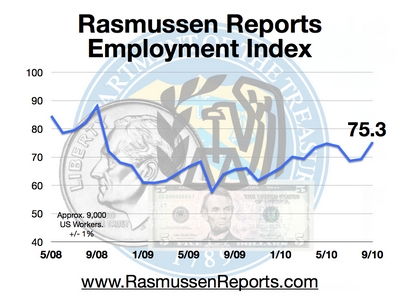
The unemployment rate is still higher than anyone thought it would be by now. But the Rasmussen Employment

Confidence Index is higher now than it has been for two years, and there are plenty of other positive trends indicating that things are moving in the right direction. But the Republican propaganda machine has been very, very effective at spreading misinfor- mation, misinformation that fosters and foments hate and fear — this despite a plethora of facts that are readily available on-line, in periodicals, and on all the news networks (except Fox) that discredit the smear campaigns.

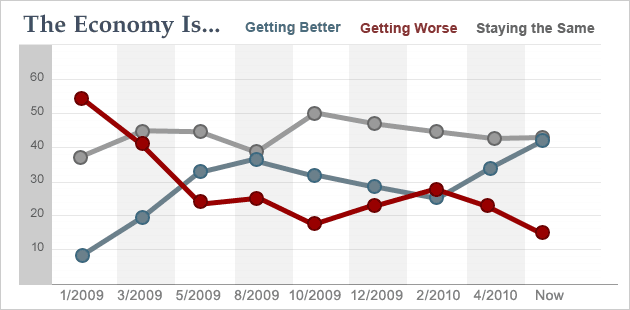
Americans’ opinions on the economy are improving too. According to a recent CBS News/ New York Times poll,

Americans are more optimistic about the future of the economy than they were last month. Forty-one percent of Americans now say the economy is improving, up eight points from April and more than at any time during this recession. Just 15 percent think the economy is getting worse, according to the poll. Even so, all the president got was a slight bump in his approval rating back in May.

I attribute the apparent dichotomy between the president’s approval rating and what’s really going on with the economy to ignorance, bigotry and gullibility. Much of the president’s credibility problem, I believe, is based on the fact that he is African-American with a funny-sounding name. These reasons, plus having had a father who was from Kenya has made him the target of an e-mail smear campaign. I get them and you probably do too if you spend any time corresponding with friends and family by e-mail and any of these people are associated in any way with the Tea Party, the religious right, or one of the many white supremacist groups in America, including a large number of resurging extremist militia groups.

FactCheck.org has responded to many many inquiries about chain e-mails (what I have called viral disinformation) and has concluded that the vast majority of them are categorically false or, at the very most, distorted half-truths. Should you get a chain e-mail forwarded to you and you wonder about its validity, go to http://www.factcheck.org/ask-factcheck/hot-topics/. You’ll probably find it or a version of it listed there with a link to full expose.

Please feel free to post a comment in response to this post, whether you agree or not.

Published in: on October 6, 2010 at 8:23 am  Comments (3)  

Truth in Politics ~ There is Such a Thing But It’s Rare

Some will refuse to believe the truth even when it lands on their heads with irrefutable facts to back it up.

October 4, 2010   Noticing my Bill White for Texas yard sign the other day, a neighbor asked whether I thought White has a chance in the upcoming race for governor.

“There’s always a chance,” was my answer. “It may not be a good chance, but I’d still be contributing to his campaign even if his chances were next-to-none.“  It’s time, I thought but didn’t say, for Rick Perry to go, for the gerrymandering in Texas to end, and for moderates and liberals too to have their voices heard again in this representative democracy of ours.

Coincidentally, the next day my wife suggested that I do some research and a blog article on whether Perry’s claim about Texas having a budget surplus this year owing to his conservative management policies (recession notwithstanding) is true. I thought about doing it for a while, but decided the issue is bigger than just one candidate’s single claim. Claims and counter-claims are flying back and forth in these final weeks before election day as fast as tennis balls over the net at a championship match.  Truth, after all, is relative, especially among politicians. There are half-truths, exaggerations built upon scant bases, and allegations based on suspicions that exploit people’s fears.

True, to borrow a line from the TV drama, X-Files, the truth is out there. But discerning what is true and what is not true is problematic. Some people don’t want to know the truth; some can’t make up their own minds and allow themselves to swayed by others’ opinions, and; some will refuse to believe the truth even when it lands on their heads with irrefutable facts to back it up.

Recognizing that all politicians are human, susceptible to the temptations of exaggerating and spinning facts to their advantage (which is not quite the same thing as calling all politicians liars – or is it), I decided, instead to tackle the bigger issue: Between the two candidates for governor of Texas this year, which is more prone to making unsubstantiated claims and which is more careful with the facts?

By the way, according to PolitiFact.com, Perry’s claim about Texas having a budget surplus this year is rated as “barley true”. Readers are encouraged to check this out for themselves at http://www.politifact.com/texas/statements/2010/feb/12/rick-perry/perry-says-texas-has-surplus/.

Why, you might ask, should you believe what PolitiFact.com has to say about anything? My answer to this is that you should visit this Pulitzer Prize winning website and, after reading a few articles, decide for yourself whether the analyses of political rhetoric and facts reviled justify my assessment. I think that it is a truly amazing public service that more people should take the time to visit regularly rather that mindlessly jabbering away with “friends” on FaceBook.

Claims from all quarters (individual politicians, the White House, Congress, PACs, even mass forwarded email claims) are analyzed by PolitiFact.com’s network of journalists all over the country, then they are peer reviewed for accuracy before being published. Claims are rated by consensus of research analysts as being either true, mostly true, half-true, barley true, false or “pants-on-fire,” meaning that the perpetrator of the claim either acted disingenuously or was sincere but should have known better. In other words, truth is measured by PolitiFact.com on a continuum from being absolutely true to being absolutely false. Most claims, it turns out, are rated somewhere in a grey area. Each claim assessment on PolitiFact.com includes an innovative graphic, a truth meter.

Setting my personal biases aside, I decided that I might use this on-line data base to determine whether Bill White or Rick Perry is the more truthful politician by looking at the claims of each in the aggregate. Rick Perry had 40 claims assessed by the site; Bill White had 22. Both politicians had claims rated true. Both had claims rated false too – even claims rated “pants on fire”.

To make some sense of all the numbers involved, I created a spreadsheet entering the number of true claims, mostly true claims, half-true claims, barely true claims, false claims, and pants-on-fire claims for each candidate. Then I assigned the value of one (1) for true ratings, three-fourths (.75) for mostly true ratings, zero (0) for half-true ratings, minus one-fourth (-.25) for barely true ratings, minus one (-1) for false ratings, and minus one and one-half (-1.5) for pants-on-fire ratings. I then multiplied the assigned values by the number of respective claim ratings for each candidate, summed the products, and then divided the sums by the number of claims analyzed for each candidate.  The result was percent for each. Multiplying the percents then by 100 produced whole numbers for comparison – what I call Truth Factors.

Had either candidate been completely truthful all the time, his Truth Factor would have been one hundred (100). But neither had a perfect score, of course. Bill White’s score was just 6.82, but Rick Perry’s was -33.75 (notice the minus sign).

Neither score was very reassuring to me, but somebody’s got to be the next governor, right? So, who are you going to vote for, the candidate whose claims trends to the far negative side of the truth continuum, or the one that’s at least on the positive side?

Yeah, I know, some will say that this just validates their suspicion that PolitiFact.com has a liberal bias. But I hasten to point out that, if PolitiFact.com favored the Democratic candidate in this pair-wise comparison, they didn’t do him much of a favor. No, I think the results of my analysis validates what I believe, the fact that it is truth that has a liberal bias.

Please feel free to post a comment, pro or con. Mention that you want it and I’ll send you a file copy of the spreadsheet used to generate my truth factors.

Published in: on October 4, 2010 at 11:04 am  Comments (4)  

Taking Back America ~ A Common Theme of Tea Parties

Why, you might ask, have the Tea Parties been so successful? Simple: for most people most of the time, emotion trumps reason.

September 24, 2010   In case you haven’t been following recent events, Tea Party candidates have done well in state primaries this month. And if you’ve been turned-off by all the ugliness in the campaign rhetoric and have therefore tuned-out, you might not know that there isn’t just one Tea Party; there’s no national committee or “official” Pledge to America. Members of different groups tend to be ultra-conservative and most excited, angry might be a better word, about different things — things like high unemployment, immigration, taxes, government spending, “Obama” Care, gay rights, Islam in America.  There’s something for everybody. But there are at least two things they all seem to agree upon: hatred of their arch-villain, Barack Hussein Obama, and the strangle-hold that career politicians seem have on Washington.

The overall Tea Party strategy, if there ever was one, has been brilliant, i.e., using the blogosphere and forwarded emails to organize and rally local groups and demonstrations, playing to regional anxieties and fears, giving the people someone and/or something to blame for their fears, then whipping their fears into focused anger and bringing them together as a force for the establishment to be reckoned with.  If in fact, as Tea Party spokespersons claim, it did start spontaneously as a grass-roots movement, it has since been exploited by charismatic, opportunistic individuals like Dick Armey, Sarah Palin and Newt Gingrich.

“Take Back America!” is a phrase often used by Tea Party key-note speakers. Their claim is that Government of, by, and for the people has been hijacked by the elite. And Barack Hussein Obama fits the description of an American elite perfectly. He is smart, he articulate, he is well-educated, he is well-connected, and, most of all, he is a self-made man having not descended from the privileged class. But he’s black, and some (though admittedly not all) Tea Partiers, though they disdain from acknowledging it, just can’t accept the fact that this historically WASP (White Anglo-Saxon, Protestant) nation now has a black president. It’s been made obvious to me by many of the signs and slogans showing up at Tea Party rallies.

The elite (from the Latin meaning “the elected”) is a hypothetical group of relatively small size that is dominant within society. Consequently, the elite are perceived to have privileged status and are envied by others who judge themselves to be less worthy.  Those at the top of the social strata are almost always put into positions of leadership, whether by force or by choice of the people. Once in-power, the holders of elite status are often pressured to maintain their status. This gives rise to counter-elite movements. Ironically, leaders of these movements inevitably become the new elite.

No, it isn’t the elite that Tea Partiers aim to topple. After all, the Founders themselves were the elite of their day, and doesn’t it just make sense that the best and brightest among us should be chosen to lead? No, they aim to topple anyone in-power who isn’t conservative enough to back extremist objectives such as:

  • Forcing literal compliance with specific provisions of the Constitution in every new law passed (Gee… according the Article Three of the Constitution, ruling on the Constitutionality of laws and Executive Orders is the responsibility of The Supreme Court).
  • Congressional term limits.
  • Repealing the new Health Care Reform law.
  • Stopping “cap and trade” economic incentives to reduce carbon dioxide emissions.
  • Limiting annual growth in federal spending.
  • Demanding a balanced federal budget with a two-thirds majority in Congress needed for any tax modification.
  • Authorizing the exploration of additional energy reserves to reduce American dependence on foreign energy sources and reducing regulatory barriers to all other forms of energy creation, e.g., nuclear energy.
  • Simplifying the tax system with a single rate for everyone and dismantling the IRS.
  • Eliminating all earmarks in legislation.

Some of these objectives are appealing, even to a Social Democrat like me, but they are simple in concept and dangerously radical in application. Rather than returning power to the people and helping to restore the middle class, some would  serve only the ensure the propagation of government of, by, and for special interests, i.e., corporations. Others would benefit only the wealthiest of Americans. Some are downright mean-spirited. Accordingly, the objective of the Tea Parties is to obstruct and repeal, turning back the clock on President Obama’s agenda of change — from the economy, to health care, to the environment, to education, to immigration and to social justice. In short, Tea Party candidates are the most extreme candidates the GOP has to offer, and, should they be elected to Congress, they will make it all the more difficult for conservatives, moderates and liberals to find good faith, common-ground solutions. I liked John McCain a whole lot more when he was still a maverick.

Take Christine O’Donnell, the Sarah Palin-backed Tea Party Senate candidate in Delaware. She’s so far out of the mainstream that even the Delaware Republican Party has called her “reckless,” “hypocritical” and “dishonest.”

Why, you might ask, have the Tea Parties been so successful? Simple: for most people most of the time, emotion trumps reason. This is the reason the Founders included the Electoral College in the Second Article of the Constitution and why the twelfth and twenty-third Amendments have been added for the indirect election of President and Vice President. They feared the electorate being swayed by powerful, charismatic influences.

Perhaps state electoral colleges for Congressional candidates and a single, eight-year term would be a good amendment for the Constitution. This would help to ensure that legislators are truly qualified to serve. It would serve to free legislators to vote their conscience on difficult issues and would limit the influence of special interests. It would also save a lot of money from being spent on reelection campaigns.

Yes, according to recent polls, Democratic candidates for Congress are in danger. Obama’s agenda for change, especially his goal of changing the way government works, is in danger. And rank-and-file Americans — middle class Americans — are in danger too. Personally, I would hope for an evolutionary change in the way we Americans govern ourselves rather than a retrograde, dangerous, revolutionary change like this.

Feel free to post a comment whether you agree with me or not.

Published in: on September 24, 2010 at 11:26 am  Comments (4)  

High Unemployment ~ Is Nine-plus Percent The New Normal?

Making the Bush/Cheney tax cuts permanent, and reducing government spending to 2008 levels isn’t going to fix what’s ailing our economy.

September 15, 2010   No one is happy with the slow recovery from the deepest recession in the U.S. since 1929, not with unemployment levels hovering around 9½ percent. Voters in the upcoming 2010 mid-term elections certainly aren’t, and many blame the party currently in control of the Congress and White House for failing to fix the problem. But what they don’t know, and neither politicians nor economists in any numbers are telling them, is that recovery from declining Gross Domestic Product (GDP) numbers and high unemployment rates are not are not fixed at the hip. They never truly have been.

If everything was as it was prior to NAFTA, the Free Trade Agreements that started in 2001, and ongoing pressure from the World Trade Organization to keep U.S. markets open to foreign-made products, the number of good paying jobs would be growing faster along with the recovery. They might even be growing fast enough to satisfy the demands of an increasing number of immigrants, both legal and il-, new graduates from high school and college, and increasing numbers of seniors who are choosing to work longer rather than retire. But it’s a new world now, and we just haven’t figured out how to adjust.

The traditional level of “normal” unemployment in this country, which economics text books say is around 6 percent, has been reset as a consequence of the recession that started in 2007 and changes in employment dynamics that started with 21st Century free trade agreements. Layoffs from good paying financial, engineering, manufacturing and construction jobs have sent semi-skilled, skilled and professional workers to fill low-wage service industry jobs in groves. The news is filled with stories of college graduates lucky to have found jobs selling cookies or making exotic coffee drinks. I personally know of a masters-prepared engineer working as a substitute teacher.

So, even though official unemployment rates remained relatively low from 2001 until the beginning of the Great Recession (http://www.bls.gov/), the decline in good paying jobs over this period has been dramatic.

Tables prepared by Charles McMillion of MBG Information Services from government data between 2001 and 2004 showed: employment in primary metals down 24 percent; machinery 21.6 percent; computer and peripheral equipment 28 percent; communications equipment 38.8 percent; semiconductors and electronic components 37 percent; electrical equipment and appliances 22.8 percent; textile mills 34.1 percent; apparel 37.3 percent; chemicals 8.3 percent; plastics and rubber products 13.8 percent; Internet publishing and broadcast 40 percent; telecommunications 19.4 percent; ISPs, search portals, data processing 22.6 percent; securities, commodity, investments 6.8 percent; computer systems design and related 17 percent.

This is the “loud sucking sound” that Texas billionaire and Independent candidate for President in 1992 and ’96, H. Ross Perot, predicted. It’s called “off-shoring.” And, no doubt, the resulting transition from a manufacturing-based economy to a service and hospitality-based economy has continued to the present day. But people can eat only so many cookies and drink only so many coffee lattes.

Economists have apologies, but no real explanations, for the loss of jobs in tradable goods and services. They are careful not to blame outsourcing of manufacturing and service jobs, which they claim creates as many new jobs as it loses. But does it? Certainly, the people who are benefiting from outsourcing want us to think it’s good for the economy. But it is not true that free trade benefits both participating parties. It’s more complicated than the simples examples I have taught in macro- economics classrooms to illustrate David Ricardo’s competitive advantage. In all transactions, there are winners and losers. And in today’s world, the United States is losing.

For years, as U.S. multinationals moved manufacturing jobs offshore, Americans have been told that their future was in “knowledge jobs.” Today, however, according to a recent Harvard Economics paper, knowledge jobs are being moved offshore even more rapidly than manufacturing jobs.

So, what are our unemployed computer engineers and information technology workers supposed to do? The answer offered by many economists is:  retrain. But retrain in what? What high value-added job can’t be outsourced?

Without government subsidized construction efforts to modernize our infrastructure, research efforts to reduce our dependency on foreign oil, and tax incentives for businesses that create and keep new jobs here in America, the kinds of things that President Obama is talking about doing, all I can think of are those that happen to be in the nontradable service sector — lawyers, dentists, and surgeons, and such. But if everyone becomes a dentist or a surgeon (we’ve already got too many lawyers in my opinion), the incomes for these professions will only be driven down.

As this trend continues — as decent-paying  jobs with benefits in America become more and more difficult to find, more and more Americans are deciding that it simply doesn’t make any sense to try anymore, not when they can draw unemployment for extended periods and qualify for food stamps and other forms of relief. This drives the unemployment rate up and keeps it up over the long term. So, yes, a nine-plus percent unemployment rate could indeed be the new normal. And it’s not likely to decline much regardless of with political party is in power until the baby-boomers start retiring in greater numbers effectively reducing the civilian workforce.

Ralph E. Gomory and William J. Baumol have written an important new work in trade theory (Global Trade and Conflicting National Interests, MIT Press). They argue that it matters very much which industries and occupations countries retain, and they challenge the assumption that free trade always produces mutual gains. They establish that, in many cases, perhaps a majority of cases, gains for countries come at the expense of other countries.

Accordingly, just making the Bush/Cheney tax cuts permanent and reducing government spending to 2008 levels isn’t going to fix what’s ailing our economy. Sorry Mr. Boehner, you’re wrong. Making the rich even richer won’t magically create jobs for the middle class; Trickle-down economics is still Voodoo economics. The recovery has been slow, according to the Fed Chairman, because Americans who are still working aren’t spending as they did before the recession. They learned a hard lesson. They are Cutting-up their credit cards, paying off their debts and saving to hedge against fears of a double-dip recession. No, to put Americans back to work in good paying jobs, jobs that will provide sufficient incomes so that demand for goods and services will increase (the only thing that will motivate the expansion of production), will take more than just trusting the Invisible Hand of free trade.

Wouldn’t it be nice if things really were that simple?

Please feel free to post a comment whether or not you agree.

Published in: on September 15, 2010 at 8:10 am  Comments (7)  

A Short Civics Lesson ~ Republican Claims Debunked

The politics of hate and fear are still very much a part of the American political system I’m afraid.

September 7, 2010   First showing up back in February of this year on the website of a candidate for Congress was an article entitled “A Short Civics Lesson”. The article was highly critical of President Obama and his handling of the economic crisis now remembered as The Great Recession. It was rife with misinformation and distorted facts. Notwithstanding, the article has been copied and pasted both verbatim and with modifications to others’ blogs and websites since then, especially on those supporting the so-called Tea Party. Now this article is being circulated as an email with the addition of a deficit spending graph created by The Heritage Foundation, a think tank dedicated to promoting and justifying conservative policies.

Among the article’s claims are:

  1. that presidents aren’t responsible for budgets;
  2. that the House and Senate, when controlled by Democrats, bypassed the president to pass continuing resolutions;
  3. that President Bush constrained Congressional spending during his first year in office, and;
  4. that Barrack Obama was personally responsible for the deficit that he claims to have inherited from Bush.

Read the article for yourself if you’re interested at  http://runningforcongress2010.blogspot.com/2010/02/short-civics-lesson.html.

There’s been a lot of this kind of thing going around, originated by people who sincerely believe that the ends justify the means. However, the “Short Civics Lesson” is most disingenuous.

Responding to the article’s first claim: Budgets do in fact start with the president then end up back on the president’s desk to be signed into law after Congress has had their way with them. Budgets are, in-effect, collaborative efforts. Yes, Congress always does send budgets (spending bills) back for the president’s signature considerably altered from what he asked for and they are usually ladened with pork. But Republican-controlled Congresses have historically been just as guilty of this as Democrat-controlled Congresses (see my earlier posting: Americans’ Political Persuasions ~ Based More on Myth than Facts).

Responding to the article’s second and third claims: It is not at all true that President Bush constrained spending by Democratically controlled Congresses. In fact, the graph included with the forwarded email neglected to include the off-budget spending during the Bush years for the wars in Iraq and Afghanistan to the tune of over $5 billion per month http://www.roanoke.com/editorials/wb/xp-25651. Democratic members of Congress actually cooperated with the president by approving a series of off-budget emergency appropriation requests to fund the wars in Iraq and Afghanistan. The graph also shows projected deficit spending by the Obama White House assuming the Bush/Cheney tax cuts are made permanent.

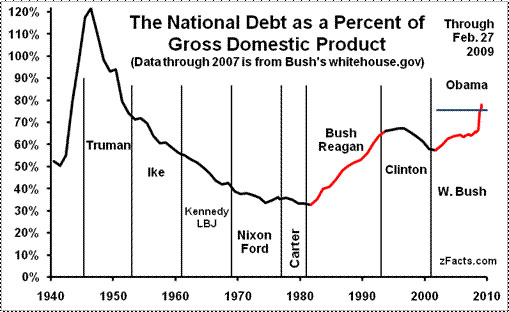
In truth, the only president since Jimmy Carter to constrain out-of-control spending by Congress was Bill Clinton, as the following graph shows. But deficit spending during Obama’s first term has so far only been in response the recession, part of his administration’s expansionary fiscal policies which has included tax cuts and credits for most Americans.

The above graph was created using George W. Bush White House budget and spending data by Z-facts.com. It is contained in an article on-line at http://zfacts.com/p/318.html.

Now, a Short History Lesson in response the fourth claim in the Short Civics Lesson article:  Many Republicans in both the House and Senate voted in favor of the Emergency Economic Stabilization Act of 2008, which authorized the Secretary of the Treasury to create the Troubled Asset Relief Program (TARP) to provide aid to banks and other financial institutions. John McCain voted for it as did Mitch McConnell. Indeed, on September 29, 2008, 65 House Republicans voted in favor of H.R. 3997, the original House vehicle for the act. After that legislation failed, on October 1, 2008, 34 Senate Republicans voted for H.R. 1424, the new vehicle for the act, and on October 3, 2008, 91 House Republicans voted for that bill. President Bush, a Republican, subsequently signed it into law.

So, the nation’s economic problems did begin long before Obama was elected and sworn-in. The fact that Obama voted for H.R. 1424 does not prove that he generated the mess he inherited. Governments during the Regan, Bush 1 and Bush 2 years did. Let’s have a little truth in advertising here, folks!

True, Democrats in Congress are facing an up-hill battle to retain control with latest polls showing an ever-increasing number of Americans disapproving of both Congress and of the president’s handling of the economy http://www.realclearpolitics.com/epolls/latest_polls/. Thirty-three percent of those recently polled by CNN actually think the president’s handling of matters has made things worse. Why do they think this? Because of misinformation contained in this kind of political propaganda. The politics of hate and fear are still very much a part of the American political system I’m afraid.

Please feel free to post a comment whether pro or con.

Published in: on September 7, 2010 at 11:55 am  Comments (5)  

Grandma’s Kitchen ~ An Economics Lesson on Fiscal Policy

I remember my great grandmother’s farm-house kitchen. With a cast iron stove burning wood and chunks of coal, it was the only warm place in the whole house in the winter.

September 1, 2010 — I woke up this morning to a comment posted in response to an article I wrote some time ago. The article was on the latest global warming deniers’ crock, namely that more CO2 is good for the environment. The comment was on the negative aspects of government stimulus spending, which seemed to me to be irrelevant to the original posting until I reread my article. Yes, I did mention stimulus spending. I mentioned it in the context that I thought then and still do that the first priority for government at this time is acting to restore the economy, that making noise in opposition to established science on climate change or protesting the building of an Islamic center blocks away from Ground Zero for that matter is just distracting voters from the more immediate issue, the economy.

It is troublesome to me that, in their zeal to spread misinformation about Obama administration policies, people are plastering counter arguments and criticisms, usually riddled with false information and logical fallacies, everywhere on the Internet.

To the point — I thought I might bring my reader’s comment to the surface in the form of a new posting so that we all might have a chance to respond. My reader, who calls himself Warren, said, “Stimulus spending??? This is the surest way to destroy the economy. Stimulus spending consumes wealth, it does not create it. If stimulus spending had a net, long term, positive benefit, then why dont we just forget about the private sector and just keep stimulating through government spending?”

Obviously, Warren is a Libertarian who subscribes to the Austrian School of economic theory, else he is just parroting something he has heard from the likes of Ron Paul .

This was my response to Warren: “Speaking of stimulus… I remember my great grandmother’s farm-house kitchen. With a cast iron stove burning wood and chunks of coal, it was the only warm place in the whole house in the winter. I spent plenty of time playing on the floor of grandma’s kitchen, playing with her trusty mouse exterminator, Fluffy the cat. Fluffy loved to chase empty thread spools rolled across the floor. But like most good capitalists, she never got the hang of bringing ’em back.

Beside grandma’s galvanized steel kitchen sink was a small water pump. Next to the pump always sat a cupful of water. This was used to prime the pump, which was necessary before any amount of hand pumping would bring water up to the sink. If she or anyone else failed to refill the cup, she would have to go out to the rain barrel next to the house to get more “stimulus”. In the winter, the stimulus was frozen solid so she would have to chip away at it to bring small chunks of it in to melt on the stove. This took time. If the rain barrel was empty, she either had to trek down to the irrigation ditch a quarter-mile away or borrow some stimulus from a neighbor. Similarly, the economic policies of the past admini- stration have left us with an empty cup, so it’s going to take more stimulus spent over a longer period than anyone would want to get things flowing on their own again.

Once the economy is growing more robustly and people are again working for living wages, we must never again forget about grandma’s priming cup.”

Because every dollar spent becomes somebody else’s income, income to be spent or saved in varying amounts over and over again, spending, whether by the private  sector or by the government, does create wealth. This is called the Spending Multiplier concept, a well established basic principle of fiscal policy in macroeconomics. It is cousin to the Money Multiplier concept which focuses on expanding the money supply generated by bank lending. Spending in a market economy is important. It represents demand for goods and services, and it is demand after all that motivates businesses to expand production and rehire laid-off workers. Supply does not create its own demand, a la Say’s Law. No credible economist today believes that it does. You’re right about one thing though, Warren. Given that government’s current stimulus spending is being accomplished with borrowed money, it is creating ‘negative’ wealth. Let’s just hope that when the economy starts moving on its own again that lawmakers remember grandma’s priming cup and that they have the wisdom and resolve to never again leave it empty.

Please feel free to post a comment whether pro or con.

Published in: on September 1, 2010 at 10:43 am  Comments (2)  

Debate Over the Islamic Center in New York ~ Just What Republicans Need

Personally, I would have thought that this president was too astute of a politician to wade into this matter, especially now.

Believe it or not, according to an NPR news story Monday, lawmakers have actually set aside debate over the economy and other pressing national matters to argue over President Obama’s statement supporting the building of an Islamic center within walking distance from Ground Zero http://www.npr.org/templates/story/story.php?storyId=129236595. This will surely add to anti-Obama passion as mid-term elections in November draw near – just what Republicans need. Right?

This will confirm for some that Obama is a Muslim, for others that his real father was Malcom X, and for others that he wasn’t even born in the United States. So, a lesser president would have remained silent in the face of injustice at the hand of public opinion.

Representative Chris Van Hollen (D-Md.), who chairs the Democratic Congressional Campaign Committee appeared on CNN’s “State of the Union” http://www.cnn.com/CNN/Programs/state.of.the.union/ to talk about the upcoming election and was asked for his personal view on whether the mosque should be built in New York.

“It would be wrong to politicize the issue,” he said, adding that the decision should be “up to the people of New York” on where the Islamic center should be built. But the president, just by bringing it up, has already made it a political issue, has he not?

Personally, I would have thought that this president was too astute of a politician to wade into this matter, especially now. Notwithstanding, the president was correct in saying that we must respect the Constitution. We can’t tarnish people’s first amendment rights whether they are Muslim, Jewish, Christian or Mormon. Allowing the Islamic center to be built says to the rest of the world that America is truly the country established by our Constitution. And if two blocks away from Ground Zero isn’t far enough away for an Islamic place of worship and school, how far away is far enough? Or is there  no room for it anywhere in New York City?  How about in your city? Demonstrations against the building of mosques have broken out in many American cities http://www.huffingtonpost.com/2010/08/08/protests-against-mosques-ground-zero_n_674766.html.

Former Republican National Committee Chairman Ed Gillespie said, “It tells you that he (the president) has a very disdainful view of the American people. And I think that’s one of the reasons his favorability ratings have come down, not just his job approval rating.”

I disagree with Mr. Gillespie on his first point, but am in total agreement with him on the second. The president does not have a disdainful view of the American people, not based on anything that he has said. But I do. Frankly, I’m disappointed – perhaps “disgusted” would be a better word — with more than two-thirds of Americans who, as indicated by their view on this subject, are so filled with hate and fear of all Muslims that they would want them deprived of their First Amendment rights simply because those who attacked us on 9/11 were Muslims radicalized by extremist forces exploiting the faith. This is tantamount, I believe, to the hatred of all Japanese, even American citizens of Japanese extraction, that most Americans felt following the attack on Pearl Harbor http://en.wikipedia.org/wiki/Japanese_American_internment.

Writing in the Huffington Post yesterday, Michael Bard put it this way http://www.huffingtonpost.com/mitchell-bard/the-proposed-lower-manhat_b_684081.html: “I have been disgusted by the right’s decision to politicize the issue, using the 9/11 terrorist attacks and the proposed Islamic center as a way to turn fear of “the other” into votes. (Newt Gingrich, an avid practitioner of fear mongering, has, not surprisingly, staked out a far-right position, equating Islam and the Nazis.) With each appeal to our basest, most xenophobic selves, the Republicans are systematically eroding the great American traditions of tolerance and diversity that have been a large part of the growth of the nation. (Note to the GOP: The Statue of Liberty is not just a pretty sculpture. It actually stands for something.) Even the use of the term “Ground Zero mosque” to describe the project is incendiary, intended to alarm at the expense of accuracy (the proposal is not for a stand-alone mosque, and the building would not be at Ground Zero).

Most of all, I have found it depressing that the right has turned a truly nuanced and complicated issue into a mean-spirited, us-versus-them test of patriotism.”

My wife’s dad, a deceased Marine veteran of WWII, was fond of saying, “I may not agree with what you say, but I will fight to the death to defend your right to say it.” Now that’s true patriotism. I will expand on that in light of the current controversy by saying, “Although do not subscribe to your religious beliefs, I will fight to the death for your right to worship as you wish so long as your beliefs do not include the goal of overthrowing our democratic form of government.”

With over 3000 Muslims currently serving in our country’s military http://online.wsj.com/article/NA_WSJ_PUB:SB125755853525335343.html, having sworn to uphold this country against all enemies, foreign and domestic, I cannot… will not believe that Muslim citizens cannot be trusted to serve the greater good.

This controversy, started by a right-wing blogger named Pamela Geller, has turned out to be a most fortunate distraction for Republicans. Now, rather than weighing Democratic efforts to restore the economy and build a better future for Americans against Republican proposals, namely, to dismantle enacted reforms and return us to the economic policies that got us into the mess we found ourselves in at the end of the Bush/Cheney years, voters will be increasingly blinded by doubt fueled by passions on steroids. Unfortunately, passion trumps reason every time for most of us.

Please feel free to respond with your views on this subject by posting a comment whether you agree with me or not.

Published in: on August 17, 2010 at 10:18 am  Comments (10)  

Zombie Lies ~ Discredited Distortions of Truth that Refuse to Die

Even if we do end up having to pay a little bit more for our energy in the short-run, this is the price that we must pay for energy independence in the long-run, which translates into improved national security and a stronger economy for future generations.

Brian Young, writing for Truth Fights Back dot Com, has sent out an appeal for help combating viral disinformation and misguided statements from Republicans like Rep. Joe Barton and their powerful corporate allies. His message was titled, “Zombie Lies.” That’s what Economics Professor and New York Times’ editorialist, Dr. Paul Krugman, calls discredited distortions that live on, repeated over and over again long after they’ve been proven false. Well, this week, the Undead Talking Points run wild all over the debate on how to limit carbon pollution and break our addiction to oil, most of which that we use being imported and much of that from countries whose people don’t like us very much. These talking points all share the same two phrases: “job killing” and “tax.”

If you have the time, I’d like to share his message with you.

First of all, he said, we have an industry front group running ads in DC using the “job killing” zombie about the American Power Act. Never mind that this group – the American Coalition for Clean Coal Electricity – was once busted for sending forged letters to Congress, letters claiming to be from minority groups that never sent them. That should tell you all you need to know about the veracity of this group’s claims.

The truth is that the American Power Act has been studied thoroughly by legitimate non-partisan groups such as the Peterson Institute for International Economics, and all major studies show that it will create millions of jobs. The only jobs that the act will kill will be those of the PR flacks pushing these discredited attacks.

Second, two Republican Senators released a “report” this weeks that’s so stale and discredited that they didn’t even bother to update the pictures from the last time they trotted out the same talking points to attack an entirely different piece of legislation. This “report” claims that billions in new taxes are included in the American Power Act, but there’s not a single dollar in taxes in the entire bill. Republicans just like to label anything government does to change the status quo for business as a tax because much of increased costs of production for businesses are typically passed on to consumers. However, according to the Peterson Institute study, the American Power Act could end up actually saving Americans on their energy costs.

Yes, by pricing carbon, the American Power Act will raise the price of fossil fuels for both businesses and consumers. Households will see an average increase of 3% in electricity rates and 5% increase in gasoline prices between 2011 and 2030, according to the Peterson Institute study. But energy efficiency improvements will largely offset these energy price increases. Accordingly, house- holds will see somewhere between a $136 increase and a $35 decrease in average annual energy expenditures – this depending on future improvements in vehicle efficiency. But, even if we do end up having to pay a little bit more for our energy in the short-run, this is the price that we must pay for energy independence in the long-run, which translates into improved national security and a stronger economy for future generations. But unlike a tax, this small increase in the cost of energy is a cost that individuals and businesses can chose to pay or not pay by moderating wasteful energy consumption habits.

By supporting the American Power Act, we can guarantee our children a cleaner, greener future and break our addiction to fossil-based energy and our dependence on petroleum imports. But to achieve this, we can’t let the debate get sidetracked by the politics of greed and fear. Oil is washing up on our shores, the climates is growing dangerously more unpredictable, and all the other side manages to do is to apologize to the big oil polluters and repeat the same ole, glassy-eyed attacks on science and main-stream economics.

Enough is enough! Let’s stand up for the truth and let the obstructionists know that we really do want change, that we are willing to sacrifice a little “skin” for a healthier, safer tomorrow. Make a donation, as I have done, to publish ads that communicate the truth about this legislation, ads that will combat the lies and distortions. You can do so through the TruthFightsBack website.

 Please feel free to post a comment, whether pro or con.

Published in: on June 24, 2010 at 11:56 am  Comments (1)  

Resisting Progress ~ More Lies and Distortions About Pending Energy Legislation

Like the health care and financial reform efforts, energy and climate change legislation will be another Big F _ _ _ ing deal. Accordingly, the political gamesmanship in Washington continues with the mid-term elections right around the corner.

The Senate’s version of the Waxman-Hartley Clean Energy bill in the House is called the Clean Energy Jobs and American Power Act (S.1713). The bill provides for the establish- ment of a cap-and-trade system for green- house gas emission allowances and sets goals for reducing these emissions by 20 percent by 2020 and by 83 percent by 2050. It’s been pending debate in the Senate for more than a year now with legislators’ efforts committed first to the health care issue and most recently to financial reform (seems like the wheels of progress in Washington can only travel down one major road at a time).

Like the health care and financial reform efforts, energy and climate change legislation will be another Big F _ _ _ ing deal. Accordingly, the political gamesmanship in Washington continues with the mid-term elections right around the corner. Whether this or the immigration issue will be tackled next is anyone’s guess, however.

Following last week’s pronouncements by the bill’s sponsor, John Kerry and likely co-sponsor, Joe Lieberman, the distortions from the right started flowing faster than oil from BP’s on-going disaster in the Gulf of Mexico. One came in the form of an email from Newt Gingrich’s 527 political action committee (PAC), American Solutions For Winning the Future. The email sums up the main distortions from those fighting reform in a single word: tax.  Big Oil lobbyists and their politician spokespersons use that word repeatedly. In fact, in a single sentence of Newt’s email, he uses some form of the word five times. But repeating something over and over again doesn’t make it true. The truth is that there is no energy tax in the bill at all.

Newt’s a master politician. He knows what he’s doing. He knows that his constituents are fearful of new taxes and he knows that if he harps on the subject enough, more and more Americans will begin to believe it. But he also knows that taxes are not part of this legislation so he’s confusing taxes (the levy of financial charges by government upon an individual or a legal entity such that failure to pay is punishable by law) with the specter of rising energy costs. But energy costs for both businesses and consumers, according to a new study by the Peterson Institute for International Economics, a private, non-partisan, non-profit think tank, could actually go down, offset by improvements in energy efficiency over the long-haul. The study counters another claim that Gingrich’s PAC hints at too, warnings of harm to our economy. The truth is that the American Power Act would add over 200,000 new clean energy jobs every year to the American economy. But maybe most important, the Peterson study concludes that the American Power Act would lower our imports of foreign oil by 40%, thus putting America back in charge of our own energy, curbing our addiction to oil, stemming the flow of American dollars to countries that don’t like us, and reducing our trade deficit which dimishes the rate at which our economy can grow. What we pay for foreign oil accounts for half or more of our annual trade deficit.

Less oil, reduced risk to the environment and to other sectors of our economy, more jobs, and lower total energy costs in the long-run. That’s the truth about the American Power Act, not the misleading claims of Newt Gingrich’s PAC and others lobbying on behalf of the unsustainable status-quo and big profits for coal and oil companies. But you don’t have to take my word for it, read the Peterson Institute’s study for yourself.

 Please feel free to post a comment whether you agree that we need a comprehensive energy plan or not.

Published in: on May 22, 2010 at 2:12 pm  Leave a Comment  

Welfare and Poverty ~ Is it a Chicken-or-Egg Relationship?

The real reality check here is that some people are willing to distort the truth or just make stuff up in order to spread their beliefs. This is called propaganda.

May 2, 2010  —  I recently received a forwarded copy of what I like to call a viral disinformation email. It was shared with me by a good friend of conservative persuasion. Yes, I do have conservative friends. The title of the message, which is currently making the rounds, is “This is an Interesting Reality Check.” It purports to be a history lesson about the Second World War and its aftermath. It includes pictures of what was left of Nagasaki and Hiroshima after the atomic bombs that were dropped on these cities in August of 1945. Additional pictures show how these cities look today – brightly-lit, towering skyscrapers and modern, efficient highways contrasted with recent scenes of the blight that has taken over Detroit, Michigan since the end of the war.

The bottom line of the message read: “Why, you ask?…… real simple…… Japan doesn’t have welfare…..and you are damn sure not going to be in their country illegally…..”

The message offers an interesting premise, but the conclusion is fallacious. It’s a prime example of the “questionable cause” fallacy. This fallacy is committed when a person assumes that one event must cause another just because the events occur together. The mistake being made here is that the causal conclusion is being drawn without adequate justification. The conclusion seems valid to some because it enforces an already-held opinion or bias. But, in addition to the logic issue, the author of this message has either knowingly misrepresented the facts or knows nothing of Japanese economic/social organization (Alliance Capitalism).

The real reality check here is that some people are willing to distort the truth or just make stuff up in order to spread their beliefs. This is called propaganda http://en.wikipedia.org/wiki/Propaganda. You see, Japan actually does have a welfare system. It relies more on family and corporations and less on the government, true enough. But government in Japan does chip-in failing assistance from the primary sources. Japanese, culturally, are more committed to family honor and respect for their elders than Americans ever thought about being, and Japanese companies care about and for their employees, whereas American companies, by in large, do not. Labor in America is expendable in the face of profit pressures, and many employers here have no qualms against hiring illegals so as to reduce labor costs at the expense of citizens. The truth is never quite so simple.

Read all about Japanese capitalism if you have the time and inclination at http://books.google.com/books?hl=en&lr=&id=wMeir3lIbq8C&oi=fnd&pg=PR9&dq=japanese+capitalism+versus+american+capitalism&ots=gNBsd7gYK3&sig=jBegXFwFJxg1wZZiirEsygBHALo#v=onepage&q&f=false

Please feel free to post a comment on my blog about this. And, if you’d like to receive a copy of the referenced message including the photos, indicate so in your comment. I will forward a copy to you.

Published in: on May 2, 2010 at 8:08 am  Leave a Comment  

Texas Conservatives Attempting to Rewrite History

“Ignorance is preferable to error, and he is less remote from the truth who believes nothing than he who believes what is wrong — Thomas Jefferson (Notes on Virginia, 1782).”

It is a popular belief among conservatives, particularly the religious-right, that the mainline media, as well as academia, are liberally biased. Hmmm, perhaps… but I think it more likely that facts simply do not support conservative ideas. Conservative solution: revise the facts.

Although not yet final, the rules require a thirty-day period for citizens’ comments, the Texas State Board of Education, approved a social studies curriculum on a party-line vote last week that will put a conservative stamp on future editions of textbooks used in public schools. This was done, according to several independent sources, despite the fact that there were no historians, sociologists or economists serving on the board and none were consulted during deliberations. This, in my opinion as a certified and seasoned social studies teacher, is tantamount to rewriting history. This eliminates any pretense of independence for “independent” school districts in Texas, and this nails it for me. I had been thinking about whether to retire from my high school economics classroom at the end of this school year. I’m not just thinking about it anymore.

Approved curriculum changes include stressing the superiority of the American free-enterprise system rather than presenting advantages and disadvantages of different economic systems in the world and avoiding the word, capitalism in economics textbooks, which has a negative connotation for some as a form economic imperialism. Another change would require students to study “the unintended consequences” of Great Society legislation, affirmative action and Title IX legislation.

Although I have not been personally able to find any historical evidence to support the idea that American citizens of German and Italian national extraction were interned wholesale in the United States during World War II as were those of Japanese extraction, future Texas textbooks will imply this to counter the idea that the internment of Japanese was motivated by racism. This is teaching students what to think as opposed to teaching them how to think. It’s replacing facts with opinions. Other changes include questioning the Founding Fathers’ commitment to a purely secular government and presenting Republican political philosophies in a more positive light. 

The board, dominated by conservative members, claims that they are merely trying to correct what they see as a liberal bias in current textbooks. To that end, they made dozens of changes to a 120-page proposal submitted by a panel of Texas teachers, changes aimed at calling into question, among other things, concepts like the separation of church and state and the secular nature of the American Revolution.

One member of the board, David Bradley, a conservative from Beaumont who works in real estate was quoted in the New York Times as saying, “I reject the notion by the left of a constitutional separation of church and state.” He is further quoted as saying, “I have $1,000 for the charity of your choice if you can find it in the Constitution.”

Well, sir, the words, “separation of church and state,” may not be literally found in the U.S. Constitution, but the notion most certainly is. From Article Six: “no religious test shall ever be required as a Qualification to any Office or public Trust under the United States.” From the First Amendment: “Congress shall make no law respecting an establishment of religion, or prohibiting the free exercise thereof.”

If the actual words from the Constitution aren’t sufficiently persuasive, perhaps you would be swayed by a primary source of evidence to support the founders’ intent, a letter written by the original author of the document, James Madison, to Baptist Churches in North Carolina, June 3, 1811:  “Having always regarded the practical distinction between Religion and Civil Government as essential to the purity of both, and as guaranteed by the Constitution of the United States, I could not have otherwise discharged my duty on the occasion which presented itself.”

Please write your $1,000 check out to the Texas Freedom Network, Mr. Bradley.

“We are adding balance,” said Dr. Don McLeroy, the leader of the conservative faction on the board, after the vote. “History has already been skewed. Academia is skewed too far to the left.”

Efforts by Hispanic board members to include more Latino figures as role models for the state’s large Hispanic population were consistently defeated, prompting one member, Mary Helen Berlanga, to storm out of a meeting late Thursday night, saying, “They can just pretend this is a white America and Hispanics don’t exist.”

“They are going overboard, they are not experts, they are not historians,” she said. “They are rewriting history, not only of Texas but of the United States and the world.”

The conservative members maintain that they are trying to correct what they see as a liberal bias among the teachers who proposed the curriculum. To that end, they made dozens of minor changes aimed at calling into question, among other things, concepts like the separation of church and state and the secular nature of the American Revolution.

Mavis B. Knight, a Democrat from Dallas, introduced an amendment requiring that students study the reasons “the founding fathers protected religious freedom in America by barring the government from promoting or disfavoring any particular religion above all others.” It was defeated on a party-line vote. After the vote, Ms. Knight said, “The social conservatives have perverted accurate history to fulfill their own agenda.”

Cynthia Dunbar, a lawyer from Richmond who is a strict constitutionalist and thinks the nation was founded on Christian beliefs, managed to cut Thomas Jefferson from a list of figures whose writings inspired revolutions in the late 18th century and 19th century, replacing him with St. Thomas Aquinas, John Calvin and William Blackstone. (Jefferson is not well liked among conservatives on the board because he coined the term “separation of church and state.”)

Parents and other citizens of Texas who sincerely care about truth and the quality of education our kids receive, be concerned — be very concerned. When political and/or religious funda- mentalists, whether ultra-conservative or ultra-liberal, dictate what can be taught in our schools, our First Amendment freedoms are substantially diminished.

A document containing the extensive revisions adopted for social studies will be posted on the Texas Education Agency website and entered in the Texas register by mid-April. Once posted, the official 30-day public comment period will begin. At that time, comments with suggested changes to the document can be sent to rules@tea.state.tx.us. In the mean time, don’t hesitate to let Ms. Gail Lowe at sboesupport@tea.state.tx.us know what you think. For more information, visit the Texas Freedom Network at http://www.tfn.org/site/PageServer.

“Ignorance is preferable to error, and he is less remote from the truth who believes nothing than he who believes what is wrong — Thomas Jefferson (Notes on Virginia, 1782).”

Please feel free to post a comment, whether pro or con.

Published in: on March 16, 2010 at 12:34 pm  Leave a Comment  

A Proposed 28th Amendment to the Constitution ~ Obstructionism in Progressive Clothing

I don’t care if members of Congress are Democrat, Republican, Independent , Liberal, Conservative, Progressive or whatever. The self-serving must stop.

March 14, 2010 — I received another viral e-mail this morning, one asking me to forward the same message on to at least twenty people. Perhaps you have received a copy of it yourself. It embodies a sentiment commonly expressed by persons who are opposed to health care reform. The message reads as follows:

“For  too long we’ve been complacent about the workings of Congress. Many citizens had no idea that

  1. Congress members can retire with the same pay after only 1 term.
  2. They don’t pay into Social Security.
  3. They specifically exempted themselves from many of the laws they have passed (i.e. being exempt from fear of prosecution for sexual harassment).

Congress’s latest game is to exempt themselves from the Healthcare Reform Bill being considered. This isn’t logical. We don’t have an elite that’s above the law.

I don’t care if members of Congress are Dem., Rep., Ind. , Lib., Con., Prog. or whatever. The self-serving must stop. The proposed 28th Amendment to the US Constitution (below) would do that. This is an idea whose time has come.

Proposed 28th Amendment to the US Constitution: Congress shall make no law applying to citizens of the USA that does not apply equally to Senators & Representatives; and Congress shall make no law that applies to Senators & Representatives that does not apply equally to citizens of the USA.

This is fair, to the point & non-partisan. The only ones who would be against it are members of the Congress!”

Sound reasonable? Sure it does. As Sara Palin, playing to the pent-up resentment of Tea Partiers, would say, “You betcha.” And, on the surface, I agree with the concept. But the author is wrong. More than just members of Congress would be against it. I am against it. I am against it as a priority at this time because it is unreasonable to expect Congress to ever consider even debating such an amendment? Read what Snopes.com has to say about it.  The URL is http://www.snopes.com/politics/medical/28thamendment.asp.

It sounds good, much like the idea of term limits for Congress sounds good, but it’s nothing that the Congress of the United States would ever consider, many members thereof truly being self-serving as the author of the message has pointed out. So, the only way this, kind of common sense proposal for a Constitutional amendment can ever become law is by way of the grassroots alternative to amendments, a national convention such as is provided by Article V of the Constitution. But amending the Constitution this way is very, very difficult. In fact, it’s never happened. Congress has proposed amendments to the Constitution on several occasions, at least in part, because of the threat of an Article V convention. Rather than risk such a convention taking control of the amendment process away from it, Congress acted pre-emptively to propose the amendments instead. At least four amendments (the Seventeenth, Twenty-First, Twenty-Second, and Twenty-Fifth Amendments) have been identified as being proposed by Congress at least partly in response to the threat of an Article V convention.

So, argue about this first, Congress exempting themselves from laws and voting raises for themselves, and health care reform will never happen, nor would anything else in the public interest. Which, by the way, is exactly what the health insurance industry and Republicans, for purely political purposes, want. Looked at in the full light of day, this is just another salvo from the right aimed at sinking President Obama’s agenda for change.

Maybe if the Tea Party and the new Coffee Party combine their growing voices to lobby enough state legislatures, things like this will someday come to pass. But don’t hold your breath. In the mean time, let’s not inhibit progressives’ efforts to pass laws that will benefit all/most Americans, laws that will help to prevent the wholesale takeover of our One Nation Under God by corporate profit interests.

Please feel free to post a comment.

Published in: on March 14, 2010 at 10:58 am  Comments (8)