Psychological Warfare in the Political Debate ~ Who’s Brainwashing Whom?

Disgusted with the current state of affairs in this country? You’re not alone.

August 15, 2001 — Have you noticed the recent terminology change in the public debate? Conservative politicians are referring to the rich as “job creators?” Republicans vying for their party’s nod to run against President Obama in 2012 are using the term over and over. Why? Psychology — they are brainwashing their constituents into believing that lower marginal tax rates, special deductions and government subsidies available only to the rich and hugely profitable industries will ultimately benefit the economy and them with more employment opportunities. It’s an extension of the old “trickle-down” theory of economics.

This is not unlike the terminology change from “inheritance tax” — another straightforward, value-neutral descriptor — to the emotionally charged term, “death tax.”

Subtle word changes like this impact the public debate by purposely replacing straightforward terms with emotionally charged words that are intended to skew the dialogue in favor of a tiny minority in this economy, the rich — excuse me, “job creators”. It’s part of the class warfare that Warren Buffett recently referred to, the warfare that he said was started by his class and which they are currently winning.

Business investments, which often do come from the wealthy, do not lead economic recovery. Business investments only follow it to take advantage of improving economic conditions. Corporations and job creators are sitting on trillions of dollars rather than investing these dollars to expand production capacity. Why? Well, Republicans and the Chamber of Commerce are saying that it’s uncertainty in the marketplace, fear of how new regulations and provisions of the new health care law will affect business. Okay, that may be partly true. But what’s more true is that businesses do not expand production and services where there is no growth in demand. Instead, businesses cut pack on domestic labor and look for new customers. In the current environment, this means expanding businesses overseas, in China and India for example, where populations are becoming more affluent even as our population is becoming less so http://articles.latimes.com/2011/aug/08/business/la-fi-consumers-overseas-20110808.

Disgusted with the current state of affairs in this country, and especially the weather here in Texas lately, a good friend recently said to me that his new idea of the American Dream is to learn German and move to Bavaria.

Please feel free to post a comment whether you agree or not.

Published in: on August 15, 2011 at 8:45 am  Comments (3)  

The Nordic Economic Model ~ Debunking the Myth That It’s a Myth

As Patrick Moynihan once said, “You’re entitled to your own opinions but not to your own facts.” 

August 12, 2011 — I don’t know why I argue politics. It’s almost always a fruitless activity, especially when I argue with a staunch conservative. To my conservative friends – I’m sorry, I mean no offense by this. It’s simply the nature of conservative thinkers to make up their minds then stick to their guns, no matter what.

A Facebook friend named Sylvia recently posted to her wall this quote attributed to Prof. Victor Davis Hanson of Sanford University: “America is drifting as never before toward Europe—the ostensible model for an Obama administration that has borrowed nearly $5 trillion in three years, federalized health care, assumed control of private companies, blocked new plant openings, is eager to increase taxation, and seeks to subordinate U.S. foreign policy to the United Nations, and did not go to the U.S. Congress for authorization….”

In my opinion, except for the bit about seeking to subordinate U.S. policy to the UN, the quote pretty much tells it the way it is — albeit not without some exaggeration. His statement has appeared on dozens of right-wing, Obama-bashing websites and blogs recently. Prof. Hanson, by the way, is a well-respected military historian, columnist, political essayist and scholar of ancient warfare and is a Senior Fellow at Stanford’s Hoover Institution http://en.wikipedia.org/wiki/Victor_Davis_Hanson.

Rather than argue with the Professor’s points, I chose to respond in a different manner. I posted this comment: “Citizens of many European countries, especially the Nordic countries, are much better off than most Americans with more wealth per capita, better health care at a much lower cost, a cleaner environment, and better education. Notwithstanding capitalists’ arguments about the degree of socialism in Nordic countries, they do have open markets, low levels of regulation, strong property rights, stable currencies, and many other policies associated with growth and prosperity. Indeed, Nordic nations generally rank among the world’s most market-oriented nations. The Nordic Model http://en.wikipedia.org/wiki/Nordic_model is no myth. People there are generally happier, wealthier and healthier, so why should we worry about this so-called drift, Sylvia, if indeed it actually exists?”

Sylvia didn’t respond to this. One of her other friends did, a man named Les. Les took up the challenge by saying (spelling and grammar errors included) , “Kent, go live there!! Not as utopic as you think. Nationalized natural resources to support the leaches of there society. They have one of the highest suicide rate in the world because of the lack of ability to face and solve problems. Capitalism with it’s flaws is still a much better way for a society to evolve and take of it own. People at least have a choice.”

This got me to thinking. Could he be right, that Nordic countries have high suicide rates because the social and economic systems there deprive people of some resolve or ability to face and solve their own problems? So I did some research. Though this idea is popular with conservative pundits as a way to criticize the higher taxes and government spending on social programs prevalent in Nordic countries, the idea does not reconcile with the mental health community.

I responded to Les saying, “No thanks, Les, I need to stick around and do my best to rescue this country from corporatocracy.

I visited a Nordic country once, Denmark, and have read much about the economic and social conditions in these countries. Yes, according to the World Health Organization, Finland and Sweden do have higher suicide rates than the U.S. Maybe this is because of the long, cold winters and lack of sunshine there. Norway’s rate, however, is less than one person per 100,000 per year more than ours and Denmark’s rate is lower than ours by about the same amount http://en.wikipedia.org/wiki/List_of_countries_by_suicide_rate. So, what’s your point?”

“By the way,” I added, “you might be interested in this. According to Gallup as reported in Forbes, the four northern-most Nordic countries are the four happiest countries in the world. http://www.forbes.com/2010/07/14/world-happiest-countries-lifestyle-realestate-gallup-table.html.

Sylvia, who started the conversation/debate thread, responded saying, “Alaska is cold and it isn’t suicidal. The Nordic tax rate of 70% kills the “animal spirits” and, they do not have the diverse population as US. You can’t run over their borders and get free money from their governments. In US for some of our populations, failing in school is an “option” – not there. Because each HS dropout it costs the rest of us $90,000. We have unfunded liabilities here up the wahzoo. European countries that are more diverse are in TROUBLE: Italy (which is too big to fail), Greece, Ireland, Portugal, Spain. Enough said. The American dream – if allowed to survive – is the best.”

I responded with, “As Patrick Moynihan once said, “You’re entitled to your own opinion but not to your own facts.” The suicide rate in Alaska is in fact a serious problem http://www.adn.com/2011/01/12/1645956/report-says-suicide-remains-an.html.

“Kent – surely you know suicide rates are highest in socialist countries,” wrote my lady friend. “Suicide rates in US are highest in California, Hawaii, Oregon, Washington. Now, what do those states have in common?”

Before I could respond to Sylvia, Les wrote (again misspellings and grammar errors are included), “This countries greatness and probably your wages and retirement came from corporations, directly or indirectly. Alaska’s suicide rate is a direct result of people being hand a living without earning it (Indigenous people) let alone the weather :-). Socialism doesn’t work and hasn’t worked. Those societies continue to decline. That is not my fact. Nothing will ever give you the right to someone else wages. Government is only proficient at wasting tax dollars.”

“No, Sylvia,” I wrote. “According to The World Health Organization’s data (previously cited), suicide rates are highest in Lithuania. But Lithuania is not a socialist state. Neither is South Korea, Japan or Kazakhstan since the breakup of the old Soviet Union. These are the countries that have the highest suicide rates. The correlation you’ve made does not hold. Neither are your numbers correct. Look again, Sylvia.  Here is a reference from Mental Health America on just which states have the best and worst statistics with respect to mental health and suicide http://www.nmha.org/go/state-ranking. California, Hawaii, Oregon and Washington State have among the nation’s lowest suicide rates.

Les, your conclusions about the causes of mental illness and resultant suicides are not shared by the mental health community. The experts say that suicides are the result of biological predispositions, environmental factors, poor health policies and a lack of access to treatment for depression.”

Accepting defeat, I assume, on the suicide argument without admitting it, Les, in typical conservative argument style, shifted to another talking point. He cited an obscure New York Times op-ed from way back in 2007 http://www.nytimes.com/2007/12/05/business/worldbusiness/05iht-labor.4.8603880.html claiming that high tax rates in Denmark were contributing to a labor shortage there. Based on this one article, he claimed that socialism is most unfair to middle class workers.

Denmark, I didn’t bother to point out, was essentially at full employment when the New York Times article he cited was published and still is with an unemployment rate of just 4.2 http://www.indexmundi.com/denmark/unemployment_rate.html. Gee, I thought to myself, wouldn’t it be nice if we had a labor shortage here too?

Something else I didn’t share with Sylvia and Les is that neither Denmark https://www.cia.gov/library/publications/the-world-factbook/geos/da.html nor any of the other Nordic countries consider themselves to be socialist. Yes, tax rates are high in these countries, but their peoples enjoy a plethora of government-provided benefits and services that we don’t have. All of these countries have thriving, highly competitive market economies. And, despite the fact that  Norway’s economy https://www.cia.gov/library/publications/the-world-factbook/geos/no.html features a combination of free market activity and government intervention to include government control of resources, Norway in recent times could claim more millionaires per capita than any other country in the world http://www.aftenposten.no/english/local/article1881847.ece.

Responding to Les, I wrote, “I know about economic theories, about the advantages and disadvantages capitalism. I’ve been teaching economics for years. The truth here is that your arguments against the success of “impure” market systems, those that are regulated and constrained sufficiently to preclude the kind of excesses that we have recently experienced here in the U.S., can’t stand the light of day. We’re in the mess we’re in today not because of excess government spending or regulation. We’re in the mess we’re in today because of corporate greed let to run unchecked. I am convinced that it is “unbridled” (laissez faire) capitalism that is most unfair to the working class. Surely you must be confusing socialism with communism, which is a political system not an economic system.”

So, the conservatives’ myth about the Nordic economic model being a myth is now debunked. At least it should be.

Please feel free to post a comment whether you agree or not.

Published in: on August 12, 2011 at 12:36 pm  Comments (10)  

The Great Society ~ An Impossible Dream?

Christians are supposed to care about their neighbors and share the fruits of their labors with those who are in-need, are they not?

What do I know about anything? I’m just a retired senior citizen whose biggest responsibility now is in taking care of his little great granddaughter following daycare each day. But I have a vision, a dream actually, one that has taken me a lifetime to develop.

My dream is of an honorable, righteous, and caring United States of America — a nation in which education and knowledge are valued above material possessions and show- manship — a nation in which politicians care more about what is good for their constituents than about getting themselves reelected. I dream of a time to come when long-range consider- ations will trump the desire for immediate gratification, when the good for the many outweighs the good for the few and when workers are valued over corporate profits. In my dream, Americans will one day wake up to the realization that there is nowhere else to go and that we must honor future generations with good stewardship of the planet’s resources.

As a veteran of the Vietnam War, I remember coming home to jeers rather than cheers. After our trans-Pacific chartered flight touched down at the Seattle-Tacoma airport, we were advised to change quickly into civilian clothes and to exit the airport individually by side doors, coming back later for connecting flights to our home cities. It was January 1970 and the headlines were all about the recent My Lai Massacre and the pending trial of Lt. William Calley, the platoon leader who had ordered the killings. Those of us in uniform weren’t too popular back then. Our former Commander-In-Chief, Lyndon Baines Johnson, wasn’t either.

Being a military officer, I was more conservative in my political views back then. I had cast an absentee ballot while still in Vietnam for Richard Nixon, and I was pleased to know that he had been elected. My future in-laws, however, had been devastated by Johnson’s announcement early the previous year that he would not run again. They were Texas Yellowdawg Democrats. But, looking back on that time, I’m sorry now that LBJ’s unpopularity did in. He is remembered today by some historians as having been one of our greatest presidents owing to his legislative victories for the common man. I see him now in a very different light.

Serving out what remained of John F. Kennedy’s one term as president, Johnson completed the unfinished work of JFK’s New Frontier. He pushed through two very important pieces of legislation. First, the Civil Rights Bill that JFK promised to sign was passed into law. He also signed into law the omnibus Economic Opportunity Act of 1964. The law created the Office of Economic Opportunity aimed at attacking the roots of American poverty. A Job Corps was established to provide valuable vocational training. And Head Start, a preschool program designed to help disadvantaged students arrive at kindergarten ready to learn was put into place. The Volunteers In Service To America (VISTA) was set up as a domestic Peace Corps. Schools in impoverished American regions would now receive volunteer teaching attention. Federal funds were sent to struggling communities to attack unemployment and illiteracy. http://en.wikipedia.org/wiki/Lyndon_B._Johnson

Campaigning in 1964, Johnson declared a “war on poverty.” He challenged Americans to build a “Great Society” that would eliminate the troubles of the poor. He won a decisive victory over his archconservative Republican opponent, Barry Goldwater of Arizona. American liberalism was at high tide. It became a progressive era.

Some of Johnson’s Great Society legislative accomplishments were: Medicare which was created to offset the costs of health care for the nation’s elderly; the Voting Rights Act which banned literacy tests and other discriminatory methods of denying suffrage to African Americans; the Immigration Act which ended discriminatory quotas based on ethnic origin; the Wilderness Protection Act which saved 9.1 million acres of forestland from industrial development; the Elementary and Secondary Education Act which provided major funding for American public schools; the National Endowment for the Arts and Humanities which used public money to fund artists and galleries; an Omnibus Housing Act which provided funds to construct low-income housing. In addition during Johnson’s years as president, Congress tightened pollution controls with stronger Air and Water Quality Acts, and standards were raised for safety in consumer products.

Unfortunately, much of the money Johnson might have spent on these social programs was siphoned off by the war in Southeast Asia. This began to overshadow his domestic achievements. He found himself maligned by conservatives for his domestic policies and by liberals for his hawkish stance on Vietnam. By 1968, his hopes of leaving a legacy of domestic reform were in serious jeopardy. http://en.wikipedia.org/wiki/Lyndon_B._Johnson

So, where are we today with respect to being a great society? Medicare is still paying some of the medical needs of seniors, but that’s largely funded by retirees’ own contributions before they retire and conservatives now in Congress want to turn it into a voucher program. As for the Voting Rights Act, Congress has reauthorized it five times. But Republican controlled states now, through redistricting done even mid-census which has been ruled Constitutional by the conservative Supreme Court, have found legal ways to undermine the concept of one-man-one-vote. The Immigration Act of 1965 is still in-effect. But with so much controversy over what to do about the many illegal immigrants flowing into the country from south of the border, many conservatives are grumbling and want it stuck or substantially changed in any agreement on dealing with illegal immigrants. The Wilderness Protection Act has brought huge tracts of land under federal protection and management, but private interests continue to press and erode the sanctity of these area. One good example is the pressure being brought by the oil industry and citizens of Alaska who benefit from royalties paid for drilling and extracting oil to expand drilling rights. Funding for the National Endowment for Arts and Humanities has suffered severe cuts year after year since 1980, and there have been continuous attacks against it by conservatives. The Elementary and Secondary Education Act has been revised by Congress.  It is now known as No Child Left Behind, a punitive system requiring states to conduct yearly testing to qualify for federal funds. The government, however, has fails to compensate states for this testing mandate.  The Omnibus Housing Act has evolved into the Department of Housing and Urban Development, or HUD. Anyone who feels that they have been discriminated against with respect to where they want to live can file a free claim with HUD. But discrimination in housing still persists. Cities and local communities still find legal ways to prohibit or restrict access to homes and apartments.

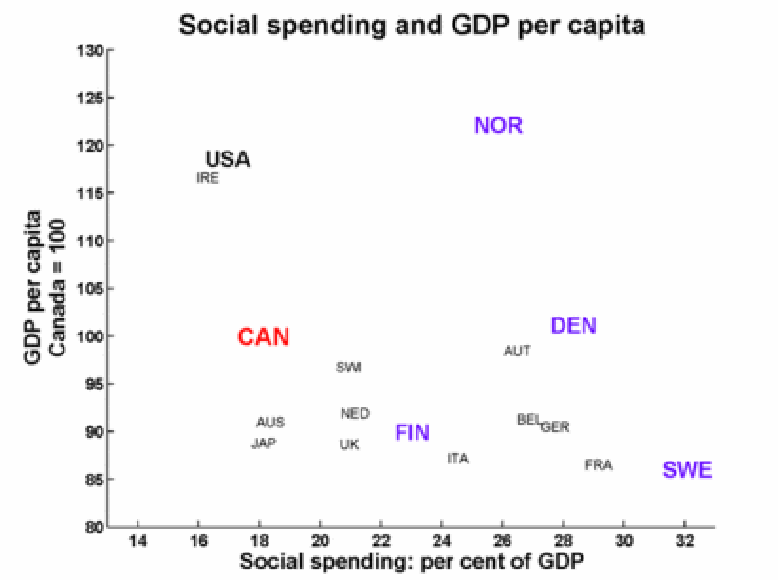
Perhaps the best way to determine whether America is really the generous land of equal opportunity and social justice that we like to think it is, we should look at what we spend for social programs as a percent of our GDP (Gross Domestic Product), the total amount of money made in a year by the production and sale of all goods and services. Comparing this to the amount of spending calculated in the same way for other countries gives us a good idea of where we actually stand. See the graphic below, which was generated by the Organization for Economic Cooperation and Development (OECD). The OECD works to promote policies that will improve the economic and social well-being of people around the world.  It uses a wealth of information on a broad range of topics to help governments promote prosperity and fight poverty http://www.oecd.org/pages/0,3417,en_36734052_36734103_1_1_1_1_1,00.html.


Look at the Nordic nation of Sweden at the bottom right on the graphic. Sweden’s GDP per capita is little more than half what ours is, yet they commit twice the percent of their GDP to the welfare of their citizens. They have achieved an enviable standard of living under a mixed system of high-tech capitalism and extensive welfare benefits. They benefit from an extensive social welfare system which includes a ceiling on health care costs, education subsidies and childcare, maternity and paternity, yes, paternity leave. They have an old-age pension program and universal sick leave among other benefits. The country has a modern distribution system, excellent internal and external communications, and a skilled labor force. Theirs is truly a great society http://www.state.gov/r/pa/ei/bgn/2880.htm.

Now look at Norway at the top, center-right. Norway has a greater GDP per capita than ours and commits ten percent more of its GDP to the welfare of its citizens. Education is free through the university level in Norway. Its health care system includes free hospital care, physicians’ compensation, cash benefits during illness and pregnancy, and other medical and dental plans. There is a public pension system http://www.state.gov/r/pa/ei/bgn/3421.htm. By the way, there are more millionaires in Norway per capita than in any other nation in the world. Wealth there is more evenly distributed.

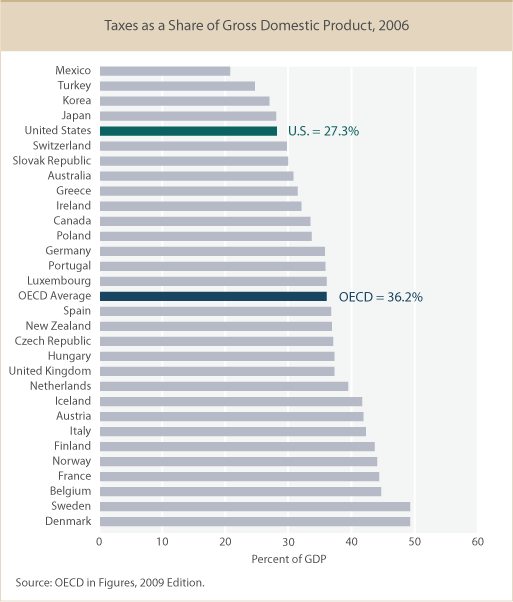
“Yeah, but what about taxes?” you might ask. Aren’t we overburdened with taxes to pay for social programs and other government waste? The answer is no. From all sources, both government and charity, our spending on anti-poverty programs is barely greater than three percent of our GDP. Scholarly studies show the United States to be an outlier in comparison to attitudes and actions taken by other wealthy nations. We have high poverty rates, low public social spending but high private social expenditures, and a rather strong belief that people are poor because of laziness or lack of will http://www.psocommons.org/ppp/vol3/iss2/art3/. The people of most modern states simply do not view poverty in the same way that we do.

Consider the following chart showing our tax burden compared to the rest of the world.

So, where’s the trick? How are these facts skewed to make Americans seem selfish? The answer is that they aren’t.

I find it curious that many in Congress, to reduce budget deficits, favor gutting social programs over increasing revenues collected from the wealthiest of Americans and highly profitable corporations. Still, social conservatives insist that America is a Christian nation. Christians are supposed to care about their neighbors and share the fruits of their labors with those who are in-need, are they not? Yet America, compared to all other nations, is clearly one of the least generous with our own citizens.

So, is my dream an impossible dream? I don’t know. But as my dear grandmother used to say, “Charity starts at home.” Maybe it wasn’t so much that her heart wasn’t in the right place; as an extended family back in the 50s and 60s, there wasn’t much left over after the bills were paid and the groceries were bought. Maybe she just expected more from those who were better off. Maybe, after the vast majority of Americans whose disposable incomes have been shrinking for the past several decades wake up and realize that the wealthiest aren’t really job creators, that trickle-down economics should really be called percolate-up economics, the progressive era that was the Johnson years will be reborn.

Please feel free to comment on this posting whether you agree or disagree.

Published in: on July 18, 2011 at 8:04 am  Comments (7)  

How to get Rich ~ According to Mark

If you weren’t born with a silver spoon in your mouth, but you still want to get rich, here’s what I suggest. Buy lotto tickets.

July 13, 20011 — I’ve made a new friend on Facebook, one whose heart and head are in the same places as mine. This friend, I’ll simply refer to him by his first name, Mark, recently posted a very interesting story on his wall. With Mark’s permission and with a few minor edits, this is what he wrote:

“When I was 8 years old I talked my way into the Grown-up section of the library. Four of the 6 books I took home that day were biographies of famous rich guys from the early 1900s. Over the next 45 years I read lots of Rich Guy Bios and found that most of them have one thing in common. That one thing was confirmed in 2005. I did a complete analysis on the Forbes 400 richest folks in America. I put together an Excel spreadsheet using the data, then started sorting by each column to see what there was to learn.

There are Rich Guy Hot Spots to live in like NYC (Central Park), The Hamptons, South Miami (and Fisher Island), Southern California and Scottsdale AZ. But what I found to be most intriguing was how they got their wealth. In the Forbes article, 12% said they inherited their money. Of the others, a large number said their wealth came from real estate, oil, banking or hotels. But that made my ‘Radar’ really start pinging. To start a business in any of these industries takes big bucks. So where did their start up money come from? I did some deeper digging into their histories. The extensive Forbes article provided lots of information and the library and internet provided more. When I was finished the answer was clear, 85+% were born into rich families and, as adults, they enhanced their wealth investing in the stated industries. So 7 out of 8 really rich people were born rich and got richer. But most of them would like for you to believe they worked for it — the ole “American Success Story”.

As for Rags to Riches, here is what I discovered. A few very wealthy made it on their own. Computer software made Gates and Jobs and some other puter gurus rich. Movies made Tom Cruise, Will Smith and other celebrities rich. A few like John McCain and John Kerry married into wealth. And we all know how Oprah made her money, by syndicating her talk show, forming her own production company, then buying the rights to the show – oh and capturing the hearts of millions with her personal story and her generosity.

Sadly, there were only 3 or 4 out of the 400 that really started with nothing and worked 24/7 for 30 to 40 years to get rich. That’s 1% that were not born rich and weren’t computer gurus or entertainers. None of them ever worked a regular job to get rich.

So if you weren’t born with a silver spoon in your mouth, but you still want to get rich, here’s what I suggest. Buy lotto tickets. The Lotto odds are 12M-to-one against you winning, but that’s a heck of a lot better odds than thinking you can start with nothing, work hard and smart all your life, and with a little luck end up rich. Those odds are around one-in-80 million. So, good luck on the Lotto.”

Thanks for this, Mark.

If anyone would like to comment on what Mark has written, feel free to post a comment below. I’ll make sure he gets it.

Published in: on July 13, 2011 at 10:48 am  Comments (3)  

Being Christian vs. Doing Christian

I’m no Biblical scholar, but parts of the Bible, especially parts of the New Testament, I think are pretty clear.

Those who know me know that I tend to be pretty liberal in my thinking and persuasions. However, when it comes to my faith persuasion, I’m not as liberal as some. Take the popular author of Christian books and articles, John Shore. John wrote the bestselling books, “Penguins, Pain and the Whole Shebang” and “I’m Okay, You’re Not – The Message We Send to Nonbelievers, and Why We Should Stop”. Like me, John maintains a blog to which he posted a piece a few years back by almost the same name as this post: Doing Christian vs. Being Christian. He makes the point in his posting that the Bible is complicated, too complicated for most of us to truly understand, which is why we rely upon others who have gone to seminary for four years just so that they could begin to understand it. By contrast, he wrote, “God himself, though, is the ultimate in uncomplicated—and, via the Holy Spirit, is or can be as fresh and new to you as the very moment in time in which you’re reading this.”

Okay, I buy that. But John sums up his post claiming that we don’t have to do anything about what God, in the person of Jesus Christ, did for us on earth, and that we certainly don’t have to make ourselves worthy of it.

Hmmmmm… Now, perhaps I don’t fully understand the message that John was making on this subject of doing vs. being Christian, but if I do understand it, John is way more liberal than I am when it comes to faith. I’m no Biblical scholar, but parts of the Bible, especially parts of the New Testament, I think are pretty clear. For example, Acts 2:42 – 47 about the fellowship of believers.

“And they devoted themselves to the apostles’ teaching and the fellowship, to the breaking of bread and the prayers. And awe came upon every soul, and many wonders and signs were being done through the apostles. And all who believed were together and had all things in common. And they were selling their possessions and belongings and distributing the proceeds to all, as any had need. And day by day, attending the temple together and breaking bread in their homes, they received their food with glad and generous hearts, praising God and having favor with all the people. And the Lord added to their number day by day those who were being saved.”

Is this not telling us that by accepting Christ as Lord and Savior, converts to the early church were changed and began to live their lives differently? If this is true, then are we not expected to change also, to be more loving and more generous? Surely, we can never hope to make ourselves worthy of Christ’s love and sacrifice. But that doesn’t mean we shouldn’t try.

Consider also, that which is written in 1 Peter, 2:19 – 25 about enduring unjust suffering.

“For this is a gracious thing, when, mindful of God, one endures sorrows while suffering unjustly. For what credit is it if, when you sin and are beaten for it, you endure? But if when you do good and suffer for it you endure, this is a gracious thing in the sight of God. For to this you have been called, because Christ also suffered for you, leaving you an example, so that you might follow in his steps. He committed no sin, neither was deceit found in his mouth. When he was reviled, he did not revile in return; when he suffered, he did not threaten, but continued entrusting himself to him who judges justly. He himself bore our sins in his body on the tree, that we might die to sin and live to righteousness. By his wounds you have been healed. For you were straying like sheep, but have now returned to the Shepherd and Overseer of your souls.”

Is this not telling us that by accepting Christ as Lord and Savior we are suppose to behave in ways that are pleasing to God?

So I take exception to John’s message, as I understand it. We do have to do something in response to what Christ did. We have to live, not for ourselves so much as for God, through worship, prayer and service to our fellow man.

We all know of many who proclaim themselves to be Christian but seldom, if ever, attend worship services. Seventy-six percent of Americans make this claim, but less than forty percent are church goers. Of that number, I wonder how many do more than just occasionally occupy a pew to enjoy the music, snooze through the sermon and drop a dollar or two in the collection plate.

Consider the messages found in Matthew 7:21.

“Not everyone who says to me, ‘Lord, Lord,’ will enter the kingdom of heaven, but only he who does the will of my Father who is in heaven.”

The operative word, for me in this passage, is “does.” Only he who does the will of God will ever enter the kingdom of heaven. And isn’t that the whole point of being Christian? So, is it even possible to be Christian without doing Christian? And what is doing Christian anyway? Is it not living our lives, to the extent humanly possible, after the example of Christ and the teachings of His Apostles — loving God, worshiping and studying His word, praying constantly, and sacrificially doing for others?

Please feel free to comment pro or con on this post.

Published in: on May 12, 2011 at 11:27 am  Comments (6)  

Balancing the Budget and Paying Down Our Debt ~ The Right Way to Do It

It’s no accident that our nation’s debt as a percent of  Gross Domestic Product (GDP) started to climb precipitously in the 1980s.

April 5, 2011 –– As President Obama meets with House and Senate leaders today to try to find some way to avoid a government shutdown at week’s end, current polls are showing that the same percentage of Americans blame Democrats for gridlock on the budget process as blame Republicans. So, neither party has an obvious political advantage for this budgetary brinkmanship. Notwithstanding, the Tea Partiers must be absolutely ecstatic seeing how much influence their party favorites are having on this process. If the facts were known, however, if sensible voters in both parties understood just why we have a deficit in the first place and who it is that will benefit from all the proposed cuts in government spending, maybe it would be different.

So, before we start cutting essential programs to balance the budget for next year, let’s see why it is that we have a deficit and a debt problem. It actually has little to do with fiscal measures taken to respond to the recent recession. Despite what Speaker Boehner says, it’s not a spending problem as much as it is a revenue problem, and the problem has been with us for decades.

Pay particular attention to the last couple of seconds of animation on the last graph in this video showing the accelerated growth of gross national debt and when this accelerated growth began. It moves pretty quick.

It’s no accident that our nation’s debt as a percent of Gross Domestic Product (GDP) started to climb precipitously in the 1980s. Government started receiving diminished revenues owing to Reagan Era tax cuts while, at the same time, started borrowing more and more to sustain increased defense spending and growing demands on entitlement programs by maturing baby boomers. Promised increases in revenues from an expanding economy never truly materialized. What little increase was realized from this tax cut stimulus (trickle-down economics) evaporated with new government subsidies and tax loopholes for corporations. Deficits then continued owing to the Bush-Cheney individual income tax cuts that overwhelmingly favored the wealthiest of Americans and borrowing to fund the wars in Afghanistan and Iraq.

Today, our tax code is full of loopholes created and exploited by big corporations. They, in turn, spend millions that they don’t pay in taxes to control our government with their army of lobbyists found on K Street in Washington.

Yes, do tell Congress to balance the federal budget and pay down our national debt. But tell them not to do it on the backs of our most vulnerable citizens. Tell them not to do it at the expense of our nation’s health and safety. Tell them not to do it and forego infrastructure and technology investments needed for a brighter, more competitive America. The right way to balance the budget and reduce our nation’s debt is to get corporations out of our nation’s business, reform election campaign financing, and restore the middle class subsidizing real people, not corporations.

Feel free to comment whether you agree or not.

Published in: on April 5, 2011 at 10:48 am  Comments (4)  

“The American Form of Government” Video ~ Political Science Revisited

The video’s argument is convincing, but only if you accept the premise that the extreme left of the political continuum is big government, and the extreme right is no government.

March 26, 2011 — A good friend recently brought to my attention a video that’s been making the rounds lately: “The American Form of Government.” Knowing that I had taught social studies subjects in Texas, including history, government and economics for serval years, he was interested in having my opinion about it. He asked, “Does this sound right? Is there something missing? Below is the video.

After watching it, I told my friend that I had found the video to be very interesting — enjoyable to watch, actually. I was impressed by the quality of its production and by much of the historical examples used to substantiate the video’s thesis, i.e., that more government is necessarily bad and less government is good. But the objective, the whole purpose of the video, I told my friend, had obviously been to correct so-called “elitist” teachings and to spread instead conservative propaganda.

The conclusion the video makes, that “big” government is in-league with communism and other forms of oligarchy like fascism is fallacious on several counts and laughable to me. Notwith- standing, this is a popular conservative theme that’s being propagated these days. To this end, the video could be called effective. It’s effective because the argument  is presented in a authoritative, simple manner. But it distorts established political science theory.

This, or something like this, will undoubtedly be taught in Texas high school government classes as soon as the new textbooks can be printed, purchased and distributed, thanks to Governor Perry’s State Board of Education. But political science is not at all as simple as the producers of this video would have viewers believe.

The video’s argument is convincing, but only if you accept the premise that the extreme left of the political continuum is big government, and the extreme right is no government. This is in contradiction with traditional teaching, to wit, that that the left of the established continuum is progressive (desiring change) while the right is conservative (resistant to change). Notice in the graphic below, which represents a much more sophisticated view of the political spectrum, where anarchism and fascism are plotted. Similar graphics depicting this are included in most current political science text books.

I suspect (and I am nothing if I am not the consummate conspiracy buff) that this video lesson was produced by those whose wish it is to see the recent trend of corporate deregulation restored to the benefit of big business and stock holders’  interests and to the disadvantage of middle America and the environment alike.

Some, including myself, are of the opinion that this country is already perilously close to being an oligarchy, a special kind of oligarchy, one that’s called a “corporatocrcy“. It is my bottom line is that it’s not the size of government that matters so much as it is the quality of government. What is it that a nation’s or state’s government purports to do? Is it to, as the preamble of our Constitution says:  to form

a more perfect Union, establish Justice, insure domestic tranquility, provide for the common defense, promote the general welfare, and secure the Blessings of Liberty to ourselves and our posterity?

Or is it to simply secure our borders, protect our economic national interests, and ensure that corporations have all the freedom they need to continue making the richest of Americans even richer at the expense of everyone else?

Please feel free to comment, whether you agree with me or not.

Published in: on March 26, 2011 at 3:23 am  Comments (8)  

Prejudice in the United States Today ~ A Problem That We May Never Resolve

I believe that we fail to resolve issues involving race and other forms of prejudice in this country because we don’t want them resolved.

March 11, 2011 — It’s been almost five decades since the Civil Rights Act of 1964. This act outlawed major forms of discrimination on the basis of race, religion, gender or ethnicity. Notwithstanding, there is still hate and bigotry in the United States. Of this there can be no doubt. No law can make people think or behave civilly, as the recent wave of anti-Islamic sentiment and protests against gays and lesbians at military funerals attest. But, from my experience and years of observation, most claims of racial prejudice in this country today have little to nothing to do with race. They have more to do with socio-economic disparities and ethnic differences. Except among racial supremacy groups, most of us believe that the biological differences of race, in a general sense, neither significantly advantage nor disadvantage one race over another.

Race — what an unfortunate term. It implies winners and losers.

I once made the statement during a church administrative board meeting that embracing diversity is not the same thing as promoting diversity. For that, some in the church labeled me racially prejudiced. Balderdash! I was simply attempting to discourage celebrating or elevating one ethnic group in what was then an ethnically diverse congregation at the expense of others.

In another venue at about the same time, I was attempting to teach the differences between nationality, ethnicity, culture, and race to my World Geography students. For my effort, I learned a few things myself.  One thing I learned is that, in the United States today, many people, or so it seems, don’t want to know the difference. Blurring the distinctions between nationality, ethnicity, culture and race is comforting for some. For others, ignoring the distinctions sustains and confirms their already-held biases.

Case in point, speaking of the different races, I used the example of Mestizo versus Mexican, explaining that Mestizo is a term traditionally used to identify people of mixed European and Native American ancestry. It is a racial term, one of which many Latinos are proud, distinguishing themselves from Indians who they consider to be lower-classed members of Mexican society. Whereas the term, Mexican, refers to a national origin. It’s what most Americans call other Americans who emigrated themselves or whose ancestors emigrated from Mexico or other Spanish-speaking countries. Some, those whose ancestors have always lived in what is today the southwestern part of the United States, are also called Mexicans. The term, Latino, is a broad cultural term, used to identify ethnicities that have the Spanish language in-common. Which is correct to use when referring to people of Spanish-American descendency? Generally, one is always safest sticking to the broader cultural term, Latino, that is, if one wants to avoid causing offense.

At that point, a question came up. One of my young men asked, “What are ethnicities, Mr. Garry?”

I explained to my class that an ethnic group is a population of human beings whose members naturally identify with each other on the basis of a real or a presumed common genealogy or ancestry. The term, culture, refers to the language, attitudes, beliefs, customs, traditions, arts and preferences that are shared by members of different ethnic groups. Culture can also refer to these kinds of things that are more broadly shared by multiple groups within a collective society. For example: Thanksgiving. Thanksgiving is a holiday that most, if not all, ethnic groups within the United States traditionally celebrate. Another example might be American-style football, a sport that appeals to Americans of all ethnic groups. The differences between ethnic groups tend to be divisive because we are most comfortable among others who are most like ourselves.

Things got a bit dicey in class when we moved on to a discussion of race, how we often confuse it with ethnicity or national origin and how the subject often elicits emotional responses. The term, race, refers to the concept of dividing people into populations or groups on the basis of various sets of genetically inherited, physical characteristics, which are usually quite easy for us to distinguish. Because we have a history of exploitation and competition between different groups in the United States, the white man against the black, the red, the yellow and the brown, different ethnic groups have been left with stigmas of guilt, shame and/or inferiority. However, hard we try to put the past behind us and move on, it seems that we may forever remain socially haunted and challenged to live up to our creed of “liberty and justice for all”.

When I was still in grammar school, and that was many years ago, a teacher once taught me that there were only five basic races or “subspecies” of human beings: Caucasian (White), Negro (Black), Mongoloid (Yellow), Malayan (Brown), and American Indian (Red). According to him, all other so-called races are just variations on these five races or mixed-race peoples. His view was based on a religious belief that the races were separately created by God. Notwithstanding, science had long before identified many more distinct races based on physical attributes.

Sir Thomas Huxley, in 1870, identified nine distinct races and he associated them with different geographic regions of origin.  The following year, Charles Darwin published his second great book, The Decent of Man and Selection in Relation to Sex. Darwin believed that all mankind had originated from a common ancestor and argued that the various races were the result of different environmental conditions that have prevailed over time in the various regions of earth where the different races evolved. He also argued that the people of all races are essentially equal in both physical and intellectual potentials. Modern science, based on comparisons of DNA markers for people all over the earth seems to validate Darwin’s conclusions.

The Census Bureau of the United States has confounded the definition of race dramatically by listing multiple racial identities for the surveyed from which to self select, identities that include ethnicity and national origin. And to avoid offending people, they list, for example, the following as a distinct race: Black, African-American or Negro. They do not list Mulatto, Mestizo or mixed-race options. But they do provide space for people to enter their own terms.

“Well, we prefer the term, African-American, Mr. Garry,” one of my young ladies said politely.

“Yes, I know you do, and I understand,” I said, “just as the Census Bureau understands. They are being what’s called, politically correct. They’re being sensitive to others’ sensitivities. And that’s a good thing, but it ignores the difference between race and ethnicity and it creates a whole new set of problems.”

There are physical and biological differences between the Whites of Western Europe and Mediterranean Whites, peoples of the Southern Europe, the Middle East and North Africa. There are physical and biological differences between the Blacks that have descended from peoples of Western Africa and the Blacks of East Africa, or the Aboriginal Blacks of Australia. There are physical and biological differences between Chinese, Vietnamese and Japanese peoples too. Referring to them simply as Asian people ignores these differences. So, shifting attention away from biological differences that are more than just skin deep to ethnic distinctions or national origins ignores the differences between races. Race and ethnicity are not the same thing.”

There was a noticeable hush in the classroom as students’ eyes were seeking to assess others’ reactions to this.

“Okay,” I said, “some of you are thinking that Mr. Garry is racially prejudiced, right.” Nobody answered, confirming my suspicion.

“Let’s talk about what you all want to talk about: prejudice. Can anybody tell me what prejudice means?”

I waited several moments. Finally, one of my young ladies bravely raised her hand and said, “People are prejudice when they say hateful things about people they don’t like.”

“Give me an example,” I said.

“Hmmmm… something like black people are stupid, or Mexicans are lazy.”

“Good, those are certainly stereotypes, good examples of prejudicial attitudes that some people have. But let me correct one thing that you said. The term, Mexican, refers to a nationality, citizens of Mexico. Most Mexicans today are Mestizo, people of mixed European and American Indian ancestry. Some Mexicans are Caucasian, some are American Indian, and some are Black. So it is inaccurate racially to refer to all Latinos as Mexican. Note that both of your examples are generalizations. We all know that neither is true. It is probably true, wouldn’t you agree, that some blacks are stupid and some Mestizos are lazy, just as some whites are stupid and some are lazy. But most Blacks are of normal intelligence just as most whites are of normal intelligence, and most Mestizos are every bit as hardworking and industrious as anyone else.

I gave my students textbook definitions.

Bias is a prejudice in a general sense, usually for having a preference to one particular point of view or ideological perspective. However, one is generally only said to be biased if one’s powers of judgment are influenced by the biases one holds. In other words, a biased person’s views are neither neutral nor objective, they are subjective. A bias could, for example, lead one to accept or deny the truth of a claim, not on the basis of the strength of the arguments in support of the claim themselves, but because of the extent to which the claim is compatible with one’s own preconceived ideas. We are all biased; it’s a human condition.

Prejudice is the process of “pre-judging” something or somebody. It implies coming to judgment on an issue before learning where the preponderance of evidence actually lies, or forming a judgment without direct experience. Holding a politically unpopular view is not in itself prejudice, and politically popular views are not necessarily free of prejudice. When applied in a social sense, prejudice generally refers to existing biases toward entire groups, often based on social stereotypes. At its extreme, prejudice results in groups being denied benefits and rights unjustly or, conversely, unfairly showing unwarranted favor towards others.

“Now,” I said, “if I say that I do not like hip-hop music and that I am pretty much disgusted with the current fashion trend many young African-American men are following, namely, wearing their pants down below their buttocks, have I communicated prejudice?”

Many of my students just stared at me, communicating either confusion or their disbelief that I would even talk about this in the classroom. Others, at least some, including a few African-Americans, shook their heads indicating that they understood.

“No, I am communicating a bias, a preference for other forms of music and a desire to see young people dress with what I consider to be – decorum (good taste). Likewise, when I say that I like enchiladas and fajitas but I do not care for soul food recipes that include offal, which are normally discarded cuts of meat such as pigs’ feet, chitterlings and tripe, I am also not guilty of prejudice. However, if I were to say that I believe the explosive growth of “Black Pride” in the United States following passage of the Civil Rights Act has benefitted people of color neither socially nor economically, I would not be speaking out of prejudice. I would simply be stating an opinion based on observation, an opinion about which many African-Americans would take offense.”

After a long hesitation, during which I wanted students to reflect on what I had just said, I opined, “I believe that we fail to resolve issues involving race and other forms of prejudice in this country because we don’t want them resolved. Like all people pretty much everywhere in the world, we are too concerned with exhibiting our ethnic distinctiveness and hanging onto to our preconceived notions about others. It’s almost as if who we think we are matters more to us than who we really are, and even more than getting along with our neighbors.

After class, I expected many calls from irate parents that evening. I was pleased when none were received.

I invite your comments whether you agree with me or not.


Published in: on March 11, 2011 at 4:32 pm  Comments (17)  

The Wisconsin Thing ~ Another Nail in the Coffin of Democracy and the Middle-Class

Benjamin Franklin famously responded to a question about what form of government the United States would have under the newly ratified Constitution saying, “We have a republic as long as we can keep it.”

February 22, 2011 — The Republican governor of Wisconsin, Scott Walker, won the November 2010 election by six (6) percentage points over his Democratic challenger, Tom Barnett.  Pretty impressive, right? But does six percentage points translate to a mandate for social change on the magnitude taking place in Wisconsin this week? http://en.wikipedia.org/wiki/Wisconsin_gubernatorial_election,_2010.

Hmmmm… It seems to me that the governor of Wisconsin is the governor for all citizens of Wisconsin, even those folks who voted for Mr. Barnett. Notwithstanding, our representative form of democracy means that the governor will have his way on this public workers’ union business regardless of what the average Wisconsin voter may think about it. This is because the Republican Party also controls the state’s legislature, by a large margin in the State Assembly http://en.wikipedia.org/wiki/Wisconsin_State_Assembly, and by lesser numbers in the Senate http://en.wikipedia.org/wiki/Wisconsin_Senate. But would the majority of Wisconsins really support this move if they knew all the facts? I wonder, but we’ll likely never know; the only poll on the question I’ve seen so far suggests bias in the way the question is being asked http://fivethirtyeight.blogs.nytimes.com/2011/02/21/rasmussen-poll-on-wisconsin-dispute-may-be-biased/.

Just because a person votes Republican doesn’t mean that they necessarily believe workers should not have the right to negotiate collectively for pay and working conditions.

Wisconsin is indeed facing a budget crunch, although its difficulties are less severe than those facing many other states. Revenue has fallen in the face of a weak economy, while stimulus funds, which helped close the gap in 2009 and 2010, have faded away. In this situation, it makes sense to call for shared sacrifice, including monetary concessions from state workers. Accordingly, union leaders have signaled that they are, in fact, willing to make such concessions http://www.huffingtonpost.com/2011/02/22/wisconsin-budget-battle-c_n_826478.html. But the governor isn’t interested in making a deal. This is partly because he doesn’t want other government workers, those who are more supportive of him and of Republican principles to have to share in the sacrifice, or so I’ve been given to understand from my reading on the subject http://www.nytimes.com/2011/02/21/opinion/21krugman.html?_r=2.

Even though Wisconsin is facing a terrible fiscal crisis, the governor has been pushing through tax cuts that make the deficit even worse. The bottom line, I think, is that he wants to end workers’ ability to bargain collectively and is therefore refusing to negotiate. Hey – why negotiate when you’re holding all the cards, right?

But why bust the unions when you can balance your budget in other ways? It’s really not helping Wisconsin deal with its current fiscal crisis. Nor is it likely to help the state’s budget prospects in the long run. Contrary to what you may think, public-sector workers in Wisconsin and everywhere else this country are paid less than what private-sector workers with comparable qualifications are paid http://www.businessinsider.com/wisconsin-public-sector-wages-2011-2. So it’s not about the budget; it’s about power.

In principle, every American citizen has an equal say in our political process. In practice, however, some of us are more equal than others: Billionaires can field armies of lobbyists; they can finance think tanks that put the desired spin on policy issues, and; they can funnel cash to politicians with sympathetic views (as the Koch brothers have done in the case of Governor Walker) http://www.nytimes.com/2011/02/22/us/22koch.html.

On paper, we’re a one-person-one-vote nation. In reality, we’re more like an oligarchy, a situation in which a handful of wealthy people dominate. And, although some define it differently, when business controls the state, this is called fascism http://en.wikipedia.org/wiki/Definitions_of_fascism. The more power wealthy business interests gain, the less power individual citizens retain.

Benjamin Franklin famously responded to a question about what form of government the United States would have under the newly ratified Constitution saying, “We have a republic as long as we can keep it.” Well, it is my belief that we are perilously close to losing it, if we have not in fact already lost it.

One does not have to love unions or believe that their policy positions are always right to recognize that they are among the few influential players in our political system that represent the interests of the middle-class. A retired teacher now myself, I have never believed in tenure for teachers. But I have always believed that workers should have the right to collectively bargain for wages and work conditions if that is what they want.

Indeed, if America has become more oligarchic and less democratic with a shrinking middle-class over the last 70 years — which it has http://finance.yahoo.com/tech-ticker/the-u.s.-middle-class-is-being-wiped-out-here’s-the-stats-to-prove-it-520657.html?tickers=%5EDJI,%5EGSPC,SPY,MCD,WMT,XRT,DIA — this is largely true because of the increasing influence the wealthy few have on government and the decline of unions since passage of the National Labor Relations Act of 1935 http://en.wikipedia.org/wiki/Union_busting.

The injustice I perceive in all of this is exacerbated by the fact that Wisconsin’s fiscal crisis, as in other states, was largely caused by the increasing power of America’s oligarchy. It was, after all, the super wealthy and most influential players in the game, not the general public, who pushed for financial deregulation. This set the stage and tumbled the economic building blocks that became the Great Recession of 2008-9, a recession whose aftermath is the main reason for current budget crunches in so many states. Now this oligarchy is pushing the political right to exploit that very crisis. Except for the fact that there is no humor to be found in it, I would call this whole situation ironic.

I invite you comments, whether you agree with me or not.

Published in: on February 22, 2011 at 11:53 am  Comments (6)  

Jesus, Our Teacher ~ Let’s Go to the Kingdom Classroom

I told my class that a wise man, a minister in whom I put great stock, once said that the Bible, both Old and New Testaments, records man’s growing understanding of God, how it has improved over the millennia.
February 9, 2011 — Suffice to say, no matter how skilled the preacher, we all come away from worship services with different insights and different levels of comprehension from sermon messages. Sometimes, with hearts and minds preoccupied, we come away without the foggiest notion of what the sermon message was about. We’re only human.

Recognizing this, our adult Sunday school class had previously decided to begin a series of lessons over the sermons our pastors preached the previous week. On this particular Sunday morning, it was my turn to teach, facilitating discussion over the sermon that I had heard the previous Sunday, Pastor Marie Mitchell’s: Jesus, Our Teacher ~ Let’s Go to the Kingdom Classroom.

The previous lesson in this series resulted in some very interesting discussion and deeper understanding among many. I hoped for the same result on this morning.

By way of explanation, we normally have two different worship services at our church, a more contemporary, early service with our associate pastor preaching and a more traditional, late morning service with our senior pastor preaching. Some of us regularly attend the earlier service while others of us regularly attend the later service. The decision to discuss one of the previous Sunday’s sermons allows us to hear a sermon message that we may have missed.

After, administrative announcements, cares and concerns, and an opening prayer, I began my lesson saying, “As Christians, we universally recognize Jesus as the greatest teacher who ever lived. But do we know why He was so great? Was it because of what He taught or how He taught?”

I allowed time for class members to reflect on this, but it didn’t take long before one of the gentlemen in the class said, “It’s both, but mostly because of how He taught.” On this, there was general agreement.

“Thank you,” I said. “Of course, since Jesus’ life, death and resurrection, many have taught the same things: to love God with all our hearts and minds and to love one another as we love ourselves. But nobody has ever taught these things so well. Isn’t it a shame that we have not all learned as well as He taught?”

My rhetorical question didn’t get the chuckles I thought it might.

Then I asked how many had heard the same sermon that I had heard the previous week. Only two hands went up. “Great,” I said. “This will be a new lesson for most of you then.”

To the two who had raised their hands, I said, “For reasons that will become obvious to you as soon as I do this, I’m going to ask you not to share about the significance of what I am about to do.” Then, to the whole class I said, “I have a treat for you this morning. Yes, a real treat: ice-cream.”

While passing out plastic spoons and individual servings of ice-cream, including some no-sugar-added, frozen yogurt treats for those who might be on restricted sugar diets, I asked everyone to think about: (1) who was their most memorable teacher; (2) from this teacher, what they had learned, and; (3) what had made this teacher so memorable.

It took a few moments for the treats to be distributed and for the sharing about remembered teachers to begin. When the sharing did begin, it became obvious that the memories stirred emotions. The stories were heart-warming. Some of the favorite teachers were women, some men. Some were actually family members. All were remembered as being sincere, caring individuals who respected their students and were, in turn, themselves respected. They all loved what they did and they loved their students. Another common denominator was that the favorite teachers, regardless of the subject they taught, were very knowledgeable about what they taught. Also, they had the ability to connect with their students on a personal level.

Summarizing, I said, “Don’t you suppose that these great teachers’ characteristics were the same characteristics our Savior employed?

I asked my class, “How did Jesus teach?” Then I summarized responses — Jesus taught using aphorisms (great one-liners, short, pithy, memorable sayings provoking and inviting further insight). Examples: “If a blind person leads another blind person, they will both fall into a ditch, Render unto Caesar that which is Caesar’s,” and, “Leave the dead to bury the dead.” He also taught using parables (short stories that invite the student to see things in light of the story. Examples: the story of the Good Samaritan and the Foolish Farmer.

While finishing up our ice-cream, I asked for volunteers to read verses from the same scripture passages used for the Offertory Praise during last week’s worship, Psalm 139. If you have a Bible close, you might wish to read this passage yourself before continuing. It’s the song of David which begins: “You have searched me, LORD, and you know me. You know when I sit and when I rise; you perceive my thoughts from afar. You discern my going out and my lying down; you are familiar with all my ways.”

After the readings, I asked what images of God are made manifest by these passages.

I wrote member responses on the class whiteboard. They included: All knowing, All powerful, Judging, and Controlling. These things, I said, reflect our conventional knowledge about the nature of God – the things that have been known for ages about the God of Abraham, of Joseph, of Moses, and Isaiah. In these passages, David doesn’t tell us anything new about God, except, perhaps, about God’s personal relationship with us.

Then, in the same order of worship followed by our pastor the previous Sunday, I next shared what was taught during the Children’s Sermon: The Importance of Signs and Why We Should Obey Them. A poster showing various traffic signs was displayed. The signs included a stop sign, a railroad crossing, a speed limit sign. When the children were asked why these warning and caution signs are important and why we should obey them, a precocious little lad answered, “Cause if you don’t, you’ll get crashed!”

“Exactly, responded the pastor. “And (holding up a Bible), there are warnings signs in here too. We need to learn about them and obey them so we won’t get crashed.”

I told my class that a wise man, a minister in whom I put great stock, once said that the Bible, both Old and New Testaments, records man’s growing understanding of God, how it has improved over the millennia. This helped me to understand how my image of God as creator, a jealous and sometimes vengeful God, can be reconciled with the New Testament image of God as an accepting and forgiving Savior.

I then asked the class, “What did Jesus teach?” I listened to their responses then summarized — Jesus taught about God, the Kingdom of Heaven and how we should treat one another. I added, “Jesus taught an alternative wisdom, did he not? He taught his disciples to see things differently.”

Next, I asked class members to read verses from Matthew 5, verses 1 through 12, The Sermon on the Mount. Again, if you have ready access to a Bible, you might want to read these verses yourself before continuing with this posting.

After the readings, I asked my class, “What do the beatitudes tell us about Jesus’ alternative wisdom?” I listened to the responses, and then summarized using the following table adding a couple of my own insights .

Conventional Wisdom
Jesus’ Alternative Wisdom
God is punitive lawgiver and judge God is gracious
A person’s worth is determined by measuring up to social standards As a children of God, all persons have infinite worth
Sinners and outcasts are to be avoided and rejected Everyone is welcome around the table and in the kingdom of God
Identity comes from social tradition Identity comes from centering in the sacred, from relationship with God
Strive to be first The first shall be last…; those who exalt themselves will be emptied…
Preserve one’s own life above all The path of dying to self and being reborn leads to life abundant
The fruit of striving is reward The fruit centered on God is compassion

Before closing, I told everyone the reason for the ice-cream. I hoped it would help them remember the bottom line message of the sermon. Our pastor had finished her sermon with a parable, teaching us a basic truth about all of us being teachers and how it’s often more important how we teach than what we teach. This was her story:

A mother took her little boy to a restaurant. After their orders were served, the mother asked her son if he would like to return thanks. He smiled, folded his little hands and bowed his head.

“God is good, God is great. Thank you for our food,” the little boy prayed, “And I would be even more thankful if I could have some ice-cream for dessert. Amen!”

Along with the laughter from the other customers, a nearby woman remarked, “That’s what’s wrong with this country. Kids today don’t even know how to pray. Asking God for ice cream! Why, I never!”

The little boy burst into tears and asked his mother, “Did I do it wrong? Is God mad at me?”

Hearing this, an elderly gentleman approached the table. He winked at the little boy and said, “I happen to know that God thought that was a great prayer.”

“Really?” the little boy asked.

“Cross my heart,” the man replied. Then, in a theatrical whisper so that others could hear too, he added (indicating the woman whose remark had started this whole thing), “It’s too bad some people never ask God for ice cream. A little ice cream is good for the soul sometimes.”

Moved by all this, the waitress who had served the mother and the little boy brought a dish of ice-cream over to the table along with the check. “Here you go,” setting the dessert down in front of the little boy. “This is on the house.”

The little boy stared at dessert for a moment, and then he did something really special. He picked up his ice-cream and walked over to the critical woman’s table, placing the dessert in front of her. With a big smile he said, “Here, this is for you. Ice cream is good for the soul sometimes and my soul is good already.”

Whether we intend to be or not, we are all teachers. So, it behooves us to remember the alternative wisdom Jesus taught and how he taught. He taught with love and compassion.

I ended my lesson with some homework. I asked my fellow class members to think of an issue in their lives or in the world today. Then ask themselves: (1) What does conventional wisdom say about it? And (2) How does Jesus’ invitation to see differently affect your perspective and response to the issue?

I look forward to reading and responding to your comments.

Published in: on February 9, 2011 at 2:06 pm  Comments (2)  

Third Party Auto Warranty Extension (Insurance) Policies ~ Not Even a Good Gamble

Turns out that, if the specific part or parts that fail are not listed under the fine print of a policy like the one I had, a claim will be denied. Only the parts least likely to fail are covered.

February 3, 2011 — Consider mine to be a voice of experience, folks. Take my advice. When your new car warranty runs out, start putting some money away for the inevitable breakdown, trade your old car in for a new car, or purchase a warranty extension from a trusted, local dealership. After all, mechanical things aren’t made to last forever. Do not … I repeat… do not purchase a third-party power train insurance policy.

I bought such a policy last year, a so-called “gold” policy through Nationwide Auto Protection for my five year-old Dodge Magnum. The salesman made it sound like everything having anything to do with the power train would be fully covered. So I figured, with the premiums for the insurance being much cheaper than payments for a new car, this would be a smart buy. I could take my time considering what to buy next, maybe even waiting a year or two to see how the new electrics like Chevrolet’s Volt perform. Wrong decision.

While hundreds of miles away from home recently, I had transmission problems. Long story made short, it took over a week to get my claim approved, and then only after a sympathetic service representative was able to convince an insurance inspector that the failure was because of a “covered” part in the trans- mission. Turns out that, if the specific part or parts that fail are not listed under the fine print of a policy like the one I had, a claim will be denied. Only the parts least likely to fail are covered. To top that off, I had to agree to pay the transmission teardown expenses in the event that my claim would be denied. So, I had to gamble around $700 in labor costs that the policy’s inspector would rule in my favor. Fortunately, I had recently had the transmission serviced too and had proof of this. Otherwise, the claim would have been denied for this reason also.

Had I not had a relative to stay with while all this took place, it would have cost me many times more to get the repairs done using the insurance than it would have just paying for it out-of-pocket. Good thing I am retired now too and didn’t need to get back to a job.

Do not walk away from this company or other such third-party insurance companies — run!

I invite your comments on this post, whether pro or con.

Published in: on February 3, 2011 at 12:30 pm  Comments (10)  

By Giving Care, One Also Receives ~ A Stephen Ministry Testimonial

I was 42 years old before life changing events brought me humbly seeking God. So I was a baby Christian when I showed up one night at a Stephen Ministry information session. I was looking to discover how to be Christian beyond the rituals of worship and Sunday school attendance, beyond the potlucks and the twenty-dollar checks that I dropped in the collection plate on Sundays.

Remembering the questions our pastor had asked me when I joined the church, “Will you be loyal to the United Methodist Church, and uphold it by your prayers, your presence, your gifts, and your service?” I was prayerfully looking for the service that was right for me. I wasn’t looking to gain anything for myself, but I got oh so much more than I gave during and after my 50 hours of training in how to give distinctly Christian care.

After filling out my application form and turning it in to the church office, I interviewed with the ministry leadership team. During the interview, I was thinking, What do I think qualifies me to do this sort of thing? Surely the leadership team is going to tell me, thanks but no thanks. But no, they just asked me what had attracted me to the ministry. My answer seemed to satisfy them. I told them that I just wanted to learn how to be a better Christian.

From the very first session of the 50 hours of training, I connected with the other trainees. Being with other like-thinking Christians on a regular basis, I enjoyed the fellowship, the sharing of joys and challenges, praying for one another, offering encouragement and practical help to one another and relating to one another in a deep and spiritual way. The other trainees, the leadership team and I formed strong, positive spiritual bonds of friendship and commitment. When the training was over with, I actually missed the weekly meetings.

From the 50 hours of training, I learned to listen to others and to appreciate their feelings. These are things that I had never been able to do well. I had always thought that listening is just a simple, natural, and passive activity. But, it’s actually more of an art form, a powerful caregiving tool. Using Jesus as our model, Stephen Ministers learn to be active listeners. This involves commitment, patience, and attention to body language. Stephen Ministers learn to listen for more than just words. They seek true understanding and empathy. I learned also how to be assertive, how to “speak the truth in love” and to avoid aggressive behaviors such as belittling and manipulation and how to avoid passive behaviors such as withdrawing and relinquishing rights. By learning to behave assertively, I became more aware of God’s will for my life and more aware of the needs of others. I learned to stop worrying about fixing others’ problems, that Stephen Ministers are not therapists or problem solvers, that they are simply caregivers. I learned that only God can bring about healing, forgiveness, and hope.

After my 50 hours of basic training, I continued learning and growing in the practical, hands-on service of caregiving. I gained a renewed sense of pride in who I had become and I felt good about being someone who is both needed and appreciated. I became a better husband to my wife and a better father to my sons. I could now talk with my friends and family members instead of just talking to them. And, after our pastors had made initial pastoral visits to sick and grieving church members, my fellow Stephen Ministers and I were available to provide on-going Christian care.

The greatest unanticipated reward for saying “yes” to Stephen Ministry came when I learned that my mother was dying and in great pain, physically, emotionally and spiritually. I took a week off from work and flew home to be by her side.  I listened to her deepest sorrows and regrets; I held her hand and cried with her over shared memories of happy times and sad times. She finally got around to asking about my acceptance of Jesus Christ as Lord and Savior, which led me to offer to pray with her, something I was quite sure she had not done in years, not since she was a little girl living on a farm with her grandparents.

My mother’s emotional and spiritual pain relieved by the grace of God, I came home knowing that I had been Christ’s hands and feet for a time, that I had spoken Christ’s words of forgiveness and assurance. I came home knowing that, when the time came, my mother would be embraced in her new, eternal home. I had been her caregiver, but God had provided the cure.

Years later now, I am still caregiving, sustaining a helping relationship with my indigent son and nurturing my granddaughter’s self-esteem as she recovers from an abusive relationship and gets back on her feet financially. I could not be doing these things, would probably refuse to do these things, had I not said “yes” years ago to Stephen Ministry.

I conclude that my goal, to become a better Christian, has been, at least in-part, realized through Stephen Ministry. I am happier now than I have ever been and my spiritual gifts are more gainfully employed. So, for anyone with the desire to accept others where they are, to love others more and better, I heartily encourage them to look into Stephen Ministry for themselves.

Please feel free to comment or to post confidential questions about my Stephen Ministry experiences.

Published in: on December 30, 2010 at 11:05 am  Comments (1)  

A Political Challenge ~ Ten and Ten

A frequent reader and friend on Facebook has challenged me to identify ten good things about the Democratic Party and ten things that President Obama has done to improve America. I’ve taken on the challenge.

While all democrats might not fully agree with my list of party virtues, I’ve listed what I think are most important and good. Likewise, all who voted for Barrack Obama might not agree with my list of accomplishments. But what follows is according to Opa.

Ten Things That Are Good About the Democratic Party

Democrats believe in and support the values of most hardworking, middle class families:

  • that wealth and privilege shouldn’t be an entitlement to rule
  • that working men and women deserve a fair wage for an honest day’s labor
  • that people have a right to seek justice in a legal system that punishes the excesses spawned by greed and corruption that flourish in an unbridled economic system
  • that all children deserve a good education
  • that no one should be denied quality medical care
  • that everyone should be afforded basic civil rights, which include equal opportunity and freedom from exploitation
  • that the government has a legitimate role to play in protecting both society and the environment
  • that our economy grows from the bottom up, not from the top down, and government can help it grow by investing in people, technology and infrastructure
  • that those who are more fortunate have a responsibility to help those who are less fortunate
  • that, in order to protect First Amendment rights for everyone, matters of religion are and should continue to be kept separate from the state

All these things, I believe, are good.

Ten Things Obama Has Done to Improve America

In just the first half of President Obama’s first term he has done the following, in no particular order of importance:

  • he, along with his economic advisors and Congress, rescued our economy from the brink of depression. The original cost of TARP, $700B, has now been reduced to a mere $25B with financials and the domestic automotive industry returning most of the funds;
  • he has commissioned a bi-partisan balanced budget commission which is about to shed the light of day on deficit spending claims and chart a path for America to rescue our young from the yoke of future unbearable debt;
  • he has, by doing nothing more than just getting himself elected, substantially improved the self-esteem and resolve of millions of young African-Americans  to succeed;
  • he has reduced inter-faith and cultural tensions contributing to world terrorist threats by convincingly addressing the Muslim world and convincing many that we are not at war with Islam;
  • At the cost of much political capital, he has seen major health care reform enacted which includes insurance coverage for millions of young people who can now remain on their parents’ insurance until they are 26;
  • he has fully funded the Veterans’ Administration;
  • he has begun the removal of combat brigades in Iraq and increased our efforts to confront al Qaeda and supportive extremist groups in Afghanistan and Pakistan from which the original 911 attack originated;
  • he has, for all intents and purposes, ended the practice of torture by America;
  • he is in the process of further reducing the nuclear threat in the world through verifiable treaties (the new START Treaty being held up by Republicans in the Senate) and marshaling UN cooperation on meaningful sanctions against Iran and North Korea;
  • he is about to legally and permanently end discrimination against gays and lesbians in our armed forces by ending Don’t Ask/Don’t Tell.
  •  

    Please feel free to post a comment whether you agree or not.
Published in: on December 1, 2010 at 12:27 pm  Comments (22)  

A Fluffy Kitten Story

Mitch McConnell is out jogging one morning. He notices a little boy on the corner with a box. Curious, he runs over to the child and says, “What’s in the box sonny?” To which the little boy responds, “Kittens, They’re brand new kittens.”

Mitch McConnell laughs and says, ‘What kind of kittens are they?  “Republicans, sir,” the little boys says.

“Oh that’s wonderful,” McConnell says, smiling contentedly as he continues his jogging.

A couple of days later McConnell is jogging again, but this time with his colleague John Boehner. He spies the same boy with his box just ahead. McConnell says to John, “You’ve just gotta see this, John.”  They both jog over to the boy with the box.

McConnell says, “Look in the box John, isn’t that cute? Look at those fluffy little kittens.”

Boehner says, “Say, those are really cute kittens young man. What kind of kittens are they?”

The boy replies, “They’re Democrats, sir.”

“What?” McConnell says. “I jogged by here the other day and you said they were Republicans. What’s changed? “Well,” the lad says, “their eyes are open now.”

Feel free to comment and/or share this if you like. It’s not original.

Published in: on December 1, 2010 at 9:28 am  Leave a Comment  

Thanksgiving 2010 ~ What’s There to be Thankful For?

Is it too early to say, “Bah Humbug?”

November 25, 2010 — Yeah, I know, it’s practically un-American not to smile big and wide and count all our blessings on this traditional day of thanks. But it’s difficult for me to be upbeat this year.

Yes, the misses was busy all day long yesterday preparing for the big day, is still busy this morning making everything just right and the house is already smelling yummy. But nobody’s happily driving over-the-river-and-through-the-wood to be here with us. Most of them live too far away — like in Utah, Colorado and Singapore for crying out loud.

Oh well, at least we can count on our little great granddaughter to liven things up for us. She and her mom have been living with us for months while mom gets back on her feet — a victim of the Great Recession. If the little girl likes nothing else that Oma has fixed, I anticipate that she’ll love Ms. Dee’s fabulous Bing Cherry jello salad.

While the retailers are all hoping for a great shopping season, it just isn’t going to happen. Too many folks are counting their nickels and dimes and praying for the economy to turn around faster. Too many folks are still out of work or underemployed. But the economy’s already turned around. What hasn’t turned around is the jobs situation, and that’s not going to turn around anytime soon, if ever.

Jobs in America depend on demand for American-made goods and services, and most of the things we buy are now made elsewhere. While we have opened our markets to almost every other country in the world, the biggest markets are still closed to us or largely so. Other nations and regions are more concerned, as our president has just discovered, about their own economic problems than they are about pulling together and helping us. It may now be a “world” economy, but it’s still a world made up of self-serving nations, trading alliances, oligopolies, corporations, and individuals. Besides, the Cowboys are having their worst season ever.

Having retired from teaching this year, I’m already missing the classroom — already missing my students’ bright and inquisitive faces even as I’m missing family so many miles away. No, retirement’s not all it’s cracked-up to be. So, as the Macy’s Thanksgiving Day Parade is being beamed to our satellite receiver this morning, I apologize for raining on your personal parades. Have a Happy Thanksgiving and put aside the problems of the world if you can, if only just for one day. Enjoy your turkey and be grateful if you have anyone with whom to share it. Hmmmm… perhaps I should take my own advice.

I think I might be feeling less glum if our nation’s leaders would just come together and agree on something. Let’s all pray about that, okay? And while we’re praying, let’s not forget our young men and women in uniform, especially those overseas, especially those in combat zones and the 28,000 or more stationed in South Korea. I can just imagine how they are spending their Thanksgiving. Turkey in the field. Yum! So, if we can find nothing else to be thankful for, we can at least be thankful for their service.

Amen?

Please feel free to comment.

Published in: on November 25, 2010 at 8:09 am  Comments (1)