Cynicism in Today’s Political Landscape and the Demise of Democracy

High school and higher-educated citizens in America used to turn-out for congressional (mid-term) and presidential elections in much greater numbers. But participation in the political process has dropped precipitously in recent years.

I am hearing more and more these days, especially from younger adults in America, that it doesn’t matter whether they vote or not, that the system is rigged. How cynical. Even more cynical in my opinion are those saying things like, “Neither political party represents me,” and, “Politicians are all the same; all they care about is getting themselves re-elected.” I have even heard the idea recently expressed that not voting is actually an alternative way of voting — expressing one’s dissatisfaction with the political system’s status quo.

My reaction to all of this is concern, fear actually, about what this means for democracy in America as we older citizens, the Silent Generation and the Baby Boomers, decline in numbers. Combined with the Supreme Court’s Citizens United decision, which not only allows but encourages greater influence on state and federal governance by corporations and other special interests, this trend points to the end of government-of-by-and-for-the-people (if ever it truly existed at all) and the ultimate establishment of a plutocracy, worse yet, maybe even a new version of Fascism.
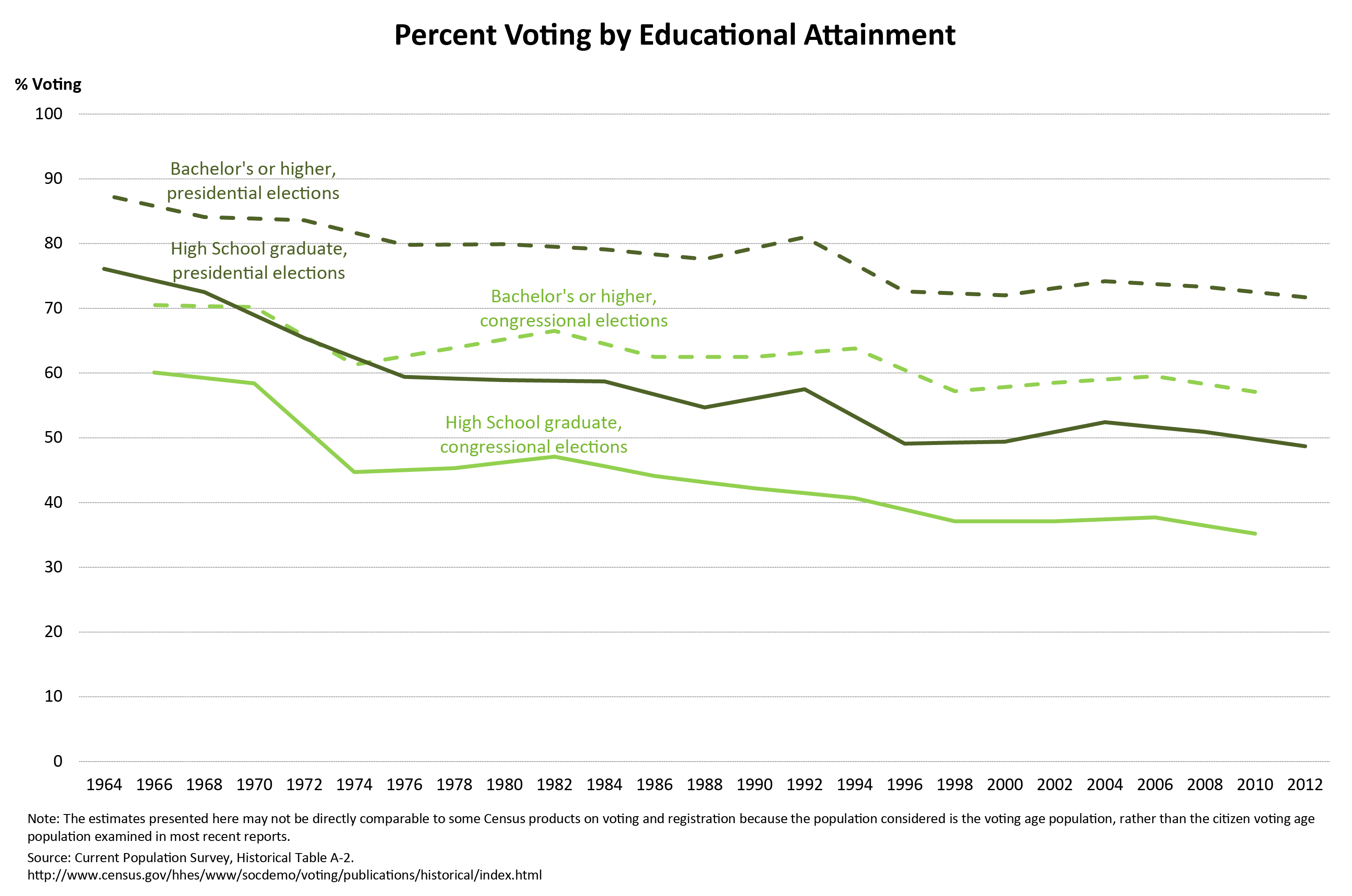
a2-educationalHigh school and higher-educated citizens in America used to turn-out for congressional (mid-term) and presidential elections in much greater numbers. But participation in the political process has dropped precipitously in recent years. Where 80 percent or better used to turn-out for national elections, now the percent has dropped to 50 or less. Compared to the rest of the world’s countries in which people vote, even where voting is not compulsory, Americans are far less likely to be involved in the political process. But why?

Statistically speaking, in any election with twenty or more votes being cast, the chance that any one vote will determine the outcome is extremely low — virtually nil. Studies show too that a single vote in a voting scheme such as the Electoral College in the United States has an even lower chance of determining the outcome. Further, studies using game theory, which takes into account the ability of voters to interact, have also found that the expected turnout for any large election should be zero. So, one might ask instead, why should we even bother?

The factors in deciding whether or not to vote are: P (the probability that an individual’s vote will affect the outcome of an election), B (the perceived benefit that would be received if a person’s favored political party or candidate were to be elected), D (originally stood for democracy or civic duty, but today represents any social or personal gratification an individual gets from voting), and C (the time, effort, and financial cost involved in voting). P times B plus D must be greater than C before a person will vote. (The basic idea behind this formula was developed by Anthony Downs in An Economic Theory of Democracy. published in 1957.)

Obviously P is a non factor. Further, considering the ensuing deadlock in Washington on issues that Americans care about, things like immigration, tax policy, equal rights for women and gays, and gun control, B has lost ground as a factor too. That leaves D, the sense of civic duty or the social and personal gratification that one derives from voting, as the prime factor in countering C, the inertia factor.

One could argue that D, the sense of social and personal gratification that African Americans derived from voting in the last two presidential elections, was the reason that Barrack Obama, the first African American to be nominated for President, handily won the White House for two terms. A large segment of voters was motivated to get off the couch and go stand in long lines to cast their votes as never before. It could be too that Hillary Clinton, because she is a woman and likely to be the first of her gender to be nominated by a major political party for President, will likewise be elected.

I believe that this factor, the social and personal gratification that one derives from voting, is at least in part the motivation for Republican controlled states to pass voting restriction laws and modified/reduced early voting dates and the numbers of polling places in urban areas, thus impacting voters who would most likely favour Democrats. Republican politicians have actually admitted this.

Can one be justified in believing that neither of the major political parties in the United States, the Republican Party nor the Democratic Party, represents them? No, not in my opinion. Believing this is simply a choice which rationalises one’s cynicism. One has only to compare the political platforms of each party, if they are inclined to do so, and assess which one aligns more with one’s beliefs and priorities. That neither party seems to be able to advance change, to move the ball down-court in the current political environment, does not mean that neither party conforms all in in-part with one’s beliefs. There is something for everyone in one party platform or the other.

Does not voting, in and of itself, constitute a vote, protest or otherwise? No, in my opinion, choosing to believe that it does is just more rationalisation for cynicism. Choosing not to vote is not a protest, not in my opinion. It is submission to the rigging of the system that we all abhor — at least those of us who have had nothing to do with the rigging. So, if one lacks the requisite sense of civic duty or the sense of social or personal gratification that comes from participation in the political process, one might more honestly just say, “I don’t care.”

Are all politicians the same? Are all motivated only by getting themselves re-elected? Of course not. But I would agree that too many are motivated primarily by personal interest. It is a human failing.

Given the political landscape in the United States, it is easy for me to understand the cynicism of many citizens, especially those among the gen-Xers and millennials who tend to be more cynical anyway. But can we allow this trend of decreasing voter turn-out to continue and risk the demise of democracy altogether? Yes we can. We can allow special interests, corporations and the wealthy to take total control of our elections. But should we? I say no. Emphatically, I say NO! That is why I think that we should consider the following: restoring the Voting Rights Act in its entirety, which the Supreme Court has recently all but nullified; reversing Citizens United which declares corporations to be citizens too; redefining what and how redistricting can be done by the states, and; amending the Constitution to implement term limits for Congress. We should also make voting universally easy for citizens — all citizens. I would not even oppose some form of compulsory voting, for when liberty and equality are in peril, extreme measures become necessary. The question is, are we at that point yet?

Whether you agree with me on this topic or not, I would very much like hear your opinion. Please feel free to post a comment.

Published in: on April 13, 2015 at 12:03 am  Comments (4)  
Tags: , , ,

Reconciling the Head with the Heart ~ The Resurrection Story

I sat there on the floor thinking about all that my grandma had told me. I thought of many more questions to ask, but I decided that it would be best just to think about them. I could tell that my grandma wasn’t comfortable answering my questions.

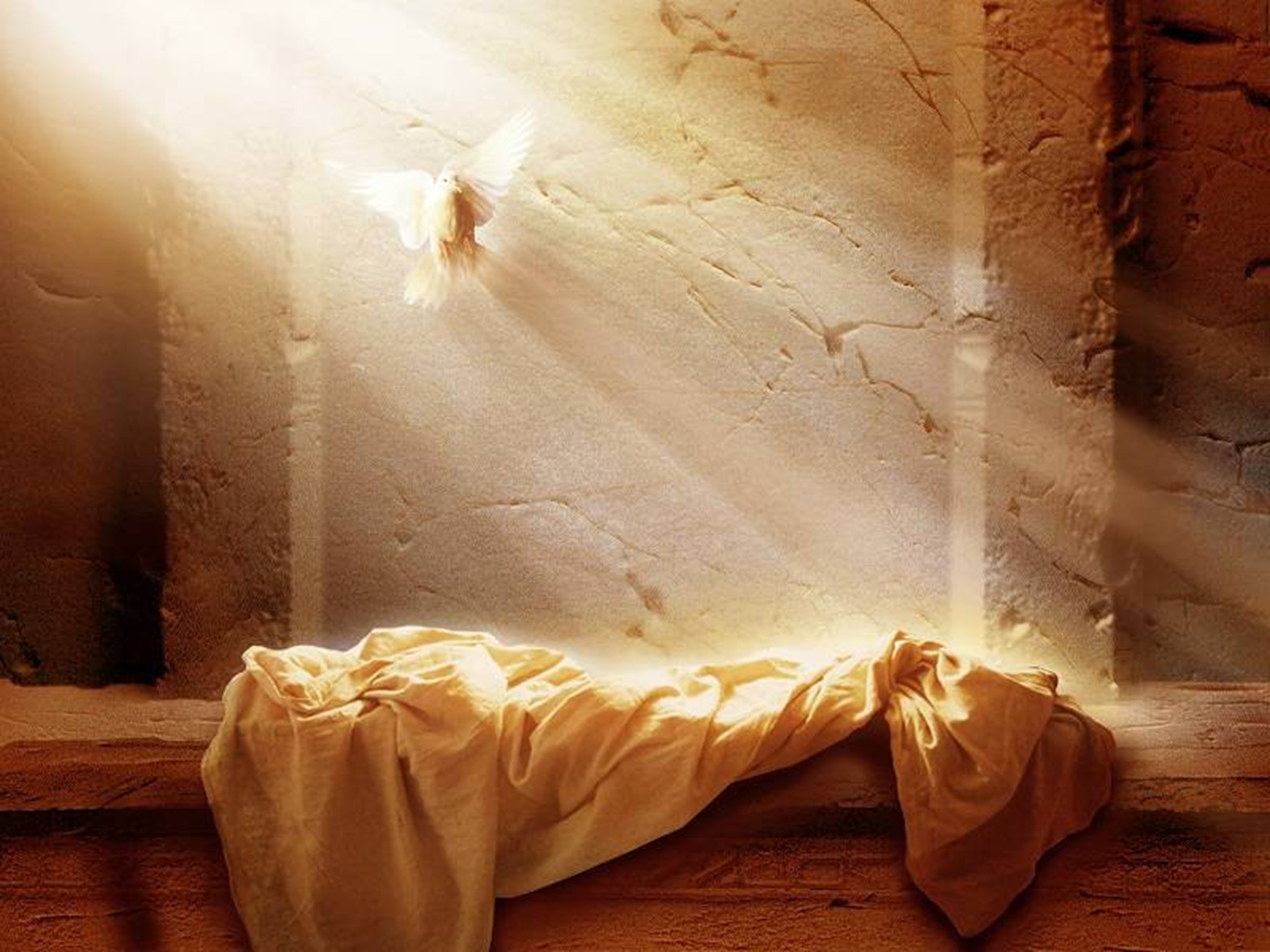
resurrection-1Our Sunday School class chose Reverend Mike Slaughter’s book, “Renegade Gospel, The Rebel Jesus” for our Lenten Season study guide this year. Wow! It offered plenty of fodder for discussion and some in the class even took exception with some of the things he wrote about. My biggest issue and greatest revelation came, not during the last chapter, titled Resurrection, but afterwards.

Beginning to speak at the end of the lesson that Sunday morning, I felt my wife’s elbow in my ribs, so I kept quiet. But I’ve been contemplating the topic ever since for this, the final post in my Lenten Season series. Cutting to the chase – I struggle with the whole idea of a physical resurrection.

A little background here for those of you who do not know me well or personally: I grew up in the shadow of the Mormon Temple. That’s a metaphor, folks; I wasn’t literally in the temple’s shadow the whole time I grew up. I was just raised in an extended family culture of Mormonism. And so, Mormon theology had a profound impact on me. By the time I was twelve or thirteen years old, I rejected it totally, and with it the whole idea of Christianity. Reason crowded out what little faith there was. Owing to the influence and example of many loving people in my life since then, however, I have come to embrace the teachings of Christ Jesus and to accept Him as my Lord and Savior, but in the Methodist faith tradition, not the Mormon. I am comfortable as a Methodist because our discipline does not require me to accept the whole of Scripture as inerrant.

I remember asking my dear little old great grandmother, a third generation descendant of the original Mormon pioneers moving into the Great Salt Lake Valley in Utah, this question: “What happens to us after we die?”

I was playing on her kitchen floor at the time with the family’s cat, teasing it with an empty sewing thread spool tied to a string. My memory of this is quite vivid. She said, “One day, long after we have been buried, we will all be made young, healthy and whole again – those of us who keep the commandments.”

“Will everybody be made whole,” grandma?”

“No, not everybody,” she said, “only those who accept the gospel (meaning the gospel according to the Book of Mormon).”

“Will the Gentiles (understood by Mormons to be unbelievers, including those who believe differently about God – Catholics, Jews, Jehovah Witnesses and all those Protestant people) be made whole?” I asked.

“No, dear,” she said. “All those people who die without accepting the gospel will be given a second chance when in Purgatory after somebody is baptized for them. That’s why we Mormons do genealogy and ‘Temple Work’ so that we can be forever with all of our ancestors.”

“So… how does God make everybody whole again, people like Uncle Seth (Uncle Seth had lost an arm in a farming accident)?”

“I don’t know, honey.”

I sat there on the floor thinking about all that my grandma had told me. I thought of many more questions to ask, but I decided that it would be best just to think about them. I could tell that my grandma wasn’t comfortable answering my questions.

To this day, I recite the Apostles Creed with tongue-in-cheek when saying the last sentence, “I believe in the Holy Spirit, the holy catholic church, the communion of saints, the forgiveness of sins, the resurrection of the body and life everlasting.”  It’s that part about the resurrection of the body that my mind quibbles with – It’s not a trivial matter to me.

According to Reverend Slaughter, and much of the New Testament, we must believe in resurrection, not just Christ’s resurrection on that first Easter Morning, but the eventual resurrection of all believers. Just goggle “what does the bible say about resurrection.” See what you get.

1 Corinthians 15:12-32 reads: “Now if Christ is proclaimed as raised from the dead, how can some of you can say that there is no resurrection of the dead? But if there is no resurrection of the dead, then not even Christ has been raised. And if Christ has not been raised, then our preaching is in vain and your faith is in vain. We are even found to be misrepresenting God, because we testified about God that he raised Christ, whom he did not raise if it is true that the dead are not raised. For if the dead are not raised, not even Christ has been raised…”

The Reverend Slaughter, in his book, claims that we have historical proof of Christ’s resurrection because the Apostle Paul (not one of the twelve) wrote his epistles during and about the year 56 AD, according to Biblical scholars. So many among these more than 500 who witnessed the resurrected Christ were still alive. But who says that more than 500 witnessed the resurrected Christ? Why, the Apostle Paul did, in 1 Corinthians 15:6. “Then he appeared to more than five hundred brothers at one time, most of whom are still alive, though some have fallen asleep.”

This is a logical do-loop and, at best, only second or third-hand evidence. But Paul, you say, himself encountered the risen Christ according to the book of Acts, chapter 9, verses 3 through 9: “Now as he went on his way, he approached Damascus, and suddenly a light from heaven shone around him. And falling to the ground he heard a voice saying to him, ‘Saul, Saul, why are you persecuting me?’ And he said, ‘Who are you, Lord?’ And he said, ‘I am Jesus, whom you are persecuting. But rise and enter the city, and you will be told what you are to do.’  The men who were traveling with him stood speechless, hearing the voice but seeing no one.  Saul rose from the ground, and although his eyes were opened, he saw nothing. So they led him by the hand and brought him into Damascus. And for three days he was without sight, and neither ate nor drank.”

Okay, you say, there you go; Paul’s personal experience is corroborated in Scripture. But who wrote Acts? Tradition from the earliest days of Christianity holds that Luke, a companion of the Apostle Paul, wrote both Acts and the Gospel according to Luke (see Colossians 4:14; 2 Timothy 4:11).

Collusion? Sure sounds like it to me – It’s certainly not corroborated historical proof as the Reverend Slaughter purports.

I recently shared these and other thoughts about Biblical conflicts with scientific evidence and with recorded secular history with a good Christian friend of mine. When I did, he said, “It sounds like you want the Bible to be wrong.”

“Not at all,” I said. “But I don’t consider the Bible to be a True book. I consider it to be a Truth book.

According to Biblical scholars, Gospel writers like Luke didn’t know Jesus personally. None of them were eye witnesses. They did not follow Him around with pens and papyrus recording everything he said and did. Instead, they came to believe in Jesus by listening to others talk about Him. So, when they wrote down what they had come to believe, they used the oral stories that they had heard.

Looking at the Gospels it’s easy to see that Luke heard stories that Mark, Matthew and John did not, stories like The Good Samaritan for example. Similarly, Matthew and Luke heard stories that Mark did not. The Sermon on the Mount for example, in Matthew, becomes The Sermon on the Plain in Luke. We also see that even when they tell the same story, the details are sometimes different. So, it’s the message that matters rather than the details.

According to The Bible Doctor, “The Gospels were not intended to be biographies or historical reports. Each of the Gospels was written to do just one thing: to help people come to believe that Jesus was the Messiah as prophesied in the Old Testament, God in human form.

When we read the Gospels we should look for truths, but not the kind of truths scientists or lawyers look for. We should look for truths about life, about Jesus, about being human, about life in God’s time. This kind of truth is held in the message of the story, not in the details. When we read the Gospels we should not ask what is true. We should ask, ‘What does it mean?’”

The Bible is full of metaphors. The parables themselves are allegories — stories told to convey truths about the Kingdom of God and the nature of mankind – stories filled with metaphors. Biblical scholars agree that the whole book of Job is a masterfully written allegory, it too filled with metaphors. So, could the concept and Biblical stories of Christ’s physical resurrection also be allegories? I think, yes, they could be.

To convince Jews and later, Gentiles, in the early years after the crucifixion that Jesus was indeed the Messiah, the living Son of God, The First Council of Nicaea had to choose Gospels that included the resurrection story along with the virgin birth story and other aspects of prophesy written long before. Otherwise, those who were familiar with the prophesies would never accept Him. Then too, promises of physical resurrection and eternal life for believers had, and continue to have, great appeal. Gospels which did not include these stories and testify to the divinity of Christ were rejected by the council. But I don’t need miracles to believe in Christ’s teachings as other, more fundamental Christians do. Neither do I need them to believe in the purpose of His sacrifice and the hope for salvation. To me, it’s all intrinsically true.

I’ve come a long way since that day on my great grandmother’s kitchen floor. For more on my profession of faith, see A Discipleship Testimonial ~ My Conversion by Profession of Faith.

I rather like this quote by Reverend William A. Kolb posted to the website, explorefaith.org: “Nowadays (forty years later) I would say that I am of two minds. One, which is my ‘worldly, common-sense’ way of thinking, tells me that the resurrection might be metaphorical, but if it is, that does not make me believe in Jesus any less, nor in him as the divine model for living and dying, any less.

But there is another part of me that continues to believe in the resurrection literally. And I would say that that is the part of me to which Jesus referred when he said, ‘The Kingdom of God is within you.’ God has put it into my heart to believe in things that neither I nor the world can prove with our mind, but which we believe with our heart, and usually with all our heart.

Do you have to believe this to ‘be a Christian?’ I would say not. I would say that what it takes to ‘be a Christian’ is to want to be a Christian. The more you believe and the more you practice the things that Jesus taught, the stronger a Christian you will be.”

After a discussion about these things over lunch, that good Christian friend I mentioned earlier, the one who said it sounded like I want the Bible to be wrong, said, “Well, at least God has something to work with in you.” That pleased me a great deal.

Whether there truly was an empty tomb and a physical resurrection – whether or not a physical resurrection awaits those of us who believe, I do believe… more in my heart than in my head. But I do believe, and I will be celebrating Easter again this year.

Please feel free to comment on this post, whether you can understand and accept what I choose to believe about resurrection. Even if you vehemently disagree, I would love to dialogue on the subject.

The Creation Story Revisited ~ Heresy? Perhaps

The Creator of mankind is like the farmer who, after claiming and clearing a suitable plot of ground, decides to grow a garden. He prepares the earth, removing stumps and rocks, breaking up the hard ground and adding fertilizer. Then He plants wild seeds – some of one kind and some of another because this is all that He has to start with.

HarvestOpa?” my little darling asked.

“Yes, dear.”

“Are there aliens?”

“Do you mean like aliens from outer space?”

“Yes.” What other kind are there?

“Well,” I said, “an alien is anything or anybody in our midst that either doesn’t belong or is just visiting. The Bible refers to these aliens as sojourners.”

“I’m only asking about the space kind.”

“Oh, I see,” I began. “Well, I don’t rightly know, honey. I’ve never met one, not to my knowledge anyway. Nobody does know for sure, although lots of people have strong beliefs about it, one way or the other. But if there aren’t others out there, it sure would be a big waste of a lot of room now wouldn’t it?”

My little darling giggled.

“The Bible doesn’t come right out and say that aliens exist, but it does talk about Heavenly Hosts and another human-like species that supposedly inhabited the earth when God created humans and gave us domination over the earth. This other species, the Nephilim, were giants, or so the Bible says. They were on the earth in those days. Maybe they got back into their spaceships and left after God favored us over them.

Later on in the Bible, in the book of Ezekiel, it says, ‘As I looked, behold, a stormy wind came out of the north, and a great cloud, with brightness around it, and fire flashing forth continually, and in the midst of the fire, as it were gleaming metal. And from the midst of it came the likeness of four living creatures. And this was their appearance: they had a human likeness…’”

“Gee, then there really are aliens.”

“Maybe”, I said. “But maybe the prophet Ezekiel was just talking about a dream vision that he had had.

“So, did God make us, people like we are today, and what about the dinosaurs? “

“Well, honey, science has discovered a lot about dinosaurs in recent years. Physical evidence tells us that they lived a long, long time before human beings ever did. But the Bible doesn’t mention them at all. It does talk about leviathans which we understand are whales. Things called behemoths are talked about in one book of the Bible, the book of Job. But biblical scholars think that this is making reference to huge mythological creatures or maybe to elephants, hippopotami, rhinoceroses or crocodiles rather than dinosaurs. When the Bible was written, I don’t think people had any idea about how old the earth really is or anything at all about dinosaurs.  As for people being created just like we are today, yes, according to the Bible, we were. But, again, when the Bible was written, I don’t think people knew. To my way of thinking, the creation story in the Bible isn’t so much about how God made people, but why He made people.”

“Why did He make us, Opa?”

“I’m just guessing here, honey,” I said, “But from what I have read in the Bible, God is love and He created us to love and have us to love Him back.

Given what science has learned in the last couple of hundred years about the earth and life on it, here’s how I would describe the creation story. It’s the way I think Jesus would have explained it to His disciples had your question been asked by them: The Creator of mankind is like the farmer who, after claiming and clearing a suitable plot of ground, decides to grow a garden. He prepares the earth, removing stumps and rocks, breaking up the hard ground and adding fertilizer. Then He plants wild seeds – some of one kind and some of another because this is all that He has to start with. Next, he waters the seeds and waits for them to sprout. He removes the weeds that grow up faster than His tender new plants, weeds that would choke out the plants.

All of what grows from the seeds that He plants do not produce fruit or usable grains. So He destroys the useless plants and decides which of the fruitful plants he likes best. From these, he keeps back some of the best seeds for the next season’s planting. And the Farmer is pleased with His harvest.

Over the many years that follow, the best of the best seeds produce plants that cross-pollinate.  So, the following year some of the plants improve. The Farmer is pleased with His harvest and continues the process of choosing the best seeds for the next season’s planting. Some years there is disease or pestilence which kills off some of the plants. But some plants always survive and these pass on resistance through their seeds to the next generation of plants. And the Farmer is pleased with His harvest.

In time, the Farmer plants seeds in newly claimed and prepared fields. In these fields, however, the soil is different. The climate where these fields are located is different too; there is more or less rain and more or less sunshine. So the seeds produce differently and the plants evolve – not better or worse, necessarily, but appropriately for the conditions where they grow. And the Farmer is pleased with His harvest.

Please feel free to comment on this posting. I would enjoy dialoguing on this subject.

Published in: on March 20, 2015 at 4:06 am  Leave a Comment  
Tags: ,

Yes, I Believe ~ But Why?

Christ’s teachings alone are enough for me. Hope in Him whose teachings inspire, sustains me in times of peril. When I have no answers and can find none, God is there.

newmeNuance is something that challenges understanding, especially outside of the scientific community. Scientists, engineers and statisticians strive to communicate with precision. People of faith — not so much. This is not to suggest that scientists, engineers and statisticians cannot also be people of faith. But the same word or phrase can mean different things to different people, even when used in the same way. Take the word, “faith,” for example.

When a fellow believer spoke recently about growing in faith, I asked him what he meant. “Do you mean growing more certain of what you believe discounting reason, or do you mean growing in understanding of what it means to be a believer and practicing what it is that you do believe?”

Faith is a word that has many different meanings. Among them are: confidence or trust in a person or thing; belief that is not based on proof; belief in God or in the doctrines or teaching of religion; the obligation of loyalty or fidelity to a person, a promise, or an engagement as in keeping the faith.

A scientist would probably shy away from using the word, faith. But if he did use it, he would likely mean it in the sense of having high confidence or trust in something. Religious persons are not so shy and use the word quite often. When they do, they most often mean it as a synonym for belief, the noun form, and to believe, the verb form, meaning to accept the doctrines and teachings of their particular faith persuasions.

When I was young and televisions where first becoming commonplace, there was a program one night a week called The Jane Froman Show. Others of my generation might remember Ms. Froman best for the movie of her life story, “With A Song in My Heart,” I do remember the movie, but I do not remember her TV show. Perhaps this is because ours was one of the last households on our block to have a TV. Anyway, Ms. Froman commissioned the writing of a special song, to inspire hope and faith to Americans because she was troubled by the outbreak of war in Korea so soon after the end of World War II. The song, “I Believe,” became the first hit song ever introduced on TV and was recorded by many others in addition to Ms. Froman. It became both a popular and religious standard of the day. Frank Sinatra  recorded it. So did Perry Como, Any Williams, Barbara Streisand and Elvis Presley. Frankie Laine‘s version of it spent eighteen non-consecutive weeks at the top of the UK Singles Chart. The most successful version of the song in America, Laine’s recording reached #2 on the charts for three straight weeks.

I have long loved this song. I loved it when I was young and I love it now. When I began this missive, the lyrics came hauntingly back to me. But as much and as long as I have loved it, it has done nothing to increase my faith. Neither has it done anything to help explain my lack of faith. Yes, I believe, but not because of the many times I have heard a newborn baby cry. The miracle of new life is awesome to behold, especially when it is a child of your own. But there is no empirical evidence that even suggests that every drop of rain produces a flower. And we all know people who have gone astray with no one coming to show them the way.

So, why do people believe? More to the point, why do I believe?

“Scholars in the fields of cognitive psychology, evolutionary psychology, cognitive anthropology, artificial intelligence, cognitive neuroscience, neurobiology, zoology, and ethology are all seeking to explain how human minds acquire, generate, and transmit religious memes by means of ordinary cognitive capacities.”

I borrowed the above words from Wikipedia, folks. I don’t even rightly know the difference between one of these disciplines and the next. But I do know that scientific theories can do nothing to ease the anxieties that a belief in something greater than oneself can comfort.

Some people point to the complexity of our planet and say that this suggests a deliberate Designer who not only created our universe, but sustains it today. They say that the universe and everything in it had a beginning and that the Big Bang just doesn’t make sense. They say that the universe operates by uniform laws of nature and ask, if not God, then why? But these so-called proofs are not proofs. They are just unanswered questions – questions that our limited minds may never be able to answer. My answer, notwithstanding all of my doubts, notwithstanding all the contradictions between science, in which I have considerable confidence, and Scripture, itself being filled with errors and contradictions, is that I am a better person professing Christ as my Lord and striving to live according to His teachings. I am a better person being in fellowship with others striving to do the same. Christ’s teachings alone are enough for me. Hope in Him whose teachings inspire, sustains me in times of peril. When I have no answers and can find none, God is there.

The great mind of modern times, Professor Stephen Hawking, author of the best selling book, “A Brief History of Time,” has said that heaven and belief in an afterlife are fairytales for people who are afraid of the dark. Yes, that may be true. But, while fairytales are not true, in the telling of them great truths are often found. And I am one of those mortals who does fear the dark — not so much for myself but for those whom I love. And so, I believe. I chose to believe because there is comfort in the belief. There is no comfort in unbelief.

Please feel free to post a comment. I would enjoy dialogue on this subject.

Published in: on March 16, 2015 at 6:20 pm  Comments (1)  
Tags:

In the Spirit of Equity ~ For on Earth There Is No Equality

I understand why so many have difficulty with the idea of “Equal Pay for Equal Work.” It’s an ideal not possible in capitalistic economies, especially those that shun or are suspicious of every aspect of socialism, like public schools, Head Start, Social Security, Medicare and Medicaid.

scales of justice“One of the teachers of the law came and heard them debating. Noticing that Jesus had given them a good answer, he asked him, ‘Of all the commandments, which is the most important?’

‘The most important one,’ answered Jesus, ‘is this: Hear, O Israel: The Lord our God, the Lord is one. Love the Lord your God with all your heart and with all your soul and with all your mind and with all your strength. ‘The second is this: Love your neighbor as yourself. There is no commandment greater than these.’”

~ Mark 12:28-31

Neighbor, you ask? Of whom was Jesus speaking?

Surely you recall the parable of the Good Samaritan. So, would not the unemployed father across town be your neighbor? How about the woman taking care of your children so that you can go to work? How about the part time employees of the largest, most successful retail sales corporation in the world?

Among those of us who know Him, can there be any doubt about how God wants us to treat these neighbors? Does He not want us to treat them fairly and impartially — equitably – not withholding or denying them a living wage? Yes. Even so, this is a tall order. It’s the best we could possibly do because, as we all know, on earth there is no equality.

I understand why so many have difficulty with the idea of “Equal Pay for Equal Work.” Notwithstanding the great and inspiring words in our Declaration of Independence: “We hold these truths to be self-evident, that all men are created equal…” there is no equality. God has not given to each of us in “equal” measures those things that can be measured in human terms. Some of us are born in the bosom of advantage and luxury. Others are born and reared in poverty and perpetual discouragement. No, there is no equality. Yet God commands us to love one another, whether rich or poor — to treat others, our neighbors, with equity.

What does equity look like? I’ll tell you what I think it looks like. It looks like a society in which children don’t go hungry, where they all go to schools where loving teachers are encouraged with enough time and compensation to be the best teachers they can possibly be – schools where vaccinations and school lunches are freely provided. It looks like a society in which a day’s pay, for those willing to work, is at least sufficient to subsist on, to pay for a day’s worth of shelter, food, clothing and medical care. That’s how it seemed to be when I was growing up, which may have been illusionary I admit. But it surely is not this way nowadays, not for everyone.

No, I understand why so many have difficulty with the idea of “Equal Pay for Equal Work.” It’s an ideal not possible in capitalistic economies , especially economies that shun or are suspicious of every aspect of socialism, like public schools, Head Start, Social Security, Medicare and Medicaid.

After retiring from a career in the military, I was hired by a firm providing engineering and programmatic support for military materiel procurement programs. Launched into this follow-on career by my successful involvement in operational test and evaluation for the U.S. Army, it wasn’t long before I was made a branch chief in one of the firm’s many departments. Test and Evaluation was my specialty and I was made a manager because I attracted customers who were willing to pay handsomely for my help. I could have been an ineffective manager, but that had nothing to do with my promotion. It was my expertise in the discipline that got me promoted.

I began to build my team, hiring first a young man who a customer of mine, a former co-worker, wanted to help. He wanted to help not because he was particularly good at anything, but because he was a friend. It soon became evident that he would not be contributing much to the collective effort. But he was now mine to groom and to supervise, which added to my workload. Next, I looked for a new hire that could provide help with human factors engineering. With this hire, I was quite fortunate; the man I hired did excellent work and could write rings around my first hire. My third hire would have been a highly qualified aerodynamics engineer, someone who could serve as my deputy. But, owing to contract constraints and externalities, my branch never quite grew sufficient to justify this third hire. I did interview some candidates though. One was particularly impressive.

She was a graduate of the Navy’s Post Graduate Engineering School and a C-141 pilot. She, a major in the Air Force, had worked in test and evaluation and in the program management office for the new C-17 cargo airplane. Her resume was on the top of my pile of candidates’ resumes when my boss called me in to inquire about my search for a deputy manager. “Who’s your first choice?” he asked.

When I told him, he rolled his eyes then said, “Yeah, I noticed her when she came through for the interview with you. Nice Stems?”

“Sir? Nice stems?” I asked.

“Legs,” he said. “She has nice legs.”

“Yes, she does. But what has that got to do with anything?”

“That has everything to do with whether we can offer her the position.”

“Why is that?” I asked naively.

“For one thing, this is a business for men. Most of your prospective customers would have no confidence in her ability to do the job, even if she could leap higher than all her male competition. Next, were we to hire her and pour time and effort getting her up to speed in this male dominated culture of ours, within two or three years, she’d be engaged and or pregnant. Her new husband, likely another service member still on active duty, would be reassigned to Timbuktu and she’d be gone. No, not her. Who’s your second choice?”

Yeah. I get it. I understand why so many have difficulty with the idea of “Equal Pay for Equal Work.”

What does the Bible say about equity?

In Mattew 20:1-15 we read: “For the kingdom of heaven is like a master of a house who went out early in the morning to hire laborers for his vineyard. After agreeing with the laborers for a denarius a day, he sent them into his vineyard. And going out about the third hour he saw others standing idle in the marketplace, and to them he said, ‘You go into the vineyard too, and whatever is right I will give you.’ So they went. Going out again about the sixth hour and the ninth hour, he did the same. And about the eleventh hour he went out and found others standing. And he said to them, ‘Why do you stand here idle all day?’ They said to him, ‘Because no one has hired us.’ He said to them, ‘You go into the vineyard too.’ And when evening came, the owner of the vineyard said to his foreman, ‘Call the laborers and pay them their wages, beginning with the last, up to the first. And when those hired about the eleventh hour came, each of them received a denarius. Now when those hired first came, they thought they would receive more, but each of them also received a denarius. And on receiving it they grumbled at the master of the house, saying, ‘These last worked only one hour, and you have made them equal to us who have borne the burden of the day and the scorching heat.’ But he replied to one of them, ‘Friend, I am doing you no wrong. Did you not agree with me for a denarius? Take what belongs to you and go. I choose to give to this last worker as I give to you. Am I not allowed to do what I choose with what belongs to me? Or do you begrudge my generosity?’”

“And whatever is right I will give you…”

Yes, I understand that, in this parable, Jesus was talking about salvation, and the master of the house represents God. He was talking about how the Father will reward even those who come to Him in the eleventh hour. But it also illustrates how a godly employer, seeing his laborers’ needs, should satisfy them according to his ability to do so.

Yes, I understand why so many have difficulty with the idea of “Equal Pay for Equal Work.” But why can’t we at least make better efforts towards equity?

What a progressive idea! Yeah, but it’s a Christian idea too. Is it not?

Please feel free to leave a comment. I would enjoy dialoguing on this subject.

Published in: on March 13, 2015 at 2:20 pm  Leave a Comment  

Forgiveness ~ A Spiritual Gift if Ever There Was One

Learning how to forgive others is one of the most unnatural duties we have as Christians. It goes against human nature.

forgivePreparing our hearts and minds for the holy days that lead up to Eastertide – for which Lent is intended – one must consider what Christ Jesus’ sacrifice and resurrection was all about. One word comes to mind: forgiveness.

The Scriptures are replete with admonitions about the importance of forgiving one another – like, for example: “Forgive us our trespasses as we forgive those who trespass against us.” Yet Christians struggle with this. People of all faiths do; we are human. But some have a greater capacity for forgiveness than most. And so, I find it curious that the Apostle Paul did not specifically include forgiveness as a spiritual gift in any of his epistles found in the New Testament. Surely God is concerned with our ability and willingness to forgive, and Paul was very much aware of this. In Ephesians 4:32 Paul wrote, “Be kind to one another, tenderhearted, forgiving one another, as God in Christ forgave you.” Yet he did not list forgiveness as a spiritual gift. I wonder why.

The spiritual gifts are found in three New Testament passages attributed to Paul: Romans 12:6-81 Corinthians 12:8-10;28-30, and Ephesians 4:11. They are: Administration, Apostleship, Discernment, Evangelism, Exhortation, Faith, Giving, Healing, Tongues and the Interpretation of Tongues, Knowledge, Leadership, Mercy, Miracles, Pastor/Shepherd, Prophecy, Serving/Ministering, Teaching, Wisdom. Perhaps Paul intended for us to understand that forgiveness is included in the gift of mercy, like pastoring and shepherding are part and partial — likewise, serving and ministering. I don’t know.

A person recently accused me of behaving in an unchristian fashion toward them, but said that she forgives me. Be not concerned about her accusation, friends. I’m not, for I know that she was just being hateful. It’s who she is. But her accusation got me to thinking about just what forgiveness, in a Christian sense, means.

Learning how to forgive others is one of the most unnatural duties we have as Christians. It goes against human nature. It’s a supernatural act that Christ Jesus was capable of. And so, I believe it requires a gift of the spirit. When we are hurt by someone, we want to hold a grudge. We want justice. Sadly, it’s hard for us to just trust God with that.

Paul wrote in Romans 12:19, “Do not take revenge, my dear friends, but leave room for God’s wrath, for it is written: ‘It is mine to avenge; I will repay,’ says the Lord.”

If we cannot take revenge, then we must forgive. God commands it. But how? How can we let it go when we have been hurt unjustly?

The answer lies in understanding the Trinity’s role in forgiveness. Christ’s role was to die for our sins. God the Father’s role was to accept Jesus’ sacrifice on our behalf and to forgive us. Today, the Holy Spirit’s role is to enable us to do those things in the Christian life that we cannot do on our own, like forgiving others.

Refusing to forgive leaves an open wound in our heart, our soul, which festers into bitterness, resentment, and depression. For our own good, and the good of the person who hurt us, we simply must forgive. But this doesn’t necessarily mean forgetting. It doesn’t mean that we have to also trust. It simply means that we will be kind and tenderhearted toward the persons whom we forgive – that we will not seek to get back, that we will set aside blame, and that we will be open to the others’ apologies. It means allowing new beginnings.

In his book, Landmines in the Path of the Believer, Charles Stanley says: “We are to forgive so that we may enjoy God’s goodness without feeling the weight of anger burning deep within our hearts. Forgiveness does not mean we recant the fact that what happened to us was wrong. Instead, we roll our burdens onto the Lord and allow Him to carry them for us.”

My friends, if we trust God for our salvation, we must trust Him also to make things right. He will do so, according to His plan for us, when we forgive. He will heal our wounds so that we can move on.

Please feel free to post a comment in response to this. I would enjoy discussing the subject.


Published in: on March 5, 2015 at 7:18 pm  Comments (8)  
Tags: , , , ,

A Modern-Day Prodigal Son

But, what does the father say?  He says, “My children, I love you all dearly and everything I have will be yours someday. But we have to celebrate and be glad, don’t you see? Your brother, my sons, and your father, my grandchildren, was dead to us. But he is alive again. He was lost to us, but now he is found.”

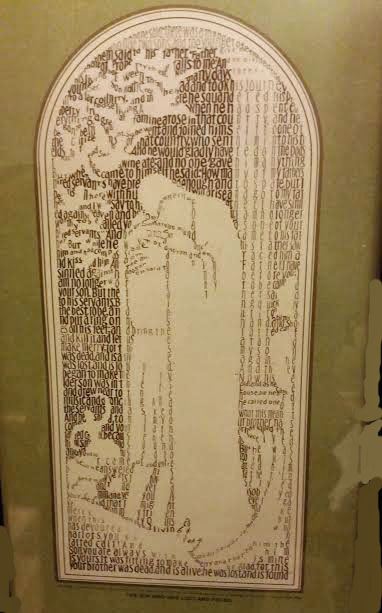
prodialsonI know you can’t read the words that comprise this piece of art. They are from the Gospel according to Luke, chapter 15 verses 11 through 32. My dear wife bought it for me years ago when one of our three sons was lost to us for a time, and then returned. In case you don’t recognize the passage, it is the parable of the prodigal son. Jesus told it ages ago to people gathered around to hear his teachings. These people included tax collectors and sinners. But the Pharisees and other rabbis were there too, listening but not hearing.

“There was a man who had two sons. The younger one said to his father, ‘Father, give me my share of the estate.’ So he divided his property between them. Not long after that, the younger son got together all he had, set off for a distant country and there squandered his wealth in wild living.  After he had spent everything, there was a severe famine in that whole country, and he began to be in need. So he went and hired himself out to a citizen of that country, who sent him to his fields to feed pigs. He longed to fill his stomach with the pods that the pigs were eating, but no one gave him anything.

When he came to his senses, he said, ‘How many of my father’s hired servants have food to spare, and here I am starving to death! I will set out and go back to my father and say to him: Father, I have sinned against heaven and against you. I am no longer worthy to be called your son; make me like one of your hired servants.’ So he got up and went to his father. But while he was still a long way off, his father saw him and was filled with compassion for him; he ran to his son, threw his arms around him and kissed him.

The son said to him, ‘Father, I have sinned against heaven and against you. I am no longer worthy to be called your son.’ But the father said to his servants, ‘Quick! Bring the best robe and put it on him. Put a ring on his finger and sandals on his feet. Bring the fattened calf and kill it. Let’s have a feast and celebrate. For this son of mine was dead and is alive again; he was lost and is found.’ So they began to celebrate.

Meanwhile, the older son was in the field. When he came near the house, he heard music and dancing. So he called one of the servants and asked him what was going on. ‘Your brother has come,’ he replied, ‘and your father has killed the fattened calf because he has him back safe and sound.’

The older brother became angry and refused to go in. So his father went out and pleaded with him. But he answered his father, ‘Look! All these years I’ve been slaving for you and never disobeyed your orders. Yet you never gave me even a young goat so I could celebrate with my friends. But when this son of yours who has squandered your property with prostitutes comes home, you kill the fattened calf for him!’

‘My son,’ the father said, ‘you are always with me, and everything I have is yours. But we had to celebrate and be glad, because this brother of yours was dead and is alive again; he was lost and is found.’”

Imagine, if you will, this modern-day equivalent to the parable.

A man has three sons, one by a previous marriage, the oldest. For personal reasons having had nothing to do with anything done to him by his father, his step-mother or brothers, decided to alienate himself from them and from his very own children as well. He did so for the sake of a new relationship, a new wife. For five long years his family heard nothing from him, save for Christmas cards sent cruelly and disingenuously by his new wife, a jealous and controlling woman. Time passed; hearts grew bitter and resentful. Then, one day, after the son’s new marriage relationship had hit a breaking point, the son reached out to his father, saying that he is sorry and asking for forgiveness.

What did the father do? He did exactly what the prodigal son’s father did. He enthusiastically raced out with open arms to welcome him back.

But the son’s brothers aren’t so anxious to have the elder son back. Neither are the son’s children. They are still hurt. They are angry, and who can blame them? “Don’t trust him,” they say to their father and grandfather. “Consider all that he has done to us, the lies that he has told. He is a drunkard, a thief and a liar. He abandoned us when we most needed him. He must first atone for his behavior.”

But, what does the father say?  He says, “My children, I love you dearly, all of you, and everything I have will be yours someday. But we have to celebrate and be glad, don’t you see? Your brother, my sons, and your father, my grandchildren, was dead to us. But he is alive again. He was lost to us, but now he is found.”

In the parable as told by Jesus, the father represents God, of course – God who loves us all despite our sins. He longs for us to turn away from sin and to come home. But who is the eldest son? Why, he is us, we who are Judgmental and unforgiving – we who would punish the repentant sinner until… until when?

Please feel free to post a comment if you wish.

Published in: on March 2, 2015 at 3:28 pm  Comments (1)  
Tags:

The Spirits World ~ Why We Alcoholics Drink

It’s like what one of my sons recently said, “… a medicine and a poison.”  Yes, it is a medicine, a dependable old chemical friend that provides existential relief. But it’s also a friend that will stab us in the back if we let it.

ManhattanBecause of recent events in my life, and in the lives of certain loved ones, I am reposting this article, this testimony, from over a year ago. In doing so I hope that it might serve as inspiration for all who happen across it and chose to read it. Why? Because I believe that all of us who drink alcohol regularly or frequently, whether alone or socially, and do so because we like how it makes us feel, are, on some level, alcoholics. It’s time for us all to stop equivocating, to know what it is we are doing, to acknowledge our addiction.

I come from a long line of alcoholics. The earliest one that I know about was my maternal great grandfather, Joseph Anderson. Although he held a fairly high station in the Melchizedek Priesthood of the Mormon Church, he imbibed quite often. My mother told me about it. She said that, as a little girl she often stayed with her grandparents and that she overheard her grandmother, her mother and her aunts talking about it. It was a source of considerable family shame.

There was a swing mom told be about hanging from a tall, old cottonwood tree just outside the bedroom window where my mother slept. Her grandpa Joe had hung it there for her, but would sit in it himself at night and sing to himself while drinking his homemade wine. This made a lasting impression on mom. We laughed about it occasionally, mom and me, when we would sit drinking together in her kitchen. Yes, mom taught me well.

The affliction, if we can call it that, seemed to skip over my mother’s mother, although my grandma could gulp down an occasional toddy herself, and do it with considerable aplomb. But mom’s biological father, or so I’ve been told, was not only a heavy drinker, but a drug user as well.

The affliction hit my mom hard. A lifelong heavy drinker like her Aunt Mic before her, another early alcoholic in my family that I know about, her drinking finally took her life. Mom died from a diseased liver.

Mom was married four different times and had several other men in her life; all of them were alcoholics including, I presume, my biological father whom I never had a chance to meet before his death. And then there is me and my siblings, half-brothers and sisters all. But I won’t speak of our lifestyles except to say that I like manhattans best. I like them on the rocks sans the cherry garnish. They are my favorite libation. Libation – now that’s an interesting word – it’s defined as a drink poured out to a deity. Sometimes I will drink two or three manhattans in a day, the first while I am preparing an evening meal for my wife and myself. The last is often left half empty, the first two and a half having put me soundly to sleep. But I never drink when we have our little darling, my great granddaughter with us. Neither will I take more than one drink before driving or drink anything when I think that I might have to drive somewhere. I go days, sometime weeks without drinking anything. And, before my retirement from multiple careers, I never missed a day of work because of my drinking. That means that I’m not really an alcoholic, right? No, that just means that I am a more responsible alcoholic than some.

I know that my drinking, the amount that I drink, is not healthy for me. I know too that it is not healthy for my marriage relationship because it worries my wife. Although my mom was little concerned about how her drinking affected relationships in her life, she knew too that her drinking was not physically healthy. Still, she drank. Still, I drink.  But why? When asked that question, according to my mother, my great grandfather answered, “I just like the way it makes my silly head feel.” But do we who like how it makes us feel like it to death? Yes, often, too often.

What do the Scriptures have to say about drinking? A lot actually, most of it warnings about drinking to excess and drunkenness, like this passage from the Book of Proverbs 20:1, “Wine is a mocker, strong drink a brawler, and whoever is led astray by it is not wise.”  But there are also passages from the Gospels like this one from Mattew 11:18-19, “For John came neither eating nor drinking, and they say, ‘He has a demon.’ The Son of Man came eating and drinking, and they say, ‘Look at him! A glutton and a drunkard, a friend of tax collectors and sinners!’ Yet wisdom is justified by her deeds.” And let’s not forget about the first miracle that Jesus performed, the turning of water into good wine at the Wedding in Cana. According to John 2;1-11, “On the third day there was a wedding at Cana in Galilee, and the mother of Jesus was there. Jesus also was invited to the wedding with his disciples. When the wine ran out, the mother of Jesus said to him, ‘They have no wine.’ And Jesus said to her, ‘Woman, what does this have to do with me? My hour has not yet come.’ His mother said to the servants, ‘Do whatever he tells you.'”

The rub seems to come then, not from the drinking itself but from drinking to excess.

There is a great article that I’ve found in the professional journal, Psychology Today, called, “The Benefits of Addiction: Why Alcoholics Drink.” It restates and confirms that there is a body of evidence recognizing the correlation of alcoholism in successive generations, thus suggesting a genetic component to alcoholism. But it says, “People who believe in the disease theory are dumb. They can’t help it, so we shouldn’t mock them. You see, they don’t have enough human insight to answer the question, ‘Why do alcoholics drink even though it hurts them?’ Other than by positing that they have some inbred disease that compels them to drink, that is.”

Wow! Now that hurts. It says that I can’t blame those who came before me for my affliction. It’s my affliction and I own it.

According to this article, drinkers like me have discovered that the experience of drinking alleviates deep-seated anxieties, anxieties that all of us have about ourselves and about our lives. Some call these anxieties pain. In other words, alcohol provides more than just a temporary camaraderie to alcoholics. It’s like what one of my sons recently said, “… a medicine and a poison.”  Yes, it is a medicine, a dependable old chemical friend that provides existential relief. But it’s also a friend that will stab us in the back if we let it — a friend that could eventually kill us either softly or roughly. From this friend we derive psychological benefits which are hard to relinquish. This is why those of us with the affliction, whether genetically predisposed to or conditioned to by association or experimentation, find it hard to walk away from. The worst of it for us, the afflicted, is that when stress in our lives becomes severe, we will often turn to it in excess.

One last quote from the referenced article: “People who have learned to allay their anxieties and fears, to feel good — or at least okay — about themselves while intoxicated, to gain some sense of control that they otherwise are bereft of — well, those are hard people to persuade to give up the bottle. Which is what AA and the 12 steps are selling — “Step over to the sunny side of the street where I live — it’s much better here.”

Please feel free to leave a comment to this posting. I would enjoy dialoging on the subject.

Published in: on February 26, 2015 at 10:53 am  Comments (5)  
Tags: , , ,

The Difference Between One’s Spirit and One’s Soul

My little darling wiped her tears away on her sleeve. She hugged me and repeated what I had said, “You will never leave me, Opa.” Then she said, “You will always be in my heart.”

newmeWhat is the difference between a spirit and a soul? Do human beings possess a soul while other living creatures do not?  I’ll tell you the truth. I don’t rightly know. Even though I have studied Scriptural passages about this, I remain a bit confused. Nevertheless, I can tell you what I have chosen to believe. I believe that human beings have a spirit, but we are not spirits. Animals too, I believe, whether they have a soul or not, have spirits. Surely they do. They have personalities, do they not? Have you not heard of a spirited horse? Have you not enjoyed the company of a friendly pet, or been worried by a bad tempered dog?

In humans, according to Scripture, the soul and the spirit are connected, but separable (Hebrews 4:12). The soul is who we are, that which lives on apart from our physical selves. The spirit is the nature of our soul, what some call our heart – as in tender hearted or hard hearted.

What does it mean then to be spiritual?

Spiritual, I believe, is the adjective form of the word, “spirit,” which is a noun. The word “character” could serve as a good synonym. It is almost always used, however, in reference to what people believe beyond the secular, the scientific, the physical world.

According to the New Testament,  only believers are said to be spiritually alive (1 Corinthians 2:11;Hebrews 4:12;James 2:26), while unbelievers are spiritually dead (Ephesians 2:1-5;Colossians 2:13). In Paul’s writing, the spiritual was pivotal to the life of the believer (1 Corinthians 2:14;3:1;Ephesians 1:3;5:19;Colossians 1:9;3:16). The spirit is the element in humanity which gives us the ability to have an intimate relationship with God. But (John 4:24) confuses things, I think, by calling God himself a spirit.

The word “soul” can refer to both the immaterial and material aspects of humanity. Unlike human beings having a spirit, human beings are souls. In its most basic sense, the word “soul” means “life.” But  beyond this essential meaning, the Bible speaks of the soul in many contexts. One of these is humanity’s eagerness to sin (Luke 12:26). Humanity is naturally evil, and our souls are tainted as a result.

A few months ago, while we were walking together hand-in-hand, my darling little great granddaughter started weeping after she told me that she loves me. I asked her what was wrong. She said that her mommy had told her that I was getting old – that someday I would die. “I’m really going to miss you when you die, Opa,” she said.

I stopped, got down on my good knee, the one that God gave me, took her little hands in mine and said to her, “Honey, someday I will die, yes. But I’m never going to leave you.”

“How can that be, Opa?”

“I will live on forever in your heart, sweetheart. As long as you remember me and the things that we have talked about , the things that I am teaching you, I will be alive in the most important way. Our love will survive, and our love is the best part of us.”

My little darling wiped her tears away on her sleeve. She hugged me and repeated what I had said, “You will never leave me, Opa.” Then she said, “You will always be in my heart.”

From a child and from what I wanted her to believe, I discovered what I believe about the difference between one’s soul and one’s spirit. Our exchange as we walked that day is what led me to research what the Scriptures say about it. So my soul may go to heaven when I die, and my spirit will go with me. But my spirit will live on too in the memories of those who will have known me while I still had a physical life.

Whether you believe as I do or not, please feel free to leave me a comment about this. 

Published in: on February 24, 2015 at 9:01 am  Comments (4)  
Tags: , ,

Generosity ~ A Spiritual Gift

Maybe a ten percent tithe for some of us isn’t really so extravagant at all. Maybe those of us who are richly blessed and have the Spiritual Gift of Generosity need to re-prioritize our giving – dig a little deeper. Maybe some of us who are richly blessed need to cultivate this Spiritual Gift.

After finding out that someone had nominated me to serve on the Stewardship Committee at my church, I thought – What is it about me that someone thinks would qualify me for this ministry? Without an answer to that question yet, I went ahead and said, yes, anyway when I was asked because I had told my pastor that I was willing to serve in whatever capacity the nominations committee thought appropriate. Subsequently, I felt called to sign up to teach in my adult Sunday school class on the subject of generosity. Maybe that was a coincidence, maybe not. But something was stirring within me about the subject.

I agreed to go to a leadership training program a couple of Sundays before scheduled to teach my lesson. There, I signed up for the finance breakout session following the keynote address. It was the closest thing to stewardship and, as it turned out, it was what everyone in group wanted to talk about. After an excellent presentation on budgeting and auditing, the lecturer asked if there were any questions. One man raised his hand then stood to ask, “Are there any here whose churches are not struggling with finances?” Silence. Every United Methodist church represented in the Dallas Metro District that day was struggling. The first question was: Why? The next was: What can we do about it? Answers to the first question came from others; all I could do was sit and listen; I had no clue. One man said, “I think it’s because church attendance is down.” Another said, “I think it’s because all the generous givers are dying off.”

I considered all that I had heard that day, then I started preparing for my Sunday school lesson. I ignored the chapter in our study guide book, Five Practices of Fruitful Congregations. It mostly talked about why we should all tithe according to Scripture passages from the Old Testament.  That whole idea seemed out of date to me — judgmental. I prepared a PowerPoint presentation to guide and facilitate discussion on generosity. I was prepared, I thought. But just before teaching, I told our pastor what I was planning to teach. He told me to tell my class that generosity is a Spiritual Gift. Hmmm, I thought. I had not heard that idea before, and I almost considered not showing my PowerPoint at all, but basing the lesson entirely on that one idea, that generosity is a Spiritual Gift. If that were true, I thought, since giving is less than it once was, is the current generation spiritually deprived? And, if so, why?

What are Spiritual Gifts? I knew on the spot that I had to talk about that. I had to talk about it because my pastor was right. We need to know the role that each of us has to play in the financial work of the Kingdom. While all of us are called to give, God has ordained some people to be super-givers. Check out this passage from Romans 12:6-8, which deals with spiritual gifts in the church:

We have different gifts, according to the grace given to each of us. If your gift is prophesying, then prophesy in accordance with your faith; if it is serving, then serve; if it is teaching, then teach; if it is to encourage, then give encouragement; if it is giving, then give generously; if it is to lead, do it diligently; if it is to show mercy, do it cheerfully.

Many of the things that Paul lists in this passage are spiritual gifts that we are well familiar with: Some people are gifted in prophecy, others in serving, others in teaching, others in encouraging, etc. In fact, you may have spent time in your church or on your own studying these spiritual gifts, trying to determine which of them is most active in your life. But did you notice, hidden in the middle of verse 8, the scripture mentions generosity? “If it is giving,” the passage says, “then give generously.” Wow.

I went ahead with using my PowerPoint, intending to weave into the presentation the idea that generosity is a Spiritual Gift. My first slide listed the Chapters in our study guide book and the title of the day’s lesson. I announced that I was departing from the study guide approach to the subject.

  • The Practice of Radical Hospitality
  • The Practice of Passionate Worship
  • The Practice of Intentional Faith Development
  • The Practice of Risk Taking Mission and Service
  • The Practice of Extravagant Generosity
  • Excellence and Fruitfulness

My next slide was this, the definition of extravagant.

ikˈstravəɡənt/

Adjective

  • Lacking restraint in spending money or using resources.
  • costing too much money.
  • exceeding what is reasonable or appropriate; absurd.

My next slide simply asked the question: What is the most extravagant thing that you’ve ever done concerning money? Everyone who responded to the question mentioned things that they had done for themselves… expensive cars, ocean voyages. I was thinking about the money I gave to my church years ago to create a quite garden for people to rest in, to meditate in, to pray in. I called it the Grandmothers’ Garden, dedicating it to the memory of my own dear grandmother. Why? I thought. Why do I remember something that I had given away rather than something I had purchased for myself? I don’t know the answer. But, in all humility, I suspect it’s because I am part of that generation of generous givers that gentleman in the finance class I sat in on mentioned. Others in my class are younger than me. They are very much in the Baby Boomer generation. Not to brag, but I barley made the cut; having been born before the end of WWII, I’m officially part of the Mature/Silent generation – the Greatest Generation.

The following information, part of which I shared with my class, comes from Dr. Jill Novak from the University of Arizona and Texas A&M. Here is a link to the information which appears at the Marketing Teacher.com website. The URL is: http://www.marketingteacher.com/the-six-living-generations-in-america/ Mind you, the following do not describe everyone in the two oldest living generations. The characterizations are general in nature according to Dr. Novak.

Mature/Silents, born 1927- 1945, went through their formative years during an era of suffocating conformity, but also during the postwar happiness: Peace! Jobs! Suburbs! Television! Rock ‘n Roll! Cars! Playboy Magazine! Mature/Silent men pledged loyalty to the corporation, once you got a job, you generally kept it for life. And they are the richest, most free-spending retirees in history. They have a strong sense of trans-generational common values and near-absolute truths. They are disciplined, self-sacrificing, and cautious as well.

Baby Boomers, born between 1946 and 1964, come in two sub-sets: 1. the save-the-world revolutionaries of the ’60s and ’70s; and, 2. the party-hardy career climbers (Yuppies) of the ’70s/’80s. These are the “me” generation. They tend to be self-righteous and self-centered. They have bought it now and they used credit to do it. They’re also too busy for much neighborly involvement, yet strong desires to reset or change the common values for the good of all. They want change, but aren’t so keen on changing themselves.

Even though their mothers were generally housewives, responsible for all child-rearing, women of this generation began working outside the home in record numbers, thereby changing the entire nation as this was the first generation to have their own children raised in a two-income household where mom was not omnipresent.

The aging of Baby Boomers will change America almost incomprehensibly; they are the first generation to use the word “retirement” to mean being able to enjoy life after the children have left home. Instead of sitting in a rocking chair, they go skydiving, exercise and take up hobbies, which increases their longevity. The American Youth Culture that began with them is now ending with them and their activism is beginning to re-emerge.

Yes, the Great Givers are a dying breed.

My next slide quoted Scripture – Matthew 6:21: For where your treasure is, your heart will be also. I asked my class what it is that they most love about our church. Almost everyone said that they love our Sunday school class best. One lady said, “Our great missions program.” Had I been asked, I told the class, I’d have said, all the opportunities that the church affords to be in service to others: The Caregiving Ministry that I lead, The Children’s Program that our little great granddaughter derives so much from, The Helping Hands Ministry, The Handy Man’s Ministry, The United Methodist Men and The United Methodist Women. But then, others in my Sunday school class, though engaged in many different missions and ministries, are mostly Baby Boomers, the Me Generation.

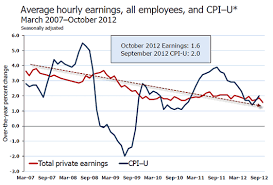
My next slide addressed the dual problem of a rising cost of living while the disposable income in most households has long been on a downward trend. Yes, the Consumer Price Index – Unchained has been up and down, the chained index has gone up and up with the costs of education and healthcare skyrocketing. Why is this? As a retired teacher of economics I can tell you that the unchained index reflects actual spending – the substitution phenomena.  When people have less disposable income, they spend less or substitute preferred goods and services for something else.

hourlyearning

It’s like the elderly halving their prescribed medications, cutting their pills in-half to make them last longer, this so that they can afford to eat too. It is true that many in our society today are struggling. So I was not surprised when one of the ladies in my class shared that she knows her married daughter and her daughter’s husband have to squeeze hard to be able to afford giving the church just fifty dollars a month. Forget about tithing. Giving ten percent of their disposable income would mean they couldn’t afford to put gas in their cars to get back and forth to their jobs.

So, it becomes clear why many churches are struggling financially in today’s world. It is clear too that they will struggle more and more in future years, at least until the economy improves for the middle class. In the meantime, what are we to do? Well, I suggest that those of us who are blessed with more will need to give more. Maybe a ten percent tithe for some of us isn’t really so extravagant at all. Maybe those of us who are richly blessed and have the Spiritual Gift of Generosity need to re-prioritize our giving – dig a little deeper. Maybe some of us who are richly blessed need to cultivate this Spiritual Gift. After all,

Each one must give as he has decided in his heart, not reluctantly or under compulsion, for God loves a cheerful giver.

~ 2 Corinthians 9:7

Published in: on February 20, 2015 at 2:14 pm  Leave a Comment  

Why One Pink Candle ~ A Caring Ministry Story for Advent

But when I got to this part of the story for my care receiver, something caused me to substitute hope instead of joy for what the pink candle symbolizes. It wasn’t planned, but in that moment, it was intentional.

advent_wreathI am both honored and blessed to be a member of the lay Caring Ministry team at our church, First United Methodist in Duncanville, Texas. As it turns out, I frequently teach Adult Sunday School lessons too and recently taught the first of a five part Advent Study. Advent, if you don’t already know, is the first holy season of the Christian year, the four weeks preceding Christmas Day. For the lesson, I had used Reverend Adam Hamilton’s book, “Not a Silent Night,” as a guide.

Visiting a fellow church member who is in a rehabilitation center, I had occasion to reflect upon and to share again part of what I had taught in Sunday School. The man I was visiting, by the way, knows that he will never fully recover from his illness – that his remaining days are few.

I asked my care receiver, a man somewhat older than myself, his wife and his sister who were also present, whether they knew the significance of the traditional Advent wreath. The sister answered first, “Well, it has four candles on a bed of greens – no, five,” she said, “counting the big candle in the center. One is lit each Sunday before Christmas, when the big white one in the center, the Christ Candle, is lit.”

“Yes,” I said, “Very good. But what do the colors of the candles represent, why is one of them pink?” — Silence. The three seemed to be searching their memories. Then the man’s wife said, “Oh, dear. I know I’ve heard this before – maybe many times.”

When I was preparing for my Sunday School lesson, I explained, I was sure that I had heard about it too. But I just couldn’t recall. So I did some research. The Advent wreath, I learned, was first used as a Christian devotion in the Middle Ages. Its design came from the customs of pre-Christian Germanic and Scandinavian cultures. Candles and greenery are symbols for light and life during winter. The wreath is a circle of evergreen boughs symbolizing renewal. The candles, usually three purple but sometimes blue, one pink or rose, and one white, symbolize the light of Christ coming into the world. The candle colors are derived from the traditional liturgical colors, purple for royalty and white for Christ’s purity. But why the one pink one?

My research revealed something that I’m sure I had never heard about before. Originally, long before Advent was added to the Christian calendar, there was only one holy season: Lent. But it wasn’t celebrated as it is now with prayer, introspection and fasting for forty days, I explained. Originally, the faithful were expected to fast for a full seven weeks! This surprised everyone.

Although there are different accounts according to different traditions that explain just how this came about, the one I like is this: After a time, realizing that seven weeks of fasting was just too much to expect of people, church leaders took pity on their flocks. They designated the third week of Lent to be a week of joy and hope. The fasting was suspended for this one week of Lent and the Pope began a tradition of incorporating a pink rose, a symbol for joy, awarding it to someone when saying mass. Other church leaders began wearing pink vestments during this special time.

When Advent was later added to the Christian calendar and Advent wreaths became part of the celebration of mass during this special time of year, the tradition of the third week being devoted to joy was carried over from the ancient Lenten tradition. And that is why the candle lit on the third week of Advent is pink in color. But when I got to this part of the story for my care receiver, something caused me to substitute hope instead of joy for what the pink candle symbolizes. It wasn’t planned, but in that moment, it was intentional. Knowing that my care receiver needed to hear about hope more than joy, I felt inspired to modify the story just this little bit. I choose to believe that the inspiration I felt was from the Holy Spirit.

Later, after sharing communion elements that had previously been consecrated by our pastor, we all held hands and prayed. Closing with Amen and opening my eyes, I knew that my care receiver had heard exactly what he had needed to hear. Though his eyes were filled with tears, his face glowed with the hope he now felt.

Please feel free to post a comment.

Published in: on November 18, 2014 at 8:51 am  Leave a Comment  
Tags: ,

The Social Contract ~ Why We Have Government

Private enterprise cares nothing about the poor! This is so abundantly clear to me; opportunity does not, never has, and never will trickle down from the good fortune of the few. 

It puzzles me why so many don’t get it, that government is not the problem as President Ronald Reagan suggested. As it is today, it certainly isn’t the whole solution. But to the extent that it is not the solution, we have only ourselves to blame. We have allowed the money changers to gain control of it.

These are words that people have come up with to describe what is meant by a social contract, one like that which we are all part of by being citizens living under the Constitution of the United States.

20130802-123052.jpg
Private enterprise cares nothing about the poor! This is so abundantly clear to me; opportunity does not, never has, and never will trickle down from the good fortune of the few. It is from us, the workers and consumers in this country, more than from their own efforts, that the privileged few owe their good fortune.

Government is not only the guarantor and protector of the social contract, it is the facilitator and arbiter as well. If you doubt this, read the Preamble to the Constitution — again.

Yes, there are a “thousand points of light,” as George Herbert Walker Bush proclaimed. But left to these alone, to individuals, benevolent corporations, churches and private charities, to help the less fortunate, millions more would be standing at road intersections with cardboard signs begging. Millions more would be living in shanty towns again. And how many of us stop to offer aid to those who are already begging? No, government is the most efficient way to alleviate suffering and to build scaffolds for the disadvantaged, perchance to restore the middle class. Government compels us to do our part, to contribute to the general welfare, to do our civic duty.

By all means, continue giving to churches and private charities. But “Render unto Ceasar” as well, for ours is a very different Ceasar from the government that was ancient Rome. Ours, if we choose to let it be, has been elightened by history, by great thinkers, and by religious teachers. Ours has been inspired by great leaders such as Washington, Jefferson, Adams, Lincoln, Roosevelt (both of them), Eisenhower, Kennedy and yes, the Reverend Doctor King. We need merely to drive the money changers out of Washington as Christ did to the money changers long ago in the temple of Jerusalem. He did this as an example for us.

Please feel free, whether you agree or not, to leave a comment in response to this posting.

Published in: on August 2, 2013 at 10:31 am  Comments (4)  

Angels’ Wings ~ A Safe Bet

Me to my little darling who wanted to play outside last night on the golf course after dinner: “Put your shoes on, honey. We don’t want you get your feet hurt out there.”

My little darling to me after walking to the sand trap behind our house: “Opa, I can take my shoes off to play in the sand, yes?”

Me to my little darling, looking over my shoulder to make sure no golfers were teaing-up three hundred yards away: “Yes, honey. But come with me out of the way quickly as soon as I say.”

My little darling to me: “Okay, Opa.”

It was pretty late, so I anticipated that there would be no more golfers on this particular fairway.

My little darling to me after burying her feet in the warm sand an squiggling her toes for several moments: “Opa, why don’t angels wear shoes?”

Me to my little darling, said with a big smile: “Because angels, heavenly angels, have wings, honey. They can’t be hurt, not physically. Earth bound angels like you, however, can be hurt when they step on sharp things.”

My little darling to me: “Will I get wings after I die?”

Me to my little darling: “I’d bet money on it, honey.”

Published in: on July 30, 2013 at 7:54 pm  Leave a Comment  

Lies About Obama ~ Character Assassination in Politics These Days

Some people refuse to consider facts after they’ve made up their minds. These people are called conservatives.

Opa_IIThings really really haven’t changed much in politics over the years, except that they have become more virulent with the advent of electronic media.  One of the few things Charles Krauthammer has said that I agree with is this: “Every two years the American politics industry fills the airwaves with the most virulent, scurrilous, wall-to-wall character assassination of nearly every political practitioner in the country — and then declares itself puzzled that America has lost trust in its politicians.”

All politicians lie, or at least they get their facts wrong from time to time. But according to a new study from the nonpartisan Center for Media and Public Affairs at George Mason University, Republican politicians are significantly more likely to lie than Democrats http://www.nationalmemo.com/republicans-lie-more-than-democrats-study-finds/. And those who vote for Republican candidates are more prone to believe their lies — confirmation bias. This is because conservatives think conservatively; they are more resistent to change and chalenges to their beliefs, or so the study’s authors say.

Giving credit where credit is due, I borrowed the portion of this post that follows which is in quotes. I borrowed it from a Facebook post that showed up on my news feed. It, in turn, had obviously been borrowed (there’s a lot of this going on in social media these days) from another Internet source; I had to do considerable text and spacing clean ups plus grammar edits before I could use it. Attempting to discover the original source, I did a text string Google search. This led me to http://first-thoughts.org/on/President+Obama/. But the original author’s thought, if in-deed this was the original author, was anonymous.  Therefore, my thanks to whomever it was that first put this together. Yours truly provided the reference links checking the liberal facts.

Conservative: Obama is not an American so he’s not fit to be president.

Liberal: The Supreme Court, and EVERY investigative Congressional body in charge of determining a president’s eligibility, has said that he IS an American… and eligible. http://www.factcheck.org/2011/04/indeed-born-in-the-u-s-a/

Conservative: Well… he’s a socialist and he wants to redistribute the wealth.

Liberal: Taxes have been the way wealth has been redistributed ever since taxes first started in this country — before Obama was even born. Redistribution is a common American practice. http://www.infoplease.com/ipa/A0005921.html

Conservative: Well… he’s a Muslim and shouldn’t be president.

Liberal: A person’s religion has no bearing on their eligibility for president, according to the Constitution, and in any case – President Obama is a professing believer in Jesus Christ. http://www.politifact.com/truth-o-meter/statements/2010/aug/26/18-percent-american-public/obama-muslim-no-hes-not-evidence-has-not-changed/

Conservative: Well… he’s ungodly because he supports a woman’s right to choose and because he supports gay marriage.

Liberal: The Supreme Court ruled that abortion is legal and gay marriage is considered a civil right now in several states… and since he swore before God and men to support and defend the Constitution (not the Bible), he has a legal and moral obligation to support these things. http://www.factcheck.org/2010/04/the-abortion-issue/

Conservative: Well… his Obamacare is gonna destroy America by raising health care costs through the roof.

Liberal: Actually, the states that have accepted the tenants of the Affordable Care Act have seen SIGNIFICANT decreases in health care costs, and costs are going to fall even more as the ACA expands according to the CBO. http://www.forbes.com/sites/rickungar/2013/05/24/unexpected-health-insurance-rate-shock-california-obamacare-insurance-exchange-announces-premium-rates/

Conservative: Well… he is exploding the size of government.

Liberal: Actually, the size of government is smaller under Obama than it has been in about 20 years… and it is getting smaller. http://www.nytimes.com/2012/05/05/business/economy/government-is-getting-smaller-in-the-us-off-the-charts.html?_r=0

Conservative: Well… he has exploded the deficit and spent more money than any other president.

Liberal: Actually, Obama has spent the LEAST of any president since Eisenhower and has already decreased the deficit by about $300 billion and, since the start of fiscal year 2011, President Barack Obama has signed into law approximately $2.4 trillion in deficit reduction for the years 2013 through 2022. http://thinkprogress.org/economy/2013/01/22/515537/obama-spending-eisenhower/?mobile=nc

Conservative: Well… he’s responsible for a cover up in Benghazi.

Liberal: There was no cover up in Benghazi… So far there have been six Congressional Investigations and none of them have found anything that is even close to a cover up… except some Republicans who changed the talking points in the emails that they accused Obama of changing – In any case, Benghazi was a CIA Outpost… not a state department operation. The CIA had operational jurisdiction… it was THEIR call what went out to the public in the talking points.  http://www.politicususa.com/republican-desperation-grows-benghazi-backfires-scandal-talk-fizzles.html

Conservative: Well… he’s responsible for the IRS cover up.

Liberal: Actually, there was no cover up. The State Department has had the IRS under Investigation for their illegal activity since 2012… and the Republican Congressmen who are accusing Obama of a cover up were aware of it because they were Informed in 2012.  http://www.politicususa.com/republicans-suggested-irs-cover-up-turns-darrell-issa-knew-2012.html

Conservative: Well… Obama was illegally investigating the media for leaks of Confidential information.

Liberal: Actually, it was the Republican controlled House of Representatives that DEMANDED the investigation into media leaks that were endangering national security, this after accusing Obama of allowing the media to perpetrate the leaks.  http://www.mediabistro.com/fishbowlny/morning-media-newsfeed-obama-troubled-by-leak-four-bidding-on-hulu-martin-joins-nyt_b83301

Conservative: Well… IMPEACH OBAMA!”

I invite your comments on this post whether you agree with it or not.

Published in: on May 31, 2013 at 9:59 am  Comments (7)  
Tags: , ,

Small World ~ Big Circles

Everyone was aghast at the strangeness of the coincidence — that half a world away we should encounter someone that, unknown to us before, would have known the same someone else.

Opa_IIMay 28, 2013 — My wife and I met Greg Kahn only a couple of different times, and then only briefly. We did not know him well, but he impressed us both most favorably. My wife may have a different memory, but what I remember most about him was his beautiful smile and genuine personal warmth.

Greg was only forty-five when he died suddenly, unexpectedly, in his hotel room in Hong Kong to where he had traveled the day before on business.

We saw Greg last in Bali, Indonesia on the occasion of our son’s most fantastic wedding celebration. On our way back home to Texas after this, I remember thinking how fortunate our son and his wife are to have friends like Greg. We grieve now for them and with all who knew and loved Greg — knowing how great is their loss.

We have learned more about Greg since his passing, most recently, just last night when we visited with a neighbor, Doris Wilson, who had just lost her own husband to a long and debilitating illness. Doris was surrounded in her home when we got there by several family members who had traveled considerable distances to comfort her. We visited for a while, sharing our memories of her husbad. Then, as we prepared to leave, I encouraged our neighbor to accept our next dinner invitation; she had not felt free to accept previous invitations we had made while her husband was still alive but too ill to accompany her. I made a point of suggesting that we might want to get together one night when or son and his wife will be visiting us soon from Singapore. But my wife opined that this might not be such a good idea because of the recent loss of their friend, Greg. We won’t know what mood they will be in — whether they will be comfortable socializing with folks they don’t know.

“Greg? Singapore?” Our neighbor asked. “Are you talking about Greg Kahn?”

“Why, yes,” my wife answered with considerable surprise.

“Craig,” our neighbor called out to her adult son who was in another room. “Come in here please. The Garry’s knew your friend, Greg.”

Everyone was aghast at the strangeness of the coincidence — that half a world away we should encounter someone that, unknown to us before, would have known the same someone else. The odds are — well, beyond calculation.

For the next half hour or more we listened to Craig Wilson tell us about his good friend, Greg. I see that Craig has posted his own remembrance story on Greg’s memorial web site. I encourage you to read it. http://kahnspiracy.com/the-great-great-greg-kahn/

So, for us the lesson in this story is that this big world of ours isn’t really so big after all; that big circles of friendship like Greg’s and Craig’s eventually intersect with our smaller circles. For me, it makes statistical probabilities less likely and the idea that God puts people in our paths for His own good reasons more likely ~ Luke 10: 29 – 37.

Rest in peace, Greg Kahn.

Published in: on May 28, 2013 at 2:46 pm  Comments (3)