Liberal vs. Conservative ~ Democrat vs. Republican

Updated from my original publication (Dec 31, 2006)

As a former social studies teacher, I was often asked by my students what the real difference is between Democrats and Republicans. They seemed to sense that parents and other authority figures extol the virtues of one political party, the one to which they subscribe, and vilify the other.  Accordingly, I attempted to teach the subject in as balanced a manner as possible.
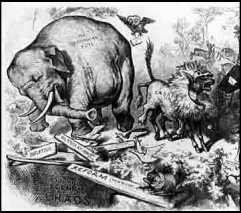
Symbols of American Political PartiesAll of what follows, save for my own observations, is readily available elsewhere on the Internet.  However, I’ve not been able to find a good, unbiased site that compares and contrasts the two major political parties in the United States today.  I shall endeavor to do so.

Political parties exist for the singular purpose of installing people to positions of power and influence in government.  It is the same all over the world and has always been so.  To do this they compete with the opposition for support of the electorate by inciting passion over issues of the time.  Whether the issues have to do with the economy, national security, individual liberties, the environment, Constitutional interpretations, or matters of moral and social conscience, parties stake claim to various convictions then pretend, as necessary, that they have always been philosophically faithful to their positions.  But this is done more often than not to simply gain support in terms of dollars and votes for their own candidates.  Additionally, many people are attracted to particular parties over single wedge-issues like abortion or gun control and discount other party positions.  So the association of any party over time with a particular political philosophy is problematic at best.  Follow along and see if you don’t agree.

The Democratic Party, claiming a position on the left of the political theory continuum, has been labeled “liberal,” both by supporters and detractors alike.  The name is derived from the Latin, liber, which means free.  And until the end of the eighteenth century, it simply meant “worthy of a free man”.  It is from this sense of the word that we speak of “liberal arts”, “liberal sciences”, “liberal occupations”, etc.  Then, beginning in the early part of the nineteenth century, the term came to imply the qualities of intellect and behavior that were considered to be characteristic of those who occupied higher social positions, whether because of wealth, education, or family relationships.  Thus, an intellectually independent, broad-minded, magnanimous, frank, open, and genial person was said to be liberal.  The suffix, “ism,” added to descriptive words produces nouns that mean a belief, an ideology, or study, as to be immersed in.  “Liberalism” then connotes a political system or tendency that is opposed to centralization and absolutism.  However, the word liberal is generally used in a derogatory way today by those who subscribe to more conservative philosophies.  For them, a liberal is someone who believes in big government and wasteful, giveaway social programs (background/definition).

Most who have political persuasions to the right on the political theory continuum label themselves, “conservative.”  According to Webster, being conservative means a tendency to conserve or to hold back.  But this understanding of the term does not necessarily apply to all who consider themselves to be Republicans today.  Since the end of the Civil War in America, conservatives have tended toward resisting change and preserving established institutions.  Thus, a conservative person would be one who would tend to be more moderate or cautious.  But it was Republicans, as we all recall, who brought about the end to slavery in America though the Civil War years and the adoption of the 13th, 14th, and 15th Amendments during Reconstruction – this was major social change (background/definition and History of the Republican Party)!

The Republican Party today attracts many different groups, including sportsmen and other gun owners who consider their right to bear arms to be under attack, business corporations (particularly defense, energy, and pharmaceutical industries) and wealthy individuals who benefit from limiting social programs, limiting regulations, and reduced taxes, as well as various fundamental or evangelical Christian groups who are lobbying for social change. Although some may argue that this is not true, the Tea Party, never a viable political party in it’s own right, and Libertarian politicians who once ran for office under the Libertarian Party banner, have now merged with the main stream Republican Party.

The Republican Party had its roots in opposition to slavery when, in 1854, former members of the Free Soil Party, the Whig Party, the American Party, and some Democrats came together in opposition to the Kansas-Nebraska Act, which would have allowed these territories to enter the Union as slave states.  Party founders adopted the name “Republican” to indicate that it was the carrier of “republican” beliefs about civic virtue, and opposition to aristocracy and corruption (History of the Republican Party, Republican Party Today, and Reconstruction Period).

In western democracies the terms, “conservative” and “right-wing” are often used interchangeably, as near-synonyms.  This is not always accurate, but it has more than incidental validity.  The political opposition is referred to as the political left (although left-wing groups and individuals may have conservative social and/or cultural attitudes, they are not generally accepted, by self-identified conservatives, as being part of the same movement).  On economic policy, conservatives and the right generally support the free market and side with business interests over rank-and-file workers and environmentalists.  This is less true of conservatives in Europe and in places other than the United States.  Attitudes on some moral issues, such as opposition to abortion, same-sex marriage, and euthanasia, are often described as being either right-wing or conservative.  Liberals, on the other hand, have traditionally drawn much of their support from labor unions, small farmers, civil servants, environmentalists, artisans, academics, philanthropists, immigrants and such – the “huddled masses”.  Collectively, liberals pretty much agree today that government should be a force for social change, to improve the lot of the disadvantaged and to protect the individual rights of all Americans, regardless of their race, sex, ethnicity, or sexual orientation.  Liberals would tend to agree that all should have affordable access to quality education and health care (Right-wing, Left-wing).

The Democratic Party in the United States traces its roots back to the early 1790s, when various factions united in opposition to Alexander Hamilton’s fiscal policies, which included a strong central treasury and new taxes to pay-off the states’ debts. Back then it was called the Anti-Administration Party, its subscribers were called Anti-Federalists.  For a time, this movement was added to other minor parties to form the Democratic-Republican Party under Thomas Jefferson.  Yes, in some ways, if not in name only, the two major political parties of America were combined. Then, after the War of 1812, the party split over whether to build and maintain a strong military.  Those favoring a strong military, especially a modern navy, came to be called the Old-Republicans.  Then, during the administration of Andrew Jackson, the Democratic Party was reborn, appealing, as had Jefferson’s Democratic-Republican Party, to the largely agrarian society of the times and to the common man.  At that time, the Old Republicans strongly favored states rights, while Jackson, even though he was a Southerner, put down the Nullification Crisis which threatened to divide the nation – North and South (History of the Democratic Party).

So, the distinction between liberal and conservative political philosophies and the Democratic and Republican parties in the United States, over time tends, to blur. Philosophies and allegiances have switched back and forth over the years.  For example, after the Civil War, most whites in the South became Democrats (Southern Democrats), known then unofficially as the “White Man’s Party“.  Then, following the signing of the Civil Rights Act of 1964, many of these Democrats switched over to support Republican candidates.

And so it goes; political parties come and go. Sometimes the names stay the same, but the philosophies and respective positions on issues change according to the winds of war and fortune.  As I tell my students, it is impossible to separate politics from economics.  It’s all about power and influence.

For the latest on what U.S. political parties and individual candidates believe, see http://www.ontheissues.org/Quiz/Quiz2010.asp#sec0. At this site you may also test yourself and your beliefs to determine your closest party match.

For more on what I personally believe and how political parties have performed in recent years, see Americans’ Political Persuasions ~  Based More on Myth than Fact?

I invite your comments whether pro and con.

Published in: on December 31, 2006 at 3:36 pm  Comments (101)  
Tags: , , , , ,

Reaching for the Highest Rung

I encourage all of my students to stay in school and to reach for the highest rung on the economic ladder, and to do so not just for their own sakes.

Having spent many weeks learning about physical geography this school year, my students and I have just completed a series of lessons on human geography.   This includes the studies of culture, population, government, urbanization, and economics.  I wish that we had had more time for this — we just barely skimmed the surface.  But alas, we had to move on so that we can cover our full curriculum this year.  Now we have begun to explore the world, region-by-region, beginning with the United States and Canada.  Oh, how I love my job…

One of the more difficult concepts in human geography for my students to grasp seemed to be the various levels of economic activity that take place in a market economy such as ours.  These levels are: primary, the basic harvesting of resources, which includes farming, ranching, fishing and such; secondary, the making of things from the harvested resources to include the processing of food; tertiary, the services that are necessary to enable and sustain the other levels, and; quaternary, information management and research.  I tried to impress upon my students how important will be the tertiary activities in their futures, that most of them will in fact be employed providing services of various kinds to individuals and businesses.  I also tried to impress upon them the fact that the fourth level, quaternary, is where real prosperity is to be found for themselves and for all of us. 

Innovation — that’s where the real payoff is going to be.  If we’re going to stay economically ahead of our competition in this increasingly competitive world of ours, we’re going to have to stay ahead literally with new ideas and new technologies.  And this will require a whole new generation of highly-educated, highly-motivated young people. 

With all our ongoing challenges, the war on terror, global warming, illegal immigration, deficit spending, an aging population, ethics scandals, and lawmakers who spend more time and effort getting re-elected than making tough choices, America’s going to have to be even more creative and forward thinking than ever before.  If we’re going to survive as a people, we’re going to have to start pulling together.  Lo, some would say that we’re going to have to start pulling together as a world, not just as separate nations, if we’re going to survive as a species.  So, I encourage all my students to stay in school and to reach for the highest rung on the economic ladder, and not just for their own sakes.

Somehow our textbook publisher failed to include the word, altruism, in the many lists of Places and Terms to know about in the study of human geography.  I’ll have to remember to correct that oversight.

My Libertarian son will probably disagree with this, but I also think that, if we’re going to survive and thrive in the competition presented by this growing global economy of ours, we’re going to have to start worrying about more than just the bottom-line.  Corporations are going to have to start thinking globally (not just internationally), long-term and “out-of-the-box.”  I think too that we are excessively rewarding CEOs and others in high manage- ment positions in this country based on quarterly profits and stock values.  We put stockholders’ interests ahead of our employees, and this motivates the kind of behavior that results in Worldcom and Enron debacles.  And, as my other, more liberal-minded son might say, when the private sector fails to make the better choices for the greater good, government needs to be willing and able to step-in with incentives of various kinds.  It cannot do this, however, when it is joined at the hip with industry.

Case in-point, there’s been lots of talk here in Texas recently about TXU’s proposal to build eleven new coal-fired electricity plants in the near future and how the state’s local and regional leadership are all united in opposition owing to the increased pollution that will ensue.  Governor Perry, siding with the energy industry, is all for it saying that Texas can’t afford to be without the energy that these plants will produce in the future to sustain our economic growth.  His Democratic challenger, Chris Bell, and all the big-city mayors in the state are saying that we can afford even less to build these plants without using the latest technology, coal gasification.  Of course, what they’re talking about is avoiding costs associated with increased damage to the environment and the respiratory health of our state’s citizens.  TXU and the governor, while seemingly thinking long-term, are really more worried about the near-term, the bottom-line, and profitability.  That’s why TXU’s management is claiming that coal gasification is an unproven technology despite the success of Tampa Florida’s Polk Station and the Wabash River plant in Indiana, plants that have been in successful operation for over a decade.  Click here to see what the U.S. Department of Energy has to say about these plants

In an October 23d TIME magazine article, “The Future is Bright,” I read where a German company, CONERGY, bought-out the New Mexico-based Dankoff Solar Products last year.  “If the U.S. market had started in 1996, maybe a U.S. company would have bought us,” said CONERGY’s CEO in this article.  This is just one example of how our competition is pulling ahead, preparing for a future wherein energy dependence will no-longer be just strategic- ally naive, but economically disastrous as well.  All the coal we have, and we do have lots of it, won’t solve the problem.  In fact, using it increasingly without applying the latest technology to spare the environment, could well mean the end of times as we’ve come to know them.

Parents, your generation, mine before yours, and my parents generation, have left a real mess for our kids to have to clean up.  So let’s stop borrowing against their tomorrows and give them an honest shot at getting it done.

To post a comment, click on the tiny COMMENTS word below.

Published in: on October 21, 2006 at 10:02 pm  Comments (1)  

Give Us This Day…

Please forgive me if a wax a bit too liberal here for my conserv- ative and evangelical friends out there, but when His followers asked Jesus to teach them to pray, He didn’t say, “Give us this day, everything that we want which is more than our fair share of Your resources.”  He said, “Give us this day, our daily bread.”  Now, without reading anything into this passage from His sermon on the mount (Matthew 6: 9-15), I take Jesus’ meaning to be give us only what we need.  He went on to pray, “And forgive us our debts as we forgive our debtors,” although modern translations such as the NIV substitute the words, “sins,” or “trespasses,” for debts.  It seems that in our materialistic societies of today, it is easier for us to think in terms of forgiving someone else’s sins than it is his debts.  Afterall, debt implies money, and money is about business and about our day-to-day living, and we can’t be letting the Word interfer with our here-and-now lives, now can we?  Sin?  Hmmm… now that’s more difficult to quantify.  But we can forgive it so long as it doesn’t touch us.  Sin against me and I may forgive you, but only after I’ve had my revenge.

I got to thinking about all this after my wife’s Sunday School lesson today.  It was based on the most recent cover article appearing in TIME magazine, “Does God Want You to Be Rich?”  Interesting question.  According to the article, this is the central theme of some of today’s mega-churches such as The Potter’s House here in South Dallas.  The theology attracting many to these more evangelical, non-denominational places of worship, Prosperity Theology, is based on an interpretation of John’s gospel (10: 10), “I have come that they may have life, and that they may have it more abundantly.” Now, be honest, do you really think that the abundance Jesus was talking about is “material” abundance?  Nah… I didn’t think so.

For me, the story of the rich young man in Mark’s gospel (10: 24-26) is answer enough to the question, “does God want us to be rich.”  After his encounter with the rich young man, Jesus explained to his disciples, “It is easier for a camel to go through the eye of a needle than it is for a rich man to enter the kingdom of God.”  Some argue in response to this, “But this is about where one places his priorities in life, not about how much one posesses.”

Hogwash, says I.  Matthew 6:24 says that no man can serve two masters.  “You cannot serve both God and worldly riches (mammon).”  So, Does God want us to be rich?  Sure He does… He wants us to be spiritually rich.

To post a comment, click on the tiny COMMENTS word below.

Published in: on September 24, 2006 at 4:23 pm  Comments (4)  

Too Many Good Choices

It seems to me that citizens who sincerely care about public education in Texas have too many good choices for governor this year.  Normally, having more than one good option is a good thing, except during elections.  This is because independents and “other party” candidates generally turn out to be spoilers in the process, except as in rare cases like the 1998 Minnesota elections when the outspoken Reform Party candidate, Jesse Ventura, was elected governor there. That’s why I believe in a two-party system.  Unfortunately, the two major parties in the United States tend to polarize over “hot-button” issues like gun-control, taxes, funding for social programs, and abortion.  But that’s a subject for another post.

As a teacher and a member of the ATPE (Association of Texas Professional Educators), I recently read the Fall 2006 ATPE News article, “Educators Hold the Trump Card on Election Day.”  The four candidates for governor responded in this article to association questions on education.  It was a great article, and if you haven’t read it, I do highly recommend it.  But I think it was inappropriately titled. Why?  Well, I’ll try to explain.

The three challengers all responded personally while Governor Perry chose to have a campaign staff member respond, which was most unfortunate, I think.  This alone said something to me, but it probably went over the heads’ of most readers.  I took it to mean that Mr. Perry has effectively written off educators’ votes to his opponents.  He knows he is not likely to carry the teachers’ voting block in Texas.  But he also knows that he probably doesn’t need to.  This block will be pretty much divided between his three opponents, all three of whom said things that spoke to fixing problems consistent with educators’ recommendations and sympathies.  The Governor’s spokes- person responded defensively, taking credit for legislative measures like Senate Bill 1691, which was intended to shore-up unfunded liabilities in the Teachers’ Retirement System (TRS) fund with punitive changes like the rule of 80 and increasing the minimum retirement age.  This bill is expected to decrease the current $13 billion dollar liability, but only to the tune of about $1.5 billion.  However, Mr. Perry, unlike the other three, does have a track record of actually doing something.  The others could only offer campaign promises.  All three challengers spoke against what they consider to be an over-emphasis on “rewards-based” TAKS testing.  The Governor’s spokesperson strongly defended TAKS, as currently employed, which punishes “under-performing” schools regardless of the reasons behind students’ poor performance.  But public opinion has been shown to be pretty much split on the value of No Child Left Behind (NCLB), the federal mandate responsible for TAKS.  So, it seems obvious to me that, whether you agree or not with Governor Perry’s assessment of where the problems lie with Texas education and what to do about them, educators do not, in fact, hold the trump card.  Hold on now… hear me out.

In a state like Texas, a state that is solidly in the “red” column nationally, many folks are going to cast votes based on issues other than education, issues like taxes, law enforcement and immigration.  And many teachers in Texas are die-hard Republicans, don’t forget.  They’ll vote for Mr. Perry regardless of how he stands on education issues.  Party loyalty in Texas is a tradition, don’t you know?  Some who are not firmly committed to one of the two major parties (folks who are, for the most part, not Texas-born and Texas-bread), will vote for whomever they like.  These are the beauty-contest voters, voters whose support all of the candidates are trying to win over.  Then there will be some who may have been impressed with what “Grandma” Strayhorn or “Kinky” Friedman have had to say since the primaries earlier this year.  But, since they voted in either of the two primaries, they cannot, by state law, sign petitions or campaign for independents, the candidates who have been attracting most of the media attention to the demise of Mr. Bell’s campaign.  So, my prediction, for what it’s worth is this:  25 percent (perhaps less) for Bell, 15 percent (maybe more) for Grandma, 20 percent (more or less) for Kinky, and 40 percent for Perry.  Congratulations, Mr. Perry.

Oh m’gosh! Y’all don’t suppose that one or both of the inde- pendent candidates this year are actually running campaigns at the behest of the Republican Party, do ya?  Nah…  But just suppose they were.  Wouldn’t that just be a perfectly brilliant political strategy, one that’s right up there with the redistricting done by Republicans here in Texas back in 2003?

So, my conclusion is this:  if Texas educators really want to see a change in the direction public education is headed, they will need to get together and collectively encourage one or both of the independents to step aside, effectively throwing their support to the remaining contender, democrat Chris Bell.  Good as their ideas may seem to be, as I see it, the chances of either winning are extremely remote anyway, despite the growing tide of support for political independents in this state.  But of course, by charter, none of our professional organizations in Texas can suggest that we do this.  So, maybe our best bet is a letter-writing campaign that says, “Teachers, don’t waste your vote on a candidate that is not a true contender this year, no matter how much they may impress you by what they say.  Check the polls before going to your polling place.”

To post a comment, click on the tiny COMMENTS word below.

Published in: on September 10, 2006 at 3:02 pm  Comments (7)  

Taking the Measure of NCLB

Here’s an interesting quote for my teacher and parent friends from an article that was published last week in the on-line version of USNews and World Report…

“According to a new Gallup Poll, 58 percent of Americans believe the five-year-old No Child Left Behind law has either harmed or had no effect on schools, compared with just over a quarter who believe it has helped. And while most people approve of NCLB’s goal of raising standardized test scores, few seem to support its methods. ‘Systematically, the public rejects every strategy in it,’ said Lowell Rose, director of the poll, which is jointly authored by Gallup and the Phi Delta Kappa teachers’ association.”

Click here to read the whole article, which goes on to say that nearly 70 percent of poll respondents believe that no “single test” could “provide a fair picture of whether a school needs improvement.”  But then, I don’t suppose our present admini- strations at state and national levels care too much about what the public thinks.

To post a comment, click on the tiny COMMENTS word below.

Published in: on August 28, 2006 at 8:00 pm  Leave a Comment  

The Sagging Problem

It has become a real issue here in the Dallas/Ft. Worth Metroplex, especially in our public schools.  More and more guys, especially African American guys, have adopted the “sagg’n ‘n bagg’n” style and are defiantly resisting school administrators’ attempts to ban the practice.  So we talked about it today in my World Geography class.  Having to do with the evolution of culture, ethnic identity, and juvenile defiance in the face of mounting adult frustration, it was a valid topic for discussion and debate.  But I had no idea how divided our young people are on the rightness and wrongness of what I consider to be a petty thing, a thing not unlike the long hair and rock ‘n roll issues of my own teen era.  I guess I was expecting more consensus and agreement among the youth.  There was some, but only within individual socio-ethnic groups.

Dallas School Board member, Ron Price, who is rumored to be seeking a city council seat himself, has appeared before the Dallas City Council to ask them for an ordinance that would prohibit pants that hang well below the waist. Price said, “To me, it’s disrespectful and dishonorable to women for men to walk around with their bottoms showing.” Several council members are backing the proposal. But Jesus Toscano, Assistant City Attorney, said he was unsure of the legality of such an ordinance and would have to research it.  See the article in the Dallas Morning News.

When asked about the issue, Texas ACLU Director Lisa Graybill said, “Is it a civil liberties issue? I don’t know. It’s a silly issue, I know that. Why can’t people just look away?”

I have to agree with Ms. Graybill.  As offensive as the practice is to me personally and to my wife, these kids are not really exposing themselves. They’re just making the same kind of in-your-face, independence statement that I made when, as a teenager, I wore my hair in my face and almost down to my shoulders.  My mother had the right idea about how to deal with it.  She told me she thought it was cute.  Then, when I started wearing my shirt unbuttoned below the breast bone, ala Elvis Presley, she laughed about it.  After several iterations of this, I finally had to give up and find something more worthy upon which to establish my identity.

So, for what it’s worth, here’s my position on this:  Kids are always going to push the line and break the rules wherever they can, especially the rules that don’t make any sense to them.  It’s been the bane of every adult generation since Aristotle tried to mold Athenian youth of his time into their parents’ image.  And the more we make an issue of things like this, the more our kids are going to defy us.  Don’t we all become our parents soon enough anyway?  So, chill out Mr. Price.  Lets get real, and let’s let the city council focus on solving the real issues of our times — real crime, real poverty, real illness, real divisiveness.

By this, I do not mean to imply that school dress code policies should be relaxed in anyway.  In fact, I am a strong advocate for school uniforms, which would largely obviate such issues as this at school.  But I do not believe that a city ordinance to address this issue would be enforceable.  So, if passed, it would only make matters worse.

To post a comment, click on the tiny COMMENTS word below.

Published in: on August 25, 2006 at 8:07 pm  Comments (5)  

Those Were the Days

Those of you who remember my wife and I doing Edith and Archie skits at our church to promote Missions Team fund raiser events should enjoy this short, little video clip. 

If you don’t happen to worship with us but do live in the Dallas area and would like to see us do similar in the flesh, just let me know.  I’ll make sure that you are invited to the next performace at our church, United Methodist Church of the Disciple in DeSoto, Texas.  In the mean time, enjoy watching this silly couple.  Just click the big arrow once to activate.  The controls should then function properly. 

To post a comment, click on the tine COMMENTS word below.

Published in: on August 17, 2006 at 8:26 pm  Comments (2)  

Quality Education in America

Every child in America has the right to a free, quality education, Right?  After all, do we not have a law called “No Child Left Behind?”

Many of my teacher friends know that my wife and I are hosting a foreign exchange student this year.  She is a delightful young lady from the Republic of Korea who likes to be called, Betsy.

On our way home from school one day recently, Betsy was asking me questions about the meaning of various English phrases.  Question after question after question… “Oh!” she would say in response to each answer, followed immediately thereafter by another question.

Growing weary of being the constant respondent, I asked, “So, Betsy, tell me, what do you think of American schools?”

“Um… American schools very different… better… everything in America is better.”

“Really?” I asked.

“Yes, schools very nice.  Teachers all very good and very… kind… but…”

“But what, Betsy?”

“American students not so kind… they make it… um… difficult.”

How very astute, I thought.  It takes a sixteen year-old girl from a foreign country, after less than two weeks attending classes in an American public school, to put her finger right where it sores the most.

Thinking about this, I remembered having heard our principal, a fine, well-liked, professional educator in his own right, tell the young people at our school on many occassions that they have no special rights as students, save for the right to a quality education.  Now, in all fairness, I’m sure that he believes this.  Hey… I believed it too until doing a little research on the subject.  I’m sorry to have to say that it simply is not true.

If it were true, the state would be compelled by law to make sure that every young person could graduate from high school with a diploma, or at least finish with a certificate of completion and trade skills of some kind.  If it were true, with things as they are, millions of parents would be suing school districts all across the country because we are not meeting the educational needs of all — not in Texas, not in Utah, not even in states like California where teachers are paid the highest salaries.  If it were true, we would have to have many, many more special education teachers in public schools, and ten times as many bilingual teachers in Texas would not suffice.  If it were true, public education would cost taxpayers a great deal more, and teachers wouldn’t have class- rooms filled with special needs students and English as a Second Language students trying to keep up with gifted, talented, and highly motivated students sitting right next to them.  If it were true, we would be more worried about each young person learning as much as they can, according to each student’s individual gifts and interests, rather than worrying about whether they can all be made to squeeze through the same academic sieve in the same way and in the same amount of time.

Truth is, none of us is created equal, and none of us has the right to a free, quality education — not in the good ole U.S. of A.  Education in the United States, contrary to the beliefs of many, is not one of our freedoms under the Constitution or any state law, neither is free access to it.  Provisions of the Civil Liberties Act of 1988 do prohibit discrimination by states in the manner by which edu- cation is provided.  But it is not a right.  Rather, it is a privilege that is given according our our states’ various priorities and resources.

I made this connection after Betsy’s comment because I recently read where the Washington, DC city council has declined to pass a measure called the DC Education Rights Charter Amendment.  This amendment would have added to the city’s essential governing charter the requirement to provide a “free, high-quality education” to all citizens.

Now, why do you suppose they declined to pass such an amend- ment?  Sounds like a good thing to me, “a free, high-quality education.”  It’s something most of us think our kids all have coming to them, considering all the tax dollars that we give to our states, ostensibly, on it’s behalf.  But what would politicians really do by passing such a mandate, a mandate that says that the same public schools that they say are failing today shall, by their decree, hereby instantly provide a free, high-quality education?  Well, it would certainly launch a million lawsuits.  Today’s lack of quality public education would become actionable.

But lawsuits forcing even higher taxes won’t solve a problem that’s even more basic than school budgets.  The problem isn’t about money, folks, nor do I believe it’s about the lack of quality, dedicated teachers.  The problem is about apathy, especially among our kids from lower income households.  And I’m not just talking about African American and Hispanic students either, although they do seem to be afflicted with this more than European and Asian American students.  Many students from lower income families, not all mind you but many, simply enter the system with low expectations for success and, over time, validate their reckoning. 

So, where have we gone wrong?  Well, maybe it’s time for legis- lators, parents, and the courts to back off from integration and pro-inclusion mandates that do nothing to motivate slower students to try harder.  All they do is squash young people’s self esteem and distract the otherwise self-confident, highly motivated students.

Maybe Betsy’s got something.  Maybe, just maybe it’s time to let teachers, administrators and educational counselors start making class placement decisions based on students’ needs and teachers’ special gifts and qualifications.  One size, after all, never did fit all.

To post a comment, click on the tiny COMMENTS word below.

Published in: on August 15, 2006 at 2:53 am  Comments (11)  

Losing the Will to Win

In the immortal words of U.S. philosopher, poet, George Santayana (1863–1952), “Those who cannot remember the past are condemned to repeat it.”

In the news this week was a story about the Democratic primary race going on in Connecticut between incumbent Senator, Joseph Liebermann and challenger, Ned Lamont for the party’s nomination.  The fight, which Liebermann seems to be loosing at this point, is over whether America should stay the course in Iraq or start bringing our troops home now.  As I understand it, the three-term senator (Lieberman) isn’t saying we were right to go into Iraq in the first place, he’s just saying that it would be irresponsible for us to “cut and run” now.  There’s an article about this, published just this morning, in the Houston Chronicle.

This all brings to mind a discussion I had with one of my sons shortly after President Bush made his now-famous speech from the deck of  the U.S.S. Abraham Lincoln on May 1st 2003, the one in which he announced “major” combat in Iraq finished.  During our exchange of e-mail messages, I expressed a serious concern I had about Iraq turning into another Vietnam — by that, I meant a quagmire, both in a military and a political sense.  Of course, my son, at that time an avid supporter of Mr. Bush and his administration’s decision to take Saddam out and establish “democracy” in the region, argued that Vietnam and Iraq have nothing in-common.  Well, just look at it now, son.

Historically, Vietnam was a quagmire waiting to happen even before Eisenhower handed over the reins to Kennedy.  How was Iraq different?  Anybody?  Anybody? 

Kennedy saw Vietnam for what it was, and started laying the groundwork for our disengagement.  Now, some conspiracy theorists believe that it was this objective, coupled with his brother’s running battles with Hoover and the intelligence community, that eventually led to his assassination… the industrial-military complex that Eisenhower tried to warn us about. 

Vietnamization was Nixon’s brainchild early-on in his administration, four administrations after the conflict and our involvement in it began.  Vietnamization, which sounds a lot like what Defense Secretary Rumsfeld is arguing as the current plan for Iraq (see this recent Fox News report on the face-off between Senator Clinton and Secretary Rumsfeld), was Nixon’s strategy for getting us out of that mess.  This, coupled with our country’s waning support for a continued military presence there, is what makes Vietnam, in my mind, similar to Iraq. The problem with the whole idea of Vietnamization was that the government we had engineered for the Republic of Vietnam became too corrupt for its own good, and the RVN forces, to include their leadership, could never be trusted to conduct independent operations.  Sound familiar?  All the billions that were spent to help the country stand on its own never built anything better than a house of cards. 

Now, corruption may not be a major problem with the Iraqi government, but dissention between major factions there certainly is.

Today, the Bush administration argues that the Iraqi government is functioning well.  But then, for all the American public knew about the government of the Republic of Vietnam back in the early 70s, it was functioning well too, right up until the day it surrendered to North Vietnamese forces.  In case you’re interest in the history of Vietnam… http://www.nationmaster.com/encyclopedia/South-Vietnam.

Vietnam proved beyond a doubt that success in war depends upon more than economic power and an edge in technology.  Carl von Clausewitz (German general and oft-quoted authority on modern war), years before the war in Vietnam, pointed to the importance of “moral factors” — fear, the impact of danger, and physical exhaustion — observing that “military activity is never directed against material forces alone; it is always aimed simultaneously at the moral forces which give it life, and the two cannot be separated.”  Our adversaries in Iraq are well aware of this and they are growing increasingly effective by appealing to moral forces according to fundamentalist interpretations of the Islamic faith.  This, to the majority of the people in the region, justifies, their use of terrorist tactics against us and their own countrymen.

Another requirement for success in war, of which the Bush administration must be painfully aware, is the commitment of the people behind the opposing forces.  Call it, the will to win.  In Vietnam, long before we had endured ten years of bloody battle scenes on the nightly news and suffered 47,410 recorded battle deaths, 10,789 other deaths in-theater, and 153,303 non-lethal battle casualties, we lost the will to win.  And so we lost the war.  As a nation, I fear that we are already losing our will to win in Iraq too.

In March 2003, when Operation Iraqi Freedom was first launched by the U.S., one of my geography students asked, “Mr. Garry, will we win this war?”

I answered that I had no doubt that we would win the war.  I hedged, however, by also saying that I questioned whether we would ever be able to win the peace. Was I wrong?  Is it time yet to admit our mistakes, cut our loses, and come home?  Lieberman doesn’t think so.  I wonder what you think?

To post a comment, click on the tiny COMMENTS word below.

Published in: on August 5, 2006 at 3:57 pm  Comments (2)  

No Room for Compromise

Congress argues Living Wage vs. Death Tax, but it ain’t about what’s good for the country that matters, it’s about what gets politicians re-elected. 

August 4, 2006 — I received an invitation from Senator John McCain today to give my opinions on major issues of the times through his Straight Talk America program.  As an outspoken political activist that tends to lean more to the left, I have no idea how I got on his mailing list, but I was happy just the same to respond.  I was even quite happy to contribute the requested $15 to defray distribution and tabu- lation costs.  I made my contribution, not as a PAC member, but simply as a concerned, supportive citizen who is impressed with this Senator’s emphasis on reforming the way business is done in Washington.

As I was filling out the questionnaire this evening, I got to thinking about the shameful way our lawmakers squander legislative opportunities, especially during an election year, arguing over partisan issues on which neither side will budge just to appease their constituents.  The proposal for a Constitutional amendment to define marriage as being only between two persons of the opposite sex is an obvious example.  Advocates always knew there was insufficient support for this with decent on both sides of the aisle.  Dead-on-arrival bills like this are given floor and media attention at the expense of more critical problems such as immigration reform.

In what would seem to be a rare case of compromise on Capitol Hill, the House of Representatives voted last week to give some of the lowest-paid American workers in this country their first raise in nearly a decade, a decade in which politicians voted themselves pay increases ten times.  But the bill they passed also included a big tax cut for some of the country’s wealthiest, cutting estate taxes, derided by Republicans as a “death tax,” and extending several other tax cuts popular among wealthy campaign contributors.  The estimated cost to the government for these tax cuts, According to a Chicago Sun-Times news article, will be about $310 billion over 10 years.

There was a bitter debate leading up to an early-hour vote Saturday, the 29th of July, according to the Chicago Sun-Times article.  The bill, which would raise the current $5.15-per-hour minimum wage in three 70-cent steps until reaching $7.25 in 2009, finally passed 230-180.  But I personally doubt the bill will ever become law.  House Democrats, as well as Republicans, know the minimum wage provision of the bill will never pass the Senate where the idea of wage increases face stiff opposition.  Both sides, in my opinion, just wanted to look good to their constituents before leaving Washington to begin a five-week summer break that will give members time to campaign for re-election.

So, it’s business as usual…

Let me again raise to my readers’ attention, the only solution that seems to make good sense: Congressional term limits.  For more information on this grass-roots initiative, visit Americans for Limited Government.

To post a comment, click on the tiny COMMENTS word below.

Published in: on August 4, 2006 at 2:01 am  Comments (3)  

We Have Met the Enemy

Anybody out there remember Pogo in the Sunday funnies?  It was always a little too sophisticated for me; much of the humor went right over my head.  But, when I saw this movie trailer on   YouTube.com today, I immediately thought about Walt Kelley’s famous comic strip.  What a sage he was.

CLICK THE PLAY ARROW ONCE TO ACTIVATE.  THE CONTROLS FOR THE VIEWER WILL THEN FUNCTION NORMALLY.


pogo.jpgI did not know until today that Kelley had a book of his best and brightest work published.  I discovered it when goggling the title I chose for this posting.  It was called The Pogo Papers, Copyright 1952-53.  So, if any of my family is reading this, you might want to remember it next time you’re wondering what you can get me for a birthday, Fathers’ Day, or Christmas, that is, if you can find a copy.  It’s a collectable now.

  

The following is from the book’s foreword:

“The publishers of this book, phrenologists of note, have laid hands upon the author’s head and report the following vibrations:

Herein can be found that rare native tree, the Presidential Timber, struck down in mid-sprout by the jawbone of a politician. Pogo returns to the swamp from a couple of political conventions to find his unfinished business being rapidly finished, once and for all, by rough and ready hands.

With that much information you are about as well equipped as anybody to plunge into the still waters of the Okefenokee Swamp, home of the Pogo people. The activities in this present book were spread shamelessly over the past drought-ridden year. Looking back across the fertilizer, small shafts of green can be seen here and there, while off in the distance wisps of smoke denote the harvesters at work.

Some nature lovers may inquire as to the identity of a few creatures here portrayed. On this point field workers are in some dispute.

Specializations and markings of individuals everywhere abound in such profusion that major idiosyncrasies can be properly ascribed to the mass*. Traces of nobility, gentleness and courage persist in all people, do what we will to stamp out the trend. So, too, do those characteristics which are ugly. It is just unfortunate that in the clumsy hands of a cartoonist all traits become ridiculous, leading to a certain amount of self-conscious expostulation and the desire to join battle.

There is no need to sally forth, for it remains true that those things which make us human are, curiously enough, always close at hand. Resolve then, that on this very ground, with small flags waving and tinny blast on tiny trumpets, we shall meet the enemy, and not only may he be ours, he may be us.

Forward!

*Quimby’s Law. (Passed by the Town of Quimby after the Trouble with Harold Porch in 1897)”

Published in: on August 1, 2006 at 9:01 pm  Leave a Comment  

Focus on America’s Dropout Crisis

The next generation of Americans won’t be better off than their parents, not if we don’t wake up soon to what’s really going on with education.

Wow!  I watched the Oprah Show yesterday afternoon, Monday the 31st of July.  The show’s subject was our nation’s growing crisis in education.  From my own experience as a teacher in a suburban school district of Northern Texas, limited as it may be, I knew that things were bad and getting worse.  But this show was a real eye-opener for me.  I hope Governor Perry and key members of our state’s legislature were paying attention.

On the show yesterday were Bill and Melinda Gates, whose foundation is making big contributions to local school districts to update campus facilities and equipment, as well as a dedicated effort to raise our nation’s level of awareness (click here to read more about this foundation).  According to Mr. Gates, more than a third of young people in high school today will not graduate.  And most of those who do will not be prepared for the riggers of college academics.  His most alarming prediction, for me at least, was that students who drop-out, and even many of those who do graduate from high school, will be doomed to a lifetime of poverty, unable to compete with workers of other nations who will be much better prepared for the high tech jobs of the future in our flattening world of a global economy.

African-American and Latino students in this country are the hardest hit by this shocking trend.  Not because they lack the intelligence to succeed, but more because they lack the expectation of success.  “Students rise to expectations,” said a guest on Oprah’s show. “Likewise, they descend to expectations, their own, those of their parents, and those of society.”  And high-stakes, punitive testing is not making things better.  It’s making things worse.  I’m sorry, Mr. President, but you are wrong about this too.

This quote is from Gary Orfield’s book, Dropouts in America, which was highlighted yesterday on the Oprah Show:  “There is a dropout crisis far beyond the imagination of most Americans, concentrated in urban schools and relegating many thousands of minority children to a life of failure. We urgently need to address this problem as a nation. Our goal in this book is to make the public aware of this issue and make improving high school graduation rates a central part of national education reform. We believe the first step must entail highlighting the severe racial disparities in high school graduation rates that exist at the school and district levels.”

Many politicians, looking for someone or something to blame for this situation, think it’s the fault of teachers or the fault of the public education system itself.  Privatize it, the say, introduce economic incentives to attract and award the good teachers and weed out the bad teachers, and things’ll get better.  But, according to a new study done by the U.S. Education Department and reported in an “All Things Considered” broadcast on National Public Radio the 26th of July, public schools perform favorably with private schools when students’ income and socio-economic status are taken into account (click here to read about this report).  The findings of the study counter a popularly held notion, that private schools outperform public schools.

Much like all the disinformation about global warming that has kept our country immobile and unresponsive to the alarms being sounded by serious scientists over the world, we have allowed our elected representatives to argue over theoretical remedies and half-hearted commitments to improve education too long.  Private and charter schools may be part of the solution because they are unencumbered by many of the legal obligations imposed on public schools.  But we owe our kids better, all of our kids, not just those from wealthy families.

I was thinking of calling this posting “Chicken Little and the Drop- out Crisis,” because I really do believe the sky is falling.  But then I remembered that, in the children’s classic story, the sky wasn’t really falling; it was acorns.  Hmmm… maybe the Chicken Little title was better, ’cause those little acorns falling now are soon going to turn into great big oak trees!  Our prisons in Texas are over- crowded as it is.  Just wait until the frustration level of a whole new wave of dropout minorities hits our streets.  So, folks, it’s a simple case of “pay me now or pay me later.”

Because of socio-economic factors beyond educators’ control, an equal education for all is simply not possible.  We’re fooling our- selves if we think it is.  And “equal” in this sense does not mean “the same”.  A quality education, however, appropriate for each student’s different gifts, abilities and interests, is well within our capabilities to provide.  Other, less prosperous countries are doing it, so can we.  To this end, we simply need legislators to help schools find the needed resources, then get out of the way and let teachers teach. 

To post a comment, click on the tiny COMMENTS word below. 

Published in: on August 1, 2006 at 12:59 am  Comments (2)  

That’s One Big Hole

Here’s a little trivia that my geography students might find interesting, the serious ones anyway.  While visiting one of my favorite weblogs this morning, Ten Daily Things, I ran across a reference to another weblog, Speedhara.com, and a posting about the world’s biggest hole.  According to the article, the hole is a diamond mine found near the Eastern Siberian town of Mirna.

mirnahole.jpgNow, having grown up in the Great Salt Lake Valley, I know that Russia doesn’t have the world’s’ biggest man-man hole.  This honor belongs to the United States.  It’s the Kennecott Copper mine in Bingham Canyon.  But, I have to admit, the Kennecott mine looks more like an huge canyon than it does a hole, as compared to the nearly-symmetrical pit in Siberia.

kennecott.jpgHere’s a picture of the Kennecott mine.  It is the world’s largest man-made excavation (a better term than “hole” I think).  Started over a hundred years ago, it pioneered open-pit mining operations.  It is located 28 miles southwest of Salt Lake City.  It’s 2.5 miles across and 3 quarters of a mile deep.  The mine is so big that it can be easily seen from space shuttles in outer space with the naked eye.  By comparison, the Mirna diamond mine is only about one-third of a mile deep and less than a mile across.

To post a comment, click on the tiny COMMENTS word below.

Published in: on July 31, 2006 at 4:28 pm  Comments (8)  

A Case for Hyphenated Americans

As a social studies teacher, I always discuss the differences between nationality, culture, ethnicity and race with my ninth-grade students.  It’s part of our World Geography curriculum (click here for a PDF paper on the subject).  I get some interesting reactions from my students during this discussion.  It is, after all, a very sensitive subject.  Many of my students do not want to be referred to as black, or red, or yellow, or whatever.  One of my girl students last year raised her hand during this discussion.  When I called on her, she said, “Mr. Garry, we prefer the term African-American.”

“I know you do, Jamasa (not her real name),” I said, “but that is a term that refers to one’s cultural or ethnic identity, not to race.  To illustrate, I continued, “In my church, there is a white family that came to the United States from South Africa.  If they were to become American citizens now, would it be appropriate for us to refer to them as African-Americans?  No, you see how that wouldn’t quite work?  Years ago, in another community, I served in a ministry that included a black man from Rhodesia.  He was still a citizen of his native country, working in the U.S. as an employee of the World Bank.  So, it would have been most inap- propriate for me to refer to him as an African-American, right?”

She, and all my other students, got the point.  But, as a result of this dialogue, the growing diversity of my present congregation, and my choice of words in recent blog postings, I have become acutely aware of a gaping chasm in the way that we refer to one another in this country.  With so many of us preferring to be referred to by our heritage… African-American, Latino, Asian-American, Native-American, etc., why is that the rest of us are just referred to as “white?”  Why is it that being called white doesn’t bother those of us who are?  Maybe it’s because we don’t need to be some special kind of Americans because we are the norm?  We’re just the regular kind of Americans.

Regular?  Hmmm… who gets to be regular in this multicultural country, and, why?  Is it because people that look and act more like me are still in the majority?  What happens after Mexican-Americans and African-Americans both outnumber whites in this country?  And, as things are progressing demographically, especially here in Northern Texas, it won’t be very long now before this becomes the new reality.  So, maybe I better start claiming my own heritage.  What do you think?

As far as I know, my great-great grandparents all came from various parts of northern Europe.  So that makes me European-American, right?  If I’m that, instead of “white,” then I am claiming my heritage.  When I call myself a European-American, I put myself on the same level as others who claim their heritage.  Then nobody gets to be “the norm,” and nobody has to feel like they are surrounded by strangers.  Either that, or we all feel surrounded.  My hunch is that after there’s no place left for “European-Americans” to flight to, and we’re all bi-lingual, we’ll stop being hyphenated Americans and just be… angels.  Won’t that’ll be the day?  In the mean time, I want to celebrate and participate in the multicultural nature of this country. The mix of languages, religions, perspectives, foods, art, music, and appear- ance adds immeasurably to my life.  To become fully a part of that multicultural reality, then, I need to claim my own heritage.

Theodore Roosevelt, who vehemently spoke out against hyphen- ated Americans in 1915 for not expressing full allegiance to this country (click here to read what he had to say), will probably roll over in his grave when I say this, but I’m finally with you, Jamasa.  I now prefer the term,  European-American, to just plain white.  Let’s leave all the racial references to the geneticists.  After all, following the completed mapping of the human genome and the huge genetic marker study recently completed, if we believe what science it telling us now about race and the origin of mankind, we all came out of Africa originally.

Is this a positive step in consciousness, or just an unneeded burden for the politically correct?  I invite your thoughts — groans included.

To post a comment, click on the tiny COMMENTS word below.

Published in: on July 29, 2006 at 8:54 pm  Comments (6)  

It Takes a Lot of Money

Here’s a little tid-bit about ethics, or the lack thereof, and politics in Texas that may not make some of my more conservative friends too happy. 

It takes a lot of money to run a successful political campaign.  Friends like Sherrie Matula, democratic candidate for the Texas House of Representatives from District 129 down Houston-way, know this all too well.  She’s been reading my stuff on education and endorsing it (see her comment in response to my Teachers’ Social Security? posting).  How candidates in Texas acquire the funds they need is the subject of this posting.

I found a reference to another blogger’s article this morning in my daily delivery from the Texas Freedom Network.  It was written in the Pink Dome, an electronic news website that is said to be written with tongues planted firmly in cheeks.  The article was about a Political Action Committee (PAC) called The Future of Texas, one of the front groups that James Leininger used to funnel money into Texas House races back during the primary.  The PAC originally focused on aiding loyal Craddick representatives like Berman, Reyna, Swinford, Campbell, Howard, Krusee, Hill, Grusendorf, Crabb, Hegar, Betty Brown, Eissler, Flynn, and Phillips. Of late, according to the article, it has also been used to secure three solid votes come the 80th session, with money still going to likely future Reps Dale Hopkins, Brandon Creighton and Tan Parker.  Anyway, the PAC is no more, yay!  They filed their final report a little over a week ago.

Oh well, as I think about it, this just means that Leininger will find some other way to funnel money to the political right.  That’s what he does.  One must wonder, however, why a successful organi- zation like The Future of Texas has closed-up shop.  Could it possibly mean that that the Texas Ethics Commission was running out of excuses not to deal with it following the criticism that the commission received in a two-page report published by a Travis County grand jury last week?  Read all about it in this American-Statesman article

Here’s a snippet from the fore-mentioned article just to wet yer whistles a bit: Texas public officials are hiding sources of income and potential conflicts of interest by calling themselves consultants on state financial disclosure forms, and an investigation into “obvious misconduct” by one official was thwarted by the practice, a Travis County grand jury has complained in a two-page report. 

Those of you who have called yourselves Texans longer than I have will remember that Texas used to be in the BLUE column.  It produced some mighty powerful democratic statesmen… and women, Lydon B. Johnson, Jim Hightower, Jim Wright, and Ann Richards for example.  Today, many districts are hard-pressed to even find somebody willing to run on the democratic ticket and many democrats have switched parties.  How come?  Well, redistricting and all that aside, I think money, and how candidates find what they need of it to conduct successful campaigns has a lot to do with it.  Republicans appeal to businesses, business interests, the wealthy and those who hope to be so someday.  Democrats have traditionally appealed to individuals, the little men and middle men like most of us.  So, their money-making machines haven’t been so big and so powerful.  There’s lots of them, but they’ve always been smaller and less well-organized. 

Now, it’s not like democrats have never been implicated in scandals of various kinds.  But lately, just from what I’ve been reading in the papers, this seems to be pretty much Republican turf.  And like Will Rogers said, “All I know is what I read in the newspapers.”

Today, the Internet has dramatically changed the way democrats raise money in this country, and there’s absolutely nothing shady about the way it’s being done.  Money raised for one purpose is not laundered for other uses, and computers keep track of individual contribution limits.  Consider the great success in fund-raising by using the Internet that was pioneered by Gov. Howard Dean of Vermont and later adopted by Sen. John Kerry of Massachusetts in the last presidential race.  The same kind of thing is being done here at the state level for local elections this year. 

When the lawmakers of one party hold all the power, a party that primarily represents the interest of the wealthy, the government is no longer a democracy.  It’s a plutocracy (check out the definition of plutocracy on Wikipedia), and that’s pretty much what we’ve got here in Texas right now.  So, if you’re not quite ready yet to give up entirely on the ideal form of government, a multiparty democracy, visit http://actblue.com and pledge your financial support for the democratic candidate(s) of your choice.  I have.  You can only vote for candidates in your own voting district, but you can help others financially from other districts who may have better chances of being elected.

To post a comment, click on the tiny COMMENTS word below.

Published in: on July 28, 2006 at 9:27 pm  Comments (1)