“So-called ‘global warming’ is just a secret ploy by wacko tree-huggers to make America energy independent, clean our air and water, improve the fuel efficiency of our vehicles, kick-start 21st-century industries, and make our cities safe and more livable. Don’t let them get away with it!”
Chip Giller, founder of Grist.org
I’ve been meeting with some like-thinking friends at a local coffee house Saturday mornings for the last several weeks. The group is open to discuss most any subject, but the war in Iraq, energy, socioeconomics, and the environment seem to be everyone’s top four concerns lately. Sure, we talk about politics too, sometimes, but not so much. With no viable Independent running this time around, most of us will vote for whomever our party of choice nominates anyway. Further, assuming that voting in key states won’t be rigged next year, we’re guessing that our next President will either be the first woman or first African-American to occupy the Oval Office. Sorry Rudi. So, with world petroleum prices quickly approaching $100 a barrel, we talked mostly last time about what we can do as a community and as individuals to survive the next round of escalating fuel prices. Hey, this is a big problem — at all levels, from the personal to the international! Watch the MSNBC video about French turning by the thousands to rented bicycles to get around Paris.
After unleaded regular hits $4.00 a gallon this summer and, assuming that there’s no new major supply of petroleum forth- coming anytime soon, I’m giving two-to-one odds that it will, I figure that it’s going to start costing me close to $20.00 a day to commute to and from my job. Now, while I’m not sure that we can believe anything Washington tells us anymore, you may see the government’s “official” projection of supplies and prices by clicking HERE.
Pondering this problem last Saturday, I noticed the quote at the top of this post on the coffee cup one of our group’s other men had brought with him. It gave me a chuckle. Funny, isn’t it, how so many things that are humorous aren’t really funny at all? Asking where he got it, I discovered Grist.org — where environmentally-friendly people gather on-line. Check it out if you have some time. There’s a link on the homepage to candidate interviews and fact sheets on how all who are vying for their party’s nomination this year rate on energy and environmental issues. There are some real eye-openers at Grist.org for the open-minded. Hmmm…
If I downsize to a more fuel-efficient car now I’ll lose thousands on my trade-in. Geeez, what a Bummer! Anybody out there in the market for a good, low-mileage 2005 Magnum? Hmmm — maybe I can find others with whom to carpool. Wow! What a great idea. Too bad there aren’t HOV lanes planned for I35 improvements south of Dallas at the US67 spur.
Hmmm… I wonder if there are any aftermarket entrepreneurs out there thinking about offering E85 conversions for gas-guzzelers like mine that loose their trade-in value in the future used car market. We really do need to get out ahead of reactionary responses to economic circumstances that can be so easily anticipated. Students, are you hearing me?
To win in Iraq, depending on your definition of winning, I believe that the Iraqi people must first be convinced that a western-style democracy is superior to an Islamic-republic.
Are more troops — another surge — the solution to this quagmire that has gone on in Iraq now longer than any other war in the history of our nation? Some may think me unpatriotic for saying so, but I think not.
As a retired, career Army officer and an avid reader of military history, I have come to believe that the Allies won a lasting peace in Western Europe following World War II because the German and Italian people, long before our defeat of Hitler’s and Mussolini’s armies, recognized that fascism was an inferior form of government. We won the war with Japan for the same reason; the Japanese people, by the end of the war, were fed-up with military imperialism and were ready for something better. They were open to embracing democracy. Likewise, the people of South Korea, after years of domination by the Japanese, were open to all that democracy promised.
By contrast, we lost the war in Vietnam because the people there believed that communism offered more than did the “democracy” they had come to know under the regime of Ngo Dinh Diem. To the Vietnamise, Americans were foreigners, occupiers of their country not unlike the French colonists had been before us. Many Iraqis feel this same way about our presence in their country. We may have liberated them from Saddam Hussein — thank you very much — but now we are occupiers. Therefore, to win the war in Iraq, depending on your definition of winning, I believe that the Iraqi people must first be convinced that a western-style democracy such as ours is superior to an Islamic-republic. And be not confused. There is nothing whatsoever democratic about Islamic-republics. Since I do not believe that that this is ever likely to happen, I agree with with those who think it’s long past time to stop sacrificing our youth and spending future generations of Americans’ money over there.
I’m sorry Mr. President, but you’re wrong, as usual. Wars are not won on the offensive — battles and campaigns are. Wars are won only after the reasons for them being fought are resolved. Like World War I, the War to End All Wars, it didn’t really end in Europe 1918 like the history books say. The aftermath just fomented more war; the years between 1918 and 1939 were just a lull in the killing. The aftermath of the first and second rounds of this war sowed the seeds of what we are dealing with now in Southwest Asia. So, unless we are willing to annihilate all in the Islamic world who oppose us on religious and moral grounds, and that won’t leave very many, we’d best be saving back something for a defensive round. We’d best be about the business too of rebuilding the “Coalition of the Willing” that your policies and bullheadedness have undone.
According to a small sampling of American opinion on the war in Iraq done by CNN a year ago this very week, only one in five believed back then that the United States was actually winning. Sixty percent of those polled said that they thought no one was winning. Notwithstanding, most of number polled agreed with President Bush that we had no choice but to “stay the course.” Today, according to a more substantial poll recently conducted by CBS News, fifty-nine percent say that they want to end the war — to bring the troops home. A full two-thirds say that if we must stay in Iraq, they do not support doing so financed by deficit spending. So, opinion on the war has completely reversed itself over the past year. Despite this fact, Republican candidates vying to be the next President of the United States are all saying that we can win the war and that we cannot afford to, as Senator McCain has put it, “choose to lose.” Therefore, if the war continues to be the number one concern in the minds of voters leading up to the elections in November next year, it looks to me like we’re about to have our first female Commander-In-Chief.
Senator McCain, the most outspoken advocate for the war among Republican candidates, now a full 13 percentage points behind the leader, Rudi Giuliani, was asked on the Jim Lehrer show last night how he defined winning the war in Iraq. But, as I read a transcript of his dialogue with the show’s host this afternoon, I don’t find where he ever really answered the question. So, if Senator McCain cannot define it, can we?
Could winning simply be a matter of stabilizing the situation there long enough for the “democratically” elected government of Iraq to make some kind of political progress toward sharing the nation’s oil wealth equitably among its diverse ethnic groups and guaran- teeing us future access to it? Does winning have to mean the eradication of all fundamentalist Muslims there, AKA “terrorists?” Is winning in Iraq a matter of our somehow training and enabling an Iraqi self-defense force so that they might deny Iran from claiming a huge share of the country after we have left and cutting us off from the oil there? Is winning all these things, or is it simply a matter of our staying in Iraq forever? Hmmm….
Vice President, Dick Cheney, as Secretary of Defense during the Persian Gulf War from early August 1990 until the end of February 1992, waxed very eloquently after that war on reasons why the United States chose not to pursue the Iraqi military driven out of Kuwait all the way back to Baghdad so as to depose Saddam Hussein then. Click on the “play” button twice, once to load the video, once to play.
After watching this video, I was left wondering what convinced Mr. Cheney that regime change in Iraq in 2001/2002 was such a good idea when it was such a bad idea ten years beforehand. Even after the revelations of “cooked up” intelligence on WMD in Iraq and Collin Powell’s resignation as Secretary of State, I do not believe that President Bush, all by himself, could have hatched such a hair brained idea. Read about Thomas P.M. Barnett’s book, “The Pentagon’s New Map.” Further, with all of his influence, I do not believe that Mr. Cheney could not have dissuaded the President from such a foolhardy course of action? Hmmm… have you checked the price of Halliburton stock lately?
To post a comment, click on the tiny COMMENT word below.
If school vouchers become the norm across our land, our most at-risk students will be even more at risk as limited public funds are drained off and redirected to unregulated, non-standardized factories of learning.
As a public school teacher in what I consider to be an excellent school district in the state of Texas, I suppose that one could say I have a biased view on the school voucher issue. But I’ve had a first-hand opportunity to compare education in both private and public sectors. While in the process of becoming certified to teach, I taught in two different private schools in this state. Yes, it’s true, there are public schools in Texas to which I would not send a son or daughter, one of them is right here in the city where my wife and I presently live. And, yes, it’s true, some private schools are superior to most public schools. But these schools are very expensive and their focus is almost always “formation” first, education second. This inequity, to my mind, is an intolerable situation, one that badly needs fixing in our state. But I’m convinced that vouchers are not the way to go about it.
Despite the arguments I hear about privatization ultimately infusing competition into the equation, thus stimulating innovation and motivation to produce superior educational services, and despite the claims of success for the limited programs that have been implemented in various communities, it takes little imagin- ation for me to see where a state-wide voucher program would lead. Let’s be clear. Economic theory and social goals are seldom on the same sides of the balance sheet.
Most teachers and parents are opposed to private school tuition vouchers. We know that public funds for vouchers will compete with dollars needed for general improvements in America’s public schools. The National Education Association (NEA) and its affiliates in every state agree. Collectively, those who know education best all oppose alternatives that divert attention, energy, and resources from efforts to reduce class sizes, enhance teachers’ performance, and provide every student in this country with books, computers, and safe, orderly schools. So, why are we even debating this issue? Why do politicians, conservatives mostly, ignore the experts on education? In a nutshell, it’s because they represent people who don’t want to pay the price that a quality education for every child in America would cost.
What follows are my arguments against school voucher programs:
First, America was founded on a concept of equity for its citizens, all of its citizens — equal justice under the law and equal oppor- tunity. Although the Tenth Amendment of the Constitution makes it clear that education is primarily a function of states’ govern- ments, time after time, the Supreme Court of the land has ruled in favor of educational equity. The Constitution of Texas includes these words, “A general diffusion of knowledge being essential to the preservation of the liberties and rights of the people, it shall be the duty of the Legislature of the State to establish and make suitable provision for the support and maintenance of an efficient system of public free schools.” This clearly establishes the priority for public rather than private education. Therefore, student achievement in all social-economic groups ought to be the driving force behind any education reform initiative.
Americans want fair, consistent standards for students. But where voucher programs are in place (Milwaukee, Cleveland, and Florida), a two-tiered system prevails that holds students in public schools to a different standard than those in private schools.
Second, what education in America really needs is help for the students, teachers, and schools that are struggling, not those who are doing well, those whose families would most benefit from implementation of voucher programs. The failure rate on TAKS tests in Texas clearly shows that children born to families in lower socio-economic circumstances are those who are at greatest risk and are, therefore, those who are in greatest need of assistance. For this reason, voucher programs are a terrible idea for solving America’s educational problems. True equity means that every child should be able to attend a good school. But voucher programs are not designed to help low-income children.
Milton Friedman himself, the founder of the voucher idea, dismissed the notion that vouchers can help low-income families. He said, and I quote, “It is essential that no conditions be attached to the acceptance of vouchers that interfere with the freedom of private enterprises to experiment.” Accordingly, I believe that a voucher system in Texas or any other state would only encourage economic, racial, ethnic, and religious stratification in our society.
Third, I believe in the separation of church and state. Vouchers would violate this principle because most private schools are parochial/religious schools, about eighty-five percent of them actually. So a state-wide voucher system would be a means for our more fundamental/Conservative citizens to circumvent Constitutional prohibitions against subsidizing religious practices and instruction.
Each year, according to the NEA, about $65 million dollars is spent by foundations and individuals to promote school voucher programs. In election years, voucher advocates spend even more on ballot measures and in support of pro-voucher candidates. In the words of political strategist, Grover Norquist, “We win just by debating school choice, because the alternative is to discuss the need to spend more money…”
Despite the efforts of school voucher proponents to make the debate about improving opportunities for low-income students and “school choice,” vouchers, in my opinion, remain an elitist strategy. From Milton Friedman’s first proposals, through the tuition tax credit proposals of Ronald Reagan, through the voucher proposals on ballots in California, Colorado, Utah and elsewhere, privatization strategies are not about expanding opportunities for low-income children or about improving education in general. Do not be fooled — they are about resisting meaningful, badly needed improve- ments, costly though they may be, to fix public education.
If school vouchers become the norm across our land, our most at-risk students will be even more at risk as limited public funds are drained off and redirected to unregulated, non-standardized factories of learning. These factories will turn out a few well-trained, socially and economically elite young men and women who have been programmed not to think, but to behave and vote the way they are told. The rest of our kids, sadly, will have been left behind despite the president’s “No Child Left Behind” law. Democracy, already weakened in this country by corporate culture, private interests, and voter apathy, will become oligarchy.
To post a comment, click on the tiny COMMENTS word below.
The following is my response to a reader’s recent comment on a posting I made earlier this year on Texas’ public schools.
Texas schools are far from perfect, I’m afraid, Alan. The quality of our schools varies from ISD to ISD. I know because I live in a city that is serviced by an overcrowded public high school to which I would not send a son or daughter, yet I teach in a city where the high school is exemplary (recognized according to TEA’s TAKS assessments). Our problems I judge, here in north central Texas, are social-economic/ethnic clustering, lack of bilingual teachers, and poor teachers’ pay. Many of the teachers in the city where I live are uncertified because the ISD here cannot afford to pay what it would take to attract and retain teachers who are both fully-qualified and experienced to work on “challenge” campuses.
Hmmm… maybe what we need, since market system forces of supply and demand don’t apply in government-provided service industries like public education, is “court-ordered” bussing of teachers.
I don’t subscribe to “Education Week,” but I came across an article last weekend in a past issue of the magazine while surfing the Net for material on a posting about quality education for my blog. The article says that… “A child born in Virginia is signifi- cantly more likely to experience success throughout life than the average child born in the United States, while a child born in New Mexico is likely to face an accumulating series of hurdles both educationally and economically.” This statement was made based on a “Chance-for-Success Index” which tracks state efforts to connect education from preschool through postsecondary education and training. The index was developed, by the way, with analysis done by the Editorial Projects in Education Research Center, part of the PEW Charitable Trusts network.
So, wondering where Texas was on this index, I dug a little deeper and went to the study itself. The researchers rated Texas 48, only 2 up from the very bottom, which is New Mexico. Heavens! I would have expected Texas to at least rate higher than Mississippi, Louisiana, and Arkansas. But, no; this independent, unbiased research center reached a different conclusion. You may see and download the report for yourself from http://www.edweek.org/media/ew/qc/2007/17shr.tx.h26.pdf.
To post a comment, click on the tiny COMMENTS word below.
At more than 9 trillion dollars today and counting, your share of the national debt, whether you are working, retired, still in school, or still in diapers, now comes to about $29,000. Just to pay the interest on this debt takes something like 9 cents out of every tax dollar. As the debt rises, so does the interest payment. Think of it as making the minimum monthly installment on Uncle Sam’s VISA or MasterCard.
“Whose fault is this anyway,” you may well ask? “How’d we get into this mess? It’s very tempting to blame the government. But it’s really not their fault. They obviously don’t know what they’re doing. Why, they can’t even agree on how big a problem it really is. So, it’s our fault really because we listen to politicians and believe what their “store-bought” economists claim. The White House maintains that even if major tax cuts set to expire in 2010 are not left in place, rising tax revenues from a growing economy will produce a surplus of about $150 billion by that year. The Congressional Budget Office, in the other hand, says that if the tax cuts stay in place until then, the projected surplus vanishes and becomes a $100 billion deficit.
As I teach my students, it is impossible to separate politics from economics. From the above, you can easily understand why this is true. Every administration since George Washington’s has “tinkered” with our economy, implementing various, different social and economic programs, albeit, with the best of intentions. As an example, Thomas Jefferson nearly destroyed the U.S. economy with his Embargo Act of 1807 baring trade with European nations in an attempt to avoid War with France and Great Britain. In more modern times, Franklin D. Roosevelt implemented the New Deal, which was deficit spending intended to “jump start” our failed economy during the Great Depression. But, historians tell us that what really got us out of the Depression was not the New Deal, it was the Second World War.
In 1981, compared to the nation’s annual income, the gross national debt reached its lowest point since before Roosevelt’s New Deal. Presidents Truman, Eisenhower, Kennedy, Nixon, and Carter all made progress toward eliminating the debt following WWII by keeping government spending less than income from taxes and other sources. Had the trend under these presidents continued to the present day, the debt would now be history. Consider the graph below courtesy of ZFacts.com. However, President Ronald Reagan implemented unprecedented peacetime deficit spending during his administration which some say brought the Soviet Union to the bargaining table on strategic arms and eventually brought down the Berlin Wall and an end to the Cold War. This, one might argue, was a good thing. But it was also a very costly thing.
This is not partisan politics speaking, it’s history combined with “positive” economics which illustrates the relationship between social and economic politics. From right off the White House web site in 2001 (since removed for some reason) we read (past tense): “The traditional pattern of running large deficits only in times of war or economic downturns was broken during much of the 1980s. In 1982 [Reagan’s first budget year], partly in response to a recession, large tax cuts were enacted as fiscal policy. However, these were accompanied by substantial increases in defense spending. Although reductions were made to nondefense spending, they were not sufficient to offset the impact on the deficit. As a result, deficits averaging $206 billion were incurred between 1983 and 1992. These unprecedented peacetime deficits increased debt held by the public from $789 billion in 1981 to $3.0 trillion (48.1% of GDP) in 1992.” [emphasis added]
Now, since 2001 and the beginning of the Bush-Cheney tax cuts (begun during peacetime with deficit nondefense spending targeted for reduction but defense spending increased and continuing at higher levels since September 11, 2001 and our declaration of War on Terror), we are at a crunch point. Our economy is still expanding, yes, but at an increasingly slower and slower pace. In fact, we may already be on the verge of a recession (see my earlier posting, Will the Real State of Our Nation’s Economy Please Stand Up?) Therefore, all the progress that was made toward paying off the National Debt by every president since Harry S. Truman up to the Regan and Bush administrations will be for naught. If our government doesn’t stop spending more than it takes in, it is highly doubtful in my opinion that even our next generation or the generation after that will be able to get it under control.
To post a comment, click on the tiny COMMENTS word below.
Earlier this week, a local TV station news program reported on a story about a poor Dallas area widow who collapsed from heat exhaustion while standing in-line to receive a free fan. She had to be taken to a hospital emergency room. She survived only because others were near to render aid.
Although tropical storm Erin has brought a temporary respite from the heat that we’ve been feeling here in north-central Texas recently, most of the people in “temperate” zones around the world are still suffering. People are dying from the heat, even in Europe where the climate has been historically cool and moist for hundreds of years.
No one that I know thinks that it has not been unusually hot — drier in some regions and wetter in others. But some are still debating the reason for the recent trend. Is it just a natural cycle of climate ups and downs, or are human activities on earth con- tributing to an ever-worsening problem. Will the trend reverse itself next year or in ten years regardless of how people choose to live, or could these temperatures be a fortaste of even hotter conditions to come?
Well, while everyone complains about it and many are still arguing whether and what to do about it, enjoy this delightful little cartoon I found on YouTube today in the comfort of your air-conditioned home or office. As you do, try not to think about those who can’t even afford to own a fan.
Click the play button once to load and a second time to play.
To post a comment, click on the tiny COMMENTS word below.
Keith Olbermann did it again July 19th when he reported on MSNBC about the Bush-Cheney administration’s condemnation of Senator Hillary Clinton’s question concerning DOD planning for a future troop withdrawal. You may see a replay of this broadcast segment by clicking twice on the play button below, once to load, the second time to play.
I had not seen this until this morning while surfing the net on war issues, although I do remember Barack Obama praising Senator Clinton for just asking the question. Senator Clinton, as a candi- date in the next election for President of the United States, did not ask the question publically, but in a private letter to the Depart- ment of Defense as a functioning member of Congress in its Consti- tutional role of oversight in the budgetary process. Notwith- standing, the Bush-Cheney administration responded publically, giving a copy of Senator Clinton’s letter to the Associated Press, thus, making it a political issue. So, if anyone was providing succor to our enemies in Iraq, it certainly was not Senator Clinton.
Further comment by myself on Mr. Olbermann’s political com- mentary is totally unnecessary. However, I do invite yours.
To post a comment, click on the tiny COMMENTS word below.
Geography provides the framework and the tools for understanding our world. More than just teaching students to read maps, it teaches students relationships between people, places, cultures, politics, economies and environments. But some of our nation’s lawmakers don’t seem to think it’s an important subject.
I have been a teacher of World Geography for high school freshmen in Texas for the past five years. I will begin teaching a new subject next year to seniors in the same independent school district — Economics and AP Macroeconomics. Accordingly, I will have an opportunity to be teacher again for many of my former students, this time focusing on a subject that’s a logical extension of the former. I’m excited about this and looking forward to the beginning of the new school year.
What makes this so exciting for me is that I have already watched these young people grow in their understanding and appreciation of the world, a world that includes our own great nation. Now I’ll be able to see them grow even more as they step out to pursue higher educations and begin their careers. These students will benefit from knowing about the world when they start competing for jobs in this increasingly global economy of ours. They will benefit too from knowing about it in helping our nation meet international challenges of the future — challenges from global terrorism, to global warming, to global disease, to global trade, and who knows what next. Naturally, I am an advocate for improving geography education in our schools.
In a recent email message from the National Geographic Society (I can’t even remember when I was not a member of this fine organi- zation and did not receive their monthly magazine), I was invited to help raise awareness within the Congress of the United States about the need to stress the teaching of geography in our schools. Through the society’s My Wonderful World campaign, you too can help if you are willing.
I did not know before receiving the aforementioned message that, of the nine core subjects included in the new No Child Left Behind legislation, geography is the only one without designated federal funding? The Teaching Geography is Fundamental Act (TGIF) will rectify this by funding professional development for educators to ensure all young people acquire the vital geography skills and experience that they will need. Thus far, the Senate version of TGIF (S. 727) has attracted 18 cosponsors, and the House version (H.R. 1228) has 39 cosponsors.
Please consider writing to your Senators and Representatives in Congress urging them to support and cosponsor the pending legislation. National Geographic has made it easy for you to contact your lawmakers to tell them this bill is a priority. Just click on the link and follow the bouncing ball. You can also spread the word and urge your friends, family, and co-workers to notify their law- makers about TGIF.
Thank you in advance for participating in the democratic process.
To post a comment, click on the tiny COMMENTS word below.
We have a tiger by the tail with respect to our War on Terror. Not only do we have a determined enemy spread across most of the world and alienated former allies, but now we have a divided citizenry as well. This is a mess that perhaps only new leadership in the White House can resolve, uniting the people once again in a broader strategy in the greater war effort.
We who do not believe the current strategy in Iraq is the best use of our nation’s resources to combat World Terrorism are not saying that we don’t support our troops who are fighting and dying there. They are, after all, our own sons and daughters. So we do not deserve to be called, “unpatriotic”. But I understand how some could think so, those who are still committed in their hearts and minds to the President’s priorities in this war, thinking that he, as Commander-in-Chief, knows best. However, in my heart and mind, it is one thing to not be in support of the war, as it is being waged, and something else entirely different to not be in support of our troops.
Let’s analyze this issue a bit — see if we can’t find some common ground here. First, we are at war, there’s no denying this. It’s a war unlike any that we’ve ever had imposed upon us before. It’s not a war against another nation-state or a coalition of aggressor states as in all previous wars we’ve had to fight. It’s a war against pan-Islamist hate. We can be against the war if we choose to be. But if we choose not to defend ourselves, we and our way of life, our democratic ideals and capitalism are doomed. Would many of us willingly choose to live in an Islamic Republic? I hardly think so. So, how can we be against the war?
Second, the War on Terrorism is not a war being fought solely in Iraq, although most of our efforts and almost all of our attention is currently “riveted” there. Iraq is but one theater of the war. So, when we speak of “the” war, we should be clear in our minds about this distinction. When we eventually leave Iraq, and we will someday, the war will not be over. Unlike Vietnam, which was a terriorial conflict, Iraq is only part of a much larger conflict.
Third, we should understand the nature of this war. It’s different, one that cannot be won by military force alone, not unless we are willing to annihilate most of the Islamic world then keep the rest of it forcefully contained ever after. This is because, at its core, it is a war of ideas not a war of resources and territorial conquest, as much as our current administration may want to make it one. We know that our ideas are better than their ideas, but they know the same about their ideas. Israel is a microcosm of this reality today and we have seen how successful military force has been in that part of Southwest Asia. The “shooting” war between Israel and her neighbors is perpetual, as so might our own war with al-Qaeda and other terrorist groups become. Accordingly, some with whom I have discussed this believe that there is no option other than to kill everyone in the world who hates us, and then to kill all their sons and daughters who will grow up hating us too because of what we will have done.
This leads me to my final point. The Blue Ribbon Iraq Study Group that met last year submitted 79 proposals to the admini- stration on how we might be more successful there. Their report included a suggestion that we should engage in talks with neigh- boring Syria and Iran to help stabilize strife-ridden Iraq. Presi- dent Bush rejected this, of course, and the Iraqi government certainly isn’t working overtime to do their part to quell the violence either, which was identified by the group as another important part of ultimate success. Now, while some of the study group’s ideas, in hindsight, may not have been as realistic as they sounded to some at the time, the fact that they were made at all illustrates that there are ways to resolve differences other than by killing each other.
Rejecting the idea of killing everyone who hates us, given the two remaining choices of either killing each other slowly but unend- ingly, or surrendering ourselves to the will of Allah, I’m thinking that maybe we need to come up with some new, non-lethal weapons for our nation’s arsenal. Something like goodwill, perhaps? Maybe some improved diplomacy and economic assist- ance in the poorest countries of the Islamic world, places like the Darfur region of Sudan, would help. I’m talking about places that have never before been seen as being in our national interests to be involved. And I don’t mean just throwing money or arms at despotic leaders for their political support, which is what we seem to be doing in Pakistan. I mean rolling up our sleeves and helping the people where they live — helping them secure sources of fresh drinking water, helping them fight diseases, helping them produce more food, helping them discover economic alternatives to growing poppies for the opium trade. “Give a man a fish and he will eat for a day…” Remember?
This is not a new idea. We used to call it the Peace Corps. Maybe it’s time to bring it back, emphasize it more in terms of national service for our young men and women, an alternative to military service. Maybe emphasizing this more than regime change would make a difference in the way that we are perceived by the rest of the world. Maybe, if we were not seen as occupiers exploiting resources and imposing foreign ideas on the people of the Islamic world, moderate Muslims would not be so easily won over to extremism. But changing perceptions will take a long, long time. Better that we should get started now. We have, in my opinion, long neglected our higher calling as a world leader. A good temp- late for this kind of effort on a national level has been provided to us by the William J. Clinton Foundation.
In the meantime, I think that we need to foster an attitude of respect and appreciation for our sons and daughters who have answered our nation’s call to arms.
I recently received an email from a reader who cannot seem to separate in her mind the conflict and the killing in Iraq from our troops who are necessarily part of that killing. She believes that military service attracts the worst in us, while I happen to think that it attracts the best in us. So I answered her email in the following way:
You have obviously been convinced or have somehow convinced yourself that the military attracts the most heinous of human instincts. I reject that idea and wish that I could persuade you someway to think more generously toward our young men and women who are serving to protect and defend us — even if in Iraq they are only making matters worse. Most of them believe in their mission, even if at the same time they doubt the prospects of their efforts to restore the peace there. Don’t you see how heroic that is?
Even though the horrors of battle can do terrible things to the minds of some who have heeded our nation’s call to service, things that might cause a tiny few to do crazy things in the heat of the moment, the vast majority of our soldiers serve with honor and distinction, targeting only “bad guys” and attempting to minimize collateral losses. I truly believe this because I’ve been a soldier myself. Don’t forget too, that the generals did not, by themselves, choose to invade Iraq; most, at the time of decision in the Pentagon, spoke against doing so. Rightly or wrongly, they and their troops were sent there by civilian leaders of our nation to do a job, the President, all the president’s men, and the vast majority of Congress.
It makes me sad to think that, by mentioning him in your message, you perhaps equate our soldiers and their motivations to serve in the military with Cho Seung-Hui and the tragic events that happened at Virginia Tech back in April of this year. That young man was a madman – he was either a psychopath, a schizophrenic, a psychotic, or maybe just an angry depressive. Since he took his own life too, we will never know. But our soldiers in Iraq are nothing like this. They are heroes, not unlike the policemen who rushed to the scene of the Virginia Tech massacre for the sake of the students and facuty there, putting themselves in harm’s way by so doing.
Until we do have new leadership in the White House, and I don’t see anything changing much until we do, we should not blame our troops for the mistakes and miscalculations that have taken place. These belong in the Oval Office, where a past great President once declared, “The Buck Stops Here.”
To post a comment, click on the tiny COMMENTS word below.
With two economic experts, the former and current chiefs of the Federal Reserve Bank of the United States, giving mixed signals, something’s gotta be wrong. Right? Or could it be that nobody really knows for sure where our country’s economy is headed?
Earlier this year, Alan Greenspan, former Fed Chief serving nearly five successive four-year terms since 1987, warned that the U.S. economy could stumble into a recession by year’s end. Markets dipped in response. Then, two days later, they rebounded on soothing words spoken by Greenspan’s successor, Ben Bernanke. Mr. Bernanke, the former chief economic advisor to President Bush, was nominated last year and confirmed by the Senate while it was still controlled by members of the president’s own party.
Hmmm… in light of what has recently taken place, even though the Fed is, by charter, suppose to function completely independent of the executive branch, maybe we’re putting too much stock in what the current administration’s choice for our nation’s head banker is saying.
So, what has taken place recently? You should know by now that the DJIA has tumbled after briefly reaching an all-time high of 14000 earlier this week. The tumble was nothing like the one-day drop that happened on Black Tuesday, October 29, 1929 starting a decline that lasted until 1954. But the loss was enough to send shock waves through Asian Markets on Thursday. According to Market Watch, the Dow industrials closed with a 311.5 point loss and there were big sell-offs for the Nasdaq and the S&P 500 as well. On Friday, the Dow was down another 208.10 points, ending the week down a total of 4.2 percent!
Experts have said that recent postponements of loan deals, weak U.S. housing data, and poor results from home builders are the reason. But I fear the problem could be bigger, maybe much bigger. The good news is that I’m not a real economic expert, so nobody needs to worry too much about what I think.
I expressed concern about the housing market last week while attending a summer institute for teachers of economics. I said I was worried about the effect that it and foreclosures on mortgage loans of sub-prime or second-chance borrowers might have on the broader market. Now we learn that many homebuyers with good credit are defaulting as well. Some of the other teachers seemed to agree that this is a bad sign, while most withheld comment. Others, one in particular who dabbles in real estate, argued that it isn’t that big of a deal. Then I pointed out, with a copy of the morning’s Wall Street Journal in-hand, that despite a sizable gain by the Dow the previous day, most mutual funds showed losses.
Click the run button twice, once to load, the second time to start.
Could Mr. Bernanke have been wrong in his forecast of future economic growth in his semiannual report to the Congress? Of course he could. Economics is not a “hard” science, it’s a “soft” science — black art may be a more appropriate term for it. You see, unlike real scientists who have laboratories in which conditions can be controlled for experiments, economists have to work in the real world, a world where conditions are constantly changing. And real science, as opposed to “pseudo” science, is devoid of any biases such as political influence. Markets respond to what Fed chairmen say about the economy, not so much because they believe what they say as much as they’re trying to anticipate what monetary policies the Fed may adopt based on what the their analysts think the economy needs.
The Fed Chairman based much of his report to the Congress on something called the Real Gross Domestic Product (GDPr), which is the value of all domestic goods and services produced over a certain timeframe, corrected for inflation. The formula for this, using the “Expenditures Approach,” is GDP=C+Ig+G+Xn, where C is consumption (what people are spending their hard earned money on), Ig is gross private investment (business purchases of equipment, tools, construction and changes to inventories), G is government spending, and Xn is net exports (the difference between exports and imports).
Mr. Bernake, in his report to Congress, was talking mostly about the GDPr for the second quarter of 2006. This is because it takes time for the government to collect all the data it needs to calculate this important economic indicator. So his report spoke to what was, not what is.
In addition to the hindsight vs. foresight problem that economists have to deal with when projecting where our economy might be headed (we’re always kind of walking backward — you see), there’s an issue in my mind having to do with data quality (garbage-in/garbage-out)… not that anyone would purposely want to make Americans think that things are better than they really are. But let’s just take a moment to do a little analysis of our own, beginning at the end of the GDP formula and working our way to the front. You can check all of what follows yourself by accessing data at the Bureau of Economic Analysis website.
We all know that the U.S. has a trade deficit. We have had for years. In 2006, according to the BEA, it was a negative $176.8 billion, with an increase in deficit over 2005 being 2.4 percent. The biggest part of this increase is in our ever increasing thirst for foreign oil. So, Xn is a negative factor.
Government spending, despite the Bush-Chaney tax cuts of 2004, was up in 2006 contributing on the positive side to the GDP calculation. It increased 8.5 percent over 2005 spending, which had an increase of 4.6 percent over 2004 spending, which was up 10.9 over 2003 spending. But most of these increases have gone to defense and the War on Terror, with much of it going to Iraq in wasteful efforts to rebuild their infrastructure. Investment in human capital and infrastructure here at home was down. This is in keeping with the current administration’s economic/political philosophy of reducing the size of government. So any growth in the economy based on government’s contribution to it is illusionary.
Growth in Ig (gross private domestic investment) was down for 2006, the increase was 2.7 percent over 2005 spending. Spending for 2005 showed an increase of 5.6 percent over 2004’s spending, which was a 9.7 percent increase over 2003. So, while industry continues to invest in our future, they’re doing so at an increas- ingly diminished rate. So much for the trickle-down theory. This helps to explain why some corporate profits have been in record territory recently with COEs making mega-bucks. Ig, while still in the black mid-way through 2006, is well on it’s way to becoming a negative factor.
Growth in C (consumer consumption) was also down. For 2006 the increase over 2005 was 3.1 percent. The increase for 2005 over 2004 spending was 3.2 percent. The increase for 2004 was 3.6 percent over 2003. So, growth in consumer spending has been declining over the past four years, even though personal income was up 9.1 percent. Keep in mind, the personal income figure is an average. The top 2 percent of Americans could be making half again as much as they did before the Bush-Cheney tax cuts went into effect, while the rest of us are making increasingly less, layoffs, out sourcing, and corporate restructuring all taken into account. According to the Bureau of Labor Statistics (BLS), real wages (the source of most Americans’ income) have not kept pace with the Consumer Price Index (CPI). Here in Texas, the average increase in real wages last month was 0.1 percent, while the CPI grew 0.4 percent. The real wages number is adjusted for inflation while the CPI is inflation. So, while most of us are spending all we make and much that we can borrow, the spending can’t be helping the economy grow. C, while still in the black ink, could really be a negative factor because much of the spending by Americans is with borrowed money.
The new Fed chief also used the current unemployment figure in his projection of continued growth. At 4.5 percent, economists consider this to be “full” employment, a rate at which the economy should be going strong, inflation being our only real concern. But the unemployment number only considers those adults who are able and willing to work. It does not take into account the number of persons recently laid-off who have not been able to find work at a commensurate wage or salary. Many have given up the search and opting instead for early retirement and dropping off the radar screen. Some, in order to keep the wolf from the door, have taken part time jobs, and part time workers are considered by the BLS to be employed. In fact, the lay-off rate has become such an embarrassment to the administration that the BLS no longer publishes percentages of change over previous periods as they do with other data. Layoffs now are reported only in gross numbers by region.
Again I say, I’m no expert on this stuff, but I don’t see anything in these numbers to suggest that the nation’s economy is strong, nor that we can expect “continued” growth for the rest of the year. But then, maybe I’m not holding my mouth exactly right. If Greenspan was right (I hope he’s not, for the country’s sake, despite my back-of-the-envelope analysis) and Bernanke chooses the wrong monetary policy, we could be in for worse than recession. After seven years of bushenomics, stagflation could now be on our nation’s doorstep.
Maybe Greenspan carefully chose his words when he said that the economy could “stumble” into a recession. Maybe he knew we were already in one, but also knew what a panic it would cause for him to say so. After nineteen years as our nation’s top banker, surely he knows the power of his words. Golly, you don’t suppose this is why he retired from the head banker’s job before com- pleting his fifth term? So, anyway, you do whatever you’re comfortable with, my friends, but my retirement portfolio, since last week when the stock market was at it zenith, is considerably less aggressive now.
To post a comment, click on the tiny COMMENTS word below.
A well-known, widely-read author, Jeffrey Zaslow, in a recent article for the Wall Street Journal, helps us to understand the current Entitlement Epidemic, an epidemic that seems to be affecting Americans today.
July 27, 2007 — Mr. Zaslow’s article entitled, “The Entitlement Epidemic: Who’s Really to Blame,” struck a chord with me last week as it did with many others who were attending a summer institute course on teaching advanced placement high school economics. He wrote about the epidemic being evident among our youth. But the problem is not only with them. The problem, we teachers decided, affects all of us. It affects us individually and it affects us collectively.
Our course curriculum was too full for us to spend much time discussing it during class, but several of us had plenty to say about it during our morning and afternoon breaks. We decided that the subject is basic to our understanding of much that is going on in our economy today.
Parents, do any of these statements sound familiar? “Mary has one, why can’t I have one too?” “It’s not fair!” “I just can’t show up without something new to wear.” “I just can’t live without one!” “Ugh! This old thing is a pile of junk, we deserve better.” “It’s not fair!” “Everybody else is doing it.”
Truth be told, our current generation of young people isn’t the first to have an inflated sense of entitlement. But the situation is obviously growing worse in our country. And whose fault is it? Well, more about this later.
When I was very young, my mother and I lived off and on with my grandparents. On my mother’s wages and tips as a waitress, we just couldn’t make it on our own. Anyway, my mother’s younger brother lived with us too, so I very naturally gauged myself against what he, my uncle, was given and what he was allowed to do. I’m not proud of it, but just to make a point here, I clearly remember pitching a fit one Saturday morning when the family was shopping at an Army/Navy surplus center and discount store. My grandparents had bought my uncle a new pair of “engineer” boots, they were much in-vogue then following the Marlon Brando movie, “The Wild One,” and my grandparents were expecting me to be satisfied with a new pair of sneakers. Sneakers!? My self-esteem was crushed. Mammaaa!
One of my own sons, when he was nine or ten I think, got into the BMX biking craze of the late 70s. He raced his bike on Saturday mornings but rarely did he finish with the pack, usually he was well behind it. He cried and whined for weeks on end because his bike was standard equipment – not customized with after-market, carbon-graphic this and chrome-molybdenum that. If only he had a better bike, he argued, he could win. So, we finally caved-in and gave him enough to buy a new, lightweight frame, which he quite literally slept with until I could prioritize enough time to help him build it up with parts from his old bike and a few other components for which he had traded belongings with his friends. Notwith- standing, after the rebuild was finished, he fared no better in subsequent races that he entered. His passion for racing soon ended.
So, what’s different today? Why do I share these personal stories with you? My son and I were certainly no less afflicted with the entitlement bug than the young people of today are, but we both learned something from our bouts with it. Far from immune to want (we are all human after all), we learned as we matured to delay gratification and to invest more of our time and energy into knowledge and skills for a better tomorrow. I don’t see this happening among many of my students today. Neither do I see this happening much among many of our younger friends’ sons and daughters — some, sure. But I just don’t see it as a moral imper- ative in our consumer culture of today that we must earn our keep. What I do see is a rude awakening waiting for many on the horizon… more and more kids choosing easy paths, liberal arts over engineering, basket weaving over calculus, fewer young adults willing to take jobs in construction or learn a trade in plumbing, electricity, or auto mechanics (these jobs are increas- ingly being filled by immigrants upon whom we’ve grown overly dependent). I see more and more young people having to move back in with parents after graduation from college because the good, entry-level jobs in the global economy are all going overseas to those who are better prepared and willing to accept less in compensation.
Why is this happening? Who’s to blame? The list of suspects, according to Mr. Zaslow, is long. It includes the state of California, Mr. Rogers, Burger King, FedEx, MTV, and parents. Mr. Zaslow especially credits over-indulgent parents for the trend. But I think parents are only passing-on the affliction and compounding the problem, one generation to the next. The more things we have, the more we want.
In my opinion, this all started with the birth of modern advertising in the late 40s and early 50s when mass media, especially tele- vision, began creating demand for products that nobody needed and spreading confusion and apathy over the dangers of products like cigarettes and over-the-counter drugs. Patronage, both for products and for politicians, has become a compodity with a price tag. Now we even have marketing aimed at our children for toys manufactured in China, for crying out loud, and nutrition-less breakfast cereals made largely of refined sugar. While Americans get bigger around the waist on fast-food and sugary drinks, corporate America gets bigger around its middle too; mergers and franchises have all but crowded out the little guys. Innovation is gobbled-up by the behemoths and buried if it threatens established business interests.
This is not the “free enterprise” that was envisioned by Adam Smith in his Wealth of Nations.
As parents, our own “wants vs. needs” and our surrender to the consumer culture that many believe fuels our economic growth does set a strong example. Just consider our willingness on average today to bear over $10,000 of credit card debt per household and to pay upwards of 20% interest year-after-year on it. Just consider our willingness to agree to adjustable rate mortgages on oversized homes knowing full well that the day will surely come when we will no longer be able to afford to live in them. Just consider our preference for driving oversized, gas-guzzling vehicles like pickup trucks and Hummers back and forth to distant workplaces, hastening the day when the world’s oil reserves will diminish to a trickle. Just consider our willingness to allow the government to add to the national debt year-after-year, increasing the interest burden our sons and daughters will have to pay so that we might have more disposable income today.
America, truly, we have mortgaged our future for pleasure, convenience and comfort today. Okay? So, what are we to do about it?
There are remedies that we teachers talked about last week, but only if adults are willing to model good behavior. We need to pull ourselves away from the television and start reading more. In their very popular book, “Freakonomics,” authors and economists Steven D. Levitt and Stephan J. Dubner point out that among the factors that are most strongly correlated with students’ having high test scores in school are whether there are many books in the home. Sure, the most important factor listed is whether the student has highly educated parents who are socially and econom- ically well-off. But nowhere on the list did I see that large collec- tions of DVDs, video games and satellite TV in the home are contributing factors.
Next, I think, we need to start weaning ourselves from credit card debt and taking more interest in people than in things. We need to get back to the way things were before bankruptcy was just a pay day away for many. And we need to find a way to spend more quality time with our kids during their formative years, whatever the cost. These are challenges for economist in each of us to solve.
On a national level, we need to allocate more of our nation’s resources to investments in human capital, public health, infra- structure, and technologies for the future, spending less on current consumption. We need to make conservation a priority again, before the environment becomes unfit for humans and other living things, and we need to restore fairness and equity in our tax code for what used to be a large middle class. Too few these days are reaping too much for doing too little – capitalism has run amok!
We are not all stock owners, but we are all stock holders. This is because high profits today, without a vision for tomorrow, will translate into disaster for us all. Rather than waging wars to ensure the continued flow of oil from the rest of the world, we need to be about the business of developing energy alternatives here at home. The oil’s going to run out sooner or later anyway, and just because we have the biggest appetite for it doesn’t mean that we are entitled to the largest share. This needs to be a national priority, coming to grips with this part of America’s entitlement epidemic, and we need to make sure that our next leaders, at both state- and national levels, are people who understand this.
To post a comment, click on the tiny COMMETS word below.
“You put your left foot in, you take your left foot out, you put your left foot in and you shake it all about. You do the hokey-pokey and you turn yourself around. That’s what it’s all about.”
Larry LaPrise, Charles Macak and Tafit Baker
DESOTO, TEXAS, JULY 14, 2007 — A small group of like-thinking adults got up early on this Saturday morning to met at a commun- ity coffeehouse. They met to dialogue on the opening chapters of Al Gore’s new book, “The Assault on Reason.” Yours truly found out about it and was invited to attend because an existing member had visited my blog and liked what she found here. When she told me this and invited me to attend, I was flattered so of course I showed up. And, yes, I am glad that I did; I met some very nice people and we had a good time. But we only danced to the one stanza of the Hokey-Pokey song, the “left-foot” stanza. After awhile, the discussion started sounding like echoes in a nearly-empty convention hall. We had no real dialogue because nobody said anything that the rest of us couldn’t readily agree with — sort of like the so-called political debates we’ve been watching on TV lately between contenders for nomination by the same party.
For those of you who are not old enough to remember the rest of the Hokey-Pokey song, it continues with putting right feet in –taking right feet out, etc., etc. According to Wikipedia.org, it became popular in the USA in the 1950s after being created as a novelty dance to entertain ski crowds at Idaho’s Sun Valley resort. But true authorship for the song and dance is something of a mystery because a similar dance was wildly popular with American servicemen and Britons during WWII, only then it was called the “Hokey-Cokey,” a derivative of “hocus pocus” perhaps, the traditional magician’s incantation. Ah well… if you’re interested, you can find out more about the possible origins of the dance by reading the sited Wikipedia page. The point I’m trying to make is this: Discussion among people who can find little or no room for disagreement is not dialogue.
As our “discussion” was winding down, I made the above point and asked if, as a group, we wanted to do more than just discuss the merits of a book we all feel compelled to read because it reinforces our already-held convictions about what is right and what is wrong with our country. There was general agreement that we should expand our number to include persons with other political leanings, Independents and Conservatives too. So we all tried to think of people we knew who are not in our own camp or on the fringes that might want to join us. We all drew a blank — “Probably a birds-of-a-feather thing,” I thought.
In response to the above thought, I drew an analogy for the group to consider, for what it’s worth: birds do not fly with one wing. Even if it were possible for a bird to stay aloft very long with only one wing, whether left or right, it could not fly other than in circles. And in doing so, any real progress would be illusionary. Perhaps this is at least part of what’s wrong with our so-called democracy today; we’ve become so polarized by the arguments of the far-left and the far-right that we don’t want to even do the whole hokey-pokey dance anymore. Most of us sit out the dance altogether.
If you live in the south-Dallas area, do not think of yourself as leaning to the left in terms of political persuasion, and have some time on your hands next Saturday morning, perhaps you’d like to join us. We’d love to listen to what you have to say, and we won’t even insist that you read Al Gore’s book before showing up. Post a comment to volunteer and I’ll be sure to get back to you on the time and place.
To post a comment, click on the tiny COMMENTS word below.
The LORD is my light and my salvation; whom shall I fear? the LORD is the strength of my life; of whom shall I be afraid?
Psalm of David: 27:1
July 12, 2007 — There’s no getting around it, we are living in scary times. The signs are all around us.We are exposed nightly to reports from Iraq and Afghanistan telling of roadside bombings and ever-increasing numbers of both American GIs and civilians being killed. Some want the killing to end, to bring our troops home, but the White House and a shrinking number of Republicans in Congress are saying that if we leave Iraq now, the terrorists will just step up their activities here on American soil.
Hmmmm…
Just last week our British allies were attacked in two separate incidents, one luckily failed altogether, the other caused minimal damage and injury. But, of course, it could have been much worse. Now, while evening news programs are showing us how easy it would be for terrorists to make “dirty” bombs in this country, we’re being told that the administration’s head of Homeland Security has a “gut feeling” that we’re about to be hit again this summer by al Qaeda.
Hmmmm…
On another front, scientists are telling us that our way of life is poisoning the earth’s atmosphere, which in turn, is causing global temperatures to rise, which in turn is causing glaciers, sea ice and continental ice sheets to melt, which in turn will soon flood the earth’s heavily populated coastal areas. Tropical storms will be more severe we’re being told, and the great rivers of the world that sustain agriculture supporting billions of people with food will cease to flow.The White House, of course, denies this.
Hmmmm…
On the other hand, we’re being told that our economy is strong and growing at an impressive rate with low unemployment owing to the President’s tax cuts in 2002. Americans shouldn’t worry.Why, just the other night, ABC News reported (without comment) that the White House is predicting the federal budget deficit to narrow to just $205 billion in the current fiscal year, the smallest shortfall since 2002.The claim is that this is due to an unexpected increase in tax revenues. The Democratically-controlled Congress, however, says that this improvement in tax revenues, at best, is only temporary and that only by raising taxes on the wealthiest of Americans can the gap be closed by 2012 with the government meeting it’s constitutional obligations to the people.
Hmmmm…
Meanwhile, Americans I know are pretty much going about their daily lives, discounting most of the claims and counter claims of doom, failure and disaster.While everybody knows somebody who’s been laid off recently and can’t find work at a commensurate level of compensation, we keep plugging along as if nothing was wrong.We drive by the increasing number of homes in our neighborhoods with for-sale signs on them and think, “Boy, I’m glad I don’t have to move just now.” We’ve become anesthetized to the violence we see and skeptical of the promises and assur- ances from our elected leaders.In short, we’ve lost confidence but are in denial about it.
“Oh well,” we think, “what difference can I make?”
Hmmmm…
Most of the people I talk to say that they don’t trust politicians in general anymore, regardless of which political party they represent.But, should we be afraid?
Hmmmm…
Franklin Delano Roosevelt, during the height of the Great Depression, told Americans, “We have nothing to fear but fear itself.” As Christians, true Christians, we have nothing to fear but God Himself. But personally, whether we are Christian or not, I think that a little fear can be a healthy thing — that is, if it isn’t unreasonable fear.
“Okay,” you say.“But what fear is unreasonable?”
Hmmmm…
Fear that is based on misinformation and deception is unreason- able fear.Fear that is generated by media pundits based on unsubstantiated claims is unreasonable fear.Fear of the unknown and fear that is fed by emotion alone is unreasonable fear.So, maybe it’s time for us to start digging for some facts on our own.Maybe it’s time for us to start listening to people who have no agenda to advance, people who are neither in government nor in business.And just who might these people be?Certainly not the FDA, the NRC, FCC, the FAA, or the CIA. They all work for the same guy now, not us.
How about journalists?Maybe, but which journalists?There are all kinds now you know, some lean to the left, some lean to the right. And some are now being paid to tell stories the way that others want them told.How about the associations – the AARP, the NAACP, the Sierra Club, the NRA? Nah… they all support special interest groups.
Hmmmm…
Who then? Oh, I know!How about the retired military generals who spoke out against going to war in Iraq?How about the fired judges?We haven’t heard from them yet.How about the past Surgeons General of this and previous administrations and the agency analysts who tried to convince President Bush that Iraq had nothing to do with 9-11?How about the scientists and other academics whose salaries are not paid by the administration, by political action groups, or by industry?
If the data collected and stored by the Bureau of Labor Statistics are not yet completely skewed by the current administration to substantiate government claims, there are plenty of graduate economists out there who can give us unbiased assessments of where we really are economically and where we are likely headed.
No, Americans should not be living in fear. Living in fear consumes us in fear, which paralyzes us into inaction. But, neither should we not be afraid. All the signs suggest that we should be… reasonably afraid. Not of “whom,” but of “what.”
Bad as it was, 9-11 did not defeat us, nor will the next attack. America will survive attacks from without. What we should fear are attacks from within. We should be afraid of too much wealth and too much power concentrated in the hands of too few. We should be afraid of our own complacencies, our own ignorances, our own dogmas (the President refers to these as principles).We should be afraid of falling intellectual prey to other’s convictions and opinions, and afraid too of giving up too much of that which made us who we were.These are not unreasonable fears.
When there is controversy, be open to hearing arguments from all sides because all sides have something to say. Do your civic duty when you’re called upon to serve, and your job to the best of your ability. And, according to your faith persuasion and traditions — pray. This may not reduce the dangers that we face, but it will reduce the fears that we feel.
Yes, you can make a difference. You can help restore democracy to America, but not unless you vote.
To post a comment, click on the tiny COMMENTS word below.
For filing away in your For-What-It’s-Worth department, I recently received an email from someone who had either been directly invited to read my recent posting, “How Dare You, Mr. President,” or had come across it while surfing the net. He chose for some reason not to publish his comment for all to read, which was, “Clinton had oral sex in the White House. What a saint he was.”
I politely responded with a thank-you for this person’s message. In my response I said, “I hope that is an indication of your willingness to dialogue. I hope to hear back from you on this and that you will continue accepting the invitations that I send out to visit my blog.”
I’ve yet to hear back from this person and doubt now that I ever will. Oh well… The rest of my response was as follows:
Democracy in America, I believe, suffers by a polarization of political ideologies and a voting public that is unwilling to discuss their beliefs and opinions with those in the opposite camp. We, all of us, tend to listen only to those who reinforce our already-held persuasions and beliefs. So, over time, our reasoning becomes clouded. Overcoming this, if only in a small way, is the purpose of The World According to Opa. So, please consider posting future comments to my blog so that others might be able to respond as well.
Yes, Bill Clinton did this… “bad thing.” He has since acknowledged it. And though many Americans can find it in their hearts to forgive him (his wife certainly seems to have gotten over it — albeit perhaps for political reasons), many of us like yourself have not been able to. That, I think, is unfortunate. Regardless, I don’t quite understand how you think that it is relevant — how it ameliorates in any way what President Bush may or may not have done while he has been in the White House (a whole new subject of a future posting perhaps).
Remember, Clinton was not impeached by Congress for his extra-marital affair. He was impeached because there was a sufficient number of Representatives and Senators in the Congress at that time who wanted him embarrassed and discredited. He was impeached for partisan reasons. His crime was not adultery, which is not necessarily the same thing as a sin. His crime was lying about it under oath. This, though serious in my book, was not judged by the Congress to be serious enough to put him on trial. The original act, and the lie that followed, did not jeopardize national security, did not put any soldiers in harm’s way, did not cost the taxpayers any money (though it did distract Congress from the business they should have been tending to, and whose fault was that?), did not contribute to the National Debt, did not damage the environment, and did not break any international treaties. It did, however, destroy the reputation of a lovely, very bright young lady who, prior to the media coverage that ensued, nobody had ever heard of, and, since, nobody will ever be able to forget. This, I believe, was the Cardinal sin. And this sin was not Bill Clinton’s.
Recall the words of Jesus according to John 8:7 (NCV), “Anyone here who has never sinned can cast the first stone at her.” The message in this for me is that we are all human, therefore we are all sinners.
There was a time in America when, what went on in the White House stayed in the White House. Would that we could return to that time.
To post a comment, click on the tiny COMMENTS word below.
After watching the video of Keith Olbermann’s July 3d call for both the President and Vice President of the United States to resign (I did not catch the original broadcast on MS-NBC) the title for this post immediately came to mind. It was inspired by dialogue in Tom Clancy’s book and movie, “Clear and Present Danger.” The danger that I see as being clear and present is not so much from some foreign adversary, certainly not from Iraq or even from al Qaeda, but from within our own democracy, a democracy that has atrophied from years of neglect by it’s own citzens.
The Founding Fathers would be truly saddened to see that we have come so far only to loose our way. You’ll fully understand what this means after reading Al Gore’s new book, “The Assault on Reason.”
You may not like what Mr. Olbermann had to say last Tuesday evening. But, after watching the video for yourself, you will almost certainly agree with me that it was journalism the likes of which we have not known since Edward R. Murrow took on Senator Joseph McCarthy on the CBS television news program, See It Now.
(click the run button twice, once to activate and once to view)
“We have met the enemy and he is us.”
(Pogo)
To post a comment, click on the tiny COMMENTS word below.
 I’ve been meeting with some like-thinking friends at a local coffee house Saturday mornings for the last several weeks. The group is open to discuss most any subject, but the war in Iraq, energy, socioeconomics, and the environment seem to be everyone’s top four concerns lately. Sure, we talk about politics too, sometimes, but not so much. With no viable Independent running this time around, most of us will vote for whomever our party of choice nominates anyway. Further, assuming that voting in key states won’t be rigged next year, we’re guessing that our next President will either be the first woman or first African-American to occupy the Oval Office. Sorry Rudi. So, with world petroleum prices quickly approaching $100 a barrel, we talked mostly last time about what we can do as a community and as individuals to survive the next round of escalating fuel prices. Hey, this is a big problem — at all levels, from the personal to the international! Watch the MSNBC video about French turning by the thousands to rented bicycles to get around Paris.
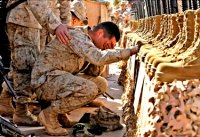 Are more troops — another surge — the solution to this quagmire that has gone on in Iraq now longer than any other war in the history of our nation? Some may think me unpatriotic for saying so, but I think not.
 I’m sorry Mr. President, but you’re wrong, as usual. Wars are not won on the offensive — battles and campaigns are. Wars are won only after the reasons for them being fought are resolved. Like World War I, the War to End All Wars, it didn’t really end in Europe 1918 like the history books say. The aftermath just fomented more war; the years between 1918 and 1939 were just a lull in the killing. The aftermath of the first and second rounds of this war sowed the seeds of what we are dealing with now in Southwest Asia. So, unless we are willing to annihilate all in the Islamic world who oppose us on religious and moral grounds, and that won’t leave very many, we’d best be saving back something for a defensive round. We’d best be about the business too of rebuilding the “Coalition of the Willing” that your policies and bullheadedness have undone.
 Senator McCain, the most outspoken advocate for the war among Republican candidates, now a full 13 percentage points behind the leader, Rudi Giuliani,
  As a public school teacher in what I consider to be an excellent school district in the state of Texas, I suppose that one could say I have a biased view on the school voucher issue. But I’ve had a first-hand opportunity to compare education in both private and public sectors. While in the process of becoming certified to teach, I taught in two different private schools in this state. Yes, it’s true, there are public schools in Texas to which I would not send a son or daughter, one of them is right here in the city where my wife and I presently live. And, yes, it’s true, some private schools are superior to most public schools. But these schools are very expensive and their focus is almost always “formation” first, education second. This inequity, to my mind, is an intolerable situation, one that badly needs fixing in our state. But I’m convinced that vouchers are not the way to go about it.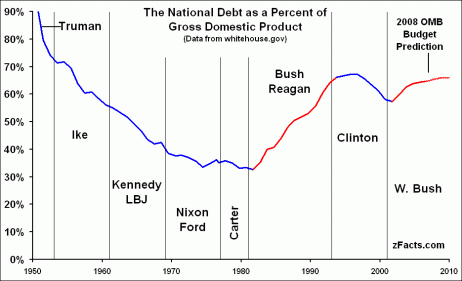
 I have been a teacher of World Geography for high school freshmen in Texas for the past five years. I will begin teaching a new subject next year to seniors in the same independent school district — Economics and AP Macroeconomics. Accordingly, I will have an opportunity to be teacher again for many of my former students, this time focusing on a subject that’s a logical extension of the former. I’m excited about this and looking forward to the beginning of the new school year.
 The World According to Opa
