The Framers really didn’t believe in those famous words, “We hold these truths to be self-evident, that all men are created equal.” We are not equal, we never have been — never will be.
 I never thought of myself as being elitist, not until Barack Obama was labeled this by Hillary Clinton for comments he had made about the every-day, working class people of Pennsylvania. But I guess, for thinking the way I do, one might call me this too.
According to Wikipedia, an elitist is one who believes that those who have outstanding personal abilities, intellect, wealth, specialized training or experience, wisdom, or other distinctive attributes – are those whose views are to be taken most seriously and are thus, best fit to govern. It does not mean that one who is a member of some elite group, whether academically, socially, or professionally, necessarily looks down upon those who, by choice or by circumstance, do not measure up. Nor does it mean that an elitist necessarily considers him or herself to be elite.
What I’m saying here, in case you haven’t anticipated where I’m going with this, is that we all should want someone this time around who is in-fact elite by virtue of intellect, experience, and wisdom to be the leader of the free world. Which brings me to the premise of this posting… if we believe that we truly have a demo- cratic process for selecting our nation’s leaders, that there really is such a thing as One Man, One Vote (or I guess I should I say, One Person, One Vote), we’re just kidding ourselves. Delegates select the winners of elections, voters don’t. And, within the Democratic Party at least, there are delegates and then there are delegates – superdelegates, those whose votes count more than those of the common delegates. Why? Because the elite don’t trust the judg- ment of We the People – they never have. And make no mistake about it; the Framers of the Constitution were elite as well as elitist. All were educated, all were relatively wealthy, all were considered to be wise, even if they all were not, and all were free, white men who considered themselves to be superior to any woman and anyone who was not white.
Think back for a moment about what we learned in our govern- ment and/or civics classes in high school. Recall that there was nothing in the original Constitution guaranteeing individuals the right to vote. That was left up to the discretion of the individual states, and the rules varied from one state to the next. But what was consistent from one state to the next was that only free, white men, men who owned property and who were not in debt, were allowed to vote. So the Framers really didn’t believe in those famous words, “We hold these truths to be self-evident, that all men are created equal.” We are not equal, we never have been – we never will be. Each of us is uniquely special — different from everyone else. What was in the Constitution, from day-one, was the process by which our Presidents are selected, the Electoral College.
Now, here’s an idea to chew on, one that I already know won’t fly. I know it won’t because my wife thinks it’s a stupid idea, and her opinion is usually pretty good when it comes to my ideas. But bear with me, if only for the sake of intelectual discourse. Logically, I think it makes sense. I call it “voter scaling.”
Resolved, we should get rid of the Electoral College altogether. Further resolved, we should get rid of the delegate selection process too, in all political parties. Instead, by Constitutional amendment so that it would apply uniformly to all citizens, we should institute procedures allowing us to elect our leaders directly – one man (person), one vote… well, sort of. To do this in a way that would ensure good judgments and minimize the influence of special interests, wealth, and the status quo at all levels of govern- ment, we should give the most weight to the votes of those among us who are the most elite in terms of education, civic conscience, altruism, and patriotic service. Notice that I have left out wealth and social status as determinants of eliteness.
Okay, let’s say that every citizen gets a vote (one point), regard- less of their level of education or other factors. Let’s say too, that everybody that graduates from high school gets another point (a second vote), completing college would qualify one for a third point, completing graduate studies, a fourth point, completing doctorate studies a fifth point. Let’s say too, that for serving our country honorably, either in uniform or in something like the Peace Corps, one would gain an additional point regardless of one’s level of education.
We could make this democratic algorithm even more sophisticated by allowing individuals to buy influence, not by contributing to political campaigns as is currently done, but by contributing time, money and other resources, to the common good. Maybe teachers and civil servants should have marginally more influence. Maybe sitting judges, winners of the Nobel Peace prize and recipients of the Presidential Freedom Award should get extra points. And just to make sure that nobody feels like their vote isn’t important, perhaps we should consider adopting the Australian practice of fining citizens for not voting.
To really fix what’s wrong with government today, I would further advocate the passage of strong campaign finance legislation and a term-limits Constitutional amendment for members of congress.
But, alas, I know my wife is right. All this is just elitist blah, blah, blah. Those who are in power today would never allow any of this to happen.
Feel free, please, to comment pro or con on this. I look forward to reading your reactions.

 A good friend of mine has referred me to an article that was posted on the Internet yester- day,
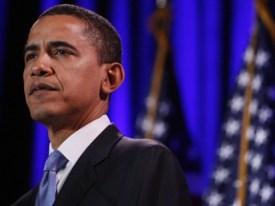 Perhaps you missed the live coverage yesterday, March 18th 2008, of Barack Obama’s speech on social and economic divisions in America — his “race” speech. I didn’t. I was home on Spring Break from teaching, so I was able to watch it in its entirety. I expected to be impressed, and I was. It was brilliant! But then, Obama is well-known for his oratory. I, however, was more impressed with his message than his delivery.
 By now, I would have thought that people were used to it, political spam that is. On any given day, I get at least two or three uninvited political messages from people I know and some from people I don’t know. It’s an election year, don’t you know? And all the candidates have discovered the newest, most cost-effective way to campaign: the Internet, websites, blogs, YouTube videos, and email — much of it being political spam (messages of a political nature that we would not otherwise choose to receive). But I read ‘em all, everything that gets past my ISP’s spam filter. Yeah, I admit it, I’ve become a political junkie.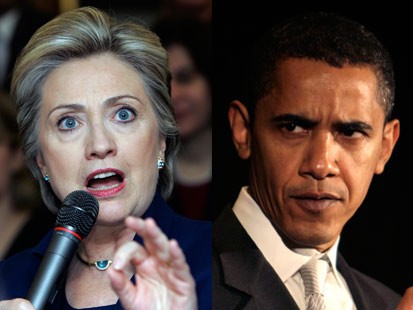
 My dictionary says that patriotism is a noun meaning love for or devotion to one’s country. The idea is simple enough, but it’s pretty darn slippery when you actually try to grab hold of it. What I mean is this: for Americans to be seen as being uniformly patriotic we must all love and be devoted to our country in the same way and to the same degree. If we’re not, some of us will think that others are less patriotic… or “un” patriotic. Take, for example, Barrack Obama’s recent choice not to comply with the conventional practice of wearing a U.S. flag lapel pin to display his patriotism. Or better yet, John McCain’s opposition to the current adminis- tration’s refusal to abide by the Geneva Convention in the War on Terror. Both men have had their patriotism called into question for these things.
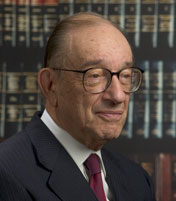 Alan Greenspan, the former Federal Reserve Chief, has been a life-long Republican. Nevertheless, he was appointed to successive four-year terms by four different presidents including Bill Clinton. He long argued that persistent budget deficits pose a danger to the economy over the long run. “Mr Bush,” he wrote in his recent book, The Age of Turbulence: Adventures in a New Land, “was never willing to contain spending or veto bills that drove the country into deeper and deeper deficits, as Congress abandoned rules that required that the cost of tax cuts be offset by savings elsewhere.” I don’t wonder that the man resigned mid-way through his last term.
 I opened with Jefferson’s quote saying that much has changed since 1803 with respect to advantage and happiness sought and gained by some in return for public service, but that one thing is a constant. Serving one’s country is still honorable.
  After the opening slide transitioned to this one, I thanked the school for asking me to speak, saying that it was a true honor to be allowed to represent all veterans, including one of my own sons who served in our first war in the Persian Gulf, Desert Storm. But I emphasized that one need not wear a uniform to be a hero, that there are EVERYDAY heroes, and they are all around us. Those who sacrifice and serve quietly on a daily basis are heroes, moms and dads taking time off to support extra-curricular school activities for example… volunteers in church and civic organizations… teachers who might be making a lot more money in other careers.
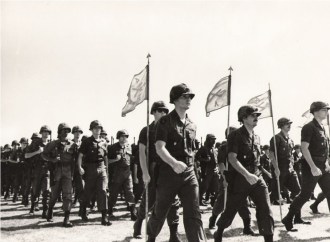 Then from the picture of me marching, I recalled my grandmother’s words of admonishment when she dropped me off at the induction station at Camp Douglas east of Salt Lake City in June of 1966. “Do what you have to do, Kent,” she said, “then come home.”
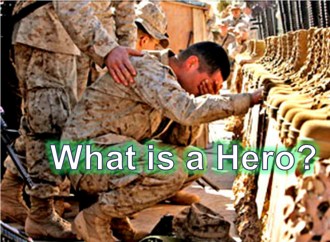 “When I came home from Vietnam,” I said, “we were told to change out of our uniforms before leaving the airport terminal and to leave from side- and rear exits. Vietnam was a most unpopular war and many then were blaming those of us in uniform for perpetuating it. No victory parades for us.
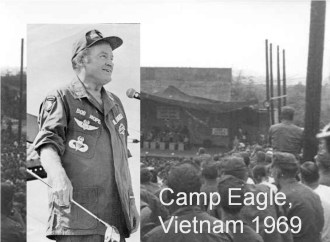 I told my audience that perhaps the most heroic thing I did while in Vietnam was to sacrifice my front row seat to see the Bob Hope Christmas show at Camp Eagle, the division base camp for the 101st Airborne/Airmobile Division. As a Transportation Detachment commander for the division, I knew that seats to see the show were limited, and that my going would mean that some other enlisted man couldn’t. So I volunteered to fly a mission on Christmas Eve of 1969 transporting a Division Chaplain from one fire support base to another.
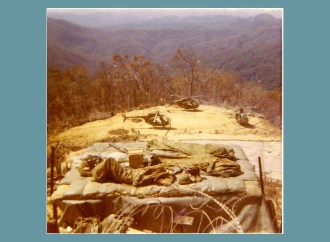 “The Chaplain and I flew together the entire day, returning to Camp Eagle to refuel only once,” I said. “This is a picture of Fire Support Base Eagle’s Nest overlooking the Asha Valley. It’s one that I took weeks before my Christmas Eve mission on a day that was not overcast. On Christmas Eve, 1969, the clouds were hanging low in the late afternoon when we arrived, and before the chaplain finished his worship service and offered sacrament to those who wanted it, we were completely ‘socked-in’. We spent the rest of the evening filling sand bags and singing Christmas carols. C-rations and mud — it remains my most memorable Christmas experience.”
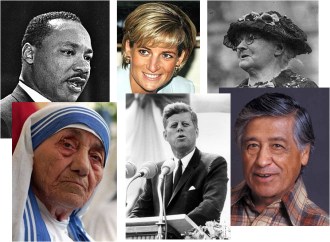 One-by-one I recalled some examples of modern-day heroes who, except for President Kennedy, were not heroes by virtue of military service.
 The World According to Opa