Tough Times in America ~ Making Ends Meet

In a family of four with father and mother both working the equivalent of twenty-four hours a day between them, what are the odds that a parent could be there when the kids come home from school in the afternoon?

I had a flash-back for some reason today, a flash-back to a time when I was very young… 1948. I was just four years old, but events back then made a lasting impression on me. My mother and I had just moved to Ohio where she could be with her new husband, an Air Force enlisted man who was stationed at Wright-Patterson AFB. We lived in a couple of rooms with a farming family near Fairborn. Times were hard, but what would I have know about it then, naive as I was. I vividly remember once having a bread and mustard sandwich for lunch — no Bologna, no cheese, just mustard. I remember laughing about it and wondering why my mother cried. I remember too, gleaning tomatoes from the farmer’s vegetable patch once when we had nothing else for dinner.

This got me to thinking about how many families these days are struggling to make ends meet, families who aren’t living anywhere near a farm where the milk is free and the farmer’s wife shares her fresh-baked bread.

In my economics classes this last week we learned about the labor movement in the United States, how it waxed during the Great Depression and waned following World War II. We also learned how wages are determined. One way is by the traditional theory, i.e., wages are determined on a schedule or a graph where the supply of available workers with particular skill sets compares with the business demand for said workers. Whenever the supply greatly outnumbers the demand, as it does in the current economy, demand becomes the primary driver. In other words, workers without collective bargaining advantages have to take whatever businesses are willing to pay. When demand exceeds the supply or when proficiency in skill sets is at a premium, such as it is in professional sports, supply becomes the driver. So, in a market economy, especially one that is now globalized to compete with labor rates in “developing” nations, who’s looking out for the average Joe? Good question.

The federal minimum wage last summer, after almost fifteen years, was finally increased by the Democrat majority Congress to $6.55 an hour. This, welcome as it was by millions of working poor in this country, is a far cry from the almost $10-an-hour level (adjusted for inflation) of the 1970s. “The influence of the minimum wage,” Holly Sklar said on the June 13 airing of The Bill Moyers Journal, “is felt most immediately and clearly by the roughly 1.7 million Americans who earn it. But, as a statement of what our country considers acceptable compensation, the minimum helps shape the pay of those higher up the economic ladder too.”

If you have the time and are interested, watch the June 13th airing of the Bill Moyers Journal, then reflect on why our country is in such a progressive mood this election year… why Barack Obama and the Democrats who are challenging Republican-held seats in Congress are set to turn the election map a whole lot bluer just one day and a wake-up from now.

After watching this program, I find it very difficult to add insight to what Ms. Sklar shared. But just think about it — to make enough money after taxes to be above the official poverty level in the United States today, a person has to work the equivalent of three full-time minimum wage jobs and never take time off for illness or take time off to care for loved ones in times of need. This strikes fear into my heart as I think about my granddaughter who is about to give birth to our first great grandchild. Our grand- daughter is doing somewhat better than minimum wage as a shift supervisor in the bakery department of a Target store, but her significant other isn’t. Thank God, she at least has access to health insurance; most Americans working minimum wage jobs don’t.

In a family of four withfather and mother bothworking the equivalent of twenty-four hours a day between them, what are the odds that a parent could be there when the kids come home from school in the afternoon? What parent could attend a PTA meeting or help a son or daughter with their homework? What parent could coach a soccer team or help-out with child and youth church programs? Could it be that this is why students living in lower social-economic circumstances fail to achieve minimum No Child Left Behind testing standards and why education in the United States is ranked only 18th among 24 industrialized nations? Could it be that this is why so many fathers abandon their families so that they might qualify for welfare. Could it be that this is why we, as a nation, have one of the industrialized world’s highest incarceration rates, one of the highest teen pregnancy rates, one of the highest infant mortality rates, one of the highest drug addiction rates?

This coming week we are going to be learning about the economic impact of taxation in my economics classes. There should be some interesting discussion on the subject of wealth redistribution.

I invite your comments, regardless of your views.

Published in: on November 2, 2008 at 8:07 pm  Comments (4)  

Like Taking Candy from Babies ~ The International Food Crisis

Has the time not come for us to accept the sovereignty of every nation, not only political sovereignty, but economic sovereignty as well?

A good friend of mine has referred me to an article that was posted on the Internet yester- day, Food Riots Erupt Worldwide.  The article can be found on AlterNet, which is an independent on-line news service that amplifies other inde- pendent news services’ articles with the goal of inspiring citizen action and advocacy on envi- ronment, human rights, civil liberties, social justice, media, and health care issues.  I guess this makes AlterNet part of the “liberal” media, so some may be tempted to dismiss this news all together.  But Alternet’s goal is near and dear to my heart, so the article really got my attention.  Accordingly, I decided to do some research myself and pass the story on with some amplification of my own.

I’m like Will Rogers who said, “All I know is what I read in the papers.” So I don’t have any first-hand knowledge of food riots, nor do I have access to primary sources of information about it.  But when I google “food riots,” I get dozens of returns on news stories posted in recent months by various news agencies about food riots in places like Mexico, Haiti, Afghanistan, Syria.  I found one story too about how Canada anticipates that we who live north of the Rio Grande may be closer to food riots ourselves than we think.  This article, UN Food Agency Needs Hundreds of Millions for Hungry, posted also yesterday by the Associated Press, confirms for me that the Third World is in fact experiencing a growing food shortage.  This has been the subject of reports and discussions on National Public Radio in recent weeks.  But the situation, to my knowledge, has not made it past the “so-what” cut to be featured prominently on evening network news programs.  How come? Are we not an enlightened, generous nation?

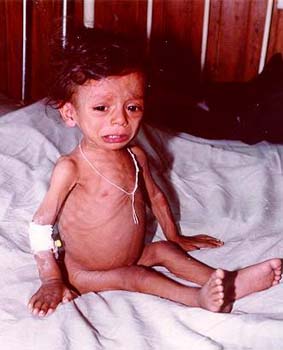
World food prices, according to the AlterNet article, have increased by a whopping 39 percent over the past year with rice prices increasing to a 19-year high. Fifty percent of this price increase occurred over a single two-week period. Commodity traders are making money “hand-over-fist.” So, while we here in the United States have been distracted by the political bickering between Senators Clinton and Obama and our own rising fuel and food cost problems, half of the world’s people, the half that must live on the equivalent of $2 a day or less, are facing starvation.  Why? 

Have I got your attention yet?

Analysts the AlterNet article cites have identified some obvious causes for the food shortages: increased demand from China and India, whose economies are booming now, thanks to free trade; rising fuel and fertilizer costs driven by steeper demand for oil owing to China’s and India’s booming economies, thanks to free trade; increased demand for bio-fuels in this country to reduce our dependency on foreign oil and trade deficits, and; climate change (much of the land in coastal rice-growing regions of Asia have experienced more frequent and more severe tropical storms in recent years with accompanying storm surges that have left the soil less fertile owing to sea water flooding).  But there’s more behind this problem than just the obvious reasons… much more.

For several decades now, the United States, the World Bank, and the International Monetary Fund have used their leverage to impose policies that have had a devastating effect on developing countries, policies that some recognize as the New Colonialism (neocolonialism).

According to a Hoover Institution essay, World Bank and IMF financing programs rarely prescribe appropriate economic policies or sufficient institutional reforms; they are at best ineffective and at worst imprudent investment and public policy decisions.  They reduce economic growth and encourage long-term IMF dependency.  By requiring countries to open up their agriculture markets to giant multinational companies, by insisting that countries dismantle their marketing boards that served to keep commodities in a rolling stock to be released in the event of bad harvests, thus protecting both producers and consumers against sharp rises or drops in prices, the First World has put the “screws” to the Third World.  Countries that were once self-sufficient in food crops are now compelled by market forces to grow exportable cash crops instead such as tea, coffee, cocoa, cotton and even flowers.  So the rich get richer… The poorest countries of the world have been forced into economic servitude, unable to repay massive loans.  Is it any wonder that so much of the rest of the world hates us now?

So, what should we do about it?

To begin with, we should stop fooling ourselves.  We may be the most generous people on earth giving 1.67 percent of our gross domestic product (GDP) to charity.  But the lion’s share of our giving goes to local and national charities like churches, the Salvation Army, and the American Red Cross.  Most of our foreign aid, a tiny fraction of our GDP, goes to Israel.  Along with this, we need to realize that free trade and market forces alone do not serve humanitarian purposes.  Free trade, as opposed to “fair” trade, simply makes it possible for money interests to exploit other’s resources.  So, it is essential that we should not stand in the way of developing-world governments reinstituting safety nets and public distribution systems for food.  Additionally, donor nations must do more, and do so immediately, to support govern- ment efforts in poor countries to avert wide-scale starvation.  But most Americans are already feeling the effects of recession, stretching family budgets and doing without to make monthly ends meet.  So, those of us who can really do need to pitch-in; the UN food program desperately needs contributions.  Warren, Bill, Oprah, and all the rest of you who so richly benefited from the Bush tax cuts over the past eight years, are you hearing this?

In the long-run, the world’s financial powers need to back off, accepting the fact that what works so well in U.S. and Canadian agricultural sectors doesn’t necessarily work in Third World countries.  With large numbers of their citizens still engaged in agriculture as a way of life, these countries cannot be left to depend so heavily on food imports to feed their people.  They need substantial production and consumption of locally grown crops from small, sustainable farms rather than large, commercial farms growing cash crops for western markets.  It may be time to reconsider whether even the IMF has a legitimate reason to exist. 

Has the time not come for us to accept and respect the sovereignty of every nation, not only political sovereignty, but economic sovereignty as well?  Then the time has come for us as well to to stop worshipping the golden calf of free markets.  Paraphrasing the words of the AlterNet article’s author, Anuradha Mittal, every country and every people have a right to affordable food.  When the free market deprives them of this, it is the market that must give back.

Please feel free to post a comment, pro or con, in response.

Published in: on April 26, 2008 at 10:47 am  Comments (6)