Gay-Straight Alliance Clubs in Texas Schools ~ Like It or Not, They’re Here

 This isn’t the first time I’ve made a right/bad decision, and it probably won’t be the last either. I guess it’s just the way I’m made.

Opa_II“Well… it’s probably a good thing that you don’t plan on teaching too many more years.”

This was my wife’s response after I informed her recently of my decision to become the sponsor of a new club at the North-Central Texas high school where I teach. The club, unless the school board wants to try to stop it, will be an affiliate group of the national GSA organization (Gay-Straight Alliance). It’ll be a group of self-identified gay and lesbian students as well as any “straight” sexually-oriented students that might be supportive of the club’s purpose, which is: to promote tolerance, understanding, and acceptance through social aware- ness. The club will most definitely not be for the purpose of promoting behavior or persuasions considered to be deviant by many.

In Texas?!!

Yes, in Texas. We’re still part of the United States, you know, and according Center for Disease Control and Prevention (CDC & P) guidelines on preventing unintentional injuries and violence in public schools, published December 7, 2001 and never rescinded during the GWB years http://www.cdc.gov/mmwr/preview/mmwrhtml/rr5022a1.htm, school administrators are compelled to combat victimization of minority groups, and that’s what this club will be about — keeping kids safe.

“Regardless of a child’s ethnic, socioeconomic, religious, sexual orientation, or physical status, all children have a right to safety. When victimization through bullying, verbal abuse, and physical violence is prevalent in a school, the entire school community experiences the consequences. When abuse against a particular group is perceived as acceptable, intergroup hatreds can become established… Students who are different from the majority of their classmates because of their race, ethnicity, sexual orientation, religion, or other personal characteristics are at increased risk for being bullied. Gay, lesbian, or bisexual students, and students perceived to be gay by their peers are often victims of repeated verbal abuse and physical assault.”

Our principal has informed me that he thinks there would be no legal way, ultimately, for him to deny this group the right to organize and assemble on school property while allowing other groups the same right such as our conservative, faith-based group of students calling themselves, “Youth Alive”.  He said that, had I not said, “yes,” to the openly gay, purpose-driven young organizer who had approached me with the request to sponsor the club, he’d have probably had to find a sponsor for it, sponsor it himself, or else withdraw permission for all non-academic or athletic groups to have school-sponsored clubs.

Learning of this young organizer’s personal history of abuse (personal attacks, both verbal and physical) against which he finally defended himself and had spent time in reform school for having done so, I came to fully appreciate his passion for wanting to start a GSA club at our school. His story put a face on the many other stories that I had heard in the news over the years about gay-bashing and horrible atrocities.

Nation-wide, there are legal battles on-going over whether administrators and school boards can deny GSA clubs the right to organize and to meet on school property. Right here in Texas, the Lubbock Independent School District trustees have said that they will do all that they legally can do to prevent a gay group from meeting on school property http://www.democraticunderground.com/discuss/duboard.php?az=view_all&address=102×15804. So, the GSA group there has taken their case to federal court. Elsewhere in the nation, in Salt Lake City a high school settled out-of-court with a GSA group after a federal court ruled against the Okeechobee School District in Florida last summer for denying a GSA group the right to assemble. The court had ordered the Okeechobee School District to pay the group $300,000 in court and attorney fees http://psychescientia.blogspot.com/2008/08/federal-court-says-okeechobee-high.html. Our school district will probably not want to go down either of these routes, but they may just decide to wait and see what happens in the Lubbock School District case — buying some time. We’ll soon find out.

Now, before you start wondering – no, I am not gay myself and, yes, I am a Christian and I worship weekly. My wife and I have been married almost forty years; we have three grown sons, three grandchildren and one great-grandchild now. So, why did I so willingly agree to sponsor this club? I don’t know – it just seemed like the right thing to do – maybe not the smart thing, but definitely the right thing. This isn’t the first time I’ve made a right/bad decision, and it probably won’t be the last either. I guess it’s just the way I’m made. I could have said, “No,” claiming that I was too busy or even that I have a moral issue with gay and lesbian orientations and practices. But that would have been a lie. I believe that all God’s children have a right to be whom and whatever they are so long as their attitudes and behaviors do not harm others.

To offend someone is one thing, for the offence is in the perception of the offended. To abuse someone is something quite different. Abuse is intentional, it is harmful and it is hateful – certainly not Christian behavior – and abuse is what GSA is organized to combat.

I covet your prayers, for me, for our school, and for the community it serves.

Please feel free to post a comment, whether pro or con.

Published in: on October 17, 2009 at 10:42 am  Comments (17)  

Capitalism — The Good, The Bad and The Ugly ~ Teaching Students How to Think vs. Teaching Them What to Think

Sadly, when it gets to the point in Texas that teachers must teach the truth in “public” schools only as social conservatives in this state are privileged to know the truth, it will be time for me to retire or find something else to do until I do.

opaSeptember 7, 2009  —  From day-one in my high school economics classes, I assure my college-bound students that my goal is not to teach them what to think, but rather how to think. I tell them that, if we are to have the freedom and ability to make up our own minds about controversial subjects, we must be exposed to facts, theory and opinion from all sides — without prejudice. They, for the most part, seem to accept and respect this as a given.

Introducing the subject of an economics lesson to my high school seniors last week, Capitalism and Free Enterprise, I quoted an Anglican Priest, W. R. Inge, who said or wrote, “The enemies of freedom do not argue, they just shout and shoot.”

I gather what Reverend Inge was saying is that, for freedom to thrive, people must be willing to engage in “reasoned” argument – that when we refuse to consider others’ arguments or stop listening to facts and start making things up to distract others from real issues, we are obstructing the democratic process and are, therefore, enemies of freedom. Now, this I did not say to my classes, but we’ve seen a good deal of shouting taking place in town hall meetings all across the country this past month. Have we not? We’ve also seen individuals showing-up at these meetings with loaded weapons, weapons they insisted were not brought to intimidate people with whom they disagree. Awhhh… give a break!

Inge was a professor at Cambridge University and a prolific author who wrote scores of articles, lectures and sermons. He also wrote over 35 books but was best known for his works on Plotinus and neoplatonic philosophy, and on Christian mysticism. He was a believer in spiritual religion — faith based not upon coercive authority but on experience and individual inspiration. Obviously, he was a pragmatic person. I can’t find any reference to his political leanings though. If he had any, he probably kept them to himself because, as in the U. S., I assume religious leaders and educators in the U. K. are pretty much expected to be apolitical. But I’ll just bet that, if he ever did vote, he voted for candidates representing either the Social Democratic Party or the “old” Liberal Democratic Party of the U.K.

I shared none of my speculation about Inge’s politics with my students, if he had any politics. Teachers in Texas are expected to be apolitical too, especially if they lean at all to the left, don’t you know? But as I write this now, I’m struck by how I was teaching this lesson last week while some parents in Texas were calling school boards and principals to threaten keeping their students out of school if they were allowed to watch President Obama’s return-to-school address to students. Sadly, when it gets to the point in Texas that teachers must teach the truth in “public” schools only as social conservatives in this state are privileged to know the truth, it will be time for me to retire or to find something else to do until I do. With the Texas Education Agency (TEA) review committee, stacked as it is with like-thinking social conservatives to rewrite the Texas Essential Knowledge and Skills (TEKS) for social studies subjects according to right-wing, radical political philosophies and beliefs, that time may be upon me sooner than later.

No, my point in using Inge’s quote was not to indoctrinate my students with “liberal” ideas. It was to get my students to think beyond the limits of our textbook lesson on capitalism – to think on a higher level – to get them to understand why some living outside the developed world are reluctant to embrace western-style capitalism, why they view our system as just another form of imperialism, an economic form. Scholars of the Islamic faith and Southwest Asian history say that this is behind much of the hatred directed toward the U.S. and European countries — why some in the Islamic World have become so militant, choosing to shout and shoot rather than accept the possibility that they could be wrong.

After discussing current economic events, including the story that broke last week about the average annual compensation for CEOs of the twenty largest banks and financial institutions in the U.S. exceeding $13,700,000 each, we covered the characteristics and merits of capitalism. These CEOs, by the way, head-up the very businesses that received most of the tax-payer funded Troubled Asset Relief Program (TARP) money last year and this. The compensation of these CEOs is more than thirty-five times as much as our president makes and more than 400 times as much as the average tax-payer.

Although not included in our text book, it is true that the roots of capitalism can be traced back to the Golden Age of Islam and the Muslim Agricultural Revolution that took place between the 8th and 12th Centuries. Europe was still in transition from Feudalism to Mercantilism and would not begin to adopt “free market” concepts until after Adam Smith’s landmark book, The Wealth of Nations published in 1776. It is also true that capitalism, the American version of it, is based on the concept of economic freedom, the idea that we are free to pursue any business we choose anywhere in the country, or outside the country for that matter, that we choose to make whatever products and provide whatever services we wish – so long as our choices don’t harm others or at least aren’t illegal. It is also true that, in America, the concept of economic freedom implies that there should be a minimum of government restrictions on businesses, that we trust the market place to punish irresponsible behavior. But this tenet differs from other western market economies wherein governments have become more involved – more shared (socialized) since the end of WWII.

Some in America believe that economic freedom is a synonym for Free Enterprise, and that Free Enterprise is simply the English translation of Laissez-Faire (meaning no government involvement whatsoever). But, as we have learned from recent experience following the deregulation of financials in this country, Adam Smith’s Invisible Hand does need a measure of guidance and oversight by regulatory agencies, whether part of the government or not as is the case with the Federal Deposit Insurance Corporation. This is because business under capitalism is driven by self-interest, another characteristic of capitalism, and sometimes this motivating force can lead to greed, excesses, and violation of the public trust.

At this point, I had my students watch a brief video interview of Bill Gates, the most successful capitalist of our time, by the editor of Time Magazine. Mr. Gates spoke of how capitalism has worked well, better than anyone could have imagined, simulating innovation and advances in all manner of products and services. But he also made quite clear that capitalism has worked best for the well-off, increasing dramatically in recent years the gulf between the wealthy and the poor – rich nations and poor nations. Without offering ideas for how to incentivize businesses to do more to alleviate poverty and suffering in the world, using their great potential for profit in altruistic ways, he postulated that they should and that, magically, somehow they will. In support of this great hope, he suggested that the young today have an innate desire to work for socially-responsible businesses and that this will temper corporate greed.

After viewing this video, one of my students suggested that Mr. Gate’s vision for the future of capitalism without government encouragement is overly optimistic. This led to a brief discussion on whether the federal government has the authority under the Constitution to limit excessive compensation. I settled the argument so that we could move on by pointing out that Congress enacted minimum wage, thereby establishing a floor for wages, under the Fair Labor Standards Act of 1938. While people still argue for and against it for its positive and negative impacts on the economy, the law has been upheld by the Supreme Court. Therefore, there is no reason to disbelieve that Congress could not enact a law establishing a ceiling on salaries and other forms of corporate compensation.

Another characteristic of capitalism is that it includes the concept of voluntary exchange – the idea that buyers and sellers can freely and willingly engage in market transactions – that we don’t have to buy products and services offered by a particular business or made here in the U.S. Likewise, businesses are not prohibited from doing business in other countries, even exporting Americans’ jobs for foreign workers. We participate in transactions believing that both buyers and sellers are made better-off there from.

Capitalism, as envisioned by Adam Smith, cannot thrive where there is inadequate competition. When a particular industry becomes excessively concentrated as, for example, health insurance in the U.S. these days, the seller has an excessive advantage in the marketplace. Prices will outpace average inflation for all other goods and services.  That’s when, as our textbook points out, government as a regulator must step-in to somehow restore competition.

Finally, American-style capitalism depends on the concept of private property, to include “intellectual” property, as in copy rights and patents on new technologies. Unfortunately, other countries’ versions of capitalism, such as that which is practiced in China’s “mixed” economy, don’t recognize this as being so important, especially since most of the creative innovation still comes from the U.S. and other market-based economies.

The lesson concluded with the various roles played in capitalistic economies such as ours, the entrepreneur, the government and the consumer. As our textbook points out, when competition is adequate, the consumer is “sovereign,” or king in the economy. This is because the dollars we spend on goods and services act as if they were votes. The choices we make, expressed by the dollars we spend for what we buy and from whom we buy determine what gets produced. Were it not such a contentious political issue and if I could be free to express my personal opinion, I’d have pointed out that this is exactly why President Obama advocates a “public” option for health insurance in the legislative debate over health care reform. Americans these days, unless they are members of Congress or are well-off enough to shop for insurance independent of an employer, have no choice. Therefore, consumers are not sovereign in this particular market; corporations are.

With minimal government regulation and state and local governments’ support for business development, American-style capitalism has clearly made some in this country very rich. This economic formula has also led to miraculous advances in technologies that have improved our material lives and longevity. But there have been down-sides too. The gulf between the rich and the poor has grown and grown to the point that average citizens are worse-off today in terms of purchasing power. Americans’ take-home pay today buys thirty percent less than the average manufacturing wage after taxes did back in the 1970s. Also, with the elimination of most trade restrictions in American-style capitalism, many well-paying jobs have been off-shored to the developing world. So foreigners are benefiting from American-style capitalism right along with the wealthy in this country. So, capitalism is good. It’s also bad and it can be ugly, especially if you’re out of work, can’t afford health insurance, and you get sick. It all depends on your point of view or your political persuasion.

Please feel free to post a comment whether you agree or not.

Published in: on September 7, 2009 at 8:15 pm  Comments (9)  

Politics in the United States ~ Just When Did It Get So Dirty?

 Mirror, mirror on the wall, which political party is the dirtiest of all? To answer this question, we need to consider some history.

mirror-mirrorAccording to the WiseGeek website, dirty politics can occur at any level of public service. Political candidates often use financial records like tax returns to embarrass an opponent or a nominee for a political appointment. Family members and known political associates may also become fair game in dirty politics. A candidate’s mental stability may be challenged, especially if he or she offers up an emotional or overheated response to dirty politics as did Ed Muskie during his bid for the presidency in 1972 . A negative ad campaign, however, is not always the same as dirty politics, provided the charges in the ads are true and verifiable.

Controversy surrounding accusations that Senator Chris Dodd, as Chairman of the Senate’s Banking Committee, and Senator Kent Conrad have accepted bribes and other “sweet deals” from the likes of failed mortgage giant, CountryWide Bank, are making things tough for Dodd, a five-term veteran lawmaker from Connecticut. He’s trailing in the polls for reelection this year against his Republican rival, Rob Simmons. The Republican propaganda machine obviously smells blood (see my earlier posting, Dodd and Obama – Are They Really Corrupt Birds of a Feather?).

Whether the accusations against Senators Dodd and Conrad can be proven or not, we don’t know. But, if they can be, why has there not been action taken against Dodd and Conrad since secret testimony was given to Republican investigators for the House Oversight and Government Reform Committee last week? Are Democrats on the Reform Committee blocking action? Is that why was the testimony was “leaked,” or could it be that what is only rumored is more politically damaging to Dodd and Conrad that what can be proved? Ask me — I think this smacks of dirty politics.

According to a recent Gallup poll on what professions the American people most and least respect, nurses ranked highest (congratulations, dear). Politicians were fourth from the lowest, just ahead of lobbyists, telemarketers and used car salesmen. Why? Well, I suspect it’s because we all know that politicians lie and resort to all manner of dirty tricks, to include slander, libel, and forgery, to embarrass or discredit a political rival. Political campaigns are notoriously outcome-oriented, so rival candidates are both likely to engage in dirty politics. Even though we are repulsed by the use of dirty politics, we tend to overlook or minimize what our candidates do, then we damn the repugnant acts committed by the other guys. As in our watching of professional sports in America, especially football and ice hockey – we want referees to call foul on the other team, but we are happy if they’re looking the other way when our team fouls.

Once elected, Congressmen and women, as well as other elected and appointed “public servants” in the United States, take on the title, “The Honorable”. Really! How hypocritical can you get? No wonder so many Americans fail to go to the polls on election days.

According to her book, Dirty Politics: Deception, Distraction and Democracy, Kathleen Hall Jamieson asserts that dirty politics have always played a role in American elections — ever since the times of Washington, Adams and Jefferson. Jefferson, for example, is said to have used pamphlets filled with incriminating or embar- rassing information about his political opponents, and several presidential elections since may have been swayed by the use of such dirty tactics.

I, for one, was dismayed by the dirty tricks committed during the 2000 and 2004 presidential campaigns. Perhaps the worst example was Republican on Republican when, after losing badly to John McCain in New Hampshire, Bush operatives decided to “chop him up” in South Carolina. Flyers appeared saying that McCain had fathered an illegitimate child with a black woman (he and his wife have an adopted Bangladeshi girl), that his five years as a prisoner of war in Vietnam had made him mentally unstable, that his wife was a drug addict – rumors and innuendo. Mr. Bush and his chief strategist then, Karl Rove –always denied any involve- ment, but they did nothing to call their attack dogs off and McCain’s campaign never recovered.

The dirt got even deeper during the national election in 2000 between Bush and Gore. Whether it really mattered or not, the Gore camp was accused by the Bush camp of being “the John Wilkes Booth” of political assassinations for bring up such “trifling” things as George Bush’s arrest and fine for admitting to a DUI charge when he was 30 years old – worse for his record on support for education in Texas, 48th in the nation while he was governor here. The Bush camp retaliated with ridicule of Gore’s proposed tax initiatives for energy incentives, for his advocacy for the environment, and for claiming to have invented the Internet. The actual word Gore used in a CNN interview with Wolf Blitzer was “create”. True, he did not invent the information technology used. But as a Congressman and later a Senator, Gore did do important legislative work that lead to making the government’s ARPANET available for commercial use – what Gore had referred to in the bill he sponsored as the “Information Super Highway”. So, in an important way, Gore did take the initiative to “help” create the Internet. While Gore’s campaign did turn negative, it wasn’t necessarily dirty. Everything it said about Bush was true and verifiable.

Who can forget the “swift-boat” attack ads against John Kerry in 2004 by the 527 group, Swift Vets and  POWs for Truth? This was in retaliation for Kerry backers pushing the story about George Bush having gone AWOL from the Texas Air National Guard after completing Air Force flight training to avoid service in Vietnam. The charge cost Kerry’s campaign dearly when documentary evidence to support the claim turned out to have “likely” been forged – but forged by which side of the argument? We may never really know. Why Bush’s failure to graduate from flight training and to fly in combat in Vietnam didn’t come up during the 2000 election campaign, we don’t know. Some speculate, however, that Gore’s campaign was afraid that the Bush camp would counter with stories about Clinton’s draft dodging. In my judgment, while the Kerry campaign’s skirts weren’t completely clean, the skirts of the Bush camp were definitely soiled – badly.

Despite the ugly things said and the disreputable accusations made by the McCain/Palin attack dogs in last year’s national election, I was truly proud of John McCain when, during a town-hall style rally, he repudiated a supporter for calling Obama an “Arab”, implying that he was not truly American and not to be trusted with the security of our nation. But, for the life of me, I cannot think of anything said or implied to by the Obama campaign that was anything but truthful and respectful toward McCain – Obama himself praising McCain for his many years of dedicated service to his country.

But the Democratic Party has not always taken the high road in national politics. According to historian and author, Joseph Cummins, the 1960s was the era of Democratic dirty tricks. In a 2007 interview with the New York Times, Cummins said, “In 1964, Lyndon Johnson oversaw one of the most corrupt elections ever against his Republican rival, Barry Goldwater.  President Lyndon Johnson, seeking his first elective term after taking over for the assassinated JFK, set out not just to defeat Goldwater, but to destroy him and to create a huge mandate for himself.

Johnson created a top secret after-hours group known as the “anti-campaign” and “the five o’clock club.” These political operatives, in close contact with the White House, set out to influence the perception of Goldwater in America’s popular culture. They put out a Goldwater joke book entitled You Can Die Laughing. They even created a children’s coloring book, in which your little one could happily color pictures of Goldwater dressed in the robes of the Ku Klux Klan.”

So, mirror, mirror on the wall, which political party is more likely to resort to the use of “dirty” tricks?  Hmmm… you chose. But I think it has more to do with the candidate than with which party he or she claims. Like love and war. elections are always “end game” contests.

Feel free to comment, whether you agree or not.

Published in: on August 3, 2009 at 1:53 pm  Leave a Comment  

How Canadians Really Feel About Their Health Care System ~ Should We Care?

Eighty-two percent of Canadians believe that their health care system is better than ours.

opa

I watched President Obama’s primetime news conference last night (July 22, 2009) on reforming our health care system. After the conference, a political ad sponsored and paid for by the Americans for Prosperity Foundation was aired on the same network, CNN. The ad featured a Canadian woman who tells of having to come to the U.S. for an operation to save her life because of long wait times for surgical procedures in Canada. Oooooooo… scary — but one woman? Is she one of thousands last year who had to do the same — hundreds, or maybe just a dozen or so? And did she really have to come here for her operation?

The ad got me to wondering how Canadians really feel about the system that they’ve had in-place now for over fifty years. I also wondered whether the ad was being aired on the Fox network too or only on networks patronized by viewers having more moderate political persuasions.

I got up this morning and, over a cup of coffee, did a little research. I found an interesting article on the subject recently published by the Canadian Press. Read the article for yourself if you wish, but to summarize, Canadians think we would be wise to consider their system as we grapple with what to do about our own. A recent survey conducted by Harris/Decima group in Canada has found that 70 percent of Canadians think their system is working well or very well and that 82 percent believe their system is better than ours. The poll, taken by telephone of 1,000 Canadians, was conducted from June 4 to 8 and has a margin of error of plus or minus 3.1 percentage points, 19 times out of 20.

On the whole then, Canadians obviously feel pretty satisfied with their system, but should we care about how Canadians feel? Maybe… A little more research came up with the following video program produced by a San Diego television station (KPBS) in cooperation with the Canadian Broadcasting Corporation (CBC). The program compares our system with Canada’s. Draw your own conclusions.

The Canadian health-care system has been in the spotlight for weeks at congressional hearings, where it has alternately been characterized as the gold standard and a troubled system plagued with problems and delays. Obviously, neither our privatized system nor their single-payer system (Canadians don’t consider it to be “socialized” medicine) is perfect. But considering comparative costs and healthcare outcomes, I think the majority of Canadians are right about which system is better. Perhaps the President’s plan, a blending of the two, would offer the best of both worlds to Americans. After watching the embedded video, let me know what you think.

I invite your comments.

Published in: on July 23, 2009 at 10:58 am  Comments (4)  

Legislating from the Bench ~ Why It’s Not Always Such a Bad Thing

Legislating from the bench is nothing new and all judges and justices do it. Furthermore, when ruling on issues of legal conflict and vagueness, judges do establish policy.

opaHere we go again, as the Senate undertakes the process to confirm or reject the nomi- nation of Sonia Sotomayor as only the third woman and first Hispanic ever to serve on the Supreme Court, we hear the same old Republican refrain, “We don’t want justices who legislate from the bench.” To my mind, this begs a question. No, not to whether Judge Sotomayor is an activist or even a prejudicial judge. Despite text from her 2001 speech addressing how judges truly do bring individual life experiences to decisions from the bench, her judicial record indicates that her many rulings over 17 years as a district and appeals court judge have been quite moderate. My question is this: do Republicans really reject all activist judges or just activist judges who are not conservative enough?

First of all, let’s define the terms?  In a general sense, an activist is one who believes in bringing about social, political, economic, and/or environmental change for the better. This means that yours truly is an activist. But don’t we all now recognize the need for change and want things changed for the better? So then, are we not all activists? The only difference is, as liberals, conservatives and moderates in between, which changes we want and in what form we want them to take.

By extension, judicial activism is a philosophy suggesting that judges should reach beyond the Constitution to achieve results that are consistent with contemporary conditions and values. The term is most often associated with the concept of liberalism, which includes the belief that a broad interpretation of the Constitution should be made which can then be applied to specific issues. The counterpart to judicial activism is judicial restraint which is advocated by those who believe that democracy will thrive best if judges stick to the letter of the law and refrain from policy debates, deferring to the legislature to clarify legal issues. Under certain conditions, however, judicial restraint is just another form of judicial activism — I call it reverse judicial activism.

Now, I do not have a degree in Constitutional Law, but doesn’t the Constitution compel/permit all three branches of the government to legislate? Yes, I know, Article I, Section 1 of the Constitution says, “All legislative powers herein granted shall be vested in a Congress of the United States…” However, Article III, Section 2 of the Constitution grants to the Supreme Court as follows: “The judicial power shall extend to all cases, in law and equity…” The key and operative word is here is “equity” which, in 18th Century terms, means righting wrongs that the strict letter of the law fails to address. Furthermore, although not specifically enumerated as a judicial power in Article III, “Judicial Review” has been a well established and controlling precedent since the “interest conflicting” dealings of John Marshall in the 1801 case of Marbury vs. Madison.

The Executive Branch legislates too when it establishes commission and agency rules and regulations that bind us just as much as do Congressional bills signed into law by the President — that is, until a subsequent administration overturns said rules and regulations. Consider the merits of cases in Executive reviews (issues involving Social Security, the IRS, military tribunals, and agencies such as the FEC, FDA, FTC, etc.). And does a President not legislate when vetoing a bill? Of course he does.

On the flip side of all this, Congress determines facts and passes “judgments” in Congressional hearings and contempt and impeachment proceedings? So it is true that all three branches have concurrent powers and overlapping checks and balances against the other. Therefore, legislating from the bench is nothing new and all judges and justices do it. Furthermore, when ruling on issues of legal conflict and vagueness, judges do establish policy. And it is altogether appropriate and fitting, in my opinion, that they should do so, assuming a court that is balanced or at least moderate in political persuasion. Judges get the law right — finally, by ultimately getting divisive issues out of the hands of untrust- worthy, disingenuous politicians who want, more than anything else, to be reelected.

Reverse judicial activism is, to my mind, the bigger problem. This is when courts rule not to interpret the law in light of contempo- rary issues and realities. Case in point — the infamous Dred Scott decision of 1857. More recently, reverse activism was demon- strated when the Supreme Court voted last June (2008) to overturn a 32-year old Washington D.C. hand gun law, ruling that it violated the Second Amendment. Obvious to me is that the defense of Washington D.C. does not rely on armed “militias” anymore if in fact it ever did. The U.S. Army, established in 1784, if not adequate to defend the nation’s capital then and when it was invaded by the British during the War of 1812, is surely adequate today.   Therefore, since the premise of the Second Amendment is no longer valid, that a well regulated militia is necessary for the security of a free state, the citizens of Washington D.C. no longer have the need nor the right to bear arms. Come to think of it, Washington D.C. isn’t even a state, so per the “letter of the law,” the Second Amendment should not even apply.

Reverse judicial activism would also be enacted should the recent California Supreme Court decision concerning gay marriage be appealed to the highest court in the land and be upheld by the heavily conservative court despite the Fourteenth Amendment guaranteeing equal treatment under the law and due process for all citizens. With six of the nine current justices being Republican and momentum for gay marriage gaining at the state level, gay rights advocates are not at all anxious for the California Supreme Court’s ruling on Proposition Eight to be appealed.

Feel free to post a comment whether you’re in agreement or not.

Published in: on June 4, 2009 at 2:53 pm  Comments (2)  

The Problem with Socialism ~ More Viral Disinformation

“The problem with socialism is that you eventually run out of other people’s money.”

Margaret Thatcher

opaThis will sound un-American to some, but, unlike the former Prime Minister of the UK, I think the real problem with socialism is that it has a bad rap here in the U.S.  Americans confuse socialism with communism.

Socialism refers to a broad set of economic theories about social organization, theories advocating public ownership and administration of critical sectors of the economy such as education, energy, public utilities, health care, and finance — theories which, when put into practice would ostensibly result in a society characterized by fairness and equity. These theories, and there are many variations on the theme, seek to slow or minimize the concentration of wealth within a small, privileged class of citizens as is the propensity for capitalism to do.  According to one government source, the top one percent of Americans enjoy thirty-three percent of the nation’s wealth while the bottom eighty percent have less than sixteen percent.  It is this kind of inequity that has historically caused revolutions. However, most socialist theories do not advocate massive “redistribution” of wealth. Quite the opposite; reward and compensation in countries like Sweden, Norway, France and Germany, countries that many Americans consider to be socialistic, are based on the value and amount of effort individuals expend in production. Interestingly, Norway, perhaps the most socialistic of the western democracies, boasts the largest number of millionaires per capita of any country in the world.

Communism, on the other hand, depending on how it is wrapped around the political system that adopts it, is a political ideology that promotes the establishment of an egalitarian, classless, stateless society and an economy based on common ownership of everything with centralized control of the means of production. Communism is totalitarian, either oligarchic or dictatorial, incorporating a branch of socialistic theory in the extreme, where it still survives (in North Korea). All other communist states, to include China, Vietnam and Cuba, are going through a process of reform — adopting market concepts to achieve mixed economies.

The confusion between socialism and communism is perhaps a lasting legacy of the Red Scare that took hold of America following the Second World War and the Cold War that lasted for decades. The Cold War is over now; we should put it behind us, I think, and move on.

I have a good friend who can’t quite seem to decide whether, because of his intellect and his understanding of Christian doctrine (love your neighbor as yourself), he should subscribe to and support liberal political philosophy or, because of his more conservative friends’ influence, subscribe to and support conservative political philosophy. He recently forwarded to me a copy of the viral disinformation email that follows asking for my opinion about it.  I suspect that it was one of his other friends who sent it to him. Anyway, I had seen it before myself, several times. Perhaps you have too; it’s been making the rounds in various forms for years.

~~~~~~~~~~~~~~~~~~~

An economics professor at Texas Tech said he had never failed a single student before but had, once, failed an entire class. The class had insisted that socialism worked and that no one would be poor and no one would be rich… a great equalizer. The professor then said ok, we will have an experiment then on whether socialism makes for good economic policy.

All grades would be averaged and everyone would receive the same grade so no one would fail and no one would receive an A.  After the first test the grades were averaged and everyone got a B. The students who studied hard were upset and the students who studied little were happy.  But, as the second test rolled around, the students who studied little had studied even less and the ones who studied hard decided they wanted a free ride too; so they studied little.  The second test average was a D!  No one was happy. When the 3rd test rolled around the average was an F.

The scores never increased as bickering, blame, name calling all resulted in hard feelings and no one would study for the benefit of anyone else.  All failed, to their great surprise, and the professor told them that socialism would also ultimately fail because when the reward is great, the effort to succeed is great; but when government takes all the reward away; no one will try or want to succeed.

Could it be any simpler than that?

~~~~~~~~~~~~~~~

As a teacher of economics, I can’t say that I have never failed a student. Hard as I try to get the basics of economics across to some of my students (that it is a body of both knowledge and opinion with conflicting ideas and theories — a soft rather than a hard science), they just can’t or won’t get it.  According to John Maynard Keynes, “Economics is an easy subject at which few excel.” But people who don’t understand the nature of this “dismal” science persist in trying to simplify it — or so it seems. The above tale of the economics professor who would fail an entire class for not agreeing with his particular beliefs is a perfect example. If there ever was such a professor and I were his dean, I would fire him for not getting it either.

The problem with trying to justify economic or political points of view with analogies like this story (comparing wage and salary competition with competition for grades) is that they are overly simplistic. They are flawed — rife with logical fallacies of composition and causation. Students do not compete for grades in the same way that people in the workplace compete for pay or promotion. Neither does socialism, except in the most extreme applications of theory (and I can think of none in actual existence), equalize reward among all participants as the economics professor’s experiment did.  Sure, the Soviet Union’s brand of socialism (communism) failed, and a large part of the reason for its failure was diminished incentive.  But Soviet-style communism, Chinese-style communism, and Cuban-style communism (each is/was unique) do not equal socialism as reconciled today with market economies in Western Europe. In fact, all communist states, save for North Korea and Cuba, have incorporated elements of market forces to become mixed economies, and Cuba’s new president, Raul Castro, has indicated that he intends to start doing the same.

 The economies of the world’s other industrialized nations are flourishing. All are still small compared to ours, but they are coming on strong. In 2008, our real gross domestic product (GDP) (GDP adjusted for inflation) grew at just 1.4 percent. Sixty-six other countries outpaced us and they have been doing so for years.  The world average was 3.8 percent. So, in the years ahead, if we do not become more socially responsible by investing more in education, health care, energy and infrastructure, we may well be left behind. Call me a socialist if you wish, but that is how this economics teacher sees it.

I invite your comments whether you agree with me or not.

Published in: on April 4, 2009 at 9:09 pm  Comments (16)  

The Failure of Another Great Experiment ~ Is America About to Legalize Drugs?

The War on Drugs is very much on Americans’ minds at this time, much like the prohibition against alcoholic beverages was during the Great Depression.

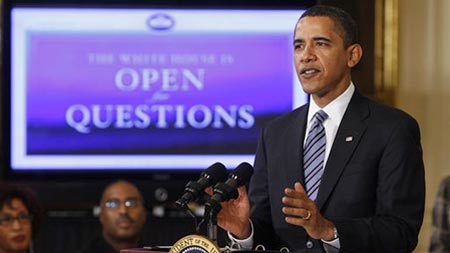
opaDuring his on-line town hall meeting on Thursday of this week, President Obama demonstrated his considerable political skills and instincts when he responded to a question about legalizing drugs. He was asked if he thought legalizing drugs would be a good way to deal with the rising violence between drug cartels and law enforcement officers on both sides of nation’s southern border and to grow our economy. Without elaboration, he simply said, “No, I don’t think legalizing drugs is a good way to grow our economy.” Regardless of what he might really think, he definitely knows that this is a highly charged political issue, one better dodged, at least for the time being. But sentiment favoring legalization is growing, especially with reports of Mexican drug cartel violence spilling over into the U.S.

town_hall

One of my students brought this up in class as her contribution to our discussion of economics in the news recently, and most of the class wanted to share their views on the issue. There was a good level of participation and, for a few moments, everybody wanted to talk at the same time. But I didn’t want to let the discussion sidetrack us from the lesson of the day.  Neither did I want to have the matter put to a vote as we often do with contentious issues.  So I didn’t let the debate go on too long. After all, our school is in the Bible Belt of north central Texas — I would like to be allowed to retire from teaching someday and not be dismissed in the near term for encouraging immorality.

According to a recent on-line CNN news article, Obama had promised to answer the most popular questions as decided by online votes to the administration’s website, whitehouse.gov. More than 3.6 million votes on 104,000 specific questions submitted by almost 93,000 people were registered by the time voting closed earlier in the day.  From these, he only addressed the winning eight, six were written questions displayed on a screen for all to see, two others were video submissions.

Think about it – out of 104,000 questions submitted, a question on legalizing drugs was among the eight most popular. Of course, we don’t know how many times the same or similar questions might have been asked, but I can only imagine that repeated questions were consolidated in the selection process. This means that the War on Drugs and crime associated with the illegal transportation, sale and possession of drugs is very much on Americans’ minds at this time, much like the prohibition against alcoholic beverages was during the Great Depression.

Popular opinion during the Great Depression led to a grassroots movement and the eventual repeal of the 18th Amendment in 1933.  Why? Well, Americans who wished to imbibe were not deterred by Prohibition; the 18thAmendment to the Constitution, sometimes called the Great Experiment, merely drove the practice underground. Speakeasies and “hideaways” developed, especially in large cities, where partiers paid inflated prices for illegally imported booze from Canada, Cuba and Mexico. “White lightening” or “bathtub gin” of questionable origins was produced by many as a means of generating income while unemployment was at record levels. Many, including my own grandfather, became deathly ill after drinking some of this stuff, another name for which was “rotgut;” some even died. And border towns like Tijuana and Juarez, expanded and thrived to service our American appetites for illicit goods and services like gambling and prostitution. American dollars flowed from our economy to other nations and the popularity and profitability of all this attracted organized crime. The same exact thing is happening today because of the prohibition of recreational drugs like marijuana and cocaine. Demand on our side of the border is driving the supply up from Mexico and Colombia.

There are excellent arguments both for and against the idea of legalizing drugs in America. Wikipedia has published an excellent article compiling and addressing all the arguments I can think of including the health arguments, the crime, terrorism and social order arguments, the legal arguments, the personal development arguments, the moral and spiritual arguments, and the economic arguments. The site also provides a great number of links to other on-line sources of information and opinion as well as hard-copy publications – studies and books by well-respected thinkers such as Milton Friedman and Stephen B. Duke.

As a teacher of economics, I was most interested in the economic arguments, all of which support legalization. However, I am still very much open to debate on the subject as I can come down on either side of the issue depending on which side of my brain I choose to listen to. Currently, the rational side of my brain is speaking loudest because I believe legalization would: (1) eliminate the incentive for associated criminal activities; (2) save billions in wasted federal, state and local dollars trying to enforce unenforce- able laws; (3) save billions of dollars spent annually to support a large portion of our imprisoned population, thereby releasing these people back into the workforce; (4) facilitate regulations that could make the products consumed safer; (5) prevent the wasteful taking of innocent lives, and; (6) generate a substantial source of tax revenues, especially if things like marijuana were to be taxed at the same level as alcohol and tobacco.

If you’re tired of reading about this but still interested and desirous of some specifics on the economic arguments, there’s a pretty good video on YouTube of a Boston University economics professor, Jeffery Miron, making the economic case for legalization. It’s a bit dated – recorded in 2000, so the numbers he uses would have to be updated, but I have found it to be persuasive. The URL is http://www.youtube.com/watch?v=1Yx9dFVa19o. Another video, a more recent one, is at http://www.youtube.com/watch?v=nLsCC0LZxkY. It is of Milton Friedman, the eminent economist, making a case for legalization, one based not on the economics of the issue but on the morals of the issue. Interesting… an economist arguing from a moral perspective. Hmmmm… could we be witnessing the failure of another Great Experiment?

As always, you are invited to share your views by posting a comment.

Published in: on March 28, 2009 at 8:11 pm  Comments (3)  

Legend of the Sinking Economy

“The fundamentals of the Economy are sound,” the captain had said. “She is unsinkable.”

opaOnce upon a time, there was a great passen- ger ship, the U.S.S. Economy. This venerable vessel had been at sea for a very long time — longer in fact, without being substantially overhauled and refitted with modern refine- ments than many other of the world’s passenger ships. She was much larger than all the others and still fast. Although other ships were faster, none were as capable in terms of tonnage per sailing time. The current captain, Captain Commerce, had little experience, but he looked good in his uniform and had the confidence of the ship’s owners; they knew he would do as they expected.

The owners of the Economy considered her design to be the best possible — unsurpassable, unsinkable in fact.  And because of this, they decided to remove most of the lifeboats on board. There were only enough for less than half the total number of passengers. Better, her owners felt, to keep the decks tidy and spacious so that the wealthy passengers could move around more freely. Why, the ship, they thought, could almost sail herself. Little did they know what a titanic mistake this would become.

There were many decks on the ship. Twenty percent of the passengers enjoyed eighty percent of the space and relative comfort with accommodations well above the water line. Nearly a fourth of these better-off passengers had staterooms with private access to spacious balconies. These passengers were afforded complimentary access to all the ship’s “finer” facilities: the grand theater and ballroom, the casino and the largest pool, this one being on the forward deck. The rest of this upper class had comfortable cabins in the ship’s interior spaces, though all were pretty much alike with limited space. These passengers were allotted separate, limited times for access to the finer facilities, but on a pay-as-you-go basis. Eighty percent of the passengers had only twenty percent of the space, and while most of this was still above the water line, large numbers of this group were relegated to accommodations below the water line and in steerage. Those in the lowest bowls of the ship were only allowed on deck for brief periods of time each day, scheduled by section. But none were ever allowed anywhere near the forward areas. Meals for these passengers were not served; they were delivered cafeteria style, dished-out on plastic trays by staff members who had lost favor with the ship’s purser.

There was icy fog one night. Nevertheless, the captain ordered full-speed ahead. This is what he knew the ship’s owners would want; a speedy crossing, after all, would mean higher profit. Then, sometime after midnight, while most of the crew on-duty was either dozing-off or playing cards, the Economy struck an iceberg a glancing blow. This caused a huge gash below the waterline amidships. There was panic among those in the lower cabins as icy water began to pour-in. But, above the water line, there was relative calm. The captain had proclaimed to the crew, who in-turn had passed the word along to all the better people on board, that all was well. “The fundamentals of the Economy are sound,” the captain had said. “She is unsinkable.” Notwithstanding, the ship began to list as it continued along at a declining pace.

As the ship rode lower and lower in the water, some of the crew and passengers began to question whether they shouldn’t go let the people below decks come up where it was dry and assist the crew in helping to repair the damage and stop the flooding. “No!” shouted the most elite, “That wouldn’t be fair. We paid big bucks for this voyage and we’re not going to share our space with the likes of those people. They made their choice; let them get what they deserve.”

Listening only to the passengers who had purchased the better accommodations, the brave captain steamed on into the night ordering ever increasing reserves of fuel into the ship’s boilers.

This, of course, is not how the story ends. You are invited to write your own ending and post for the rest of us to read as a comment below. Will the Economy survive?

Published in: on February 21, 2009 at 12:13 pm  Comments (12)  

Capitalism and Socialism ~ Both Evil Extremes of Economic Theory?

opaI watched with jaw agape Sunday morning, February 15, 2009, as one of the most conservative legislators still serving in the U.S. Senate, Senator Lindsey Graham of South Carolina, said that he is open to discussing the nationalization of large U.S. banks. He said this on This Week with George Stephanopoulos!

Who would have thought such a thing could be possible as little as just a year ago? This is socialism! Right… or is it?

Things must really be bad because this isn’t just some hare-brained idea coming from a single wacky politician who doesn’t know his right from his left (pun indented), it was the subject of debate in Business Week’s February 2d publication, Nationalize Broken U.S. Banks.

Having grown-up during the Cold War, I was taught by all those around me, my grandparents, my teachers and other adults, that socialism is bad and that capitalism is good. Our great enemy of the time, the Soviet Union, they told me, was a godless nation led by ruthless ideologues bent on spreading their radial beliefs throughout the world, by force if necessary. Their economic system was the most extreme manifestation of socialism, communism.

Our economic system, capitalism, prevailed in that epic struggle of right vs. wrong when the Berlin Wall came tumbling down and the “Evil Empire” collapsed in 1985. For much of the world, this victory of one ideology over another seemed to resolve any debate over which system is best. The former Soviet republics all rushed to establish “free enterprise” in varying degrees but with dubious success. Over the past 20 years of transition to capitalism in these now “free” nation-states, according to Professor James Petras in a Global Research Internet posting (Capitalism versus Socialism: The Great Debate Revisited), most basic industries, those that were formally controlled by the state, have been taken over by European- and U.S.-lead multi-national corporations and by mafia billionaires. In Poland, the former Gdansk Shipyard, point of origin of the Solidarity Trade Union, is now a museum and over 20 percent of the country’s work force is unemployed. Another 30 percent, according to Financial Times (February 21/22, 2004), was employed at the date of this publication in marginal, low-paid jobs including prostitution, contraband, drugs, flea markets and street vending. In other former Soviet republics, things have been even worse. Bulgaria, Rumania and Latvia, according to the CIA World Fact Book, all are struggling with high unemployment, high rates of inflation, corruption and crime.

In our own country, with government regulation and oversight of industries, everything from aviation to banking and finance to peanut production, reduced substantially over the past thirty years, beginning with Reagan’s two terms (Clinton did nothing to reverse the deregulation trend while he was President although he did restore a more progressive tax code and constrained government spending), we’ve witnessed the disparity between the haves and have-nots grow dramatically; the rich have gotten richer while the poor have gotten poorer.

At the beginning of the Reagan era, the richest twenty percent of Americans held nearly eighty percent of our nation’s wealth. Today, they are estimated to hold over ninety percent with over forty percent concentrated within the top one percent. That leaves just twenty percent for the rest of us.

Even as the current recession was beginning, and please don’t try to convince me that the Bush Administration was caught unaware, with the subprime mortgage debacle gaining attention in the press, unemployment starting to creep upward, and the price of gasoline soaring to over $4.00 per gallon for regular unleaded in much of the country, the biggest corporations in America like Exxon/ Mobile and Wal-Mart were posting record profits. Top executives of failing banks and the auto industry were still making millions. So our economics textbooks are right, capitalism guarantees nothing with respect to economic equity — quite the opposite. Capitalism, when unconstrained, guarantees systematic exploitation of the world’s resources and the vast majority of humanity by the privileged few.

Freedom is good, yes, but too much freedom is anarchy — and in anarchy, only the strong and well-connected survive.

My granddaughter, a heretofore valued employee as manager of the bakery department for a large retail outlet firm’s store in Utah, a right-to-work state, has been given notice. After seven years of working for the firm, steadily advancing in responsibility and salary, she’s now making too much money what with sales down and profits declining for the store during the current recession. Management wants to consolidate her department with another under a new manager to whom they can pay less. But to do so, they first had to make up an excuse to fire her. Otherwise they would have had to move her at her current salary to a different job. So, they are claiming that the employees under her are suddenly complaining about her management style and erratic behavior. They say that she’s too emotional, having recently given birth to her first child and being diagnosed with post-partum depression. Is this fair? No, I don’t think so. But being in a right-to-work state, they’ll probably get away with it, at least in the near-term. We are encouraging our granddaughter to file a claim against them through the state’s Equal Employment Opportunity Commission. Should this fail, and I anticipate it will, we will stand behind her and subsidize her efforts to claim compensation under the American’s with Disabilities Act.

My reason for sharing this story is to illustrate the fact that corporations, by and large, have no conscience. All they really care about is meeting shareholders’ expectations for growth and profitability. When aggregate demand declines, businesses scale back production and services, so unemployment rises. This is why giving businesses tax breaks during times of recession does nothing to stimulate the economy.

Seen on a continuum of practice among economic systems in the world today, capitalism and socialism are not either/or options. No system can claim to be pure; ours, since the Great Depression, has never been more than a limited free-enterprise economy. Therefore, capitalism and socialism, to my mind, are both outmoded ideologies — both proven to be vulnerable to human nature — corruptible and failed in extreme or near-extreme practices.  

If we nationalize banks or extend a helping hand to the poor by making health care affordable and available to all, if we guarantee a quality education to all our young, and/or if we permit the government to negotiate drug prices for Medicare recipients with the pharmaceutical industry, are we stepping out on the proverbial slippery slope? If we say that we are, are we not guilty of the pitfall to objective thinking called the post hoc fallacy? On the other hand, if we refuse to consider changes in our economic system, changes that could advance “social” and “economic” goals alike — goals like improving our nation’s health, making sure the next generation is competitive in the global economy, protecting the environment, and advancing economic equity, what does this say about us as a people?

By our behavior in recent years and by our media messages, movies, television programming and Internet content, is it not understandable that others, especially the Islamic world, see us as being a godless nation led by ruthless ideologues bent on spreading our radial beliefs throughout the world, by force if necessary? Hmmm… that sounds familiar.

Okay, so say that we do move our political and economic systems more toward the middle of the social/economic continuum by divesting the mega corporations of their stranglehold on prices and wages. Say we reconsider whether it was wise to allow the merger of Exxon and Mobile for example and that we restore regulation to the financial sector. Say that we begin holding the captains of industry responsible for decisions that prove harmful to the people as a whole. Say that we implement public oversight of corporations accepting tax-player bailouts and that we give relief to the poor, whether working or unemployed by no fault of their own. Say that we allow governments to “make work…” create jobs through public works projects that make meaningful and lasting improve- ments to our infrastructure. What then? Will we have, as the world’s best example of what capitalism can accomplish, compro- mised our ideals, or will we have merely stopped deluding ourselves? The top twenty percent of Americans would probably not like it. The top one percent surely wouldn’t. But are we are not still a democracy?

Please feel free to post a comment, whether or not you agree.

Published in: on February 16, 2009 at 3:10 pm  Comments (5)  

Big Government vs. Small Government ~ Which is Best?

The political right in the United States today, represented by the Republican party and some Libertarian and Independent candidates, often refer to their opposition, mostly Democrats, as being Big Government, tax-and-spend Liberals.

October 19, 2008  —  With the whole nation anxious about the economy, it’s certainly an interesting time to be teaching economics.  As it turned out, we covered Aggregate Expenditures and Aggregate Demand and Supply in my high school Advanced Placement Macroeconomics class last week, just when our two finalists in the 2008 race for the White House were sharing details about their different plans for the economy.  I showed my students a replay of selected exchanges between Senators McCain and Obama as they defended their different plans during the final Presidential debate. As my students watched with a better basis for understanding how the different plans might work, I could almost see the light bulbs going on over their heads – some tinted red, some tinted blue. Afterward, there was some vigorous discussion in class on the issue of redistributing income — “spreading the wealth around,” as Senator McCain had put it during the debate. He was referring to what he characterized as being the Big Government, tax-and-spend plans proposed by Senator Obama. Obama, according to Senator McCain, had used the spreading-the-wealth phrase as he responded to a question from the now-famous Joe the Plumber (Joe Wurzelbacher) just days before the debate.

The political right in the United States today, represented by the Republican party and some Libertarian and Independent candidates, often refer to their opposition, mostly Democrats, as being Big Government, tax-and-spend Liberals. They use these terms to describe a government that has grown excessively large, corrupt and inefficient, or a government that is inappropriately involved in certain areas of public policy where the advocates of Small Government and Laissez-faire economic policies believe government should not go. In this, I personally think the pot is calling the kettle black owing to the growth in the size of govern- ment and deficit spending during the Reagan and both Bush administrations. But I resisted sharing this opinion with my students.

According to Wikipedia, Big Government is a pejorative term that can mean any number of different bureaucratic criticisms such as:  government program goals that could be accomplished by smaller, more nimble organizations; federalized programs that are tradit- ionally implemented at the state level; governments becoming involved in programs that seek to accomplish things normally done by the private sector; programs that are likely to increase significantly in cost over time; programs that are resistant to reform; large bureaucracies lacking in accountability; limited checks and balances on power; inadequate or inconsistent metrics to verify to efficacy, and; programs that return limited benefits to tax payers. Common examples of Big Government are unfunded or underfunded federal mandates (No Child Left Behind is one such mandate that immediately comes to this teacher’s mind).

Liberal commentators and some Democrats and Independents often counter the criticisms of Big Government with criticisms of “big business”, casting it and elected officials who court it with special legislative and regulatory favors in return for campaign contributions, as an alliance against the public’s interest. Other special-interest bigs include: “big labor”, “big oil”, “big tobacco”, “big pharma”, and other big Political Action Committees (PACS). Those who argue that Big Government is not the problem, that corrupt government and inefficient government programs are, believe that government governs best when it believes in itself and when it governs in the “public” interest rather than in the “special” interest. Big Government, they say, can get things done, partic- ularly in the field of large public works like:  the Tennessee Valley Authority (TVA), our Interstate Highway system, the Panama Canal, the Erie Canal, the New Orleans port facilities and levee system, Hoover Dam, the Golden Gate and San Francisco Bay bridges, the Chesapeake Bay Tunnel-Bridge, and Alaska’s infamous “bridge to nowhere.”

So, which is best, Big Government or Small Government? My Libertarian son has argued that the only legitimate role for Big Government is defense, that if government at the federal level would just “butt-out”, individual states would be better off handling law enforcement, infrastructure, education, etc., by themselves. He also argues that the federal income tax is unfair, that it punishes those who are most successful by taking a larger share of their Personal Income (PI) and redistributing it to those who are less successful in Robin Hood fashion. Most Republicans, so it seems, are likewise persuaded. So, okay, let’s look at the Big vs. Small Government issue from the standpoint of taxing and spending.

First, I assume that all who are still reading this believe in utilitarianism, those who, like Star Trek’s Mr. Spock character, believe that “the good of the many outweighs the good of the few, or the one.” If you don’t believe this, then you are probably a Social Darwinist and won’t much be convinced with any argument for an economic system that, like a tide when it rises “lifts all boats.”

Second, some basic review on the Keynesian Aggregate Expenditures model

We know from empirical data that the more societies produce, the more they consume. It is also true that the more they produce, the more they save. Saving, unlike investing, is simply the opposite of consuming, spending delayed. But it is consuming that drives our economy. Of all the factors considered in calculating Gross Domes- tic Product (GDP) using the expenditures method, consumption, gross investment, government spending, and net export (GDP = C + Ig + G + Xn), fully two-thirds is estimated to be from consump- tion. And what is true for society as a whole, is also true for households… the more “disposable” income (DI) a household has, the more it will consume or spend and the more it will save. However, the propensity or tendency to consume is higher for those with lower incomes; these households spend more and, in many cases, all of what they make. In fact, most even consume or spend more than they make, whether by borrowing, called dissaving, or by obtaining money, goods and/or services from welfare and other benevolences… TINSTAAFL (There Is No Such Thing As A Free Lunch).

Notwithstanding the source, dissaving creates a burden on households (the interest paid to service the debt plus the lost opportunity to consume). Dissaving by society as a whole creates a burden as well. Fully fourteen percent of our national budget goes to service debt currently, and ten to fifteen percent of this is paid to foreign holders of this debt, primarily Japan and China. The propensity to save, or tendency to delay consumption (the storing up of wealth) is higher for those with higher incomes – DAHHH, and much higher for the super rich. So, the more income a household has, the greater the propensity to save and the lower the propensity to consume. These are called “marginal” propensities, or the change in consumption divided by the change in income and the change in saving divided by the change in income. Added together, marginal consumption and marginal saving always equals one (1), assuming a closed economy… one without leakage such as we have as a result of our trade deficit and interest paid to foreign holders of debt obligations.

The fraction, or percentage, of total consumption divided by total income is called the Average Propensity to Consume (APC). The fraction, or percentage of total saving divided by total income is called the Average Propensity to Save (APS). For argument-sake, let’s say the APC for the United States is 0.75 and the APS is 0.25 – close enough for purposes of illustration.

Third, understanding multiplier effects…

Consumption, government spending, investment and taxation all have multiplier effects. By this it is meant that a portion of one household’s disposable income (DI), in the case of the consumption multiplier, becomes a portion of another household’s income. Likewise, government spending and investment, or the purchase of capital (although not as direct and unadulterated as consump- tion and government spending), becomes others’ incomes. In the case of consumption, 0.75 percent of DI is spent over and over again, assuming each household’s MPC is also society’s APC, until the original amount is depleted by successive reductions. An APC of 0.75 has a multiplier of four (one divided by 0.25), which means a dollar spent increases aggregate expenditures, or GDP, four dollars. All multipliers are positive, at the national level, adding to domestic output or GDP, except for the taxation multiplier, which is negative. However, since taxation reduces both consumption and savings, the effect has less weight than does government spending affecting output. Domestic government spending, like consumption, but unlike investment and foreign exchange, has a direct and unadulterated effect on aggregate expenditures.

Assume $20 billion of taxes on income where all else is equal (ceteris paribus). Applying the taxation multiplier, four (4), which is negative, to $15 billion ($5 billion of the 20 being reduced from saving, which doesn’t help the economy in the near term), output or GDP is diminished by $60 billion (15 X 4 = 60).   However, assuming a balanced budget, that same $20 billion now becomes available for the government to spend, and since government never saves (hasn’t at least since the end of the Clinton administration), that $20 billion is all multiplied by four (4)… a plus four (4). Therefore, GDP grows by $80 billion, a net difference of a plus $20 billion. So taxing and spending actually helps the economy as a whole. This is what Senator Obama was trying to convey to Joe the Plumber when he used the phrase, “…spread the wealth around.”

Government spending raises the tide, a metaphor for the economy, which lifts all boats. Tax cuts too are good; they help the economy since people have more DI (personal income after taxes). But this assumes a balanced budget. When government spends more than it takes in, especially when this spending is done overseas, the tide is lowered taking all boats with it. That, at least in-part, is what has happened to our economy over the past four years.

Now, not to sound elitist or anything, but I would expect a magna cum laude Harvard law school graduate to understand this, whereas a Naval Academy officer graduating fifth from the bottom of his class, or a student who attended six colleges in five years before finally completing her baccalaureate in communications-journalism with a GPA that she has not seen fit to make public might not, much less Joe the Plumber. As Mr. Spock would say, “The logic is sound.” But, whether one follows the logic and/or accepts it, it seems to me that a true Christian would have to admit the concept is Biblical.

I invite your comment, pro or con.

Published in: on October 19, 2008 at 9:45 pm  Comments (69)  

The Buffalo Theory ~ Feeling Smarter Than We Really Are

Herd members must keep up or else be left behind – no exceptions. Even new-born calves must keep pace. So, should we not treat people the same way?

Social-Darwinisis the belief that some are created more equal than others, which is obvious despite the famous words at the beginning of our Declaration of Independence: “We hold these truths to be self-evident… etc., etc.” This and other forms of social pseudo- science is the topic of Chapter Three in Susan Jacoby’s book, “The Age of American Unreason.” Better known today by the popular phrase, “Survival of the Fittest,” social-darwinism postulates that successful people and societies succeed because they are superior and so, by right, deserve to keep their spoils and rule over the rest of us. But Darwin never used the phrase, “Survival of the Fittest.” His science was about evolution, the origin of species, not about social ethics.

I find it curious that so many who find themselves on the political right today reject the “hard” science of Darwin but embrace the pseudoscience of Social-Darwinism, which was based loosely on Darwin’s work when popularized in the United States during the Gilded Age in America.

Diverting from the primary theme of this posting briefly, when political campaigns run out of new credible ideas to address the issues that concern voters, they become defensive, protecting their base support by attacking the opposition obliquely and by reaf- firming core party values. Recall the old adage: The best defense is a strong offense. They do this by going after individuals, raising doubts about their opponents’ “true” motives and qualifications for the job, and by fanning the flames of fear and doubt — sometimes under the guise of injecting a little “harmless” humor into the campaign.

Don’t you just love politics?

In light of the recent McCain campaign videos blaming Obama for the high price of gasoline and comparing him to Brittany Spears, Paris Hilton and Moses, this seems to be the strategy of the moment for the McCain team. The Obama team moved to counter this negative tactic with an attack of their own, not against McCain personally, but against his ideas for bringing down the price of gasoline by giving Big Oil more tax breaks and pledging to continue the business-friendly fiscal policies of George W. Bush.

Along similar lines, politically-motivated, freelance authors are using the Internet to circulate rumors and innuendos intended to help their party of choice prevail this year. For example, a close friend who leans sharply to the right recently shared one such example of “viral disinformation” with me. It was a Please-Forward-This-To-Everybody-You-Know email claiming that the Democratically-led Congress is planning to implement a “windfall profits” tax on retirement income. Perhaps you have received a version of this yourself… perhaps not. But rest assured; the claim is false. Check it out here on Snoops.com. If this or a similar com- munication resonated with you and added conviction to your resolve to vote for your party this year regardless of your feelings for or about your party’s presumptive nominee, then you have been made to feel smarter than you really are – not unlike after drinking a few beers. Bear with me, you’ll understand what I mean by this in a moment.

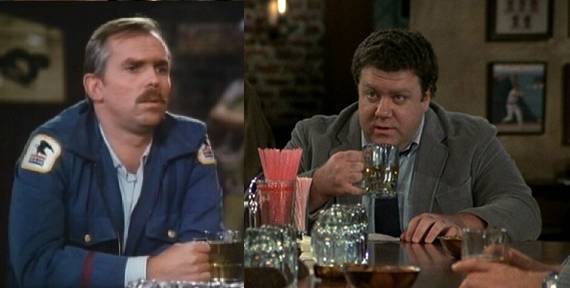
Another close friend, closer to the center politically but also leaning farther to the right than myself, shared the following allegory from an old episode of the once popular TV show, Cheers , which is also making the rounds on the Internet:

“Cliff is seated at the bar describing the Buffalo Theory to his buddy, Norm.

‘Well, you see, Norm, it’s like this… A herd of buffalo can only move as fast as the slowest buffalo. And when the herd is hunted, it is the slowest and weakest ones at the back that are killed first. This natural selection is good for the herd as a whole, because the general speed and health of the whole group keeps improving by the regular killing of the weakest members. In much the same way, the human brain can only operate as fast as the slowest brain cells. Now, as we know, excessive intake of alcohol kills brain cells. But naturally, it attacks the slowest and weakest brain cells first. In this way, regular consumption of beer eliminates the weaker brain cells, making the brain a faster and more efficient machine.  And that, Norm, is why you always feel smarter after a few beers.'”

For many, Cliff’s explanation for why we feel smarter after consuming a few beers might seem plausible, especially since so many people believe the premises… ONE: that “culling” herds in the wild of weak and infirm members is beneficial to the larger body because it makes the herd less vulnerable to predators, and TWO: that alcohol kills brain cells. But neither premise is true, not really.

In the wild, herd members must keep up or else they are left behind – no exceptions. Even new-born calves must keep pace. But studies have shown that herd speed does not reduce vulnerability to predation, mass behavior does. According to something called the selfish herd hypothesis, herds of various species move for the most part instinctively based on grazing preferences and seasonal changes, not anxiety caused by fear of predators. Individual herd members decrease predation risk by moving toward one another, which is called aggregation. Previous studies have shown that aggregation can form using simple movement rules designed to decrease each animal’s domain of danger.

As for alcohol destroying brain cells, taking out the weakest first — alcohol surely does affect the brain, as we all know, causing slurred speech, clumsiness, slowed reflexes, and a loss of inhibition. But alcohol doesn’t destroy the brain cells, per se, to cause these problems. Rather, alcohol dilates the channels in the cellular structure that regulates the flow of calcium. More calcium than normal flows into the cells and stimulates increased activity. It is this increased activity that, over time, if consumption is heavy enough and uninterrupted by periods of abstinence, causes a loss of nerve cell end segments, to include those found in the brain. But this effect has been shown in clinical studies to be general and gradual among heavy drinkers, affecting different people in different ways and at different rates.

So, even if you haven’t been drinking a beer while reading this, you should feel smarter now – right? The facts have been reveled and documented. But Cliff’s buffalo herd allegory isn’t really about feeling smarter after a few beers, is it? The subliminal message is about how society would be better off without laggards, a belief that I’ve found to be widely held by those on the political right.  The extension of this is, of course, why encourage them? They’re not worth our time and effort. Go far enough with this line of thinking and we find ourselves on the slippery slope of fascism.

I responded to the friend who sent me Cliff’s allegory by saying, “Would that it really worked that way, ___________ (name omitted here)… the beer drinking part of it at least. But the implication of this snippet from the old Cheers episode is really that society is not unlike a herd of buffalo wherein the less productive members slow the progress of the whole. Conclusion: either leave them behind for the wolves or drag ’em along with you. There’s possibly a third option though, one that mitigates the burden of the weak to society: nurture them from our excess so that many might be better able to contribute, which if I recall my Scripture correctly, is the Christian thing to do. Which option do you choose, my friend?”

Not that my friend isn’t a Christian and generous person, for I know him well enough to know beyond a doubt that he is — both, but in his response, after saying,  “Well, go ahead and contribute,” my friend deigned to change the subject. He doesn’t send me forwarded emails of a political nature anymore.

I invite your comments, supportive or un…

Published in: on August 4, 2008 at 1:39 pm  Comments (2)  

What’s the Difference Between a Town and a City — An Urban Area and a Rural Area?

Do you think you think you know the answer?

A friend recently challenged me with this question. He chose to ask it of me because he knew that I had taught geography for several years. Even so, I felt that I had to check my facts before responding and, in so doing, I broadened my own understanding on the subject a bit. He, like many Americans, thought that the official difference between a town and a city had to have something to do either with population size or with geographical area. Well, it doesn’t.

Strange as it may seem, geographers don’t classify more-densely populated areas as cities or towns. They are all called urban areas as opposed to rural areas. That’s because there is no universally accepted criteria based on either population size or square miles/ kilometers. Rural areas are less densely populated, offer fewer services, and are generally devoted to economic activities such as farming and ranching. In the U.S., according to About.com – geography, an urban area is one that has a population providing services that numbers at least 2,500. Smaller populations pro- viding services are called villages. This differs from country to country, of course. In Japan, an urban area must have a population of at least 30,000.

In England, from which we Americans originally adopted our sense of such things, a city was a town with a cathedral. All other densely populated areas were simply called towns. But they are all towns in today’s “United Kingdom,” including (in all Britishers’ eyes) the mother town of them all, London Town.

I think what most people in the U.S. understand to be a city today is a larger urbanized area that has government buildings like county seats do here in Texas. Cities in the U.S. usually have a university or two in lieu of community colleges. They very often have museums and other cultural centers too like zoos and the like. In the vernacular of a place, however, it is quite acceptable for people to refer to their urban area as either a town or a city. It’s all perception.

Metropolitan areas like Dallas, Texas are agglomerated urban areas with peripheral zones not themselves necessarily urban in character, but closely bound to the urban center by employment or commerce. A metroplex is when metropolitan areas grow large enough to merge, as in the Dallas/Ft. Worth Metroplex. A megolopolis is when many metropolitan areas merge, as on the east coast of the U.S. with BosWash, a huge urban area incorp- orating the cities of Boston, New York and New Jersey, Baltimore and Washington D.C.

My wife and I lived for several years in Springfield, VA — Virginia still calling itself a “Common Wealth” in the old English tradition.  Springfield had a population then of over 30,000, yet it was classified by Fairfax County not as a city or a town, but simply as a “populated place.” It had homes, churches, a post office, a county health department office, buildings housing police and fire depart- ments, and even a huge shopping mall containing a drivers’ licensing office for the county, but it had no government separate from Fairfax County. Vienna, also in Fairfax County, was char- tered and had an elected school board making decisions for a separate school district servicing its population. Therefore, it was considered a city.

DeSoto, Texas, with an estimated population in 2005 of 38,580, calls itself a city and even won national distinction in 2006 as an All-American City. Yet it is not a county seat. It has no zoo or museum that I know of, unless one considers my wife’s office in our home with all her nursing memorabilia a museum. Neither does DeSoto have a cathedral. But I won’t argue against its right to call itself a city. Round Top, Texas, with an estimated population of 25, considers itself to be the smallest city in Texas, being an incorporated township, but the “city fathers” of Impact, Texas disagree. They claim to be the smallest. Neither, however, even qualifies by official numbers to be an urban area. So, go figure — the answer you get pretty much seems to depend on where you are when you ask the question.

I invite your comments pro or con.

Published in: on July 23, 2008 at 3:20 pm  Comments (31)  

America ~ Is It Still a Land of Opportunity?

Obviously, it is getting more and more difficult for the vast majority of young people in America to achieve the same levels of success as their parents and grandparents, at least in terms of personal income.

July 18, 2008  —  We were delighted to learn recently that Stephanie, the oldest daughter of dear friends of ours back in Missouri, David and Nancy Israel, will be graduating from nursing school soon. Although she probably had some financial assistance based on merit, or need, or both, we suspect that her parents still had to dig pretty deep to see her through — her father being a Methodist minister and her mother a school teacher. Both careers are known to be rewarding, but not necessarily in the salary-way.

With the rising cost of higher education in this country outpacing pretty much everything except the cost of health care, more and more parents like David and Nancy are finding it more and more difficult to provide their sons and daughters with a college edu- cation — the “open doorway” to both personal and professional success in life.

To help pay for tax cuts that have primarily benefited the wealthy, President Bush reduced the size and cost of government when he became President in 2001. He stripped $12 billion from the federal student loan program as part of this reduction, and the previous level of funding for this has never been restored. Today, a Pell Grant covers only 33% of a student’s annual college costs. In1975, Pell Grants covered 84% of students’ costs. But this isn’t all the President’s fault. When Bush took office, the cost of tuition at a public four year institution was $3,501.The cost this year, 2008, is $6,185 – an increase of 56.7%. Over this same time period, median household incomes have decreased 2% despite an economy, as measured by the administration’s Gross Domestic Product (GDP), that has been expanding.  Because of this burdensome cost, the reduction in aid programs and the government’s favorable policies toward the $85 billion a year student loan industry, over 400,000 qualified high school graduates will not be able to attend college this year.

According to Bill Moyers’s new book, Moyers On Democracy, one-third of all college students graduated with debt in 1993. In 2004, two-thirds did. And, according to the College Board, the total volume of private student loans has grown by 27% since 2001, the year that George Bush became our President. Some of these “private” loans carry interest rates as high as 19%, and most undergraduate students finish with close to $20,000 in student loans whether he or she is able to find a good job or not. This is a 108% increase in just a decade. Compare this to the $11,100 in debt his/her counterpart graduate carried in 1975 paying just 6.8% interest when the government was still making these loans. This was before we started off-shoring many of our better-paying jobs for entry-level graduates. But Stephanie won’t have a problem finding a decent-paying job; nurses are in great and growing demand. Hopefully, she won’t be paying upwards of a third of her salary to retire student loans as some must.

So who has been making all this money in an expanding economy? Good question.

According to a PhD economist, Paul Robin Krugman, who is professor of economics and international affairs at Princeton University and also a columnist for The New York Times, if we were to equate the total population of Americans in the civilian labor force with 1,000 people and line them all up left-to-right according to how much they make, then equate their personal incomes with how tall they are, the person in the middle would be six feet eight inches tall. The person on the extreme left would be only 20 inches tall. But the person on the extreme right — wow!  He would be almost 600 feet tall — nearly 5 times taller than his counterpart back in the mid-seventies. The persons to the left of center would have all grown too, reflecting a growing economy, but they would only be about fourteen percent taller today.

So, one might well ask, “Is America still a land of opportunity?” This, I realize, depends on how one defines success. But if income is part of one’s definition of success, the correlation between years of education and success could not be stronger. The following table is from the textbook that I use in my Economics Survey class published by Glenco/McGraw-Hill.


Obviously, it is getting more and more difficult for the vast majority of young people in America to achieve the same levels of success as their parents and grandparents, at least in terms of personal income. And the so-called gender-gap is still very real. But that doesn’t answer the question, “Is America still a land of opportunity?” In the abstract, it certainly is. Odds are now that Stephanie, with her college degree, will enjoy a measure of success, both personally and professionally. But what about those 400,000 otherwise qualified high school graduates that won’t be going to college because it has become too expensive?

As you can see, the ramp to success in this country is getting steeper — the social goal of equal opportunity, more elusive. So, out of curiosity, I decided to find out what people think about America still being a land opportunity. In a recent survey of The World According to Opa readers, I posed this question, “Do you believe that anybody in America can be successful in this day and age if they try hard enough?” Follow-up questions included, “how much do you believe money has to do with success, do you consider yourself to be more liberal or more conservative,” and, “how do you define success?” With 75 responses (more than half of them coming from persons self-identifying as being more con- servative than liberal) I got some very interesting results. From the numbers and correlations I was able to make, the results supported my hypothesis that conservative thinkers are more likely to believe that anyone can still make it in America, but not strongly. The correlation between conservatives and believing this was 82.5 percent. The correlation between liberals and believing was 17.5 percentage points less. Somewhat surprising to me, considering the rising costs of higher education, skyrocketing energy, food and medical costs, and the escalating number of home foreclosures, is that nearly three-fourths of all who responded still believe. So, despite it all, Americans remain an optimistic people.

All my data were from respondents who are affluent enough to have Internet access, mostly middle class, homeowners. So the survey was not entirely valid in that it did not include opinions from people in lower socio-economic circumstances. They, no doubt would be more pessimistic. But, if I included the same number of people from higher socio-economic circumstances too, they tending to be more optimistic, the more inclusive survey would probably balance-out with similar results to that which I already have from middle class homeowners.

Seventy percent of respondents said that they believed money was “somewhat” important as a measure of success, while only 7.5% said that it was “very” important. Twenty-two and a half percent said that money had very little to do with it. Surprise! But the most interesting result, I think, had to do with how respon- dents said they view success. Almost all said that being self-sufficient and able to provide basic needs and wants for loved ones is important. Most also included considerations of self-esteem and being happy with one’s lot in life in their definitions. About 80% included considerations of altruism…being able to give back to society in some way, while a small number said that success simply meant being able to do what one wants to do when one wants to do it. Sixty-nine point seven percent of conservatives included altruism in their definitions; a whopping 92.3% of liberals did the same.

So, I conclude that, for most Americans, equal opportunity has become less equal in recent years. Despite what we teach to our students in classrooms all across the land, and despite what most Americans still believe, America is not the land of opportunity that it was for us Baby Boomers and for our kids, the Generation Xers. I also conclude that, at least among those who read my blog, in addition to being optimistic, Americans are a generous people. But the most generous of Americans are those who call themselves liberal. It will be these voters who, I predict, if they are successful this year in restoring the White House and full-control of the Congress to Democrats, will begin to restore to us all to something closer to equal opportunity. And may God bless us all, rich and poor alike.

 I invite your comments, both pro and con.

Published in: on July 18, 2008 at 12:27 pm  Comments (4)  

A Comprehensive Energy Plan ~ Thinking Out of the Box

We must tighten our belts – we must evolve both socially and economically if we are going to survive.

One of the most serious limitations of economics, as every teacher of the subject is aware, is that the study defaults to using money as its bottom-line measure and storehouse of value. We can’t easily factor-in quality-of-life, happiness, or the environment and other so-called subjective considerations. It’s not that we can’t. It’s just that we find it easier to stick with dollars, pesos, renminbi, euros and yen. For these we have exchange rates, and it is for these that investors clamber. But how many Chinese renminbi is the life of a single child worth having succumbed to arsenism, fluorosis, or any number of respiratory illnesses that result from the combustion of low-grade coal? Who will compen- sate the family for this loss?

These questions are almost like asking how many angels can dance on the head of a pin. We may not be able to know, but we must be able to decide if the world as we know it will long survive.

All Presidents since Richard Nixon and the oil crisis of the 1970s have included energy considerations in administration policies. Nixon gave us the National Maximum Speed Limitof 55 mph. Carter deregulated domestic oil production and gave us the Federal Department of Energy, then pushed Congress to increase Corporate Average Fuel Economy (CAFÉ) standards. In 1978, the United States Strategic Petroleum Reserve was created and the National Energy Act was introduced. Ronald Regan, in 1983, pushing for more nuclear energy, attempted to get government out of the energy business by merging the Department of Energy with the Commerce Department, which Congress refused to go along with. He was, however, able to get Congress to approve initial steps in building the Yucca Mountain Nuclear Waste Storage Facility on Federal lands in Nevada. George H. W. Bush put together an impressive international force to drive Saddam Hussein out of Kuwait in 1990 – 91 and his son, George W. Bush, took us back to Iraq in 2003. Now, while one will still get some argument over this, most Americans are convinced today, as are the Iraqis, that Operations Desert Storm and Iraqi Freedom had/have more to do with the oil found in Kuwait and Iraq than they did with the freedom of Kuwaitis or with Weapons of Mass Destruction (WMD). What did Bill Clinton do for us? Overruling Treasury Department Antitrust concerns, his administration approved the merger of Exxon and Mobile oil companies, making it the single largest private corporation in the world at that time.

Why has so much of our energy policy emphasis been on oil? It’s because the United States gets approximately 80% of its energy from fossil fuels, and 17% of this is from oil, two-thirds of which is imported. In coal and natural gas, we are self-sufficient, but it’s not economically feasible to fuel cars, trucks and airplanes with coal and natural gas. That’s why most of the oil we use is consumed by the transportation sector.

Americans, who constitute less than 5% of the world’s population, consume 26% of the world’s energy. We account for about 25% of the world’s petroleum consumption, while producing only 6% of the world’s annual supply. So… increase U.S. oil production, right? Wrong, we have only 3% of the world’s known reserves. Even with ANWR and other coastal areas opened to drilling, we would still be dependent on foreign sources to sustain our current life styles.

A new, comprehensive energy policy is needed, one that has two goals:  1) the reduction/elimination of dependency on foreign sources of oil, especially sources other than North American, and; 2) avoidance of environmental calamity owing to Global Warming, a calamity the vast preponderance of climate scientists in the world are predicting. You’ve heard enough about this already and you’re either convinced this threat is real or you’re not. But I am convinced, and I am very much afraid for the future of mankind.  According to Dr. James Hansen, head of the NASAA Goddard Institute for Space Studies and the father of climate change research at that agency, we must reduce our atmospheric concen- tration of CO2 from its current 385 ppm (particles per million) to 350 ppm or less to avert disaster in our lifetimes. That means cutting way back on our consumption of fossil fuels, especially dirty coal and petroleum.

If we do not change our consumption habits, world demand for energy from all current sources will only increase as our populations grow and emerging economies become more affluent from free trade. Therefore, a comprehensive national policy will not be enough to address the second goal, that of avoiding a global warming catastrophe, which, in the long run, truly is the bigger problem. Accordingly, our new comprehensive energy policy must be coordinated with the rest of the world. This means returning to the negotiating table – revisiting the Kyoto Accords, which we could never satisfy now, or hammering out a more demanding protocol as part of a successor accord. For the U.S., this might mean committing to a 40% reduction in CO2 emissions by 2020 and an 80% reduction by 2050 as our “fair” share of the contri- bution. Can we afford to do this? Can we afford not to do this?

Pay me now or pay me later.

How do we get there? Well, I’m sorry folks – but policies aimed at bringing down the price of gasoline and other fuels so that we can continue on the same path we’ve been on since the end of WWII address neither goal of a “comprehensive” energy policy. They won’t make us any safer and they sure won’t make us any healthier. We must tighten our belts – we must evolve both socially and economically if we are going to survive.

Not indifference to Senator McCain’s thoughts on energy policy announced last week, here are my recommendation for the next administration to pursue with the American people through their representatives in Congress. First, convene a bipartisan panel for “long-term” energy policy that includes energy, environmental and economic experts who are not representatives of energy industries’ profit interests. Energy policy this time around should be motivated by the moral equivalency of survival rather than profit. Second, leave nothing off the table for consideration… nothing, not new nuclear power plants, not carbon cap ‘n trade regulations, not conservation or moratoriums on new coal-fired electric plants, not the drilling in ANWR and new coastal areas, and not even nationalization of energy production or considerations of eminent domain. Too much is at stake here: national survival — nay, even the survival of our civilization.

This new energy panel might consider the following: 

1. new tax subsidies for urban area mass transit systems and the expansion of interstate, rapid rail transportation systems;

2. Federally-funded alternative energy research with a national goal such as that established by President Kennedy in 1961 to put a man on the moon (industry seems to be more interested in exploiting current geo-political circumstances and lobbying Congress so that they can produce more oil for profit than in seriously considering alternatives);

3. backing-off subsidies for bio-fuels until technologies are available at a sufficient scale to make the production of ethanol and other bio-fuels from non-food sources practical;

4. the regulation or nationalization of energy and transpor- tation industries seeking cost containment and efficiencies (I know, I know, this smacks of socialism, but these things are working for other, mostly-market economies like our European and industrialized Asian friends);

5. tax incentives to help people transition from gas-guzzlers to hybrid and electric cars as they become more widely available, and the acceleration/expansion of CAFÉ requirements for new vehicles to discourage both production and demand for energy- wasting vehicles (certainly, pickup trucks and SUVs should not be excused from the same mileage and environmental standards as sedans);

6. “New Deal” style government work programs and tax incentives to insulate older homes, replace outdated, energy-hog appliances, and install decentralized, renewable energy sources such as wind generators and solar panels.

It is my personal belief that nothing short of an “all-court” press is going to salvage the energy situation that we find ourselves in today. This means that we’re all going to have to get on the same team, because the opposition is not China or OPEC. The opposition isn’t even al Qaeda. The opposition is inertia (resistance to change) and greed.

I invite your comments, pro or con, and would be very much interested in hearing of any ideas to expand my list for the next administration to consider (I don’t have all the answers; nobody does).

Published in: on June 30, 2008 at 12:00 pm  Comments (3)  

Normative Economics ~ Weighing-in On the Windfall Profits Debate

Politicians all want to do something for the economy in the worst way, and they usually do. Why?  They do so either because they want to get elected, get reelected, or make money for themselves and their friends. 

Perhaps a better title for this posting would be, Normative vs. Positive Economics ~ Why Politicians Aren’t Always the Best Deciders. But, because the windfall profits tax is a hot blog topic lately, I figured I’d get more hits on it with the title I chose.

Most economists, including those of us who, as teachers, just dabble at the edges of this “dismal science“, question the wisdom of imposing a windfall profits tax on big oil. We all teach that, ceteris paribus, when governments raise taxes on producers, much of that increased cost of production is simply passed-on to consumers. But if economics is only useful in the study of how things are (positive economics), then it truly is a dismal science. Fortunately, economics also involves consideration of the way things should be (normative economics).

Most Democrats in Congress, and the presumptive nominee of the Democratic Party for President, responding to the country’s desire for change, think that a windfall profits tax on big oil would be a “fair and reasonable” way to ease the pain and anxiety that Americans are feeling over rising fuel costs. They tend to believe that democracy should deliver the basics of life for all working Americans — normative economics.  Republicans, who are more resistant to change, tend to be more pragmatic. They believe in classic economics which teaches that government should get out of the way and let market forces do what they do — positive economics. 

I don’t recall for sure who said it first, but it certainly seems to be true: Politicians all want to do something for the economy in the worst way, and they usually do. Why?  They want to do so either so they can get elected, get reelected, or so they can make money for themselves and their friends. 

Here’s an interesting quote from the latest Sierra magazine: “Let us rid ourselves of the fiction that low oil prices are somehow good for the United States.” Who said this?  Then representative Dick Cheney in 1986 said this as he introduced a bill before Congress to impose a tax on imported oil. Gee – that was smart.

President Jimmy Carter, who has taken an awful lot of flak over the years from Republicans for the economic problems that persisted during his administration, may just be the exception to the rule for politicians. As President, responding to OPEC’s orchestrated reduction of output to punish the west for its support of Israel during the Yum Kippur War, Carter created the Depart- ment of Energy and established a national energy policy aimed at reducing our dependence on foreign oil. By personal example, he encouraged Americans to cut back on energy consumption and he removed price controls from domestic petroleum production.  As imports and oil company profits later began to grow, he tried a windfall profits tax anticipating big revenues. Instead, tax revenues declined and domestic oil production plummeted by an estimated 795 million barrels. So, we’ve been down this road before.

I personally believe that Carter was acting on the best advice of the economic advisors who had his ear at the time, and that he acted in the best interests of the nation as a whole. But one would think that we’d have learned our lesson by now.

Try as I may, I fail to find much convincing argument on the Internet currently to support Barack Obama’s pledge to impose a windfall profits tax on big oil. To the contrary, the blogosphere is filled with augments against it (good work McCain supporters). But Obama’s opponent this year isn’t making much economic sense either by advocating a federal gas tax holiday. So, why are they both making these kinds of promises? They are doing so because these things resonate with the voters, and the voters are very much in a populist mood this year. Only 47 percent of Americans are against nationalizing our oil companies, which most other nations have already done, oil being such a basic commodity to the livlihood and social welfare of a nation’s people.

A June 14th Rasmussen Report poll found that only 36 percent of voters believe that a windfall profits tax on big oil would cause fuel prices to go up. The rest, less 23 percent who said that they were not sure, said that prices would either go down or that they would stay the same. So, while the tax idea may be a loser in terms of offering a near-term solution to higher prices, it’s not necessary a looser politically, unless McCain supporters can successfully educate voters to the contrary before November.  Nor is the tax necessarily a looser in terms of contributing to a long-term solution. The same Rasmussen Report poll found that 76 percent of Americans believe that new energy technology developments are more likely to solve the problem than anything else, and the majority polled said that, given sufficient investment, private industry would be far more likely to succeed at this than government research programs.

Okay, you say, but you don’t believe in polls. Well, I do. I believe that, collectively, Americans are not dumb. It’s called, government of, by and for the people, not just for stockholders, but for people who must borrow from Peter to pay Paul on a monthly basis just to keep food on the table and their kids in school.

Now we get into the arguments about whether big oil’s profits are truly excessive and whether big oil is or is not already investing substantially in alternative energy technologies.

Exxon Mobil, the world’s largest oil company, reported last quarter a profit of $10.9 billion, up 17 percent from a year before. It was the second-most-lucrative quarter in the company’s history, after the record $11.7 billion pocketed in the previous three months. Chevron reported profit of $5.2 billion, up almost 10 percent from a year earlier. Europe’s Royal Dutch Shell said its quarterly profit jumped 25 percent to a record $9.1 billion, while British Petroleum said its profit soared 63 percent to a record $7.6 billion. Earlier, ConocoPhillips said its profit rose 17 percent to $4.1 billion, and Occidental Petroleum said its profit climbed 50 percent to a record $1.8 billion. But, is any of this excessive? What is a fair and reasonable profit? Should government ever set limits on how successful corporations can be in terms of profit, and should we not be able to compel businesses, by legislation, to act responsibly?  All these questions are in the realm of normative economics, so the answers tend to be subjective. 

Most of us would agree that 10 percent profit is fair and reason- able… but twice that much – seven times that much, especially when the average Joe can’t afford enough gas to just commute back and forth to work? Forget about that summer trip this year, kids. No wonder Americans are outraged. Even John McCain is outraged. On May 5, while campaigning in North Carolina, McCain said that he was willing to consider the windfall profits tax too. “I don’t like obscene profits being made anywhere,” McCain said, “I’d be glad to look not just at the windfall profits tax, that’s not what bothers me, but we should look at any incentives that we are giving to people – or industries or corporations – that are distorting the markets.”

On the score card for investments in alternative energy tech- nologies by U.S. oil companies, it seems to me that the picture is more objective. Speaking at a Houston energy conference last year, Exxon Mobil chairman and CEO Rex Tillerson said, “I don’t know much about farming, I’m not an expert on biofuels, and there’s not a lot of technology I can add to moonshine. There is really nothing we can bring to that whole issue. We don’t see a direct role for ourselves with today’s technology.” Obviously, he and the second largest corporation in the world after WalMart, are more interested in near term profits than into long term sustain- ability. Long term? Hey, that’s my grandkids we’re talking about now!

During their press conference last month, the founding family and self-billed longest continuous shareholders of Exxon Mobil, the Rockefellers, said that they think the oil giant should be investing more in clean energy — and that separating the chairman and CEO functions may put the company in a better position to face challenges in the future. Exxon Mobil’s competitors, they pointed out, like British Petroleum, Royal Dutch Shell, Conoco Phillips, and Chevron, have collectively invested billions of dollars in recent years in renewable, low carbon technology research to reduce emissions and integrate the cost of carbon into strategic planning and investments. But half of these companies are foreign, government-owned companies. So, no, I do not think that U.S. oil companies are adequately committed to the long term, best interests of the American people. They are concerned first and foremost about near term profit for their shareholders.

The problem of high fuel prices is basically an issue of supply and demand. The high and ever-growing global demand for oil and its limited supply, coupled with market uncertainty over the stability of its supply, is raising the price per barrel. At the same time, profit expectations of oil company stockholders stoke each company’s drive to seek ever higher profit margins. Obviously, these two factors are in tension. If economic theory holds, in time the market will find an equilibrium that suits both the consumer and the investor. But this begs the question:  will it happen soon enough?  As John Maynard Keynes said, “In the long run we are all dead.”

Fuel prices are less in the United States than they are in most of the rest of the world. However, Americans don’t care. Our economy and our standards of living, for as long as any of us can remember, have been based on the false assumptions of an unlimited and uninterrupted supply of oil. We complain about volatile prices for gas and diesel at the pump while, at the same time, we demand that our investments turn a profit.

A windfall profits tax, if implemented properly with incentives built-in to increase investment in capital to include new energy technologies, might help to regulate market volatility felt at the pump. But let me emphasize the underlined word, might; big oil moguls and large shareholders could just decide, as they have in the past, to just take their money and run. I’m sorry Barack, but I must conclude that it’s highly unlikely that a windfall profits tax will raise much revenue or ever bring prices down. To bring prices down, we must do some combination of the fallowing: reduce world demand for oil; restore the value of our dollar by reducing debt and the foreign exchange deficit; reduce or eliminate market anxieties concerning the flow of oil out of the Persian Gulf; and develop sustainable alternatives for it.

I invite your comments to this posting, whether pro or con.

Published in: on June 21, 2008 at 5:29 pm  Comments (6)