Generosity ~ A Spiritual Gift

Maybe a ten percent tithe for some of us isn’t really so extravagant at all. Maybe those of us who are richly blessed and have the Spiritual Gift of Generosity need to re-prioritize our giving – dig a little deeper. Maybe some of us who are richly blessed need to cultivate this Spiritual Gift.

After finding out that someone had nominated me to serve on the Stewardship Committee at my church, I thought – What is it about me that someone thinks would qualify me for this ministry? Without an answer to that question yet, I went ahead and said, yes, anyway when I was asked because I had told my pastor that I was willing to serve in whatever capacity the nominations committee thought appropriate. Subsequently, I felt called to sign up to teach in my adult Sunday school class on the subject of generosity. Maybe that was a coincidence, maybe not. But something was stirring within me about the subject.

I agreed to go to a leadership training program a couple of Sundays before scheduled to teach my lesson. There, I signed up for the finance breakout session following the keynote address. It was the closest thing to stewardship and, as it turned out, it was what everyone in group wanted to talk about. After an excellent presentation on budgeting and auditing, the lecturer asked if there were any questions. One man raised his hand then stood to ask, “Are there any here whose churches are not struggling with finances?” Silence. Every United Methodist church represented in the Dallas Metro District that day was struggling. The first question was: Why? The next was: What can we do about it? Answers to the first question came from others; all I could do was sit and listen; I had no clue. One man said, “I think it’s because church attendance is down.” Another said, “I think it’s because all the generous givers are dying off.”

I considered all that I had heard that day, then I started preparing for my Sunday school lesson. I ignored the chapter in our study guide book, Five Practices of Fruitful Congregations. It mostly talked about why we should all tithe according to Scripture passages from the Old Testament.  That whole idea seemed out of date to me — judgmental. I prepared a PowerPoint presentation to guide and facilitate discussion on generosity. I was prepared, I thought. But just before teaching, I told our pastor what I was planning to teach. He told me to tell my class that generosity is a Spiritual Gift. Hmmm, I thought. I had not heard that idea before, and I almost considered not showing my PowerPoint at all, but basing the lesson entirely on that one idea, that generosity is a Spiritual Gift. If that were true, I thought, since giving is less than it once was, is the current generation spiritually deprived? And, if so, why?

What are Spiritual Gifts? I knew on the spot that I had to talk about that. I had to talk about it because my pastor was right. We need to know the role that each of us has to play in the financial work of the Kingdom. While all of us are called to give, God has ordained some people to be super-givers. Check out this passage from Romans 12:6-8, which deals with spiritual gifts in the church:

We have different gifts, according to the grace given to each of us. If your gift is prophesying, then prophesy in accordance with your faith; if it is serving, then serve; if it is teaching, then teach; if it is to encourage, then give encouragement; if it is giving, then give generously; if it is to lead, do it diligently; if it is to show mercy, do it cheerfully.

Many of the things that Paul lists in this passage are spiritual gifts that we are well familiar with: Some people are gifted in prophecy, others in serving, others in teaching, others in encouraging, etc. In fact, you may have spent time in your church or on your own studying these spiritual gifts, trying to determine which of them is most active in your life. But did you notice, hidden in the middle of verse 8, the scripture mentions generosity? “If it is giving,” the passage says, “then give generously.” Wow.

I went ahead with using my PowerPoint, intending to weave into the presentation the idea that generosity is a Spiritual Gift. My first slide listed the Chapters in our study guide book and the title of the day’s lesson. I announced that I was departing from the study guide approach to the subject.

  • The Practice of Radical Hospitality
  • The Practice of Passionate Worship
  • The Practice of Intentional Faith Development
  • The Practice of Risk Taking Mission and Service
  • The Practice of Extravagant Generosity
  • Excellence and Fruitfulness

My next slide was this, the definition of extravagant.

ikˈstravəɡənt/

Adjective

  • Lacking restraint in spending money or using resources.
  • costing too much money.
  • exceeding what is reasonable or appropriate; absurd.

My next slide simply asked the question: What is the most extravagant thing that you’ve ever done concerning money? Everyone who responded to the question mentioned things that they had done for themselves… expensive cars, ocean voyages. I was thinking about the money I gave to my church years ago to create a quite garden for people to rest in, to meditate in, to pray in. I called it the Grandmothers’ Garden, dedicating it to the memory of my own dear grandmother. Why? I thought. Why do I remember something that I had given away rather than something I had purchased for myself? I don’t know the answer. But, in all humility, I suspect it’s because I am part of that generation of generous givers that gentleman in the finance class I sat in on mentioned. Others in my class are younger than me. They are very much in the Baby Boomer generation. Not to brag, but I barley made the cut; having been born before the end of WWII, I’m officially part of the Mature/Silent generation – the Greatest Generation.

The following information, part of which I shared with my class, comes from Dr. Jill Novak from the University of Arizona and Texas A&M. Here is a link to the information which appears at the Marketing Teacher.com website. The URL is: http://www.marketingteacher.com/the-six-living-generations-in-america/ Mind you, the following do not describe everyone in the two oldest living generations. The characterizations are general in nature according to Dr. Novak.

Mature/Silents, born 1927- 1945, went through their formative years during an era of suffocating conformity, but also during the postwar happiness: Peace! Jobs! Suburbs! Television! Rock ‘n Roll! Cars! Playboy Magazine! Mature/Silent men pledged loyalty to the corporation, once you got a job, you generally kept it for life. And they are the richest, most free-spending retirees in history. They have a strong sense of trans-generational common values and near-absolute truths. They are disciplined, self-sacrificing, and cautious as well.

Baby Boomers, born between 1946 and 1964, come in two sub-sets: 1. the save-the-world revolutionaries of the ’60s and ’70s; and, 2. the party-hardy career climbers (Yuppies) of the ’70s/’80s. These are the “me” generation. They tend to be self-righteous and self-centered. They have bought it now and they used credit to do it. They’re also too busy for much neighborly involvement, yet strong desires to reset or change the common values for the good of all. They want change, but aren’t so keen on changing themselves.

Even though their mothers were generally housewives, responsible for all child-rearing, women of this generation began working outside the home in record numbers, thereby changing the entire nation as this was the first generation to have their own children raised in a two-income household where mom was not omnipresent.

The aging of Baby Boomers will change America almost incomprehensibly; they are the first generation to use the word “retirement” to mean being able to enjoy life after the children have left home. Instead of sitting in a rocking chair, they go skydiving, exercise and take up hobbies, which increases their longevity. The American Youth Culture that began with them is now ending with them and their activism is beginning to re-emerge.

Yes, the Great Givers are a dying breed.

My next slide quoted Scripture – Matthew 6:21: For where your treasure is, your heart will be also. I asked my class what it is that they most love about our church. Almost everyone said that they love our Sunday school class best. One lady said, “Our great missions program.” Had I been asked, I told the class, I’d have said, all the opportunities that the church affords to be in service to others: The Caregiving Ministry that I lead, The Children’s Program that our little great granddaughter derives so much from, The Helping Hands Ministry, The Handy Man’s Ministry, The United Methodist Men and The United Methodist Women. But then, others in my Sunday school class, though engaged in many different missions and ministries, are mostly Baby Boomers, the Me Generation.

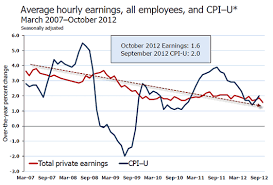
My next slide addressed the dual problem of a rising cost of living while the disposable income in most households has long been on a downward trend. Yes, the Consumer Price Index – Unchained has been up and down, the chained index has gone up and up with the costs of education and healthcare skyrocketing. Why is this? As a retired teacher of economics I can tell you that the unchained index reflects actual spending – the substitution phenomena.  When people have less disposable income, they spend less or substitute preferred goods and services for something else.
hourlyearning

It’s like the elderly halving their prescribed medications, cutting their pills in-half to make them last longer, this so that they can afford to eat too. It is true that many in our society today are struggling. So I was not surprised when one of the ladies in my class shared that she knows her married daughter and her daughter’s husband have to squeeze hard to be able to afford giving the church just fifty dollars a month. Forget about tithing. Giving ten percent of their disposable income would mean they couldn’t afford to put gas in their cars to get back and forth to their jobs.

So, it becomes clear why many churches are struggling financially in today’s world. It is clear too that they will struggle more and more in future years, at least until the economy improves for the middle class. In the meantime, what are we to do? Well, I suggest that those of us who are blessed with more will need to give more. Maybe a ten percent tithe for some of us isn’t really so extravagant at all. Maybe those of us who are richly blessed and have the Spiritual Gift of Generosity need to re-prioritize our giving – dig a little deeper. Maybe some of us who are richly blessed need to cultivate this Spiritual Gift. After all,

Each one must give as he has decided in his heart, not reluctantly or under compulsion, for God loves a cheerful giver.

~ 2 Corinthians 9:7

Published in: on February 20, 2015 at 2:14 pm  Leave a Comment  

The Social Contract ~ Why We Have Government

Private enterprise cares nothing about the poor! This is so abundantly clear to me; opportunity does not, never has, and never will trickle down from the good fortune of the few. 

It puzzles me why so many don’t get it, that government is not the problem as President Ronald Reagan suggested. As it is today, it certainly isn’t the whole solution. But to the extent that it is not the solution, we have only ourselves to blame. We have allowed the money changers to gain control of it.

These are words that people have come up with to describe what is meant by a social contract, one like that which we are all part of by being citizens living under the Constitution of the United States.

20130802-123052.jpg
Private enterprise cares nothing about the poor! This is so abundantly clear to me; opportunity does not, never has, and never will trickle down from the good fortune of the few. It is from us, the workers and consumers in this country, more than from their own efforts, that the privileged few owe their good fortune.

Government is not only the guarantor and protector of the social contract, it is the facilitator and arbiter as well. If you doubt this, read the Preamble to the Constitution — again.

Yes, there are a “thousand points of light,” as George Herbert Walker Bush proclaimed. But left to these alone, to individuals, benevolent corporations, churches and private charities, to help the less fortunate, millions more would be standing at road intersections with cardboard signs begging. Millions more would be living in shanty towns again. And how many of us stop to offer aid to those who are already begging? No, government is the most efficient way to alleviate suffering and to build scaffolds for the disadvantaged, perchance to restore the middle class. Government compels us to do our part, to contribute to the general welfare, to do our civic duty.

By all means, continue giving to churches and private charities. But “Render unto Ceasar” as well, for ours is a very different Ceasar from the government that was ancient Rome. Ours, if we choose to let it be, has been elightened by history, by great thinkers, and by religious teachers. Ours has been inspired by great leaders such as Washington, Jefferson, Adams, Lincoln, Roosevelt (both of them), Eisenhower, Kennedy and yes, the Reverend Doctor King. We need merely to drive the money changers out of Washington as Christ did to the money changers long ago in the temple of Jerusalem. He did this as an example for us.

Please feel free, whether you agree or not, to leave a comment in response to this posting.

Published in: on August 2, 2013 at 10:31 am  Comments (4)  

Socialism vs. Fascism

Tell me if you think I’m wrong, but it seems to me that America is moving away from democracy and toward fascism rather than flirting with socialism as many on the far right are claiming.

Opa_IIApril 11, 2013 — With all the name calling going on by political media show hosts/pundits and politicians these days, people seem not to know the difference between socialism and fascism. Despite what some have said and written to confuse us for political purposes, the difference is as stark as it is simple. Under socialism the government owns the major industries, not the capitalists http://en.wikipedia.org/wiki/Socialism. Under fascism, wealthy capitalists/corporations basically own the government http://en.wikipedia.org/wiki/Fascism. History makes this clear.

Coming to power during the early 1930s, Adolf Hitler targeted the Communist and Socialist Parties in Germany for elimination. At first, however, Hitler claimed socialist views to gain popular support, hence the name National Socialists. But he was never truly a socialist. Once in control of the party, he, with Hermann Göring and Heinrich Himmler at his side, moved it away from its original leanings and Germany ended up fascist. Big capital was allowed to operate profitably provided it cooperated with the state, and workers were completely excluded from power http://en.wikipedia.org/wiki/Adolf_Hitler’s_rise_to_power.

Tell me if you think I’m wrong, but it seems to me that America is moving away from democracy and toward fascism rather than flirting with socialism as many on the far right are claiming. Why? Look at all the influence wealthy capitalists and corporate interests have with Congress. Consider how the Koch brothers and fossil energy industries have essentially squashed any meaningful efforts to address global warming by promoting skeptic/deniest arguments. Consider the significance of the Supreme Court’s decision on the Citizens United case — declaring that corporations are people. Consider the NRA’s influence with Congress to squash any meaningful measures to reduce gun violence in America notwithstanding massive public support for them. Consider how Big Pharma was able to protect themselves from lower priced drug imports from Canada. Consider Wall Street’s efforts through Congress to prevent enforcement of new consumer rights regulations. Consider too how the party of big business has in recent years elevated gerrymandering in Republican controlled, Right-to-Work states to new levels, effectively denying the poor, the elderly, minorities and young voters equal representation during elections. Is this not excluding workers from power/participation in the democratic process?

Wait a minute you say, is capitalism fascist then? No, not necessarily; it’s a matter of degrees. Neither is socialism communist. Communism is a form of totalitarian government employing socialism exclusively or with a limited amount of free enterprise called a mixed economy. http://en.wikipedia.org/wiki/Communism

Capitalism is getting a bad rap lately, largely because of its success. Big-this and big-that, in my opinion, have eliminated so much competition and gained so much political clout that markets are losing self-discipline. Banks, oil companies, airlines and pharmaceuticals are colluding through mergers and lobbyists to force favorable legislation and looser regulations for their industries.

Socialism has an important role to play in any free society. It facilitates sharing resources and services: clean water, public utilities, police, fire and other emergency responders, public education, etc. But, as an economic system, a market economy with some degree of capitalism, is still the only way to go. The problem arises when the forces of competition and greed become greater than the people’s democratic government itself. Corporate success in the marketplaces of goods, services and ideas, must therefore be constrained with reasonable regulations to protect the very people that corporations claim to serve. And government must remain of, for and by the REAL people rather than the corporate people.

I invite your comments.

Published in: on April 11, 2013 at 8:28 am  Comments (1)  

Political Terrorism ~ A Troubling Analogy

No, I don’t think republican politicians are terrorists. I do believe, however, that they don’t realize their actions to resist progressive changes are tantamount to the same thing. 

July 8, 2012 — I usually don’t hesitate to share things on my Facebook page that resonate with me. But I thought better of it this morning. A post that compared current republican politicians to terrorists struck me as being over-the-top. I’m more used to seeing and hearing extreme rhetoric from the right. So I was bothered by this kind of thing coming from the left. Still, the rationale for the comparison was… well, troublingly sound. Mind you, I’m not making this argument myself, just throwing it out there for discussion. What follows is what my Facebook friend said.

“One of the more interesting questions is: What is the difference between crimes of omission and crimes of commission? Are there any? And if so, are they differences in degree or difference in kind? Is there any real difference between allowing people to die when you have the means of preventing their deaths at hand and killing them by your own hand?  If I know that you are going to die if you don’t get a certain medication and I have the money to buy that medication for you – and I don’t? Don’t I bear some responsibility for your death?

The GOP argument seems to be that it’s okay for us as individuals to save one another. That would be charity. But it’s not okay for society to do this as a matter of public policy. That, you see, would be socialism! Terrorists, republicans would say, are evil villains who kill innocent people in order to make a political point.  Republicans, however, call themselves compassionate conserv- atives who simply allow innocent people to die in order to make their political point. They don’t seem to notice that innocent people are dead, one way or the other.

We are the only developed nation that doesn’t practice socialism in its health care system. And if helping the sick and the dying with tax dollars is socialism, I say, let’s have socialism.”

Again, I’m not myself making the argument that current crop of republican politicians are terrorists. But wasn’t a health care concept involving an individual mandate to buy health insurance not first advanced by the conservative think tank, the Heritage Foundation?  Weren’t health care bills containing the individual mandate introduced and promoted in the Congress by republicans back in the 90’s as alternatives to the Clintons’ proposal for universal coverage?  http://healthcarereform.procon.org/view.resource.php?resourceID=004182

Why now are republicans so much against a health care plan for the nation that their own nominee-apparent for president, Mitt Romney, implemented in Massachusetts when he was governor there? Could it be that the sitting president, Barack Obama was in the White House when the republicans’ plan was finally passed (over their objections) and signed into law. Now, because it has a democrat president’s name associated with it, it’s suddenly socialism. Hmmmm?

Seems to me that republicans decided they didn’t like the idea of any kind of health care bill soon after President Obama was elected. Republican Senator Jim DeMint said, “If we’re able to stop Obama on this it will be his Waterloo. It will break him” http://crooksandliars.com/john-amato/scs-jim-demint-would-rather-bring-pain, and democrats are accusing republicans lately of seeking political gains over the good of the country. As evidence to support this, they point to McConnell’s quote from October 2010 in which he said, “The single most important thing we want to achieve is for President Obama to be a one-term president.”

No, I don’t think republican politicians are terrorists. I do believe, however, that they don’t realize their actions to resist progressive changes are tantamount to the same thing.

Recall that Congressional republicans held the full faith and credit of the United States hostage  last summer, threatening to impose fiscal catastrophe on all of us to achieve a specific (and unnecessary) policy goal. It was, to my mind, the worst thing an American major party has done, at least in terms of domestic politics, since the Civil War. Now they are gearing up to do the very same thing again http://www.nytimes.com/2012/05/16/us/politics/gop-pledges-new-standoff-on-debt-limit.html. Now, if this isn’t terrorism, it’s terrorism-like. They might as well have held a gun to the president’s head last year.

With regard to “actual” life-and-death matters, republicans argue that America has the best health care system in the world. Never mind that 45,000 Americans die every year, according to a Harvard Medical School study, for lack of insurance coverage http://www.reuters.com/article/2009/09/17/us-usa-healthcare-deaths-idUSTRE58G6W520090917,  Never mind that the World Health Organization (WHO) ranks our system only 37th in the world behind, not only the whole list of European “socialist” countries, like France, the Netherlands and Nordic countries, but countries like Colombia, Chile and Saudi Arabia too. Our system does rank first in something though, it’s first in cost http://en.wikipedia.org/wiki/World_Health_Organization_ranking_of_health_systems.

Sure, for Americans and foreigners with money to spend, our system is great. For folks with premium insurance policies, it’s also pretty doggone good. Hey, on Medicare with an AARP supplement policy, I got a new knee last year and received excellent care from my surgeon, the hospital and the entire team of doctors and nurses. I got excellent physical therapy following the surgery too. I can now keep up with my great granddaughter on the playground (almost). The only cost to me was, and continues, to be the monthly premiums for my supplement. But I can afford it. For Americans who happen to be out of a job or working for minimum wage and without insurance, take a number and wait in emergency rooms while the cost for care grows at a rate of sixteen percent per year http://en.wikipedia.org/wiki/Health_care_in_the_United_States. You get no annual checkups and no preventive care unless you are a child on CHIPS or retired and on Medicare. This is the state of affairs that Obamacare is designed to correct.

When asked on Fox News recently what plans republicans in Congress have to cover the 30,000,000 uninsured people that Obamacare (which used to be their plan recall) will cover, Mitch McConnell gave the answer in this video.

Decide for yourself if republicans are acting in the best interests of average Americans, or whether they are just obstructing progress so that we can go back to good-ole-bad-ole days of deregulation and continue subsidies for big corporations and low taxes for the wealthy. Do they really want what’s best for America or are they convinced that their ends justify their means?

I think you know what I think, but I’m not calling anyone a terrorist. I am saying that any system that profits from deciding who gets care and who doesn’t is inherently evil.

Please don’t hesitate to post a comment in response to this, whether you agree with me or not.

Published in: on July 8, 2012 at 1:58 pm  Comments (3)  

Mental Health in Texas ~ A Problem That’s Likely to Get Worse

There is a growing shortage of mental health services in Texas. It’s a crisis that will only get worse if the state doesn’t invest more in its mental health workforce.

My wife and I attended our first NAMI (National Alliance on Mental Illness) http://www.nami.org/ family-to-family meeting last night. It was good to meet with other couples and single caregivers. We learned a lot. Unfortunately, owing to the stigma associated with mental illness, family members of those afflicted by mental illness seldom seek support for the pain and anxiety they experience. Many lose hope that their loved ones will ever be well or even stable enough to function in society. They become sick themselves with grief.

NAMI in Dallas is a grassroots family and consumer self-help organization dedicated to relieving the effects of severe mental illness on individuals, family members, and society. The organization does this through support, education, and research. In addition to family-to-family meetings and training, NAMI organizes and conducts peer-to-peer support meetings for the afflicted who are willing to participate. The organization conducts Education programs (With Hope in Mind, and Visions for Tomorrow), and provides information and referral through a multi-cultural outreach including an interfaith program. The organization also provides advocacy with state and local governments through volunteers.

Participants in the meeting last night took turns introducing themselves and briefly sharing their stories. When it was our turn, my wife shared about our son and his situation, I spoke briefly about our granddaughter. Both suffer with mental illness but each has very different issues, very different diagnoses, and very different histories of coping.

We learned from the other participants that we are not alone. In the stories told by the others, we heard much of our own. Feeling bonds of understanding and empathy with the others, we were encouraged. We talked about finding ways to find and sustain hope, even in what seems to be hopeless circumstances. We also learned more about state and local agencies and about private resources, psychological and legal.

Sadly, we learned too that there is a growing shortage of mental health services in Texas and that it is a crisis that will only get worse if the state doesn’t invest more in its mental health workforce. Fat chance of that, however, with our budget shortfall last fiscal year, one likely for the next year, and the governor refusing to tap into Rainy-Day funds for public services.

In 2009, one hundred seventy-one (171) Texas counties out of two hundred fifty-four (254) lacked a psychiatrist in mental health offices. One hundred two (102) counties lacked a psychologist, and forty-eight (48) counties did not have a licensed professional counselor. Forty (40) counties had no social worker – all this according to a briefing published by the Hogg Foundation for Mental Health at the University of Texas at Austin and the San Antonio-based nonprofit Methodist Healthcare Ministries http://www.scribd.com/doc/53286433/Mental-Health-Workforce-Shortages-in-Texas.

The multiple underlying causes, according to the briefing, include an aging workforce that’s beginning to retire, recruitment and training challenges, lack of professional internship sites in Texas, a growing and increasingly diverse population and inadequate pay and reimbursement rates in the public mental health system. But who cares? This seems to be the prevailing attitude in our Texas state legislature.

Most people don’t think mental health is an issue that they need to be concerned with. They think it only affects others’ family members, that it could never happen to them. Yet statistics show that nearly half of all Americans will experience a mental health problem sometime in their lives http://www.nmha.org/go/state-ranking.

Notwithstanding the good mental health ranking Mental Health America (MHA) gives to Texas, there are problems and they are growing. In Texas last year (2010), an estimated 489,000 adults had a serious, persistent mental illness and roughly 155,000 children had a severe emotional disturbance. Only 33.6 percent of these adults and 28.9 percent of these children received services through their community health system. This could be one reason why the MHA data are so skewed I speculate http://www.dshs.state.tx.us/datareports.shtm. Another reason could be the large number of persons with mental health issues incarcerated in Texas. Services they receive aren’t counted with the services received by Texas citizens at large.

The Hogg Foundation paper (see the above link) identifies seven steps that Texas could take now to start to reverse the shortage in mental health professionals. They include: Expanding graduate education programs, developing tele-health opportunities and requiring professional boards to collect data that will aid in identifying specific racial, ethnic, cultural and linguistic workforce shortages.

It’s the same trouble with nursing. The nursing shortage extends across the nation and to Texas, but what we really have is a nursing educator shortage. That means there aren’t enough teachers to train the next crop of willing nurses — particularly ones who want a bachelor’s degree or higher credential in the field.

Ashley Zugelter is the Executive Director of NAMI Dallas. Marsha Rodgers is the Office Manager.  Both of these staff members can be reached at the NAMI office at 214-341-7133. The general email address for NAMI Dallas is namidallas@namidallas.org.

Please feel free to post a comment below.

Published in: on August 19, 2011 at 10:01 am  Comments (7)  

Moral Hazard ~ A Deceitful Double Standard

An economic concept called “moral hazard” divides Americans and helps to define political philosophies.

After Sunday school last week, I carpooled with other members of our church up to Dallas. We went to help serve the noon meal at The Bridge, the homeless shelter there. What a powerful experience. Without exception, the clients were respectful and appreciative, especially when they themselves were shown respect in any way. Several actually offered me blessings as I filled their glasses with ice water. Many bowed their heads in silent prayer before eating.

When the meal was over and the clients had all left the dining facility, I spoke for awhile with the supervisor of the “Stew Pot” mission team http://www.thestewpot.org/sz.asp which volunteers to run the dining facility. The facility, by the way, is aptly named The Second Chance Cafe. Our discussion led me to deep introspection about the plight of a growing number of homeless in this economy.

Our youngest son, suffering from a laundry-list of psychological problems, is a homeless person notwithstanding how much we continue trying to help him. Our granddaughter, a high school graduate and trained cosmetologist, still reeling from the aftermath of an abusive relationship with the father of her little girl, has told us that she too would most likely be in a shelter if it were not for our intervention and on-going help. So, if it can happen in our family, it can happen in yours.

On my way out to return home, I picked up a printed copy of the local version of an international publication, Street Zine. It was filled with thought-provoking articles about the poor, the homeless and disabled – the sheep I believe Jesus was talking about when He told his disciple, Simon son of John, also known as Peter, to take care of them (John 21:16). One particular article, from which I have borrowed title of this post, struck me hard. You can read the whole thing for yourself on-line if you wish. It’s at http://www.streetnewsservice.org/news/2011/june/feed-286/%E2%80%9Cmoral-hazard%E2%80%9D-%E2%80%93-a-deceitful-double-standard.aspx. Below, combined with my thoughts on the subject, is an abstract of the article which was written by Domink Jenne, a citizen of Freiburg, Germany.

The term, “moral hazard,” according to Herr Jenne, means something similar to moral temptation. It’s actually an abstract term from the insurance industry. In economic theory, it describes a situation in which a party insulated from risk behaves differently from how it would behave if it were fully exposed to the risk http://en.wikipedia.org/wiki/Moral_hazard. According to the theory, a driver with insurance, for example, will drive with less care because he knows he won’t have to pay in the event of an accident. The term has now become a social slogan among conservatives who refer to it as a destructive mentality that results from knowing someone will take care of you.

The welfare state, conservatives claim, promotes “moral hazard” because it removes personal responsibility and diminishes the motivation to search for work whilst living comfortably on welfare. Cutbacks are therefore necessary, even perhaps the complete removal of spending on social programs to eliminate the danger of moral temptation and damage to the economy. But you know what? I’d bet that most, if not all, of the clients I served in the Second Chance Café Sunday would jump at the chance to have a job that would pay them enough to just get by on. Unfortunately, most have issues, their own fault, somebody else’s fault or nobody’s fault, that prevent them from successfully competing in the job market.

Didn’t Jesus say that the poor would always be with us (Matthew 26:11)?

To conservatives, who perceive themselves to be the injured party, “moral hazard” threatens to affect not only those who apparently don’t want to find employment, but also those who are lucky enough to have a job – this to justify the surveillance of employees who might pilfer from stock shelves and cash drawers. So broad is conservatives’ perception of the danger of moral temptation, according to the article’s author, that it is necessary to introduce counter measures against it. Anyone who tries to counter the argument with terms such as “mutual trust” or “social responsibility,” is likely to be laughed at as a worldly innocent. Mistrust is the foundation of the argument.

The concept not only encompasses the malicious viewpoints of social deceivers and hypochondriacs, it also affects the financial sector and is a concern for us all. Consider the executives of too-big-to-fail investment banks and insurance companies who have made such horrible decisions in recent months and years, even committing fraud but not being held accountable. Still, they continue to receive huge bonuses and severance packages! Is this too not “moral hazard”?

When banks with millions, even billions in debt are saved from collapse, then it actually becomes possible that the lack of regulation and oversight encourage a high risk attitude. But conservatives don’t seem to see it this way. In Congress they resist the passage of laws and the enactment policies to prevent future fraud. The difference here is that the amounts stolen from investors by investment bankers are significantly higher than the amounts paid to alleged welfare fraudsters. Is this not A Deceitful Double Standard?

The Nobel Prize winner Kenneth J. Arrow – the man who first popularized the concept of moral hazard back in 1990 – has written and said much about the importance of spending on social programs http://gatton.uky.edu/Faculty/hoytw/751/articles/arrow.pdf. And he should know.

Please feel free to post a comment whether you agree or disagree.

Published in: on August 17, 2011 at 7:50 am  Comments (8)  

The Nordic Economic Model ~ Debunking the Myth That It’s a Myth

As Patrick Moynihan once said, “You’re entitled to your own opinions but not to your own facts.” 

August 12, 2011 — I don’t know why I argue politics. It’s almost always a fruitless activity, especially when I argue with a staunch conservative. To my conservative friends – I’m sorry, I mean no offense by this. It’s simply the nature of conservative thinkers to make up their minds then stick to their guns, no matter what.

A Facebook friend named Sylvia recently posted to her wall this quote attributed to Prof. Victor Davis Hanson of Sanford University: “America is drifting as never before toward Europe—the ostensible model for an Obama administration that has borrowed nearly $5 trillion in three years, federalized health care, assumed control of private companies, blocked new plant openings, is eager to increase taxation, and seeks to subordinate U.S. foreign policy to the United Nations, and did not go to the U.S. Congress for authorization….”

In my opinion, except for the bit about seeking to subordinate U.S. policy to the UN, the quote pretty much tells it the way it is — albeit not without some exaggeration. His statement has appeared on dozens of right-wing, Obama-bashing websites and blogs recently. Prof. Hanson, by the way, is a well-respected military historian, columnist, political essayist and scholar of ancient warfare and is a Senior Fellow at Stanford’s Hoover Institution http://en.wikipedia.org/wiki/Victor_Davis_Hanson.

Rather than argue with the Professor’s points, I chose to respond in a different manner. I posted this comment: “Citizens of many European countries, especially the Nordic countries, are much better off than most Americans with more wealth per capita, better health care at a much lower cost, a cleaner environment, and better education. Notwithstanding capitalists’ arguments about the degree of socialism in Nordic countries, they do have open markets, low levels of regulation, strong property rights, stable currencies, and many other policies associated with growth and prosperity. Indeed, Nordic nations generally rank among the world’s most market-oriented nations. The Nordic Model http://en.wikipedia.org/wiki/Nordic_model is no myth. People there are generally happier, wealthier and healthier, so why should we worry about this so-called drift, Sylvia, if indeed it actually exists?”

Sylvia didn’t respond to this. One of her other friends did, a man named Les. Les took up the challenge by saying (spelling and grammar errors included) , “Kent, go live there!! Not as utopic as you think. Nationalized natural resources to support the leaches of there society. They have one of the highest suicide rate in the world because of the lack of ability to face and solve problems. Capitalism with it’s flaws is still a much better way for a society to evolve and take of it own. People at least have a choice.”

This got me to thinking. Could he be right, that Nordic countries have high suicide rates because the social and economic systems there deprive people of some resolve or ability to face and solve their own problems? So I did some research. Though this idea is popular with conservative pundits as a way to criticize the higher taxes and government spending on social programs prevalent in Nordic countries, the idea does not reconcile with the mental health community.

I responded to Les saying, “No thanks, Les, I need to stick around and do my best to rescue this country from corporatocracy.

I visited a Nordic country once, Denmark, and have read much about the economic and social conditions in these countries. Yes, according to the World Health Organization, Finland and Sweden do have higher suicide rates than the U.S. Maybe this is because of the long, cold winters and lack of sunshine there. Norway’s rate, however, is less than one person per 100,000 per year more than ours and Denmark’s rate is lower than ours by about the same amount http://en.wikipedia.org/wiki/List_of_countries_by_suicide_rate. So, what’s your point?”

“By the way,” I added, “you might be interested in this. According to Gallup as reported in Forbes, the four northern-most Nordic countries are the four happiest countries in the world. http://www.forbes.com/2010/07/14/world-happiest-countries-lifestyle-realestate-gallup-table.html.

Sylvia, who started the conversation/debate thread, responded saying, “Alaska is cold and it isn’t suicidal. The Nordic tax rate of 70% kills the “animal spirits” and, they do not have the diverse population as US. You can’t run over their borders and get free money from their governments. In US for some of our populations, failing in school is an “option” – not there. Because each HS dropout it costs the rest of us $90,000. We have unfunded liabilities here up the wahzoo. European countries that are more diverse are in TROUBLE: Italy (which is too big to fail), Greece, Ireland, Portugal, Spain. Enough said. The American dream – if allowed to survive – is the best.”

I responded with, “As Patrick Moynihan once said, “You’re entitled to your own opinion but not to your own facts.” The suicide rate in Alaska is in fact a serious problem http://www.adn.com/2011/01/12/1645956/report-says-suicide-remains-an.html.

“Kent – surely you know suicide rates are highest in socialist countries,” wrote my lady friend. “Suicide rates in US are highest in California, Hawaii, Oregon, Washington. Now, what do those states have in common?”

Before I could respond to Sylvia, Les wrote (again misspellings and grammar errors are included), “This countries greatness and probably your wages and retirement came from corporations, directly or indirectly. Alaska’s suicide rate is a direct result of people being hand a living without earning it (Indigenous people) let alone the weather :-). Socialism doesn’t work and hasn’t worked. Those societies continue to decline. That is not my fact. Nothing will ever give you the right to someone else wages. Government is only proficient at wasting tax dollars.”

“No, Sylvia,” I wrote. “According to The World Health Organization’s data (previously cited), suicide rates are highest in Lithuania. But Lithuania is not a socialist state. Neither is South Korea, Japan or Kazakhstan since the breakup of the old Soviet Union. These are the countries that have the highest suicide rates. The correlation you’ve made does not hold. Neither are your numbers correct. Look again, Sylvia.  Here is a reference from Mental Health America on just which states have the best and worst statistics with respect to mental health and suicide http://www.nmha.org/go/state-ranking. California, Hawaii, Oregon and Washington State have among the nation’s lowest suicide rates.

Les, your conclusions about the causes of mental illness and resultant suicides are not shared by the mental health community. The experts say that suicides are the result of biological predispositions, environmental factors, poor health policies and a lack of access to treatment for depression.”

Accepting defeat, I assume, on the suicide argument without admitting it, Les, in typical conservative argument style, shifted to another talking point. He cited an obscure New York Times op-ed from way back in 2007 http://www.nytimes.com/2007/12/05/business/worldbusiness/05iht-labor.4.8603880.html claiming that high tax rates in Denmark were contributing to a labor shortage there. Based on this one article, he claimed that socialism is most unfair to middle class workers.

Denmark, I didn’t bother to point out, was essentially at full employment when the New York Times article he cited was published and still is with an unemployment rate of just 4.2 http://www.indexmundi.com/denmark/unemployment_rate.html. Gee, I thought to myself, wouldn’t it be nice if we had a labor shortage here too?

Something else I didn’t share with Sylvia and Les is that neither Denmark https://www.cia.gov/library/publications/the-world-factbook/geos/da.html nor any of the other Nordic countries consider themselves to be socialist. Yes, tax rates are high in these countries, but their peoples enjoy a plethora of government-provided benefits and services that we don’t have. All of these countries have thriving, highly competitive market economies. And, despite the fact that  Norway’s economy https://www.cia.gov/library/publications/the-world-factbook/geos/no.html features a combination of free market activity and government intervention to include government control of resources, Norway in recent times could claim more millionaires per capita than any other country in the world http://www.aftenposten.no/english/local/article1881847.ece.

Responding to Les, I wrote, “I know about economic theories, about the advantages and disadvantages capitalism. I’ve been teaching economics for years. The truth here is that your arguments against the success of “impure” market systems, those that are regulated and constrained sufficiently to preclude the kind of excesses that we have recently experienced here in the U.S., can’t stand the light of day. We’re in the mess we’re in today not because of excess government spending or regulation. We’re in the mess we’re in today because of corporate greed let to run unchecked. I am convinced that it is “unbridled” (laissez faire) capitalism that is most unfair to the working class. Surely you must be confusing socialism with communism, which is a political system not an economic system.”

So, the conservatives’ myth about the Nordic economic model being a myth is now debunked. At least it should be.

Please feel free to post a comment whether you agree or not.

Published in: on August 12, 2011 at 12:36 pm  Comments (10)  

The Great Society ~ An Impossible Dream?

Christians are supposed to care about their neighbors and share the fruits of their labors with those who are in-need, are they not?

What do I know about anything? I’m just a retired senior citizen whose biggest responsibility now is in taking care of his little great granddaughter following daycare each day. But I have a vision, a dream actually, one that has taken me a lifetime to develop.

My dream is of an honorable, righteous, and caring United States of America — a nation in which education and knowledge are valued above material possessions and show- manship — a nation in which politicians care more about what is good for their constituents than about getting themselves reelected. I dream of a time to come when long-range consider- ations will trump the desire for immediate gratification, when the good for the many outweighs the good for the few and when workers are valued over corporate profits. In my dream, Americans will one day wake up to the realization that there is nowhere else to go and that we must honor future generations with good stewardship of the planet’s resources.

As a veteran of the Vietnam War, I remember coming home to jeers rather than cheers. After our trans-Pacific chartered flight touched down at the Seattle-Tacoma airport, we were advised to change quickly into civilian clothes and to exit the airport individually by side doors, coming back later for connecting flights to our home cities. It was January 1970 and the headlines were all about the recent My Lai Massacre and the pending trial of Lt. William Calley, the platoon leader who had ordered the killings. Those of us in uniform weren’t too popular back then. Our former Commander-In-Chief, Lyndon Baines Johnson, wasn’t either.

Being a military officer, I was more conservative in my political views back then. I had cast an absentee ballot while still in Vietnam for Richard Nixon, and I was pleased to know that he had been elected. My future in-laws, however, had been devastated by Johnson’s announcement early the previous year that he would not run again. They were Texas Yellowdawg Democrats. But, looking back on that time, I’m sorry now that LBJ’s unpopularity did in. He is remembered today by some historians as having been one of our greatest presidents owing to his legislative victories for the common man. I see him now in a very different light.

Serving out what remained of John F. Kennedy’s one term as president, Johnson completed the unfinished work of JFK’s New Frontier. He pushed through two very important pieces of legislation. First, the Civil Rights Bill that JFK promised to sign was passed into law. He also signed into law the omnibus Economic Opportunity Act of 1964. The law created the Office of Economic Opportunity aimed at attacking the roots of American poverty. A Job Corps was established to provide valuable vocational training. And Head Start, a preschool program designed to help disadvantaged students arrive at kindergarten ready to learn was put into place. The Volunteers In Service To America (VISTA) was set up as a domestic Peace Corps. Schools in impoverished American regions would now receive volunteer teaching attention. Federal funds were sent to struggling communities to attack unemployment and illiteracy. http://en.wikipedia.org/wiki/Lyndon_B._Johnson

Campaigning in 1964, Johnson declared a “war on poverty.” He challenged Americans to build a “Great Society” that would eliminate the troubles of the poor. He won a decisive victory over his archconservative Republican opponent, Barry Goldwater of Arizona. American liberalism was at high tide. It became a progressive era.

Some of Johnson’s Great Society legislative accomplishments were: Medicare which was created to offset the costs of health care for the nation’s elderly; the Voting Rights Act which banned literacy tests and other discriminatory methods of denying suffrage to African Americans; the Immigration Act which ended discriminatory quotas based on ethnic origin; the Wilderness Protection Act which saved 9.1 million acres of forestland from industrial development; the Elementary and Secondary Education Act which provided major funding for American public schools; the National Endowment for the Arts and Humanities which used public money to fund artists and galleries; an Omnibus Housing Act which provided funds to construct low-income housing. In addition during Johnson’s years as president, Congress tightened pollution controls with stronger Air and Water Quality Acts, and standards were raised for safety in consumer products.

Unfortunately, much of the money Johnson might have spent on these social programs was siphoned off by the war in Southeast Asia. This began to overshadow his domestic achievements. He found himself maligned by conservatives for his domestic policies and by liberals for his hawkish stance on Vietnam. By 1968, his hopes of leaving a legacy of domestic reform were in serious jeopardy. http://en.wikipedia.org/wiki/Lyndon_B._Johnson

So, where are we today with respect to being a great society? Medicare is still paying some of the medical needs of seniors, but that’s largely funded by retirees’ own contributions before they retire and conservatives now in Congress want to turn it into a voucher program. As for the Voting Rights Act, Congress has reauthorized it five times. But Republican controlled states now, through redistricting done even mid-census which has been ruled Constitutional by the conservative Supreme Court, have found legal ways to undermine the concept of one-man-one-vote. The Immigration Act of 1965 is still in-effect. But with so much controversy over what to do about the many illegal immigrants flowing into the country from south of the border, many conservatives are grumbling and want it stuck or substantially changed in any agreement on dealing with illegal immigrants. The Wilderness Protection Act has brought huge tracts of land under federal protection and management, but private interests continue to press and erode the sanctity of these area. One good example is the pressure being brought by the oil industry and citizens of Alaska who benefit from royalties paid for drilling and extracting oil to expand drilling rights. Funding for the National Endowment for Arts and Humanities has suffered severe cuts year after year since 1980, and there have been continuous attacks against it by conservatives. The Elementary and Secondary Education Act has been revised by Congress.  It is now known as No Child Left Behind, a punitive system requiring states to conduct yearly testing to qualify for federal funds. The government, however, has fails to compensate states for this testing mandate.  The Omnibus Housing Act has evolved into the Department of Housing and Urban Development, or HUD. Anyone who feels that they have been discriminated against with respect to where they want to live can file a free claim with HUD. But discrimination in housing still persists. Cities and local communities still find legal ways to prohibit or restrict access to homes and apartments.

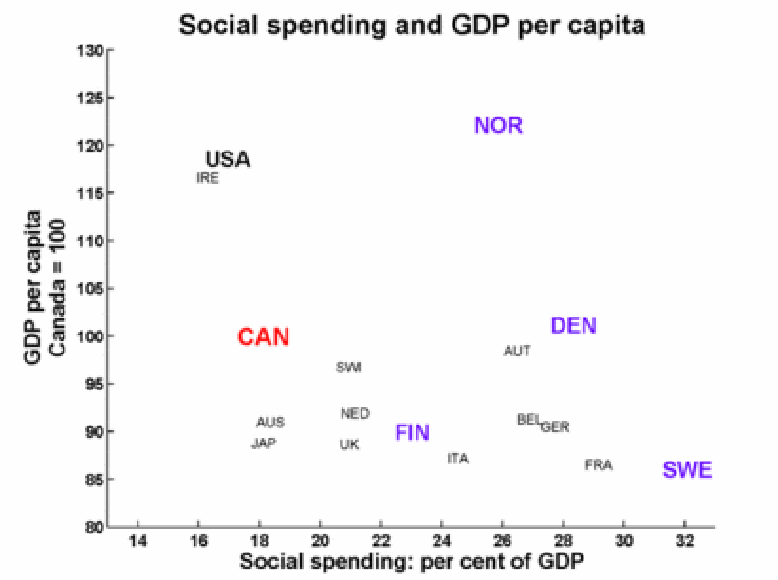
Perhaps the best way to determine whether America is really the generous land of equal opportunity and social justice that we like to think it is, we should look at what we spend for social programs as a percent of our GDP (Gross Domestic Product), the total amount of money made in a year by the production and sale of all goods and services. Comparing this to the amount of spending calculated in the same way for other countries gives us a good idea of where we actually stand. See the graphic below, which was generated by the Organization for Economic Cooperation and Development (OECD). The OECD works to promote policies that will improve the economic and social well-being of people around the world.  It uses a wealth of information on a broad range of topics to help governments promote prosperity and fight poverty http://www.oecd.org/pages/0,3417,en_36734052_36734103_1_1_1_1_1,00.html.


Look at the Nordic nation of Sweden at the bottom right on the graphic. Sweden’s GDP per capita is little more than half what ours is, yet they commit twice the percent of their GDP to the welfare of their citizens. They have achieved an enviable standard of living under a mixed system of high-tech capitalism and extensive welfare benefits. They benefit from an extensive social welfare system which includes a ceiling on health care costs, education subsidies and childcare, maternity and paternity, yes, paternity leave. They have an old-age pension program and universal sick leave among other benefits. The country has a modern distribution system, excellent internal and external communications, and a skilled labor force. Theirs is truly a great society http://www.state.gov/r/pa/ei/bgn/2880.htm.

Now look at Norway at the top, center-right. Norway has a greater GDP per capita than ours and commits ten percent more of its GDP to the welfare of its citizens. Education is free through the university level in Norway. Its health care system includes free hospital care, physicians’ compensation, cash benefits during illness and pregnancy, and other medical and dental plans. There is a public pension system http://www.state.gov/r/pa/ei/bgn/3421.htm. By the way, there are more millionaires in Norway per capita than in any other nation in the world. Wealth there is more evenly distributed.

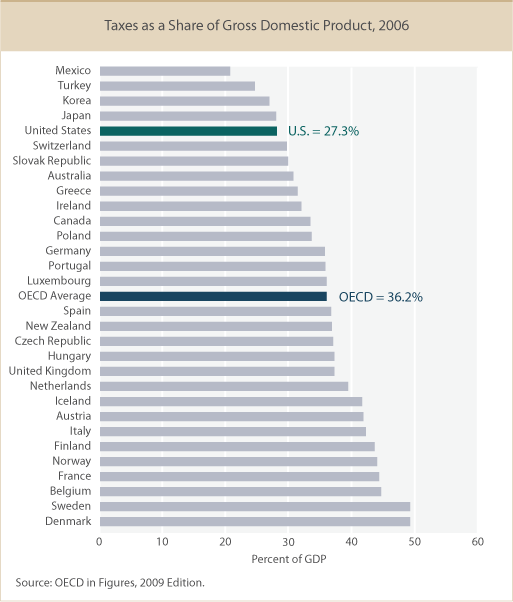
“Yeah, but what about taxes?” you might ask. Aren’t we overburdened with taxes to pay for social programs and other government waste? The answer is no. From all sources, both government and charity, our spending on anti-poverty programs is barely greater than three percent of our GDP. Scholarly studies show the United States to be an outlier in comparison to attitudes and actions taken by other wealthy nations. We have high poverty rates, low public social spending but high private social expenditures, and a rather strong belief that people are poor because of laziness or lack of will http://www.psocommons.org/ppp/vol3/iss2/art3/. The people of most modern states simply do not view poverty in the same way that we do.

Consider the following chart showing our tax burden compared to the rest of the world.

So, where’s the trick? How are these facts skewed to make Americans seem selfish? The answer is that they aren’t.

I find it curious that many in Congress, to reduce budget deficits, favor gutting social programs over increasing revenues collected from the wealthiest of Americans and highly profitable corporations. Still, social conservatives insist that America is a Christian nation. Christians are supposed to care about their neighbors and share the fruits of their labors with those who are in-need, are they not? Yet America, compared to all other nations, is clearly one of the least generous with our own citizens.

So, is my dream an impossible dream? I don’t know. But as my dear grandmother used to say, “Charity starts at home.” Maybe it wasn’t so much that her heart wasn’t in the right place; as an extended family back in the 50s and 60s, there wasn’t much left over after the bills were paid and the groceries were bought. Maybe she just expected more from those who were better off. Maybe, after the vast majority of Americans whose disposable incomes have been shrinking for the past several decades wake up and realize that the wealthiest aren’t really job creators, that trickle-down economics should really be called percolate-up economics, the progressive era that was the Johnson years will be reborn.

Please feel free to comment on this posting whether you agree or disagree.

Published in: on July 18, 2011 at 8:04 am  Comments (7)  

Prejudice in the United States Today ~ A Problem That We May Never Resolve

I believe that we fail to resolve issues involving race and other forms of prejudice in this country because we don’t want them resolved.

March 11, 2011 — It’s been almost five decades since the Civil Rights Act of 1964. This act outlawed major forms of discrimination on the basis of race, religion, gender or ethnicity. Notwithstanding, there is still hate and bigotry in the United States. Of this there can be no doubt. No law can make people think or behave civilly, as the recent wave of anti-Islamic sentiment and protests against gays and lesbians at military funerals attest. But, from my experience and years of observation, most claims of racial prejudice in this country today have little to nothing to do with race. They have more to do with socio-economic disparities and ethnic differences. Except among racial supremacy groups, most of us believe that the biological differences of race, in a general sense, neither significantly advantage nor disadvantage one race over another.

Race — what an unfortunate term. It implies winners and losers.

I once made the statement during a church administrative board meeting that embracing diversity is not the same thing as promoting diversity. For that, some in the church labeled me racially prejudiced. Balderdash! I was simply attempting to discourage celebrating or elevating one ethnic group in what was then an ethnically diverse congregation at the expense of others.

In another venue at about the same time, I was attempting to teach the differences between nationality, ethnicity, culture, and race to my World Geography students. For my effort, I learned a few things myself.  One thing I learned is that, in the United States today, many people, or so it seems, don’t want to know the difference. Blurring the distinctions between nationality, ethnicity, culture and race is comforting for some. For others, ignoring the distinctions sustains and confirms their already-held biases.

Case in point, speaking of the different races, I used the example of Mestizo versus Mexican, explaining that Mestizo is a term traditionally used to identify people of mixed European and Native American ancestry. It is a racial term, one of which many Latinos are proud, distinguishing themselves from Indians who they consider to be lower-classed members of Mexican society. Whereas the term, Mexican, refers to a national origin. It’s what most Americans call other Americans who emigrated themselves or whose ancestors emigrated from Mexico or other Spanish-speaking countries. Some, those whose ancestors have always lived in what is today the southwestern part of the United States, are also called Mexicans. The term, Latino, is a broad cultural term, used to identify ethnicities that have the Spanish language in-common. Which is correct to use when referring to people of Spanish-American descendency? Generally, one is always safest sticking to the broader cultural term, Latino, that is, if one wants to avoid causing offense.

At that point, a question came up. One of my young men asked, “What are ethnicities, Mr. Garry?”

I explained to my class that an ethnic group is a population of human beings whose members naturally identify with each other on the basis of a real or a presumed common genealogy or ancestry. The term, culture, refers to the language, attitudes, beliefs, customs, traditions, arts and preferences that are shared by members of different ethnic groups. Culture can also refer to these kinds of things that are more broadly shared by multiple groups within a collective society. For example: Thanksgiving. Thanksgiving is a holiday that most, if not all, ethnic groups within the United States traditionally celebrate. Another example might be American-style football, a sport that appeals to Americans of all ethnic groups. The differences between ethnic groups tend to be divisive because we are most comfortable among others who are most like ourselves.

Things got a bit dicey in class when we moved on to a discussion of race, how we often confuse it with ethnicity or national origin and how the subject often elicits emotional responses. The term, race, refers to the concept of dividing people into populations or groups on the basis of various sets of genetically inherited, physical characteristics, which are usually quite easy for us to distinguish. Because we have a history of exploitation and competition between different groups in the United States, the white man against the black, the red, the yellow and the brown, different ethnic groups have been left with stigmas of guilt, shame and/or inferiority. However, hard we try to put the past behind us and move on, it seems that we may forever remain socially haunted and challenged to live up to our creed of “liberty and justice for all”.

When I was still in grammar school, and that was many years ago, a teacher once taught me that there were only five basic races or “subspecies” of human beings: Caucasian (White), Negro (Black), Mongoloid (Yellow), Malayan (Brown), and American Indian (Red). According to him, all other so-called races are just variations on these five races or mixed-race peoples. His view was based on a religious belief that the races were separately created by God. Notwithstanding, science had long before identified many more distinct races based on physical attributes.

Sir Thomas Huxley, in 1870, identified nine distinct races and he associated them with different geographic regions of origin.  The following year, Charles Darwin published his second great book, The Decent of Man and Selection in Relation to Sex. Darwin believed that all mankind had originated from a common ancestor and argued that the various races were the result of different environmental conditions that have prevailed over time in the various regions of earth where the different races evolved. He also argued that the people of all races are essentially equal in both physical and intellectual potentials. Modern science, based on comparisons of DNA markers for people all over the earth seems to validate Darwin’s conclusions.

The Census Bureau of the United States has confounded the definition of race dramatically by listing multiple racial identities for the surveyed from which to self select, identities that include ethnicity and national origin. And to avoid offending people, they list, for example, the following as a distinct race: Black, African-American or Negro. They do not list Mulatto, Mestizo or mixed-race options. But they do provide space for people to enter their own terms.

“Well, we prefer the term, African-American, Mr. Garry,” one of my young ladies said politely.

“Yes, I know you do, and I understand,” I said, “just as the Census Bureau understands. They are being what’s called, politically correct. They’re being sensitive to others’ sensitivities. And that’s a good thing, but it ignores the difference between race and ethnicity and it creates a whole new set of problems.”

There are physical and biological differences between the Whites of Western Europe and Mediterranean Whites, peoples of the Southern Europe, the Middle East and North Africa. There are physical and biological differences between the Blacks that have descended from peoples of Western Africa and the Blacks of East Africa, or the Aboriginal Blacks of Australia. There are physical and biological differences between Chinese, Vietnamese and Japanese peoples too. Referring to them simply as Asian people ignores these differences. So, shifting attention away from biological differences that are more than just skin deep to ethnic distinctions or national origins ignores the differences between races. Race and ethnicity are not the same thing.”

There was a noticeable hush in the classroom as students’ eyes were seeking to assess others’ reactions to this.

“Okay,” I said, “some of you are thinking that Mr. Garry is racially prejudiced, right.” Nobody answered, confirming my suspicion.

“Let’s talk about what you all want to talk about: prejudice. Can anybody tell me what prejudice means?”

I waited several moments. Finally, one of my young ladies bravely raised her hand and said, “People are prejudice when they say hateful things about people they don’t like.”

“Give me an example,” I said.

“Hmmmm… something like black people are stupid, or Mexicans are lazy.”

“Good, those are certainly stereotypes, good examples of prejudicial attitudes that some people have. But let me correct one thing that you said. The term, Mexican, refers to a nationality, citizens of Mexico. Most Mexicans today are Mestizo, people of mixed European and American Indian ancestry. Some Mexicans are Caucasian, some are American Indian, and some are Black. So it is inaccurate racially to refer to all Latinos as Mexican. Note that both of your examples are generalizations. We all know that neither is true. It is probably true, wouldn’t you agree, that some blacks are stupid and some Mestizos are lazy, just as some whites are stupid and some are lazy. But most Blacks are of normal intelligence just as most whites are of normal intelligence, and most Mestizos are every bit as hardworking and industrious as anyone else.

I gave my students textbook definitions.

Bias is a prejudice in a general sense, usually for having a preference to one particular point of view or ideological perspective. However, one is generally only said to be biased if one’s powers of judgment are influenced by the biases one holds. In other words, a biased person’s views are neither neutral nor objective, they are subjective. A bias could, for example, lead one to accept or deny the truth of a claim, not on the basis of the strength of the arguments in support of the claim themselves, but because of the extent to which the claim is compatible with one’s own preconceived ideas. We are all biased; it’s a human condition.

Prejudice is the process of “pre-judging” something or somebody. It implies coming to judgment on an issue before learning where the preponderance of evidence actually lies, or forming a judgment without direct experience. Holding a politically unpopular view is not in itself prejudice, and politically popular views are not necessarily free of prejudice. When applied in a social sense, prejudice generally refers to existing biases toward entire groups, often based on social stereotypes. At its extreme, prejudice results in groups being denied benefits and rights unjustly or, conversely, unfairly showing unwarranted favor towards others.

“Now,” I said, “if I say that I do not like hip-hop music and that I am pretty much disgusted with the current fashion trend many young African-American men are following, namely, wearing their pants down below their buttocks, have I communicated prejudice?”

Many of my students just stared at me, communicating either confusion or their disbelief that I would even talk about this in the classroom. Others, at least some, including a few African-Americans, shook their heads indicating that they understood.

“No, I am communicating a bias, a preference for other forms of music and a desire to see young people dress with what I consider to be – decorum (good taste). Likewise, when I say that I like enchiladas and fajitas but I do not care for soul food recipes that include offal, which are normally discarded cuts of meat such as pigs’ feet, chitterlings and tripe, I am also not guilty of prejudice. However, if I were to say that I believe the explosive growth of “Black Pride” in the United States following passage of the Civil Rights Act has benefitted people of color neither socially nor economically, I would not be speaking out of prejudice. I would simply be stating an opinion based on observation, an opinion about which many African-Americans would take offense.”

After a long hesitation, during which I wanted students to reflect on what I had just said, I opined, “I believe that we fail to resolve issues involving race and other forms of prejudice in this country because we don’t want them resolved. Like all people pretty much everywhere in the world, we are too concerned with exhibiting our ethnic distinctiveness and hanging onto to our preconceived notions about others. It’s almost as if who we think we are matters more to us than who we really are, and even more than getting along with our neighbors.

After class, I expected many calls from irate parents that evening. I was pleased when none were received.

I invite your comments whether you agree with me or not.


Published in: on March 11, 2011 at 4:32 pm  Comments (17)  

By Giving Care, One Also Receives ~ A Stephen Ministry Testimonial

I was 42 years old before life changing events brought me humbly seeking God. So I was a baby Christian when I showed up one night at a Stephen Ministry information session. I was looking to discover how to be Christian beyond the rituals of worship and Sunday school attendance, beyond the potlucks and the twenty-dollar checks that I dropped in the collection plate on Sundays.

Remembering the questions our pastor had asked me when I joined the church, “Will you be loyal to the United Methodist Church, and uphold it by your prayers, your presence, your gifts, and your service?” I was prayerfully looking for the service that was right for me. I wasn’t looking to gain anything for myself, but I got oh so much more than I gave during and after my 50 hours of training in how to give distinctly Christian care.

After filling out my application form and turning it in to the church office, I interviewed with the ministry leadership team. During the interview, I was thinking, What do I think qualifies me to do this sort of thing? Surely the leadership team is going to tell me, thanks but no thanks. But no, they just asked me what had attracted me to the ministry. My answer seemed to satisfy them. I told them that I just wanted to learn how to be a better Christian.

From the very first session of the 50 hours of training, I connected with the other trainees. Being with other like-thinking Christians on a regular basis, I enjoyed the fellowship, the sharing of joys and challenges, praying for one another, offering encouragement and practical help to one another and relating to one another in a deep and spiritual way. The other trainees, the leadership team and I formed strong, positive spiritual bonds of friendship and commitment. When the training was over with, I actually missed the weekly meetings.

From the 50 hours of training, I learned to listen to others and to appreciate their feelings. These are things that I had never been able to do well. I had always thought that listening is just a simple, natural, and passive activity. But, it’s actually more of an art form, a powerful caregiving tool. Using Jesus as our model, Stephen Ministers learn to be active listeners. This involves commitment, patience, and attention to body language. Stephen Ministers learn to listen for more than just words. They seek true understanding and empathy. I learned also how to be assertive, how to “speak the truth in love” and to avoid aggressive behaviors such as belittling and manipulation and how to avoid passive behaviors such as withdrawing and relinquishing rights. By learning to behave assertively, I became more aware of God’s will for my life and more aware of the needs of others. I learned to stop worrying about fixing others’ problems, that Stephen Ministers are not therapists or problem solvers, that they are simply caregivers. I learned that only God can bring about healing, forgiveness, and hope.

After my 50 hours of basic training, I continued learning and growing in the practical, hands-on service of caregiving. I gained a renewed sense of pride in who I had become and I felt good about being someone who is both needed and appreciated. I became a better husband to my wife and a better father to my sons. I could now talk with my friends and family members instead of just talking to them. And, after our pastors had made initial pastoral visits to sick and grieving church members, my fellow Stephen Ministers and I were available to provide on-going Christian care.

The greatest unanticipated reward for saying “yes” to Stephen Ministry came when I learned that my mother was dying and in great pain, physically, emotionally and spiritually. I took a week off from work and flew home to be by her side.  I listened to her deepest sorrows and regrets; I held her hand and cried with her over shared memories of happy times and sad times. She finally got around to asking about my acceptance of Jesus Christ as Lord and Savior, which led me to offer to pray with her, something I was quite sure she had not done in years, not since she was a little girl living on a farm with her grandparents.

My mother’s emotional and spiritual pain relieved by the grace of God, I came home knowing that I had been Christ’s hands and feet for a time, that I had spoken Christ’s words of forgiveness and assurance. I came home knowing that, when the time came, my mother would be embraced in her new, eternal home. I had been her caregiver, but God had provided the cure.

Years later now, I am still caregiving, sustaining a helping relationship with my indigent son and nurturing my granddaughter’s self-esteem as she recovers from an abusive relationship and gets back on her feet financially. I could not be doing these things, would probably refuse to do these things, had I not said “yes” years ago to Stephen Ministry.

I conclude that my goal, to become a better Christian, has been, at least in-part, realized through Stephen Ministry. I am happier now than I have ever been and my spiritual gifts are more gainfully employed. So, for anyone with the desire to accept others where they are, to love others more and better, I heartily encourage them to look into Stephen Ministry for themselves.

Please feel free to comment or to post confidential questions about my Stephen Ministry experiences.

Published in: on December 30, 2010 at 11:05 am  Comments (1)  

Spiritual Maturity ~ What is it and Who Has it?

The foundation for subsequent spiritual growth has three layers: 1) discovering what we are; 2) learning who we are, and; 3) understanding whose we are.

October 27, 2010  —  In the Christian faith, according to New Testament Gospel authors, all who freely and sincerely profess Jesus Christ as Lord and Savior have at least some degree of spiritual maturity [Mark 16:16]. But what is spiritual maturity? How do we strengthen it?

I posed these questions to my adult Sunday school class recently. In response, the expressions on peoples’ faces varied. Most had to think hard about it, coming up no doubt with indicators of maturity like attending worship services regularly, paying a full and righteous tithe, and participating in missions and ministries. But one, even without having to think, quietly said, “It is a journey.”

“Yes,” I said. “It’s not a destination, at least not one to be found in this life, for we cannot hope to attain perfection [Romans 3:22-24]. So, it is a journey, yes… a journey toward perfection.” And the way is to be found by being and doing all that we can in service to one another [Matthew 25:35-41], using all gifts and graces that we have been given. But we are weak. We are lazy. We put ourselves first and we are plagued with doubt.

As I think about it now, this reminds me of the prayer offered by the father of a young boy suffering from convulsions (Mark 9:22-25). After Jesus proclaimed, “Everything is possible for him who believes,” Immediately the boy’s father exclaimed, “I do believe; help me overcome my unbelief!”

How often do we call out to the Lord in our times of need and fall back in times of ease and comfort into complacency? How many of us pray incessantly only when we have a personal need to pray about?

The Scriptures tell us that we love God in the person of Jesus because He first loved us [1 John 4:19-21]. Out of this love then comes our desire to serve Him, to become more like Him by serving others [John 13:14-15]. The more like Him we become the more spiritually mature we become. But some of us are satisfied with whom we are; we don’t want to change because change is hard. Some even proclaim that they cannot change.

To illustrate this, on the class whiteboard I drew a crude picture of the cartoon character, Popeye The Sailor Man. Popeye, as we seniors all recall, often proclaimed in classical cartoon shows, “I yam what I yam and that’s all what I yam!” We laughed in acknowledgement that this is indeed human nature, resistance to change. Notwithstanding, all my fellow class members agreed that change is both possible and necessary if we are to grow and mature spiritually.

I established, without dissent by anyone in the class, that the foundation for subsequent spiritual growth has three layers: 1) discovering what we are; 2) learning who we are, and; 3) understanding whose we are.

Discovering What We Are

Discovering what we are is not so difficult for some. Some are born into traditional families with parents and other adult role models who nurture them with authority and consistency. They are affirmed as good and worthy persons. They are praised for successes and appropriate social behaviors. As a result, they leave the identity crisis of adolescence, as described by modern-day psychologists, behind with relative ease. They claim emotional adulthood through moments of commitment in relationships. Others aren’t so lucky and struggle as I did for years with issues of legitimacy and sexual identity.

By the time I graduated from high school I knew that I was white, Anglo, male, heterosexual, artistic, non-academic, apolitical and agnostic. In time, after discovering who I am, the last three identifiers would change.

Discovering Who We Are

Once we know what we are, we can go on to discover who we are and to evolve. Who we are, by the way, has little to nothing to do with what we do for a living. Surprise!

Who we are has more to do with how we respond to day-to-day challenges – the aggregate of our personality traits. None of us, for example, are so well-balanced emotionally that we never exhibit neuroses or personality disorders. But the better balanced we are, the happier and more productive we tend to be.

A person with a neurotic personality exhibits characteristics of excessive worry and anxiety over normal life events. He or she tends to blame themself when things go wrong. Symptoms can include depression, unrealistic fears, obsessions, and repetitive, compulsive behaviors, as well as low self-esteem and being tense or irritable.

A personality disordered person tends to cast blame on others when things go wrong. He or she may possess one or more of several distinct psychological features including disturbances in self-image; ability to have successful interpersonal relationships; appropriateness of range of emotion, ways of perceiving themselves, others, and the world, and; difficulty possessing proper impulse control.

Needless to say, none of us is perfect. Most of us bounce back and forth from slightly neurotic to slightly personality disordered. Some, those with manic-depressive disorder, vacillate between extremes. Only Jesus is perfect. But with effort, prayer, and sometimes professional help, we can learn to control our fears and inappropriate impulses. We can build self-esteem. We can control impulses, addictions and behaviors so that we can sustain beneficial interpersonal relationships.

I told my class that I first responded to a Myers-Briggs Type Indicator survey, not without substantial trepidation, as a captain on active duty with the U.S. Army during the Field Artillery advanced course. All of us in the class were fearful that analysis and recording of our responses in personnel records might render us less competitive for choice assignments and advancement. When we finished we were told the results without counseling so that we might understand that there are no right or wrong answers – no good or bad types – only preferred ways of responding to circumstances and situations.

My attitude indicator was strongly “I” for introversion. My function indicators, combined according David Kiersey as a personal temperament, were strongly “N” for intuitive and “T” for thinking. My life style indicator was strongly “J” for judging. Plotting them as they were then on the classroom whiteboard in four quadrants similar to Myers-Briggs four dichotomies rendered a picture like this.

I remain today, an INTJ.

Discovering Whose We Are

I was 42 years old, still on active duty as an Army Lieutenant Colonel, before I finally discovered whose I am. The process and events leading up to this profession of faith are subjects for another Sunday school lesson. But, in retrospect, I was gainfully employed then as a senior analyst in test and evaluation work – perfectly well-suited for my INTJ personality type.

Interesting, is it not, how we gravitate to doing what we are best suited by temperament to do?

New to the faith, I endeavored to “do” Christian. I committed to regular worship, prayer, giving, and ministry. I joined a class with others to develop care-giving skills for Stephen Ministry and took a spiritual gifts survey. My spiritual gifts at that time were strongest in leadership and administration with a lesser gift for helping. I took additional leadership training and became a Stephen Leader.

After our basic fifty hours of training in Stephen Ministry, we attended a weekend retreat and responded to a Myers-Briggs survey followed by spiritually oriented counseling on the interpretation and self-validation of response choices. Not too surprising, I was still an INTJ, but my “I” was somewhat less strong. In my new life I was becoming less introverted, enjoying activities and fellowship in larger groups more and needing less “alone” time to reflect and recharge.

Having discovered whose I am, after retirement from active duty military service I set about preparing myself for a follow-on career in teaching. I reasoned… no, “felt” might be a better word, that I could better serve my fellow-man by helping to prepare the next generation to do a better job in decision-making than my own and my parent’s generation had. Continued work in the art and craft of war just didn’t seem to be what Jesus would prefer that I do.

Could it be that my function indicators could have evolved too? Might my “T” and my “N” have become less strong? Hmmm…

On the class whiteboard then, I plotted my new, less extreme MBTI on the same dichotomy quadrants. Then I extended the bottom of the vertical line. The result looked like this.

“By the way,” I told my class, “after having served in Stephen Ministry and teaching for a number of years, my latest spiritual gifts survey results have teaching as number one with caring and helping also ranking high. Could it be that we become what we develop a passion for doing?

Then I asked my class what Jesus’ MBTI plotting might look like compared to my own. The answer came without hesitation. Everyone seemed instinctively to know that Jesus would be at the center of the cross, equally comfortable responding in the most appropriate way to any challenge or situation. This then became my conclusion. My postulation for spiritual growth is that we should, in every endeavor, in every relationship, strive to be balanced in temperament. In this way we will be better able to love and come closer to perfection in this life.

O Divine Master,
grant that I may not so much seek to be consoled, as to console;
to be understood, as to understand;
to be loved, as to love.
For it is in giving that we receive.
It is in pardoning that we are pardoned,
and it is in dying that we are born to Eternal Life.
Amen.

Please don’t hesitate to post a comment on this. Let me know where you think I am wrong.

Published in: on October 27, 2010 at 11:25 am  Comments (6)  

Jesus Christ ~ In Today’s World, Would He be a Capitalist or a Socialist?

Let the rich get richer, conservatives say. The benefits will “trickle down” to all the rest of us. It’s a neat, simple concept, except, it doesn’t always work as advertised.

October 14, 2010 (based on A Biblical Basis for Liberal Politics by David Chandler)

I find it interesting that the “Religious Right” in the U.S., the Moral Majority, the Christian Coalition, etc., is so active in politics. By all appearances, one might think that conser- vatism somehow equates to Christianity. But all who claim Jesus as Savior are not Republicans. So, where is the Religious Left? If it even exists, why don’t we hear about it in the media? Could it be that liberals are more inclined to accept the concept of separation of church and state? Yes, I think so.

As I dialogue through this blog with those who share the con- servative persuasion, I’m often assailed with the argument that America’s greatness is the result of an economic system whose driving force is the profit motive — capitalism. True, at least in part; our economy rewards self-interest, aka greed.

In classic economic theory, greed is good. A person motivated by greed will create unintentional byproducts that benefit everyone. These benefits include goods and services, employment, and advances in technology. The wonders of the modern world, jet airliners, TV, computers, the Internet and cell phones are just a few examples. So, let the rich get richer, conservatives say. The benefits will “trickle down” to all the rest of us. It’s a neat, simple concept, except, it doesn’t always work as advertised.

John Kenneth Galbraith, famous 20th Century Canadian-American economist, criticized trickle-down economic theory, calling it the “Horse and Sparrow” theory. “If you feed enough oats to the horse, some will pass through to feed the sparrows.” George Herbert Walker Bush, called it “Voodoo” Economics.

The truth is that a rising tide does not raise all boats. Under a purely capitalistic system wherein the government keeps its hands off things and allows the market to decide for itself what is needed, what is fair and proper, wealth does not flow down from the top. It flows up from the bottom. So, rising tides tend to swamp smaller boats.

One would think that, after decades of deregulation, tax cuts favoring the most wealthy, downsizing by America’s corporations and the “off-shoring” of good-paying American jobs, all of this resulting the shrinking of the middle class and growing disparity in the distribution of wealth, that American’s would understand this. But no, most Americans still think that tampering with the market system to promote fairness and equal opportunity, and a progressive tax code to redistribute the wealth and assure that the unemployed, the poor and disabled are helped and protected, is tantamount to socialism. And most Americans think that socialism is bad. But what does Jesus think?

By now, I think you know where I’m going with this.

Jesus spoke most about the Kingdom of God. But He also talked a lot about wealth and poverty. To the poor He said, “Blessed are you, for yours is the kingdom of God,” (Luke’s version). To the rich he said, “Do not lay up for yourselves treasures on earth,” and “go, sell what you have, and give to the poor.” When the rich turned away from Him because they had so much wealth, He observed, “It is easier for a camel to go through the eye of a needle than for a rich man to enter the kingdom of God.”

According to Jesus, helping the poor and the outcast is not an option. It is the essence of what it means to love God. In the parable of the last judgment, He welcomes the righteous into heaven saying, “I was hungry and you gave me food, I was thirsty and you gave me drink, I was a stranger and you welcomed me, I was naked and you clothed me, I was sick and you visited me, I was in prison and you came to me.” When the righteous answered that they didn’t recall doing any of these things for Him, He said, “As you did it to one of the least of these my brethren, you did it to me.”

We are to “forgive our debtors” and “give to everyone who begs from us.” But don’t handouts contribute to moral decay? Jesus, I think, was more concerned about the moral decay in those of us who are so attached to our wealth that we would hoard it for ourselves and our issue rather than share it with others who are less fortunate.

Our better angels tell us that giving does not corrupt. We sacrifice to give good things to our children and do our best to provide them with every opportunity as they grow up. We do this to give them a sense of security and a foundation for growth because we love them. Many of us will reach out to help friends in hard times even though we know that we will never be repaid. We do this because we love them. But how many of us contribute regularly to charity? How many of us give a full and righteous tithe? How many of us divert our eyes and pass by the beggar on the street? No, we do we not love the stranger. So, it is in dealing with need in the abstract that we fall back on the “moral decay” argument.

What does Jesus have to say in Scripture about trickle-down economics? Well, recall the story Jesus told about a rich man and the beggar, Lazarus, who desired only to be fed by what fell from the rich man’s table. Needless to say, the story ends with Lazarus going to a better place than the rich man.

Trickle-down theory is about crumbs falling off the tables of the rich, it’s about oats passing undigested through horses. Therefore, those of us who say that we should settle for crumbs or a few oats, those of us who advocate free-trade, laissez-faire economics would also have most of us become beggars or sparrows.

There is economic inequality in the world, the haves and the have-nots. There always has been. In response to this reality, Jesus admonishes us to share our wealth.

In 1960, John F. Kennedy, who had been shocked by the hunger he saw in West Virginia, made the fight against hunger a theme of his presidential campaign. After his election he created the modern food stamp program, which today helps millions of Americans get enough to eat. Ronald Reagan, on the other hand, thought the issue of hunger in this, the world’s richest nation, was something to joke about. In his famous speech in 1964, A Time for Choosing, he said, “We were told four years ago that 17 million people went to bed hungry each night. Well, that was probably true. They were all on a diet.” Later he clarified saying that hunger in America was simply a problem of distribution.

Distribution? What does that mean? In a business/economics sense it means moving products from factory or farm to wholesaler to retailer to consumer. But this involves the exchange of dollars, money flowing upstream from consumers to the entrepreneurs and corporate owners. To Jesus, however, distribution means something else.

Recall the story in John 6 (1-14) wherein Jesus fed the 5000 with five barley loaves and a couple of fish that were offered up by a boy who had come to hear Him speak. Did you ever think on hearing or reading this story why Jesus used the proffered loaves and fish? Why didn’t he just turn rocks into bread and grass into fish? Would that not have been an even more impressive miracle? Well, I think the story has more to do with distribution (sharing) than it does with miracles. I think that there was plenty of food among those who followed Jesus that day. I suspect too that, by telling his disciples to take the loaves and the fish and distribute them freely to the crowd, He compelled those with food to join him in giving it away. It was an object lesson for the disciples, for the people who there that day. It was an object lesson for us. But some hear and do not listen; some look and do not see.

Ok, you say, as a Christian I agree that I should be concerned about the poor. But shouldn’t this concern be simply a private matter to be handled through donations to churches and other charities, George H. W. Bush’s Thousand Points of Light. Why should government have anything to do with it? Hold that thought.

Americans are a generous people. According to the National Philanthropic Trust, charitable giving for 2010 will total 2.2 percent of our GDP. By comparison, according to the Congressional Budget Office, federal social program spending alone, not counting Social Security, Medicare, CHIP and unemployment, will total 12.5 percent of GDP this year. Now, if Washington were to suspend all this social program spending and reduce income taxes by a corresponding amount, Americans would surely increase their charitable giving by that same amount, right?

Surely, you get the point. Left to the private sector alone to care for the less-fortunate, Hoovervilles would return to open spaces in and around our cities.

Our economy is currently in the worst condition it’s been in since before the beginning of the Second World War. It’s based on a system that has the potential to produce tremendous wealth, but it has failed to maintain its lead over foreign competition. Consider the possibility that this could be, at least in part, because the system fails to distribute wealth equitably. It neglects the poor and it corrupts the rich. On both counts, it destroys community. It divides us against one another. It pushes more and more of us toward the margins. It warehouses more and more of us in prisons, and it creates an increased burden for government to provide services without having to borrow from the rest of the world. But why would those who profit from the system want to change it? They wouldn’t.

The Bible calls upon rulers to create just societies, and, in our democratic form of government, in theory at least, we are the rulers. The choices our representatives make, or should make, are extensions of our own choices, our own actions. And by our participation in government, or passive consent, we share responsibility for what our nation does or doesn’t do.

A decent life for all in a land of plenty is a matter of simple justice, not charity! There are remedies that will make the system work better in the interests of all of the people without resorting to Soviet-style socialism, which we all know doesn’t work. But mixed economies do quite well. Consider how well-off the average Dane is, or the average Swede, or the average Norwegian compared to the average American. But it will take active political involvement by an informed, compassionate electorate to implement these remedies.

So, would Jesus be more of a capitalist or more of a socialist in today’s world? What do you think?

I invite your comments.

Published in: on October 14, 2010 at 11:47 am  Comments (24)  

Debate Over the Islamic Center in New York ~ Just What Republicans Need

Personally, I would have thought that this president was too astute of a politician to wade into this matter, especially now.

Believe it or not, according to an NPR news story Monday, lawmakers have actually set aside debate over the economy and other pressing national matters to argue over President Obama’s statement supporting the building of an Islamic center within walking distance from Ground Zero http://www.npr.org/templates/story/story.php?storyId=129236595. This will surely add to anti-Obama passion as mid-term elections in November draw near – just what Republicans need. Right?

This will confirm for some that Obama is a Muslim, for others that his real father was Malcom X, and for others that he wasn’t even born in the United States. So, a lesser president would have remained silent in the face of injustice at the hand of public opinion.

Representative Chris Van Hollen (D-Md.), who chairs the Democratic Congressional Campaign Committee appeared on CNN’s “State of the Union” http://www.cnn.com/CNN/Programs/state.of.the.union/ to talk about the upcoming election and was asked for his personal view on whether the mosque should be built in New York.

“It would be wrong to politicize the issue,” he said, adding that the decision should be “up to the people of New York” on where the Islamic center should be built. But the president, just by bringing it up, has already made it a political issue, has he not?

Personally, I would have thought that this president was too astute of a politician to wade into this matter, especially now. Notwithstanding, the president was correct in saying that we must respect the Constitution. We can’t tarnish people’s first amendment rights whether they are Muslim, Jewish, Christian or Mormon. Allowing the Islamic center to be built says to the rest of the world that America is truly the country established by our Constitution. And if two blocks away from Ground Zero isn’t far enough away for an Islamic place of worship and school, how far away is far enough? Or is there  no room for it anywhere in New York City?  How about in your city? Demonstrations against the building of mosques have broken out in many American cities http://www.huffingtonpost.com/2010/08/08/protests-against-mosques-ground-zero_n_674766.html.

Former Republican National Committee Chairman Ed Gillespie said, “It tells you that he (the president) has a very disdainful view of the American people. And I think that’s one of the reasons his favorability ratings have come down, not just his job approval rating.”

I disagree with Mr. Gillespie on his first point, but am in total agreement with him on the second. The president does not have a disdainful view of the American people, not based on anything that he has said. But I do. Frankly, I’m disappointed – perhaps “disgusted” would be a better word — with more than two-thirds of Americans who, as indicated by their view on this subject, are so filled with hate and fear of all Muslims that they would want them deprived of their First Amendment rights simply because those who attacked us on 9/11 were Muslims radicalized by extremist forces exploiting the faith. This is tantamount, I believe, to the hatred of all Japanese, even American citizens of Japanese extraction, that most Americans felt following the attack on Pearl Harbor http://en.wikipedia.org/wiki/Japanese_American_internment.

Writing in the Huffington Post yesterday, Michael Bard put it this way http://www.huffingtonpost.com/mitchell-bard/the-proposed-lower-manhat_b_684081.html: “I have been disgusted by the right’s decision to politicize the issue, using the 9/11 terrorist attacks and the proposed Islamic center as a way to turn fear of “the other” into votes. (Newt Gingrich, an avid practitioner of fear mongering, has, not surprisingly, staked out a far-right position, equating Islam and the Nazis.) With each appeal to our basest, most xenophobic selves, the Republicans are systematically eroding the great American traditions of tolerance and diversity that have been a large part of the growth of the nation. (Note to the GOP: The Statue of Liberty is not just a pretty sculpture. It actually stands for something.) Even the use of the term “Ground Zero mosque” to describe the project is incendiary, intended to alarm at the expense of accuracy (the proposal is not for a stand-alone mosque, and the building would not be at Ground Zero).

Most of all, I have found it depressing that the right has turned a truly nuanced and complicated issue into a mean-spirited, us-versus-them test of patriotism.”

My wife’s dad, a deceased Marine veteran of WWII, was fond of saying, “I may not agree with what you say, but I will fight to the death to defend your right to say it.” Now that’s true patriotism. I will expand on that in light of the current controversy by saying, “Although do not subscribe to your religious beliefs, I will fight to the death for your right to worship as you wish so long as your beliefs do not include the goal of overthrowing our democratic form of government.”

With over 3000 Muslims currently serving in our country’s military http://online.wsj.com/article/NA_WSJ_PUB:SB125755853525335343.html, having sworn to uphold this country against all enemies, foreign and domestic, I cannot… will not believe that Muslim citizens cannot be trusted to serve the greater good.

This controversy, started by a right-wing blogger named Pamela Geller, has turned out to be a most fortunate distraction for Republicans. Now, rather than weighing Democratic efforts to restore the economy and build a better future for Americans against Republican proposals, namely, to dismantle enacted reforms and return us to the economic policies that got us into the mess we found ourselves in at the end of the Bush/Cheney years, voters will be increasingly blinded by doubt fueled by passions on steroids. Unfortunately, passion trumps reason every time for most of us.

Please feel free to respond with your views on this subject by posting a comment whether you agree with me or not.

Published in: on August 17, 2010 at 10:18 am  Comments (10)  

Welfare and Poverty ~ Is it a Chicken-or-Egg Relationship?

The real reality check here is that some people are willing to distort the truth or just make stuff up in order to spread their beliefs. This is called propaganda.

May 2, 2010  —  I recently received a forwarded copy of what I like to call a viral disinformation email. It was shared with me by a good friend of conservative persuasion. Yes, I do have conservative friends. The title of the message, which is currently making the rounds, is “This is an Interesting Reality Check.” It purports to be a history lesson about the Second World War and its aftermath. It includes pictures of what was left of Nagasaki and Hiroshima after the atomic bombs that were dropped on these cities in August of 1945. Additional pictures show how these cities look today – brightly-lit, towering skyscrapers and modern, efficient highways contrasted with recent scenes of the blight that has taken over Detroit, Michigan since the end of the war.

The bottom line of the message read: “Why, you ask?…… real simple…… Japan doesn’t have welfare…..and you are damn sure not going to be in their country illegally…..”

The message offers an interesting premise, but the conclusion is fallacious. It’s a prime example of the “questionable cause” fallacy. This fallacy is committed when a person assumes that one event must cause another just because the events occur together. The mistake being made here is that the causal conclusion is being drawn without adequate justification. The conclusion seems valid to some because it enforces an already-held opinion or bias. But, in addition to the logic issue, the author of this message has either knowingly misrepresented the facts or knows nothing of Japanese economic/social organization (Alliance Capitalism).

The real reality check here is that some people are willing to distort the truth or just make stuff up in order to spread their beliefs. This is called propaganda http://en.wikipedia.org/wiki/Propaganda. You see, Japan actually does have a welfare system. It relies more on family and corporations and less on the government, true enough. But government in Japan does chip-in failing assistance from the primary sources. Japanese, culturally, are more committed to family honor and respect for their elders than Americans ever thought about being, and Japanese companies care about and for their employees, whereas American companies, by in large, do not. Labor in America is expendable in the face of profit pressures, and many employers here have no qualms against hiring illegals so as to reduce labor costs at the expense of citizens. The truth is never quite so simple.

Read all about Japanese capitalism if you have the time and inclination at http://books.google.com/books?hl=en&lr=&id=wMeir3lIbq8C&oi=fnd&pg=PR9&dq=japanese+capitalism+versus+american+capitalism&ots=gNBsd7gYK3&sig=jBegXFwFJxg1wZZiirEsygBHALo#v=onepage&q&f=false

Please feel free to post a comment on my blog about this. And, if you’d like to receive a copy of the referenced message including the photos, indicate so in your comment. I will forward a copy to you.

Published in: on May 2, 2010 at 8:08 am  Leave a Comment  

A Proposed 28th Amendment to the Constitution ~ Obstructionism in Progressive Clothing

I don’t care if members of Congress are Democrat, Republican, Independent , Liberal, Conservative, Progressive or whatever. The self-serving must stop.

March 14, 2010 — I received another viral e-mail this morning, one asking me to forward the same message on to at least twenty people. Perhaps you have received a copy of it yourself. It embodies a sentiment commonly expressed by persons who are opposed to health care reform. The message reads as follows:

“For  too long we’ve been complacent about the workings of Congress. Many citizens had no idea that

  1. Congress members can retire with the same pay after only 1 term.
  2. They don’t pay into Social Security.
  3. They specifically exempted themselves from many of the laws they have passed (i.e. being exempt from fear of prosecution for sexual harassment).

Congress’s latest game is to exempt themselves from the Healthcare Reform Bill being considered. This isn’t logical. We don’t have an elite that’s above the law.

I don’t care if members of Congress are Dem., Rep., Ind. , Lib., Con., Prog. or whatever. The self-serving must stop. The proposed 28th Amendment to the US Constitution (below) would do that. This is an idea whose time has come.

Proposed 28th Amendment to the US Constitution: Congress shall make no law applying to citizens of the USA that does not apply equally to Senators & Representatives; and Congress shall make no law that applies to Senators & Representatives that does not apply equally to citizens of the USA.

This is fair, to the point & non-partisan. The only ones who would be against it are members of the Congress!”

Sound reasonable? Sure it does. As Sara Palin, playing to the pent-up resentment of Tea Partiers, would say, “You betcha.” And, on the surface, I agree with the concept. But the author is wrong. More than just members of Congress would be against it. I am against it. I am against it as a priority at this time because it is unreasonable to expect Congress to ever consider even debating such an amendment? Read what Snopes.com has to say about it.  The URL is http://www.snopes.com/politics/medical/28thamendment.asp.

It sounds good, much like the idea of term limits for Congress sounds good, but it’s nothing that the Congress of the United States would ever consider, many members thereof truly being self-serving as the author of the message has pointed out. So, the only way this, kind of common sense proposal for a Constitutional amendment can ever become law is by way of the grassroots alternative to amendments, a national convention such as is provided by Article V of the Constitution. But amending the Constitution this way is very, very difficult. In fact, it’s never happened. Congress has proposed amendments to the Constitution on several occasions, at least in part, because of the threat of an Article V convention. Rather than risk such a convention taking control of the amendment process away from it, Congress acted pre-emptively to propose the amendments instead. At least four amendments (the Seventeenth, Twenty-First, Twenty-Second, and Twenty-Fifth Amendments) have been identified as being proposed by Congress at least partly in response to the threat of an Article V convention.

So, argue about this first, Congress exempting themselves from laws and voting raises for themselves, and health care reform will never happen, nor would anything else in the public interest. Which, by the way, is exactly what the health insurance industry and Republicans, for purely political purposes, want. Looked at in the full light of day, this is just another salvo from the right aimed at sinking President Obama’s agenda for change.

Maybe if the Tea Party and the new Coffee Party combine their growing voices to lobby enough state legislatures, things like this will someday come to pass. But don’t hold your breath. In the mean time, let’s not inhibit progressives’ efforts to pass laws that will benefit all/most Americans, laws that will help to prevent the wholesale takeover of our One Nation Under God by corporate profit interests.

Please feel free to post a comment.

Published in: on March 14, 2010 at 10:58 am  Comments (8)