A Modern-Day Prodigal Son

But, what does the father say?  He says, “My children, I love you all dearly and everything I have will be yours someday. But we have to celebrate and be glad, don’t you see? Your brother, my sons, and your father, my grandchildren, was dead to us. But he is alive again. He was lost to us, but now he is found.”
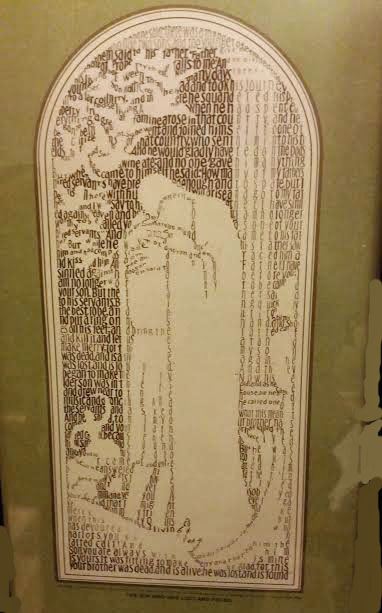
prodialsonI know you can’t read the words that comprise this piece of art. They are from the Gospel according to Luke, chapter 15 verses 11 through 32. My dear wife bought it for me years ago when one of our three sons was lost to us for a time, and then returned. In case you don’t recognize the passage, it is the parable of the prodigal son. Jesus told it ages ago to people gathered around to hear his teachings. These people included tax collectors and sinners. But the Pharisees and other rabbis were there too, listening but not hearing.

“There was a man who had two sons. The younger one said to his father, ‘Father, give me my share of the estate.’ So he divided his property between them. Not long after that, the younger son got together all he had, set off for a distant country and there squandered his wealth in wild living.  After he had spent everything, there was a severe famine in that whole country, and he began to be in need. So he went and hired himself out to a citizen of that country, who sent him to his fields to feed pigs. He longed to fill his stomach with the pods that the pigs were eating, but no one gave him anything.

When he came to his senses, he said, ‘How many of my father’s hired servants have food to spare, and here I am starving to death! I will set out and go back to my father and say to him: Father, I have sinned against heaven and against you. I am no longer worthy to be called your son; make me like one of your hired servants.’ So he got up and went to his father. But while he was still a long way off, his father saw him and was filled with compassion for him; he ran to his son, threw his arms around him and kissed him.

The son said to him, ‘Father, I have sinned against heaven and against you. I am no longer worthy to be called your son.’ But the father said to his servants, ‘Quick! Bring the best robe and put it on him. Put a ring on his finger and sandals on his feet. Bring the fattened calf and kill it. Let’s have a feast and celebrate. For this son of mine was dead and is alive again; he was lost and is found.’ So they began to celebrate.

Meanwhile, the older son was in the field. When he came near the house, he heard music and dancing. So he called one of the servants and asked him what was going on. ‘Your brother has come,’ he replied, ‘and your father has killed the fattened calf because he has him back safe and sound.’

The older brother became angry and refused to go in. So his father went out and pleaded with him. But he answered his father, ‘Look! All these years I’ve been slaving for you and never disobeyed your orders. Yet you never gave me even a young goat so I could celebrate with my friends. But when this son of yours who has squandered your property with prostitutes comes home, you kill the fattened calf for him!’

‘My son,’ the father said, ‘you are always with me, and everything I have is yours. But we had to celebrate and be glad, because this brother of yours was dead and is alive again; he was lost and is found.’”

Imagine, if you will, this modern-day equivalent to the parable.

A man has three sons, one by a previous marriage, the oldest. For personal reasons having had nothing to do with anything done to him by his father, his step-mother or brothers, decided to alienate himself from them and from his very own children as well. He did so for the sake of a new relationship, a new wife. For five long years his family heard nothing from him, save for Christmas cards sent cruelly and disingenuously by his new wife, a jealous and controlling woman. Time passed; hearts grew bitter and resentful. Then, one day, after the son’s new marriage relationship had hit a breaking point, the son reached out to his father, saying that he is sorry and asking for forgiveness.

What did the father do? He did exactly what the prodigal son’s father did. He enthusiastically raced out with open arms to welcome him back.

But the son’s brothers aren’t so anxious to have the elder son back. Neither are the son’s children. They are still hurt. They are angry, and who can blame them? “Don’t trust him,” they say to their father and grandfather. “Consider all that he has done to us, the lies that he has told. He is a drunkard, a thief and a liar. He abandoned us when we most needed him. He must first atone for his behavior.”

But, what does the father say?  He says, “My children, I love you dearly, all of you, and everything I have will be yours someday. But we have to celebrate and be glad, don’t you see? Your brother, my sons, and your father, my grandchildren, was dead to us. But he is alive again. He was lost to us, but now he is found.”

In the parable as told by Jesus, the father represents God, of course – God who loves us all despite our sins. He longs for us to turn away from sin and to come home. But who is the eldest son? Why, he is us, we who are Judgmental and unforgiving – we who would punish the repentant sinner until… until when?

Please feel free to post a comment if you wish.

Published in: on March 2, 2015 at 3:28 pm  Comments (1)  
Tags:

The Spirits World ~ Why We Alcoholics Drink

It’s like what one of my sons recently said, “… a medicine and a poison.”  Yes, it is a medicine, a dependable old chemical friend that provides existential relief. But it’s also a friend that will stab us in the back if we let it.

ManhattanBecause of recent events in my life, and in the lives of certain loved ones, I am reposting this article, this testimony, from over a year ago. In doing so I hope that it might serve as inspiration for all who happen across it and chose to read it. Why? Because I believe that all of us who drink alcohol regularly or frequently, whether alone or socially, and do so because we like how it makes us feel, are, on some level, alcoholics. It’s time for us all to stop equivocating, to know what it is we are doing, to acknowledge our addiction.

I come from a long line of alcoholics. The earliest one that I know about was my maternal great grandfather, Joseph Anderson. Although he held a fairly high station in the Melchizedek Priesthood of the Mormon Church, he imbibed quite often. My mother told me about it. She said that, as a little girl she often stayed with her grandparents and that she overheard her grandmother, her mother and her aunts talking about it. It was a source of considerable family shame.

There was a swing mom told be about hanging from a tall, old cottonwood tree just outside the bedroom window where my mother slept. Her grandpa Joe had hung it there for her, but would sit in it himself at night and sing to himself while drinking his homemade wine. This made a lasting impression on mom. We laughed about it occasionally, mom and me, when we would sit drinking together in her kitchen. Yes, mom taught me well.

The affliction, if we can call it that, seemed to skip over my mother’s mother, although my grandma could gulp down an occasional toddy herself, and do it with considerable aplomb. But mom’s biological father, or so I’ve been told, was not only a heavy drinker, but a drug user as well.

The affliction hit my mom hard. A lifelong heavy drinker like her Aunt Mic before her, another early alcoholic in my family that I know about, her drinking finally took her life. Mom died from a diseased liver.

Mom was married four different times and had several other men in her life; all of them were alcoholics including, I presume, my biological father whom I never had a chance to meet before his death. And then there is me and my siblings, half-brothers and sisters all. But I won’t speak of our lifestyles except to say that I like manhattans best. I like them on the rocks sans the cherry garnish. They are my favorite libation. Libation – now that’s an interesting word – it’s defined as a drink poured out to a deity. Sometimes I will drink two or three manhattans in a day, the first while I am preparing an evening meal for my wife and myself. The last is often left half empty, the first two and a half having put me soundly to sleep. But I never drink when we have our little darling, my great granddaughter with us. Neither will I take more than one drink before driving or drink anything when I think that I might have to drive somewhere. I go days, sometime weeks without drinking anything. And, before my retirement from multiple careers, I never missed a day of work because of my drinking. That means that I’m not really an alcoholic, right? No, that just means that I am a more responsible alcoholic than some.

I know that my drinking, the amount that I drink, is not healthy for me. I know too that it is not healthy for my marriage relationship because it worries my wife. Although my mom was little concerned about how her drinking affected relationships in her life, she knew too that her drinking was not physically healthy. Still, she drank. Still, I drink.  But why? When asked that question, according to my mother, my great grandfather answered, “I just like the way it makes my silly head feel.” But do we who like how it makes us feel like it to death? Yes, often, too often.

What do the Scriptures have to say about drinking? A lot actually, most of it warnings about drinking to excess and drunkenness, like this passage from the Book of Proverbs 20:1, “Wine is a mocker, strong drink a brawler, and whoever is led astray by it is not wise.”  But there are also passages from the Gospels like this one from Mattew 11:18-19, “For John came neither eating nor drinking, and they say, ‘He has a demon.’ The Son of Man came eating and drinking, and they say, ‘Look at him! A glutton and a drunkard, a friend of tax collectors and sinners!’ Yet wisdom is justified by her deeds.” And let’s not forget about the first miracle that Jesus performed, the turning of water into good wine at the Wedding in Cana. According to John 2;1-11, “On the third day there was a wedding at Cana in Galilee, and the mother of Jesus was there. Jesus also was invited to the wedding with his disciples. When the wine ran out, the mother of Jesus said to him, ‘They have no wine.’ And Jesus said to her, ‘Woman, what does this have to do with me? My hour has not yet come.’ His mother said to the servants, ‘Do whatever he tells you.'”

The rub seems to come then, not from the drinking itself but from drinking to excess.

There is a great article that I’ve found in the professional journal, Psychology Today, called, “The Benefits of Addiction: Why Alcoholics Drink.” It restates and confirms that there is a body of evidence recognizing the correlation of alcoholism in successive generations, thus suggesting a genetic component to alcoholism. But it says, “People who believe in the disease theory are dumb. They can’t help it, so we shouldn’t mock them. You see, they don’t have enough human insight to answer the question, ‘Why do alcoholics drink even though it hurts them?’ Other than by positing that they have some inbred disease that compels them to drink, that is.”

Wow! Now that hurts. It says that I can’t blame those who came before me for my affliction. It’s my affliction and I own it.

According to this article, drinkers like me have discovered that the experience of drinking alleviates deep-seated anxieties, anxieties that all of us have about ourselves and about our lives. Some call these anxieties pain. In other words, alcohol provides more than just a temporary camaraderie to alcoholics. It’s like what one of my sons recently said, “… a medicine and a poison.”  Yes, it is a medicine, a dependable old chemical friend that provides existential relief. But it’s also a friend that will stab us in the back if we let it — a friend that could eventually kill us either softly or roughly. From this friend we derive psychological benefits which are hard to relinquish. This is why those of us with the affliction, whether genetically predisposed to or conditioned to by association or experimentation, find it hard to walk away from. The worst of it for us, the afflicted, is that when stress in our lives becomes severe, we will often turn to it in excess.

One last quote from the referenced article: “People who have learned to allay their anxieties and fears, to feel good — or at least okay — about themselves while intoxicated, to gain some sense of control that they otherwise are bereft of — well, those are hard people to persuade to give up the bottle. Which is what AA and the 12 steps are selling — “Step over to the sunny side of the street where I live — it’s much better here.”

Please feel free to leave a comment to this posting. I would enjoy dialoging on the subject.

Published in: on February 26, 2015 at 10:53 am  Comments (5)  
Tags: , , ,

The Difference Between One’s Spirit and One’s Soul

My little darling wiped her tears away on her sleeve. She hugged me and repeated what I had said, “You will never leave me, Opa.” Then she said, “You will always be in my heart.”

newmeWhat is the difference between a spirit and a soul? Do human beings possess a soul while other living creatures do not?  I’ll tell you the truth. I don’t rightly know. Even though I have studied Scriptural passages about this, I remain a bit confused. Nevertheless, I can tell you what I have chosen to believe. I believe that human beings have a spirit, but we are not spirits. Animals too, I believe, whether they have a soul or not, have spirits. Surely they do. They have personalities, do they not? Have you not heard of a spirited horse? Have you not enjoyed the company of a friendly pet, or been worried by a bad tempered dog?

In humans, according to Scripture, the soul and the spirit are connected, but separable (Hebrews 4:12). The soul is who we are, that which lives on apart from our physical selves. The spirit is the nature of our soul, what some call our heart – as in tender hearted or hard hearted.

What does it mean then to be spiritual?

Spiritual, I believe, is the adjective form of the word, “spirit,” which is a noun. The word “character” could serve as a good synonym. It is almost always used, however, in reference to what people believe beyond the secular, the scientific, the physical world.

According to the New Testament,  only believers are said to be spiritually alive (1 Corinthians 2:11;Hebrews 4:12;James 2:26), while unbelievers are spiritually dead (Ephesians 2:1-5;Colossians 2:13). In Paul’s writing, the spiritual was pivotal to the life of the believer (1 Corinthians 2:14;3:1;Ephesians 1:3;5:19;Colossians 1:9;3:16). The spirit is the element in humanity which gives us the ability to have an intimate relationship with God. But (John 4:24) confuses things, I think, by calling God himself a spirit.

The word “soul” can refer to both the immaterial and material aspects of humanity. Unlike human beings having a spirit, human beings are souls. In its most basic sense, the word “soul” means “life.” But  beyond this essential meaning, the Bible speaks of the soul in many contexts. One of these is humanity’s eagerness to sin (Luke 12:26). Humanity is naturally evil, and our souls are tainted as a result.

A few months ago, while we were walking together hand-in-hand, my darling little great granddaughter started weeping after she told me that she loves me. I asked her what was wrong. She said that her mommy had told her that I was getting old – that someday I would die. “I’m really going to miss you when you die, Opa,” she said.

I stopped, got down on my good knee, the one that God gave me, took her little hands in mine and said to her, “Honey, someday I will die, yes. But I’m never going to leave you.”

“How can that be, Opa?”

“I will live on forever in your heart, sweetheart. As long as you remember me and the things that we have talked about , the things that I am teaching you, I will be alive in the most important way. Our love will survive, and our love is the best part of us.”

My little darling wiped her tears away on her sleeve. She hugged me and repeated what I had said, “You will never leave me, Opa.” Then she said, “You will always be in my heart.”

From a child and from what I wanted her to believe, I discovered what I believe about the difference between one’s soul and one’s spirit. Our exchange as we walked that day is what led me to research what the Scriptures say about it. So my soul may go to heaven when I die, and my spirit will go with me. But my spirit will live on too in the memories of those who will have known me while I still had a physical life.

Whether you believe as I do or not, please feel free to leave me a comment about this. 

Published in: on February 24, 2015 at 9:01 am  Comments (4)  
Tags: , ,

Generosity ~ A Spiritual Gift

Maybe a ten percent tithe for some of us isn’t really so extravagant at all. Maybe those of us who are richly blessed and have the Spiritual Gift of Generosity need to re-prioritize our giving – dig a little deeper. Maybe some of us who are richly blessed need to cultivate this Spiritual Gift.

After finding out that someone had nominated me to serve on the Stewardship Committee at my church, I thought – What is it about me that someone thinks would qualify me for this ministry? Without an answer to that question yet, I went ahead and said, yes, anyway when I was asked because I had told my pastor that I was willing to serve in whatever capacity the nominations committee thought appropriate. Subsequently, I felt called to sign up to teach in my adult Sunday school class on the subject of generosity. Maybe that was a coincidence, maybe not. But something was stirring within me about the subject.

I agreed to go to a leadership training program a couple of Sundays before scheduled to teach my lesson. There, I signed up for the finance breakout session following the keynote address. It was the closest thing to stewardship and, as it turned out, it was what everyone in group wanted to talk about. After an excellent presentation on budgeting and auditing, the lecturer asked if there were any questions. One man raised his hand then stood to ask, “Are there any here whose churches are not struggling with finances?” Silence. Every United Methodist church represented in the Dallas Metro District that day was struggling. The first question was: Why? The next was: What can we do about it? Answers to the first question came from others; all I could do was sit and listen; I had no clue. One man said, “I think it’s because church attendance is down.” Another said, “I think it’s because all the generous givers are dying off.”

I considered all that I had heard that day, then I started preparing for my Sunday school lesson. I ignored the chapter in our study guide book, Five Practices of Fruitful Congregations. It mostly talked about why we should all tithe according to Scripture passages from the Old Testament.  That whole idea seemed out of date to me — judgmental. I prepared a PowerPoint presentation to guide and facilitate discussion on generosity. I was prepared, I thought. But just before teaching, I told our pastor what I was planning to teach. He told me to tell my class that generosity is a Spiritual Gift. Hmmm, I thought. I had not heard that idea before, and I almost considered not showing my PowerPoint at all, but basing the lesson entirely on that one idea, that generosity is a Spiritual Gift. If that were true, I thought, since giving is less than it once was, is the current generation spiritually deprived? And, if so, why?

What are Spiritual Gifts? I knew on the spot that I had to talk about that. I had to talk about it because my pastor was right. We need to know the role that each of us has to play in the financial work of the Kingdom. While all of us are called to give, God has ordained some people to be super-givers. Check out this passage from Romans 12:6-8, which deals with spiritual gifts in the church:

We have different gifts, according to the grace given to each of us. If your gift is prophesying, then prophesy in accordance with your faith; if it is serving, then serve; if it is teaching, then teach; if it is to encourage, then give encouragement; if it is giving, then give generously; if it is to lead, do it diligently; if it is to show mercy, do it cheerfully.

Many of the things that Paul lists in this passage are spiritual gifts that we are well familiar with: Some people are gifted in prophecy, others in serving, others in teaching, others in encouraging, etc. In fact, you may have spent time in your church or on your own studying these spiritual gifts, trying to determine which of them is most active in your life. But did you notice, hidden in the middle of verse 8, the scripture mentions generosity? “If it is giving,” the passage says, “then give generously.” Wow.

I went ahead with using my PowerPoint, intending to weave into the presentation the idea that generosity is a Spiritual Gift. My first slide listed the Chapters in our study guide book and the title of the day’s lesson. I announced that I was departing from the study guide approach to the subject.

  • The Practice of Radical Hospitality
  • The Practice of Passionate Worship
  • The Practice of Intentional Faith Development
  • The Practice of Risk Taking Mission and Service
  • The Practice of Extravagant Generosity
  • Excellence and Fruitfulness

My next slide was this, the definition of extravagant.

ikˈstravəɡənt/

Adjective

  • Lacking restraint in spending money or using resources.
  • costing too much money.
  • exceeding what is reasonable or appropriate; absurd.

My next slide simply asked the question: What is the most extravagant thing that you’ve ever done concerning money? Everyone who responded to the question mentioned things that they had done for themselves… expensive cars, ocean voyages. I was thinking about the money I gave to my church years ago to create a quite garden for people to rest in, to meditate in, to pray in. I called it the Grandmothers’ Garden, dedicating it to the memory of my own dear grandmother. Why? I thought. Why do I remember something that I had given away rather than something I had purchased for myself? I don’t know the answer. But, in all humility, I suspect it’s because I am part of that generation of generous givers that gentleman in the finance class I sat in on mentioned. Others in my class are younger than me. They are very much in the Baby Boomer generation. Not to brag, but I barley made the cut; having been born before the end of WWII, I’m officially part of the Mature/Silent generation – the Greatest Generation.

The following information, part of which I shared with my class, comes from Dr. Jill Novak from the University of Arizona and Texas A&M. Here is a link to the information which appears at the Marketing Teacher.com website. The URL is: http://www.marketingteacher.com/the-six-living-generations-in-america/ Mind you, the following do not describe everyone in the two oldest living generations. The characterizations are general in nature according to Dr. Novak.

Mature/Silents, born 1927- 1945, went through their formative years during an era of suffocating conformity, but also during the postwar happiness: Peace! Jobs! Suburbs! Television! Rock ‘n Roll! Cars! Playboy Magazine! Mature/Silent men pledged loyalty to the corporation, once you got a job, you generally kept it for life. And they are the richest, most free-spending retirees in history. They have a strong sense of trans-generational common values and near-absolute truths. They are disciplined, self-sacrificing, and cautious as well.

Baby Boomers, born between 1946 and 1964, come in two sub-sets: 1. the save-the-world revolutionaries of the ’60s and ’70s; and, 2. the party-hardy career climbers (Yuppies) of the ’70s/’80s. These are the “me” generation. They tend to be self-righteous and self-centered. They have bought it now and they used credit to do it. They’re also too busy for much neighborly involvement, yet strong desires to reset or change the common values for the good of all. They want change, but aren’t so keen on changing themselves.

Even though their mothers were generally housewives, responsible for all child-rearing, women of this generation began working outside the home in record numbers, thereby changing the entire nation as this was the first generation to have their own children raised in a two-income household where mom was not omnipresent.

The aging of Baby Boomers will change America almost incomprehensibly; they are the first generation to use the word “retirement” to mean being able to enjoy life after the children have left home. Instead of sitting in a rocking chair, they go skydiving, exercise and take up hobbies, which increases their longevity. The American Youth Culture that began with them is now ending with them and their activism is beginning to re-emerge.

Yes, the Great Givers are a dying breed.

My next slide quoted Scripture – Matthew 6:21: For where your treasure is, your heart will be also. I asked my class what it is that they most love about our church. Almost everyone said that they love our Sunday school class best. One lady said, “Our great missions program.” Had I been asked, I told the class, I’d have said, all the opportunities that the church affords to be in service to others: The Caregiving Ministry that I lead, The Children’s Program that our little great granddaughter derives so much from, The Helping Hands Ministry, The Handy Man’s Ministry, The United Methodist Men and The United Methodist Women. But then, others in my Sunday school class, though engaged in many different missions and ministries, are mostly Baby Boomers, the Me Generation.

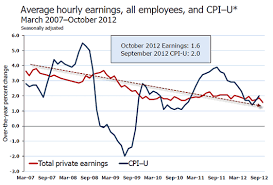
My next slide addressed the dual problem of a rising cost of living while the disposable income in most households has long been on a downward trend. Yes, the Consumer Price Index – Unchained has been up and down, the chained index has gone up and up with the costs of education and healthcare skyrocketing. Why is this? As a retired teacher of economics I can tell you that the unchained index reflects actual spending – the substitution phenomena.  When people have less disposable income, they spend less or substitute preferred goods and services for something else.

hourlyearning

It’s like the elderly halving their prescribed medications, cutting their pills in-half to make them last longer, this so that they can afford to eat too. It is true that many in our society today are struggling. So I was not surprised when one of the ladies in my class shared that she knows her married daughter and her daughter’s husband have to squeeze hard to be able to afford giving the church just fifty dollars a month. Forget about tithing. Giving ten percent of their disposable income would mean they couldn’t afford to put gas in their cars to get back and forth to their jobs.

So, it becomes clear why many churches are struggling financially in today’s world. It is clear too that they will struggle more and more in future years, at least until the economy improves for the middle class. In the meantime, what are we to do? Well, I suggest that those of us who are blessed with more will need to give more. Maybe a ten percent tithe for some of us isn’t really so extravagant at all. Maybe those of us who are richly blessed and have the Spiritual Gift of Generosity need to re-prioritize our giving – dig a little deeper. Maybe some of us who are richly blessed need to cultivate this Spiritual Gift. After all,

Each one must give as he has decided in his heart, not reluctantly or under compulsion, for God loves a cheerful giver.

~ 2 Corinthians 9:7

Published in: on February 20, 2015 at 2:14 pm  Leave a Comment  

Why One Pink Candle ~ A Caring Ministry Story for Advent

But when I got to this part of the story for my care receiver, something caused me to substitute hope instead of joy for what the pink candle symbolizes. It wasn’t planned, but in that moment, it was intentional.

advent_wreathI am both honored and blessed to be a member of the lay Caring Ministry team at our church, First United Methodist in Duncanville, Texas. As it turns out, I frequently teach Adult Sunday School lessons too and recently taught the first of a five part Advent Study. Advent, if you don’t already know, is the first holy season of the Christian year, the four weeks preceding Christmas Day. For the lesson, I had used Reverend Adam Hamilton’s book, “Not a Silent Night,” as a guide.

Visiting a fellow church member who is in a rehabilitation center, I had occasion to reflect upon and to share again part of what I had taught in Sunday School. The man I was visiting, by the way, knows that he will never fully recover from his illness – that his remaining days are few.

I asked my care receiver, a man somewhat older than myself, his wife and his sister who were also present, whether they knew the significance of the traditional Advent wreath. The sister answered first, “Well, it has four candles on a bed of greens – no, five,” she said, “counting the big candle in the center. One is lit each Sunday before Christmas, when the big white one in the center, the Christ Candle, is lit.”

“Yes,” I said, “Very good. But what do the colors of the candles represent, why is one of them pink?” — Silence. The three seemed to be searching their memories. Then the man’s wife said, “Oh, dear. I know I’ve heard this before – maybe many times.”

When I was preparing for my Sunday School lesson, I explained, I was sure that I had heard about it too. But I just couldn’t recall. So I did some research. The Advent wreath, I learned, was first used as a Christian devotion in the Middle Ages. Its design came from the customs of pre-Christian Germanic and Scandinavian cultures. Candles and greenery are symbols for light and life during winter. The wreath is a circle of evergreen boughs symbolizing renewal. The candles, usually three purple but sometimes blue, one pink or rose, and one white, symbolize the light of Christ coming into the world. The candle colors are derived from the traditional liturgical colors, purple for royalty and white for Christ’s purity. But why the one pink one?

My research revealed something that I’m sure I had never heard about before. Originally, long before Advent was added to the Christian calendar, there was only one holy season: Lent. But it wasn’t celebrated as it is now with prayer, introspection and fasting for forty days, I explained. Originally, the faithful were expected to fast for a full seven weeks! This surprised everyone.

Although there are different accounts according to different traditions that explain just how this came about, the one I like is this: After a time, realizing that seven weeks of fasting was just too much to expect of people, church leaders took pity on their flocks. They designated the third week of Lent to be a week of joy and hope. The fasting was suspended for this one week of Lent and the Pope began a tradition of incorporating a pink rose, a symbol for joy, awarding it to someone when saying mass. Other church leaders began wearing pink vestments during this special time.

When Advent was later added to the Christian calendar and Advent wreaths became part of the celebration of mass during this special time of year, the tradition of the third week being devoted to joy was carried over from the ancient Lenten tradition. And that is why the candle lit on the third week of Advent is pink in color. But when I got to this part of the story for my care receiver, something caused me to substitute hope instead of joy for what the pink candle symbolizes. It wasn’t planned, but in that moment, it was intentional. Knowing that my care receiver needed to hear about hope more than joy, I felt inspired to modify the story just this little bit. I choose to believe that the inspiration I felt was from the Holy Spirit.

Later, after sharing communion elements that had previously been consecrated by our pastor, we all held hands and prayed. Closing with Amen and opening my eyes, I knew that my care receiver had heard exactly what he had needed to hear. Though his eyes were filled with tears, his face glowed with the hope he now felt.

Please feel free to post a comment.

Published in: on November 18, 2014 at 8:51 am  Leave a Comment  
Tags: ,

Angels’ Wings ~ A Safe Bet

Me to my little darling who wanted to play outside last night on the golf course after dinner: “Put your shoes on, honey. We don’t want you get your feet hurt out there.”

My little darling to me after walking to the sand trap behind our house: “Opa, I can take my shoes off to play in the sand, yes?”

Me to my little darling, looking over my shoulder to make sure no golfers were teaing-up three hundred yards away: “Yes, honey. But come with me out of the way quickly as soon as I say.”

My little darling to me: “Okay, Opa.”

It was pretty late, so I anticipated that there would be no more golfers on this particular fairway.

My little darling to me after burying her feet in the warm sand an squiggling her toes for several moments: “Opa, why don’t angels wear shoes?”

Me to my little darling, said with a big smile: “Because angels, heavenly angels, have wings, honey. They can’t be hurt, not physically. Earth bound angels like you, however, can be hurt when they step on sharp things.”

My little darling to me: “Will I get wings after I die?”

Me to my little darling: “I’d bet money on it, honey.”

Published in: on July 30, 2013 at 7:54 pm  Leave a Comment  

Small World ~ Big Circles

Everyone was aghast at the strangeness of the coincidence — that half a world away we should encounter someone that, unknown to us before, would have known the same someone else.

Opa_IIMay 28, 2013 — My wife and I met Greg Kahn only a couple of different times, and then only briefly. We did not know him well, but he impressed us both most favorably. My wife may have a different memory, but what I remember most about him was his beautiful smile and genuine personal warmth.

Greg was only forty-five when he died suddenly, unexpectedly, in his hotel room in Hong Kong to where he had traveled the day before on business.

We saw Greg last in Bali, Indonesia on the occasion of our son’s most fantastic wedding celebration. On our way back home to Texas after this, I remember thinking how fortunate our son and his wife are to have friends like Greg. We grieve now for them and with all who knew and loved Greg — knowing how great is their loss.

We have learned more about Greg since his passing, most recently, just last night when we visited with a neighbor, Doris Wilson, who had just lost her own husband to a long and debilitating illness. Doris was surrounded in her home when we got there by several family members who had traveled considerable distances to comfort her. We visited for a while, sharing our memories of her husbad. Then, as we prepared to leave, I encouraged our neighbor to accept our next dinner invitation; she had not felt free to accept previous invitations we had made while her husband was still alive but too ill to accompany her. I made a point of suggesting that we might want to get together one night when or son and his wife will be visiting us soon from Singapore. But my wife opined that this might not be such a good idea because of the recent loss of their friend, Greg. We won’t know what mood they will be in — whether they will be comfortable socializing with folks they don’t know.

“Greg? Singapore?” Our neighbor asked. “Are you talking about Greg Kahn?”

“Why, yes,” my wife answered with considerable surprise.

“Craig,” our neighbor called out to her adult son who was in another room. “Come in here please. The Garry’s knew your friend, Greg.”

Everyone was aghast at the strangeness of the coincidence — that half a world away we should encounter someone that, unknown to us before, would have known the same someone else. The odds are — well, beyond calculation.

For the next half hour or more we listened to Craig Wilson tell us about his good friend, Greg. I see that Craig has posted his own remembrance story on Greg’s memorial web site. I encourage you to read it. http://kahnspiracy.com/the-great-great-greg-kahn/

So, for us the lesson in this story is that this big world of ours isn’t really so big after all; that big circles of friendship like Greg’s and Craig’s eventually intersect with our smaller circles. For me, it makes statistical probabilities less likely and the idea that God puts people in our paths for His own good reasons more likely ~ Luke 10: 29 – 37.

Rest in peace, Greg Kahn.

Published in: on May 28, 2013 at 2:46 pm  Comments (3)  

Creationism ~ A Child’s Understanding of the Reason for Seasons

The creation by accident idea is so utterly unsatisfying to me, so beyond my ability to comprehend, that I need justification. Including God, putting Him at the forefront of creation, provides me with this justification – it answers the why.

HappyGirlMay 23, 2013 — I’m hard of hearing. So when I am driving and my little darling speaks to me from the back where she is properly restrained in her car seat, I’m not always able to understand her. Even though I have made this clear to her over and over again, she continues to ask questions while the world glides by. At just four years-old, she is more than just precocious. She’s very bright and very curious. She really wants to understand things. But then, I could be just a little bit biased in my assessment. I’m never surprised by the things she asks, but I’m not always prepared with an appropriate answer.

Sometimes I have to tell her that I just can’t understand her while I’m driving. When I can’t understand her, I tell her to remember her question and ask it again after we get where we are going. I said this to her recently following a question even though I clearly understood her. I used my poor hearing as an excuse to buy time for deciding how to answer. Her question had been: “Opa, why do we have seasons?”

Hmmmmm… I reasoned that she didn’t really want to know what causes us to experience the changing seasons in most places on earth. She was probably only wanting to know why she was having to wait so long for the outdoor pool to reopen at the apartment complex where she lives with her mother — why it couldn’t be warm year round. She really loves to play in the water. So I decided to help her understand why seasons are important rather than what causes them.

Sometimes my little darling forgets to ask her question again after we arrive at our destination, her little mind having moved on to other, more immediate matters. But not this time. “Opa, why do we have seasons?”

I unbuckled her seat belt and invited her to join me upfront. Holding her little hand in mine then, I began to explain, and she listened attentively.

“Honey,” I said, “when God created the world, He knew that his people would have to feed themselves. They would have to grow food — grains, fruits and vegetables. The plants these things come from all need soil, sunshine and water to grow. But it doesn’t always rain everywhere on earth enough or as often as plants need. So farmers have to use the water from rivers and streams which flow down from the melting snow and ice up in the mountains. This snow and ice piles up during the winter. Also during the winter, when the plants aren’t growing or producing fruit, the soil rests and regains the richness that plants will need for the next growing season. So, farmers prepare the soil and plant seeds in the springtime. Farmers tend the growing plants during the summer to make sure that weeds and certain insects don’t hurt the plants too much. Then, in the fall, when the plants are fully grown and the fruit is ripe, farmers harvest the food so that there will be plenty for everyone to eat through the winter and until it’s time for the next harvest.”

Clearly satisfied with my answer, my little darling said, “God sure is smart, isn’t He Opa?”

“Yes, honey,” I said, “God is smart — and good. He loves us.”

I didn’t tell my little darling that some people don’t believe that God had anything to do with the creation of the earth, life or with the intelligent design of the cycle of seasons for that matter. I didn’t tell her that some people think the fact that our earth, a rocky planet with a magnetic core that protects us from deadly solar radiation, is just a fortunate accident. These same people think the fact our planet orbits a sun that’s just the right size and just the right distance away so that water can exist in liquid form is just more good luck. They think that the earth’s twenty-three and a half degree tilt, which allows the sun’s direct energy to be received in varying amounts north and south of the equator throughout the year, just happened. They reason that the universe is so vast that these perfect conditions had to exist someplace.

Neither did I tell my little darling that, as a student and former teacher of earth sciences, I believe in evolution and the explanations that science provides for the  formation of the earth, the oceans, the continents, landforms, and the geography of soils and climates. I did not tell my little darling that I do not literally accept the Bible’s simplistic version of the creation story. But neither did I lie to her when I answered her question about seasons. This is because, though I have no reason to believe in God other than my desire to believe, I do believe. The creation by accident idea is so utterly unsatisfying to me, so beyond my ability to comprehend, that I need justification. Including God, putting Him at the forefront of creation, provides me with this justification — it answers the why.

Some people are not be able to let go of any part of Scripture, fearing that in doing so they will loose their faith entirely. This is an application of the Camel’s Nose falacy. That is fine for some people, but I can’t be so fundamental. I can’t ignore scientific truths. Neither can I have things two different ways at the same time.

My smart little darling will eventually learn all about the various scientific theories explaining the how of creation. By the time she is in high school, science will have undoubtedly discovered more about it . I very much doubt, however, that science will ever discover a testable hypothesis to answer the why question. So, until she is mature enough to grapple with the relative merits of creationist and scientific arguments, mature enough to reconcile in her own way the earth’s physical record with the Word of God, I want her to have the comfort of believing, as I do, in a loving creator. Better to believe in this than in an uncaring, statistical probability. Perhaps she will accept the existance of dinosaurs in the earth’s distant past and our relationship to other, now extinct, human species, as I have, without having to reject what is true in Scripture. The world, afterall, is a scary enough place in which to grow up. Not having an answer to the why makes it even more scary. And on what better foundation can one have to grow, both emotionally and spiritually, than on the why — God’s love?

Please feel free to leave a comment.

Published in: on May 23, 2013 at 12:16 pm  Comments (4)  
Tags:

Coincidence ~ How it Conforms to God’s Will

Natural events like tornadoes, hurricanes and tsunamis befalling all. Would God intentionally cause natural disasters like these to strike innocents? Really?

Opa_IIFebruary 25, 2013 — I meet with friends for prayer breakfast every Friday morning. This is one of my better habits. We are there not just for the food and ourselves but for one another. The fellowship is both comforting and affirming. The prayer is assuring.

Last Friday morning one of my prayer breakfast friends returned a book that he had borrowed from me for a series of Sunday school lessons. The book was Reverend Leslie Weatherhead’s, “The Will of God.” Anxious to share with us about how his lesson series had gone, he first had to explain Weatherhead’s premise: that our free-will sometimes interferes with God’s Intentional Will, thus resulting in something that Weatherhead calls, God’s Circumstantial Will. But, according to Weatherhead, our interference is only temporary. God, in His infinite grace, allows us the freedom to fail. But He uses the circumstances of our choices, good or bad, and happenstances of the natural world that He created to forge His Ultimate Will. This led to a discussion about how God is involved in our daily lives.

Another prayer breakfast friend told us that he had prayed for God’s help with a business problem earlier in the week and that a solution was subsequently and soon after identified. “Surely God had answered my prayer,” he said. Then I asked whether it was possible that he was attributing Devine assistance to coincidence – whether we aren’t sometimes overly anxious to see God’s hand in everything we do.

While my friend was considering an answer to my question, another friend said, “No. It may seem to be coincidence to you, but God causes all things to work together for good to those who love Him. It says so in Romans 8:28.”

I chose then not to debate the point. If my friend had chosen to give God the credit for his business solution, I knew that God would not mind. But, having read Weatherhead’s book myself, I pondered about this later that day. I sat with the Bible, accessed via the Internet, and came across the following Scripture passages: Time and chance happenth to them all (Ecc 9:11), and It rains on the just and the unjust (Mat 5:45). Hmmmm…

Chance? Natural events like tornadoes,  hurricanes and tsunamis befalling all? Would God intentionally cause natural disasters to strike innocents? Really? Or are innocents simply so much collateral damage when “acts of God” like these occur? Does God cause the disasters allowing the innocents to suffer, or is He simply bound by the nature of His own creation? When man perpetrates unspeakable evil upon his fellow man, why does God allow it? The Holocaust comes readily to mind. What should we believe?

Well, we can either believe that God is involved in everything, responsible for everything, or that He is not — which is not to say that He is never involved. So that gives us a third choice, the choice that I choose to believe. When we invite God into a situation, He is there with us — may even choose to “tip the scales” on our behalf. But I know that His will is not always what we would choose.

Understanding that God ordained and made natural laws, life cycles and all things, and that these often play out over time independent of manipulation does not make me an unbeliever — just a liberal believer. I think that Weatherhead would agree.

Please feel free to post a comment, whether you agree or not.

Published in: on February 25, 2013 at 2:24 pm  Comments (1)  

Hush my Darling, Don’t Fear my Darling ~ A Child’s First Encounter with Jesus

After picking her up from daycare, we sat in my car, my little bi-racial great grand- daughter and me. We were listening to the last of a favorite song.

Hush my darling, don’t fear my darling. The lion sleeps tonight.

Wimoweh, wimoweh, wimoweh, wimoweh

Ee-e-e-um-um-a-weh
Ee-e-e-um-um-a-weh

While singing along, she played with the cross hanging from my rear-view mirror. She flipped in over, then took it down, then put it around her neck, then removed it and put it around my neck.

A few days shy of just four years-old, my little darling said, “Opa – why do you leave this cross in your car? Why don’t you take it in the house?”

“I like having it in my car, honey. When driving, it comforts me.”

“Hugh? How does it comfort you?” she asked.

“This is the cross of Jesus, honey. He died on it so that we might be forgiven for all of our sins. It reminds me of his love and assures me that if anything bad should happen, I will go to heaven and be with him.”

“Jesus is dead?”

“No, honey. He did die, but then he came back to life for a short while to prove to us that he truly is the son of God. After this he went to heaven, promising to return again someday.”

Quiet now, listening to the song’s final Ee-e-e-um-um-a-wehs, tears began to stream down my little darling’s face.

“What’s wrong, honey. Why are you sad??

“Opa,” she said, “I don’t want you to go to heaven. I want you to stay here with me.”

“I will, honey. I promise I will. I will stay here with you for as long as I possibly can. But we all want to go to heaven someday; we all have to die eventually.”

I strung the cross back over my rear-view mirror and my little darling moved onto my lap hugging me around the neck.

“Come on, sweetheart,” I said. “Let’s go in the house and have a little snack.”

The next morning, I was up at the crack of dawn, which is my daily habit. I was laying back in my big leather recliner with my first cup of coffee in one hand, my iPad in my lap, and a stylus in my other hand when my little darling came padding down the stairs. She had a stuffed puppy cradled under one arm and was dragging a blanket behind her with the other.

“Opa?” She asked. “Who killed Jesus?”

Obviously, she had taken our short discussion of life and death and the hereafter to bed with her the night before. I put down my coffee cup and set aside my iPad. “Come here, sweetheart.”

Lifting her and her stuffed toy onto my lap, I cradled her in my arms for a moment.

“Honey, Jesus lived and died and lived again a long, long time ago. He came to earth from heaven to give us the truth about who we are and whose we are. He taught us what we needed to know about God and how God wants us to behave. His teachings threatened some who, back in those times, had power over people’s lives. So they had him crucified, nailed to a cross, to get rid of him and to warn others not to challenge their authority.”

“So, that’s why we have a big cross in our church, right Opa?”

“Yes, honey. That’s right. The cross is the Christian symbol for Jesus, for what he did for us.”

“And now he is in heaven?”

“Yes, honey.”

“Opa? Where is heaven?”

“Some people think it’s somewhere up in the sky. Others think it’s on another planet, or in a whole different dimension of time and space. But I like to think that, part of it at least, is right here in the human heart.” I said this placing my hand over her heart.

She sat quietly for a time, obviously thinking about everything I had said. Then she said, “Opa, was Jesus brown like me or white like you?”

“Honey,” I said, “nobody knows for sure exactly what Jesus looked like. All we have today are paintings and statues of him that were made by people who lived long after the time of Jesus. These people used their imagination to create images of him, images that looked the way they wanted him to look.”

I picked up my iPad, googled Jesus, and then touched the image option at the top of the screen. Hundreds of pictures appeared for my little darling to see. Some of them were tanned, middle-eastern in appearance. Some were more European looking. Some were dark complexioned with broader features. One was very light complexioned with light brown hair and blue eyes. One was very dark with curly hair. Most had long hair and short beards, but not all.

“People like to think of Jesus as looking like themselves, honey. How would you like him to look?”

My little darling didn’t answer right away. I could tell that she was really thinking hard about this. She looked at image after image of Jesus. Then she said, “I guess it really doesn’t matter what he looked like, Opa. But if he looked like you do, that would be okay with me.”

Published in: on November 14, 2012 at 9:44 am  Comments (7)  

Fathers’ Day ~ A Special Children’s Sermon

June 15, 2012 — Good morning (speaking to the children).

So, it’s Fathers’ Day, right? Yeah… that’s right. Father’s Day is a special day set aside for us to honor our fathers, our male parents. Are there other names for our fathers? Raise your hand if you know of one (listen for examples and move microphone to children who want to share)?

Ok, good… dad, daddy, poppa. These are special names we sometimes give to our earthly fathers. How about our fathers’ fathers and our mothers’ fathers, our grandfathers? Is this a day for honoring them too? Yeah, sure it is. But what are we supposed to do if we don’t have a male parent actually living with us? Some boys and girls don’t have one you know. I didn’t. I grew up without a father. But I was lucky enough to have a grandfather. I called him grandpa. He wasn’t really my grandfather, he was my mother’s step father, so there was no blood relation. But he loved me anyway, and taught me lots of good stuff.

Y’know, Jesus had a special name for his father. His father was Father God, who just so happens to be our Father too, our Heavenly Father. So, in a way, that makes Jesus our big brother. How cool is that?!?! This means that, whether we have an earthly father living with us our not, and even if we don’t have a special male role model in our lives right now, we always have the best father possible, our Heavenly Father.

In the language Jesus spoke, the word for daddy was Abba. So, when he prayed to our Heavenly Father, he might have addressed him as Abba. Do you think God would mind if we called him Abba too? Nah… I think He would probably like it.

Who will count for us today?

ONE, TWO, THREE – (CLAP!)

Thank you, Father God — Abba,

for being the perfect parent.

Thank you for loving us like You do

and for sending us your first-born son,

our Big Brother, Jesus, to be our example

for how you want us to live.

Amen

Published in: on June 15, 2012 at 10:07 am  Leave a Comment  
Tags: ,

Purpose ~ Discovering the Meaning of Life

May 11, 2012 ~ Why are we here? What is the meaning of life? These are questions we have all spent some time wondering about — some of us more than others. Even the most nihilistic of atheists have considered these questions, though ultimately rejecting them as meaningless. For agnostics, those who neither believe in a god or gods or a higher power, nor reject the possibility of such, the answer is complicated. They will say, “It depends.” For those of us who believe in a god or higher power, however, the answer is quite simple. But to tell you the answer now would obviate your reason for reading the rest of this.

Whether we are believers or non-believers, we are all tempted to answer these questions the same way. This is because we all want the same things in life:  success, happiness and well-being for ourselves and for our loved ones. If we achieve these things, many would say that they have discovered and achieved their purpose – that life is simply a matter of satisfying Maslow’s hierarchy of needs. But is it really? And, if it’s not, how do we discover our real purpose in life?

No, I’m not talking about our jobs, our daily responsibilities, or even our long-term goals. I mean the real reason why we’re here at all — the very reason that we exist.

Consider the possibility that you are satisfying all of your earthly goals, that you have secured for yourself and your loved ones all of Maslow’s needs. You believe yourself to be secure and you have all you could want or ever need, materially as well as emotionally. You find yourself at Maslow’s self-actualization level. You are a good, moral person, not impinging on others’ rights, not directly anyway. You are involved in a hobby or a sport that you love and you are actively involved in civic activities – helping your community to grow. Then you get sick or have a terrible accident, or you lose your whole family. Worst case situation: the reason you lost your family happens to be your fault. You have lost your self-esteem; you have lost your confidence; you have lost the respect of others. Your achievements now are history.

Now what’s your purpose? What reason do you have to go on living? If you decide to end it all, you wouldn’t be the first.

My wife and I once knew and were close to a couple who seemed to have it all together. The husband, Ronny, and the wife, Harriet, were both reasonably successful professionally. They had two boys about the same age as our two boys. Ronnie and Harriet were fun to be around. We did things together, as couples sometimes, at other times, including all the boys. They were Christians but infrequent church goers; neither seemed to be particularly spiritual. But from all outward appearances, they had satisfied most of Maslow’s needs. But something was wrong, something insidious. Ronny had an addiction; he liked to gamble. Harriet, deciding that life with the father of her sons would always be one of disappointment and marginal security at best, started seeing another man, a married physician whose wife was an invalid.

The story ended in tragedy with Harriet dying in a stupid traffic accident hurrying home from a liaison with her lover. Ronny then, some months later, killed himself leaving a suicide note behind for his sons saying that he was sorry for gambling away all their school money.

What was the purpose in all that? Only God knows.

My wife and I have known another couple, Jerry and Debbie. Their situation stands out in stark contrast to the first couple’s. They were members of our same congregation in the United Methodist Church for several years. They, following our two-year tenure as lay leaders, served the church tirelessly in this capacity for the same amount of time. They worked together in harmony running a small business, a business that satisfied many of their secular needs. Like us, they had family members with issues, serious issues. We often prayed together about our loved-ones.

Together, Jerry and Debbie loved horses. They kept and cared for several on their property. We sometimes joined them for what Debbie called, barn dates.

We did not know it when we first knew them, but Debbie suffered from two serious physical ailments, cirrhosis of the liver caused by hepatitis-C and pulmonary hypertension. She never let on until she became too weak from her conditions to hide it from us any longer. Doctors tried interferon treatments, but these only made Debbie sicker. She was on the list for a liver transplant, the only thing that might make her well, for something like eight years. She wasn’t sick enough yet to be moved to the top of the list.

During this whole time, Jerry was her devoted, loving, and almost constant companion. He left her bedside during the day only to tend to their business and to care for their horses. At night he left only when Debbie sent him away so that he could get the rest he needed to sustain him in his devotion.

When an appropriate liver was finally made available, surgery was made problematic because of high pressure in the arteries of her lungs. Though the surgery was a success, the anti-rejection medication Debbie had to take caused breathing issues. She could keep no solid food down after she came home from the hospital and grew weaker and weaker.

Skipping the details here, Debbie finally had to return to the hospital. After weeks in intensive care, she lapsed into a coma, her devoted husband at her side. When the decision had to be made whether to keep her alive artificially or to let her go, Jerry made the decision by himself choosing to spare their children from having to be a party to it.

What was the purpose in this? God knows, and so do we who trust in Him. Debbie’s suffering and ultimate death was not without purpose. It caused us all to come closer to Him, and Jerry to blossom into a more powerful man of God, a man now free and inspired to spread far and wide the great love that he once gave in focused devotion to Debbie. I see Jerry often these days and can assure you that he is living with renewed passion his purpose in life.

Do you yet not know that which is your purpose for living?

No? Okay, if you are Christian, consider the book of Isaiah, chapter 45, verse 18, “The Lord created the heavens — He is the one who is God! He formed and made the earth — He made it firm and lasting. He did not make it a desolate waste, but a place for people to live. It is He who says, I am the Lord and there is no other god.”

Consider also Psalms 100:3, “Acknowledge that the Lord is God!  He made us, and we are his. We are his people, the sheep of his pasture.”

What do these passages of scripture mean? I think it is clear, they mean that God created us so that we might know and acknowledge Him, that we might worship Him. And how do we do that? By keeping His commandments, the first of which being, “Love the Lord your God with all your heart and with all your soul and with all your strength and with all your mind.” The second is like the first, “Love your neighbor as yourself.” Luke 10:27.

If you are Jewish or Muslim, you know that these same Old Testament passages are found in the Torah and the Quran, and Muslim’s accept Jesus as a great prophet and teacher, His gospel to be holy. If you are Hindu or Buddhist, similar concepts are incorporated in your beliefs.

If you are a non-believer, consider that all great religions of the world have this in-common: some version of the Golden Rule – Do unto others as you would have them do unto you. I know, I know: they could all be wrong. But there is a secular version of this, “You scratch my back and I’ll scratch yours.” Notice, however, rather than being the first to give as in the faith-based version, the secular version expects the other guy to give first. Self-interest is the motivation in the secular version. Yes, the faith-based version tells us how God wants us to behave. This then, is our purpose because it was first His purpose; He loved us first and longs for our love in return. No matter what else might befall us, if we adopt His purpose as our own, we will never be without.

With due consideration and prayer, here is my purpose statement: to love God, seeking His Will by living consciously and courageously, to resonate with love and compassion for everyone, to stir the hearts and minds of others per-chance to awaken the spirit within them, and to someday leave this world in peace.

If you are a non-believer,  good luck, my friend, in discovering your own true purpose in life, should you ever go looking for it. If you never do, I’m quite sure that God will find one for you.

Published in: on May 11, 2012 at 8:30 pm  Comments (2)  
Tags:

Questioning Abraham’s Faithfulness ~ Is This Islamophobic?

I’ve been hearing the idea among Christians lately that Father Abraham of the Old Testament, patriarch of nations and revered as “father of the faithful” in the New Testament, wasn’t so faithful after all. Curious.

The idea that Abram (his name before God changed it) was ever unfaithful to God runs contrary to my understanding of Scripture. True, he was not without sin and, yes, he took his wife’s handmaiden, Hagar, to bed so that she might bear a surrogate child for an heir (Gen. 16). But God never commanded Abram to be faithful only to his wife, and it was Abram’s wife’s idea in the first place. She, Sarai, told him to do it. God’s agreement with Abram (Gen. 15), that he would give his descendants the land between the great river of Egypt and the great river Euphrates, was based only on God’s acceptance of Abram’s faith (Gen. 15:6). Abram’s faith made him right with God.

By the way, the land God said he would give to Abram’s descendants is much larger than just modern-day Israel. It includes many modern-day Islamic countries too.

After Hagar gave Abram a son, whom Abram named Ishmael (Gen. 16:15), God revisited Abram thirteen years later and changed his name from Abram to Abraham — because, God said, “I am making you a father of many nations. I will give you many descendants (Gen. 17:5-6).”

I can’t imagine that God would have given Abraham this proof of His previous agreement if Abraham had in any way been unfaithful. Anyway, how was Abram to know that the descendants of whom God had previously spoken would not be those fathered with other wives or slaves? It was, after all, customary in Old Testament times for men to take more than one wife and not unlawful, even under Mosaic law, for a man to have sex with his slaves http://bible.org/question/why-did-godly-men-ot-have-more-one-wife. The Torah, in fact, does not forbid polygamy http://www.chabad.org/library/article_cdo/aid/558598/jewish/Does-Jewish-law-forbid-polygamy.htm.

Further on in Genesis, God says, “And I will make an agreement between me and you and all your descendants from now on. I will be your God and the God of all your descendants (Gen: 17:7).” Abraham’s part of the agreement was that he and all his descendants would be circumcised to show that they are part of the agreement “that lasts forever (Gen. 17:13).”

I find it interesting that circumcision is practiced to this day by Muslims http://www.circumstitions.com/Islam.html, but not by Christians as an act of faith, not since Peter declared it and the Mosaic law to be an ‘unbearable yoke’ (Acts 15:7-11).

When I read Genesis 17:7 to Christian friends during a prayer breakfast recently, one questioned the Hebrew meaning for the word, all, as is used in the English translation of Genesis referring to Abraham’s descendants. The Hebrew word for all is Kǒl, as in Kǒl HaKdoshim, which means all saints http://answers.yahoo.com/question/index?qid=20091023053101AAO2kOr. Kǒl can also mean “voice” depending on the way it is used. But I very much doubt God said, “… ‘voice’ your descendants.”

Abraham is called the father of the faithful (Gal. 3:16-29Rom. 4:11) and “the friend of God” (Jas. 2:23). He is an example to us in many ways. Nearly every action in Abraham’s life shows his great faithfulness to God. He left his country and countrymen never to return (Heb. 11:8-16). He believed the promise of a son though such a birth was naturally impossible (Rom. 4:18-21). He cast out his son, Ishmael when Sarah and God commanded it (Gen. 21:9-14). He was even willing to offer Isaac, the son of promise, when God demanded it (Heb. 11:17-19). Therefore, because God did not question Abraham’s faithfulness, neither should we.

I don’t know, but I suspect that this so-called “Christian” idea, that Abraham was somehow unfaithful to God in taking Hagar to bed for an heir has a lot to do with Christianity’s reluctance to accept the fact that the descendants of Hagar’s son, Ishmael, are also God’s people. The sins of the father revisited upon his sons, if you will. Surely, questioning the Hebrew meaning of the word, all, in God’s promise to Abraham, was an effort to cast doubt on this. But all Christians don’t see it this way. I don’t.

Yes, after Abraham sent his son, Ishmael and his mother into the desert with little more than provisions sufficient to guarantee their deaths (a sin in my book), God heard Ishmael crying and sent an angel to rescue them with a promise that God’s agreement with Abraham and all his descendants also would apply to him (Gen. 21:8-20).

Read what another Biblical scholar, not that I’m one by any means, has to say about this — http://www.fatherdave.org/article/article_51.html. It’s a good read.

I know, I know – John 14:6. But that’s for another discussion and another posting on another day.

Published in: on February 10, 2012 at 12:52 pm  Comments (2)  

Moral Hazard ~ A Deceitful Double Standard

An economic concept called “moral hazard” divides Americans and helps to define political philosophies.

After Sunday school last week, I carpooled with other members of our church up to Dallas. We went to help serve the noon meal at The Bridge, the homeless shelter there. What a powerful experience. Without exception, the clients were respectful and appreciative, especially when they themselves were shown respect in any way. Several actually offered me blessings as I filled their glasses with ice water. Many bowed their heads in silent prayer before eating.

When the meal was over and the clients had all left the dining facility, I spoke for awhile with the supervisor of the “Stew Pot” mission team http://www.thestewpot.org/sz.asp which volunteers to run the dining facility. The facility, by the way, is aptly named The Second Chance Cafe. Our discussion led me to deep introspection about the plight of a growing number of homeless in this economy.

Our youngest son, suffering from a laundry-list of psychological problems, is a homeless person notwithstanding how much we continue trying to help him. Our granddaughter, a high school graduate and trained cosmetologist, still reeling from the aftermath of an abusive relationship with the father of her little girl, has told us that she too would most likely be in a shelter if it were not for our intervention and on-going help. So, if it can happen in our family, it can happen in yours.

On my way out to return home, I picked up a printed copy of the local version of an international publication, Street Zine. It was filled with thought-provoking articles about the poor, the homeless and disabled – the sheep I believe Jesus was talking about when He told his disciple, Simon son of John, also known as Peter, to take care of them (John 21:16). One particular article, from which I have borrowed title of this post, struck me hard. You can read the whole thing for yourself on-line if you wish. It’s at http://www.streetnewsservice.org/news/2011/june/feed-286/%E2%80%9Cmoral-hazard%E2%80%9D-%E2%80%93-a-deceitful-double-standard.aspx. Below, combined with my thoughts on the subject, is an abstract of the article which was written by Domink Jenne, a citizen of Freiburg, Germany.

The term, “moral hazard,” according to Herr Jenne, means something similar to moral temptation. It’s actually an abstract term from the insurance industry. In economic theory, it describes a situation in which a party insulated from risk behaves differently from how it would behave if it were fully exposed to the risk http://en.wikipedia.org/wiki/Moral_hazard. According to the theory, a driver with insurance, for example, will drive with less care because he knows he won’t have to pay in the event of an accident. The term has now become a social slogan among conservatives who refer to it as a destructive mentality that results from knowing someone will take care of you.

The welfare state, conservatives claim, promotes “moral hazard” because it removes personal responsibility and diminishes the motivation to search for work whilst living comfortably on welfare. Cutbacks are therefore necessary, even perhaps the complete removal of spending on social programs to eliminate the danger of moral temptation and damage to the economy. But you know what? I’d bet that most, if not all, of the clients I served in the Second Chance Café Sunday would jump at the chance to have a job that would pay them enough to just get by on. Unfortunately, most have issues, their own fault, somebody else’s fault or nobody’s fault, that prevent them from successfully competing in the job market.

Didn’t Jesus say that the poor would always be with us (Matthew 26:11)?

To conservatives, who perceive themselves to be the injured party, “moral hazard” threatens to affect not only those who apparently don’t want to find employment, but also those who are lucky enough to have a job – this to justify the surveillance of employees who might pilfer from stock shelves and cash drawers. So broad is conservatives’ perception of the danger of moral temptation, according to the article’s author, that it is necessary to introduce counter measures against it. Anyone who tries to counter the argument with terms such as “mutual trust” or “social responsibility,” is likely to be laughed at as a worldly innocent. Mistrust is the foundation of the argument.

The concept not only encompasses the malicious viewpoints of social deceivers and hypochondriacs, it also affects the financial sector and is a concern for us all. Consider the executives of too-big-to-fail investment banks and insurance companies who have made such horrible decisions in recent months and years, even committing fraud but not being held accountable. Still, they continue to receive huge bonuses and severance packages! Is this too not “moral hazard”?

When banks with millions, even billions in debt are saved from collapse, then it actually becomes possible that the lack of regulation and oversight encourage a high risk attitude. But conservatives don’t seem to see it this way. In Congress they resist the passage of laws and the enactment policies to prevent future fraud. The difference here is that the amounts stolen from investors by investment bankers are significantly higher than the amounts paid to alleged welfare fraudsters. Is this not A Deceitful Double Standard?

The Nobel Prize winner Kenneth J. Arrow – the man who first popularized the concept of moral hazard back in 1990 – has written and said much about the importance of spending on social programs http://gatton.uky.edu/Faculty/hoytw/751/articles/arrow.pdf. And he should know.

Please feel free to post a comment whether you agree or disagree.

Published in: on August 17, 2011 at 7:50 am  Comments (8)  

Being Christian vs. Doing Christian

I’m no Biblical scholar, but parts of the Bible, especially parts of the New Testament, I think are pretty clear.

Those who know me know that I tend to be pretty liberal in my thinking and persuasions. However, when it comes to my faith persuasion, I’m not as liberal as some. Take the popular author of Christian books and articles, John Shore. John wrote the bestselling books, “Penguins, Pain and the Whole Shebang” and “I’m Okay, You’re Not – The Message We Send to Nonbelievers, and Why We Should Stop”. Like me, John maintains a blog to which he posted a piece a few years back by almost the same name as this post: Doing Christian vs. Being Christian. He makes the point in his posting that the Bible is complicated, too complicated for most of us to truly understand, which is why we rely upon others who have gone to seminary for four years just so that they could begin to understand it. By contrast, he wrote, “God himself, though, is the ultimate in uncomplicated—and, via the Holy Spirit, is or can be as fresh and new to you as the very moment in time in which you’re reading this.”

Okay, I buy that. But John sums up his post claiming that we don’t have to do anything about what God, in the person of Jesus Christ, did for us on earth, and that we certainly don’t have to make ourselves worthy of it.

Hmmmmm… Now, perhaps I don’t fully understand the message that John was making on this subject of doing vs. being Christian, but if I do understand it, John is way more liberal than I am when it comes to faith. I’m no Biblical scholar, but parts of the Bible, especially parts of the New Testament, I think are pretty clear. For example, Acts 2:42 – 47 about the fellowship of believers.

“And they devoted themselves to the apostles’ teaching and the fellowship, to the breaking of bread and the prayers. And awe came upon every soul, and many wonders and signs were being done through the apostles. And all who believed were together and had all things in common. And they were selling their possessions and belongings and distributing the proceeds to all, as any had need. And day by day, attending the temple together and breaking bread in their homes, they received their food with glad and generous hearts, praising God and having favor with all the people. And the Lord added to their number day by day those who were being saved.”

Is this not telling us that by accepting Christ as Lord and Savior, converts to the early church were changed and began to live their lives differently? If this is true, then are we not expected to change also, to be more loving and more generous? Surely, we can never hope to make ourselves worthy of Christ’s love and sacrifice. But that doesn’t mean we shouldn’t try.

Consider also, that which is written in 1 Peter, 2:19 – 25 about enduring unjust suffering.

“For this is a gracious thing, when, mindful of God, one endures sorrows while suffering unjustly. For what credit is it if, when you sin and are beaten for it, you endure? But if when you do good and suffer for it you endure, this is a gracious thing in the sight of God. For to this you have been called, because Christ also suffered for you, leaving you an example, so that you might follow in his steps. He committed no sin, neither was deceit found in his mouth. When he was reviled, he did not revile in return; when he suffered, he did not threaten, but continued entrusting himself to him who judges justly. He himself bore our sins in his body on the tree, that we might die to sin and live to righteousness. By his wounds you have been healed. For you were straying like sheep, but have now returned to the Shepherd and Overseer of your souls.”

Is this not telling us that by accepting Christ as Lord and Savior we are suppose to behave in ways that are pleasing to God?

So I take exception to John’s message, as I understand it. We do have to do something in response to what Christ did. We have to live, not for ourselves so much as for God, through worship, prayer and service to our fellow man.

We all know of many who proclaim themselves to be Christian but seldom, if ever, attend worship services. Seventy-six percent of Americans make this claim, but less than forty percent are church goers. Of that number, I wonder how many do more than just occasionally occupy a pew to enjoy the music, snooze through the sermon and drop a dollar or two in the collection plate.

Consider the messages found in Matthew 7:21.

“Not everyone who says to me, ‘Lord, Lord,’ will enter the kingdom of heaven, but only he who does the will of my Father who is in heaven.”

The operative word, for me in this passage, is “does.” Only he who does the will of God will ever enter the kingdom of heaven. And isn’t that the whole point of being Christian? So, is it even possible to be Christian without doing Christian? And what is doing Christian anyway? Is it not living our lives, to the extent humanly possible, after the example of Christ and the teachings of His Apostles — loving God, worshiping and studying His word, praying constantly, and sacrificially doing for others?

Please feel free to comment pro or con on this post.

Published in: on May 12, 2011 at 11:27 am  Comments (6)