The Swimming Pool Analogy ~ More Viral Disinformation

“Owners of capital will stimulate the working class to buy more and more of expensive goods, houses and technology, pushing them to take more and more expensive credits, until their debt becomes unbearable. The unpaid debt will lead to bankruptcy of banks which will have to be nationalized and the State will take the road which will eventually lead to communism.”

Das Kapital — Karl Marx, 1867

opaMarch 8, 2009 — My students and I discuss economically relevant news items at the beginning of each of my classes. I challenge them to claim their share of daily-assignment A’s, two for each student per grading period, for staying informed. Lately, however, it seems as though everything in the news is economically relevant — so this isn’t much of a challenge, except for the fact that most come prepared with the same most news-worthy items each day. Whoever gets their hand up first wins.

One story that everyone seemed to miss last week was that Russia’s Ambassador to the United States, Sergey Ivanovich Kislyak, predicted that our economy will fail completely during 2010. I shared this with my students from whom I was pleased to note that none seemed overly concerned about the ambassador’s opinion. After all, Russia, we all know, still isn’t overly fond of us, jealous perhaps – their own recent experiment with capitalism having all but failed following their financial crisis in 1998. Entrepreneurism, political corruption and crime rushed into the economic vacuum left behind by the failure of the Soviet Union’s command economy.

Offering something for discussion not gleaned from the legitimate media, thus avoiding the competiton for her daily assignment A, one of my advanced placement students brought a copy of the following to class, a much circulated email message, subject: “THIS SAYS IT ALL.” I read the message to my class including Karl Marx’s nineteenth century prediction about the future of capitalism, which seems to be hauntingly applicable to our current crisis.

  ~~~~~~~~~~~~~~

 Shortly after class, an economics student approaches his economics professor and says, “I don’t understand this stimulus bill.  Can you explain it to me?”

The professor replied, “I don’t have any time to explain it at my office, but if you come over to my house on Saturday and help me with my weekend project, I’ll be glad to explain it to you.” The student agreed.

At the agreed-upon time, the student showed at the professor’s house.  The professor stated that the weekend project involved his backyard pool.

They both went out back to the pool, and the professor handed the student a bucket.  Demonstrating with his own bucket, the professor said, “First, go over to the deep end, and fill your bucket with as much water as you can.” The student did as he was instructed.

The professor then continued, “Follow me over to the shallow end, and then dump all the water from your bucket into it.” The student was naturally confused, but did as he was told.

The professor then explained they were going to do this many more times, and began walking back to the deep end of the pool.

The confused student asked, “Excuse me, but why are we doing this?”

The professor matter-of-factly stated that he was trying to make the shallow end much deeper.

The student didn’t think the economics professor was serious, but figured that he would find out the real story soon enough.

However, after the 6th trip between the shallow end and the deep end, the student began to become worried that his economics professor had gone mad.  The student finally replied, “All we’re doing is wasting valuable time and effort on unproductive pursuits.  Even worse, when this process is all over, everything will be at the same level it was before, so all you’ll really have accomplished is the destruction of what could have been truly productive action!”

The professor put down his bucket and replied with a smile, “Congratulations.  You now understand the stimulus bill.”

~~~~~~~~~~~~~

After reading this to the class, I asked my students what they thought of it. Nobody offered an opinion, not at first. But I was patient, giving them a chance to think about it. Finally, one brave young fellow raised his hand and offered this, “I think the explanation is too simple… so simple that the author must think everybody else is stupid.”

Another student said, “Yes, and if economics was that simple we’d all be getting A’s.” In response to this, most of the class started laughing including me.

“Remember, class,” I said, “the John Maynard Keynes quote: ‘Economics is an easy subject at which few excel’.”

Then, the student who had brought the email to class sheepishly asked why the story’s professor was so wrong using a swimming pool as a metaphor for our economy.

“Unlike the professor in the story,” I said, “I will take the time and at least try to explain. Yes, this lesson on the Economic Recovery and Investment Act of 2009 is flawed on many levels.

First, our economy is not at all like a fluid swimming pool. Wealth does not flow freely from the deep end to the shallow. Wealth tends to flow from the shallow end to the deep where much of it tends to stay. At the beginning of the Bush/Cheney years, 80 percent of the water [wealth] in this nation belonged to 20 percent of its citizens, or just 20 percent of the pool. Now nearly 90 percent of it is in the deep end with much of it cashed away in U.S. Treasury Bonds, foreign numbered bank accounts and other investments that impede circulation. This is because the rich have a much lower propensity to consume and a higher propensity to save. Recall our lessons on the aggregate expenditures model. And, be not confused, saving is not the same thing as investing (http://www.finweb.com/financial-planning/finances-savings/saving-vs-investing.html), which is what many monetarist/supply-side economists would have us all believe. By the way, there aren’t very many serious supply-side economists left.

Second, we don’t have a private backyard pool any more. Our nation’s pool is connected to those in the back yards of all other nations.

Third, and there is little controversy over this among most economists now, government spending under the law will not be wasteful/unproductive activity. Infrastructure projects that this country badly needs done will get done. This will make us more efficient and reduce future costs (true investment)… plus, wages paid to get this work done will be spent and money spent eventually becomes someone else’s income — over and over again. Much of it will save state and federal governments’ unemployment and health care costs.

Finally, much of the water moved (government spending) will be used to nurture education and do research on alternative energy sources making us even more efficient and competitive in the future.

Viral disinformation like this swimming pool analogy making the rounds lately, I think, are poor attempts by those who oppose the current administration’s efforts to deal with the recession. They raise doubts and promote fear for political purposes and, as such, are disingenuous. It’s sad because what we need just now in the private sector is a sense of unity and confidence. But informed individuals, or at least those who have open inquisitive minds, won’t be suckered-in by simplistic appeals like this. We know that the world is not flat, and we know that laissez faire  economics is anarchy. An economy without structure and rules is like a jungle wherein only the fittest survive.  I must admit, however, the Karl Marx quote, does come pretty close to explaining what has happened to us owing to deregulation of the financial sector. Let’s all hope his forecast isn’t correct too. If foreigners decide to stop lending us money, it could come to that, heaven forbid!”

Please feel free to respond to this posting below with a comment, whether or not you agree.

Published in: on March 8, 2009 at 3:20 pm  Comments (19)  

What’s the Difference Between a Town and a City — An Urban Area and a Rural Area?

Do you think you think you know the answer?

A friend recently challenged me with this question. He chose to ask it of me because he knew that I had taught geography for several years. Even so, I felt that I had to check my facts before responding and, in so doing, I broadened my own understanding on the subject a bit. He, like many Americans, thought that the official difference between a town and a city had to have something to do either with population size or with geographical area. Well, it doesn’t.

Strange as it may seem, geographers don’t classify more-densely populated areas as cities or towns. They are all called urban areas as opposed to rural areas. That’s because there is no universally accepted criteria based on either population size or square miles/ kilometers. Rural areas are less densely populated, offer fewer services, and are generally devoted to economic activities such as farming and ranching. In the U.S., according to About.com – geography, an urban area is one that has a population providing services that numbers at least 2,500. Smaller populations pro- viding services are called villages. This differs from country to country, of course. In Japan, an urban area must have a population of at least 30,000.

In England, from which we Americans originally adopted our sense of such things, a city was a town with a cathedral. All other densely populated areas were simply called towns. But they are all towns in today’s “United Kingdom,” including (in all Britishers’ eyes) the mother town of them all, London Town.

I think what most people in the U.S. understand to be a city today is a larger urbanized area that has government buildings like county seats do here in Texas. Cities in the U.S. usually have a university or two in lieu of community colleges. They very often have museums and other cultural centers too like zoos and the like. In the vernacular of a place, however, it is quite acceptable for people to refer to their urban area as either a town or a city. It’s all perception.

Metropolitan areas like Dallas, Texas are agglomerated urban areas with peripheral zones not themselves necessarily urban in character, but closely bound to the urban center by employment or commerce. A metroplex is when metropolitan areas grow large enough to merge, as in the Dallas/Ft. Worth Metroplex. A megolopolis is when many metropolitan areas merge, as on the east coast of the U.S. with BosWash, a huge urban area incorp- orating the cities of Boston, New York and New Jersey, Baltimore and Washington D.C.

My wife and I lived for several years in Springfield, VA — Virginia still calling itself a “Common Wealth” in the old English tradition.  Springfield had a population then of over 30,000, yet it was classified by Fairfax County not as a city or a town, but simply as a “populated place.” It had homes, churches, a post office, a county health department office, buildings housing police and fire depart- ments, and even a huge shopping mall containing a drivers’ licensing office for the county, but it had no government separate from Fairfax County. Vienna, also in Fairfax County, was char- tered and had an elected school board making decisions for a separate school district servicing its population. Therefore, it was considered a city.

DeSoto, Texas, with an estimated population in 2005 of 38,580, calls itself a city and even won national distinction in 2006 as an All-American City. Yet it is not a county seat. It has no zoo or museum that I know of, unless one considers my wife’s office in our home with all her nursing memorabilia a museum. Neither does DeSoto have a cathedral. But I won’t argue against its right to call itself a city. Round Top, Texas, with an estimated population of 25, considers itself to be the smallest city in Texas, being an incorporated township, but the “city fathers” of Impact, Texas disagree. They claim to be the smallest. Neither, however, even qualifies by official numbers to be an urban area. So, go figure — the answer you get pretty much seems to depend on where you are when you ask the question.

I invite your comments pro or con.

Published in: on July 23, 2008 at 3:20 pm  Comments (31)  

America ~ Is It Still a Land of Opportunity?

Obviously, it is getting more and more difficult for the vast majority of young people in America to achieve the same levels of success as their parents and grandparents, at least in terms of personal income.

July 18, 2008  —  We were delighted to learn recently that Stephanie, the oldest daughter of dear friends of ours back in Missouri, David and Nancy Israel, will be graduating from nursing school soon. Although she probably had some financial assistance based on merit, or need, or both, we suspect that her parents still had to dig pretty deep to see her through — her father being a Methodist minister and her mother a school teacher. Both careers are known to be rewarding, but not necessarily in the salary-way.

With the rising cost of higher education in this country outpacing pretty much everything except the cost of health care, more and more parents like David and Nancy are finding it more and more difficult to provide their sons and daughters with a college edu- cation — the “open doorway” to both personal and professional success in life.

To help pay for tax cuts that have primarily benefited the wealthy, President Bush reduced the size and cost of government when he became President in 2001. He stripped $12 billion from the federal student loan program as part of this reduction, and the previous level of funding for this has never been restored. Today, a Pell Grant covers only 33% of a student’s annual college costs. In1975, Pell Grants covered 84% of students’ costs. But this isn’t all the President’s fault. When Bush took office, the cost of tuition at a public four year institution was $3,501.The cost this year, 2008, is $6,185 – an increase of 56.7%. Over this same time period, median household incomes have decreased 2% despite an economy, as measured by the administration’s Gross Domestic Product (GDP), that has been expanding.  Because of this burdensome cost, the reduction in aid programs and the government’s favorable policies toward the $85 billion a year student loan industry, over 400,000 qualified high school graduates will not be able to attend college this year.

According to Bill Moyers’s new book, Moyers On Democracy, one-third of all college students graduated with debt in 1993. In 2004, two-thirds did. And, according to the College Board, the total volume of private student loans has grown by 27% since 2001, the year that George Bush became our President. Some of these “private” loans carry interest rates as high as 19%, and most undergraduate students finish with close to $20,000 in student loans whether he or she is able to find a good job or not. This is a 108% increase in just a decade. Compare this to the $11,100 in debt his/her counterpart graduate carried in 1975 paying just 6.8% interest when the government was still making these loans. This was before we started off-shoring many of our better-paying jobs for entry-level graduates. But Stephanie won’t have a problem finding a decent-paying job; nurses are in great and growing demand. Hopefully, she won’t be paying upwards of a third of her salary to retire student loans as some must.

So who has been making all this money in an expanding economy? Good question.

According to a PhD economist, Paul Robin Krugman, who is professor of economics and international affairs at Princeton University and also a columnist for The New York Times, if we were to equate the total population of Americans in the civilian labor force with 1,000 people and line them all up left-to-right according to how much they make, then equate their personal incomes with how tall they are, the person in the middle would be six feet eight inches tall. The person on the extreme left would be only 20 inches tall. But the person on the extreme right — wow!  He would be almost 600 feet tall — nearly 5 times taller than his counterpart back in the mid-seventies. The persons to the left of center would have all grown too, reflecting a growing economy, but they would only be about fourteen percent taller today.

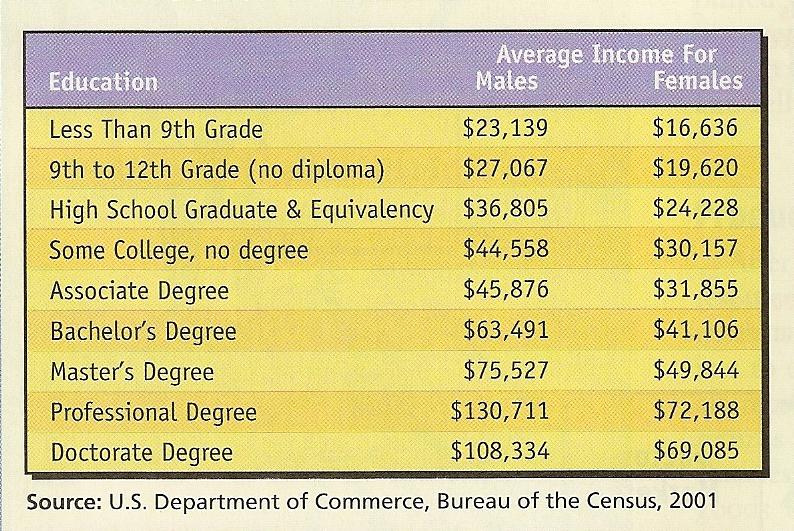
So, one might well ask, “Is America still a land of opportunity?” This, I realize, depends on how one defines success. But if income is part of one’s definition of success, the correlation between years of education and success could not be stronger. The following table is from the textbook that I use in my Economics Survey class published by Glenco/McGraw-Hill.


Obviously, it is getting more and more difficult for the vast majority of young people in America to achieve the same levels of success as their parents and grandparents, at least in terms of personal income. And the so-called gender-gap is still very real. But that doesn’t answer the question, “Is America still a land of opportunity?” In the abstract, it certainly is. Odds are now that Stephanie, with her college degree, will enjoy a measure of success, both personally and professionally. But what about those 400,000 otherwise qualified high school graduates that won’t be going to college because it has become too expensive?

As you can see, the ramp to success in this country is getting steeper — the social goal of equal opportunity, more elusive. So, out of curiosity, I decided to find out what people think about America still being a land opportunity. In a recent survey of The World According to Opa readers, I posed this question, “Do you believe that anybody in America can be successful in this day and age if they try hard enough?” Follow-up questions included, “how much do you believe money has to do with success, do you consider yourself to be more liberal or more conservative,” and, “how do you define success?” With 75 responses (more than half of them coming from persons self-identifying as being more con- servative than liberal) I got some very interesting results. From the numbers and correlations I was able to make, the results supported my hypothesis that conservative thinkers are more likely to believe that anyone can still make it in America, but not strongly. The correlation between conservatives and believing this was 82.5 percent. The correlation between liberals and believing was 17.5 percentage points less. Somewhat surprising to me, considering the rising costs of higher education, skyrocketing energy, food and medical costs, and the escalating number of home foreclosures, is that nearly three-fourths of all who responded still believe. So, despite it all, Americans remain an optimistic people.

All my data were from respondents who are affluent enough to have Internet access, mostly middle class, homeowners. So the survey was not entirely valid in that it did not include opinions from people in lower socio-economic circumstances. They, no doubt would be more pessimistic. But, if I included the same number of people from higher socio-economic circumstances too, they tending to be more optimistic, the more inclusive survey would probably balance-out with similar results to that which I already have from middle class homeowners.

Seventy percent of respondents said that they believed money was “somewhat” important as a measure of success, while only 7.5% said that it was “very” important. Twenty-two and a half percent said that money had very little to do with it. Surprise! But the most interesting result, I think, had to do with how respon- dents said they view success. Almost all said that being self-sufficient and able to provide basic needs and wants for loved ones is important. Most also included considerations of self-esteem and being happy with one’s lot in life in their definitions. About 80% included considerations of altruism…being able to give back to society in some way, while a small number said that success simply meant being able to do what one wants to do when one wants to do it. Sixty-nine point seven percent of conservatives included altruism in their definitions; a whopping 92.3% of liberals did the same.

So, I conclude that, for most Americans, equal opportunity has become less equal in recent years. Despite what we teach to our students in classrooms all across the land, and despite what most Americans still believe, America is not the land of opportunity that it was for us Baby Boomers and for our kids, the Generation Xers. I also conclude that, at least among those who read my blog, in addition to being optimistic, Americans are a generous people. But the most generous of Americans are those who call themselves liberal. It will be these voters who, I predict, if they are successful this year in restoring the White House and full-control of the Congress to Democrats, will begin to restore to us all to something closer to equal opportunity. And may God bless us all, rich and poor alike.

 I invite your comments, both pro and con.

Published in: on July 18, 2008 at 12:27 pm  Comments (4)  

Drilling for Oil in ANWR ~ Tell Me Again What it Solves

Once it becomes scarce enough, if we have not by then moved on to some other solution for our energy needs, it’s quite possible that we could see mankind destroy itself scrabbling over what’s left of it.

So that readers might know where I’m coming from, I wish to preface this posting with the following pronouncement: I am a fiscally conservative Democrat. This means that, while I have liberal leanings socially, I believe in balanced budgets, I believe in maintaining a strong national defense capa- bility, I believe in abiding by the rule of law, and I believe in protecting both the people and the environment from the ravages of corporate greed and in doing so with “measured”, reasonable restrictions on “free” markets.


I was watching MSNBC’s political host talk show, Hardball, with Chris Matthews one evening earlier this week. Chris was mediating (if that’s a good word for what he does) a discussion between an Obama supporter and a McCain supporter. I’m sorry, but I do not recall the names of the participants, one of whom, however, was a fireball of an outspoken lady on Republican policies (note that I do not use the term, conservative here as I believe the Republican Party has completely forgotten what it means to be conservative).

The discussion turned to energy policy, the rising price of gasoline, diesel and aviation fuels causing great consternation and economic impact for voters in America this year. Chris and the Obama supporter ganged-up on this lady over John McCain’s federal gas tax holiday proposal stating that no economist thinks that it is an idea worthy of serious debate, and certainly not a long-term solution to anything. In response, the lady very skillfully switched topics to that of drilling for oil in Alaska’s National Wildlife Reserve (ANWR).  She spoke as if this would be a long-term solution, freeing us from our addiction to foreign oil, most of which now comes from Canada (19%), Mexico (15%), Saudi Arabia (11.5%), Nigeria (10.5%) and Venezuela (10.5%).  These foreign imports amount to 66.5% of our total consumption of oil and are the biggest reason for our near trillion dollar annual trade deficit. But, typical of ANWR drilling proponents, she greatly overstated the facts, and I was disappointed that Chris and the other man didn’t counter her claims.  Perhaps they didn’t know enough to do so — neither seemed to know that the presumptive Republian nominee had sided with most Democrats on this issue in the past.

We talked quite a bit about the current “energy crisis” in my economics classes last school year. High school students are very much concerned about this, having waited years to be old enough to drive, and now not being able to make enough money from entry-level jobs to keep gas in anything bigger than a roller skate.  One of my AP Macro students spoke out one afternoon pro- claiming that the solution was simple. “All we have to do,” he said, “is open up ANWR to drilling. There’s enough oil up there to last us 200 years!”

“That’s good news, Aaron,” I responded. Then to the rest of the class I said, “Who else has heard about this… anyone?”  Three or four hands went up — cautiously, perhaps because they feared being rebuffed.

“Great!” I said. “Problem solved then… but wait, does hearing a claim like this make it so?”  Heads began to shake, slowly. “How many of you believe this?”  No one said they did, so I turned my attention back to Aaron.

“Aaron, don’t you believe it?”

“Yeah,” he said.

“How come?  I mean, sure… it sounds good and I’d like to believe it too, but maybe we oughtta check it out.  From whom or from what source did you get this information?

“My dad,” said Aaron.

“Oh.  Well, I don’t want to contradict your dad. Fact is, I don’t have enough information immediately available to do so anyway.  But I do think this sounds a bit too good to be true… Tell you what: you do some research over the weekend.  On Tuesday next week when we meet again, if you can bring me two credible, unbiased sources to support your claim, I’ll bump your last test grade up to an A+. And that goes for anyone else in class who wants to put in the effort.  Class dismissed.”

ANWR is a National Wildlife Refuge in northeastern Alaska. It consists of 19,049,236 acres (79,318 km²) in the Alaska North Slope region. Because this area is believed to contain a large supply of crude oil, the issue of drilling for oil there has been a debated topic in Congress since the end of World War II. The controversy has been a political football for every U.S. President since Jimmy Carter.

The refuge supports a greater variety of plant and animal life than any other protected area north of the Arctic Circle. A continuum of six different ecozones spans some 200 miles (300 km) north to south and there are presently no roads within or leading into the refuge.  There are a couple of Indian settlements there though. On the northern edge of the refuge is the Inupiat village of Kaktovik and, on the southern boundary is a Gwich’nsettlement of Arctic Village. Fearing that exploitation of the ANWR oil reserves would spell the end of their ancesrial way of life, these people do not want drilling to take place.

Tuesday came and I was anxious to hear what Aaron had to tell us.

“Aaron, did you do your homework?”

“Yes, sir,” he said. “I spent an hour on the Internet, but the only sources I could find were from oil companies, an old news item about President Bush scolding Congress for not allowing it, and pro-drilling statements on the websites of both of Alaska’s Senators. None of them, however, claimed to know how long the oil there might last.”

“Ahh… too bad,” I said. “Anybody else come up with something convincing?” Nobody did.

“Well, I came up with something,” I said. “I went to the U.S. Geological Survey’s website and found a study that was done in 1998 for Congress on the amount of oil that might possibly be recoverable from ANWR. The study indicated on the low end, with a statistical probability of 95%, that there’s at least 4.3 billion barrels there. On the high end, the report said that there might be as much as 11.8 billion barrels, but only with a statistical prob- ability of 5%. The mean value is 7.7 billion barrels, meaning that there’s a 50/50 chance of that much oil being there that’s technically recoverable, whether or not it is economically feasible to do so.  In addition, in the entire assessment area, which covers not only land under Federal jurisdiction, but also Native lands and adjacent state waters within three miles, technically recoverable oil is estimated to be 10.4 billion barrels. This again is the mean value. Now, understand, nobody knows for sure how much oil is up there — could be more, could be less. But let’s gamble. Let’s say that there is definitely 10.4 billion barrels there and that, with oil at $130+ a barrel, it’s all economically recoverable. If we could have it all tomorrow, or at least as fast as we could use it, how long would it last us?”

To this I got lots of blank stares.

“Hey, 10.4 billion barrels… that’s a lot of oil, right?” To this I got 100% agreement.

“Okay, let’s figure out how long it would last us. From the CIA’s World Factbook, I learned that Americans use, according to a 2005 estimate, 20.8 million barrels a day. Let’s be conservative and round that up to 21. Surely we are using a lot more than that now, three years later — but just to be fair, we’ll use the published number I was able to find. First one to tell me how long 10.4 billion barrels would last us at that rate gets an A on today’s daily assignment.”

One of my brighter students had his hand up in less than a minute. “That would be a little over a year and 4 months, Mr. Garry.”

“Great, thank you, Matt. That’s exactly what I got when I did the math — less than a year and a half worth. But that assumes that we can get it all and that we can get it all out of the ground as fast as we can transport it, refine it, and distribute it, right?” Heads nodded. “Truth is, once drilling starts, it’ll be 5 to 10 years, depending on who you want to believe, before any oil starts flowing out of ANWR and the surrounding areas, and oil companies will only bring out as much of it to market and as fast as it is profitable for them to do so. If they were to decide that it’s most profitable to use it at a rate so as to replace 5% of the supply we get from other countries, the oil there, using our mean figure of 10.4 billion barrels, would last approximately 22 years. But would we, the consumers, notice any difference at all in the price of gasoline at the pump? Who would stand to the gain most from the drilling? And would this much reduction in foreign oil dependence be sufficiently significant to warrant going ahead with it? Before you answer, understand that the native people who live there do not want the drilling to take place. Also, remember what happened in Prince William Sound off the coast of Alaska in 1989 — Exxon Valdez.” 

I got blank stares again… then, after a long quiet pause, “What should we do, Mr. Garry?” This was Aaron again.

“I don’t know, Aaron, but if you’re asking for my opinion, I think we ought to be conservative.  I think we ought to seize upon this moment in history to focus our efforts more on reducing our consumption of oil rather than on sustaining our current appetite for it. The transition to smaller, more fuel-efficient cars and mass transit alternatives will be costly and painful. Old habits do die hard. But within your lifetimes, world oil production will be well beyond its peak and, as world demand grows for it, it will only become more and more expensive. Once it becomes scarce enough, if we have not by then moved on to some other solution for our energy needs, it’s quite possible that we could see mankind destroy itself scrabbling over what’s left of it. In the mean time, we’ve got global warming with which to contend. I think it’s time to start thinking creatively and long-term.”

I invite your comments pro or con to this posting.

Published in: on June 13, 2008 at 4:11 pm  Comments (21)  

The Birdfeeder Allegory ~ An Example of Viral Disinformation

As we become more and more absolute in our convictions, more and more polarized from and stigmatized by the other half of society, we no longer have minds that are open to facts.


April, 5, 2008 — I recently received an email message from one of my more-conservative thinking friends.  It contained a forwarded story, an allegory really, about birds flocking to free food.  The birds in the story were obviously a metaphor for illegal aliens.  My friend invited me to read the story then respond with what I thought of it. The original message, the one passed-on to me, encouraged recipients to pass the story on to others in chain-letter fashion.

My response to my friend began, “Interesting that you should ask this now, Bobby (not my friend’s real name); I’m teaching a lesson to my economics students tomorrow entitled, ‘Social Goals vs. Market Efficiency’.  Social goals include things like equal justice, quality education for all, gainful employment for all who are able and willing to work, freedom from crime, and security in our old age.  I think I’ll share this story with my students and ask them what they think.”

What follows next is the story as it was originally forwarded to me.

The Birdfeeder

I bought a bird feeder. I hung it on my back porch and filled it with seed. Within a week we had hundreds of birds taking advantage of the continuous flow of free and easily accessible food. But then the birds started building nests in the boards of the patio, above the table, and next to the barbecue.

Then came the poop. It was everywhere: on the patio tile, the chairs, the table…everywhere. Then some of the birds turned mean: They would dive bomb me and try to peck me even though I had fed them out of my own pocket. And others birds were boisterous and loud: They sat on the feeder and squawked and screamed at all hours of the day and night and demanded that I fill it when it got low on food.

After a while, I couldn’t even sit on my own back porch anymore. I took down the bird feeder and in three days the birds were gone. I cleaned up their mess and took down the many nests they had built all over the patio.

Soon, the back yard was like it used to be…quite, serene and no one demanding their rights to a free meal. 

Now let’s see… our government gives out free food, subsidized housing, free medical care, free education and allows anyone born here to be an automatic citizen. Then the illegals came by the tens of thousands. Suddenly our taxes went up to pay for free services; small apartments are housing 5 families: you have to wait 6 hours to be seen by an emergency room doctor: you child’s 2nd grade class is behind other schools because over half the class doesn’t speak English: Corn Flakes now come in a bilingual box; I have to press “one” to hear my bank talk to me in English, and people waving flags other than “Old Glory” are squawking and screaming in the streets, demanding more rights and free liberties. 

Maybe it’s time for the government to take down the bird feeder. 

The rest of the response to my friend read as follows:

“The market can very efficiently make some of us very rich while leaving the majority of us in poverty, or it can raise the standard and quality of life for all.  I know that this sounds like socialism, but that’s an extreme I do not advocate.  Neither do I advocate laissez faire politics wherein the rich get richer and the poor get poorer.  No serious student of economics believes in laissez faire anymore; that’s survival of the fittest — jungle rules.  So, we can either invest up front in human capital (head start programs, education, health care, etc.) or we can accept the consequences of higher high school drop-out rates, teen pregnancies, declining economic growth, and growing crime rates in our inner cities.  For me, it all boils down to a choice between near-term investments vs. long-term expenditures.

We are not birds — we are human beings, charged by our common Lord to love one another.”

I did share this story and how it came to my attention with my high school economics class seniors the next day and the next (our school is on a block schedule).  I didn’t lecture them or lead them to any particular conclusion about it.  I just read the story then let them respond and discuss their varying attitudes about it.  A few laughed and indicated that they thought the story was very astute, representing as it were an obvious truth about lazy, unethical people in our society, especially illegal aliens.  About an equal number of students argued that it was an ugly, unfair generali- zation about poor people and that it speaks more to a prevailing attitude of selfishness.  Some said they thought most immigrants, legal and otherwise, have come to America, not for a free ride but for opportunities to better themselves. Most students, however, offered no opinion at all, perhaps fearing criticism from me or from their peers.

In retrospect, I see this story, and the way that it has been circulated, as an example of how political opinion is and has been shaped in this country since the advent of mass communications, especially television and the Internet.  I consider this kind of thing to be Viral Disinformation as it is originated and spread from one individual who is infected with biased, adamant, unreasoned beliefs to many others who share or are susceptible to the same frame of reference.  Not willing to discuss our beliefs and doubts with those who disagree with us, we have become intellectually lazy, taking in, first, “sound bytes” and now “video bytes” ala YouTube from entertainers who bill themselves as being well-informed, experts on any number of different subjects.

In the twenties and early thirties, the sound bytes were from entertainers like Will Rogers.  Today the bits and bytes are coming from the likes of Rush Limbaugh, Ann Coulter, and Keith Olbermann on the television, radio, and over the Internet… and from charismatic preachers in places of worship too.  In some cases, this can perhaps be the most virulent source of dis- information.  This kind of thing, according to Susan Jacoby in her book, The Age of American Unreason, is “infotainment.” Rather than reading newspaper editorials – point and counterpoint – as our grandparents used to do, then discussing things with our friends and our neighbors in pubs, schools, parks, and other community places, we sit in air-conditioned homes alone after work and on weekends in front of the television or computer digesting only those sides of things that resonate with us.  We become more and more absolute in our convictions, more and more polarized from and stigmatized by the other half of society.

We no longer have minds that are open to facts.  In fact, if the facts conflict with the dogma we have already adopted, we reject them entirely notwithstanding the majority convictions of intellectuals like our scientists, doctors, and academics – the freethinkers.  We choose to believe instead, whichever politician curries our votes by agreeing to something we consider sacrosanct, like the literal, absolute truth found in the Scriptures, for example.  In this way we become victims to pitfalls of objective thinking: biases, loaded terminology, and the fallacies of composition and causation.

Hmmmm… I wonder if I am not playing into viral disinformation myself by writing and posting this article to The World According to Opa. Let me know what you think by posting a comment.

Published in: on April 5, 2008 at 1:27 pm  Comments (9)  

Everyday Heroes and Veterans Too

After learning that I had been a guest speaker at a high school Veterans’ Day assembly last week, one of my sons expressed regret that he could not have been present to experience it.  He asked if I had a transcript.  “Nope,” I responded…”no transcript, son — I spoke from the heart using a PowerPoint presentation to keep myself from rambling.  Because I wish too that you could have been there, I’ll try to recall what I said for you.”  This, I think, is pretty close to what I said.

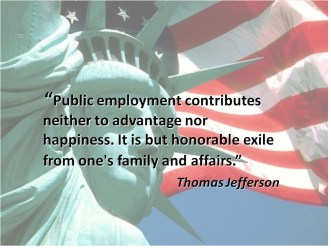
Slide OneI opened with Jefferson’s quote saying that much has changed since 1803 with respect to advantage and happiness sought and gained by some in return for public service, but that one thing is a constant.  Serving one’s country is still honorable. 

Slide TwoAfter the opening slide transitioned to this one, I thanked the school for asking me to speak, saying that it was a true honor to be allowed to represent all veterans, including one of my own sons who served in our first war in the Persian Gulf, Desert Storm.  But I emphasized that one need not wear a uniform to be a hero, that there are EVERYDAY heroes, and they are all around us. Those who sacrifice and serve quietly on a daily basis are heroes, moms and dads taking time off to support extra-curricular school activities for example… volunteers in church and civic organizations… teachers who might be making a lot more money in other careers.
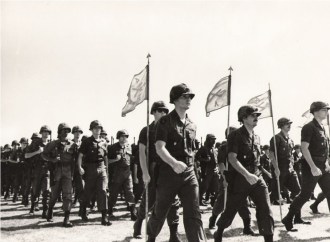
Slide ThreeThen from the picture of me marching, I recalled my grandmother’s words of admonishment when she dropped me off at the induction station at Camp Douglas east of Salt Lake City in June of 1966. “Do what you have to do, Kent,” she said, “then come home.”
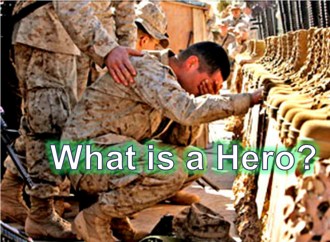
 I told my audience that I later came to understand that my grandmother wasn’t telling me to go be a hero.  She was telling not to be a coward just as the Spartan mother of ancient Greece was telling her own son not to be a coward when she said, “Come home carrying your shield or be carried home upon it.” 

I explained to my audience that I wasn’t a hero just because I wore a uniform and served honorably in combat, for true heroism goes beyond serving reluctantly as I did.  My service was reluct- ant because I didn’t want to be judged to be a coward.  I could have done as others did and left to live in Canada to avoid the draft.  I might have done so too, but I didn’t want to be judged by others to be a coward.  No, true heroism means at a minimum, volunteering, and all our servicemen and women today are volunteers.  Therefore, they all come closer to deserving the hero’s moniker than I did.  I was not a hero.

I explained how, as a draftee, I went on to become a Field Artillery officer, then a helicopter pilot, then an aircraft maintenance officer and maintenance test pilot, volunteering for one school after another thinking that the longer I stayed in school, the longer I could stay HERE and avoid going over THERE.  I told them how, after graduation from flight school, the majority of my class went straight to Vietnam and found themselves smack in the middle of the Têt Offensive of ’68, the bloodiest year of the whole war.  I read about it each morning in the Army Times while sitting in classrooms at Ft. Eustis, VA learning how to administer aviation maintenance units and oversee aircraft repair efforts.  From the obituaries each week in the paper I read name after name of fallen comrades, young men with whom I had flown, studied, and partied on weekends.  I wrote letters to families of the fallen I had known, but I was feeling less and less heroic as the days and weeks passed by before it would finally be my turn to see combat.

At this point, I showed a YouTube slide-show video put to music by a 15 year old girl named Lizzy Palmer.  I had downloaded it and converted it for showing in my PowerPoint using third-party software.  While YouTube.com probably wouldn’t like my having done this, I’m pretty sure that Lizzy would be most happy knowing that I shared her work with my audience.  Click on the play button twice, once to load and once to view.

Following the video, I asked for a show of hands by those who have a family member or friend currently in uniform and serving overseas.  About one-third of my audience raised their hands.  Then I told everyone else to look around.  “Most of us,” I said, “are going about our business day after day, so far unaffected by this war.  The only ones bearing the burden are the volunteers themselves and the people who, like those who had their hands in the air, are waiting and praying for their loved ones’ safe return.  Our nation,” I said,” while legally at war, is not on a wartime footing — hasn’t been from the beginning of it after 9-11.  The price of the war, in terms of blood, sweat and tears, is being paid by only a few of us.  The cost of it, in terms of dollars, is being added to the national debt for future generations to have to deal with.”

Slide Four“When I came home from Vietnam,” I said, “we were told to change out of our uniforms before leaving the airport terminal and to leave from side- and rear exits.  Vietnam was a most unpopular war and many then were blaming those of us in uniform for perpetuating it.  No victory parades for us.
On Veterans’ Day 1971, after having visited the parents of one of my fallen flight school comrads, a Second Lieutenant named Johnny Benton, I was determined to wear my uniform on the University of Utah campus.  I had returned there to finish my undergraduate degree so that I might be able to make the Army a career.  Despite the boo’s and jeers doing so provoked, despite the spittle and rude body-block bumps endured, I carried myself proudly for Johnny’s sake and I finally felt somehow patriotic.  Please,” I said, “don’t let our veterans today have to go through anything like that.  No matter how unpopular this current war may become, don’t blame the troops for fighting it.  They didn’t start it!”

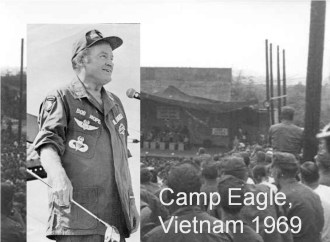
Slide fiveI told my audience that perhaps the most heroic thing I did while in Vietnam was to sacrifice my front row seat to see the Bob Hope Christmas show at Camp Eagle, the division base camp for the 101st Airborne/Airmobile Division.  As a Transportation Detachment commander for the division, I knew that seats to see the show were limited, and that my going would mean that some other enlisted man couldn’t.  So I volunteered to fly a mission on Christmas Eve of 1969 transporting a Division Chaplain from one fire support base to another.
“Bob Hope here,” I told my audience, “was a hero for all of us, dedicating himself year after year to entertain troops away from home at Christmas and other special times of the year.  He never wore a uniform, at least not officially.  But no serviceman or women ever resented his penchant for wearing unit patches and qualification badges; he was an honorary member of every unit in every service, and his passing in 2003 marked the end of an era.  There’ll never be another quite like him.”

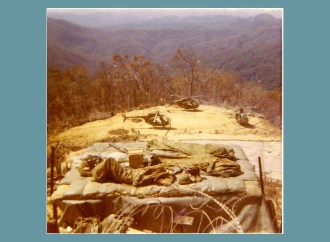
Slide Six“The Chaplain and I flew together the entire day, returning to Camp Eagle to refuel only once,”  I said.  “This is a picture of Fire Support Base Eagle’s Nest overlooking the Asha Valley.  It’s one that I took weeks before my Christmas Eve mission on a day that was not overcast.  On Christmas Eve, 1969, the clouds were hanging low in the late afternoon when we arrived, and before the chaplain finished his worship service and offered sacrament to those who wanted it, we were completely ‘socked-in’.  We spent the rest of the evening filling sand bags and singing Christmas carols.  C-rations and mud — it remains my most memorable Christmas experience.”
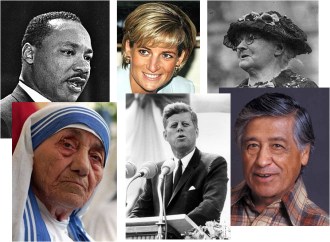
Slide SevenOne-by-one I recalled some examples of modern-day heroes who, except for President Kennedy, were not heroes by virtue of military service.

First, Dr. Martin Luther King who, by his efforts we have the Civil Rights Amendment making discrimination illegal whether by race, creed, religion or national origin.  He was a hero.  Then I asked my audience if, despite the Civil Rights Amendment, we still have discrimination in America.  I heard a resounding, YES, in response from many.  Then I responded to them saying, “Then be heroes and put an end to it.  Each of you.  Grow beyond the prejudices you harbor in your own hearts and stand up for fair and equal treatment whenever you encounter injustice.  Every time you do so, you will be a hero.”

Second, Mother Jones who organized a children’s crusade in the 1930s that led to laws making child labor illegal in America.  Her efforts contributed greatly to the National Labor Relations Act of 1935, which in-turn lead to government passing laws to ensure safety in working places and the people’s right to collectively bargain for wages, benefits and working conditions.  She was a heroine.

Third, Mother Teresa who saw crushing poverty in the world and went to the heart of it in Calcutta, India alleviating suffering where she could and moving many others to do likewise.  She was a heroine.

Fourth, Cesar Chavez who saw inequity and unfair treatment of migrant workers, gave his life to make things better for unskilled laborers.  He was a hero.

Fifth, Princess Diana showed us all that privilege and wealth does not put us above giving more than just money to correct injustices in the world where we find it.  She worked tirelessly to promote efforts to rid war torn regions of the world from landmines which made and continue to make it impossible for farmers to raise food to feed their families in relative safety or children to play outdoors.  She was a heroine.

Sixth, President Kennedy, already a hero by virtue of military service above and beyond the call of duty during WWII, inspired a nation of young and old alike when he said at his inaugural address, “Ask not what your country can do for you.  Ask what you can do for your country.”  He energized thousands to join the Peace Corps.  It still exists today as an independent federal agency and is still helping to turn hatred and resentment toward Americans into gratitude and respect.  But it lacks the numbers today that it once had.

In closing I asked the students what they could do for their country, not after graduation from high school or college but right now… today.  After a five count of hushed silence, I said:  “Go back to class and learn all you can — that’s what you can do.  Stay in school and prepare yourselves for a better tomorrow.  There’s much to be done.  Me and my generation, your parents’ generation too, we’ve managed to make a pretty big mess of things.  So, if new leadership in today’s generation cannot set aside political, social and economic differences long enough to get something lasting done, it’ll be up to you and your generation to straighten it all out.  But you will not be up to the task if you are not educated and if you do not stay well-informed.”  Then I thanked them for their kind attention and told them that I would look forward to having them in my economics class when they become seniors.

 To post a comment, click on the tiny COMMENTS word below.

Published in: on November 11, 2007 at 4:59 pm  Comments (12)  

Why I Am Against School Vouchers

 If school vouchers become the norm across our land, our most at-risk students will be even more at risk as limited public funds are drained off and redirected to unregulated, non-standardized factories of learning. 

Texas Student StudyingAs a public school teacher in what I consider to be an excellent school district in the state of Texas, I suppose that one could say I have a biased view on the school voucher issue.  But I’ve had a first-hand opportunity to compare education in both private and public sectors.  While in the process of becoming certified to teach, I taught in two different private schools in this state.  Yes, it’s true, there are public schools in Texas to which I would not send a son or daughter, one of them is right here in the city where my wife and I presently live.  And, yes, it’s true, some private schools are superior to most public schools.  But these schools are very expensive and their focus is almost always “formation” first, education second.  This inequity, to my mind, is an intolerable situation, one that badly needs fixing in our state.  But I’m convinced that vouchers are not the way to go about it. 

Despite the arguments I hear about privatization ultimately infusing competition into the equation, thus stimulating innovation and motivation to produce superior educational services, and despite the claims of success for the limited programs that have been implemented in various communities, it takes little imagin- ation for me to see where a state-wide voucher program would lead.  Let’s be clear.  Economic theory and social goals are seldom on the same sides of the balance sheet. 

Most teachers and parents are opposed to private school tuition vouchers.  We know that public funds for vouchers will compete with dollars needed for general improvements in America’s public schools.  The National Education Association (NEA) and its affiliates in every state agree.  Collectively, those who know education best all oppose alternatives that divert attention, energy, and resources from efforts to reduce class sizes, enhance teachers’ performance, and provide every student in this country with books, computers, and safe, orderly schools.  So, why are we even debating this issue?  Why do politicians, conservatives mostly, ignore the experts on education?  In a nutshell, it’s because they represent people who don’t want to pay the price that a quality education for every child in America would cost.

What follows are my arguments against school voucher programs:

First, America was founded on a concept of equity for its citizens, all of its citizens — equal justice under the law and equal oppor- tunity.  Although the Tenth Amendment of the Constitution makes it clear that education is primarily a function of states’ govern- ments, time after time, the Supreme Court of the land has ruled in favor of educational equity.  The Constitution of Texas includes these words, “A general diffusion of knowledge being essential to the preservation of the liberties and rights of the people, it shall be the duty of the Legislature of the State to establish and make suitable provision for the support and maintenance of an efficient system of public free schools.”  This clearly establishes the priority for public rather than private education.  Therefore, student achievement in all social-economic groups ought to be the driving force behind any education reform initiative.

Americans want fair, consistent standards for students.  But where voucher programs are in place (Milwaukee, Cleveland, and Florida), a two-tiered system prevails that holds students in public schools to a different standard than those in private schools.

Second, what education in America really needs is help for the students, teachers, and schools that are struggling, not those who are doing well, those whose families would most benefit from implementation of voucher programs.  The failure rate on TAKS tests in Texas clearly shows that children born to families in lower socio-economic circumstances are those who are at greatest risk and are, therefore, those who are in greatest need of assistance.  For this reason, voucher programs are a terrible idea for solving America’s educational problems.  True equity means that every child should be able to attend a good school.  But voucher programs are not designed to help low-income children.

Milton Friedman himself, the founder of the voucher idea, dismissed the notion that vouchers can help low-income families.  He said, and I quote, “It is essential that no conditions be attached to the acceptance of vouchers that interfere with the freedom of private enterprises to experiment.”  Accordingly, I believe that a voucher system in Texas or any other state would only encourage economic, racial, ethnic, and religious stratification in our society.

Third, I believe in the separation of church and state.  Vouchers would violate this principle because most private schools are parochial/religious schools, about eighty-five percent of them actually.  So a state-wide voucher system would be a means for our more fundamental/Conservative citizens to circumvent Constitutional prohibitions against subsidizing religious practices and instruction.

Each year, according to the NEA, about $65 million dollars is spent by foundations and individuals to promote school voucher programs.  In election years, voucher advocates spend even more on ballot measures and in support of pro-voucher candidates.  In the words of political strategist, Grover Norquist, “We win just by debating school choice, because the alternative is to discuss the need to spend more money…”

Despite the efforts of school voucher proponents to make the debate about improving opportunities for low-income students and “school choice,” vouchers, in my opinion, remain an elitist strategy.  From Milton Friedman’s first proposals, through the tuition tax credit proposals of Ronald Reagan, through the voucher proposals on ballots in California, Colorado, Utah and elsewhere, privatization strategies are not about expanding opportunities for low-income children or about improving education in general.  Do not be fooled — they are about resisting meaningful, badly needed improve- ments, costly though they may be, to fix public education.

If school vouchers become the norm across our land, our most at-risk students will be even more at risk as limited public funds are drained off and redirected to unregulated, non-standardized factories of learning.  These factories will turn out a few well-trained, socially and economically elite young men and women who have been programmed not to think, but to behave and vote the way they are told.  The rest of our kids, sadly, will have been left behind despite the president’s “No Child Left Behind” law.  Democracy, already weakened in this country by corporate culture, private interests, and voter apathy, will become oligarchy.

To post a comment, click on the tiny COMMENTS word below.

Published in: on October 7, 2007 at 1:34 pm  Comments (14)  

More on the Quality of Texas’ Public Schools

The following is my response to a reader’s recent comment on a posting I made earlier this year on Texas’ public schools.

Texas schools are far from perfect, I’m afraid, Alan.  The quality of our schools varies from ISD to ISD.  I know because I live in a city that is serviced by an overcrowded public high school to which I would not send a son or daughter, yet I teach in a city where the high school is exemplary (recognized according to TEA’s TAKS assessments).  Our problems I judge, here in north central Texas, are social-economic/ethnic clustering, lack of bilingual teachers, and poor teachers’ pay.  Many of the teachers in the city where I live are uncertified because the ISD here cannot afford to pay what it would take to attract and retain teachers who are both fully-qualified and experienced to work on “challenge” campuses.

 Hmmm… maybe what we need, since market system forces of supply and demand don’t apply in government-provided service industries like public education, is “court-ordered” bussing of teachers.

I don’t subscribe to “Education Week,” but I came across an article last weekend in a past issue of the magazine while surfing the Net for material on a posting about quality education for my blog.   The article says that… “A child born in Virginia is signifi- cantly more likely to experience success throughout life than the average child born in the United States, while a child born in New Mexico is likely to face an accumulating series of hurdles both educationally and economically.” This statement was made based on a “Chance-for-Success Index” which tracks state efforts to connect education from preschool through postsecondary education and training.  The index was developed, by the way, with analysis done by the Editorial Projects in Education Research Center, part of the PEW Charitable Trusts network.

So, wondering where Texas was on this index, I dug a little deeper and went to the study itself.  The researchers rated Texas 48, only 2 up from the very bottom, which is New Mexico.  Heavens!  I would have expected Texas to at least rate higher than Mississippi, Louisiana, and Arkansas.  But, no; this independent, unbiased research center reached a different conclusion.  You may see and download the report for yourself from http://www.edweek.org/media/ew/qc/2007/17shr.tx.h26.pdf.

To post a comment, click on the tiny COMMENTS word below.

Published in: on September 22, 2007 at 10:11 pm  Comments (3)  

Putting Geography Back on the Map

Geography provides the framework and the tools for understanding our world. More than just teaching students to read maps, it teaches students relationships between people, places, cultures, politics, economies and environments.  But some of our nation’s lawmakers don’t seem to think it’s an important subject.

Statue of LibertyI have been a teacher of World Geography for high school freshmen in Texas for the past five years.  I will begin teaching a new subject next year to seniors in the same independent school district — Economics and AP Macroeconomics.  Accordingly, I will have an opportunity to be teacher again for many of my former students, this time focusing on a subject that’s a logical extension of the former.  I’m excited about this and looking forward to the beginning of the new school year.

What makes this so exciting for me is that I have already watched these young people grow in their understanding and appreciation of the world, a world that includes our own great nation.  Now I’ll be able to see them grow even more as they step out to pursue higher educations and begin their careers.  These students will benefit from knowing about the world when they start competing for jobs in this increasingly global economy of ours.  They will benefit too from knowing about it in helping our nation meet international challenges of the future — challenges from global terrorism, to global warming, to global disease, to global trade, and who knows what next.  Naturally, I am an advocate for improving geography education in our schools.

In a recent email message from the National Geographic Society (I can’t even remember when I was not a member of this fine organi- zation and did not receive their monthly magazine), I was invited to help raise awareness within the Congress of the United States about the need to stress the teaching of geography in our schools.  Through the society’s My Wonderful World campaign, you too can help if you are willing. 

I did not know before receiving the aforementioned message that, of the nine core subjects included in the new No Child Left Behind legislation, geography is the only one without designated federal funding?  The Teaching Geography is Fundamental Act (TGIF) will rectify this by funding professional development for educators to ensure all young people acquire the vital geography skills and experience that they will need.  Thus far, the Senate version of TGIF (S. 727) has attracted 18 cosponsors, and the House version (H.R. 1228) has 39 cosponsors.

Please consider writing to your Senators and Representatives in Congress urging them to support and cosponsor the pending legislation.  National Geographic has made it easy for you to contact your lawmakers to tell them this bill is a priority.  Just click on the link and follow the bouncing ball.  You can also spread the word and urge your friends, family, and co-workers to notify their law- makers about TGIF.

Thank you in advance for participating in the democratic process.

To post a comment, click on the tiny COMMENTS word below.

— ALL RIGHTS RESERVED —

Published in: on August 15, 2007 at 3:26 pm  Leave a Comment  

America’s Entitlement Epidemic — Coming to Grips With It

A well-known, widely-read author, Jeffrey Zaslow, in a recent article for the Wall Street Journal, helps us to understand the current Entitlement Epidemic, an epidemic that seems to be affecting Americans today.

July 27, 2007 — Mr. Zaslow’s article entitled, “The Entitlement Epidemic: Who’s Really to Blame,” struck a chord with me last week as it did with many others who were attending a summer institute course on teaching advanced placement high school economics.  He wrote about the epidemic being evident among our youth.  But the problem is not only with them.  The problem, we teachers decided, affects all of us.  It affects us individually and it affects us collectively.

Our course curriculum was too full for us to spend much time discussing it during class, but several of us had plenty to say about it during our morning and afternoon breaks.  We decided that the subject is basic to our understanding of much that is going on in our economy today.

Parents, do any of these statements sound familiar?  “Mary has one, why can’t I have one too?”  “It’s not fair!”  “I just can’t show up without something new to wear.”  “I just can’t live without one!”  “Ugh!  This old thing is a pile of junk, we deserve better.”  “It’s not fair!”  “Everybody else is doing it.”

Truth be told, our current generation of young people isn’t the first to have an inflated sense of entitlement.  But the situation is obviously growing worse in our country.  And whose fault is it?  Well, more about this later.

When I was very young, my mother and I lived off and on with my grandparents.  On my mother’s wages and tips as a waitress, we just couldn’t make it on our own.  Anyway, my mother’s younger brother lived with us too, so I very naturally gauged myself against what he, my uncle, was given and what he was allowed to do.   I’m not proud of it, but just to make a point here, I clearly remember pitching a fit one Saturday morning when the family was shopping at an Army/Navy surplus center and discount store.  My grandparents had bought my uncle a new pair of “engineer” boots, they were much in-vogue then following the Marlon Brando movie, “The Wild One,” and my grandparents were expecting me to be satisfied with a new pair of sneakers.  Sneakers!?  My self-esteem was crushed.  Mammaaa!

One of my own sons, when he was nine or ten I think, got into the BMX biking craze of the late 70s.  He raced his bike on Saturday mornings but rarely did he finish with the pack, usually he was well behind it.  He cried and whined for weeks on end because his bike was standard equipment – not customized with after-market, carbon-graphic this and chrome-molybdenum that.  If only he had a better bike, he argued, he could win.  So, we finally caved-in and gave him enough to buy a new, lightweight frame, which he quite literally slept with until I could prioritize enough time to help him build it up with parts from his old bike and a few other components for which he had traded belongings with his friends.  Notwith- standing, after the rebuild was finished, he fared no better in subsequent races that he entered.  His passion for racing soon ended.

So, what’s different today?  Why do I share these personal stories with you?  My son and I were certainly no less afflicted with the entitlement bug than the young people of today are, but we both learned something from our bouts with it.  Far from immune to want (we are all human after all), we learned as we matured to delay gratification and to invest more of our time and energy into knowledge and skills for a better tomorrow.  I don’t see this happening among many of my students today.  Neither do I see this happening much among many of our younger friends’ sons and daughters — some, sure.  But I just don’t see it as a moral imper- ative in our consumer culture of today that we must earn our keep.  What I do see is a rude awakening waiting for many on the horizon… more and more kids choosing easy paths, liberal arts over engineering, basket weaving over calculus, fewer young adults willing to take jobs in construction or learn a trade in plumbing, electricity, or auto mechanics (these jobs are increas- ingly being filled by immigrants upon whom we’ve grown overly dependent).  I see more and more young people having to move back in with parents after graduation from college because the good, entry-level jobs in the global economy are all going overseas to those who are better prepared and willing to accept less in compensation.

Why is this happening? Who’s to blame?  The list of suspects, according to Mr. Zaslow, is long.  It includes the state of California, Mr. Rogers, Burger King, FedEx, MTV, and parents.  Mr. Zaslow especially credits over-indulgent parents for the trend.  But I think parents are only passing-on the affliction and compounding the problem, one generation to the next.  The more things we have, the more we want.

In my opinion, this all started with the birth of modern advertising in the late 40s and early 50s when mass media, especially tele- vision, began creating demand for products that nobody needed and spreading confusion and apathy over the dangers of products like cigarettes and over-the-counter drugs.  Patronage, both for products and for politicians, has become a compodity with a price tag.  Now we even have marketing aimed at our children for toys manufactured in China, for crying out loud, and nutrition-less breakfast cereals made largely of refined sugar.  While Americans get bigger around the waist on fast-food and sugary drinks, corporate America gets bigger around its middle too; mergers and franchises have all but crowded out the little guys.  Innovation is gobbled-up by the behemoths and buried if it threatens established business interests.

This is not the “free enterprise” that was envisioned by Adam Smith in his Wealth of Nations.

As parents, our own “wants vs. needs” and our surrender to the consumer culture that many believe fuels our economic growth does set a strong example.  Just consider our willingness on average today to bear over $10,000 of credit card debt per household and to pay upwards of 20% interest year-after-year on it.  Just consider our willingness to agree to adjustable rate mortgages on oversized homes knowing full well that the day will surely come when we will no longer be able to afford to live in them.  Just consider our preference for driving oversized, gas-guzzling vehicles like pickup trucks and Hummers back and forth to distant workplaces, hastening the day when the world’s oil reserves will diminish to a trickle.  Just consider our willingness to allow the government to add to the national debt year-after-year, increasing the interest burden our sons and daughters will have to pay so that we might have more disposable income today.

America, truly, we have mortgaged our future for pleasure, convenience and comfort today.  Okay?  So, what are we to do about it?

There are remedies that we teachers talked about last week, but only if adults are willing to model good behavior.  We need to pull ourselves away from the television and start reading more.  In their very popular book, “Freakonomics,” authors and economists Steven D. Levitt and Stephan J. Dubner point out that among the factors that are most strongly correlated with students’ having high test scores in school are whether there are many books in the home.  Sure, the most important factor listed is whether the student has highly educated parents who are socially and econom- ically well-off.  But nowhere on the list did I see that large collec- tions of DVDs, video games and satellite TV in the home are contributing factors.

Next, I think, we need to start weaning ourselves from credit card debt and taking more interest in people than in things.  We need to get back to the way things were before bankruptcy was just a pay day away for many.  And we need to find a way to spend more quality time with our kids during their formative years, whatever the cost.  These are challenges for economist in each of us to solve.

On a national level, we need to allocate more of our nation’s resources to investments in human capital, public health, infra- structure, and technologies for the future, spending less on current consumption.  We need to make conservation a priority again, before the environment becomes unfit for humans and other living things, and we need to restore fairness and equity in our tax code for what used to be a large middle class.  Too few these days are reaping too much for doing too little – capitalism has run amok!

We are not all stock owners, but we are all stock holders.  This is because high profits today, without a vision for tomorrow, will translate into disaster for us all.  Rather than waging wars to ensure the continued flow of oil from the rest of the world, we need to be about the business of developing energy alternatives here at home.  The oil’s going to run out sooner or later anyway, and just because we have the biggest appetite for it doesn’t mean that we are entitled to the largest share.  This needs to be a national priority, coming to grips with this part of America’s entitlement epidemic, and we need to make sure that our next leaders, at both state- and national levels, are people who understand this.

To post a comment, click on the tiny COMMETS word below.

Published in: on July 23, 2007 at 11:33 am  Comments (3)  

Perry Consistently On the Wrong Side

It boggles my mind — why anyone would oppose a reasonable, bipartisan state bill that would protect kids from unnecessarily high levels of noxious diesel fuel pollution generated by idling school buses, and do it at a net cost savings for school districts and taxpayers.

That’s the question Environmental Defense is asking Texas Governor Rick Perry in the wake of his outrageous veto of HB 3457.   Click here to read his lame excuse for it.  Hmmm, could the real reason be that a major campaign reelection contributor has him on a short leash?

Learn more about this by visiting the Environmental Defense web site at http://environmentaldefense.org/article.cfm?contentid=5340.

Send an email by clicking here to tell Gov. Perry that he’s wrong for opposing clean air standards for Texas school buses.

Published in: on July 2, 2007 at 12:38 pm  Comments (2)  

Only In an America Dominated by Big Oil

With crude oil supplies at an all time high, why are many refineries in America sitting idle long after the normal spring maintenance period?  Could this be an indicator of price manipulation by the major oil companies doing business in our country?

When I heard on NPR while driving home yesterday that oil supplies are at an all time high in America, it seemed inconsistent with the Laws of Supply and Demand —  prices for gasoline being so high.  Then the commentator said that a large number of refineries are still shut down long after the usual spring maintenance closings.  Ah ha!  Now it made sense to me.  Reacting to projections about Americans planning shorter vacations closer to home this summer, or not traveling at all, oil companies are limiting production to sustain prices at artificially high levels.  Is this price fixing, or is it just smart business?  I believe that it’s the former and, in a free market econ- omy like we’re suppose to have in this country, it shouldn’t happen (recent Houston Chronical business article on gasoline prices).

As a teacher of World Geography for the past five years, and now Economics, I tell my high school students that it’s impossible to separate government from economics even though they are taught as separate subjects. This is because the state of our economy is a major concern for voters, even if they don’t understand it; they feel the consequences of its ups and downs. Accordingly, the politicians who run things in Washington want to keep things on an even keel. Better yet, they want to be able to claim credit for measures taken to stabilize the economy when it’s their time to get re-elected. Even better, they want to be able to claim credit for improving the economy.

Things like our current trade deficit, inflation, interest rates, the value and supply of the dollar compared to foreign currencies, the unem- ployment rate, government spending, and consumer confidence, all of these are vital aspects of our nation’s economic health.  But Politians don’t always listen to the economists that they hire to analyze trends and forecast the results of fiscal and monetary policies.  Case in point — the1999 merger of the Exxon and Mobil oil companies.

Claiming that the merger would enhance our nation’s ability to effectively compete in a volatile industry and an increasingly competitive world economy, the chairmen and chief executive officers of Exxon and Mobil signed an agreement to merge and form a new company called Exxon Mobil Corporation. This occurred after months and months of negotiations to obtain shareholder, U.S., and international regulatory approvals. Today this corporation is the largest publicly-held company in the world, both in terms of proven oil and gas reserves and revenue produced.  Although the largest among corporate oil producers, it’s still eclipsed by several foreign, state-owned petroleum producers.

You can learn all you might want to know about Exxon Mobile, as I did, from  http://www.exxonmobil.com/corporate/, the corporation’s own website, and from  http://en.wikipedia.org/wiki/Exxon_Mobil.  The Wikipedia address is particularly revealing in details about Exxon Mobil’s foreign business practices, it’s human rights contro- versies, it’s record of contributions to Republican Party candidates and organizations critical of climate change science, and it’s slow response to the Valdez oil spill disaster of 1989. What I have not been able to find, although I’m sure the information is out there somewhere, is what share of the U.S. energy market Exxon Mobil controls.  So, suffice for now to hazard a guess… forty percent maybe? 

In my book, when a company gets the size of Exxon Mobil it has too much power, economic power to influence prices and supplies for critical resources, and political power in terms of its ability to influence government decision makers through political contributions and political action groups (PACs).  Exxon Mobil isn’t a monopoly, which is defined as a single supplier of a good or service.  But, big as it is, it does have the power to easily form a cartel or oligopoly with the remaining number of smaller suppliers. When this happens, the group can control supply to maximize profit for all of its members, which is easy enough to do when the product or service has a relatively inelastic demand such as gasoline and fuel oils.  Without getting into a lesson on economics here, elasticity has to do with demand or supply responsiveness to changes in price. 

“But wait a minute,” you say, “what about the Sherman Antitrust Act?  Doesn’t that prevent companies in America from growing too big and having too much control over things?”  The answer is — yes and no.  It does give the government the power to prevent trusts, which, by one definition, are agreements between large companies that limit free trade.  Government has the power to prevent mergers, but the law does not compel the government to restrict trusts or other- wise prevent companies from merging to form larger and larger companies.  Government does what government wants to do, even in America, or so it seems lately  Learn more about this at Wikipedia.com. 

Mulling all this over after hearing the NPR news report, I began to wonder at the logic of allowing Exxon and Mobil to merge. So I decided to discuss this with an economics professor friend of mine, Dr. Christopher Wreh. Knowing that the U.S. Department of Justice rules on merger requests like this one, I asked Dr. Wreh what model economists working for the government use to determine whether large companies should be allowed to merge. The answer was the Herfindahl index, also known as Herfindahl-Hirschman Index or HHI.  It’s a measure of the size of firms in relationship to the industry and an indicator of the amount of competition among them. It is an economic concept but one that is widely applied in competition law and antitrust. Here’s the formula:

  hii.jpg

It works like this… the higher the HHI, the closer a market is to being a monopoly (the higher the market’s concentration and the lower its competition). If, for example, there were only one firm in an industry, that firm would have 100% market share, and the HHI would equal 10,000  It is calculated by squaring the market share of each firm competing in a market, and then summing the resulting numbers. The HHI number can range from close to zero to 10,000.

Typically, the U.S. Department of Justice considers a market with a result of less than 1,000 to be a competitive marketplace; a result of 1,000-1,800 to be a moderately concentrated marketplace; and a result of 1,800 or greater to be a highly concentrated marketplace. As a general rule, mergers that increase the HHI by more than 100 points in concentrated markets raise antitrust concerns. 

If I had the market share information from back in 1998/99, I think I could plug-in the numbers and see whether, at that time, it made economic sense for Exxon and Mobil to merge, but I don’t need to do the research.  Dr. Wher has already done it.  As a doctorial candidate at Utah State University at the time, the issue challenged him to do the study.  The number he said he came up with, after checking the result many times, was 2300.  In other words, the HHI for a combined Exxon Mobile corporation was nearly twice what the Justice Department would normally approve for merger requests.

So, what have I learned from all this?  I’ve learned that economic decisions, whether they turn out to be right or wrong, always need to make sense and they always need to be based on some rational relationship of factual data.  Political decisions?  Well, maybe they don’t need to make sense at all.  I’ve also learned that busi- nesses listen to their economists even if government doesn’t, and that maybe the checks and balances that we learned about in high school don’t work as well today as our Founders intended.

The U.S. Senate is currently considering the Ten-in-Ten Fuel Economy Bill (S-357), which includes a provision to preclude Big Oil from “price gouging.”  This Bill would require U.S. auto makers to improve fuel economy by an average of ten miles per gallon across model types over ten years, thus reducing our dependency on foreign oil along with greenhouse gas emissions.  But of course, we can expect Big Oil to lobby furiously against the passage of this Bill in it’s present form.  Learn more about this Bill here.

Do us all a favor, contact your congressional representatives to express support for this Bill, and make certain to mention how important the provision against price gouging is.  It could one day lead to breaking up this mega-corporation and the cartel that they seem to be leading.  This, I believe, would help to restore democracy and free enterprise in America.  Who represents Me?

To post a comment, click on the tiny COMMENTS word below.

Published in: on June 26, 2007 at 6:41 pm  Comments (3)  

Thinking Globally

This video has made a big impression on me.  Check it out (click the play button twice).

To post a comment, click on the tiny COMMENTS word below.

Published in: on June 13, 2007 at 3:00 pm  Comments (2)  

Excellence in the Classroom — Indeed

The following is an open letter to teachers’ professional organizations in Texas. It is in response to a recently-received, full-color mailing from an organization purporting to “Support Our Teachers.”

 What, if anything, is our collective response to this organization’s political agenda (http://www.excellenceintheclassroom.com)?  Should we not be mounting a defensive campaign of some kind?

It seems clear to me that this movement is a well-funded marketing effort to garner public support for a bill that, if passed, would mandate merit pay, impose TEA performance evaluations, and force the early retirement of many good, hard-working educators in our state. Rather than improving teacher retention (one of this organization’s stated goals), I foresee just the opposite happening.  Public school teachers’ jobs will become even more frustrating and difficult than they already are. 

Talk about a crisis in education!  When enough teachers walk away from their careers in public education, they will be hired back by an increasing number of private schools that are funded, at least in-part, by school vouchers.  In these schools, teachers will be free from government mandates and restrictions (these are the real problem as I see it).  Once free, teachers will finally be able to focus on students’ individual learning needs.  Hmmm… Maybe I should just relax and, borrowing from the title of a 1960s satirical film on the Cold War, “…Learn to Love the Bomb.”  However, when the bomb finally drops there will no longer be even a pretense of equal educational opportunity.

Whether you are persuaded by this mailing (you should have received you own copy by now if you are a homeowner in Texas and not employed by one of our “independent” school districts), or see through it for what it is and really do side with teachers in your area, please contact your state representative to let him/her know where you stand.

To post a comment, click on the tiny COMMENT word below.

Published in: on March 15, 2007 at 9:17 am  Comments (1)  

Liberal vs. Conservative ~ Democrat vs. Republican

Updated from my original publication (Dec 31, 2006)

As a former social studies teacher, I was often asked by my students what the real difference is between Democrats and Republicans. They seemed to sense that parents and other authority figures extol the virtues of one political party, the one to which they subscribe, and vilify the other.  Accordingly, I attempted to teach the subject in as balanced a manner as possible.

Symbols of American Political PartiesAll of what follows, save for my own observations, is readily available elsewhere on the Internet.  However, I’ve not been able to find a good, unbiased site that compares and contrasts the two major political parties in the United States today.  I shall endeavor to do so.

Political parties exist for the singular purpose of installing people to positions of power and influence in government.  It is the same all over the world and has always been so.  To do this they compete with the opposition for support of the electorate by inciting passion over issues of the time.  Whether the issues have to do with the economy, national security, individual liberties, the environment, Constitutional interpretations, or matters of moral and social conscience, parties stake claim to various convictions then pretend, as necessary, that they have always been philosophically faithful to their positions.  But this is done more often than not to simply gain support in terms of dollars and votes for their own candidates.  Additionally, many people are attracted to particular parties over single wedge-issues like abortion or gun control and discount other party positions.  So the association of any party over time with a particular political philosophy is problematic at best.  Follow along and see if you don’t agree.

The Democratic Party, claiming a position on the left of the political theory continuum, has been labeled “liberal,” both by supporters and detractors alike.  The name is derived from the Latin, liber, which means free.  And until the end of the eighteenth century, it simply meant “worthy of a free man”.  It is from this sense of the word that we speak of “liberal arts”, “liberal sciences”, “liberal occupations”, etc.  Then, beginning in the early part of the nineteenth century, the term came to imply the qualities of intellect and behavior that were considered to be characteristic of those who occupied higher social positions, whether because of wealth, education, or family relationships.  Thus, an intellectually independent, broad-minded, magnanimous, frank, open, and genial person was said to be liberal.  The suffix, “ism,” added to descriptive words produces nouns that mean a belief, an ideology, or study, as to be immersed in.  “Liberalism” then connotes a political system or tendency that is opposed to centralization and absolutism.  However, the word liberal is generally used in a derogatory way today by those who subscribe to more conservative philosophies.  For them, a liberal is someone who believes in big government and wasteful, giveaway social programs (background/definition).

Most who have political persuasions to the right on the political theory continuum label themselves, “conservative.”  According to Webster, being conservative means a tendency to conserve or to hold back.  But this understanding of the term does not necessarily apply to all who consider themselves to be Republicans today.  Since the end of the Civil War in America, conservatives have tended toward resisting change and preserving established institutions.  Thus, a conservative person would be one who would tend to be more moderate or cautious.  But it was Republicans, as we all recall, who brought about the end to slavery in America though the Civil War years and the adoption of the 13th, 14th, and 15th Amendments during Reconstruction – this was major social change (background/definition and History of the Republican Party)!

The Republican Party today attracts many different groups, including sportsmen and other gun owners who consider their right to bear arms to be under attack, business corporations (particularly defense, energy, and pharmaceutical industries) and wealthy individuals who benefit from limiting social programs, limiting regulations, and reduced taxes, as well as various fundamental or evangelical Christian groups who are lobbying for social change. Although some may argue that this is not true, the Tea Party, never a viable political party in it’s own right, and Libertarian politicians who once ran for office under the Libertarian Party banner, have now merged with the main stream Republican Party.

The Republican Party had its roots in opposition to slavery when, in 1854, former members of the Free Soil Party, the Whig Party, the American Party, and some Democrats came together in opposition to the Kansas-Nebraska Act, which would have allowed these territories to enter the Union as slave states.  Party founders adopted the name “Republican” to indicate that it was the carrier of “republican” beliefs about civic virtue, and opposition to aristocracy and corruption (History of the Republican Party, Republican Party Today, and Reconstruction Period).

In western democracies the terms, “conservative” and “right-wing” are often used interchangeably, as near-synonyms.  This is not always accurate, but it has more than incidental validity.  The political opposition is referred to as the political left (although left-wing groups and individuals may have conservative social and/or cultural attitudes, they are not generally accepted, by self-identified conservatives, as being part of the same movement).  On economic policy, conservatives and the right generally support the free market and side with business interests over rank-and-file workers and environmentalists.  This is less true of conservatives in Europe and in places other than the United States.  Attitudes on some moral issues, such as opposition to abortion, same-sex marriage, and euthanasia, are often described as being either right-wing or conservative.  Liberals, on the other hand, have traditionally drawn much of their support from labor unions, small farmers, civil servants, environmentalists, artisans, academics, philanthropists, immigrants and such – the “huddled masses”.  Collectively, liberals pretty much agree today that government should be a force for social change, to improve the lot of the disadvantaged and to protect the individual rights of all Americans, regardless of their race, sex, ethnicity, or sexual orientation.  Liberals would tend to agree that all should have affordable access to quality education and health care (Right-wing, Left-wing).

The Democratic Party in the United States traces its roots back to the early 1790s, when various factions united in opposition to Alexander Hamilton’s fiscal policies, which included a strong central treasury and new taxes to pay-off the states’ debts. Back then it was called the Anti-Administration Party, its subscribers were called Anti-Federalists.  For a time, this movement was added to other minor parties to form the Democratic-Republican Party under Thomas Jefferson.  Yes, in some ways, if not in name only, the two major political parties of America were combined. Then, after the War of 1812, the party split over whether to build and maintain a strong military.  Those favoring a strong military, especially a modern navy, came to be called the Old-Republicans.  Then, during the administration of Andrew Jackson, the Democratic Party was reborn, appealing, as had Jefferson’s Democratic-Republican Party, to the largely agrarian society of the times and to the common man.  At that time, the Old Republicans strongly favored states rights, while Jackson, even though he was a Southerner, put down the Nullification Crisis which threatened to divide the nation – North and South (History of the Democratic Party).

So, the distinction between liberal and conservative political philosophies and the Democratic and Republican parties in the United States, over time tends, to blur. Philosophies and allegiances have switched back and forth over the years.  For example, after the Civil War, most whites in the South became Democrats (Southern Democrats), known then unofficially as the “White Man’s Party“.  Then, following the signing of the Civil Rights Act of 1964, many of these Democrats switched over to support Republican candidates.

And so it goes; political parties come and go. Sometimes the names stay the same, but the philosophies and respective positions on issues change according to the winds of war and fortune.  As I tell my students, it is impossible to separate politics from economics.  It’s all about power and influence.

For the latest on what U.S. political parties and individual candidates believe, see http://www.ontheissues.org/Quiz/Quiz2010.asp#sec0. At this site you may also test yourself and your beliefs to determine your closest party match.

For more on what I personally believe and how political parties have performed in recent years, see Americans’ Political Persuasions ~  Based More on Myth than Fact?

I invite your comments whether pro and con.

Published in: on December 31, 2006 at 3:36 pm  Comments (101)  
Tags: , , , , ,