America ~ Is It Still a Land of Opportunity?

Obviously, it is getting more and more difficult for the vast majority of young people in America to achieve the same levels of success as their parents and grandparents, at least in terms of personal income.

July 18, 2008  —  We were delighted to learn recently that Stephanie, the oldest daughter of dear friends of ours back in Missouri, David and Nancy Israel, will be graduating from nursing school soon. Although she probably had some financial assistance based on merit, or need, or both, we suspect that her parents still had to dig pretty deep to see her through — her father being a Methodist minister and her mother a school teacher. Both careers are known to be rewarding, but not necessarily in the salary-way.

With the rising cost of higher education in this country outpacing pretty much everything except the cost of health care, more and more parents like David and Nancy are finding it more and more difficult to provide their sons and daughters with a college edu- cation — the “open doorway” to both personal and professional success in life.

To help pay for tax cuts that have primarily benefited the wealthy, President Bush reduced the size and cost of government when he became President in 2001. He stripped $12 billion from the federal student loan program as part of this reduction, and the previous level of funding for this has never been restored. Today, a Pell Grant covers only 33% of a student’s annual college costs. In1975, Pell Grants covered 84% of students’ costs. But this isn’t all the President’s fault. When Bush took office, the cost of tuition at a public four year institution was $3,501.The cost this year, 2008, is $6,185 – an increase of 56.7%. Over this same time period, median household incomes have decreased 2% despite an economy, as measured by the administration’s Gross Domestic Product (GDP), that has been expanding.  Because of this burdensome cost, the reduction in aid programs and the government’s favorable policies toward the $85 billion a year student loan industry, over 400,000 qualified high school graduates will not be able to attend college this year.

According to Bill Moyers’s new book, Moyers On Democracy, one-third of all college students graduated with debt in 1993. In 2004, two-thirds did. And, according to the College Board, the total volume of private student loans has grown by 27% since 2001, the year that George Bush became our President. Some of these “private” loans carry interest rates as high as 19%, and most undergraduate students finish with close to $20,000 in student loans whether he or she is able to find a good job or not. This is a 108% increase in just a decade. Compare this to the $11,100 in debt his/her counterpart graduate carried in 1975 paying just 6.8% interest when the government was still making these loans. This was before we started off-shoring many of our better-paying jobs for entry-level graduates. But Stephanie won’t have a problem finding a decent-paying job; nurses are in great and growing demand. Hopefully, she won’t be paying upwards of a third of her salary to retire student loans as some must.

So who has been making all this money in an expanding economy? Good question.

According to a PhD economist, Paul Robin Krugman, who is professor of economics and international affairs at Princeton University and also a columnist for The New York Times, if we were to equate the total population of Americans in the civilian labor force with 1,000 people and line them all up left-to-right according to how much they make, then equate their personal incomes with how tall they are, the person in the middle would be six feet eight inches tall. The person on the extreme left would be only 20 inches tall. But the person on the extreme right — wow!  He would be almost 600 feet tall — nearly 5 times taller than his counterpart back in the mid-seventies. The persons to the left of center would have all grown too, reflecting a growing economy, but they would only be about fourteen percent taller today.

So, one might well ask, “Is America still a land of opportunity?” This, I realize, depends on how one defines success. But if income is part of one’s definition of success, the correlation between years of education and success could not be stronger. The following table is from the textbook that I use in my Economics Survey class published by Glenco/McGraw-Hill.
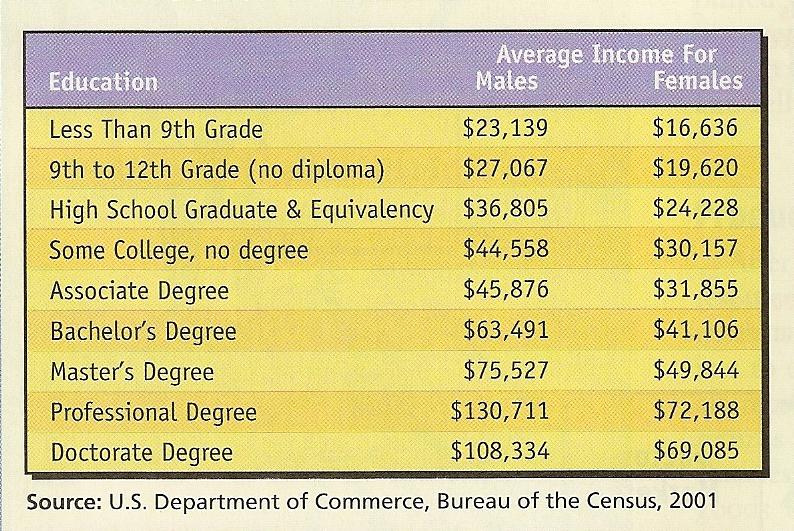
 

Obviously, it is getting more and more difficult for the vast majority of young people in America to achieve the same levels of success as their parents and grandparents, at least in terms of personal income. And the so-called gender-gap is still very real. But that doesn’t answer the question, “Is America still a land of opportunity?” In the abstract, it certainly is. Odds are now that Stephanie, with her college degree, will enjoy a measure of success, both personally and professionally. But what about those 400,000 otherwise qualified high school graduates that won’t be going to college because it has become too expensive?

As you can see, the ramp to success in this country is getting steeper — the social goal of equal opportunity, more elusive. So, out of curiosity, I decided to find out what people think about America still being a land opportunity. In a recent survey of The World According to Opa readers, I posed this question, “Do you believe that anybody in America can be successful in this day and age if they try hard enough?” Follow-up questions included, “how much do you believe money has to do with success, do you consider yourself to be more liberal or more conservative,” and, “how do you define success?” With 75 responses (more than half of them coming from persons self-identifying as being more con- servative than liberal) I got some very interesting results. From the numbers and correlations I was able to make, the results supported my hypothesis that conservative thinkers are more likely to believe that anyone can still make it in America, but not strongly. The correlation between conservatives and believing this was 82.5 percent. The correlation between liberals and believing was 17.5 percentage points less. Somewhat surprising to me, considering the rising costs of higher education, skyrocketing energy, food and medical costs, and the escalating number of home foreclosures, is that nearly three-fourths of all who responded still believe. So, despite it all, Americans remain an optimistic people.

All my data were from respondents who are affluent enough to have Internet access, mostly middle class, homeowners. So the survey was not entirely valid in that it did not include opinions from people in lower socio-economic circumstances. They, no doubt would be more pessimistic. But, if I included the same number of people from higher socio-economic circumstances too, they tending to be more optimistic, the more inclusive survey would probably balance-out with similar results to that which I already have from middle class homeowners.

Seventy percent of respondents said that they believed money was “somewhat” important as a measure of success, while only 7.5% said that it was “very” important. Twenty-two and a half percent said that money had very little to do with it. Surprise! But the most interesting result, I think, had to do with how respon- dents said they view success. Almost all said that being self-sufficient and able to provide basic needs and wants for loved ones is important. Most also included considerations of self-esteem and being happy with one’s lot in life in their definitions. About 80% included considerations of altruism…being able to give back to society in some way, while a small number said that success simply meant being able to do what one wants to do when one wants to do it. Sixty-nine point seven percent of conservatives included altruism in their definitions; a whopping 92.3% of liberals did the same.

So, I conclude that, for most Americans, equal opportunity has become less equal in recent years. Despite what we teach to our students in classrooms all across the land, and despite what most Americans still believe, America is not the land of opportunity that it was for us Baby Boomers and for our kids, the Generation Xers. I also conclude that, at least among those who read my blog, in addition to being optimistic, Americans are a generous people. But the most generous of Americans are those who call themselves liberal. It will be these voters who, I predict, if they are successful this year in restoring the White House and full-control of the Congress to Democrats, will begin to restore to us all to something closer to equal opportunity. And may God bless us all, rich and poor alike.

 I invite your comments, both pro and con.

Published in: on July 18, 2008 at 12:27 pm  Comments (4)  

A Comprehensive Energy Plan ~ Thinking Out of the Box

We must tighten our belts – we must evolve both socially and economically if we are going to survive.

One of the most serious limitations of economics, as every teacher of the subject is aware, is that the study defaults to using money as its bottom-line measure and storehouse of value. We can’t easily factor-in quality-of-life, happiness, or the environment and other so-called subjective considerations. It’s not that we can’t. It’s just that we find it easier to stick with dollars, pesos, renminbi, euros and yen. For these we have exchange rates, and it is for these that investors clamber. But how many Chinese renminbi is the life of a single child worth having succumbed to arsenism, fluorosis, or any number of respiratory illnesses that result from the combustion of low-grade coal? Who will compen- sate the family for this loss?

These questions are almost like asking how many angels can dance on the head of a pin. We may not be able to know, but we must be able to decide if the world as we know it will long survive.

All Presidents since Richard Nixon and the oil crisis of the 1970s have included energy considerations in administration policies. Nixon gave us the National Maximum Speed Limitof 55 mph. Carter deregulated domestic oil production and gave us the Federal Department of Energy, then pushed Congress to increase Corporate Average Fuel Economy (CAFÉ) standards. In 1978, the United States Strategic Petroleum Reserve was created and the National Energy Act was introduced. Ronald Regan, in 1983, pushing for more nuclear energy, attempted to get government out of the energy business by merging the Department of Energy with the Commerce Department, which Congress refused to go along with. He was, however, able to get Congress to approve initial steps in building the Yucca Mountain Nuclear Waste Storage Facility on Federal lands in Nevada. George H. W. Bush put together an impressive international force to drive Saddam Hussein out of Kuwait in 1990 – 91 and his son, George W. Bush, took us back to Iraq in 2003. Now, while one will still get some argument over this, most Americans are convinced today, as are the Iraqis, that Operations Desert Storm and Iraqi Freedom had/have more to do with the oil found in Kuwait and Iraq than they did with the freedom of Kuwaitis or with Weapons of Mass Destruction (WMD). What did Bill Clinton do for us? Overruling Treasury Department Antitrust concerns, his administration approved the merger of Exxon and Mobile oil companies, making it the single largest private corporation in the world at that time.

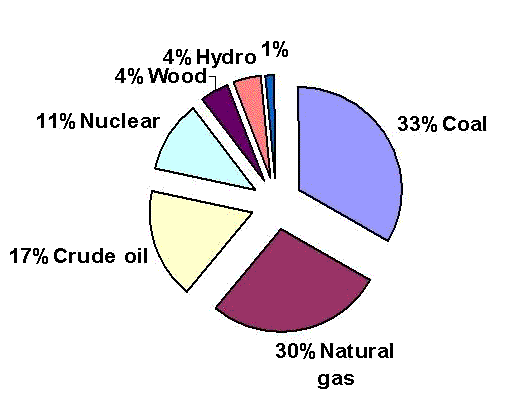
Why has so much of our energy policy emphasis been on oil? It’s because the United States gets approximately 80% of its energy from fossil fuels, and 17% of this is from oil, two-thirds of which is imported. In coal and natural gas, we are self-sufficient, but it’s not economically feasible to fuel cars, trucks and airplanes with coal and natural gas. That’s why most of the oil we use is consumed by the transportation sector.

Americans, who constitute less than 5% of the world’s population, consume 26% of the world’s energy. We account for about 25% of the world’s petroleum consumption, while producing only 6% of the world’s annual supply. So… increase U.S. oil production, right? Wrong, we have only 3% of the world’s known reserves. Even with ANWR and other coastal areas opened to drilling, we would still be dependent on foreign sources to sustain our current life styles.

A new, comprehensive energy policy is needed, one that has two goals:  1) the reduction/elimination of dependency on foreign sources of oil, especially sources other than North American, and; 2) avoidance of environmental calamity owing to Global Warming, a calamity the vast preponderance of climate scientists in the world are predicting. You’ve heard enough about this already and you’re either convinced this threat is real or you’re not. But I am convinced, and I am very much afraid for the future of mankind.  According to Dr. James Hansen, head of the NASAA Goddard Institute for Space Studies and the father of climate change research at that agency, we must reduce our atmospheric concen- tration of CO2 from its current 385 ppm (particles per million) to 350 ppm or less to avert disaster in our lifetimes. That means cutting way back on our consumption of fossil fuels, especially dirty coal and petroleum.

If we do not change our consumption habits, world demand for energy from all current sources will only increase as our populations grow and emerging economies become more affluent from free trade. Therefore, a comprehensive national policy will not be enough to address the second goal, that of avoiding a global warming catastrophe, which, in the long run, truly is the bigger problem. Accordingly, our new comprehensive energy policy must be coordinated with the rest of the world. This means returning to the negotiating table – revisiting the Kyoto Accords, which we could never satisfy now, or hammering out a more demanding protocol as part of a successor accord. For the U.S., this might mean committing to a 40% reduction in CO2 emissions by 2020 and an 80% reduction by 2050 as our “fair” share of the contri- bution. Can we afford to do this? Can we afford not to do this?

Pay me now or pay me later.

How do we get there? Well, I’m sorry folks – but policies aimed at bringing down the price of gasoline and other fuels so that we can continue on the same path we’ve been on since the end of WWII address neither goal of a “comprehensive” energy policy. They won’t make us any safer and they sure won’t make us any healthier. We must tighten our belts – we must evolve both socially and economically if we are going to survive.

Not indifference to Senator McCain’s thoughts on energy policy announced last week, here are my recommendation for the next administration to pursue with the American people through their representatives in Congress. First, convene a bipartisan panel for “long-term” energy policy that includes energy, environmental and economic experts who are not representatives of energy industries’ profit interests. Energy policy this time around should be motivated by the moral equivalency of survival rather than profit. Second, leave nothing off the table for consideration… nothing, not new nuclear power plants, not carbon cap ‘n trade regulations, not conservation or moratoriums on new coal-fired electric plants, not the drilling in ANWR and new coastal areas, and not even nationalization of energy production or considerations of eminent domain. Too much is at stake here: national survival — nay, even the survival of our civilization.

This new energy panel might consider the following: 

1. new tax subsidies for urban area mass transit systems and the expansion of interstate, rapid rail transportation systems;

2. Federally-funded alternative energy research with a national goal such as that established by President Kennedy in 1961 to put a man on the moon (industry seems to be more interested in exploiting current geo-political circumstances and lobbying Congress so that they can produce more oil for profit than in seriously considering alternatives);

3. backing-off subsidies for bio-fuels until technologies are available at a sufficient scale to make the production of ethanol and other bio-fuels from non-food sources practical;

4. the regulation or nationalization of energy and transpor- tation industries seeking cost containment and efficiencies (I know, I know, this smacks of socialism, but these things are working for other, mostly-market economies like our European and industrialized Asian friends);

5. tax incentives to help people transition from gas-guzzlers to hybrid and electric cars as they become more widely available, and the acceleration/expansion of CAFÉ requirements for new vehicles to discourage both production and demand for energy- wasting vehicles (certainly, pickup trucks and SUVs should not be excused from the same mileage and environmental standards as sedans);

6. “New Deal” style government work programs and tax incentives to insulate older homes, replace outdated, energy-hog appliances, and install decentralized, renewable energy sources such as wind generators and solar panels.

It is my personal belief that nothing short of an “all-court” press is going to salvage the energy situation that we find ourselves in today. This means that we’re all going to have to get on the same team, because the opposition is not China or OPEC. The opposition isn’t even al Qaeda. The opposition is inertia (resistance to change) and greed.

I invite your comments, pro or con, and would be very much interested in hearing of any ideas to expand my list for the next administration to consider (I don’t have all the answers; nobody does).

Published in: on June 30, 2008 at 12:00 pm  Comments (3)  

Normative Economics ~ Weighing-in On the Windfall Profits Debate

Politicians all want to do something for the economy in the worst way, and they usually do. Why?  They do so either because they want to get elected, get reelected, or make money for themselves and their friends. 

Perhaps a better title for this posting would be, Normative vs. Positive Economics ~ Why Politicians Aren’t Always the Best Deciders. But, because the windfall profits tax is a hot blog topic lately, I figured I’d get more hits on it with the title I chose.

Most economists, including those of us who, as teachers, just dabble at the edges of this “dismal science“, question the wisdom of imposing a windfall profits tax on big oil. We all teach that, ceteris paribus, when governments raise taxes on producers, much of that increased cost of production is simply passed-on to consumers. But if economics is only useful in the study of how things are (positive economics), then it truly is a dismal science. Fortunately, economics also involves consideration of the way things should be (normative economics).

Most Democrats in Congress, and the presumptive nominee of the Democratic Party for President, responding to the country’s desire for change, think that a windfall profits tax on big oil would be a “fair and reasonable” way to ease the pain and anxiety that Americans are feeling over rising fuel costs. They tend to believe that democracy should deliver the basics of life for all working Americans — normative economics.  Republicans, who are more resistant to change, tend to be more pragmatic. They believe in classic economics which teaches that government should get out of the way and let market forces do what they do — positive economics. 

I don’t recall for sure who said it first, but it certainly seems to be true: Politicians all want to do something for the economy in the worst way, and they usually do. Why?  They want to do so either so they can get elected, get reelected, or so they can make money for themselves and their friends. 

Here’s an interesting quote from the latest Sierra magazine: “Let us rid ourselves of the fiction that low oil prices are somehow good for the United States.” Who said this?  Then representative Dick Cheney in 1986 said this as he introduced a bill before Congress to impose a tax on imported oil. Gee – that was smart.

President Jimmy Carter, who has taken an awful lot of flak over the years from Republicans for the economic problems that persisted during his administration, may just be the exception to the rule for politicians. As President, responding to OPEC’s orchestrated reduction of output to punish the west for its support of Israel during the Yum Kippur War, Carter created the Depart- ment of Energy and established a national energy policy aimed at reducing our dependence on foreign oil. By personal example, he encouraged Americans to cut back on energy consumption and he removed price controls from domestic petroleum production.  As imports and oil company profits later began to grow, he tried a windfall profits tax anticipating big revenues. Instead, tax revenues declined and domestic oil production plummeted by an estimated 795 million barrels. So, we’ve been down this road before.

I personally believe that Carter was acting on the best advice of the economic advisors who had his ear at the time, and that he acted in the best interests of the nation as a whole. But one would think that we’d have learned our lesson by now.

Try as I may, I fail to find much convincing argument on the Internet currently to support Barack Obama’s pledge to impose a windfall profits tax on big oil. To the contrary, the blogosphere is filled with augments against it (good work McCain supporters). But Obama’s opponent this year isn’t making much economic sense either by advocating a federal gas tax holiday. So, why are they both making these kinds of promises? They are doing so because these things resonate with the voters, and the voters are very much in a populist mood this year. Only 47 percent of Americans are against nationalizing our oil companies, which most other nations have already done, oil being such a basic commodity to the livlihood and social welfare of a nation’s people.

A June 14th Rasmussen Report poll found that only 36 percent of voters believe that a windfall profits tax on big oil would cause fuel prices to go up. The rest, less 23 percent who said that they were not sure, said that prices would either go down or that they would stay the same. So, while the tax idea may be a loser in terms of offering a near-term solution to higher prices, it’s not necessary a looser politically, unless McCain supporters can successfully educate voters to the contrary before November.  Nor is the tax necessarily a looser in terms of contributing to a long-term solution. The same Rasmussen Report poll found that 76 percent of Americans believe that new energy technology developments are more likely to solve the problem than anything else, and the majority polled said that, given sufficient investment, private industry would be far more likely to succeed at this than government research programs.

Okay, you say, but you don’t believe in polls. Well, I do. I believe that, collectively, Americans are not dumb. It’s called, government of, by and for the people, not just for stockholders, but for people who must borrow from Peter to pay Paul on a monthly basis just to keep food on the table and their kids in school.

Now we get into the arguments about whether big oil’s profits are truly excessive and whether big oil is or is not already investing substantially in alternative energy technologies.

Exxon Mobil, the world’s largest oil company, reported last quarter a profit of $10.9 billion, up 17 percent from a year before. It was the second-most-lucrative quarter in the company’s history, after the record $11.7 billion pocketed in the previous three months. Chevron reported profit of $5.2 billion, up almost 10 percent from a year earlier. Europe’s Royal Dutch Shell said its quarterly profit jumped 25 percent to a record $9.1 billion, while British Petroleum said its profit soared 63 percent to a record $7.6 billion. Earlier, ConocoPhillips said its profit rose 17 percent to $4.1 billion, and Occidental Petroleum said its profit climbed 50 percent to a record $1.8 billion. But, is any of this excessive? What is a fair and reasonable profit? Should government ever set limits on how successful corporations can be in terms of profit, and should we not be able to compel businesses, by legislation, to act responsibly?  All these questions are in the realm of normative economics, so the answers tend to be subjective. 

Most of us would agree that 10 percent profit is fair and reason- able… but twice that much – seven times that much, especially when the average Joe can’t afford enough gas to just commute back and forth to work? Forget about that summer trip this year, kids. No wonder Americans are outraged. Even John McCain is outraged. On May 5, while campaigning in North Carolina, McCain said that he was willing to consider the windfall profits tax too. “I don’t like obscene profits being made anywhere,” McCain said, “I’d be glad to look not just at the windfall profits tax, that’s not what bothers me, but we should look at any incentives that we are giving to people – or industries or corporations – that are distorting the markets.”

On the score card for investments in alternative energy tech- nologies by U.S. oil companies, it seems to me that the picture is more objective. Speaking at a Houston energy conference last year, Exxon Mobil chairman and CEO Rex Tillerson said, “I don’t know much about farming, I’m not an expert on biofuels, and there’s not a lot of technology I can add to moonshine. There is really nothing we can bring to that whole issue. We don’t see a direct role for ourselves with today’s technology.” Obviously, he and the second largest corporation in the world after WalMart, are more interested in near term profits than into long term sustain- ability. Long term? Hey, that’s my grandkids we’re talking about now!

During their press conference last month, the founding family and self-billed longest continuous shareholders of Exxon Mobil, the Rockefellers, said that they think the oil giant should be investing more in clean energy — and that separating the chairman and CEO functions may put the company in a better position to face challenges in the future. Exxon Mobil’s competitors, they pointed out, like British Petroleum, Royal Dutch Shell, Conoco Phillips, and Chevron, have collectively invested billions of dollars in recent years in renewable, low carbon technology research to reduce emissions and integrate the cost of carbon into strategic planning and investments. But half of these companies are foreign, government-owned companies. So, no, I do not think that U.S. oil companies are adequately committed to the long term, best interests of the American people. They are concerned first and foremost about near term profit for their shareholders.

The problem of high fuel prices is basically an issue of supply and demand. The high and ever-growing global demand for oil and its limited supply, coupled with market uncertainty over the stability of its supply, is raising the price per barrel. At the same time, profit expectations of oil company stockholders stoke each company’s drive to seek ever higher profit margins. Obviously, these two factors are in tension. If economic theory holds, in time the market will find an equilibrium that suits both the consumer and the investor. But this begs the question:  will it happen soon enough?  As John Maynard Keynes said, “In the long run we are all dead.”

Fuel prices are less in the United States than they are in most of the rest of the world. However, Americans don’t care. Our economy and our standards of living, for as long as any of us can remember, have been based on the false assumptions of an unlimited and uninterrupted supply of oil. We complain about volatile prices for gas and diesel at the pump while, at the same time, we demand that our investments turn a profit.

A windfall profits tax, if implemented properly with incentives built-in to increase investment in capital to include new energy technologies, might help to regulate market volatility felt at the pump. But let me emphasize the underlined word, might; big oil moguls and large shareholders could just decide, as they have in the past, to just take their money and run. I’m sorry Barack, but I must conclude that it’s highly unlikely that a windfall profits tax will raise much revenue or ever bring prices down. To bring prices down, we must do some combination of the fallowing: reduce world demand for oil; restore the value of our dollar by reducing debt and the foreign exchange deficit; reduce or eliminate market anxieties concerning the flow of oil out of the Persian Gulf; and develop sustainable alternatives for it.

I invite your comments to this posting, whether pro or con.

Published in: on June 21, 2008 at 5:29 pm  Comments (6)  

Drilling for Oil in ANWR ~ Tell Me Again What it Solves

Once it becomes scarce enough, if we have not by then moved on to some other solution for our energy needs, it’s quite possible that we could see mankind destroy itself scrabbling over what’s left of it.

So that readers might know where I’m coming from, I wish to preface this posting with the following pronouncement: I am a fiscally conservative Democrat. This means that, while I have liberal leanings socially, I believe in balanced budgets, I believe in maintaining a strong national defense capa- bility, I believe in abiding by the rule of law, and I believe in protecting both the people and the environment from the ravages of corporate greed and in doing so with “measured”, reasonable restrictions on “free” markets.

I was watching MSNBC’s political host talk show, Hardball, with Chris Matthews one evening earlier this week. Chris was mediating (if that’s a good word for what he does) a discussion between an Obama supporter and a McCain supporter. I’m sorry, but I do not recall the names of the participants, one of whom, however, was a fireball of an outspoken lady on Republican policies (note that I do not use the term, conservative here as I believe the Republican Party has completely forgotten what it means to be conservative).

The discussion turned to energy policy, the rising price of gasoline, diesel and aviation fuels causing great consternation and economic impact for voters in America this year. Chris and the Obama supporter ganged-up on this lady over John McCain’s federal gas tax holiday proposal stating that no economist thinks that it is an idea worthy of serious debate, and certainly not a long-term solution to anything. In response, the lady very skillfully switched topics to that of drilling for oil in Alaska’s National Wildlife Reserve (ANWR).  She spoke as if this would be a long-term solution, freeing us from our addiction to foreign oil, most of which now comes from Canada (19%), Mexico (15%), Saudi Arabia (11.5%), Nigeria (10.5%) and Venezuela (10.5%).  These foreign imports amount to 66.5% of our total consumption of oil and are the biggest reason for our near trillion dollar annual trade deficit. But, typical of ANWR drilling proponents, she greatly overstated the facts, and I was disappointed that Chris and the other man didn’t counter her claims.  Perhaps they didn’t know enough to do so — neither seemed to know that the presumptive Republian nominee had sided with most Democrats on this issue in the past.

We talked quite a bit about the current “energy crisis” in my economics classes last school year. High school students are very much concerned about this, having waited years to be old enough to drive, and now not being able to make enough money from entry-level jobs to keep gas in anything bigger than a roller skate.  One of my AP Macro students spoke out one afternoon pro- claiming that the solution was simple. “All we have to do,” he said, “is open up ANWR to drilling. There’s enough oil up there to last us 200 years!”

“That’s good news, Aaron,” I responded. Then to the rest of the class I said, “Who else has heard about this… anyone?”  Three or four hands went up — cautiously, perhaps because they feared being rebuffed.

“Great!” I said. “Problem solved then… but wait, does hearing a claim like this make it so?”  Heads began to shake, slowly. “How many of you believe this?”  No one said they did, so I turned my attention back to Aaron.

“Aaron, don’t you believe it?”

“Yeah,” he said.

“How come?  I mean, sure… it sounds good and I’d like to believe it too, but maybe we oughtta check it out.  From whom or from what source did you get this information?

“My dad,” said Aaron.

“Oh.  Well, I don’t want to contradict your dad. Fact is, I don’t have enough information immediately available to do so anyway.  But I do think this sounds a bit too good to be true… Tell you what: you do some research over the weekend.  On Tuesday next week when we meet again, if you can bring me two credible, unbiased sources to support your claim, I’ll bump your last test grade up to an A+. And that goes for anyone else in class who wants to put in the effort.  Class dismissed.”

ANWR is a National Wildlife Refuge in northeastern Alaska. It consists of 19,049,236 acres (79,318 km²) in the Alaska North Slope region. Because this area is believed to contain a large supply of crude oil, the issue of drilling for oil there has been a debated topic in Congress since the end of World War II. The controversy has been a political football for every U.S. President since Jimmy Carter.

The refuge supports a greater variety of plant and animal life than any other protected area north of the Arctic Circle. A continuum of six different ecozones spans some 200 miles (300 km) north to south and there are presently no roads within or leading into the refuge.  There are a couple of Indian settlements there though. On the northern edge of the refuge is the Inupiat village of Kaktovik and, on the southern boundary is a Gwich’nsettlement of Arctic Village. Fearing that exploitation of the ANWR oil reserves would spell the end of their ancesrial way of life, these people do not want drilling to take place.

Tuesday came and I was anxious to hear what Aaron had to tell us.

“Aaron, did you do your homework?”

“Yes, sir,” he said. “I spent an hour on the Internet, but the only sources I could find were from oil companies, an old news item about President Bush scolding Congress for not allowing it, and pro-drilling statements on the websites of both of Alaska’s Senators. None of them, however, claimed to know how long the oil there might last.”

“Ahh… too bad,” I said. “Anybody else come up with something convincing?” Nobody did.

“Well, I came up with something,” I said. “I went to the U.S. Geological Survey’s website and found a study that was done in 1998 for Congress on the amount of oil that might possibly be recoverable from ANWR. The study indicated on the low end, with a statistical probability of 95%, that there’s at least 4.3 billion barrels there. On the high end, the report said that there might be as much as 11.8 billion barrels, but only with a statistical prob- ability of 5%. The mean value is 7.7 billion barrels, meaning that there’s a 50/50 chance of that much oil being there that’s technically recoverable, whether or not it is economically feasible to do so.  In addition, in the entire assessment area, which covers not only land under Federal jurisdiction, but also Native lands and adjacent state waters within three miles, technically recoverable oil is estimated to be 10.4 billion barrels. This again is the mean value. Now, understand, nobody knows for sure how much oil is up there — could be more, could be less. But let’s gamble. Let’s say that there is definitely 10.4 billion barrels there and that, with oil at $130+ a barrel, it’s all economically recoverable. If we could have it all tomorrow, or at least as fast as we could use it, how long would it last us?”

To this I got lots of blank stares.

“Hey, 10.4 billion barrels… that’s a lot of oil, right?” To this I got 100% agreement.

“Okay, let’s figure out how long it would last us. From the CIA’s World Factbook, I learned that Americans use, according to a 2005 estimate, 20.8 million barrels a day. Let’s be conservative and round that up to 21. Surely we are using a lot more than that now, three years later — but just to be fair, we’ll use the published number I was able to find. First one to tell me how long 10.4 billion barrels would last us at that rate gets an A on today’s daily assignment.”

One of my brighter students had his hand up in less than a minute. “That would be a little over a year and 4 months, Mr. Garry.”

“Great, thank you, Matt. That’s exactly what I got when I did the math — less than a year and a half worth. But that assumes that we can get it all and that we can get it all out of the ground as fast as we can transport it, refine it, and distribute it, right?” Heads nodded. “Truth is, once drilling starts, it’ll be 5 to 10 years, depending on who you want to believe, before any oil starts flowing out of ANWR and the surrounding areas, and oil companies will only bring out as much of it to market and as fast as it is profitable for them to do so. If they were to decide that it’s most profitable to use it at a rate so as to replace 5% of the supply we get from other countries, the oil there, using our mean figure of 10.4 billion barrels, would last approximately 22 years. But would we, the consumers, notice any difference at all in the price of gasoline at the pump? Who would stand to the gain most from the drilling? And would this much reduction in foreign oil dependence be sufficiently significant to warrant going ahead with it? Before you answer, understand that the native people who live there do not want the drilling to take place. Also, remember what happened in Prince William Sound off the coast of Alaska in 1989 — Exxon Valdez.” 

I got blank stares again… then, after a long quiet pause, “What should we do, Mr. Garry?” This was Aaron again.

“I don’t know, Aaron, but if you’re asking for my opinion, I think we ought to be conservative.  I think we ought to seize upon this moment in history to focus our efforts more on reducing our consumption of oil rather than on sustaining our current appetite for it. The transition to smaller, more fuel-efficient cars and mass transit alternatives will be costly and painful. Old habits do die hard. But within your lifetimes, world oil production will be well beyond its peak and, as world demand grows for it, it will only become more and more expensive. Once it becomes scarce enough, if we have not by then moved on to some other solution for our energy needs, it’s quite possible that we could see mankind destroy itself scrabbling over what’s left of it. In the mean time, we’ve got global warming with which to contend. I think it’s time to start thinking creatively and long-term.”

I invite your comments pro or con to this posting.

Published in: on June 13, 2008 at 4:11 pm  Comments (21)  

Responding to Four-dollar Gas ~ Thinking Like an Economist

What am I personally going to do about four-dollar a gallon gas? I’ve been thinking about buying a motorcycle. Whoa… Hold on. Let me explain.

I was 64 on my last birthday, and my wife tells me that I’ve become more pessimistic with each added year since she married me. Perhaps she’s right; I certainly don’t antici- pate the price of gasoline to come down by much anytime soon. But is this pessimism or am I just thinking like an economist?

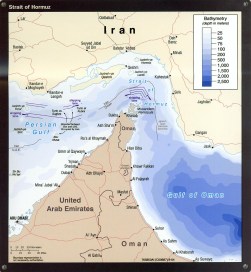
 We’ve all heard the most commonly accepted reasons for the recent rise in the price of gasoline: growing world-wide demand for crude and the declining value of the dollar.  But have you heard this one: price speculation driven by fear of an imminent dis- ruption of thirty percent the world’s supply of oil caused by an expansion of the conflict in the Persian Gulf region? Even with China and India subsidizing the cost of gasoline for their citizens, world demand is currently being met. So the laws of supply and demand alone do not fully explain the rapid rise in cost.

 The Strait of Hormuz is a 21 mile-wide choke point through which nearly a third of the world’s total supply oil must pass to get to world markets. Having just completed a two-day economic summit for educators at the Dallas Federal Reserve Bank, I’ve been left thinking about this quite a bit lately.

Osama Bin Laden has said, “Oil is the umbilical cord and lifeline of the crusader community.” Maybe al-Qaeda is winning this war and our current leadership doesn’t even recognize it.

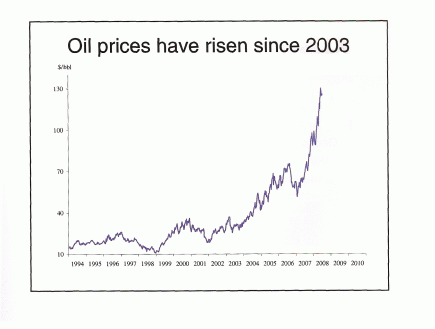
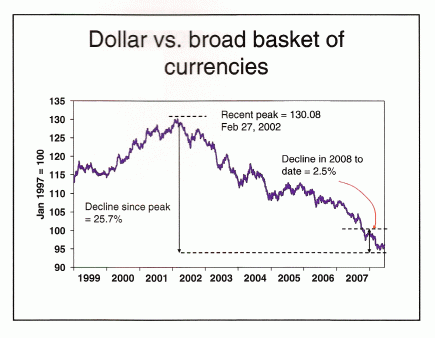
History may recall that our decision to invade Iraq, however noble our rationale for this may have seemed at the time, was the biggest economic blunder of all time. Consider the following two charts. The first one shows the rising price of oil since 2003, the year that we invaded Iraq. But on closer inspection, one can see the rapid increase really started soon after our 2001 invasion of Afghanistan.  The second chart shows the dollar’s decline against a broad basket of currencies over the same period. 

Interesting, hugh? 

Surely the war is not the only thing causing our economic woes, but the correlation of these two trends, the rising price of oil and the declining value of our dollar, to 911 and our declaration of war on terror cannot be just a coincidence. HELLO!?!?

So, what am I personally going to do about this? Well, for one thing, I’m certainly not going to vote in the upcoming national election for the same kind of thinking that got us into this mess.  Aside from that… I’ve been thinking about buying a motorcycle.  Yes… this will save me money on gas and help the economy, especially if I buy a Harley Davidson, the only motorcycle that’s still made by Americans right here in America.

My wife and I will be getting an economic stimulus check soon. I didn’t think we would owing to the amount of money that we had to claim on our 2007 income tax, but the IRS only prorated our $1200 downward based on the amount over the maximum for a couple filing jointly. Woo – woo! Now, we could do the smart thing and pay-down some of our remaining consumer credit we still owe – we’ve been trying in recent years to eliminate as much of this liability as we can. But the government is borrowing money, adding something like another $100 billion to the national debt this year on top of the separate resolutions to pay for the war in an attempt to jump-start our stalled economic engine – consumption. So the least we can do is our patriotic duty, right?

Let’s see now… the bike I want is a 1200 Sportster XL with an extension package for my longer legs and a passenger extended seat, just in case my wife overcomes her dread and decides to ride with me someday. Not counting finance charges, sales tax, an increased premium to my existing auto insurance, an increased premium for a greater amount of accidental death insurance, and safety gear — can’t forget the safety gear — that’ll run me $11,000, give or take, for a new one.  If I ride a little more than half of the time and drive a little less than half of the time, let’s say 6300 miles annually on the motorcycle and 5700 miles in my car, and the motorcycle gets 80 mpg, I’ll be saving $758.17 a year in gas assuming the long-term average price stabilizes at $4.25.

Wow!  At that rate the motorcycle will have paid for itself after just 15 years.  Of course, I could get rid of my car and only travel on my new motorcycle, assuming that I could find someone who wants to buy my 2004 Magnum.  I already know that it’s worth thousands less now than what I owe on it.  If I could get rid of it without having to take too much of a loss, the payoff time would be greatly reduced, of course. But the risk of having an accident would be greatly increased and I’d be sacrificing a whole lot of flexibility.

How many seventy-nine year-olds do you know who still ride Harley Davidsons?  Anticipating that I will live long enough to see my purchase pay for itself, or even that it might last that long, would be pretty optimistic, don’t you think?  But, hell, let’s say that I am an optimist rather than the pessimist my wife thinks I am — MISSION ACCOMPLISHED!

Hmmmm… where have we heard that before?

I guess there are some drawbacks to thinking like an economist after all. We can’t always justify everything we want. Even when we can, there are always trade-offs to consider.

I wonder if John McCain can follow this logic; it’s called cost-benefit analysis. We already know that George Bush can’t.

I invite your comments pro or con to this posting.

Published in: on June 12, 2008 at 10:14 am  Comments (6)  

Liberal Thinking vs. Conservative Thinking This Election Year

Recognizing the benefits of both kinds of thinking, I think it is safe to say that we need both from those who represent us…

June 2, 2008  —  Liberal thinking is rational, creative and compassionate.  Driven by the right side of our brains, it sees the big picture first, then fills-in the details.  It inspired a new and promising form of government 232 years ago – the United States of America.  It secured freedom and opportunity for millions, most of whom were immigrants and former slaves. It brought about new technologies that revo- lutionized agriculture, communication, transportation, and medicine.  It gave us a second chance when the Industrial Revolution ran out of steam and capitalism alone wasn’t working for most Americans.  It promoted “progressive” reforms that gave women the right to vote, made discrimination in schools and the workplace illegal, and committed society to providing for citizens who are unable, whether because of disability or age, to provide for themselves.  It was liberal thinking that challenged our physical and mental limitations and put men on the moon.

Conservative thinking is guarded, cautious, protective and resistant to change.  Driven by the left side of our brains, it processes information in a linear manner, arranging parts in a step-by-step process before arriving at conclusions.  It too played an important role in the building of this great nation.  Conservative thinking by the Founding Fathers protected us from excesses of power by providing for checks and balances in the Constitution.  Conservative thinkers in state governments then forced the fledgling national government to add the Bill of Rights to the Constitution so that basic, individual rights would be protected under a stronger, “federal” government. These kinds of thinkers, our first President among them, cautioned us against foreign wars and economic entanglements, insisted on fiscal responsibility, built a strong Navy to protect the nation as a whole, and established national preserves to protect the environment and our national resources. But the party that claims the conservative moniker today seems to have forgotten its roots.

Recognizing the benefits of both kinds of thinking, I think it is safe to say that we need both by those who represent us if they are to make good decisions… and, yes, it is possible for the same person to employ both kinds of thinking, although we each do have a dominant style.  Hence, Republicans are capable of liberal thought, though some might be loath to admit to it, and Democrats are capable of conservative thought.  Imagine that…  Science on the subject tells us that the learning and thinking processes are enhanced when both sides of the brain participate in a balanced manner.

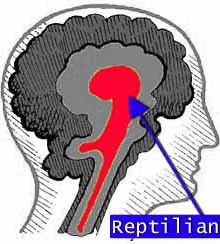
We are all also prone to reptilian thinking, but this is not the kind of thinking we need governing us or even in selecting those who do. What, you may ask, is reptilian thinking?  It is basic, instinctive, and emotional thinking.  It is the kind of thinking that causes us sometimes to act without thoroughly considering the consequences, or to act even without thinking at all. The basic ruling emotions of love, hate, fear, lust, and contentment emanate from this, the first stage of our brains. When we are out of control with rage, it is our reptilian, basic brain that overrides the rational parts of our brain. So, if someone says that they have reacted with their heart instead of their head, what they really mean is that they have conceded a decision to their primitive emotions, their reptilian brain.

If Americans concede to their primitive emotions this election year and vote with their heart rather than their head, they may well be voting for a four-year extension of fiscal policies (taxing, borrowing and spending) that have brought us to the precipice of depression.  I say this because:  the national debt is nearly twice what it is was when George Bush first took office; our roads and our bridges are falling apart; real jobs with decent pay and benefits have been lost to other nations; the dollar has lost 40 percent of its value; gas now costs twice as much as it did then, which is driving up the cost of everything else; our homes on a national average have lost 14 percent of their value, and; to sustain our efforts in Iraq, we must borrow ever more from China and Japan.  Sure, most of us have had a measly couple extra hundred dollars after taxes each year to spend, but that doesn’t buy much these days. The truth is that big business is more profitable than ever while small business is rapidly becoming extinct.  If you own preferred stock, you’re rolling in dough.  If you own common stock, you’ve either lost your shirt or you are barely breaking even.  Executive directors are making obscene salaries even as employees’ benefits are being sacrificed to the competition. Therefore, a small percentage of Americans have grown wealthier at the expense of all the rest of us. But our government doesn’t want us to know how bad things really are (see the below reference).

John McCain has committed to supporting the Bush tax cuts during his administration, although he opposed them as a Senator.  He has said too that he is committed to keeping our military in Iraq for “as long as it takes.” However, after nearly eight years of President Bush and his policies, most Americans (62 percent when I last checked) say that they think we’re on the wrong path, both in the War on Terror and on the economy. I believe that they are right. and I too believe that it is time for change. As Albert Einstein once said, “Insanity is doing the same thing over and over again expecting different results.”

I read a comment on-line last weekend in response to an ABC news article.  It was written by someone who said she is a great grandmother, older and wiser now, thinking about the mess we are leaving her grandchildren to clean up and to pay for.  She said, “I would not vote for Hillary Clinton just because she is a woman.  I would not vote against Barack Obama because he is young, black and has a funny sounding name. Neither would I vote against John McCain because of his age or for him because he is a decorated veteran. I will vote for the candidate whose convictions and advocated policies make the most sense for the nation as a whole.”

I plan to do the same.  I pray that you will do likewise.

Please feel free to respond pro or con to this posting.


[i] Kevin Phillips, Harper’s Magazine, “Numbers Racket ~ Why the Economy is Worse Than We Know,” page 43, May 2008


Published in: on June 2, 2008 at 2:26 pm  Comments (10)  

Sowing the Seeds of Change ~ Setting New National Priorities

If ever there was a time for the immortal words of John F. Kennedy, “Ask not what your country can do for you — ask what you can do for your country,” it is now.

Human nature being what it is, people are adverse to change.  Change may be perceived as being arduous or even dangerous.  We resist it, even if we find ourselves at the bottom of the socio-economic pyramid. At least there we’ve got a lot of company.  Then too, there is comfort in knowing and living within our boundaries, especially if we think our needs are already being met, and some- times, even if they are not being fully met.  Consider the paradox of abused spouses who remain in relationship with those who abuse them.

This aversion to change is especially true of corporations, govern- ments, and hierarchal groups of all kinds since those in power tend to resist that which threatens the status quo. Notwithstanding, we are hearing a lot about change this election year.  It’s the “buzz word” du jour thanks to Barack Obama’s campaign, and it has struck a chord with many Americans, especially among the young and better-educated.  So there must be many who, in today’s economy, are not satisfied with things as they are or to where they see that trends may be leading us.  Bully! I say, Bravo! It’s about time.

Now, before we get into the specifics of what needs to be changed and how, let’s see if we can agree on this: there are no magic solutions to any of our problems today, which are all intercon- nected so that acting on one has an impact on all the others.  But one thing is certain – doing nothing about them in the near term will only make solutions more elusive and difficult later-on.

On the economic front, nothing short of an “all court press” or a miracle will bring back the many good, living-wage jobs that have been lost to foreign competition in recent years, stem inflation, restore real estate values, and solve the energy crisis.  Unfortun- ately, we have a war on our hands, one that does not fit into our annual budgets and for which we have had to borrow billions of dollars.  For it to continue, we will have to borrow many more billions of dollars or else raise taxes.  This is something that no one in Washington seems to want to talk about.  So miracles, just now, are in short supply.  At the same time, we are finally waking up to the fact that we have to deal with the environmental crisis of global warming if we are to avert what has been coined, The Greatest Market Collapse in History.  Reversing the effects of global warming will require great sacrifices of us all, innovation, and international cooperation.  In economic terms, There Is No Such Thing As A Free Lunch!

In the best of times, with an expanding economy, low inflation, a stable dollar, and our work force fully and gainfully employed to produce both goods and services, it would be difficult to deal with the many problems we have today on the domestic front.  Among them are immigration, education, health care, social security, drugs and crime.  All are likely to be issues in the upcoming Presidential debates this year, and they must all be dealt with, sooner or later — but these are not the best of times.  No matter what the President and all the President’s men are telling us (or not telling us), with consumer confidence at a thirty-year low, the American people know that we are in a resession already, they can feel it.

So, in the now-famous words of Bill Clinton’s 1992 campaign strategist, James Carville, “It’s the economy, stupid!” This, it seems most clear to me, must be our new national, Number One priority if we’re going to be successful addressing the other issues.  And, for every other issue, if change would result in a negative, near-term economic consequence, change should be subordinated, in my opinion, to the greater issue, which is the economy.

If you’ve read this far, you might be interested in the following video of a recent Bill Moyers interview with authors of the book, “Where Does The Money Go.”  Presented, I believe, in a politically balanced way, I felt that it would be okay to share it with my high school economics students.  After watching it, they praised it for being most enlightening. 

So, it seems as though there are, as I have said, no magic solutions.  Both liberals and conservatives are going to have to yield ground.  That is why we need someone this time around in the White House who can both ignite and unite.

If ever there was a time for the immortal words of John F. Kennedy, “Ask not what your country can do for you — ask what you can do for your country,” it is now.

I invite your comments, both pro and con.



Published in: on May 10, 2008 at 4:58 pm  Leave a Comment  

Federal Gas Tax Relief ~ Is This the Price of Your Vote?

This is classic pay-me-now-or-pay-me-later, near-term-gain-for-long-term-pain thinking.  Let’s face it, the age of cheap oil is history.  America must now adapt to this new economic reality. 

Showing us just how much he really does not know about economics, Senator John McCain has proposed Federal gas tax relief (Memorial Day to Labor Day) as a way of alleviating some of our economic pain this year.  Does this sound good to you?  Yeah, I thought so too until I did the math.

Hillary Clinton, recognizing a good election year ploy to buy your votes, was quick to endorse McCain’s idea, while Barack Obama is saying, “No.” How come?  I think it’s because he believes it’s better to be honest with voters.  He trusts that voters are too smart to be bought for the price of a cup of coffee a day for ninety-seven days.

The Federal excise tax on gasoline, by the way, is 18.4 cents per gallon, it’s 27.2 cents per gallon on diesel fuel.  If the tax on just the gasoline were to be suspended for the summer, each of us who drives a car would save approximately 46 cents a day, assuming that we drive an average of 50 miles a day and that our car gets 20 miles per gallon of gas.  But, given that there are approximately 300,000,000 registered vehicles in America today, not counting commercial trucks and recreational vehicles (let’s say just two-thirds of them are driven the average 50 miles a day), the Highway Traffic Fund would lose $91,908,000.00.   While not as generous as the Economic Stimulus package that Congress has already agreed to add to deficit spending this year, the money that we might not spend individually at the pump this summer will be money that won’t be spent later maintaining our nation’s highway infrastructure.  Hmmm… I wonder how many jobs in how many states this amount of money translates into.

This is a classic case of pay-me-now-or-pay-me-later, near-term-gain-for-long-term-pain thinking.  Let’s face it, the age of cheap oil is history.  America must now adapt to this new economic reality.

At a time when economic conditions signal the need for expansion- ary fiscal policies on the part of our Federal government, it’s no time for anyone to be “nickel-and-dime’n” their way into the White House.  We need to drastically reduce our demand for foreign oil, which is the biggest part of our trade deficit, and we need to cut down on CO2 emissions for the sake of our planet.  We do not need government to subsidize our continued gluttony, even if only psychologically and if only for a few short weeks. The only winners will be the share holders of big oil.  Only when world demand for oil declines will prices decline.

Please feel free to comment pro or con to this posing.

Published in: on May 1, 2008 at 5:14 pm  Comments (5)  

Like Taking Candy from Babies ~ The International Food Crisis

Has the time not come for us to accept the sovereignty of every nation, not only political sovereignty, but economic sovereignty as well?

A good friend of mine has referred me to an article that was posted on the Internet yester- day, Food Riots Erupt Worldwide.  The article can be found on AlterNet, which is an independent on-line news service that amplifies other inde- pendent news services’ articles with the goal of inspiring citizen action and advocacy on envi- ronment, human rights, civil liberties, social justice, media, and health care issues.  I guess this makes AlterNet part of the “liberal” media, so some may be tempted to dismiss this news all together.  But Alternet’s goal is near and dear to my heart, so the article really got my attention.  Accordingly, I decided to do some research myself and pass the story on with some amplification of my own.
I’m like Will Rogers who said, “All I know is what I read in the papers.” So I don’t have any first-hand knowledge of food riots, nor do I have access to primary sources of information about it.  But when I google “food riots,” I get dozens of returns on news stories posted in recent months by various news agencies about food riots in places like Mexico, Haiti, Afghanistan, Syria.  I found one story too about how Canada anticipates that we who live north of the Rio Grande may be closer to food riots ourselves than we think.  This article, UN Food Agency Needs Hundreds of Millions for Hungry, posted also yesterday by the Associated Press, confirms for me that the Third World is in fact experiencing a growing food shortage.  This has been the subject of reports and discussions on National Public Radio in recent weeks.  But the situation, to my knowledge, has not made it past the “so-what” cut to be featured prominently on evening network news programs.  How come? Are we not an enlightened, generous nation?

World food prices, according to the AlterNet article, have increased by a whopping 39 percent over the past year with rice prices increasing to a 19-year high. Fifty percent of this price increase occurred over a single two-week period. Commodity traders are making money “hand-over-fist.” So, while we here in the United States have been distracted by the political bickering between Senators Clinton and Obama and our own rising fuel and food cost problems, half of the world’s people, the half that must live on the equivalent of $2 a day or less, are facing starvation.  Why? 

Have I got your attention yet?

Analysts the AlterNet article cites have identified some obvious causes for the food shortages: increased demand from China and India, whose economies are booming now, thanks to free trade; rising fuel and fertilizer costs driven by steeper demand for oil owing to China’s and India’s booming economies, thanks to free trade; increased demand for bio-fuels in this country to reduce our dependency on foreign oil and trade deficits, and; climate change (much of the land in coastal rice-growing regions of Asia have experienced more frequent and more severe tropical storms in recent years with accompanying storm surges that have left the soil less fertile owing to sea water flooding).  But there’s more behind this problem than just the obvious reasons… much more.

For several decades now, the United States, the World Bank, and the International Monetary Fund have used their leverage to impose policies that have had a devastating effect on developing countries, policies that some recognize as the New Colonialism (neocolonialism).

According to a Hoover Institution essay, World Bank and IMF financing programs rarely prescribe appropriate economic policies or sufficient institutional reforms; they are at best ineffective and at worst imprudent investment and public policy decisions.  They reduce economic growth and encourage long-term IMF dependency.  By requiring countries to open up their agriculture markets to giant multinational companies, by insisting that countries dismantle their marketing boards that served to keep commodities in a rolling stock to be released in the event of bad harvests, thus protecting both producers and consumers against sharp rises or drops in prices, the First World has put the “screws” to the Third World.  Countries that were once self-sufficient in food crops are now compelled by market forces to grow exportable cash crops instead such as tea, coffee, cocoa, cotton and even flowers.  So the rich get richer… The poorest countries of the world have been forced into economic servitude, unable to repay massive loans.  Is it any wonder that so much of the rest of the world hates us now?

So, what should we do about it?

To begin with, we should stop fooling ourselves.  We may be the most generous people on earth giving 1.67 percent of our gross domestic product (GDP) to charity.  But the lion’s share of our giving goes to local and national charities like churches, the Salvation Army, and the American Red Cross.  Most of our foreign aid, a tiny fraction of our GDP, goes to Israel.  Along with this, we need to realize that free trade and market forces alone do not serve humanitarian purposes.  Free trade, as opposed to “fair” trade, simply makes it possible for money interests to exploit other’s resources.  So, it is essential that we should not stand in the way of developing-world governments reinstituting safety nets and public distribution systems for food.  Additionally, donor nations must do more, and do so immediately, to support govern- ment efforts in poor countries to avert wide-scale starvation.  But most Americans are already feeling the effects of recession, stretching family budgets and doing without to make monthly ends meet.  So, those of us who can really do need to pitch-in; the UN food program desperately needs contributions.  Warren, Bill, Oprah, and all the rest of you who so richly benefited from the Bush tax cuts over the past eight years, are you hearing this?

In the long-run, the world’s financial powers need to back off, accepting the fact that what works so well in U.S. and Canadian agricultural sectors doesn’t necessarily work in Third World countries.  With large numbers of their citizens still engaged in agriculture as a way of life, these countries cannot be left to depend so heavily on food imports to feed their people.  They need substantial production and consumption of locally grown crops from small, sustainable farms rather than large, commercial farms growing cash crops for western markets.  It may be time to reconsider whether even the IMF has a legitimate reason to exist. 

Has the time not come for us to accept and respect the sovereignty of every nation, not only political sovereignty, but economic sovereignty as well?  Then the time has come for us as well to to stop worshipping the golden calf of free markets.  Paraphrasing the words of the AlterNet article’s author, Anuradha Mittal, every country and every people have a right to affordable food.  When the free market deprives them of this, it is the market that must give back.

Please feel free to post a comment, pro or con, in response.

Published in: on April 26, 2008 at 10:47 am  Comments (6)  

The Pursuit of More Economic Freedom ~ What It Has Cost Us

Most Americans would agree that economic freedom is a good thing.  But, I wonder, can too much of a good thing be a bad thing?

Before speculating on why our economy is in the pits lately, I feel a need to respond to an accusation made in a recent comment to my Birdfeeder post, i.e., that The World According to Opa is itself a source of viral disinformation.

I have been assured by more empathetic readers that my blog is not a source of viral disinformation. They say, and I choose to believe, that it is just the opposite; it is an open blog inviting input and dialogue from all quarters.  It is dedicated to those of us who enjoy safe opportunities to express ourselves on controversial issues of the day.  While I would hope to one day win over the minds of those who disagree with me (that is after all the purpose of debate), this is not the essential reason for the blog’s existence.  Furthermore, I leave open the possibility of being won over to others’ interpretation of the facts from time to time.  I encourage all my readers to comment publically and I respond to all comments, even the hateful ones (although these I choose to answer offline).  The blog might be considered to be “infotainment” by some, but only if they choose to receive (or ignore) the ideas presented unidirectionally.  It’s their choice.

To prove my point, in response to a recent comment to the Birdfeeder post, I concede… sort-of.  There are other countries that are rated as having more economic freedom than the United States.  According to assessments made by “conservative” think tanks like the Cato Institute and the Heritage Foundation, there are a few nations that rank higher on the Economic Freedom of the World (EFW) index than the United States does, but only a few, not “a number,” implying several as one of my readers has claimed.  Hong Kong has consistently ranked most economically free over the years.  But (and I guess it matters what parameters are measured and how), the United States isn’t far behind.  The more “liberal” camp of think tanks, like the Pew Charitable Trusts, concern themselves with issues like social justice, collective welfare, human rights, and the environment — more so than “individual” rights and “economic” freedom, but I respect what the conservative think camp does too.  Most Americans would agree that economic freedom is a good thing.  But, I wonder, can too much of a good thing be a bad thing?

According to a Cato Institute report that’s four years old now, at the end of the Clinton administration, the United States was tied for third place with New Zealand, Switzerland, and Great Britain for having economic freedom. The factors considered in Cato’s EFW are:  the degree to which property rights are safe guarded (I can’t imagine that Hong Kong, being a province of China, gets a high score on this, but perhaps); the level of contract enforcement; whether or not and to what degree free trade is allowed; the maintenance of low marginal tax rates, and; the degree to which the nation’s money holds its value against foreign currencies. Hong Kong, according to this report, had a score of 8.7 on a scale of 10, whereas Singapore had an 8.6. The third place countries all had an 8.2.  Today, however, the United States is ranked fifth according to a recent Heritage Foundation report, even with more free trade and lower marginal tax rates.  We may have slipped owing to less government oversight of business transactions, especially in the financial sector, to enforce contract agreements and because we’ve allowed the dollar to loose much of it’s value… just a guess.  So, if anything, the point my reader raised only serves to illustrate how we’ve lost ground economically under the two Bush/Cheney administrations and a Congress that was dominated most of this time by Republicans.

Wait a minute!  Wait a minute!  According to the CIA Factbook, Hong Kong is a Special Administrative District of China, not a country (a soverign nation-state).  And when you look at Singapore on a map, it becomes obvious that it is city-state not a nation-state.  These two economically bustling, populated places in Asia should not be directly compared with nation-states, which have more complicated and dynamic political landscapes. Take away these two, the U.S. then was really tied for first place with two other “real” countries four years ago, and now still ranks third despite the devaluation of the dollar to pay for our military adventurism of recent years.  So I take my concession back.

This teacher of economics suspects, based on various studies done as far back as 2001 that I have read (and Alan Greenspan’s book since) on the likely (now historical) long-term effects of Bush’s tax cuts, even with the lower marginal tax rates involved, that output (GDP) would be (and now obviously has been) constrained because of them.  Expansion has slowed and we are now actually experiencing a recession because spending was not reduced by the Government commensurate with reduced revenues after the tax cuts were enacted.  Also, government spending in the public sector, as a percentage of total spending, has declined with billions leaking from our economy into the hands of Afghan and Pakistani warlords and to reconstruction efforts in Iraq.  Leakage from our economy has also resulted from our growing trade deficit thanks to more free trade.  We have expanded the money supply to fund the wars in Afghanistan and Iraq with the sale of government securities primarily to China and Japan, which is largely the reason for the declining value of the dollar; world demand for the dollar is down because we have flooded the market.

Another reason we are in recession today, I firmly believe, is because more and more middle class American jobs have been lost through off-shoring, another consequence of free trade.  More and more Americans are earning less and less and, therefore, have less to spend.  Finally, we are in recession today because the ultra wealthy, for whom Bush’s tax cuts overwhelmingly favored, have saved much of their increased disposable income.  Rather than plowing it back into the economy through consumption or investment to stimulate the economy, they have bought treasury bonds with their savings or stashed it away in off-shore accounts and other such tax havens.  The rich know best how to do this.

Yes, I must conclude that it is possible to have too much of a good thing.

On yet another of my readers points in his most recent comment, no, I do not agree that we are “all” free thinkers.  I know many who won’t even consider much less listen to others’ opinions and some, fundamental Christians among them, who reject scientific theory (facts) because they cling to already-held dogma.  These people cannot be considered free thinkers.

President Bush, in my humble opinion, is a good example of someone who is not a free thinker.  He once said, as reported in Susan Jacoby’s book, The Age of American Unreason, that he never reads newspapers as that would expose him to public opinion.  This revalation, according to Jacoby’s account, was reported to a Fox news correspondent during an interview with the President back in 2003.  Now I admit that this is secondary information, but it rings true with my opinion of the man.

Please feel free to post a comment, pro or con.  Everyone’s opinion matters.

Published in: on April 8, 2008 at 9:18 pm  Comments (7)  

What We Know vs. What We Think

In psychology, confirmation bias is a tendency to search for or interpret new information in a way that confirms one’s preconceptions.  It’s a trap into which we are all vulnerable to fall.  Because our beliefs comfort us in our uncertainties, we tend to avoid information and interpretations that contradict our beliefs.

I suspect that I encountered confirmation bias in another person recently while discussing the current line-up of political candidates.  I was talking with a conservative teacher friend of mine.  Yes, folks, I do have some conservative friends, those who are still open to discussing things without getting red-in-the-face mad and calling me names.
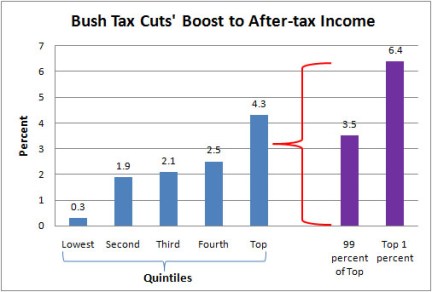

My friend must have felt challenged by my assertion that a Democrat would most likely occupy the White House after next year’s elections, this owing to current economic conditions in our country.  History tells us that Americans always vote for the other party’s candidate when the economy is on the ropes.  Mind you, I didn’t say that I thought the Bush-Cheney tax cuts and run-away spending by a Congress dominated until recently by Republicans was entirely to blame, but I’m pretty sure this is what he thought I was implying.  In defense of the tax cuts, my friend made a claim that I had not heard before.  He said that a recession prevailed during the last three quarters of Bill Clinton’s second term. 

As a teacher of economics, I had not heard this claim before, a belief that I now understand to be widely-held by conservatives.  It challenged me, a “glass-is-half-empty” type of more liberal thinker, so I decided to check it out for myself.  I researched economic data for that period, which is available at the Bureau of Economic Analysis (BEA) website.  What I found was interesting –to me anyway.  While it is true, based on the data I found, that the U.S. economy shrank in three non-consecutive quarters in the early 2000s (the third quarter of 2000, the first quarter of 2001, and the third quarter of 2001), this did not constitute a recession –the official definition of recession being “a fall of a country’s real GDP in two or more successive quarters.”   A minor technicality that the declining quarters were not consecutive?  Perhaps.

My friend was right though; the economy was on shaky ground back then with relatively high unemployment following the burst of the dot-com bubble.  The unemployment was structural, caused by a series of layoffs by companies shifting manufacturing jobs overseas.  Spending was down because many took early retire- ment or adjusted their household budgets from what they had brought home from high-paying, assembly line jobs to what they could make with temporary, part time jobs in the services sector.  All of which validates the point that I was making in the first place.  And that is:  voters go for candidates representing the “other” party whenever the economy is in a slump.  But was this economic downturn Clinton’s fault for having increased taxes on the most wealthy of Americans in 1993 to generate budget surpluses in order to reduce the national debt?  No, I don’t think so.  The stock market had just become over expanded owing to investor enthusiasm for anything with a dot-com in its name.  Impounding the surpluses and buying back treasuries with the surplus generated by higher taxes and lower spending was the right thing to do, in my opinion, to keep inflation under control during those years of rapid economic growth.

Future historians will no doubt recall these shaky economic conditions in the final year of Bush-Cheney administration, conditions caused largely by the second-tier mortgage finance problem, which begat a decline in home values, which begat a decline in the entire housing sector (a huge part of the total economy), which begat a major fall in consumer confidence.  Also factoring into this mess is the dollar’s decline against foreign currencies resulting in large part from the Fed’s expansion of the money supply to cover deficit spending.  And don’t forget the inflation that everyone anticipates owing to the recent increase in the price per barrel of oil.  Why the high price for oil?  Oil prices are pegged to the U.S. dollar world-wide, which is now worth about forty percent less than before 911.  Also, world-wide demand for oil has rapidly increased in recent years as millions of people in China and India step up to their turns behind the wheel of automobiles.

With the national debt now more than $10 Trillion dollars (it was only $5.7 Trillion when Bush was first elected), this neophyte economist believes that we’re in for a long hard pull to dig our- selves out of the hole that we are now in.  If we are already in a recession and don’t know it yet, no matter what this or the next administration attempts to do (whether fiscal or monetary), other matters will be made worse.  If the Fed expands the money supply any more, the dollar will lose more value even quicker and foreign investors will look elsewhere for places to invest.  China has already announced that she is looking toward European countries for safer places to invest.  Oil, ever increasing in price as demand grows and OPEC refuses to produce more, will cost us dispro- portionately more than it costs other countries. With respect to the fiscal policy alternative government has with which to boost the economy, if more is spent ala FDR’s new deal, the national debt could soon rival the 120 percent of the GDP we had during WWII.

Yep, I really am a “glass-is-half-empty” kind of guy.  So I hope that I’m all wet in my assessment of where we are after eight years of reduced national income, this owing to tax cuts that favored households with a lower marginal propensity to consume (MPC), and unconstrained national spending on congressional district pork and a war that could go on forever.

But all this is just what I think; it’s not what I know.  So, please correct me, whoever you are, wherever you think my thinking is wrong.  I hope to never become so closed-minded in my beliefs that I’m not open to fully hearing opposing arguments.

To post a comment, just click on the tiny COMMENT word below.

Published in: on December 8, 2007 at 11:18 am  Comments (2)  

Government vs. Politics and Economics as a Pawn in the Perpetual Game

  Reading recently that approval rates for President Bush and the democratically controlled Congress are both at all-time lows, I am somewhat pleased to note that the voting public seems to be catching-on. 

Government is indeed BIG business, which is why I think we suffer as a nation from persistent budget deficits, why government panders to business and fails to protect consumers, why special interest groups proliferate, and why bureaucracies continue notwithstanding presidential promises to cut them.

As I’ve written here before, I often remind my students that one cannot separate economics from government.  I say this despite the fact that many more-learned, working economists would say otherwise.  They like to characterize themselves as being merely advisors to business and government decision-makers.  In this way, they are able to keep their skirts clean and dodge responsi- bility when economic policies go awry.  But advocates of Public Choice economic theory are not fooled.  These economists say that politicians, regardless of party affiliation, use and sometimes distort economic theory to gain advantage over their opponents. 

Before I go on, let’s define some terms.  Government, according to Webster, is a system of rule or power over society’s affairs, where- as politics is the science or “tactics” of government.  So, govern- ment is the what while politics is the how, and nothing, save for perhaps the threat of invasion or terrorist attacks, grabs voters’ attention more than the economy. 

The Public Choice school of economic theory was first advanced by James M. Buchanan, 1986 winner of the Nobel Prize in economics.  While most economists say that they view politics as a barrier to sound economic policy, Buchanan and other Public Choice econo- mists say that politics can only be fully understood by employing economic tools of analysis.  They know, as most Americans are finally beginning to suspect, that economic policy is often used not so much for the collective good of society as it is for a means to gain political support.  Take the Bush/Cheney tax cuts for example.

The first of these tax cuts was the Economic Growth and Tax Relief Reconciliation Act (EGTRRA) of 2001.  The second was the Jobs and Growth Tax Relief Reconciliation Act (JGTRRA) of 2003.  The names imply lofty social goals:  to reduce Americans’ tax burdens while, at the same time, spur economic growth and create jobs.  However, the combined effect of these acts bears scant resemblance to their names.  They have done little else but to skim wealth from the masses and move it to those who are already rich, households that are less likely to spend the additional discretionary income on consumption.  The graph below illustrates this redistribution, which, according to The Economic Policy Institute, has been recently estimated by William Gale and Peter Orszag of the Brookings Institution.

Bush Tax Cuts

The impact of the Bush tax cuts is clearly seen to be uneven across the income scale.  In fact, the results are even more uneven within the top quintile (the fifth bar from the left), seen broken down in the two right-most bars between the top one percent and the rest of wealthiest one-fifth of Americans.  As you can see, the gains of the top one percent are well above the rest of us.

When the Bush Administration claims that it has improved the progressivity of taxes, it points to the percentage changes in shares of income taxes paid as evidence.  But, as the chart shows, reaping large percentage cuts in taxes for those who pay little to begin with does little to boost the after-tax income of those at the bottom of the scale.  In other words, what matters most is not the change in what you pay in taxes, but the change in what you have left after you pay.  In reality, the distribution of the after-tax gains was stacked heavily in favor of the highest-income taxpayers.  And these people don’t spend everything they make like you and I do, they don’t need to.  They sock it away in off-shore accounts and other investments like U.S. treasuries and municiple bonds so as to make more off the taxes paid by the masses in tax-free interest.

Growth in consumer spending, according to the expenditures approach to calculating Gross Domestic Product (GDP) has experienced a slowing trend during the Bush/Cheney years, as has gross investment spending by business.  The trade deficit has been accelerating, but this has been largely offset by increased govern- ment spending owing to the wars in Iraq and Afghanistan — spending over there rather than over here, which has been financed largely with borrowed money (see the numbers for yourself at the government’s Bureau of Economic Analysis).  So, the administration’s economists haven’t had to lie when they have said that the economy has been expanding.  They have exag- gerated greatly though whenever they have said that this expan- sion has been healthy and that the economy is strong… for an economy that expands on borrowed money is like a house being built on a foundation of sand.  When the tide comes in, the house will fall.

Alan GreenspanAlan Greenspan, the former Federal Reserve Chief, has been a life-long Republican.  Nevertheless, he was appointed to successive four-year terms by four different presidents including Bill Clinton.  He long argued that persistent budget deficits pose a danger to the economy over the long run.  “Mr Bush,” he wrote in his recent book, The Age of Turbulence: Adventures in a New Land, “was never willing to contain spending or veto bills that drove the country into deeper and deeper deficits, as Congress abandoned rules that required that the cost of tax cuts be offset by savings elsewhere.”  I don’t wonder that the man resigned mid-way through his last term.

“My biggest frustration remained the president’s unwillingness to wield his veto against out-of-control spending,” Greenspan wrote. “Not exercising the veto power became a hallmark of the Bush presidency. . . . To my mind, Bush’s collaborate-don’t-confront approach was a major mistake.”

Though Mr. Greenspan does not admit in his book that he made a mistake, he does express remorse about how Republicans in Congress jumped on his endorsement of the 2001 tax cuts to push through unconditional cuts without any safeguards against surprises. He recounts how Mr. Rubin and Senator Kent Conrad, Democrat of North Dakota, begged him to hold off on an endorse- ment because of how it would be perceived.

“It turned out that Conrad and Rubin were right,” he acknowl- edges, and says in his book that Republican leaders in Congress made a grievous error in spending whatever it took to ensure a permanent Republican majority.  He also says that the Republicans deserved to lose control of Congress in the last mid-term elections as a consequence of their lack of fiscal restraint.

While the rich get richer and the poor wait their turn by way of supply-side economists’ “trickle-down” effect, America grows more and more ready for real change.  Despite all this, the administration’s economists at OMB, the BEA and the BLS (Office of Management and Budget) have found ways in the past to manipulate favorable reports and forecasts, which have consis- tently been overly optimistic.  So, at the end of the day, what have the Bush/Cheney tax cuts accomplished?  Well… they got ‘em elected – twice.  Which serves only to prove what Mr. Wasden, my sixth grade teacher, said was true, “Americans vote their own pocketbooks,” and give scant consideration for the consequences to the country as a whole.

I am convinced that, so long as the voting public remains econom- ically ignorant, trusting in politicians and brokerage firm talking heads for information and advice about the economy of the nation, economics will forever be a pawn in the perpetual game of politics.

To post a comment, click on the tiny COMMENTS word below.

Published in: on November 22, 2007 at 9:03 pm  Comments (3)  

Don’t Let Them Get Away With It!

“So-called ‘global warming’ is just a secret ploy by wacko tree-huggers to make America energy independent, clean our air and water, improve the fuel efficiency of our vehicles, kick-start 21st-century industries, and make our cities safe and more livable. Don’t let them get away with it!”

Chip Giller, founder of Grist.org

So-called Global WarmingI’ve been meeting with some like-thinking friends at a local coffee house Saturday mornings for the last several weeks.  The group is open to discuss most any subject, but the war in Iraq, energy, socioeconomics, and the environment seem to be everyone’s top four concerns lately.  Sure, we talk about politics too, sometimes, but not so much.  With no viable Independent running this time around, most of us will vote for whomever our party of choice nominates anyway.  Further, assuming that voting in key states won’t be rigged next year, we’re guessing that our next President will either be the first woman or first African-American to occupy the Oval Office.  Sorry Rudi.  So, with world petroleum prices quickly approaching $100 a barrel, we talked mostly last time about what we can do as a community and as individuals to survive the next round of escalating fuel prices.  Hey, this is a  big problem — at all levels, from the personal to the international!  Watch the MSNBC video about French turning by the thousands to rented bicycles to get around Paris.

After unleaded regular hits $4.00 a gallon this summer and, assuming that there’s no new major supply of petroleum forth- coming anytime soon, I’m giving two-to-one odds that it will, I figure that it’s going to start costing me close to $20.00 a day to commute to and from my job.  Now, while I’m not sure that we can believe anything Washington tells us anymore, you may see the government’s “official” projection of supplies and prices by clicking HERE.

Pondering this problem last Saturday, I noticed the quote at the top of this post on the coffee cup one of our group’s other men had brought with him.  It gave me a chuckle.  Funny, isn’t it, how so many things that are humorous aren’t really funny at all?  Asking where he got it, I discovered Grist.org — where environmentally-friendly people gather on-line.  Check it out if you have some time.  There’s a link on the homepage to candidate interviews and fact sheets on how all who are vying for their party’s nomination this year rate on energy and environmental issues.  There are some real eye-openers at Grist.org for the open-minded.   Hmmm…

If I downsize to a more fuel-efficient car now I’ll lose thousands on my trade-in.  Geeez, what a Bummer!  Anybody out there in the market for a good, low-mileage 2005 Magnum?  Hmmm — maybe I can find others with whom to carpool.  Wow!  What a great idea.  Too bad there aren’t HOV lanes planned for I35 improvements south of Dallas at the US67 spur.

Hmmm… I wonder if there are any aftermarket entrepreneurs out there thinking about offering E85 conversions for gas-guzzelers like mine that loose their trade-in value in the future used car market.  We really do need to get out ahead of reactionary responses to economic circumstances that can be so easily anticipated.  Students, are you hearing me?

I invite your comments, supportive or un.

Published in: on October 28, 2007 at 2:49 pm  Leave a Comment  

Why I Am Against School Vouchers

 If school vouchers become the norm across our land, our most at-risk students will be even more at risk as limited public funds are drained off and redirected to unregulated, non-standardized factories of learning. 

Texas Student StudyingAs a public school teacher in what I consider to be an excellent school district in the state of Texas, I suppose that one could say I have a biased view on the school voucher issue.  But I’ve had a first-hand opportunity to compare education in both private and public sectors.  While in the process of becoming certified to teach, I taught in two different private schools in this state.  Yes, it’s true, there are public schools in Texas to which I would not send a son or daughter, one of them is right here in the city where my wife and I presently live.  And, yes, it’s true, some private schools are superior to most public schools.  But these schools are very expensive and their focus is almost always “formation” first, education second.  This inequity, to my mind, is an intolerable situation, one that badly needs fixing in our state.  But I’m convinced that vouchers are not the way to go about it. 
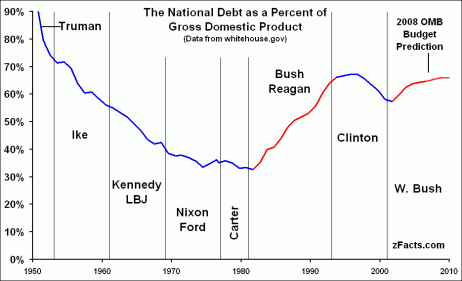
Despite the arguments I hear about privatization ultimately infusing competition into the equation, thus stimulating innovation and motivation to produce superior educational services, and despite the claims of success for the limited programs that have been implemented in various communities, it takes little imagin- ation for me to see where a state-wide voucher program would lead.  Let’s be clear.  Economic theory and social goals are seldom on the same sides of the balance sheet. 

Most teachers and parents are opposed to private school tuition vouchers.  We know that public funds for vouchers will compete with dollars needed for general improvements in America’s public schools.  The National Education Association (NEA) and its affiliates in every state agree.  Collectively, those who know education best all oppose alternatives that divert attention, energy, and resources from efforts to reduce class sizes, enhance teachers’ performance, and provide every student in this country with books, computers, and safe, orderly schools.  So, why are we even debating this issue?  Why do politicians, conservatives mostly, ignore the experts on education?  In a nutshell, it’s because they represent people who don’t want to pay the price that a quality education for every child in America would cost.

What follows are my arguments against school voucher programs:

First, America was founded on a concept of equity for its citizens, all of its citizens — equal justice under the law and equal oppor- tunity.  Although the Tenth Amendment of the Constitution makes it clear that education is primarily a function of states’ govern- ments, time after time, the Supreme Court of the land has ruled in favor of educational equity.  The Constitution of Texas includes these words, “A general diffusion of knowledge being essential to the preservation of the liberties and rights of the people, it shall be the duty of the Legislature of the State to establish and make suitable provision for the support and maintenance of an efficient system of public free schools.”  This clearly establishes the priority for public rather than private education.  Therefore, student achievement in all social-economic groups ought to be the driving force behind any education reform initiative.

Americans want fair, consistent standards for students.  But where voucher programs are in place (Milwaukee, Cleveland, and Florida), a two-tiered system prevails that holds students in public schools to a different standard than those in private schools.

Second, what education in America really needs is help for the students, teachers, and schools that are struggling, not those who are doing well, those whose families would most benefit from implementation of voucher programs.  The failure rate on TAKS tests in Texas clearly shows that children born to families in lower socio-economic circumstances are those who are at greatest risk and are, therefore, those who are in greatest need of assistance.  For this reason, voucher programs are a terrible idea for solving America’s educational problems.  True equity means that every child should be able to attend a good school.  But voucher programs are not designed to help low-income children.

Milton Friedman himself, the founder of the voucher idea, dismissed the notion that vouchers can help low-income families.  He said, and I quote, “It is essential that no conditions be attached to the acceptance of vouchers that interfere with the freedom of private enterprises to experiment.”  Accordingly, I believe that a voucher system in Texas or any other state would only encourage economic, racial, ethnic, and religious stratification in our society.

Third, I believe in the separation of church and state.  Vouchers would violate this principle because most private schools are parochial/religious schools, about eighty-five percent of them actually.  So a state-wide voucher system would be a means for our more fundamental/Conservative citizens to circumvent Constitutional prohibitions against subsidizing religious practices and instruction.

Each year, according to the NEA, about $65 million dollars is spent by foundations and individuals to promote school voucher programs.  In election years, voucher advocates spend even more on ballot measures and in support of pro-voucher candidates.  In the words of political strategist, Grover Norquist, “We win just by debating school choice, because the alternative is to discuss the need to spend more money…”

Despite the efforts of school voucher proponents to make the debate about improving opportunities for low-income students and “school choice,” vouchers, in my opinion, remain an elitist strategy.  From Milton Friedman’s first proposals, through the tuition tax credit proposals of Ronald Reagan, through the voucher proposals on ballots in California, Colorado, Utah and elsewhere, privatization strategies are not about expanding opportunities for low-income children or about improving education in general.  Do not be fooled — they are about resisting meaningful, badly needed improve- ments, costly though they may be, to fix public education.

If school vouchers become the norm across our land, our most at-risk students will be even more at risk as limited public funds are drained off and redirected to unregulated, non-standardized factories of learning.  These factories will turn out a few well-trained, socially and economically elite young men and women who have been programmed not to think, but to behave and vote the way they are told.  The rest of our kids, sadly, will have been left behind despite the president’s “No Child Left Behind” law.  Democracy, already weakened in this country by corporate culture, private interests, and voter apathy, will become oligarchy.

To post a comment, click on the tiny COMMENTS word below.

Published in: on October 7, 2007 at 1:34 pm  Comments (14)  

Continued Deficit Spending — Why We Should Care

 At more than 9 trillion dollars today and counting, your share of the national debt, whether you are working, retired, still in school, or still in diapers, now comes to about $29,000.  Just to pay the interest on this debt takes something like 9 cents out of every tax dollar.  As the debt rises, so does the interest payment. Think of it as making the minimum monthly installment on Uncle Sam’s VISA or MasterCard. 

“Whose fault is this anyway,” you may well ask?  “How’d we get into this mess?  It’s very tempting to blame the government.  But it’s really not their fault.  They obviously don’t know what they’re doing.  Why, they can’t even agree on how big a problem it really is.  So, it’s our fault really because we listen to politicians and believe what their “store-bought” economists claim.  The White House maintains that even if major tax cuts set to expire in 2010 are not left in place, rising tax revenues from a growing economy will produce a surplus of about $150 billion by that year.  The Congressional Budget Office, in the other hand, says that if the tax cuts stay in place until then, the projected surplus vanishes and becomes a $100 billion deficit.

As I teach my students, it is impossible to separate politics from economics.  From the above, you can easily understand why this is true.  Every administration since George Washington’s has “tinkered” with our economy, implementing various, different social and economic programs, albeit, with the best of intentions.  As an example, Thomas Jefferson nearly destroyed the U.S. economy with his Embargo Act of 1807 baring trade with European nations in an attempt to avoid War with France and Great Britain.  In more modern times, Franklin D. Roosevelt implemented the New Deal, which was deficit spending intended to “jump start” our failed economy during the Great Depression.  But, historians tell us that what really got us out of the Depression was not the New Deal, it was the Second World War.

In 1981, compared to the nation’s annual income, the gross national debt reached its lowest point since before Roosevelt’s New Deal.  Presidents Truman, Eisenhower, Kennedy, Nixon, and Carter all made progress toward eliminating the debt following WWII by keeping government spending less than income from taxes and other sources.  Had the trend under these presidents continued to the present day, the debt would now be history.  Consider the graph below courtesy of ZFacts.comHowever, President Ronald Reagan implemented unprecedented peacetime deficit spending during his administration which some say brought the Soviet Union to the bargaining table on strategic arms and eventually brought down the Berlin Wall and an end to the Cold War.  This, one might argue, was a good thing.  But it was also a very costly thing. 

This is not partisan politics speaking, it’s history combined with “positive” economics which illustrates the relationship between social and economic politics.  From right off the White House web site in 2001 (since removed for some reason) we read (past tense):  “The traditional pattern of running large deficits only in times of war or economic downturns was broken during much of the 1980s. In 1982 [Reagan’s first budget year], partly in response to a recession, large tax cuts were enacted as fiscal policy. However, these were accompanied by substantial increases in defense spending.  Although reductions were made to nondefense spending, they were not sufficient to offset the impact on the deficit.  As a result, deficits averaging $206 billion were incurred between 1983 and 1992.  These unprecedented peacetime deficits increased debt held by the public from $789 billion in 1981 to $3.0 trillion (48.1% of GDP) in 1992.” [emphasis added]

 National Debt as a Percent of the GDP

Now, since 2001 and the beginning of the Bush-Cheney tax cuts (begun during peacetime with deficit nondefense spending targeted for reduction but defense spending increased and continuing at higher levels since September 11, 2001 and our declaration of War on Terror), we are at a crunch point.  Our economy is still expanding, yes, but at an increasingly slower and slower pace.  In fact, we may already be on the verge of a recession (see my earlier posting, Will the Real State of Our Nation’s Economy Please Stand Up?)  Therefore, all the progress that was made toward paying off the National Debt by every president since Harry S. Truman up to the Regan and Bush administrations will be for naught.  If our government doesn’t stop spending more than it takes in, it is highly doubtful in my opinion that even our next generation or the generation after that will be able to get it under control.

To post a comment, click on the tiny COMMENTS word below.

Published in: on September 11, 2007 at 8:44 pm  Comments (1)