How Canadians Really Feel About Their Health Care System ~ Should We Care?

Eighty-two percent of Canadians believe that their health care system is better than ours.

opa

I watched President Obama’s primetime news conference last night (July 22, 2009) on reforming our health care system. After the conference, a political ad sponsored and paid for by the Americans for Prosperity Foundation was aired on the same network, CNN. The ad featured a Canadian woman who tells of having to come to the U.S. for an operation to save her life because of long wait times for surgical procedures in Canada. Oooooooo… scary — but one woman? Is she one of thousands last year who had to do the same — hundreds, or maybe just a dozen or so? And did she really have to come here for her operation?

The ad got me to wondering how Canadians really feel about the system that they’ve had in-place now for over fifty years. I also wondered whether the ad was being aired on the Fox network too or only on networks patronized by viewers having more moderate political persuasions.

I got up this morning and, over a cup of coffee, did a little research. I found an interesting article on the subject recently published by the Canadian Press. Read the article for yourself if you wish, but to summarize, Canadians think we would be wise to consider their system as we grapple with what to do about our own. A recent survey conducted by Harris/Decima group in Canada has found that 70 percent of Canadians think their system is working well or very well and that 82 percent believe their system is better than ours. The poll, taken by telephone of 1,000 Canadians, was conducted from June 4 to 8 and has a margin of error of plus or minus 3.1 percentage points, 19 times out of 20.

On the whole then, Canadians obviously feel pretty satisfied with their system, but should we care about how Canadians feel? Maybe… A little more research came up with the following video program produced by a San Diego television station (KPBS) in cooperation with the Canadian Broadcasting Corporation (CBC). The program compares our system with Canada’s. Draw your own conclusions.

The Canadian health-care system has been in the spotlight for weeks at congressional hearings, where it has alternately been characterized as the gold standard and a troubled system plagued with problems and delays. Obviously, neither our privatized system nor their single-payer system (Canadians don’t consider it to be “socialized” medicine) is perfect. But considering comparative costs and healthcare outcomes, I think the majority of Canadians are right about which system is better. Perhaps the President’s plan, a blending of the two, would offer the best of both worlds to Americans. After watching the embedded video, let me know what you think.

I invite your comments.

Published in: on July 23, 2009 at 10:58 am  Comments (4)  

Our Economic Airplane ~ Why Decisive Action on Health Care Reform is Critical for Economic Recovery

Like an overloaded airplane at high density altitude, our economy is underpowered and burdened with unproductive drag.

opaYears ago, as a student pilot vying for a commercial fixed-wing license, my wife and I were flying cross country in a rented Piper Arrow. As a requirement for my new license, I had to log a number of solo cross country hours anyway, so we were taking advantage of the requirement to enjoy a little get-away. My VA educational benefits were paying for the flight hours. Thank you, Uncle Sam.

After three glorious days at South Shore Tahoe where the altitude above sea level is 6,237 feet, we were taking off again on the next leg of our trip. It was mid-afternoon, warmer and more humid than usual. A storm was approaching so the “density altitude” must have been at least 10,000 feet.

With us on this flight was another young couple, a full load of fuel, and at least one suitcase for each of us. We were too heavy and I should have known better. Cecil? Helen? If you’re reading this now, I’m sorry. I screwed up!

The stall horn started sounding almost immediately after breaking ground following a long take-off roll. I never should have rotated, but I was committed now. My wife asked, “What’s that noise?” At the same time, a tower operator advised me over the radio that there was a golf course to the right just off my nose if I needed it. With flaps and landing gear still down, I was struggling to gain altitude and ponderosa conifers at the base of Sierra Nevada mountains were coming up fast. Our couple friends in the back were oblivious to the looming disaster.

Zoom forward. It’s today. We’re still alive.

I recently responded to several comments posted by a reader of my blog who is skeptical about our nation’s need for healthcare reform. His major point is that we are in the midst of a serious recession and that healthcare reform will cost more than a trillion dollars over the next ten years. He, like many Americans, are fearful of the impact of a growing national debt on our already sick economy and he expressed an unwillingness to do his part to address the problem — arguably one of the biggest reasons our economy is struggling to gain altitude.

Like an overloaded airplane at high density altitude, our economy is underpowered and burdened with unproductive drag. The drag is our outmoded, out-of-date, managed care system for compensating doctors, hospitals and the rest of the health care community — or should I say “industry”. So our economic airplane is losing altitude even as a range of mountains looms ahead. I’m speaking of course of the baby-boom generation fast approaching retirement age. There are other sources of drag on our economy, like our dependency on foreign oil which may be as big a problem as health care. But that’s another issue. Minimizing the health care drag is something that we can do today without having to invent or perfect new technologies and replace much of our energy infrastructure.

SHOUTAmerica, a non-profit organization committed to culti- vating sustainable solutions and policies that address today’s healthcare crisis with a conscience for tomorrow, has created an excellent video designed to grab our attention about the need for healthcare reform. If you haven’t yet watched it, I think you’ll find it both informative and compelling.

Despite the serious nature of this crisis situation, the CPR (Conservatives for Patients’ Rights) is airing infomercials suggesting that the government’s plans for healthcare reform will actually raise costs and pit “government bureaucrat” gatekeepers between us and our doctors. Well, gee, don’t we already have gatekeepers employed by commercial insurance companies standing between us and our doctors (see Republican Arguments Against Health Care Reform ~ The Ammunition of Myths)? If we are lucky enough to still have insurance, and 46 million people living in America do not, whether we have opted for a lower cost HMO or a higher cost PPO, this is true. Notwithstanding, CPR’s efforts seem to be having their intended effect. Public support for reform and the political will to get it done, according to some independent polls, seem to be slipping. That’s why the President wants Congress to act swiftly. The politics of fear worked for private interests last time around with the Harry and Louise infomercials. Let’s not let it happen again.

I apologize for my own scare tactics… act decisively or crash ‘n burn. But sometimes one must fight fire with fire.

Oh yeah, you are wondering how we survived the looming disaster years ago at South Shore Tahoe. Well, I decisively risked a might more back pressure on the airplane’s yoke and started a slow, cautious bank to the right (I wish I could say to the left, my analogy falters here somewhat, but that’s not the geography at South Shore Tahoe). After barely clearing the trees, I pushed the yoke forward to gain enough airspeed over the clearing afforded by the golf course so that retracting the landing gear and flaps wouldn’t add too much more drag. We gained altitude, slowly but it was enough so that I could wind our way up the steep valleys ahead of us and eventually clear the mountain tops. The golf course proved to be our salvation and I learned several important lessons about flying that day:  plan a good flight considering all relevant factors, and then fly the plan; if the plan doesn’t work out, innovate smartly and decisively; get your head out of the cockpit and trust good advise from unbiased experts. The tower operator that day was not in the airplane with us that day, but he sure knew what he was talking about. Likewise… trust the good advise from unbiased experts on the need for health care reform. Who are the biased experts? Those whose ears are had by those who profit by the status quo.

Health care reform, as advocated by the President, like the golf course at South Shore Tahoe, will be our economy’s salvation. But we cannot hesitate to act decisively.

I invite your comments, whether you support the President’s plan or not.

Published in: on July 17, 2009 at 4:13 pm  Comments (2)  

CO2 as Plant Food ~ The Latest Global Warming Deniers’ Crock

Pour enough salt in the beans and even the starving will turn away from them.

opaA perfectly reasonable gentleman engaging me in debate over the issue of global warming (See Fomenting Doubt ~ The Tactics and Motivations of Global Warming Deniers plus the post’s comment thread) has suggested that increased levels of carbon dioxide (CO2) in the atmosphere is actually good for the plant kingdom. This idea, the latest “crock” thrown out by global warming deniers to confuse us on the issue, asserts that, since CO2 is food for plants, more of it accelerates the growth of trees and food crops, thus absorbing more carbon fuel emissions through photosynthesis and providing more food for the world’s hungry. If this idea sounds perfectly reasonable to you, as it did to the gentleman sharing it with me, take a moment to watch the following video:

Global warming deniers are increasingly throwing out “viral disinformation” like this.  It’s not about questioning the science of climate change, not really. This is about partisan politics as usual — fear and doubt. Pour enough salt in the beans and even the starving will turn away from them. But fear and doubt are not what our nation needs just now, fear and doubt are not what the world needs. We need to have renewed confidence in the preponderance of scientists warning us that our actions have consequences. We need to have renewed confidence in the preponderance of economists telling us to give the latest round of economic stimulus spending a chance to work. We need to have renewed confidence in our democracy and communicate regularly with our elected representatives. Mostly, we need to stop being distracted by the vocal minority of special interest groups advocating tried and failed policies and start thinking for ourselves.

Please feel free to post a comment, pro or con.

Published in: on July 12, 2009 at 2:28 pm  Comments (32)  

The Conservative Economist vs. the Liberal Economist

We here in the United States have had it pretty doggone good for a long, long time. We’ve been riding the gravy train for decades, borrowing from tomorrow so that we can have it all today…

April 18, 2009 — In the wake of nation-wide “tea parties” on Tax Day this year, another teacher and I had occasion to discuss our different views.  In as much as his political persuasion is strongly conservative and mine is more liberal, I celebrate the fact that we are able to have civil, respectful discussions like this. He, by the way, used to teach advanced macroeconomics at the high school level while I teach the same subject currently.

My colleague said that he thought these protest demonstrations (they were a pretty big deal for conservative voters here in Texas) were entirely appropriate. My position was that they were less about taxing and spending and more about protesting the fact that Democrats have taken control of Washington and are now in a position to push their liberal agenda on a wide range of issues. Based on some of the protest signs I saw in news coverage by the various networks including Fox, I also said that I thought many attended because of the outrage they feel at having an African American in the White House. He disagreed saying that he thought the primary focus of the demonstrations was on the economy and that the right thing to do to combat the recession would be to reduce taxes even more and to tighten governments’ belts: local, state and federal.

I reminded my colleague that this is exactly what government did prior to and during Hoover’s one term as president. This was during the recession that took hold of us in the 1920s, the resession that bloomed into the Great Depression of the 1930s. We have learned from that experience, at least some of us have, that tightening the money supply and reducing government spending only serves to exacerbate the decline of aggregate demand, and it is aggregate demand that drives the economy, not aggregate supply. Supply only follows demand or the anticipation of improved market conditions as businesses  have no motivation to produce goods and services that cannot be sold — hence higher unemployment during recessions. My colleague teaches U.S. History now, by the way.

My colleague countered with the view that raising taxes on people who earn $200,000-plus, which is what he said the president’s tax provisions in the current budget plan will do, will hurt small businesses causing them to have to scale back on production and services.

Hmmm… no one, it seems, enjoys having to pay taxes, but — and I pointed this out to my colleague — the Obama administration and the Congress is not raising taxes this year on people making more than $200,000. Their taxes will not change until after the Bush/Cheney tax cuts expire, and that won’t happen until the end of the year. When it does, their marginal rate will increase by only 2 percent. This year, everyone making less than $200,000 will see their federal taxes decline.

taxdataWe here in the United States have had it pretty doggone good for a long, long time. We’ve been riding the gravy train for decades, borrowing from tomorrow so that we can have it all today, which has allowed the rich to get ever richer while the earning power for all the rest of us has actually declined. Investment bankers and senior executives of major corporations are laughing all the way to their off-shore, numbered bank accounts. According to the text book from which I teach my high school seniors, because of inflation and the demise of manufacturing in the United States, the minimum wage, as a percent of average manufacturing wages, buys only about 70 percent of what it did in 1968.

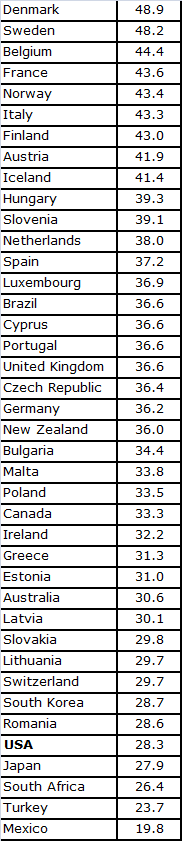
On the right is a listing of countries’ average taxes paid in 2007 by citizens as a percentage of their GDPs. Notice how the United States is ranked. I found this information on the Internet at Wikipedia. The data came from a publication by the Organization for Cooperation and Economic Development. After Obama’s tax cuts for 95 percent of the population are approved and implemented for 2010, we will probably be paying slightly more than South Africans do. Can you even imagine what Japan’s taxes would be like if they had anything like the defense budget to fund that we have? Further, since Obama’s cuts target the preponderance of citizens who have the highest propensity to consume, our aggregate demand will increase and short-range aggregate supply will respond returning us to full employment — eventually, all of which is text book macroeconomics. So, I told my colleague, I can’t quite understand why Republicans and Libertarians believe that making the Bush/Cheney tax cuts for the super rich permanent would be a good thing for the economy, unless y’all still believe in Say’s Law, i.e., that supply creates its own demand. Trickle-down/supply-side economics has failed us. That is why we are in our current situation. That is why it is time for change, time for us to adopt the bottom-up approach that Obama and all his economic advisors support.

Yeah, but what about the massive government spending in the Democrats’ budget plan for 2010? It’ll generate a 1.2 trillion dollar deficit at projected revenue levels. Yes it will. But where was the conservative base of the Republican Party for the previous eight years? Why weren’t they protesting the spending that exceeded revenues during the Bush/Cheney years, years when we weren’t having a recession, years when we should have been balancing the budget or better yet, paying down the national debt — saving for the next business cycle decline. During the Bush/Cheney years  the national debt grew from $5.66 trillion to $10.62 trillion? So, the only truly conservative president we’ve had in recent years was Bill Clinton.

National Debt

Yes, once we are out of this recession, it is reasonable to anticipate that tax levels will rise for those who can afford it, especially if reasonable leaders are still in power and if we don’t get control of rising health, energy and education costs. But we’ve a debt to repay to future Americans, my sons and daughters and yours.  We need to be about repaying it — and I for one think that those who can do more should do more.

No, the tea parties were not about taxing and spending — big government vs. small government.  No matter what the demonstration organizers claim, the demonstrations were about a whole host of “social” conservative-value wedge issues, issues like abortion, gay rights, gun control and… sadly, race. Yes, race. The demonstrations were about consolidating elements of the GOP that have been fragmented by the last two elections. The demonstrations were about salvaging the Republican Party in advance of the mid-term elections in 2010. And if some in attendance actually thought they were there about taxing and spending, they were misinformed — misled by the money interests in this country, which are the real base of the Republican Party.

When the Bush/Cheney tax cuts expire in 2010, the rich will still be rich and everybody will be better off with the economy on the mend.

I invite your comments whether pro or con.

Published in: on April 18, 2009 at 9:59 am  Comments (34)  

The Problem with Socialism ~ More Viral Disinformation

“The problem with socialism is that you eventually run out of other people’s money.”

Margaret Thatcher

opaThis will sound un-American to some, but, unlike the former Prime Minister of the UK, I think the real problem with socialism is that it has a bad rap here in the U.S.  Americans confuse socialism with communism.

Socialism refers to a broad set of economic theories about social organization, theories advocating public ownership and administration of critical sectors of the economy such as education, energy, public utilities, health care, and finance — theories which, when put into practice would ostensibly result in a society characterized by fairness and equity. These theories, and there are many variations on the theme, seek to slow or minimize the concentration of wealth within a small, privileged class of citizens as is the propensity for capitalism to do.  According to one government source, the top one percent of Americans enjoy thirty-three percent of the nation’s wealth while the bottom eighty percent have less than sixteen percent.  It is this kind of inequity that has historically caused revolutions. However, most socialist theories do not advocate massive “redistribution” of wealth. Quite the opposite; reward and compensation in countries like Sweden, Norway, France and Germany, countries that many Americans consider to be socialistic, are based on the value and amount of effort individuals expend in production. Interestingly, Norway, perhaps the most socialistic of the western democracies, boasts the largest number of millionaires per capita of any country in the world.

Communism, on the other hand, depending on how it is wrapped around the political system that adopts it, is a political ideology that promotes the establishment of an egalitarian, classless, stateless society and an economy based on common ownership of everything with centralized control of the means of production. Communism is totalitarian, either oligarchic or dictatorial, incorporating a branch of socialistic theory in the extreme, where it still survives (in North Korea). All other communist states, to include China, Vietnam and Cuba, are going through a process of reform — adopting market concepts to achieve mixed economies.

The confusion between socialism and communism is perhaps a lasting legacy of the Red Scare that took hold of America following the Second World War and the Cold War that lasted for decades. The Cold War is over now; we should put it behind us, I think, and move on.

I have a good friend who can’t quite seem to decide whether, because of his intellect and his understanding of Christian doctrine (love your neighbor as yourself), he should subscribe to and support liberal political philosophy or, because of his more conservative friends’ influence, subscribe to and support conservative political philosophy. He recently forwarded to me a copy of the viral disinformation email that follows asking for my opinion about it.  I suspect that it was one of his other friends who sent it to him. Anyway, I had seen it before myself, several times. Perhaps you have too; it’s been making the rounds in various forms for years.

~~~~~~~~~~~~~~~~~~~

An economics professor at Texas Tech said he had never failed a single student before but had, once, failed an entire class. The class had insisted that socialism worked and that no one would be poor and no one would be rich… a great equalizer. The professor then said ok, we will have an experiment then on whether socialism makes for good economic policy.

All grades would be averaged and everyone would receive the same grade so no one would fail and no one would receive an A.  After the first test the grades were averaged and everyone got a B. The students who studied hard were upset and the students who studied little were happy.  But, as the second test rolled around, the students who studied little had studied even less and the ones who studied hard decided they wanted a free ride too; so they studied little.  The second test average was a D!  No one was happy. When the 3rd test rolled around the average was an F.

The scores never increased as bickering, blame, name calling all resulted in hard feelings and no one would study for the benefit of anyone else.  All failed, to their great surprise, and the professor told them that socialism would also ultimately fail because when the reward is great, the effort to succeed is great; but when government takes all the reward away; no one will try or want to succeed.

Could it be any simpler than that?

~~~~~~~~~~~~~~~

As a teacher of economics, I can’t say that I have never failed a student. Hard as I try to get the basics of economics across to some of my students (that it is a body of both knowledge and opinion with conflicting ideas and theories — a soft rather than a hard science), they just can’t or won’t get it.  According to John Maynard Keynes, “Economics is an easy subject at which few excel.” But people who don’t understand the nature of this “dismal” science persist in trying to simplify it — or so it seems. The above tale of the economics professor who would fail an entire class for not agreeing with his particular beliefs is a perfect example. If there ever was such a professor and I were his dean, I would fire him for not getting it either.

The problem with trying to justify economic or political points of view with analogies like this story (comparing wage and salary competition with competition for grades) is that they are overly simplistic. They are flawed — rife with logical fallacies of composition and causation. Students do not compete for grades in the same way that people in the workplace compete for pay or promotion. Neither does socialism, except in the most extreme applications of theory (and I can think of none in actual existence), equalize reward among all participants as the economics professor’s experiment did.  Sure, the Soviet Union’s brand of socialism (communism) failed, and a large part of the reason for its failure was diminished incentive.  But Soviet-style communism, Chinese-style communism, and Cuban-style communism (each is/was unique) do not equal socialism as reconciled today with market economies in Western Europe. In fact, all communist states, save for North Korea and Cuba, have incorporated elements of market forces to become mixed economies, and Cuba’s new president, Raul Castro, has indicated that he intends to start doing the same.

 The economies of the world’s other industrialized nations are flourishing. All are still small compared to ours, but they are coming on strong. In 2008, our real gross domestic product (GDP) (GDP adjusted for inflation) grew at just 1.4 percent. Sixty-six other countries outpaced us and they have been doing so for years.  The world average was 3.8 percent. So, in the years ahead, if we do not become more socially responsible by investing more in education, health care, energy and infrastructure, we may well be left behind. Call me a socialist if you wish, but that is how this economics teacher sees it.

I invite your comments whether you agree with me or not.

Published in: on April 4, 2009 at 9:09 pm  Comments (16)  

The Failure of Another Great Experiment ~ Is America About to Legalize Drugs?

The War on Drugs is very much on Americans’ minds at this time, much like the prohibition against alcoholic beverages was during the Great Depression.

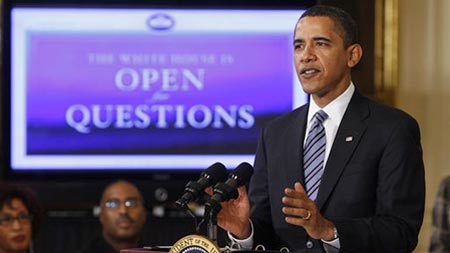
opaDuring his on-line town hall meeting on Thursday of this week, President Obama demonstrated his considerable political skills and instincts when he responded to a question about legalizing drugs. He was asked if he thought legalizing drugs would be a good way to deal with the rising violence between drug cartels and law enforcement officers on both sides of nation’s southern border and to grow our economy. Without elaboration, he simply said, “No, I don’t think legalizing drugs is a good way to grow our economy.” Regardless of what he might really think, he definitely knows that this is a highly charged political issue, one better dodged, at least for the time being. But sentiment favoring legalization is growing, especially with reports of Mexican drug cartel violence spilling over into the U.S.

town_hall

One of my students brought this up in class as her contribution to our discussion of economics in the news recently, and most of the class wanted to share their views on the issue. There was a good level of participation and, for a few moments, everybody wanted to talk at the same time. But I didn’t want to let the discussion sidetrack us from the lesson of the day.  Neither did I want to have the matter put to a vote as we often do with contentious issues.  So I didn’t let the debate go on too long. After all, our school is in the Bible Belt of north central Texas — I would like to be allowed to retire from teaching someday and not be dismissed in the near term for encouraging immorality.

According to a recent on-line CNN news article, Obama had promised to answer the most popular questions as decided by online votes to the administration’s website, whitehouse.gov. More than 3.6 million votes on 104,000 specific questions submitted by almost 93,000 people were registered by the time voting closed earlier in the day.  From these, he only addressed the winning eight, six were written questions displayed on a screen for all to see, two others were video submissions.

Think about it – out of 104,000 questions submitted, a question on legalizing drugs was among the eight most popular. Of course, we don’t know how many times the same or similar questions might have been asked, but I can only imagine that repeated questions were consolidated in the selection process. This means that the War on Drugs and crime associated with the illegal transportation, sale and possession of drugs is very much on Americans’ minds at this time, much like the prohibition against alcoholic beverages was during the Great Depression.

Popular opinion during the Great Depression led to a grassroots movement and the eventual repeal of the 18th Amendment in 1933.  Why? Well, Americans who wished to imbibe were not deterred by Prohibition; the 18thAmendment to the Constitution, sometimes called the Great Experiment, merely drove the practice underground. Speakeasies and “hideaways” developed, especially in large cities, where partiers paid inflated prices for illegally imported booze from Canada, Cuba and Mexico. “White lightening” or “bathtub gin” of questionable origins was produced by many as a means of generating income while unemployment was at record levels. Many, including my own grandfather, became deathly ill after drinking some of this stuff, another name for which was “rotgut;” some even died. And border towns like Tijuana and Juarez, expanded and thrived to service our American appetites for illicit goods and services like gambling and prostitution. American dollars flowed from our economy to other nations and the popularity and profitability of all this attracted organized crime. The same exact thing is happening today because of the prohibition of recreational drugs like marijuana and cocaine. Demand on our side of the border is driving the supply up from Mexico and Colombia.

There are excellent arguments both for and against the idea of legalizing drugs in America. Wikipedia has published an excellent article compiling and addressing all the arguments I can think of including the health arguments, the crime, terrorism and social order arguments, the legal arguments, the personal development arguments, the moral and spiritual arguments, and the economic arguments. The site also provides a great number of links to other on-line sources of information and opinion as well as hard-copy publications – studies and books by well-respected thinkers such as Milton Friedman and Stephen B. Duke.

As a teacher of economics, I was most interested in the economic arguments, all of which support legalization. However, I am still very much open to debate on the subject as I can come down on either side of the issue depending on which side of my brain I choose to listen to. Currently, the rational side of my brain is speaking loudest because I believe legalization would: (1) eliminate the incentive for associated criminal activities; (2) save billions in wasted federal, state and local dollars trying to enforce unenforce- able laws; (3) save billions of dollars spent annually to support a large portion of our imprisoned population, thereby releasing these people back into the workforce; (4) facilitate regulations that could make the products consumed safer; (5) prevent the wasteful taking of innocent lives, and; (6) generate a substantial source of tax revenues, especially if things like marijuana were to be taxed at the same level as alcohol and tobacco.

If you’re tired of reading about this but still interested and desirous of some specifics on the economic arguments, there’s a pretty good video on YouTube of a Boston University economics professor, Jeffery Miron, making the economic case for legalization. It’s a bit dated – recorded in 2000, so the numbers he uses would have to be updated, but I have found it to be persuasive. The URL is http://www.youtube.com/watch?v=1Yx9dFVa19o. Another video, a more recent one, is at http://www.youtube.com/watch?v=nLsCC0LZxkY. It is of Milton Friedman, the eminent economist, making a case for legalization, one based not on the economics of the issue but on the morals of the issue. Interesting… an economist arguing from a moral perspective. Hmmmm… could we be witnessing the failure of another Great Experiment?

As always, you are invited to share your views by posting a comment.

Published in: on March 28, 2009 at 8:11 pm  Comments (3)  

The Swimming Pool Analogy ~ More Viral Disinformation

“Owners of capital will stimulate the working class to buy more and more of expensive goods, houses and technology, pushing them to take more and more expensive credits, until their debt becomes unbearable. The unpaid debt will lead to bankruptcy of banks which will have to be nationalized and the State will take the road which will eventually lead to communism.”

Das Kapital — Karl Marx, 1867

opaMarch 8, 2009 — My students and I discuss economically relevant news items at the beginning of each of my classes. I challenge them to claim their share of daily-assignment A’s, two for each student per grading period, for staying informed. Lately, however, it seems as though everything in the news is economically relevant — so this isn’t much of a challenge, except for the fact that most come prepared with the same most news-worthy items each day. Whoever gets their hand up first wins.

One story that everyone seemed to miss last week was that Russia’s Ambassador to the United States, Sergey Ivanovich Kislyak, predicted that our economy will fail completely during 2010. I shared this with my students from whom I was pleased to note that none seemed overly concerned about the ambassador’s opinion. After all, Russia, we all know, still isn’t overly fond of us, jealous perhaps – their own recent experiment with capitalism having all but failed following their financial crisis in 1998. Entrepreneurism, political corruption and crime rushed into the economic vacuum left behind by the failure of the Soviet Union’s command economy.

Offering something for discussion not gleaned from the legitimate media, thus avoiding the competiton for her daily assignment A, one of my advanced placement students brought a copy of the following to class, a much circulated email message, subject: “THIS SAYS IT ALL.” I read the message to my class including Karl Marx’s nineteenth century prediction about the future of capitalism, which seems to be hauntingly applicable to our current crisis.

  ~~~~~~~~~~~~~~

 Shortly after class, an economics student approaches his economics professor and says, “I don’t understand this stimulus bill.  Can you explain it to me?”

The professor replied, “I don’t have any time to explain it at my office, but if you come over to my house on Saturday and help me with my weekend project, I’ll be glad to explain it to you.” The student agreed.

At the agreed-upon time, the student showed at the professor’s house.  The professor stated that the weekend project involved his backyard pool.

They both went out back to the pool, and the professor handed the student a bucket.  Demonstrating with his own bucket, the professor said, “First, go over to the deep end, and fill your bucket with as much water as you can.” The student did as he was instructed.

The professor then continued, “Follow me over to the shallow end, and then dump all the water from your bucket into it.” The student was naturally confused, but did as he was told.

The professor then explained they were going to do this many more times, and began walking back to the deep end of the pool.

The confused student asked, “Excuse me, but why are we doing this?”

The professor matter-of-factly stated that he was trying to make the shallow end much deeper.

The student didn’t think the economics professor was serious, but figured that he would find out the real story soon enough.

However, after the 6th trip between the shallow end and the deep end, the student began to become worried that his economics professor had gone mad.  The student finally replied, “All we’re doing is wasting valuable time and effort on unproductive pursuits.  Even worse, when this process is all over, everything will be at the same level it was before, so all you’ll really have accomplished is the destruction of what could have been truly productive action!”

The professor put down his bucket and replied with a smile, “Congratulations.  You now understand the stimulus bill.”

~~~~~~~~~~~~~

After reading this to the class, I asked my students what they thought of it. Nobody offered an opinion, not at first. But I was patient, giving them a chance to think about it. Finally, one brave young fellow raised his hand and offered this, “I think the explanation is too simple… so simple that the author must think everybody else is stupid.”

Another student said, “Yes, and if economics was that simple we’d all be getting A’s.” In response to this, most of the class started laughing including me.

“Remember, class,” I said, “the John Maynard Keynes quote: ‘Economics is an easy subject at which few excel’.”

Then, the student who had brought the email to class sheepishly asked why the story’s professor was so wrong using a swimming pool as a metaphor for our economy.

“Unlike the professor in the story,” I said, “I will take the time and at least try to explain. Yes, this lesson on the Economic Recovery and Investment Act of 2009 is flawed on many levels.

First, our economy is not at all like a fluid swimming pool. Wealth does not flow freely from the deep end to the shallow. Wealth tends to flow from the shallow end to the deep where much of it tends to stay. At the beginning of the Bush/Cheney years, 80 percent of the water [wealth] in this nation belonged to 20 percent of its citizens, or just 20 percent of the pool. Now nearly 90 percent of it is in the deep end with much of it cashed away in U.S. Treasury Bonds, foreign numbered bank accounts and other investments that impede circulation. This is because the rich have a much lower propensity to consume and a higher propensity to save. Recall our lessons on the aggregate expenditures model. And, be not confused, saving is not the same thing as investing (http://www.finweb.com/financial-planning/finances-savings/saving-vs-investing.html), which is what many monetarist/supply-side economists would have us all believe. By the way, there aren’t very many serious supply-side economists left.

Second, we don’t have a private backyard pool any more. Our nation’s pool is connected to those in the back yards of all other nations.

Third, and there is little controversy over this among most economists now, government spending under the law will not be wasteful/unproductive activity. Infrastructure projects that this country badly needs done will get done. This will make us more efficient and reduce future costs (true investment)… plus, wages paid to get this work done will be spent and money spent eventually becomes someone else’s income — over and over again. Much of it will save state and federal governments’ unemployment and health care costs.

Finally, much of the water moved (government spending) will be used to nurture education and do research on alternative energy sources making us even more efficient and competitive in the future.

Viral disinformation like this swimming pool analogy making the rounds lately, I think, are poor attempts by those who oppose the current administration’s efforts to deal with the recession. They raise doubts and promote fear for political purposes and, as such, are disingenuous. It’s sad because what we need just now in the private sector is a sense of unity and confidence. But informed individuals, or at least those who have open inquisitive minds, won’t be suckered-in by simplistic appeals like this. We know that the world is not flat, and we know that laissez faire  economics is anarchy. An economy without structure and rules is like a jungle wherein only the fittest survive.  I must admit, however, the Karl Marx quote, does come pretty close to explaining what has happened to us owing to deregulation of the financial sector. Let’s all hope his forecast isn’t correct too. If foreigners decide to stop lending us money, it could come to that, heaven forbid!”

Please feel free to respond to this posting below with a comment, whether or not you agree.

Published in: on March 8, 2009 at 3:20 pm  Comments (19)  

Legend of the Sinking Economy

“The fundamentals of the Economy are sound,” the captain had said. “She is unsinkable.”

opaOnce upon a time, there was a great passen- ger ship, the U.S.S. Economy. This venerable vessel had been at sea for a very long time — longer in fact, without being substantially overhauled and refitted with modern refine- ments than many other of the world’s passenger ships. She was much larger than all the others and still fast. Although other ships were faster, none were as capable in terms of tonnage per sailing time. The current captain, Captain Commerce, had little experience, but he looked good in his uniform and had the confidence of the ship’s owners; they knew he would do as they expected.

The owners of the Economy considered her design to be the best possible — unsurpassable, unsinkable in fact.  And because of this, they decided to remove most of the lifeboats on board. There were only enough for less than half the total number of passengers. Better, her owners felt, to keep the decks tidy and spacious so that the wealthy passengers could move around more freely. Why, the ship, they thought, could almost sail herself. Little did they know what a titanic mistake this would become.

There were many decks on the ship. Twenty percent of the passengers enjoyed eighty percent of the space and relative comfort with accommodations well above the water line. Nearly a fourth of these better-off passengers had staterooms with private access to spacious balconies. These passengers were afforded complimentary access to all the ship’s “finer” facilities: the grand theater and ballroom, the casino and the largest pool, this one being on the forward deck. The rest of this upper class had comfortable cabins in the ship’s interior spaces, though all were pretty much alike with limited space. These passengers were allotted separate, limited times for access to the finer facilities, but on a pay-as-you-go basis. Eighty percent of the passengers had only twenty percent of the space, and while most of this was still above the water line, large numbers of this group were relegated to accommodations below the water line and in steerage. Those in the lowest bowls of the ship were only allowed on deck for brief periods of time each day, scheduled by section. But none were ever allowed anywhere near the forward areas. Meals for these passengers were not served; they were delivered cafeteria style, dished-out on plastic trays by staff members who had lost favor with the ship’s purser.

There was icy fog one night. Nevertheless, the captain ordered full-speed ahead. This is what he knew the ship’s owners would want; a speedy crossing, after all, would mean higher profit. Then, sometime after midnight, while most of the crew on-duty was either dozing-off or playing cards, the Economy struck an iceberg a glancing blow. This caused a huge gash below the waterline amidships. There was panic among those in the lower cabins as icy water began to pour-in. But, above the water line, there was relative calm. The captain had proclaimed to the crew, who in-turn had passed the word along to all the better people on board, that all was well. “The fundamentals of the Economy are sound,” the captain had said. “She is unsinkable.” Notwithstanding, the ship began to list as it continued along at a declining pace.

As the ship rode lower and lower in the water, some of the crew and passengers began to question whether they shouldn’t go let the people below decks come up where it was dry and assist the crew in helping to repair the damage and stop the flooding. “No!” shouted the most elite, “That wouldn’t be fair. We paid big bucks for this voyage and we’re not going to share our space with the likes of those people. They made their choice; let them get what they deserve.”

Listening only to the passengers who had purchased the better accommodations, the brave captain steamed on into the night ordering ever increasing reserves of fuel into the ship’s boilers.

This, of course, is not how the story ends. You are invited to write your own ending and post for the rest of us to read as a comment below. Will the Economy survive?

Published in: on February 21, 2009 at 12:13 pm  Comments (12)  

Capitalism and Socialism ~ Both Evil Extremes of Economic Theory?

opaI watched with jaw agape Sunday morning, February 15, 2009, as one of the most conservative legislators still serving in the U.S. Senate, Senator Lindsey Graham of South Carolina, said that he is open to discussing the nationalization of large U.S. banks. He said this on This Week with George Stephanopoulos!

Who would have thought such a thing could be possible as little as just a year ago? This is socialism! Right… or is it?

Things must really be bad because this isn’t just some hare-brained idea coming from a single wacky politician who doesn’t know his right from his left (pun indented), it was the subject of debate in Business Week’s February 2d publication, Nationalize Broken U.S. Banks.

Having grown-up during the Cold War, I was taught by all those around me, my grandparents, my teachers and other adults, that socialism is bad and that capitalism is good. Our great enemy of the time, the Soviet Union, they told me, was a godless nation led by ruthless ideologues bent on spreading their radial beliefs throughout the world, by force if necessary. Their economic system was the most extreme manifestation of socialism, communism.

Our economic system, capitalism, prevailed in that epic struggle of right vs. wrong when the Berlin Wall came tumbling down and the “Evil Empire” collapsed in 1985. For much of the world, this victory of one ideology over another seemed to resolve any debate over which system is best. The former Soviet republics all rushed to establish “free enterprise” in varying degrees but with dubious success. Over the past 20 years of transition to capitalism in these now “free” nation-states, according to Professor James Petras in a Global Research Internet posting (Capitalism versus Socialism: The Great Debate Revisited), most basic industries, those that were formally controlled by the state, have been taken over by European- and U.S.-lead multi-national corporations and by mafia billionaires. In Poland, the former Gdansk Shipyard, point of origin of the Solidarity Trade Union, is now a museum and over 20 percent of the country’s work force is unemployed. Another 30 percent, according to Financial Times (February 21/22, 2004), was employed at the date of this publication in marginal, low-paid jobs including prostitution, contraband, drugs, flea markets and street vending. In other former Soviet republics, things have been even worse. Bulgaria, Rumania and Latvia, according to the CIA World Fact Book, all are struggling with high unemployment, high rates of inflation, corruption and crime.

In our own country, with government regulation and oversight of industries, everything from aviation to banking and finance to peanut production, reduced substantially over the past thirty years, beginning with Reagan’s two terms (Clinton did nothing to reverse the deregulation trend while he was President although he did restore a more progressive tax code and constrained government spending), we’ve witnessed the disparity between the haves and have-nots grow dramatically; the rich have gotten richer while the poor have gotten poorer.

At the beginning of the Reagan era, the richest twenty percent of Americans held nearly eighty percent of our nation’s wealth. Today, they are estimated to hold over ninety percent with over forty percent concentrated within the top one percent. That leaves just twenty percent for the rest of us.

Even as the current recession was beginning, and please don’t try to convince me that the Bush Administration was caught unaware, with the subprime mortgage debacle gaining attention in the press, unemployment starting to creep upward, and the price of gasoline soaring to over $4.00 per gallon for regular unleaded in much of the country, the biggest corporations in America like Exxon/ Mobile and Wal-Mart were posting record profits. Top executives of failing banks and the auto industry were still making millions. So our economics textbooks are right, capitalism guarantees nothing with respect to economic equity — quite the opposite. Capitalism, when unconstrained, guarantees systematic exploitation of the world’s resources and the vast majority of humanity by the privileged few.

Freedom is good, yes, but too much freedom is anarchy — and in anarchy, only the strong and well-connected survive.

My granddaughter, a heretofore valued employee as manager of the bakery department for a large retail outlet firm’s store in Utah, a right-to-work state, has been given notice. After seven years of working for the firm, steadily advancing in responsibility and salary, she’s now making too much money what with sales down and profits declining for the store during the current recession. Management wants to consolidate her department with another under a new manager to whom they can pay less. But to do so, they first had to make up an excuse to fire her. Otherwise they would have had to move her at her current salary to a different job. So, they are claiming that the employees under her are suddenly complaining about her management style and erratic behavior. They say that she’s too emotional, having recently given birth to her first child and being diagnosed with post-partum depression. Is this fair? No, I don’t think so. But being in a right-to-work state, they’ll probably get away with it, at least in the near-term. We are encouraging our granddaughter to file a claim against them through the state’s Equal Employment Opportunity Commission. Should this fail, and I anticipate it will, we will stand behind her and subsidize her efforts to claim compensation under the American’s with Disabilities Act.

My reason for sharing this story is to illustrate the fact that corporations, by and large, have no conscience. All they really care about is meeting shareholders’ expectations for growth and profitability. When aggregate demand declines, businesses scale back production and services, so unemployment rises. This is why giving businesses tax breaks during times of recession does nothing to stimulate the economy.

Seen on a continuum of practice among economic systems in the world today, capitalism and socialism are not either/or options. No system can claim to be pure; ours, since the Great Depression, has never been more than a limited free-enterprise economy. Therefore, capitalism and socialism, to my mind, are both outmoded ideologies — both proven to be vulnerable to human nature — corruptible and failed in extreme or near-extreme practices.  

If we nationalize banks or extend a helping hand to the poor by making health care affordable and available to all, if we guarantee a quality education to all our young, and/or if we permit the government to negotiate drug prices for Medicare recipients with the pharmaceutical industry, are we stepping out on the proverbial slippery slope? If we say that we are, are we not guilty of the pitfall to objective thinking called the post hoc fallacy? On the other hand, if we refuse to consider changes in our economic system, changes that could advance “social” and “economic” goals alike — goals like improving our nation’s health, making sure the next generation is competitive in the global economy, protecting the environment, and advancing economic equity, what does this say about us as a people?

By our behavior in recent years and by our media messages, movies, television programming and Internet content, is it not understandable that others, especially the Islamic world, see us as being a godless nation led by ruthless ideologues bent on spreading our radial beliefs throughout the world, by force if necessary? Hmmm… that sounds familiar.

Okay, so say that we do move our political and economic systems more toward the middle of the social/economic continuum by divesting the mega corporations of their stranglehold on prices and wages. Say we reconsider whether it was wise to allow the merger of Exxon and Mobile for example and that we restore regulation to the financial sector. Say that we begin holding the captains of industry responsible for decisions that prove harmful to the people as a whole. Say that we implement public oversight of corporations accepting tax-player bailouts and that we give relief to the poor, whether working or unemployed by no fault of their own. Say that we allow governments to “make work…” create jobs through public works projects that make meaningful and lasting improve- ments to our infrastructure. What then? Will we have, as the world’s best example of what capitalism can accomplish, compro- mised our ideals, or will we have merely stopped deluding ourselves? The top twenty percent of Americans would probably not like it. The top one percent surely wouldn’t. But are we are not still a democracy?

Please feel free to post a comment, whether or not you agree.

Published in: on February 16, 2009 at 3:10 pm  Comments (5)  

A Nobel Prize Winner’s Recession Solution

Obviously, individuals, even individual industries, acting as we do in “rational” self-interest, are incapable of effective measures to correct the overall situation.

opaMy students are asking, “Are we going to have another Great Depression, Mr. Garry?” When they do, I try to reassure them. Things are bad, yes, and they’re likely to get worse before they get better. However, thanks to measures taken by the government during the 1930s, things like unemployment compensation, Social Security and Medicare, and empowerment of the Federal Reserve to regulate banking and the nation’s money supply, it’s hardly conceivable that we will ever have to go through things anywhere near as bad as they were during the Great Depression. But with unemployment and foreclosures skyrocketing, the stock market in the ditch and headed farther downstream, and consumer confidence at its lowest level since the early ’50s, economists and economic commentators (not exactly the same) are already beginning to call our current situation the “Great Recession.”

So, what are we — our government — to do about it? Obviously, individuals, even individual industries, acting as we do in “rational” self-interest, are incapable of effective measures to correct the overall situation. In fact, as we take individual measures to conserve, we are actually making the aggregate situation worse.  So government must act — it cannot just leave things alone and expect recovery in the , as President-elect and very soon now, our 44th President has been doing, paying less attention to what voters are saying and more attention to what the preponderance of noted economists saying — economists like Nobel Prize winner and professor of Economics and International Affairs at Princeton University Paul Krugman. Supply-side economists are very much in the minority these days, by the way. Perhaps you’ve noticed.

No, perhaps it’s not a good time to be raising taxes — on anybody. But neither is it a good time to be trying to balance the budget. It is a good time, however, for each of us to be doing more for our fellow man.

At the following link is a report on an interview with Professor Krugman published by ABC News. I found it to be both an enlightening and comforting read.  ABC News: Nobel Prize Winner’s Recession Solution

Comments are welcome, whether you agree or disagree.

Published in: on January 15, 2009 at 12:25 pm  Comments (1)  

What Should Be Done About the U.S. Auto Industry?

Warren Buffet and I are in total agreement that bankruptcy would be a wasteful, totally inefficient way to force the imposition of a new business model on U.S. automakers.

opaThe plight of U.S. Auto manufacturers, General Motors, Ford and Chrysler, and inaction by Congress to date on the industry’s collective request for a loan of $25 billion to stay afloat during these economic hard times has been a topic of discussion in my economics classes lately. My students have offered various opinions on what should be done, but almost all agree that something should be done. After all, they point out; billions have already been given to the financial sector to little or no avail. They ask, isn’t the manufacturing sector worth saving too?

My students seem to sense that failure to act and to act soon, letting this other linchpin of our domestic economy fail altogether, would be reckless and would, at a minimum, add insult to injury to the economy. In my own opinion, Congress should act and do so soon. Abandoning General Motors, Ford and Chrysler at this critical time would seal their fate — bankruptcy — which would give foreign automakers already in this country just the opening they need to permanently dominate the “world” market for automobiles. In addition, it would cost America millions of jobs. The unemployment these workers would draw following the industry’s demise could easily cost the government more than the $25 billion for which the automakers are initially asking.

So… it’s a pay-me-now or pay-me-later situation, right? But, how should Congress act, and what kind of package can the Democratic leadership in the House put together that would have sufficient minority support in the Senate to avoid an almost certain veto from President Bush? Can the automakers hold-on until after Obama’s Inauguration on January 20th 2009? Maybe, just barely.

One of my personal heroes, an important economic advisor to the Obama Transition Team, is Warren Buffett. Buffett, if you don’t already know, is a legendary American investor, businessman, and philanthropist. He is the largest shareholder and CEO of Berkshire Hathaway and was ranked by Forbes during the first half of 2008 as the richest man in the world with an estimated net worth of $62.0 billion. Often called the “Oracle of Omaha”, Buffett is noted for his adherence to a value investing philosophy and for personal frugality despite his immense wealth. Buffett is also a notable philanthropist. In 2006, he announced a plan to give away his fortune to charity, with 83% of it going to the Bill & Melinda Gates Foundation. In 2007, he was listed among Time‘s 100 Most Influential People in The World. So, what would Buffet suggest?

In a recent interview with FoxBusiness, Buffet said, “I would drive a deal like I would drive myself if I were buying a business.  And I think, I would say there’s plan A or plan B.  And if you don’t want to do it this way, you know, then… take bankruptcy. I would make the CEOs buy in.  I would say, you know, the United States government is willing to put in X dollars, but we’re going to have you put in a certain percentage of your net worth right along with us. We’ll give you more upside, but you’re going to lose if we lose.”

I like that approach, making the industry’s executives buy-in, but rather than allowing them the choice of taking bankruptcy, which they just might do rather than risk their personal fortunes, I would propose a middle road. How about buying them out? Yes, rescuing the industry by partially nationalizing it, actually buying into the business as Buffet alluded to in his interview, at least temporarily. Sound un-American? Smack of socialism? Yes, but desperate situations call for desperate measures. The U.S. Treasury has already established a president for this by recently purchasing stock in the beleaguered insurance giant AIG.

Warren Buffet and I are in total agreement that bankruptcy is a wasteful, totally inefficient way to force the imposition of a new business model on U.S. automakers. But I think it is impractical to expect industry executives to put their personal nets worth into the companies they currently run. They all know, as many in Congress seem to know, that their money, and ours if given in a no-strings-attached bailout, will be used up in no time supporting liabilities on existing union contracts and on retired employees’ pensions. Who knows how long the current recession will last and how long it will be before Americans start spending again? So, unless their companies do go through bankruptcy, is there any option left to us other than nationalization?

With representatives of President Elect Obama’s Car Czar, Professor Daniel Tarullo of Georgetown University, temporarily providing direction and oversight on the industry’s Boards of Directors and with the United Autoworkers’ (UAW) union cooperating fully (perhaps the only way to avoid bankruptcy and collapse of the union altogether), a more practical way to save the industry might be possible. A pay system based on company performance from the top down would have to be implemented with union contracts renegotiated in the process. Everyone, in fact, would have to sacrifice with base salaries and benefits set to the same levels as those offered by Toyota and Honda with quarterly or year-end bonuses paid only if the companies do well. This way, everyone involved would be motivated to save company money and to be more productive and more innovative. This way the playing field would be leveled giving U.S. manufacturers an equal chance to compete in the new international marketplace and, this way, the government might just get the taxpayers’ money back someday.

I invite your comments regardless of your views.

Published in: on November 22, 2008 at 6:53 pm  Comments (6)  

Big Government vs. Small Government ~ Which is Best?

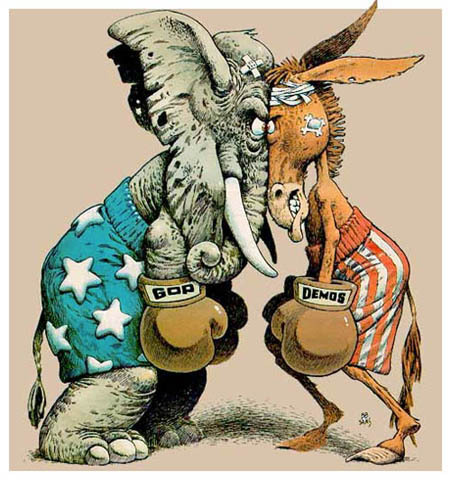
The political right in the United States today, represented by the Republican party and some Libertarian and Independent candidates, often refer to their opposition, mostly Democrats, as being Big Government, tax-and-spend Liberals.

October 19, 2008  —  With the whole nation anxious about the economy, it’s certainly an interesting time to be teaching economics.  As it turned out, we covered Aggregate Expenditures and Aggregate Demand and Supply in my high school Advanced Placement Macroeconomics class last week, just when our two finalists in the 2008 race for the White House were sharing details about their different plans for the economy.  I showed my students a replay of selected exchanges between Senators McCain and Obama as they defended their different plans during the final Presidential debate. As my students watched with a better basis for understanding how the different plans might work, I could almost see the light bulbs going on over their heads – some tinted red, some tinted blue. Afterward, there was some vigorous discussion in class on the issue of redistributing income — “spreading the wealth around,” as Senator McCain had put it during the debate. He was referring to what he characterized as being the Big Government, tax-and-spend plans proposed by Senator Obama. Obama, according to Senator McCain, had used the spreading-the-wealth phrase as he responded to a question from the now-famous Joe the Plumber (Joe Wurzelbacher) just days before the debate.

The political right in the United States today, represented by the Republican party and some Libertarian and Independent candidates, often refer to their opposition, mostly Democrats, as being Big Government, tax-and-spend Liberals. They use these terms to describe a government that has grown excessively large, corrupt and inefficient, or a government that is inappropriately involved in certain areas of public policy where the advocates of Small Government and Laissez-faire economic policies believe government should not go. In this, I personally think the pot is calling the kettle black owing to the growth in the size of govern- ment and deficit spending during the Reagan and both Bush administrations. But I resisted sharing this opinion with my students.

According to Wikipedia, Big Government is a pejorative term that can mean any number of different bureaucratic criticisms such as:  government program goals that could be accomplished by smaller, more nimble organizations; federalized programs that are tradit- ionally implemented at the state level; governments becoming involved in programs that seek to accomplish things normally done by the private sector; programs that are likely to increase significantly in cost over time; programs that are resistant to reform; large bureaucracies lacking in accountability; limited checks and balances on power; inadequate or inconsistent metrics to verify to efficacy, and; programs that return limited benefits to tax payers. Common examples of Big Government are unfunded or underfunded federal mandates (No Child Left Behind is one such mandate that immediately comes to this teacher’s mind).

Liberal commentators and some Democrats and Independents often counter the criticisms of Big Government with criticisms of “big business”, casting it and elected officials who court it with special legislative and regulatory favors in return for campaign contributions, as an alliance against the public’s interest. Other special-interest bigs include: “big labor”, “big oil”, “big tobacco”, “big pharma”, and other big Political Action Committees (PACS). Those who argue that Big Government is not the problem, that corrupt government and inefficient government programs are, believe that government governs best when it believes in itself and when it governs in the “public” interest rather than in the “special” interest. Big Government, they say, can get things done, partic- ularly in the field of large public works like:  the Tennessee Valley Authority (TVA), our Interstate Highway system, the Panama Canal, the Erie Canal, the New Orleans port facilities and levee system, Hoover Dam, the Golden Gate and San Francisco Bay bridges, the Chesapeake Bay Tunnel-Bridge, and Alaska’s infamous “bridge to nowhere.”

So, which is best, Big Government or Small Government? My Libertarian son has argued that the only legitimate role for Big Government is defense, that if government at the federal level would just “butt-out”, individual states would be better off handling law enforcement, infrastructure, education, etc., by themselves. He also argues that the federal income tax is unfair, that it punishes those who are most successful by taking a larger share of their Personal Income (PI) and redistributing it to those who are less successful in Robin Hood fashion. Most Republicans, so it seems, are likewise persuaded. So, okay, let’s look at the Big vs. Small Government issue from the standpoint of taxing and spending.

First, I assume that all who are still reading this believe in utilitarianism, those who, like Star Trek’s Mr. Spock character, believe that “the good of the many outweighs the good of the few, or the one.” If you don’t believe this, then you are probably a Social Darwinist and won’t much be convinced with any argument for an economic system that, like a tide when it rises “lifts all boats.”

Second, some basic review on the Keynesian Aggregate Expenditures model

We know from empirical data that the more societies produce, the more they consume. It is also true that the more they produce, the more they save. Saving, unlike investing, is simply the opposite of consuming, spending delayed. But it is consuming that drives our economy. Of all the factors considered in calculating Gross Domes- tic Product (GDP) using the expenditures method, consumption, gross investment, government spending, and net export (GDP = C + Ig + G + Xn), fully two-thirds is estimated to be from consump- tion. And what is true for society as a whole, is also true for households… the more “disposable” income (DI) a household has, the more it will consume or spend and the more it will save. However, the propensity or tendency to consume is higher for those with lower incomes; these households spend more and, in many cases, all of what they make. In fact, most even consume or spend more than they make, whether by borrowing, called dissaving, or by obtaining money, goods and/or services from welfare and other benevolences… TINSTAAFL (There Is No Such Thing As A Free Lunch).

Notwithstanding the source, dissaving creates a burden on households (the interest paid to service the debt plus the lost opportunity to consume). Dissaving by society as a whole creates a burden as well. Fully fourteen percent of our national budget goes to service debt currently, and ten to fifteen percent of this is paid to foreign holders of this debt, primarily Japan and China. The propensity to save, or tendency to delay consumption (the storing up of wealth) is higher for those with higher incomes – DAHHH, and much higher for the super rich. So, the more income a household has, the greater the propensity to save and the lower the propensity to consume. These are called “marginal” propensities, or the change in consumption divided by the change in income and the change in saving divided by the change in income. Added together, marginal consumption and marginal saving always equals one (1), assuming a closed economy… one without leakage such as we have as a result of our trade deficit and interest paid to foreign holders of debt obligations.

The fraction, or percentage, of total consumption divided by total income is called the Average Propensity to Consume (APC). The fraction, or percentage of total saving divided by total income is called the Average Propensity to Save (APS). For argument-sake, let’s say the APC for the United States is 0.75 and the APS is 0.25 – close enough for purposes of illustration.

Third, understanding multiplier effects…

Consumption, government spending, investment and taxation all have multiplier effects. By this it is meant that a portion of one household’s disposable income (DI), in the case of the consumption multiplier, becomes a portion of another household’s income. Likewise, government spending and investment, or the purchase of capital (although not as direct and unadulterated as consump- tion and government spending), becomes others’ incomes. In the case of consumption, 0.75 percent of DI is spent over and over again, assuming each household’s MPC is also society’s APC, until the original amount is depleted by successive reductions. An APC of 0.75 has a multiplier of four (one divided by 0.25), which means a dollar spent increases aggregate expenditures, or GDP, four dollars. All multipliers are positive, at the national level, adding to domestic output or GDP, except for the taxation multiplier, which is negative. However, since taxation reduces both consumption and savings, the effect has less weight than does government spending affecting output. Domestic government spending, like consumption, but unlike investment and foreign exchange, has a direct and unadulterated effect on aggregate expenditures.

Assume $20 billion of taxes on income where all else is equal (ceteris paribus). Applying the taxation multiplier, four (4), which is negative, to $15 billion ($5 billion of the 20 being reduced from saving, which doesn’t help the economy in the near term), output or GDP is diminished by $60 billion (15 X 4 = 60).   However, assuming a balanced budget, that same $20 billion now becomes available for the government to spend, and since government never saves (hasn’t at least since the end of the Clinton administration), that $20 billion is all multiplied by four (4)… a plus four (4). Therefore, GDP grows by $80 billion, a net difference of a plus $20 billion. So taxing and spending actually helps the economy as a whole. This is what Senator Obama was trying to convey to Joe the Plumber when he used the phrase, “…spread the wealth around.”

Government spending raises the tide, a metaphor for the economy, which lifts all boats. Tax cuts too are good; they help the economy since people have more DI (personal income after taxes). But this assumes a balanced budget. When government spends more than it takes in, especially when this spending is done overseas, the tide is lowered taking all boats with it. That, at least in-part, is what has happened to our economy over the past four years.

Now, not to sound elitist or anything, but I would expect a magna cum laude Harvard law school graduate to understand this, whereas a Naval Academy officer graduating fifth from the bottom of his class, or a student who attended six colleges in five years before finally completing her baccalaureate in communications-journalism with a GPA that she has not seen fit to make public might not, much less Joe the Plumber. As Mr. Spock would say, “The logic is sound.” But, whether one follows the logic and/or accepts it, it seems to me that a true Christian would have to admit the concept is Biblical.

I invite your comment, pro or con.

Published in: on October 19, 2008 at 9:45 pm  Comments (69)  

Interdependent Behavior ~ Why Gas Prices Are Still So High

“Teach a parrot how to say the terms, ‘Demand and Supply,’ and he’ll think he’s an economist.”

Thomas Carlyle

October 4, 2008  —  I had just started introducing the subject of the day’s lesson to my high school economics students when I noticed one of our vice principals standing just inside the classroom entrance – there for what reason I did not know. I caught his eye, anticipating that he needed to see one of my students for something. But when he said nothing, I decided that he was just stopping by to observe. Accordingly, I continued with my introduction.

“Mr. Garry?” one of my brighter students asked, raising her hand for a question.

“Yes, Tra’Nisha?”

“With the price of oil down now to around a hundred dollars a barrel, why are gas prices still so high? I thought you told us last week that when the price of production inputs fall, producers will produce more.”

“Thank you for the question, Tra’Nisha,” I said. “It’s a good one, but recall all that I said… that producers will normally produce more when the price of production inputs fall. The Law of Supply, you see, is not infallible. It’s not a hard-and-fast law. The reason for this is that markets are not all alike. In markets with less than sufficient supplier competition, Adam Smith’s invisible hand is hindered; it doesn’t work like it should.

“Less than sufficient supplier competition?  I don’t get it,” said Tra’Nisha;” there are lots of different gas stations.”

“Yes, Tra’Nisha… but most of these are independent retailers. They buy their gas and other petroleum products from one of the few big oil companies still doing business in the United States – Exxon/Mobile, Chevron/Texaco, Conoco/Philips, Dutch Royal Shell and British Petroleum, all of which have vertically aligned business models. They control all aspects of production, from resource exploration, drilling and recovery, to transportation, to refining and finally, to distribution. It is these, the wholesalers, more so than the retailers, who set the price. The retailers just add-on to wholesale prices what they need add so as to make a small profit and still be competitive in their communities. The big profits are retained farther “upstream” by the majors, and they, few as there are anymore, are able to control wholesale prices with interdependent behavior by controlling supply. This interdepen- dent behavior is called collusion. We’ll get into this more in a later lesson on competition and market structure. But when only a few large businesses dominate an industry like petro-chemical, it’s called an oligopoly.

“So what is the problem, Mr. Garry?” this from the vice principal who was still standing just inside the doorway. “Is it a supply problem?”

“No, sir, I don’t think it’s a supply problem. I think it’s a greed problem.” At this, he smiled, then walked out leaving me to further explain what I meant by this to my students. So much for what I had come prepared to teach…

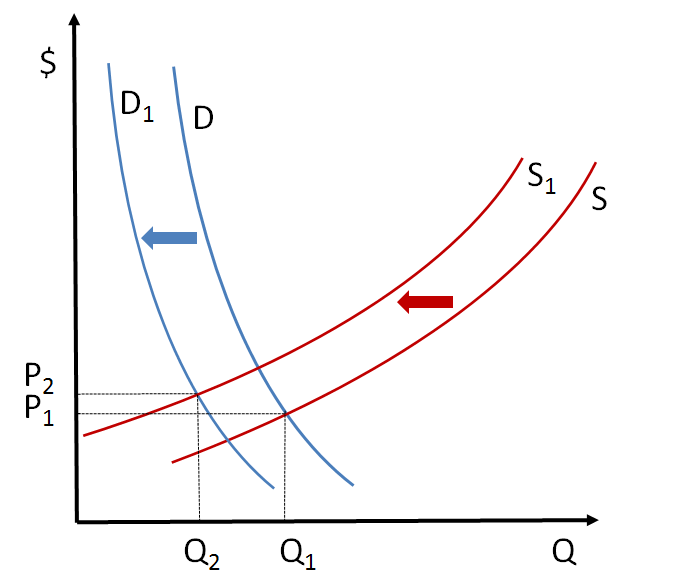
Last Spring, when oil was trading on the International market near $140 per barrel, I told my economics students that the only way to bring down the price of gas at the pump would be for Americans to reduce our demand for the product – drive less, buy smaller more fuel-efficient cars, etc.  Most economists were saying the same thing, and Americans did just that. Demand today is way down now. In its weekly inventory report, the Energy Department’s Energy Information Administration said that gasoline demand fell by 6.4 million barrels to 202.8 million barrels for the week that ended August 8th.  This is nearly three times more than the 2.2 million barrel drop that analysts had expected. In response to this drop in demand, oil companies have cut way back on production, shutting down refineries. And who can blame them? Why should they produce something in amounts that exceed the quantity demanded?

But, if Big Oil acted fairly and responsibly, and market forces worked like they are suppose to, not even considering the above mentioned decline in demand, gasoline prices should be lower. With oil’s price down from a high of $147 in July to less than $100 in mid-September, a 32 percent decrease, gas prices should have dropped by the same amount — right? So, let’s see… the national average price for regular unleaded in July was near $4.00. Today it’s something like $3.55. Therefore, the price of regular unleaded has dropped just 11 percent. Hmmm… perhaps our decline in demand actually worked to consumers’ disadvantage. Accordingly, I told my students that, even though I teach this stuff, I’m very much like Thomas Carlyle’s parrot. I just think I’m an economist. And that’s why economics is called, the dismal science. We do a pretty good job of explaining what’s already happened, but we’re not so good at predicting the future.

Another student asked, “How are they able to control supply so easily, Mr. Garry?”

In response, I reminded my class about our lessons on demand and supply elasticity, which is a measure of how responsive demand and supply are to changes in price levels. Demand for gasoline is very “inelastic,” or less susceptible to price changes. This is because we depend on it, there are no adequate substitutes for it, we can’t delay our purchases of it (when our tanks are dry we’ve got to buy), and it takes up a considerable amount of our disposable incomes. The elasticity of supply for gasoline, on the other hand, is very elastic. This is because producers, with the excess refining capacity they have today, can respond quite rapidly to market forces. When the price they have to pay for crude increases, they pay whatever they must, then just pass the additional cost on down-stream where the consumer ultimately makes up the difference. When demand for their product falls, they close refineries and lay-off employees so as to protect profits and take care of their shareholders. To do otherwise, they would be giving money away, and for-profit corporations hate to give money away.

This situation is illustrated in the demand/supply graph for gasoline at the right (hypo- thetical), wherein the demand curve (in blue), representing all possible prices and corresponding quantities demanded at each price, is relatively steep and down-sloping. This shows an indirect relationship between price and quantity, the Law of Demand (the lower the price the more people are willing and able to buy). But responsiveness to changes in price, either up or down, is small. On the other hand, the supply curve (in red), representing all possible prices and corresponding quantities supplied at each price, is relatively shallow and up-sloping. This shows a direct relationship between price and quantity on the supply side, the Law of Supply (the higher the price, the more producers would normally be willing to supply). But, unlike in the case of demand, respon- siveness to price changes for the supply of gasoline is relatively large, which means it is elastic, at least in the short-run. Notwithstanding, because oil companies can and, in my opionion, do act in collusion, they are able to rapidly adjust to market forces and control market supply. Therefore, prices can be controlled. In the example illustrated, demand and supply have both declined; the demand and supply curves both shifting to the left in equal amounts. Markets both before and after the shifts are at equilibrium where demand and supply curves intersect. So now one can readily see that, had the price of oil not declined in recent months (ceteris paribus), we could actually be paying more per gallon for gasoline as a result of our reduced demand for it.

So, my student was right to ask her question.  Congress has asked the major oil companies’ CEOs the same thing over and over again in recent years. The answer they always get from industry leaders, however, is this: “We don’t set gasoline prices, the market does.” But the market isn’t operating today on a level playing field, and Congress knows it isn’t. It’s slanted in Big Oil’s favor, and it’s government’s fault, in the name of FREE trade, for having allowed the oil industry to organize itself so efficiently. This is why Big Oil is able to generate the huge profits we’ve been hearing about lately, profits that are at the expense of every other aspect of our economy. They have done this through a series of many mergers over the years, mergers that administrations, both Republican and Democrat, have allowed even though Treasury Department economic analysts have advised against it. Why? Well, I don’t know, I just think I’m an economist. But, as a free thinker, I’m pretty sure the answer can be found at the end of the money trail.

It is time for change — the right kind of change — change that we can believe in, which does not, in my opinion, include giving Big Oil more freedom to control prices and drag down the rest of our economy. Tax breaks for Big Oil will not lead to greater supply and lowering prices for consumers. Tax breaks for Big Oil will simply lead to higher profits for Big Oil.

I invite your comments, both pro and con.

Published in: on October 4, 2008 at 8:15 pm  Comments (7)  

Americans’ Political Persuasions ~ Based More on Myth than Fact

Like flies attracted to garbage, it seems that we Americans have less time for the real issues and for digging out the facts than we have for listening to unsubstantiated claims and political slogans… 

September 13, 2008  —  The latest hullabaloo over Barack Obama’s use of the “lipstick on a pig” phrase during a recent campaign speech is clear evidence to me that Americans are less interested in facts and issues and more impressed with myth and even outright lies told by the party of their particular persuasion.

Com’on, folks… Obama wasn’t alluding to Governor Sarah Palin and the pit-bull joke she made at the Republican national convention. Her’s was a great speech that resonated with millions of like-thinking voters and helped to give a significant “bounce” in the polls for the Republican ticket this year. There’s no denying that. But, if you listened to Obama’s speech, you would know that he was talking about Senator McCain’s proposed economic policy when he uttered this common phrase. He wasn’t talking about Governor Palin.  This same phrase, by the way, was used by Senator McCain no less than three different times in his campaign earlier this year when speaking about Senator Clinton’s proposals for a national health care program.

Like flies attracted to garbage, it seems that we Americans have less time for the real issues and for digging out the facts than we have for listening to unsubstantiated claims and political slogans like No Child Left Behind, Straight Talk Express, and Change Is Coming. Gee, that one sounds familiar.

Many of us, it seems to me, care more about wedge-issues like gun control, immigration, abortion, or the gender, race or religion of a candidate than we do about larger the issues like the economy and national security. We support whichever party claims to champion our heart-felt causes, usually the same party our parents have supported, then we believe unfailingly in whatever other claims our parties make. According to the Pew Research Center, social status and religious backgrounds influence American political persuasions more than reason.

I don’t often read articles in the ContinUUm, a magazine that my alma mater, the University of Utah, sends to me every month hoping that I will contribute to their Alumni Fund. But the most recent edition had some interesting articles in it about the state of our nation’s health care system. Thumbing through the pages one morning this week while sipping my first cup of coffee, one particular article just jumped out and grabbed me. It was written by a fellow alumnus, Carl R. Summers. Carl, who graduated ten years after me, is a scientist today working as a researcher with the Defense and Veterans Traumatic Brain Injury Center at Walter Reed Hospital. But his article wasn’t about brain injuries. It was about political myths. His hobby being statistics, he decided that a scientific look at real numbers might help to substantiate or debunk some of our two major parties’ basic claims… Interesting. Very interesting indeed.

You can find more on the actual numbers that Carl crunched and the methodologies he used on-line in a series of articles he has published at OutsidersDC (www.outsidersdc.com).

We are told that the Republican Party is the party of business and small government, lower taxes and reduced government regulation. The Democratic Party, we are reminded over and over  again by Republican Party politicians and right-wing pundits like Rush Limbaugh, is the party of big government, high taxes, big give-away spending, and bleeding-heart, wasteful social programs for the down and out. Right? Well, if this is true, would it not follow then that the nation’s growth in output of goods and services, the real (adjusted for inflation) Gross Domestic Product (GDP) would be higher year after successive year during Republican rather than Democratic administrations? Wouldn’t it also follow that average taxes paid would be lower during Republican administrations and in years that Congress was controlled by the Republican Party? After all, Congress, not the President, has the most to say about taxes and spending. Shouldn’t we also expect less government spending by conservative lawmakers?  In as much as every Republican administration since Reagan has embraced some form of the “trickle-down,” supply-side economic theory in formulating tax policies, shouldn’t everybody be better-off with more after-tax income to spend and shouldn’t there be more and better jobs?

Asking himself these questions, Carl looked at readily available data and scientifically compared the performance of Republicans and Democrats occupying the White House every year since 1950. He also looked at records on taxing and spending when each party had control of the Senate and House of Representatives. What he found was surprising, even to me, a “fiscal” conservative and teacher of economics.  He discovered that the average real increase in GDP for Republicans was 2.8 percent per year. The average increase for Democrats was 4.4 percent. So, despite claims to the contrary, business performed 57 percent better on average under Democratic administrations than under Republican administrations.

What about unemployment?  Remember, Democrats are supposed to be the party of the working class. Carl discovered that the average unemployment rate under Republican administrations has been 6.1 percent. That’s what the Bureau of Labor Statistics is currently reporting. Under Democratic administrations, the average was 5.1 percent. So, the Democratic claim is substantiated.

Carl asked himself — If the trickle-down theory has any validity, if lowering business taxes, capital gains, and individual income taxes on the wealthiest of Americans encourages investment and creates jobs (a rising tide lifting all boats), then shouldn’t this raise the value of corporations? Shouldn’t this be reflected by gains in broad stock indexes like the Dow Jones Industrial Average (DJIA) and the Standard and Poor’s 500? To answer this issue, he looked at respected business data over the years and concluded that the average change, or increase in stock prices grew 7.4 percent during Republican administrations. Not too shabby, you say?  Well, stock prices grew 10.4 during Democratic administrations. Furthermore, he noted that during Democratic years, the Dow showed relatively small, somewhat consistent ups and downs, what economists call normal business cycles.  During Republican years, the Dow was, in his words, “… like a roller coaster ride with large, unpredictable peaks and valleys.”

On the issue of which party favors low taxes and which party favors high, Carl normalized “federal receipt” data by comparing it over the years as a percentage of real GDP. He did this to compen- sate for variations in the economy like inflation, population growth and tax policies. What he found out was that when Republicans were in the White House, government taxed at the rate of 18.9 percent of real GDP while, when Democrats were in the White House, government taxed at 19.1 percent. Yes, Democratic administrations did tax at a slightly higher rate, but the two-tenths of one percent difference, he says, is statistically too close to call. But remember, it is Congress, more so than the President, that controls our nation’s purse strings. In the years that Republicans controlled the Senate, government collected 18.5 of real GDP compared to 17.7 percent when Democrats ruled. In the House of Representatives, when Republicans ruled, government collected 18.7 compared to the same 17.7 percent when Democrats were in control.  This difference is statistically relevant and it means that, after all these years of Republican claims about Democrats raising taxes, the reality is that taxes are almost exactly the same regardless of the President’s party, but they are actually higher when Republicans have control of the House and/or Senate.

Ok, you say, but what about spending? Well, treating expenditures the same way he did revenues, as a percent of our nation’s real GDP, Carl discovered that Republican administrations spent 20.2 percent while Democratic administrations spent significantly less, 19.2. This is a 5.2 percent difference, folks!

So, now you know. Based on fact rather than myth, the real tax-and-spend party has been… well, its mascot, like Pinocchio, has a prominent proboscis.

I invite your comments, pro or con.

Published in: on September 13, 2008 at 10:45 am  Comments (10)  

Energy Saving Ideas ~ Big and Small

Discouraging the BIG OIL and COAL industries from continuing business-as-usual/high profit operations at the expense of the environment and the health of the nation, just might motivate them to think more “out of the box” on energy alternatives.

Being a member of and contributor to environmental organizations, I get emails from them often, heightening my aware- ness of things, asking for donations, and encouraging me to send letters and emails to my representatives Washington asking them to support earth-friendly legis- lation.  I got one from the Environmental Defense Fund today asking for energy saving ideas, big and small (something different this time) – on how I, my family, and our country can rethink the way we live and work in this age of not-so-cheap oil. So I went to their weblog and found some interesting observations and perspectives already posted there. I left the following comment of my own:

On the home front, the wife and I are already limiting our trips, combining errands whenever possible. The wife is carpooling now 3 or 4 days a week, and I hope to find someone with whom to carpool too once school restarts this year (I teach high school economics, and so am off for the summer). When I drive my ’05 Dodge Magnum, I hypermile, which nets me about 4 to 5 extra miles per gallon. Hypermiling includes driving slower, accelerating gradually, and making sure my tires are properly inflated, a common sense thing Barack Obama advocates that we all do, which John McCain has made fun of lately. But, hey – every little bit helps — right? I’m riding a motorcycle when it’s not too hot and when it otherwise makes sense to do so. Our summer getaways this year were fewer and to closer destinations, and we don’t anticipate traveling as much in the future either, even if the price of gas comes down substantially. When next it is time to buy or lease, we plan to make mileage the number-one priority. And we are going GREEN in many other ways too… we have switched our electric company to Green Mountain Energy, which generates 100% of its power from renewable sources. Their price per kwh is very competitive, by the way.

At the local level where natural gas is plentiful like it is here in Texas, and becoming more plentiful all the time with drilling into the Barnett Shale, I would recommend public transit, and especially school buses, be converted to run on this fuel as an interim alternative to diesel until better, more environmentally friendly technologies become available, such as electric fuel cell hybrids. Near term cost benefits might be negligible for this, but there are health benefits to consider, and doing so would reduce our demand for foreign oil. Hopefully too, the growing demand for mass transit will stimulate the expansion of existing systems and the development of new ones. Suburban communities, larger cities and state governments really should welcome and encourage this.

At state and national levels, every effort to support the devel- opment of alternative energy sources should be promoted as a priority over new drilling — anywhere. More oil just perpetuates our addiction to it and continues pumping CO2 into the atmos- phere. Wind and solar farms should definitely be in the mix, and I would not rule-out new nuclear power plants where demand is highest and real estate is limited. New coal-fired plants should be discouraged, in my opinion, unless carbon sequestering technol- ogies are incorporated.  Discouraging the BIG OIL and COAL industries from continuing business-as-usual/high profit oper- ations at the expense of the environment and the health of the nation, just might motivate them to think more “out of the box” on energy alternatives. Although it would be competing with the private sector, I admit, i.e., the airlines, I believe that there should be government efforts to promote the return and update of passenger rail systems.

Finally, I would advocate and support the idea of governments offering individual tax credits and other incentives for people and businesses to weatherize and upgrade to new, “made in the U.S.A.,” highly efficient, environmental systems. Government should back T. Boone Pickens’ energy plan too, stimulating the manufacture of millions more state-of-the-art wind gener- ators. Not only would these things save energy, but they would generate jobs for people put out of work by offshoring and the decline in demand for new homes and American-made automo- biles. These would be jobs that could not be exported. With people going back to work, consumption would increase, as would the tax base. With more money spent on American-made items, the trade deficit would decline and our economy might just start to improve like a rising tide, “lifting all boats” this time, not just those of the rich. This, I think, would make a whole lot more sense as a fiscal policy for Washington than short-term stimulus checks and tax cuts for businesses that are already posting record profits.

I invite your comments, supportive or un, and ideas of your own.

Published in: on August 11, 2008 at 2:10 pm  Comments (2)