The Great Society ~ An Impossible Dream?

Christians are supposed to care about their neighbors and share the fruits of their labors with those who are in-need, are they not?

What do I know about anything? I’m just a retired senior citizen whose biggest responsibility now is in taking care of his little great granddaughter following daycare each day. But I have a vision, a dream actually, one that has taken me a lifetime to develop.

My dream is of an honorable, righteous, and caring United States of America — a nation in which education and knowledge are valued above material possessions and show- manship — a nation in which politicians care more about what is good for their constituents than about getting themselves reelected. I dream of a time to come when long-range consider- ations will trump the desire for immediate gratification, when the good for the many outweighs the good for the few and when workers are valued over corporate profits. In my dream, Americans will one day wake up to the realization that there is nowhere else to go and that we must honor future generations with good stewardship of the planet’s resources.

As a veteran of the Vietnam War, I remember coming home to jeers rather than cheers. After our trans-Pacific chartered flight touched down at the Seattle-Tacoma airport, we were advised to change quickly into civilian clothes and to exit the airport individually by side doors, coming back later for connecting flights to our home cities. It was January 1970 and the headlines were all about the recent My Lai Massacre and the pending trial of Lt. William Calley, the platoon leader who had ordered the killings. Those of us in uniform weren’t too popular back then. Our former Commander-In-Chief, Lyndon Baines Johnson, wasn’t either.

Being a military officer, I was more conservative in my political views back then. I had cast an absentee ballot while still in Vietnam for Richard Nixon, and I was pleased to know that he had been elected. My future in-laws, however, had been devastated by Johnson’s announcement early the previous year that he would not run again. They were Texas Yellowdawg Democrats. But, looking back on that time, I’m sorry now that LBJ’s unpopularity did in. He is remembered today by some historians as having been one of our greatest presidents owing to his legislative victories for the common man. I see him now in a very different light.

Serving out what remained of John F. Kennedy’s one term as president, Johnson completed the unfinished work of JFK’s New Frontier. He pushed through two very important pieces of legislation. First, the Civil Rights Bill that JFK promised to sign was passed into law. He also signed into law the omnibus Economic Opportunity Act of 1964. The law created the Office of Economic Opportunity aimed at attacking the roots of American poverty. A Job Corps was established to provide valuable vocational training. And Head Start, a preschool program designed to help disadvantaged students arrive at kindergarten ready to learn was put into place. The Volunteers In Service To America (VISTA) was set up as a domestic Peace Corps. Schools in impoverished American regions would now receive volunteer teaching attention. Federal funds were sent to struggling communities to attack unemployment and illiteracy. http://en.wikipedia.org/wiki/Lyndon_B._Johnson

Campaigning in 1964, Johnson declared a “war on poverty.” He challenged Americans to build a “Great Society” that would eliminate the troubles of the poor. He won a decisive victory over his archconservative Republican opponent, Barry Goldwater of Arizona. American liberalism was at high tide. It became a progressive era.

Some of Johnson’s Great Society legislative accomplishments were: Medicare which was created to offset the costs of health care for the nation’s elderly; the Voting Rights Act which banned literacy tests and other discriminatory methods of denying suffrage to African Americans; the Immigration Act which ended discriminatory quotas based on ethnic origin; the Wilderness Protection Act which saved 9.1 million acres of forestland from industrial development; the Elementary and Secondary Education Act which provided major funding for American public schools; the National Endowment for the Arts and Humanities which used public money to fund artists and galleries; an Omnibus Housing Act which provided funds to construct low-income housing. In addition during Johnson’s years as president, Congress tightened pollution controls with stronger Air and Water Quality Acts, and standards were raised for safety in consumer products.

Unfortunately, much of the money Johnson might have spent on these social programs was siphoned off by the war in Southeast Asia. This began to overshadow his domestic achievements. He found himself maligned by conservatives for his domestic policies and by liberals for his hawkish stance on Vietnam. By 1968, his hopes of leaving a legacy of domestic reform were in serious jeopardy. http://en.wikipedia.org/wiki/Lyndon_B._Johnson

So, where are we today with respect to being a great society? Medicare is still paying some of the medical needs of seniors, but that’s largely funded by retirees’ own contributions before they retire and conservatives now in Congress want to turn it into a voucher program. As for the Voting Rights Act, Congress has reauthorized it five times. But Republican controlled states now, through redistricting done even mid-census which has been ruled Constitutional by the conservative Supreme Court, have found legal ways to undermine the concept of one-man-one-vote. The Immigration Act of 1965 is still in-effect. But with so much controversy over what to do about the many illegal immigrants flowing into the country from south of the border, many conservatives are grumbling and want it stuck or substantially changed in any agreement on dealing with illegal immigrants. The Wilderness Protection Act has brought huge tracts of land under federal protection and management, but private interests continue to press and erode the sanctity of these area. One good example is the pressure being brought by the oil industry and citizens of Alaska who benefit from royalties paid for drilling and extracting oil to expand drilling rights. Funding for the National Endowment for Arts and Humanities has suffered severe cuts year after year since 1980, and there have been continuous attacks against it by conservatives. The Elementary and Secondary Education Act has been revised by Congress.  It is now known as No Child Left Behind, a punitive system requiring states to conduct yearly testing to qualify for federal funds. The government, however, has fails to compensate states for this testing mandate.  The Omnibus Housing Act has evolved into the Department of Housing and Urban Development, or HUD. Anyone who feels that they have been discriminated against with respect to where they want to live can file a free claim with HUD. But discrimination in housing still persists. Cities and local communities still find legal ways to prohibit or restrict access to homes and apartments.

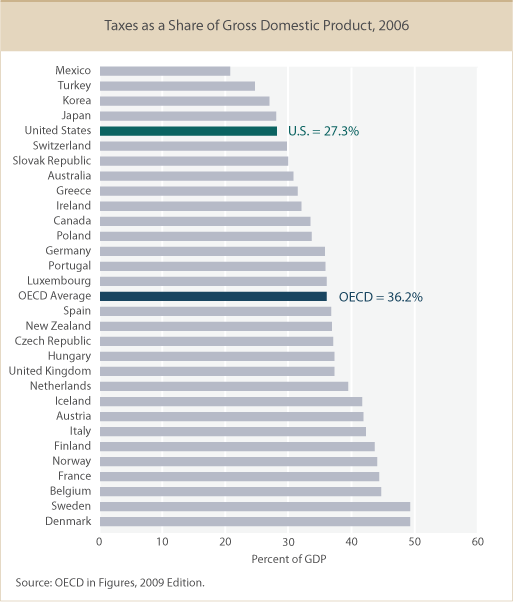
Perhaps the best way to determine whether America is really the generous land of equal opportunity and social justice that we like to think it is, we should look at what we spend for social programs as a percent of our GDP (Gross Domestic Product), the total amount of money made in a year by the production and sale of all goods and services. Comparing this to the amount of spending calculated in the same way for other countries gives us a good idea of where we actually stand. See the graphic below, which was generated by the Organization for Economic Cooperation and Development (OECD). The OECD works to promote policies that will improve the economic and social well-being of people around the world.  It uses a wealth of information on a broad range of topics to help governments promote prosperity and fight poverty http://www.oecd.org/pages/0,3417,en_36734052_36734103_1_1_1_1_1,00.html.
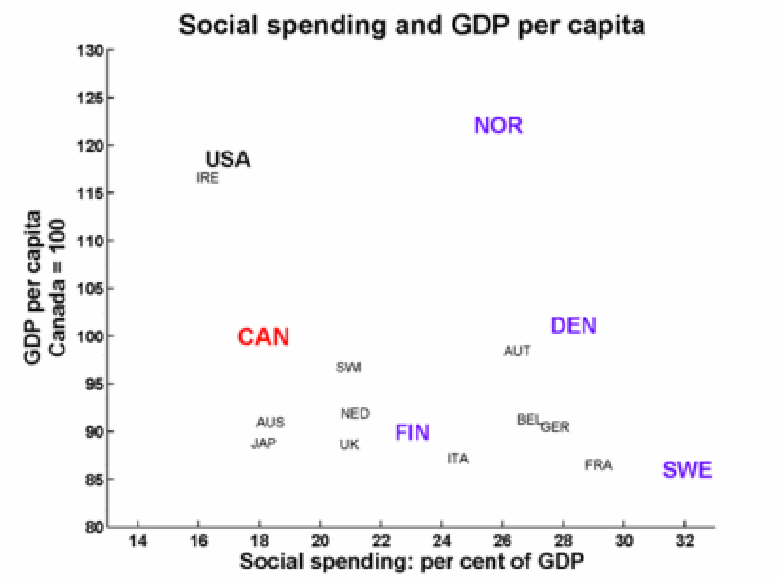

Look at the Nordic nation of Sweden at the bottom right on the graphic. Sweden’s GDP per capita is little more than half what ours is, yet they commit twice the percent of their GDP to the welfare of their citizens. They have achieved an enviable standard of living under a mixed system of high-tech capitalism and extensive welfare benefits. They benefit from an extensive social welfare system which includes a ceiling on health care costs, education subsidies and childcare, maternity and paternity, yes, paternity leave. They have an old-age pension program and universal sick leave among other benefits. The country has a modern distribution system, excellent internal and external communications, and a skilled labor force. Theirs is truly a great society http://www.state.gov/r/pa/ei/bgn/2880.htm.

Now look at Norway at the top, center-right. Norway has a greater GDP per capita than ours and commits ten percent more of its GDP to the welfare of its citizens. Education is free through the university level in Norway. Its health care system includes free hospital care, physicians’ compensation, cash benefits during illness and pregnancy, and other medical and dental plans. There is a public pension system http://www.state.gov/r/pa/ei/bgn/3421.htm. By the way, there are more millionaires in Norway per capita than in any other nation in the world. Wealth there is more evenly distributed.

“Yeah, but what about taxes?” you might ask. Aren’t we overburdened with taxes to pay for social programs and other government waste? The answer is no. From all sources, both government and charity, our spending on anti-poverty programs is barely greater than three percent of our GDP. Scholarly studies show the United States to be an outlier in comparison to attitudes and actions taken by other wealthy nations. We have high poverty rates, low public social spending but high private social expenditures, and a rather strong belief that people are poor because of laziness or lack of will http://www.psocommons.org/ppp/vol3/iss2/art3/. The people of most modern states simply do not view poverty in the same way that we do.

Consider the following chart showing our tax burden compared to the rest of the world.
So, where’s the trick? How are these facts skewed to make Americans seem selfish? The answer is that they aren’t.

I find it curious that many in Congress, to reduce budget deficits, favor gutting social programs over increasing revenues collected from the wealthiest of Americans and highly profitable corporations. Still, social conservatives insist that America is a Christian nation. Christians are supposed to care about their neighbors and share the fruits of their labors with those who are in-need, are they not? Yet America, compared to all other nations, is clearly one of the least generous with our own citizens.

So, is my dream an impossible dream? I don’t know. But as my dear grandmother used to say, “Charity starts at home.” Maybe it wasn’t so much that her heart wasn’t in the right place; as an extended family back in the 50s and 60s, there wasn’t much left over after the bills were paid and the groceries were bought. Maybe she just expected more from those who were better off. Maybe, after the vast majority of Americans whose disposable incomes have been shrinking for the past several decades wake up and realize that the wealthiest aren’t really job creators, that trickle-down economics should really be called percolate-up economics, the progressive era that was the Johnson years will be reborn.

Please feel free to comment on this posting whether you agree or disagree.

Published in: on July 18, 2011 at 8:04 am  Comments (7)  

How to get Rich ~ According to Mark

If you weren’t born with a silver spoon in your mouth, but you still want to get rich, here’s what I suggest. Buy lotto tickets.

July 13, 20011 — I’ve made a new friend on Facebook, one whose heart and head are in the same places as mine. This friend, I’ll simply refer to him by his first name, Mark, recently posted a very interesting story on his wall. With Mark’s permission and with a few minor edits, this is what he wrote:

“When I was 8 years old I talked my way into the Grown-up section of the library. Four of the 6 books I took home that day were biographies of famous rich guys from the early 1900s. Over the next 45 years I read lots of Rich Guy Bios and found that most of them have one thing in common. That one thing was confirmed in 2005. I did a complete analysis on the Forbes 400 richest folks in America. I put together an Excel spreadsheet using the data, then started sorting by each column to see what there was to learn.

There are Rich Guy Hot Spots to live in like NYC (Central Park), The Hamptons, South Miami (and Fisher Island), Southern California and Scottsdale AZ. But what I found to be most intriguing was how they got their wealth. In the Forbes article, 12% said they inherited their money. Of the others, a large number said their wealth came from real estate, oil, banking or hotels. But that made my ‘Radar’ really start pinging. To start a business in any of these industries takes big bucks. So where did their start up money come from? I did some deeper digging into their histories. The extensive Forbes article provided lots of information and the library and internet provided more. When I was finished the answer was clear, 85+% were born into rich families and, as adults, they enhanced their wealth investing in the stated industries. So 7 out of 8 really rich people were born rich and got richer. But most of them would like for you to believe they worked for it — the ole “American Success Story”.

As for Rags to Riches, here is what I discovered. A few very wealthy made it on their own. Computer software made Gates and Jobs and some other puter gurus rich. Movies made Tom Cruise, Will Smith and other celebrities rich. A few like John McCain and John Kerry married into wealth. And we all know how Oprah made her money, by syndicating her talk show, forming her own production company, then buying the rights to the show – oh and capturing the hearts of millions with her personal story and her generosity.

Sadly, there were only 3 or 4 out of the 400 that really started with nothing and worked 24/7 for 30 to 40 years to get rich. That’s 1% that were not born rich and weren’t computer gurus or entertainers. None of them ever worked a regular job to get rich.

So if you weren’t born with a silver spoon in your mouth, but you still want to get rich, here’s what I suggest. Buy lotto tickets. The Lotto odds are 12M-to-one against you winning, but that’s a heck of a lot better odds than thinking you can start with nothing, work hard and smart all your life, and with a little luck end up rich. Those odds are around one-in-80 million. So, good luck on the Lotto.”

Thanks for this, Mark.

If anyone would like to comment on what Mark has written, feel free to post a comment below. I’ll make sure he gets it.

Published in: on July 13, 2011 at 10:48 am  Comments (3)  

Balancing the Budget and Paying Down Our Debt ~ The Right Way to Do It

It’s no accident that our nation’s debt as a percent of  Gross Domestic Product (GDP) started to climb precipitously in the 1980s.

April 5, 2011 –– As President Obama meets with House and Senate leaders today to try to find some way to avoid a government shutdown at week’s end, current polls are showing that the same percentage of Americans blame Democrats for gridlock on the budget process as blame Republicans. So, neither party has an obvious political advantage for this budgetary brinkmanship. Notwithstanding, the Tea Partiers must be absolutely ecstatic seeing how much influence their party favorites are having on this process. If the facts were known, however, if sensible voters in both parties understood just why we have a deficit in the first place and who it is that will benefit from all the proposed cuts in government spending, maybe it would be different.

So, before we start cutting essential programs to balance the budget for next year, let’s see why it is that we have a deficit and a debt problem. It actually has little to do with fiscal measures taken to respond to the recent recession. Despite what Speaker Boehner says, it’s not a spending problem as much as it is a revenue problem, and the problem has been with us for decades.

Pay particular attention to the last couple of seconds of animation on the last graph in this video showing the accelerated growth of gross national debt and when this accelerated growth began. It moves pretty quick.

It’s no accident that our nation’s debt as a percent of Gross Domestic Product (GDP) started to climb precipitously in the 1980s. Government started receiving diminished revenues owing to Reagan Era tax cuts while, at the same time, started borrowing more and more to sustain increased defense spending and growing demands on entitlement programs by maturing baby boomers. Promised increases in revenues from an expanding economy never truly materialized. What little increase was realized from this tax cut stimulus (trickle-down economics) evaporated with new government subsidies and tax loopholes for corporations. Deficits then continued owing to the Bush-Cheney individual income tax cuts that overwhelmingly favored the wealthiest of Americans and borrowing to fund the wars in Afghanistan and Iraq.

Today, our tax code is full of loopholes created and exploited by big corporations. They, in turn, spend millions that they don’t pay in taxes to control our government with their army of lobbyists found on K Street in Washington.

Yes, do tell Congress to balance the federal budget and pay down our national debt. But tell them not to do it on the backs of our most vulnerable citizens. Tell them not to do it at the expense of our nation’s health and safety. Tell them not to do it and forego infrastructure and technology investments needed for a brighter, more competitive America. The right way to balance the budget and reduce our nation’s debt is to get corporations out of our nation’s business, reform election campaign financing, and restore the middle class subsidizing real people, not corporations.

Feel free to comment whether you agree or not.

Published in: on April 5, 2011 at 10:48 am  Comments (4)  

The Wisconsin Thing ~ Another Nail in the Coffin of Democracy and the Middle-Class

Benjamin Franklin famously responded to a question about what form of government the United States would have under the newly ratified Constitution saying, “We have a republic as long as we can keep it.”

February 22, 2011 — The Republican governor of Wisconsin, Scott Walker, won the November 2010 election by six (6) percentage points over his Democratic challenger, Tom Barnett.  Pretty impressive, right? But does six percentage points translate to a mandate for social change on the magnitude taking place in Wisconsin this week? http://en.wikipedia.org/wiki/Wisconsin_gubernatorial_election,_2010.

Hmmmm… It seems to me that the governor of Wisconsin is the governor for all citizens of Wisconsin, even those folks who voted for Mr. Barnett. Notwithstanding, our representative form of democracy means that the governor will have his way on this public workers’ union business regardless of what the average Wisconsin voter may think about it. This is because the Republican Party also controls the state’s legislature, by a large margin in the State Assembly http://en.wikipedia.org/wiki/Wisconsin_State_Assembly, and by lesser numbers in the Senate http://en.wikipedia.org/wiki/Wisconsin_Senate. But would the majority of Wisconsins really support this move if they knew all the facts? I wonder, but we’ll likely never know; the only poll on the question I’ve seen so far suggests bias in the way the question is being asked http://fivethirtyeight.blogs.nytimes.com/2011/02/21/rasmussen-poll-on-wisconsin-dispute-may-be-biased/.

Just because a person votes Republican doesn’t mean that they necessarily believe workers should not have the right to negotiate collectively for pay and working conditions.

Wisconsin is indeed facing a budget crunch, although its difficulties are less severe than those facing many other states. Revenue has fallen in the face of a weak economy, while stimulus funds, which helped close the gap in 2009 and 2010, have faded away. In this situation, it makes sense to call for shared sacrifice, including monetary concessions from state workers. Accordingly, union leaders have signaled that they are, in fact, willing to make such concessions http://www.huffingtonpost.com/2011/02/22/wisconsin-budget-battle-c_n_826478.html. But the governor isn’t interested in making a deal. This is partly because he doesn’t want other government workers, those who are more supportive of him and of Republican principles to have to share in the sacrifice, or so I’ve been given to understand from my reading on the subject http://www.nytimes.com/2011/02/21/opinion/21krugman.html?_r=2.

Even though Wisconsin is facing a terrible fiscal crisis, the governor has been pushing through tax cuts that make the deficit even worse. The bottom line, I think, is that he wants to end workers’ ability to bargain collectively and is therefore refusing to negotiate. Hey – why negotiate when you’re holding all the cards, right?

But why bust the unions when you can balance your budget in other ways? It’s really not helping Wisconsin deal with its current fiscal crisis. Nor is it likely to help the state’s budget prospects in the long run. Contrary to what you may think, public-sector workers in Wisconsin and everywhere else this country are paid less than what private-sector workers with comparable qualifications are paid http://www.businessinsider.com/wisconsin-public-sector-wages-2011-2. So it’s not about the budget; it’s about power.

In principle, every American citizen has an equal say in our political process. In practice, however, some of us are more equal than others: Billionaires can field armies of lobbyists; they can finance think tanks that put the desired spin on policy issues, and; they can funnel cash to politicians with sympathetic views (as the Koch brothers have done in the case of Governor Walker) http://www.nytimes.com/2011/02/22/us/22koch.html.

On paper, we’re a one-person-one-vote nation. In reality, we’re more like an oligarchy, a situation in which a handful of wealthy people dominate. And, although some define it differently, when business controls the state, this is called fascism http://en.wikipedia.org/wiki/Definitions_of_fascism. The more power wealthy business interests gain, the less power individual citizens retain.

Benjamin Franklin famously responded to a question about what form of government the United States would have under the newly ratified Constitution saying, “We have a republic as long as we can keep it.” Well, it is my belief that we are perilously close to losing it, if we have not in fact already lost it.

One does not have to love unions or believe that their policy positions are always right to recognize that they are among the few influential players in our political system that represent the interests of the middle-class. A retired teacher now myself, I have never believed in tenure for teachers. But I have always believed that workers should have the right to collectively bargain for wages and work conditions if that is what they want.

Indeed, if America has become more oligarchic and less democratic with a shrinking middle-class over the last 70 years — which it has http://finance.yahoo.com/tech-ticker/the-u.s.-middle-class-is-being-wiped-out-here’s-the-stats-to-prove-it-520657.html?tickers=%5EDJI,%5EGSPC,SPY,MCD,WMT,XRT,DIA — this is largely true because of the increasing influence the wealthy few have on government and the decline of unions since passage of the National Labor Relations Act of 1935 http://en.wikipedia.org/wiki/Union_busting.

The injustice I perceive in all of this is exacerbated by the fact that Wisconsin’s fiscal crisis, as in other states, was largely caused by the increasing power of America’s oligarchy. It was, after all, the super wealthy and most influential players in the game, not the general public, who pushed for financial deregulation. This set the stage and tumbled the economic building blocks that became the Great Recession of 2008-9, a recession whose aftermath is the main reason for current budget crunches in so many states. Now this oligarchy is pushing the political right to exploit that very crisis. Except for the fact that there is no humor to be found in it, I would call this whole situation ironic.

I invite you comments, whether you agree with me or not.

Published in: on February 22, 2011 at 11:53 am  Comments (6)  

Thanksgiving 2010 ~ What’s There to be Thankful For?

Is it too early to say, “Bah Humbug?”

November 25, 2010 — Yeah, I know, it’s practically un-American not to smile big and wide and count all our blessings on this traditional day of thanks. But it’s difficult for me to be upbeat this year.

Yes, the misses was busy all day long yesterday preparing for the big day, is still busy this morning making everything just right and the house is already smelling yummy. But nobody’s happily driving over-the-river-and-through-the-wood to be here with us. Most of them live too far away — like in Utah, Colorado and Singapore for crying out loud.

Oh well, at least we can count on our little great granddaughter to liven things up for us. She and her mom have been living with us for months while mom gets back on her feet — a victim of the Great Recession. If the little girl likes nothing else that Oma has fixed, I anticipate that she’ll love Ms. Dee’s fabulous Bing Cherry jello salad.

While the retailers are all hoping for a great shopping season, it just isn’t going to happen. Too many folks are counting their nickels and dimes and praying for the economy to turn around faster. Too many folks are still out of work or underemployed. But the economy’s already turned around. What hasn’t turned around is the jobs situation, and that’s not going to turn around anytime soon, if ever.

Jobs in America depend on demand for American-made goods and services, and most of the things we buy are now made elsewhere. While we have opened our markets to almost every other country in the world, the biggest markets are still closed to us or largely so. Other nations and regions are more concerned, as our president has just discovered, about their own economic problems than they are about pulling together and helping us. It may now be a “world” economy, but it’s still a world made up of self-serving nations, trading alliances, oligopolies, corporations, and individuals. Besides, the Cowboys are having their worst season ever.

Having retired from teaching this year, I’m already missing the classroom — already missing my students’ bright and inquisitive faces even as I’m missing family so many miles away. No, retirement’s not all it’s cracked-up to be. So, as the Macy’s Thanksgiving Day Parade is being beamed to our satellite receiver this morning, I apologize for raining on your personal parades. Have a Happy Thanksgiving and put aside the problems of the world if you can, if only just for one day. Enjoy your turkey and be grateful if you have anyone with whom to share it. Hmmmm… perhaps I should take my own advice.

I think I might be feeling less glum if our nation’s leaders would just come together and agree on something. Let’s all pray about that, okay? And while we’re praying, let’s not forget our young men and women in uniform, especially those overseas, especially those in combat zones and the 28,000 or more stationed in South Korea. I can just imagine how they are spending their Thanksgiving. Turkey in the field. Yum! So, if we can find nothing else to be thankful for, we can at least be thankful for their service.

Amen?

Please feel free to comment.

Published in: on November 25, 2010 at 8:09 am  Comments (1)  

Jesus Christ ~ In Today’s World, Would He be a Capitalist or a Socialist?

Let the rich get richer, conservatives say. The benefits will “trickle down” to all the rest of us. It’s a neat, simple concept, except, it doesn’t always work as advertised.

October 14, 2010 (based on A Biblical Basis for Liberal Politics by David Chandler)

I find it interesting that the “Religious Right” in the U.S., the Moral Majority, the Christian Coalition, etc., is so active in politics. By all appearances, one might think that conser- vatism somehow equates to Christianity. But all who claim Jesus as Savior are not Republicans. So, where is the Religious Left? If it even exists, why don’t we hear about it in the media? Could it be that liberals are more inclined to accept the concept of separation of church and state? Yes, I think so.

As I dialogue through this blog with those who share the con- servative persuasion, I’m often assailed with the argument that America’s greatness is the result of an economic system whose driving force is the profit motive — capitalism. True, at least in part; our economy rewards self-interest, aka greed.

In classic economic theory, greed is good. A person motivated by greed will create unintentional byproducts that benefit everyone. These benefits include goods and services, employment, and advances in technology. The wonders of the modern world, jet airliners, TV, computers, the Internet and cell phones are just a few examples. So, let the rich get richer, conservatives say. The benefits will “trickle down” to all the rest of us. It’s a neat, simple concept, except, it doesn’t always work as advertised.

John Kenneth Galbraith, famous 20th Century Canadian-American economist, criticized trickle-down economic theory, calling it the “Horse and Sparrow” theory. “If you feed enough oats to the horse, some will pass through to feed the sparrows.” George Herbert Walker Bush, called it “Voodoo” Economics.

The truth is that a rising tide does not raise all boats. Under a purely capitalistic system wherein the government keeps its hands off things and allows the market to decide for itself what is needed, what is fair and proper, wealth does not flow down from the top. It flows up from the bottom. So, rising tides tend to swamp smaller boats.

One would think that, after decades of deregulation, tax cuts favoring the most wealthy, downsizing by America’s corporations and the “off-shoring” of good-paying American jobs, all of this resulting the shrinking of the middle class and growing disparity in the distribution of wealth, that American’s would understand this. But no, most Americans still think that tampering with the market system to promote fairness and equal opportunity, and a progressive tax code to redistribute the wealth and assure that the unemployed, the poor and disabled are helped and protected, is tantamount to socialism. And most Americans think that socialism is bad. But what does Jesus think?

By now, I think you know where I’m going with this.

Jesus spoke most about the Kingdom of God. But He also talked a lot about wealth and poverty. To the poor He said, “Blessed are you, for yours is the kingdom of God,” (Luke’s version). To the rich he said, “Do not lay up for yourselves treasures on earth,” and “go, sell what you have, and give to the poor.” When the rich turned away from Him because they had so much wealth, He observed, “It is easier for a camel to go through the eye of a needle than for a rich man to enter the kingdom of God.”

According to Jesus, helping the poor and the outcast is not an option. It is the essence of what it means to love God. In the parable of the last judgment, He welcomes the righteous into heaven saying, “I was hungry and you gave me food, I was thirsty and you gave me drink, I was a stranger and you welcomed me, I was naked and you clothed me, I was sick and you visited me, I was in prison and you came to me.” When the righteous answered that they didn’t recall doing any of these things for Him, He said, “As you did it to one of the least of these my brethren, you did it to me.”

We are to “forgive our debtors” and “give to everyone who begs from us.” But don’t handouts contribute to moral decay? Jesus, I think, was more concerned about the moral decay in those of us who are so attached to our wealth that we would hoard it for ourselves and our issue rather than share it with others who are less fortunate.

Our better angels tell us that giving does not corrupt. We sacrifice to give good things to our children and do our best to provide them with every opportunity as they grow up. We do this to give them a sense of security and a foundation for growth because we love them. Many of us will reach out to help friends in hard times even though we know that we will never be repaid. We do this because we love them. But how many of us contribute regularly to charity? How many of us give a full and righteous tithe? How many of us divert our eyes and pass by the beggar on the street? No, we do we not love the stranger. So, it is in dealing with need in the abstract that we fall back on the “moral decay” argument.

What does Jesus have to say in Scripture about trickle-down economics? Well, recall the story Jesus told about a rich man and the beggar, Lazarus, who desired only to be fed by what fell from the rich man’s table. Needless to say, the story ends with Lazarus going to a better place than the rich man.

Trickle-down theory is about crumbs falling off the tables of the rich, it’s about oats passing undigested through horses. Therefore, those of us who say that we should settle for crumbs or a few oats, those of us who advocate free-trade, laissez-faire economics would also have most of us become beggars or sparrows.

There is economic inequality in the world, the haves and the have-nots. There always has been. In response to this reality, Jesus admonishes us to share our wealth.

In 1960, John F. Kennedy, who had been shocked by the hunger he saw in West Virginia, made the fight against hunger a theme of his presidential campaign. After his election he created the modern food stamp program, which today helps millions of Americans get enough to eat. Ronald Reagan, on the other hand, thought the issue of hunger in this, the world’s richest nation, was something to joke about. In his famous speech in 1964, A Time for Choosing, he said, “We were told four years ago that 17 million people went to bed hungry each night. Well, that was probably true. They were all on a diet.” Later he clarified saying that hunger in America was simply a problem of distribution.

Distribution? What does that mean? In a business/economics sense it means moving products from factory or farm to wholesaler to retailer to consumer. But this involves the exchange of dollars, money flowing upstream from consumers to the entrepreneurs and corporate owners. To Jesus, however, distribution means something else.

Recall the story in John 6 (1-14) wherein Jesus fed the 5000 with five barley loaves and a couple of fish that were offered up by a boy who had come to hear Him speak. Did you ever think on hearing or reading this story why Jesus used the proffered loaves and fish? Why didn’t he just turn rocks into bread and grass into fish? Would that not have been an even more impressive miracle? Well, I think the story has more to do with distribution (sharing) than it does with miracles. I think that there was plenty of food among those who followed Jesus that day. I suspect too that, by telling his disciples to take the loaves and the fish and distribute them freely to the crowd, He compelled those with food to join him in giving it away. It was an object lesson for the disciples, for the people who there that day. It was an object lesson for us. But some hear and do not listen; some look and do not see.

Ok, you say, as a Christian I agree that I should be concerned about the poor. But shouldn’t this concern be simply a private matter to be handled through donations to churches and other charities, George H. W. Bush’s Thousand Points of Light. Why should government have anything to do with it? Hold that thought.

Americans are a generous people. According to the National Philanthropic Trust, charitable giving for 2010 will total 2.2 percent of our GDP. By comparison, according to the Congressional Budget Office, federal social program spending alone, not counting Social Security, Medicare, CHIP and unemployment, will total 12.5 percent of GDP this year. Now, if Washington were to suspend all this social program spending and reduce income taxes by a corresponding amount, Americans would surely increase their charitable giving by that same amount, right?

Surely, you get the point. Left to the private sector alone to care for the less-fortunate, Hoovervilles would return to open spaces in and around our cities.

Our economy is currently in the worst condition it’s been in since before the beginning of the Second World War. It’s based on a system that has the potential to produce tremendous wealth, but it has failed to maintain its lead over foreign competition. Consider the possibility that this could be, at least in part, because the system fails to distribute wealth equitably. It neglects the poor and it corrupts the rich. On both counts, it destroys community. It divides us against one another. It pushes more and more of us toward the margins. It warehouses more and more of us in prisons, and it creates an increased burden for government to provide services without having to borrow from the rest of the world. But why would those who profit from the system want to change it? They wouldn’t.

The Bible calls upon rulers to create just societies, and, in our democratic form of government, in theory at least, we are the rulers. The choices our representatives make, or should make, are extensions of our own choices, our own actions. And by our participation in government, or passive consent, we share responsibility for what our nation does or doesn’t do.

A decent life for all in a land of plenty is a matter of simple justice, not charity! There are remedies that will make the system work better in the interests of all of the people without resorting to Soviet-style socialism, which we all know doesn’t work. But mixed economies do quite well. Consider how well-off the average Dane is, or the average Swede, or the average Norwegian compared to the average American. But it will take active political involvement by an informed, compassionate electorate to implement these remedies.

So, would Jesus be more of a capitalist or more of a socialist in today’s world? What do you think?

I invite your comments.

Published in: on October 14, 2010 at 11:47 am  Comments (24)  

President Obama’s Job Approval Rate ~ Why It’s So Low

Much of the president’s credibility problem, I believe, is based on the fact that he is African-American with a funny-sounding name.

October 6, 2010  —  According to the Rasmussen Daily Presidential Tracking poll for Tuesday the 5th of October, President Obama’s job approval rating shows that 30% of the nation’s voters Strongly Approve of the way that he is doing his job. Forty-one percent (41%) Strongly Disapprove, giving Obama a Presidential Approval Index rating of -11 (see trends). His index rating has been steadily declining since his inauguration. But why?

No, he hasn’t delivered all the change that he campaigned on. But, hey… he’s not yet half-way through his first term. Check-out PolitiFact.com’s ObamaMeter. He has tried to work with the minority party in Congress, which was one of his promises to the American people. But Republicans have been united in opposition to everything from health care reform, to stimulus spending, to consumer finance protection, to financial oversight, to tax cuts for 98 percent of Americans, tax incentives for small businesses, and yes, cap-and-trade. Notwithstanding, he has accomplished a great deal and his expansionary economic policies have stopped the recession and started the economy growing again.

Yes, the recovery has been slow and largely a jobless one so far. But this has been because corporations are sitting on their wallets, slow to take advantage of the lowest interest rates for anything much other than buying back shares of corporate stock, which has the effect of driving up share prices. This is why the Dow and the S&P 500 are recovering faster than productivity. The same thing happened in Japan during the 1990s, which makes me wonder why the Fed hasn’t figured this out yet… Low interest rates will not, by themselves, stimulate job growth. Only demand for American-made products and services can do this. See my earlier posting, The Conservative Economist vs. the Liberal Economist.

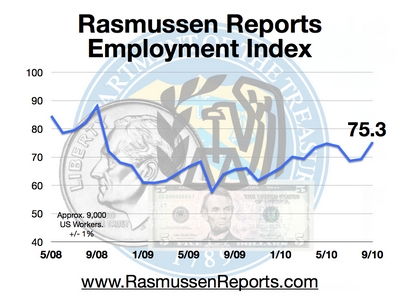
The unemployment rate is still higher than anyone thought it would be by now. But the Rasmussen Employment

Confidence Index is higher now than it has been for two years, and there are plenty of other positive trends indicating that things are moving in the right direction. But the Republican propaganda machine has been very, very effective at spreading misinfor- mation, misinformation that fosters and foments hate and fear — this despite a plethora of facts that are readily available on-line, in periodicals, and on all the news networks (except Fox) that discredit the smear campaigns.

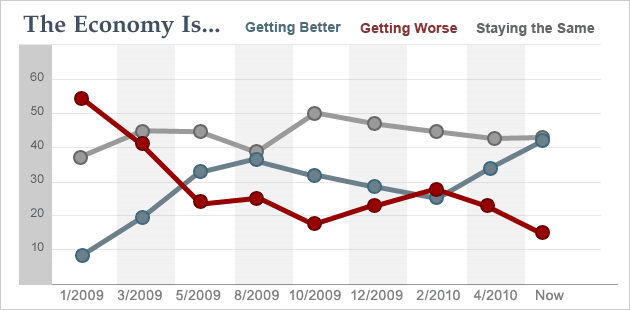
Americans’ opinions on the economy are improving too. According to a recent CBS News/ New York Times poll,

Americans are more optimistic about the future of the economy than they were last month. Forty-one percent of Americans now say the economy is improving, up eight points from April and more than at any time during this recession. Just 15 percent think the economy is getting worse, according to the poll. Even so, all the president got was a slight bump in his approval rating back in May.

I attribute the apparent dichotomy between the president’s approval rating and what’s really going on with the economy to ignorance, bigotry and gullibility. Much of the president’s credibility problem, I believe, is based on the fact that he is African-American with a funny-sounding name. These reasons, plus having had a father who was from Kenya has made him the target of an e-mail smear campaign. I get them and you probably do too if you spend any time corresponding with friends and family by e-mail and any of these people are associated in any way with the Tea Party, the religious right, or one of the many white supremacist groups in America, including a large number of resurging extremist militia groups.

FactCheck.org has responded to many many inquiries about chain e-mails (what I have called viral disinformation) and has concluded that the vast majority of them are categorically false or, at the very most, distorted half-truths. Should you get a chain e-mail forwarded to you and you wonder about its validity, go to http://www.factcheck.org/ask-factcheck/hot-topics/. You’ll probably find it or a version of it listed there with a link to full expose.

Please feel free to post a comment in response to this post, whether you agree or not.

Published in: on October 6, 2010 at 8:23 am  Comments (3)  

High Unemployment ~ Is Nine-plus Percent The New Normal?

Making the Bush/Cheney tax cuts permanent, and reducing government spending to 2008 levels isn’t going to fix what’s ailing our economy.

September 15, 2010   No one is happy with the slow recovery from the deepest recession in the U.S. since 1929, not with unemployment levels hovering around 9½ percent. Voters in the upcoming 2010 mid-term elections certainly aren’t, and many blame the party currently in control of the Congress and White House for failing to fix the problem. But what they don’t know, and neither politicians nor economists in any numbers are telling them, is that recovery from declining Gross Domestic Product (GDP) numbers and high unemployment rates are not are not fixed at the hip. They never truly have been.

If everything was as it was prior to NAFTA, the Free Trade Agreements that started in 2001, and ongoing pressure from the World Trade Organization to keep U.S. markets open to foreign-made products, the number of good paying jobs would be growing faster along with the recovery. They might even be growing fast enough to satisfy the demands of an increasing number of immigrants, both legal and il-, new graduates from high school and college, and increasing numbers of seniors who are choosing to work longer rather than retire. But it’s a new world now, and we just haven’t figured out how to adjust.

The traditional level of “normal” unemployment in this country, which economics text books say is around 6 percent, has been reset as a consequence of the recession that started in 2007 and changes in employment dynamics that started with 21st Century free trade agreements. Layoffs from good paying financial, engineering, manufacturing and construction jobs have sent semi-skilled, skilled and professional workers to fill low-wage service industry jobs in groves. The news is filled with stories of college graduates lucky to have found jobs selling cookies or making exotic coffee drinks. I personally know of a masters-prepared engineer working as a substitute teacher.

So, even though official unemployment rates remained relatively low from 2001 until the beginning of the Great Recession (http://www.bls.gov/), the decline in good paying jobs over this period has been dramatic.

Tables prepared by Charles McMillion of MBG Information Services from government data between 2001 and 2004 showed: employment in primary metals down 24 percent; machinery 21.6 percent; computer and peripheral equipment 28 percent; communications equipment 38.8 percent; semiconductors and electronic components 37 percent; electrical equipment and appliances 22.8 percent; textile mills 34.1 percent; apparel 37.3 percent; chemicals 8.3 percent; plastics and rubber products 13.8 percent; Internet publishing and broadcast 40 percent; telecommunications 19.4 percent; ISPs, search portals, data processing 22.6 percent; securities, commodity, investments 6.8 percent; computer systems design and related 17 percent.

This is the “loud sucking sound” that Texas billionaire and Independent candidate for President in 1992 and ’96, H. Ross Perot, predicted. It’s called “off-shoring.” And, no doubt, the resulting transition from a manufacturing-based economy to a service and hospitality-based economy has continued to the present day. But people can eat only so many cookies and drink only so many coffee lattes.

Economists have apologies, but no real explanations, for the loss of jobs in tradable goods and services. They are careful not to blame outsourcing of manufacturing and service jobs, which they claim creates as many new jobs as it loses. But does it? Certainly, the people who are benefiting from outsourcing want us to think it’s good for the economy. But it is not true that free trade benefits both participating parties. It’s more complicated than the simples examples I have taught in macro- economics classrooms to illustrate David Ricardo’s competitive advantage. In all transactions, there are winners and losers. And in today’s world, the United States is losing.

For years, as U.S. multinationals moved manufacturing jobs offshore, Americans have been told that their future was in “knowledge jobs.” Today, however, according to a recent Harvard Economics paper, knowledge jobs are being moved offshore even more rapidly than manufacturing jobs.

So, what are our unemployed computer engineers and information technology workers supposed to do? The answer offered by many economists is:  retrain. But retrain in what? What high value-added job can’t be outsourced?

Without government subsidized construction efforts to modernize our infrastructure, research efforts to reduce our dependency on foreign oil, and tax incentives for businesses that create and keep new jobs here in America, the kinds of things that President Obama is talking about doing, all I can think of are those that happen to be in the nontradable service sector — lawyers, dentists, and surgeons, and such. But if everyone becomes a dentist or a surgeon (we’ve already got too many lawyers in my opinion), the incomes for these professions will only be driven down.

As this trend continues — as decent-paying  jobs with benefits in America become more and more difficult to find, more and more Americans are deciding that it simply doesn’t make any sense to try anymore, not when they can draw unemployment for extended periods and qualify for food stamps and other forms of relief. This drives the unemployment rate up and keeps it up over the long term. So, yes, a nine-plus percent unemployment rate could indeed be the new normal. And it’s not likely to decline much regardless of with political party is in power until the baby-boomers start retiring in greater numbers effectively reducing the civilian workforce.

Ralph E. Gomory and William J. Baumol have written an important new work in trade theory (Global Trade and Conflicting National Interests, MIT Press). They argue that it matters very much which industries and occupations countries retain, and they challenge the assumption that free trade always produces mutual gains. They establish that, in many cases, perhaps a majority of cases, gains for countries come at the expense of other countries.

Accordingly, just making the Bush/Cheney tax cuts permanent and reducing government spending to 2008 levels isn’t going to fix what’s ailing our economy. Sorry Mr. Boehner, you’re wrong. Making the rich even richer won’t magically create jobs for the middle class; Trickle-down economics is still Voodoo economics. The recovery has been slow, according to the Fed Chairman, because Americans who are still working aren’t spending as they did before the recession. They learned a hard lesson. They are Cutting-up their credit cards, paying off their debts and saving to hedge against fears of a double-dip recession. No, to put Americans back to work in good paying jobs, jobs that will provide sufficient incomes so that demand for goods and services will increase (the only thing that will motivate the expansion of production), will take more than just trusting the Invisible Hand of free trade.

Wouldn’t it be nice if things really were that simple?

Please feel free to post a comment whether or not you agree.

Published in: on September 15, 2010 at 8:10 am  Comments (7)  

A Short Civics Lesson ~ Republican Claims Debunked

The politics of hate and fear are still very much a part of the American political system I’m afraid.

September 7, 2010   First showing up back in February of this year on the website of a candidate for Congress was an article entitled “A Short Civics Lesson”. The article was highly critical of President Obama and his handling of the economic crisis now remembered as The Great Recession. It was rife with misinformation and distorted facts. Notwithstanding, the article has been copied and pasted both verbatim and with modifications to others’ blogs and websites since then, especially on those supporting the so-called Tea Party. Now this article is being circulated as an email with the addition of a deficit spending graph created by The Heritage Foundation, a think tank dedicated to promoting and justifying conservative policies.

Among the article’s claims are:

  1. that presidents aren’t responsible for budgets;
  2. that the House and Senate, when controlled by Democrats, bypassed the president to pass continuing resolutions;
  3. that President Bush constrained Congressional spending during his first year in office, and;
  4. that Barrack Obama was personally responsible for the deficit that he claims to have inherited from Bush.

Read the article for yourself if you’re interested at  http://runningforcongress2010.blogspot.com/2010/02/short-civics-lesson.html.

There’s been a lot of this kind of thing going around, originated by people who sincerely believe that the ends justify the means. However, the “Short Civics Lesson” is most disingenuous.

Responding to the article’s first claim: Budgets do in fact start with the president then end up back on the president’s desk to be signed into law after Congress has had their way with them. Budgets are, in-effect, collaborative efforts. Yes, Congress always does send budgets (spending bills) back for the president’s signature considerably altered from what he asked for and they are usually ladened with pork. But Republican-controlled Congresses have historically been just as guilty of this as Democrat-controlled Congresses (see my earlier posting: Americans’ Political Persuasions ~ Based More on Myth than Facts).

Responding to the article’s second and third claims: It is not at all true that President Bush constrained spending by Democratically controlled Congresses. In fact, the graph included with the forwarded email neglected to include the off-budget spending during the Bush years for the wars in Iraq and Afghanistan to the tune of over $5 billion per month http://www.roanoke.com/editorials/wb/xp-25651. Democratic members of Congress actually cooperated with the president by approving a series of off-budget emergency appropriation requests to fund the wars in Iraq and Afghanistan. The graph also shows projected deficit spending by the Obama White House assuming the Bush/Cheney tax cuts are made permanent.

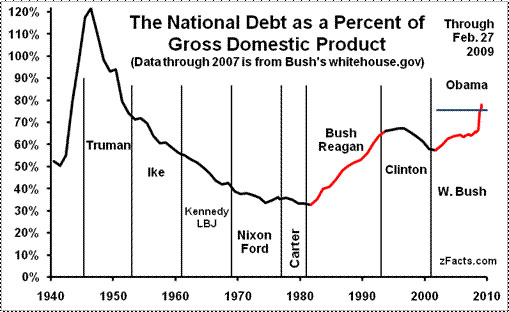
In truth, the only president since Jimmy Carter to constrain out-of-control spending by Congress was Bill Clinton, as the following graph shows. But deficit spending during Obama’s first term has so far only been in response the recession, part of his administration’s expansionary fiscal policies which has included tax cuts and credits for most Americans.

The above graph was created using George W. Bush White House budget and spending data by Z-facts.com. It is contained in an article on-line at http://zfacts.com/p/318.html.

Now, a Short History Lesson in response the fourth claim in the Short Civics Lesson article:  Many Republicans in both the House and Senate voted in favor of the Emergency Economic Stabilization Act of 2008, which authorized the Secretary of the Treasury to create the Troubled Asset Relief Program (TARP) to provide aid to banks and other financial institutions. John McCain voted for it as did Mitch McConnell. Indeed, on September 29, 2008, 65 House Republicans voted in favor of H.R. 3997, the original House vehicle for the act. After that legislation failed, on October 1, 2008, 34 Senate Republicans voted for H.R. 1424, the new vehicle for the act, and on October 3, 2008, 91 House Republicans voted for that bill. President Bush, a Republican, subsequently signed it into law.

So, the nation’s economic problems did begin long before Obama was elected and sworn-in. The fact that Obama voted for H.R. 1424 does not prove that he generated the mess he inherited. Governments during the Regan, Bush 1 and Bush 2 years did. Let’s have a little truth in advertising here, folks!

True, Democrats in Congress are facing an up-hill battle to retain control with latest polls showing an ever-increasing number of Americans disapproving of both Congress and of the president’s handling of the economy http://www.realclearpolitics.com/epolls/latest_polls/. Thirty-three percent of those recently polled by CNN actually think the president’s handling of matters has made things worse. Why do they think this? Because of misinformation contained in this kind of political propaganda. The politics of hate and fear are still very much a part of the American political system I’m afraid.

Please feel free to post a comment whether pro or con.

Published in: on September 7, 2010 at 11:55 am  Comments (5)  

Grandma’s Kitchen ~ An Economics Lesson on Fiscal Policy

I remember my great grandmother’s farm-house kitchen. With a cast iron stove burning wood and chunks of coal, it was the only warm place in the whole house in the winter.

September 1, 2010 — I woke up this morning to a comment posted in response to an article I wrote some time ago. The article was on the latest global warming deniers’ crock, namely that more CO2 is good for the environment. The comment was on the negative aspects of government stimulus spending, which seemed to me to be irrelevant to the original posting until I reread my article. Yes, I did mention stimulus spending. I mentioned it in the context that I thought then and still do that the first priority for government at this time is acting to restore the economy, that making noise in opposition to established science on climate change or protesting the building of an Islamic center blocks away from Ground Zero for that matter is just distracting voters from the more immediate issue, the economy.

It is troublesome to me that, in their zeal to spread misinformation about Obama administration policies, people are plastering counter arguments and criticisms, usually riddled with false information and logical fallacies, everywhere on the Internet.

To the point — I thought I might bring my reader’s comment to the surface in the form of a new posting so that we all might have a chance to respond. My reader, who calls himself Warren, said, “Stimulus spending??? This is the surest way to destroy the economy. Stimulus spending consumes wealth, it does not create it. If stimulus spending had a net, long term, positive benefit, then why dont we just forget about the private sector and just keep stimulating through government spending?”

Obviously, Warren is a Libertarian who subscribes to the Austrian School of economic theory, else he is just parroting something he has heard from the likes of Ron Paul .

This was my response to Warren: “Speaking of stimulus… I remember my great grandmother’s farm-house kitchen. With a cast iron stove burning wood and chunks of coal, it was the only warm place in the whole house in the winter. I spent plenty of time playing on the floor of grandma’s kitchen, playing with her trusty mouse exterminator, Fluffy the cat. Fluffy loved to chase empty thread spools rolled across the floor. But like most good capitalists, she never got the hang of bringing ’em back.

Beside grandma’s galvanized steel kitchen sink was a small water pump. Next to the pump always sat a cupful of water. This was used to prime the pump, which was necessary before any amount of hand pumping would bring water up to the sink. If she or anyone else failed to refill the cup, she would have to go out to the rain barrel next to the house to get more “stimulus”. In the winter, the stimulus was frozen solid so she would have to chip away at it to bring small chunks of it in to melt on the stove. This took time. If the rain barrel was empty, she either had to trek down to the irrigation ditch a quarter-mile away or borrow some stimulus from a neighbor. Similarly, the economic policies of the past admini- stration have left us with an empty cup, so it’s going to take more stimulus spent over a longer period than anyone would want to get things flowing on their own again.

Once the economy is growing more robustly and people are again working for living wages, we must never again forget about grandma’s priming cup.”

Because every dollar spent becomes somebody else’s income, income to be spent or saved in varying amounts over and over again, spending, whether by the private  sector or by the government, does create wealth. This is called the Spending Multiplier concept, a well established basic principle of fiscal policy in macroeconomics. It is cousin to the Money Multiplier concept which focuses on expanding the money supply generated by bank lending. Spending in a market economy is important. It represents demand for goods and services, and it is demand after all that motivates businesses to expand production and rehire laid-off workers. Supply does not create its own demand, a la Say’s Law. No credible economist today believes that it does. You’re right about one thing though, Warren. Given that government’s current stimulus spending is being accomplished with borrowed money, it is creating ‘negative’ wealth. Let’s just hope that when the economy starts moving on its own again that lawmakers remember grandma’s priming cup and that they have the wisdom and resolve to never again leave it empty.

Please feel free to post a comment whether pro or con.

Published in: on September 1, 2010 at 10:43 am  Comments (2)  

Zombie Lies ~ Discredited Distortions of Truth that Refuse to Die

Even if we do end up having to pay a little bit more for our energy in the short-run, this is the price that we must pay for energy independence in the long-run, which translates into improved national security and a stronger economy for future generations.

Brian Young, writing for Truth Fights Back dot Com, has sent out an appeal for help combating viral disinformation and misguided statements from Republicans like Rep. Joe Barton and their powerful corporate allies. His message was titled, “Zombie Lies.” That’s what Economics Professor and New York Times’ editorialist, Dr. Paul Krugman, calls discredited distortions that live on, repeated over and over again long after they’ve been proven false. Well, this week, the Undead Talking Points run wild all over the debate on how to limit carbon pollution and break our addiction to oil, most of which that we use being imported and much of that from countries whose people don’t like us very much. These talking points all share the same two phrases: “job killing” and “tax.”

If you have the time, I’d like to share his message with you.

First of all, he said, we have an industry front group running ads in DC using the “job killing” zombie about the American Power Act. Never mind that this group – the American Coalition for Clean Coal Electricity – was once busted for sending forged letters to Congress, letters claiming to be from minority groups that never sent them. That should tell you all you need to know about the veracity of this group’s claims.

The truth is that the American Power Act has been studied thoroughly by legitimate non-partisan groups such as the Peterson Institute for International Economics, and all major studies show that it will create millions of jobs. The only jobs that the act will kill will be those of the PR flacks pushing these discredited attacks.

Second, two Republican Senators released a “report” this weeks that’s so stale and discredited that they didn’t even bother to update the pictures from the last time they trotted out the same talking points to attack an entirely different piece of legislation. This “report” claims that billions in new taxes are included in the American Power Act, but there’s not a single dollar in taxes in the entire bill. Republicans just like to label anything government does to change the status quo for business as a tax because much of increased costs of production for businesses are typically passed on to consumers. However, according to the Peterson Institute study, the American Power Act could end up actually saving Americans on their energy costs.

Yes, by pricing carbon, the American Power Act will raise the price of fossil fuels for both businesses and consumers. Households will see an average increase of 3% in electricity rates and 5% increase in gasoline prices between 2011 and 2030, according to the Peterson Institute study. But energy efficiency improvements will largely offset these energy price increases. Accordingly, house- holds will see somewhere between a $136 increase and a $35 decrease in average annual energy expenditures – this depending on future improvements in vehicle efficiency. But, even if we do end up having to pay a little bit more for our energy in the short-run, this is the price that we must pay for energy independence in the long-run, which translates into improved national security and a stronger economy for future generations. But unlike a tax, this small increase in the cost of energy is a cost that individuals and businesses can chose to pay or not pay by moderating wasteful energy consumption habits.

By supporting the American Power Act, we can guarantee our children a cleaner, greener future and break our addiction to fossil-based energy and our dependence on petroleum imports. But to achieve this, we can’t let the debate get sidetracked by the politics of greed and fear. Oil is washing up on our shores, the climates is growing dangerously more unpredictable, and all the other side manages to do is to apologize to the big oil polluters and repeat the same ole, glassy-eyed attacks on science and main-stream economics.

Enough is enough! Let’s stand up for the truth and let the obstructionists know that we really do want change, that we are willing to sacrifice a little “skin” for a healthier, safer tomorrow. Make a donation, as I have done, to publish ads that communicate the truth about this legislation, ads that will combat the lies and distortions. You can do so through the TruthFightsBack website.

 Please feel free to post a comment, whether pro or con.

Published in: on June 24, 2010 at 11:56 am  Comments (1)  

Resisting Progress ~ More Lies and Distortions About Pending Energy Legislation

Like the health care and financial reform efforts, energy and climate change legislation will be another Big F _ _ _ ing deal. Accordingly, the political gamesmanship in Washington continues with the mid-term elections right around the corner.

The Senate’s version of the Waxman-Hartley Clean Energy bill in the House is called the Clean Energy Jobs and American Power Act (S.1713). The bill provides for the establish- ment of a cap-and-trade system for green- house gas emission allowances and sets goals for reducing these emissions by 20 percent by 2020 and by 83 percent by 2050. It’s been pending debate in the Senate for more than a year now with legislators’ efforts committed first to the health care issue and most recently to financial reform (seems like the wheels of progress in Washington can only travel down one major road at a time).

Like the health care and financial reform efforts, energy and climate change legislation will be another Big F _ _ _ ing deal. Accordingly, the political gamesmanship in Washington continues with the mid-term elections right around the corner. Whether this or the immigration issue will be tackled next is anyone’s guess, however.

Following last week’s pronouncements by the bill’s sponsor, John Kerry and likely co-sponsor, Joe Lieberman, the distortions from the right started flowing faster than oil from BP’s on-going disaster in the Gulf of Mexico. One came in the form of an email from Newt Gingrich’s 527 political action committee (PAC), American Solutions For Winning the Future. The email sums up the main distortions from those fighting reform in a single word: tax.  Big Oil lobbyists and their politician spokespersons use that word repeatedly. In fact, in a single sentence of Newt’s email, he uses some form of the word five times. But repeating something over and over again doesn’t make it true. The truth is that there is no energy tax in the bill at all.

Newt’s a master politician. He knows what he’s doing. He knows that his constituents are fearful of new taxes and he knows that if he harps on the subject enough, more and more Americans will begin to believe it. But he also knows that taxes are not part of this legislation so he’s confusing taxes (the levy of financial charges by government upon an individual or a legal entity such that failure to pay is punishable by law) with the specter of rising energy costs. But energy costs for both businesses and consumers, according to a new study by the Peterson Institute for International Economics, a private, non-partisan, non-profit think tank, could actually go down, offset by improvements in energy efficiency over the long-haul. The study counters another claim that Gingrich’s PAC hints at too, warnings of harm to our economy. The truth is that the American Power Act would add over 200,000 new clean energy jobs every year to the American economy. But maybe most important, the Peterson study concludes that the American Power Act would lower our imports of foreign oil by 40%, thus putting America back in charge of our own energy, curbing our addiction to oil, stemming the flow of American dollars to countries that don’t like us, and reducing our trade deficit which dimishes the rate at which our economy can grow. What we pay for foreign oil accounts for half or more of our annual trade deficit.

Less oil, reduced risk to the environment and to other sectors of our economy, more jobs, and lower total energy costs in the long-run. That’s the truth about the American Power Act, not the misleading claims of Newt Gingrich’s PAC and others lobbying on behalf of the unsustainable status-quo and big profits for coal and oil companies. But you don’t have to take my word for it, read the Peterson Institute’s study for yourself.

 Please feel free to post a comment whether you agree that we need a comprehensive energy plan or not.

Published in: on May 22, 2010 at 2:12 pm  Leave a Comment  

Welfare and Poverty ~ Is it a Chicken-or-Egg Relationship?

The real reality check here is that some people are willing to distort the truth or just make stuff up in order to spread their beliefs. This is called propaganda.

May 2, 2010  —  I recently received a forwarded copy of what I like to call a viral disinformation email. It was shared with me by a good friend of conservative persuasion. Yes, I do have conservative friends. The title of the message, which is currently making the rounds, is “This is an Interesting Reality Check.” It purports to be a history lesson about the Second World War and its aftermath. It includes pictures of what was left of Nagasaki and Hiroshima after the atomic bombs that were dropped on these cities in August of 1945. Additional pictures show how these cities look today – brightly-lit, towering skyscrapers and modern, efficient highways contrasted with recent scenes of the blight that has taken over Detroit, Michigan since the end of the war.

The bottom line of the message read: “Why, you ask?…… real simple…… Japan doesn’t have welfare…..and you are damn sure not going to be in their country illegally…..”

The message offers an interesting premise, but the conclusion is fallacious. It’s a prime example of the “questionable cause” fallacy. This fallacy is committed when a person assumes that one event must cause another just because the events occur together. The mistake being made here is that the causal conclusion is being drawn without adequate justification. The conclusion seems valid to some because it enforces an already-held opinion or bias. But, in addition to the logic issue, the author of this message has either knowingly misrepresented the facts or knows nothing of Japanese economic/social organization (Alliance Capitalism).

The real reality check here is that some people are willing to distort the truth or just make stuff up in order to spread their beliefs. This is called propaganda http://en.wikipedia.org/wiki/Propaganda. You see, Japan actually does have a welfare system. It relies more on family and corporations and less on the government, true enough. But government in Japan does chip-in failing assistance from the primary sources. Japanese, culturally, are more committed to family honor and respect for their elders than Americans ever thought about being, and Japanese companies care about and for their employees, whereas American companies, by in large, do not. Labor in America is expendable in the face of profit pressures, and many employers here have no qualms against hiring illegals so as to reduce labor costs at the expense of citizens. The truth is never quite so simple.

Read all about Japanese capitalism if you have the time and inclination at http://books.google.com/books?hl=en&lr=&id=wMeir3lIbq8C&oi=fnd&pg=PR9&dq=japanese+capitalism+versus+american+capitalism&ots=gNBsd7gYK3&sig=jBegXFwFJxg1wZZiirEsygBHALo#v=onepage&q&f=false

Please feel free to post a comment on my blog about this. And, if you’d like to receive a copy of the referenced message including the photos, indicate so in your comment. I will forward a copy to you.

Published in: on May 2, 2010 at 8:08 am  Leave a Comment  

Overcoming the Great Recession ~ Seven Things That We Need to Do

 George Santayana, philosopher, essayist, poet and novelist, famously said, “Those who cannot remember the past are condemned to repeat it.”

Thanksgiving Eve, November 25, 2009  In the wake of growing doubts about the President’s handling of the economy, doubts fomented by his political opposition, Treasury Secretary, Timothy Geithner, was grilled last week by Conservative members of the Joint Economic Committee, grilled and asked to resign over his “mishandling” of TARP and economic recovery funds.

To many Americans, this criticism would seem to be justified. Obviously, many bailed-out banks and Wall Street firms have not used tax payers’ dollars as intended, i.e, to make badly-need loans to struggling small businesses. Then too, despite the Treasury’s stated “strong dollar” policy, we have witnessed the dollar suffer historic declines against foreign currencies in recent weeks. Even though the stock market is soaring, the jobs picture grows worse day-by-day despite the holiday season’s temporary jobs. And just to make matters worse for the Administration, bogus jobs data were discovered last week on the White House’s Recovery Act website.

Welcome home from the Asia-Pacific Economic Cooperation summit in Singapore and your four-country Asian rim tour, Mr. President. Too bad you couldn’t get our biggest trading partners, China and Japan, to agree to more equitable terms. But, did you really think they would? Maybe they’ll grow softer after we grow more firm; afterall, we’re still their best customers.

Hmmm… it seems to me like there’s something wrong with this scenario, which is why I’m on the sidelines now with my brokerage account.

There can be little doubt that this economy, the worst since the Great Depression, isn’t going to turn around on a dime anytime soon. In fact, we likely won’t see any real improvement on the jobs front until after next year at best, and housing values may take a decade or more to recover to last year’s levels – if ever indeed they do. So, here we go again – no psycho talk here, folks, just history which has a funny way of repeating itself.

Herbert Hoover and a Congress controlled by Republicans got us into The Great Depression. Yes, despite conservative claims that New Deal program spending actually delayed recovery, things got worse in 1937 after Congress turned-off the money spicket. So  it took WWII to get us out of that economic money-pit. Then, after decades of economic expansion, Ronald Reagan put us on the path to this, The Great Recession, by reducing taxes and massively increasing spending. Yes, he did break the back of the Evil Empire with his spending, but we are paying the price in spades for this today. George H. W. Bush, too late, tried to increase revenues to curtail deficit spending and paid the ultimate political price for a Republican by failing to honor his promise not to increase taxes. Bill Clinton increased taxes and refused to let Congress spend more than the government collected. But he contributed in his own way to today’s recession by negotiating Free Trade agreements without “fair” trade protections for American industries.

Then came George W. Bush who, like Reagan before him, reduced revenues with promised tax cuts to get elected then allowed Congress to increase spending. Both acts were politically smart but economically foolish. To his credit, though he probably had no idea of what he was doing at the time, he started moving us away from recession by declaring the War on Terror. But rather than putting Americans back to work producing tanks, landing craft, airplanes and aircraft carriers, he mostly threw money at bankers by promoting an Alan Greenspan proposal that banks should make high-risk mortgage loans (adjustable rate mortgages) to marginally credit-worthy families. Rather than asking Americans to make sacrifices to pay for the war through higher taxes or with war bonds, he and Congress authorized unprecedented borrowing year after year.

Now, more than eight years later, we are in the middle of the worst economic slump since 1938 and we all better hope that Obama can fix it because, without aggressive employment of economic accelerators afforded by both fiscal and monetary policies, we could indeed experience depression-era conditions once again. Deficit spending is never desirable, but now it is unavoidable. Unfortunately, as in the Great Depression, Congressional Conservatives would rather see the economy crash and burn than see Democrats succeed.

George Santayana, philosopher, essayist, poet and novelist, famously said, “Those who cannot remember the past are condemned to repeat it.” How right he was. Unfortunately, they — those who cannot remember the past — could well drag the rest of us with them back to the worst of times.

To illustrate the facts presented above, please consider the following graph provided by ZFacts.com:


Lesson planning for my AP Macro class and preparing my upcoming lesson assignment challenge for students on balancing the nation’s budget, I have researched on-line the actual, historical values for Gross Domestic Product (GDP) and our National Debt Outstanding by year from Treasury Department records. Calculating the ratio of national debt to GDP in Excel, looking just at values for every five (5) years from 1950 to the present, I was able to almost exactly duplicate the ZFacts graph. If you doubt my sincerity or my honesty, you may download my Excel spreadsheet to check data sources, my calculations and my conclusions by clicking this hyperlink.

Okay, so how do we get out of the mess that has been left for us by the trickle-down, buy-now/pay-me-later crowd? The main thing to remember is that, with consumer spending down, businesses are going to continue laying people off — not hiring them. You can’t blame businesses for doing this. It’s just a vicious cycle that the economy gets into. And you can’t blame consumers for not wanting to spend in bad times. So, the only way out of this, if we don’t want to wait forever for the “free market” to recover on its own, is for the government to spend, pay unemployment insurance, and/or give tax breaks to people who will spend, and this doesn’t include the rich; their propensity to save rather than spend is much higher than the majority of taxpayers. Additional recommended measures, the seven things I think we need to do, follow:

1) Stop bailing-out Wall Street and just take over failing banks, investment and insurance companies. Once they’re working again under reasonable oversight regulations and enforcement, they can be sold back to the private sector.
 
2) Don’t wait for the Bush tax cuts to expire after 2010. Roll them back now for those at the top who most benefited. This will help defray the cost of sending more troops to Afghanistan. While in the process, pass corporate tax reforms favoring companies that create jobs for Americans rather than doing business by exporting jobs to other countries.
 
3) Plan and work toward organized withdrawals from both Iraq and Afghanistan soonest. Money spent overseas in vain attempts to avert future terrorist attracts rather than spending it here at home on jobs and social goals for Americans just contributes to further weakening of the U.S. dollar and to al Qaeda’s goals. Dollars flowing overseas is “leakage” from our own economy.
 
4) Pass healthcare reform legislation this year, reform that improves the availability and quality of care while reducing future costs. Failing to do this will result in the government’s default on legislative safety net promises and fiscal bankruptcy in our lifetimes.
 
5) Pass Cap and Trade legislation mandating reductions in carbon emissions. This will generate new, good paying construction and manufacturing jobs for Americans, jobs that cannot be exported. This will bring down energy costs ultimately and reduce the trade deficit. We cannot continue borrowing from China to buy Canadian, Mexican and Saudi oil indefinitely. As a side benefit, this will inspire other nations to join with us in measures necessary to save the planet for posterity.
 
6) Prioritize educational reforms based on tried and proven solutions rather than on failed political priorities. Single-size curricula do not fit all and the fastest growing student demographics are poor inner-city blacks and Hispanics with limited English skills. These are tomorrow’s workers.
 
7) Pass new anti-trust legislation and begin the rigorous enforcement of regulations against excessive financial risk-taking and oligopolies’ (near monopolies) abilities to reduce free market competition through mergers that concentrate sector control over production and thereby prices.   

Once we’re out of this particular money-pit and the economy is once again expanding on its own, we’ve got to somehow find the resolve as a nation to stop spending more than we take in.

Pity the demise of Big Banking, Big Oil, Big Pharma, Big Retailer, and Big Insurance company’s profits if you wish, but they have been gorging themselves from the economic vitality of this nation, common men and women, for years. In 2004, according to the Federal Reserve Board,  the top 5 percent of this country controlled more wealth than the rest of the nation combined. After nearly nine years of tax cuts favoring the rich, surely this imbalance is even greater. This relentless capillary rise of wealth from those who do the work to those who direct the work cannot continue indefinitely. These are conditions that spawn revolution.

All seven of the above measures pose short-term economic and political costs since many Americans are entrenched in principle-based, what’s-in-it-for-me political thinking and have an unhealthy disregard for the lessons of history. They fail to see beyond the ends of their noses. However, failing to act in the long-term interests of this country risks the economic if not physical survival of future generations. Our national preeminence as a super power has already been substantially diminished.

In spite of it all, have a wonderful Thanksgiving . We still have much to be thankful for.

I invite your comments, pro or con.

Published in: on November 25, 2009 at 5:18 am  Leave a Comment  

Capitalism — The Good, The Bad and The Ugly ~ Teaching Students How to Think vs. Teaching Them What to Think

Sadly, when it gets to the point in Texas that teachers must teach the truth in “public” schools only as social conservatives in this state are privileged to know the truth, it will be time for me to retire or find something else to do until I do.

opaSeptember 7, 2009  —  From day-one in my high school economics classes, I assure my college-bound students that my goal is not to teach them what to think, but rather how to think. I tell them that, if we are to have the freedom and ability to make up our own minds about controversial subjects, we must be exposed to facts, theory and opinion from all sides — without prejudice. They, for the most part, seem to accept and respect this as a given.

Introducing the subject of an economics lesson to my high school seniors last week, Capitalism and Free Enterprise, I quoted an Anglican Priest, W. R. Inge, who said or wrote, “The enemies of freedom do not argue, they just shout and shoot.”

I gather what Reverend Inge was saying is that, for freedom to thrive, people must be willing to engage in “reasoned” argument – that when we refuse to consider others’ arguments or stop listening to facts and start making things up to distract others from real issues, we are obstructing the democratic process and are, therefore, enemies of freedom. Now, this I did not say to my classes, but we’ve seen a good deal of shouting taking place in town hall meetings all across the country this past month. Have we not? We’ve also seen individuals showing-up at these meetings with loaded weapons, weapons they insisted were not brought to intimidate people with whom they disagree. Awhhh… give a break!

Inge was a professor at Cambridge University and a prolific author who wrote scores of articles, lectures and sermons. He also wrote over 35 books but was best known for his works on Plotinus and neoplatonic philosophy, and on Christian mysticism. He was a believer in spiritual religion — faith based not upon coercive authority but on experience and individual inspiration. Obviously, he was a pragmatic person. I can’t find any reference to his political leanings though. If he had any, he probably kept them to himself because, as in the U. S., I assume religious leaders and educators in the U. K. are pretty much expected to be apolitical. But I’ll just bet that, if he ever did vote, he voted for candidates representing either the Social Democratic Party or the “old” Liberal Democratic Party of the U.K.

I shared none of my speculation about Inge’s politics with my students, if he had any politics. Teachers in Texas are expected to be apolitical too, especially if they lean at all to the left, don’t you know? But as I write this now, I’m struck by how I was teaching this lesson last week while some parents in Texas were calling school boards and principals to threaten keeping their students out of school if they were allowed to watch President Obama’s return-to-school address to students. Sadly, when it gets to the point in Texas that teachers must teach the truth in “public” schools only as social conservatives in this state are privileged to know the truth, it will be time for me to retire or to find something else to do until I do. With the Texas Education Agency (TEA) review committee, stacked as it is with like-thinking social conservatives to rewrite the Texas Essential Knowledge and Skills (TEKS) for social studies subjects according to right-wing, radical political philosophies and beliefs, that time may be upon me sooner than later.

No, my point in using Inge’s quote was not to indoctrinate my students with “liberal” ideas. It was to get my students to think beyond the limits of our textbook lesson on capitalism – to think on a higher level – to get them to understand why some living outside the developed world are reluctant to embrace western-style capitalism, why they view our system as just another form of imperialism, an economic form. Scholars of the Islamic faith and Southwest Asian history say that this is behind much of the hatred directed toward the U.S. and European countries — why some in the Islamic World have become so militant, choosing to shout and shoot rather than accept the possibility that they could be wrong.

After discussing current economic events, including the story that broke last week about the average annual compensation for CEOs of the twenty largest banks and financial institutions in the U.S. exceeding $13,700,000 each, we covered the characteristics and merits of capitalism. These CEOs, by the way, head-up the very businesses that received most of the tax-payer funded Troubled Asset Relief Program (TARP) money last year and this. The compensation of these CEOs is more than thirty-five times as much as our president makes and more than 400 times as much as the average tax-payer.

Although not included in our text book, it is true that the roots of capitalism can be traced back to the Golden Age of Islam and the Muslim Agricultural Revolution that took place between the 8th and 12th Centuries. Europe was still in transition from Feudalism to Mercantilism and would not begin to adopt “free market” concepts until after Adam Smith’s landmark book, The Wealth of Nations published in 1776. It is also true that capitalism, the American version of it, is based on the concept of economic freedom, the idea that we are free to pursue any business we choose anywhere in the country, or outside the country for that matter, that we choose to make whatever products and provide whatever services we wish – so long as our choices don’t harm others or at least aren’t illegal. It is also true that, in America, the concept of economic freedom implies that there should be a minimum of government restrictions on businesses, that we trust the market place to punish irresponsible behavior. But this tenet differs from other western market economies wherein governments have become more involved – more shared (socialized) since the end of WWII.

Some in America believe that economic freedom is a synonym for Free Enterprise, and that Free Enterprise is simply the English translation of Laissez-Faire (meaning no government involvement whatsoever). But, as we have learned from recent experience following the deregulation of financials in this country, Adam Smith’s Invisible Hand does need a measure of guidance and oversight by regulatory agencies, whether part of the government or not as is the case with the Federal Deposit Insurance Corporation. This is because business under capitalism is driven by self-interest, another characteristic of capitalism, and sometimes this motivating force can lead to greed, excesses, and violation of the public trust.

At this point, I had my students watch a brief video interview of Bill Gates, the most successful capitalist of our time, by the editor of Time Magazine. Mr. Gates spoke of how capitalism has worked well, better than anyone could have imagined, simulating innovation and advances in all manner of products and services. But he also made quite clear that capitalism has worked best for the well-off, increasing dramatically in recent years the gulf between the wealthy and the poor – rich nations and poor nations. Without offering ideas for how to incentivize businesses to do more to alleviate poverty and suffering in the world, using their great potential for profit in altruistic ways, he postulated that they should and that, magically, somehow they will. In support of this great hope, he suggested that the young today have an innate desire to work for socially-responsible businesses and that this will temper corporate greed.

After viewing this video, one of my students suggested that Mr. Gate’s vision for the future of capitalism without government encouragement is overly optimistic. This led to a brief discussion on whether the federal government has the authority under the Constitution to limit excessive compensation. I settled the argument so that we could move on by pointing out that Congress enacted minimum wage, thereby establishing a floor for wages, under the Fair Labor Standards Act of 1938. While people still argue for and against it for its positive and negative impacts on the economy, the law has been upheld by the Supreme Court. Therefore, there is no reason to disbelieve that Congress could not enact a law establishing a ceiling on salaries and other forms of corporate compensation.

Another characteristic of capitalism is that it includes the concept of voluntary exchange – the idea that buyers and sellers can freely and willingly engage in market transactions – that we don’t have to buy products and services offered by a particular business or made here in the U.S. Likewise, businesses are not prohibited from doing business in other countries, even exporting Americans’ jobs for foreign workers. We participate in transactions believing that both buyers and sellers are made better-off there from.

Capitalism, as envisioned by Adam Smith, cannot thrive where there is inadequate competition. When a particular industry becomes excessively concentrated as, for example, health insurance in the U.S. these days, the seller has an excessive advantage in the marketplace. Prices will outpace average inflation for all other goods and services.  That’s when, as our textbook points out, government as a regulator must step-in to somehow restore competition.

Finally, American-style capitalism depends on the concept of private property, to include “intellectual” property, as in copy rights and patents on new technologies. Unfortunately, other countries’ versions of capitalism, such as that which is practiced in China’s “mixed” economy, don’t recognize this as being so important, especially since most of the creative innovation still comes from the U.S. and other market-based economies.

The lesson concluded with the various roles played in capitalistic economies such as ours, the entrepreneur, the government and the consumer. As our textbook points out, when competition is adequate, the consumer is “sovereign,” or king in the economy. This is because the dollars we spend on goods and services act as if they were votes. The choices we make, expressed by the dollars we spend for what we buy and from whom we buy determine what gets produced. Were it not such a contentious political issue and if I could be free to express my personal opinion, I’d have pointed out that this is exactly why President Obama advocates a “public” option for health insurance in the legislative debate over health care reform. Americans these days, unless they are members of Congress or are well-off enough to shop for insurance independent of an employer, have no choice. Therefore, consumers are not sovereign in this particular market; corporations are.

With minimal government regulation and state and local governments’ support for business development, American-style capitalism has clearly made some in this country very rich. This economic formula has also led to miraculous advances in technologies that have improved our material lives and longevity. But there have been down-sides too. The gulf between the rich and the poor has grown and grown to the point that average citizens are worse-off today in terms of purchasing power. Americans’ take-home pay today buys thirty percent less than the average manufacturing wage after taxes did back in the 1970s. Also, with the elimination of most trade restrictions in American-style capitalism, many well-paying jobs have been off-shored to the developing world. So foreigners are benefiting from American-style capitalism right along with the wealthy in this country. So, capitalism is good. It’s also bad and it can be ugly, especially if you’re out of work, can’t afford health insurance, and you get sick. It all depends on your point of view or your political persuasion.

Please feel free to post a comment whether you agree or not.

Published in: on September 7, 2009 at 8:15 pm  Comments (9)