A Democratic Manifesto – Why Democrats Must Prevail in November

“One does not establish a dictatorship in order to safeguard a revolution; one makes the revolution in order to establish the dictatorship.”

~ George Orwell, 1984

Democrats typically don’t turn out to vote in great numbers for mid-term elections. This year must be different. Here’s why…

History’s dictators all came to power the same way, by dividing citizens against one another. They used fear and hate to pit ethnic, religious and racial majorities against minorities, siding always with the majorities. Trump isn’t a dictator, not yet, but he wants to be. He has even speculated about possibly becoming President for Life on day. Accordingly, he’s doing what any would-be dictator would do. With him in the White House we are becoming more and more divided every day. Events are being staged and the media is being manipulated to distract us from the worst of what’s really going on, namely the wholesale destruction of our representative form of democracy. Government no longer represents the people; it represents corporate interests and those who have the money to buy legislative favor. This, my fellow citizens, defines Fascism.

Think about it. The same thing happened in Lenin’s Russia, in Hitler’s Germany, in Franco’s Spain, in Mussolini’s Italy, in Zedong’s China, in Hussein’s Iraq, in Pasha’s Turkey, in Gaddafi’s Libya, in Kahn’s Pakistan, in Assad’s Syria. It matters not whether their regimes were Communist, Fascist, Monarchy or Military, all were authoritarian regimes, all were dictatorships.

Trump, in a revolutionary move supported by a foreign power — Russia, has taken over the Republican Party. This party, since the Equal Rights Amendment, has become predominantly white and holier-than-thou, Evangelical Protestant and Mormon. It’s not the party it was when I was younger — when I was still trying to decide which party best aligned with my beliefs. It has become the party of militant, phony patriotism — the party of anti-intellectuals — the party of anti-gay, anti-immigrant, anti-choice and anti-labor. It’s the party that was long ago co-opted by wealthy industrialists. With Donald Trump now at the head of the party, with both houses of Congress under Republican control, and with conservative justices dominating the third branch of government, the Supreme Court, the revolution has accelerated. Corporations are now people with an unfettered right to buy political favors. The Voting Rights Act is now history, states are free to disenfranchise whole groups of people at will. Now, with Brett Kavanaugh confirmed, the highest court in the land is primed and ready to decide whether a sitting President has absolute pardoning authority and is above the law – immune to indictment.

The Republican Party no longer needs to pretend to be the party of fiscal responsibility, or even the party of family values. The Republican Party can ignore Trump’s many impeachable offenses to include: obstruction of justice, human rights violations, suspected campaign finance law violations, conspiracy to interfere with states’ free elections, and violation of the Emoluments Clause of the Constitution.

The revolution to which I am referring is not the typical blood-bath type of revolution. There has been no armed insurrection, no open warfare between the people and government. Up until recently, it has largely been a quiet, long drawn-out, political revolution with corporate interests gaining more and more influence on our two major political parties, Democrat and Republican, especially Republican. The revolution was put on-hold by mutual agreement between all parties involved during the Second World War. But it started up again soon afterward with the Republican Party making a brilliant move, the Taft-Hartley Act of 1947. The Republican party controlled both houses of Congress then, as it does now, and so, it had enough votes to override President Truman’s veto. With the Act made law, individual states were given the latitude to impose Right-to-Work laws on labor unions. Workers over time lost the right to organize and collectively bargain for fair wages and working conditions, a right guaranteed by the National Labor Relations Act of 1935 (the Wagner Act) and parts of the Federal Anti-Injunction Act of 1932.

The revolution continues today, one political faction against another, corporate interests against individual citizens’ interests. And Donald Trump has come along at an opportune time to accelerate things to his personal advantage.

No, the Republican Party isn’t against everything, seemingly implied by me in a previous paragraph. No, the party is for some things: lower taxes, especially for the rich who are ostensibly our job-creators; for corporate subsidies and high defense expenditures, even for new weapons systems that the military neither wants nor needs; for laissez-faire free trade (deregulated capitalism), and; for stand-your-ground, open carry gun laws. The party protects the Second Amendment they say, so that we can protect ourselves against all-comers, including the “deep-state” government. Unfortunately, this means that we have to have the highest, by far-and-away, gun violence rate per capita of any civilized country in the world. But that’s just the price of freedom, the price of protecting the Constitution.

The party exploits our fears of drug gangs, of bad hombres, of foreign-born and native Muslims (terrorists), and especially our fear of big government, i.e., creeping socialism and a takeover of our freedoms.

The Republican Party exploits passions as well as fears. The Christian majority among the religious in America has been conditioned over recent years to assail against a woman’s right to choose, her right to decide whether to allow a zygote to develop into a fetus and mature into an unborn. But being anti-abortion has not always been a GOP tenant. Republicans supported legalized abortion before the Roe v Wade decision in 1973. Letting women, not lawmakers, decide whether to give birth was in line with their ideological affinity then for individual rights and small government. Republicans were also more likely to prefer abortion over subsequent years of taxpayer-funded support for poor women and children. Moderate Republican governor, Nelson Rockefeller of New York, was a main force behind his state’s abortion reform law in 1970, just as Ronald Reagan, a leader of the party’s rising conservative faction, signed a similar bill in 1967 as governor of California. But, once the school segregation issue was resolved by the Civil Rights Act in 1964, superseding all state and local laws requiring segregation, the party needed a new moral issue for the influx of Evangelical Southern whites. Aided by the strict edict against abortion by the Roman Catholic Church, abortion fit the bill after the Roe v Wade decision was made, and moderate Republican politicians toed the line.

The Republican Party generally gives tacit support to other passions of Evangelical Christians. One of these is to allow, even require, prayer in public schools. Another is to permit religious displays on government property, thus blurring if not eliminating entirely the Separation of Church and State. Some within the party would reverse the recent federal decision to make same sex marriage legal, and they would reinstate the Don’t Ask Don’t Tell guideline for gays serving in the military.

There was a time when, for Republicans, the national debt was a major concern of the party. At least they claimed it was. Party leaders blamed Democratic Tax-and-Spend fiscal policy for it. But the facts did not fit their narrative. When Democratic administrations used expansionary fiscal policy (deficit spending), it was when the economy was left in deep recession by Republicans’ “trickle-down” tax cuts and deregulation. In each case, when Democrats took the budgetary helm, the economy rebounded generating increased tax revenues. So, Republicans cannot make this claim, not with evidence to support it, and especially not since the most recent Republican tax cut. The top 1 percent of Americans will derive over 80 percent of the benefit American Jobs and Tax Cut. The CBO and the Treasury Department are both projecting annual trillion-dollar deficits as a result of it. To bring budgets back into some semblance of balance, Trump’s proposed budget for 2019 makes massive cuts to social programs, even Medicare and Medicaid, programs he pledged to protect before the 2016 election. Now Speaker of the House, Paul Ryan, is pushing to revise Social Security, increasing the retirement age and reducing benefits.

So, why is the Democratic Party a better choice? Here are thirteen reasons off the top of my head:

1. Democrats don’t want to live in the past.  The party isn’t as progressive as some younger voters would like, but it’s moving in that direction. We don’t want to make America Great Again. We want to make America Greater, not just for some but for everyone, making our nation a land which is truly one and truly indivisible, with liberty, justice and opportunity for all. Democrats, for the most part, believe the mantra, Greed Is Good, represents an economic ideology which will never advance this goal.

2. Democrats believe in democracy. We believe in a democratic form of government, one that exists to achieve, as a community, state and nation, what we cannot achieve as individuals. We believe too that government must serve all its citizens. Now, while by our Constitution, ours is a “representative” form of democracy, we cannot fairly and equitably be represented if citizens are not allowed to vote. But Republicans have no problem with, through gerrymandering and restrictive voting laws, disenfranchising people of color, Hispanic heritage and culture, and economic disadvantage, from registering to vote, accessing polling places and having their vote considered with diminished weight.

3. Democrats believe in responsible fiscal policies. Congress and the President are responsible for fiscal policy, which is laws on taxation and government spending designed to influence the economy. Fiscal policy is always in place; that is, there are always laws in effect that determine tax levels and government spending. Fiscal policy which rewards businesses and upper the upper echelons of society in the short term and at the expense of average tax payers is irresponsible. This is not just what Democrats believe. It’s what the majority of economists believe, and for good reason; time and again we have seen what policies like this precipitate — time and again, Democratic Presidents and lawmakers have had clean up the mess that Republican administrations have left in their wake. Trickle-down, supply-side fiscal policies and deregulation are components of a sinister, corporate con game.

4. Democrats are not xenophobic. Democrats recognize and celebrate the fact that, except for the few remaining Americans which are one hundred percent Native American, if there even are any left, we are all immigrants or sons and daughters of immigrants.

5. Democrats are not homophobic. For the most part, Democrats believe the science on gender identity which affirms that LGBTQ are who they are, not by choice but by nature. According to a Gallup estimate, 4.5 percent of American adults identify as being lesbian, gay, bisexual or transgender. The percentage works out to be more than 11 million U.S. adults. Accordingly, these persons are very much a part of our society and they deserve to treated with the same rights, privileges and respect as the rest of us.

6. Democrats are not racist. Not that all Republicans are racist, but, according to Pew Research, 83 percent of all registered voters who identify as Republican are non-Hispanic whites. Many Democrats used to be, the so-called Dixiecrats. But, since the Civil Rights Amendment, they’ve all become Republicans. People do not usually proclaim their racist attitudes. Sometimes they do, like when those “fine people” among the Alt-right and KKK members who marched in the torchlight demonstration in Charlottesville, Virginia. Recall their chant: “Jews will not overcome us!” But my go-to argument du jour for why I believe so many Republicans are racist is that they cannot understand and will not accept that the “Take a Knee” demonstrations by NFL players are acceptable, Constitutionally-protected protests about Black Injustice, protest that have merit with so many young, unarmed black men being killed by police.

7. Democrats support greener energy. We believe the consensus of climate change scientists. Their prognostications of dire consequences for our planet if we do not step up our collective efforts to reduce the warming of our atmosphere scare us to death. ‘Nuf said.

8. Democrats acknowledge the Separation of Church and State. America is not a Christian nation; The Constitution says so. The First Amendment guarantees freedoms concerning religion, expression, assembly, and the right to petition. It forbids Congress from both promoting one religion over others and also restricting an individual’s religious practices. It guarantees freedom of expression by prohibiting Congress from restricting the press or the rights of individuals to speak freely. It also guarantees the right of citizens to assemble peaceably and to petition their government. Literally the First Amendment reads: “Congress shall make no law respecting an establishment of religion, or prohibiting the free exercise thereof.”

9. Democrats support equal pay for women. Women in the U.S. who work full time, year-round are paid only 80 cents for every dollar paid to men — and for women of color, the wage gap is even larger. It’s long past time to close the gap. The free market has no incentive to make this happen. So, if women will ever be treated fairly, equitably in America, government must. But Republicans will never do this.

10. Democrats support a minimum wage increase. It’s been nearly 50 years since the last time the federal minimum wage peaked. This was way back in 1968. That was the last time the then-current federal minimum wage was on par with the rate with inflation, even though the minimum wage rate was raised back in 2009 to $7.25. Nobody can live on today’s minimum wage, and the free market has little incentive to raise it. So, if we are a society that truly cares about people, believes that corporations should not be allowed to exploit the disadvantaged, then government must raise the minimum wage and index it to the rate of inflation. But Republicans will never do this.

11. Democrats believe that, under most conditions, military action should be the last resort not the first. We believe that we have been too quick in the past to assert our influence on foreign nations by military invasion and occupation. Our invasion of Iraq during the Bush administration, is one such example. Yes, we toppled a brutal dictator. But, in so doing, the world is now reaping the consequences of instability in the Middle East and a widening of International terrorism.

12. Democrats support stricter gun control. The Constitutional right to own and “bear” arms is not absolute. The Supreme Court long ago decided this. But Republicans, under considerable influence by the National Rifle Association (NRA) would like to change this. The new SCOTUS may do so despite the fact that multiple studies from researchers at Johns Hopkins University have found that such “permit to purchase” laws, which include a particularly strong background check, reduce homicides, suicides and gun trafficking. Literature reviews that examine a wide range of gun policies throughout the U.S. also consistently find that these laws save lives.

Research also shows that domestic violence restraining orders with the teeth to remove firearms from abusers reduce intimate-partner homicide. Likewise, banning high-capacity magazines would likely reduce the deadly outcome of shootings. Australia’s ban and buyback of semi-automatic firearms significantly reduced gun deaths in that country.

13. Democrats believe that healthcare is a basic human right. The United States and Mexico are the only countries of the 34 members of the Organization for Economic Co-operation and Development (OECD) that do not have universal health care. We believe that this is deplorable.

On December 10, 1948, the United States and 47 other nations signed the United Nations Universal Declaration of Human Rights. The document stated that “everyone has the right to a standard of living adequate for the health and well-being of oneself and one’s family, including… medical care.” In 2005, the United States and the other member states of the World Health Organization signed World Health Assembly resolution 58.33, which stated that everyone should have access to health care services and should not suffer financial hardship when obtaining these services. According to a 2008 peer-reviewed study in the Lancet, “right-to-health features are not just good management, justice, or humanitarianism, they are obligations under human-rights law.”

As I said in my introductory paragraph, Fascism already has a foothold in our nation. Government no longer represents the people; it represents corporate interests and those, including corporations now, thanks to Citizens United, who have the money to buy legislative favors. But it doesn’t necessarily have to stay this way; we can restore our democracy and prospects for the future of our children and grandchildren. Whether you subscribe to all or any of the above reasons that I believe in the Democratic Party’s platform, believe this:  Fascism is here and it is supported by the Republican Party. We can defeat it, Fascism, again like we did during WWII, not with military might this time but with the exercise of our civil right to vote.

If we do not take up this challenge, if we do not turnout in large enough numbers and cast our votes for Democratic candidates up and down the ballot, dictatorship will almost certainly follow. Independent and third-party candidates won’t be able to make a difference; they can only caucus with one of the two major parties, Democrat or Republican. Republicans aren’t going to stand in Trump’s way either. GOP party leaders, in my opinion, are implicated in the conspiracy with Vladimir Putin and Donald Trump to install him in the White House.

Please feel free to post a comment, pro or con.

Published in: on October 11, 2018 at 1:58 pm  Leave a Comment  

The Unvarnished Hypocrisy of the Religious Right

The Bible says, “Learn to do good; seek justice, correct oppression; bring justice to the fatherless, plead the widow’s cause.” ~ Isaiah 1:17 (ESV)

hypocricy Hypocricy is a common theme in the Bible. We all behave hypocritically at times; it’s human nature. But Jesus and all the prophets admonish us when we do. The thing is, most of us recognize when we are behaving hypocritically and we stop, we apologize to those whom we have offended, and we strive to behave more justly in the future. True hypocrites deceive themselves — they either don’t realize what they are doing, how they are thinking, or they rationalize away their sin. Here is what the Bible has to say about hypocrisy.
I know that I should follow the good advise of a much revered person in my family, my wife’s late father, Popo. Popo used to say, “If you can’t say something nice, keep your mouth shut.” He was right, you know; there are consequences for speaking one’s mind, and I anticipate that this piece will offend a lot of people, some of them my friends. But I have to say it. I have to proclaim the truth as I see it… I call my Evangelicals brothers and sisters, fundamentalist Christians who are on the political right, hypocrites — and I very much doubt that there are many Evangelicals today who are not on the political right. Four-fifths of self-identifying Evangelicals voted for Donald Trump in the last Presidential election.

How can anyone who loves and reveres the teachings of Jesus Christ support and defend someone with the morals demonstrated by Donald Trump: his affairs, his penchant for lying, his hateful, braggadocios, obviously racist comments, his business practices – multiple bankruptcies and legal judgments against him settled out of court? It’s not just his personality, it’s his character. So, there you have it — hypocrisy.

The Evangelical label says something more to me about a person than just the fervor of his or her religious beliefs. It speaks to me about how that person thinks — not just what they believe but how they come to believe what they do. Their thinking is hypocritical — privileged thinking, and it is unvarnished. It’s unvarnished because it’s in plain sight for everyone else to see. They, of course, cannot see it in themselves or in others who share their beliefs. If they could, they would not be true hypocrites. They can’t see their hypocrisy because they suffer from cognitive dissonance. We all suffer from this to some extent. But thinking critically can get us past our biases to recognize truth, or a better version of it.

When confronted with facts that contradict our personal beliefs, ideals, and values, cognitive dissonance causes us to find ways to resolve the contradiction so as to reduce the incongruity, the discomfort that we feel from it. But rather than adjusting, adapting or changing beliefs, Evangelicals and other “conservative” thinkers will ignore or rationalize away the new information to protect the biases that they so strongly hold. Despite verifiable facts, they are sincere and resolute in what they have chosen to believe. Evangelicals can read the Scriptures as well as I or anyone else can. But despite reading and actually saying aloud, “Love your neighbor as yourself,” the message eludes them. It goes right over their heads and bypasses their hearts. They understand that love, as used in this context, is an action word, one compelling us to do as the Prophet Isaiah admonishes us to do. But they choose to blame the poor for their own plights, they shun sojourners, and they support the withholding of tax dollars from social safety net, education and public assistance programs that help lift the disadvantaged out of poverty. They confess how regrettable it is that refugee children have been separated from parents and held in cages. But they say in response to this, “Well, it’s their own fault; the parents brought it upon themselves. They just better stop coming here!”

The Bible and Christian tradition have much to say about loving the stranger, welcoming and caring for refugees and foreigners. Indeed, a strong argument can be made with scriptural support for permeable borders and for a more compassionate approach to immigration, including a pathway to citizenship for young, undocumented persons who were brought here as children. But these arguments would unlikely convince evangelical Christians in America, Christians who are predominately white and who either grew up in the South or were nurtured by the culture that was Jim Crow, a culture which has dispersed throughout the land. Yes, these people, though most of them will deny it, are more likely to hold racist views.

While Evangelicals, those who claim to hold the Bible in highest regard, are more supportive than not of immigration reform, they have more negative views about immigrants than any other religious demographic. This is despite the advocacy efforts of many evangelical organizations and prominent leaders. In fact, the Bible appears to hold little sway on evangelicals when it comes to immigration. A LifeWay Research poll conducted in 2016 found that 90 percent of all Evangelicals say that Scripture has no impact on their views toward immigration reform. They are equally as supportive of measures to strengthen border control — building a wall — as they are for having a pathway to citizenship for undocumented immigrants who are already here. Many Evangelicals call this amnesty, and they are adamantly opposed to it.

Evangelicals, it seems to me, are not basing their views on Scripture or on rational thought. Instead, they are acting out of a powerful, cohesive worldview — an ideology that is at the heart of their religious, cultural and political identities, an ideology that is influenced by conservative media sources and deeply rooted in their own cultural traditions. Rather than love, it seems to me, that fear and hate, xenophobia, homophobia and self-interest are the more motivating emotions.

Let me say here that conservative is a word that I have trouble using in a political context anymore. I have trouble using it because it connotes moderation. Conservatives in today’s political environment, many or most of them, are anything but moderate in my opinion.

The hypocrisy of the religious right even hurts them in their own pocketbooks. But they fail to appreciate the backfire. The reason for this myopia is fear… in this case it’s fear of what they consider to be a “foreign” ideology: socialism. Because of this fear, it is easier for them to believe in “trickle-down” economic theory, which they associate now since the Reagan Revolution, actually consider it to be part and parcel with, capitalism. Trickle-down is the belief that when the rich are rich enough, they will create opportunity. It’s easier for them to believe this and in limited government than it is for them to believe in nurturing human infrastructure — loving our neighbors.

In 1978,” according to Robert Reich, “a typical male worker made $48,302, while the typical top 1 percenter earned $393,663, more than eight times as much. In 2010, even as overall gross domestic product and productivity increased, the average male worker’s wage fell to $33,751. Meanwhile, the average top 1 percenter was making more than $1.1 million — 32 times the average earner.” But while U.S. corporations have been raking it in at the expense of middle America, the religious right in America seems only to care about abolishing Roe vs. Wade, getting prayer back in public schools, and discriminating against people who have gender identities differing from the bodies that they were born to and/or are homosexual.

In the 1950s, according to Forbes, a typical corporate CEO made 20 times the salary of his or her average worker. In 2016, CEO pay at a typical S&P 500 Index firm soared to an average of 361 times than the average rank-and-file workers in the same company, or pay of $13,940,000 a year. I can hardly wait to read next year how much this disparity will have increased thanks to this year’s Republican tax cut favoring the rich.

Republican evangelical voters, where is the justice in all this?

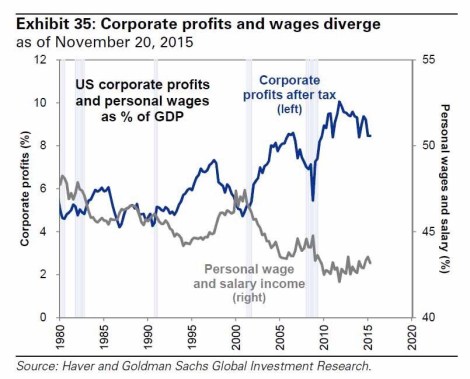
One might wonder what happened circa 2001, 2 and 3 that so significantly changed the relationship between corporate profits and average wages. Aside from the fact that large corporations typically surge after the bloodletting that takes place during recessions, consider this: George W. Bush was President during the 2001 recession. It was a short, relatively mild recession compared to the big one at the end of his tenure. But, on the heels of the recession, the Bush administration’s economic footprint was made manifest by significant income tax cuts in 2001 and 2003, the implementation of Medicare Part D in 2003, increased military spending for two wars, a housing bubble due to banking deregulation which contributed to the subprime mortgage crisis of 2007–2008, and the Great Recession…

George Bush embraced a governing philosophy of deregulation. This philosophy trickled down to federal oversight agencies, which in turn eased off on banks and mortgage brokers. Yes, Bush did push early on for tighter controls over Fannie Mae and Freddie Mac, but he failed to move Congress on this. After the Enron scandal, Bush did back and sign the regulatory Sarbanes-Oxley Act. But it was largely toothless — a political, slap-on-the-wrist response. SEC head William Donaldson tried to boost regulation of mutual and hedge funds. But he was blocked by Bush’s advisers at the White House as well as other powerful Republicans. So he gave up trying.

In 2013, the CBPP (Center on Budget and Policy Priorities) estimated that, when the associated interest costs are taken into account, the Bush tax cuts (including those that policymakers later made permanent) would add $5.6 trillion to deficits from 2001 to 2018.

The hypocricy of the religious right plays well into the hands of the political right. Because evangelicals are less prone to be critical thinkers, they are more easily swayed to accept political protestations, talking points rather than historical and scientific facts and statistical evidence on a host of social, environmental and economic matters. Small government (low taxes and lax business regulations) and immigaration are just two of them. Take for example: gun control, climate change, environmental policy, healthcare, and foreign policy. This is why, in my opinion, so many who vote Republican believe what they hear from talk show hosts, politicians and people like Donald Trump rather than scientists and legitimate news agencies.

Please feel free to post a comment or rebuttal.

Published in: on September 12, 2018 at 11:31 am  Comments (3)  

The Next Recession ~ Yes, One is Coming

It’s a recession when your neighbor loses his job; it’s a depression when you lose yours.  ~ Harry S. Truman

One does not have to be an economic wizard to predict the next recession in the United States. As I write this, I can assure you that all the signs are there. So it behooves one to be prepared. This could be a bad one, one that will spread to other countries.

Economists agree that economic recessions are significant slowdowns in overall economic activity, slowdowns which can and often do last long enough to cause  economic contractions. True recessions are characterized by economic decline across all or most sectors of a nation’s economy. This distinguishes them from “structural” crises which can occur in separate industries. True economic recessions, however, can only be confirmed if they last for a period of two or more consecutive quarters so as to nullify any seasonal effects.

Due to the globalization of modern businesses and trade, a recession in one country can easily cross national borders and strike whole regions or the entire world.

A recession becomes visible through decline of all major macroeconomic indicators: GDP (Gross Domestic Product) growth slows down or goes negative; production, investment spending, household incomes and spending. All of these decline while bankruptcies and unemployment increase. Recessions are therefore painful. But are they inevitable downsides of business cycles, as most economists think? This economist isn’t quite so sure. If they are part of natural business cycles, a recession will, in theory, always follow economic periods of expansion. Those who believe that recessions are inevitable have history to buoy their persuasions. They certainly seem to be right.

A normal business cycle usually consists of four successive phases: expansion, boom, recession and crisis. Each phase is important for transition of a cycle. Not only do different social and economic contradictions gain momentum during a recession and crisis, but recessions also establish a basis for future growth. Over long-term periods, the highs and lows of business cycles form the trend, or average, economic growth rate. But a boom phase does not always precede recessions.

Numerous factors that cause recessions can be divided in two large groups – internal (endogenous) and external (exogenous). Exogenous causes are represented by various factors of a catastrophic nature: wars, revolutions and natural disasters. The economy of agricultural countries may be influenced by climatic changes. Coffee producing countries of Central America, for example, are already experiencing serious economic problems caused by climate change. Neoclassical economists also consider state regulations, labor union acts, business monopolies and technological shocks to be  exogenous recession factors. In most cases, external factors explain all the economic crises that occurred prior to The Great Depression in the 1930s. The Great Depression was the longest and deepest recession of the 20th Century. It followed a rapid expansion of the U.S. economy, a boom, and overconfidence by investors in an unregulated stock market. Rich people who wanted to be more rich poured too much money into overvalued stocks. And when the market finally crashed, proving the old adage that “what goes up must eventually come down,” millions lost everything they owned. It was triggered by a laissez-faire structural crisis.

Pray that the coming recession, one that will, in my opinion, be triggered by exogenous causes: inept fiscal and trade policies enacted by the current administration, won’t bloom into a Second Great Depression. It could.

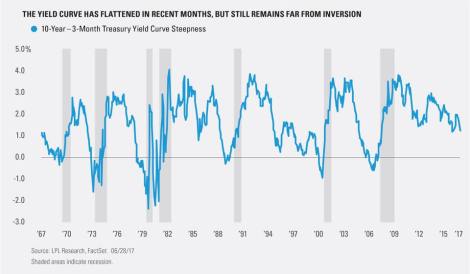
yield curve

Historically, economic expansions in the U.S. rarely last longer than 100 months, and we’re already past that length of time. In fact, there have only been two expansion periods that lasted as long as the one that we’re currently in. To match the record 120-month expansion in the 1990s, we’d need to keep the economy growing past January 2019, an occurrence that The Wall Street Journal deems to be “a very tall order.” It might happen, of course; past performance is not always an accurate predictor of the future. But this, in my opinion, could only come to pass baring a geopolitical/economic shock.

Need I remind you that, thanks to President Donald Trump’s import tariffs, we’re already in the early stages of a trade war with our biggest trading partners: China, Canada, Mexico, and Germany/the EU? In addition, the ten-year/three-month Treasury yield spread, widely used to predict recessions, is nearing inversion. It was all the way down to 0.90 as of June 27, 2018 (the graph shown above is a year old. See what it is today). Recessions always follow spread inversions and, with all the borrowing that the Treasury Department has announced to compensate for lost revenues owing to the recent tax cut, I look for the spread to be in negative territory by July.  Therefore, I predict the next recession will occur before the end of the year, probably before the mid-term elections.

Sorry Republicans. It couldn’t happen at a worse time for y’all. But you’ve made your bed… again.

Please feel free to post a comment, pro or con, in response to this article.

Published in: on June 29, 2018 at 1:18 pm  Leave a Comment  

America, Are We Not Still Great?

quote-a-nation-s-greatness-is-measured

National pride is a good thing. We all want to feel proud of our country. Donald Trump knows this, so his campaign for president is appealing to this desire. He has based his campaign on the idea that our country isn’t great anymore, that eight years of Obama in the White House and Hillary Clinton as his Secretary of State are the reasons why. He promises, that he, and only he, can restore us to greatness again. His campaign motto is, Make America Great Again. Hillary Clinton’s campaign is countering this message with the idea that we are still a great nation but acknowledges that we do have problems. Her campaign promises that, by working together, we can address these problems — make progress toward a brighter future for all. Her campaign motto is, We Are Stronger Together.

In truth, most of us, Republicans, Democrats, Libertarians, Greens and Independents alike, have awakened to the realization that we really aren’t as great a nation as we once thought we were. Only the reasons that we aren’t are not the same reasons that many die-hard Trump supporters believe. We don’t fall short of true greatness because our military is weak or our economy is not strong and expanding. It’s not because we are compassionate and tolerate millions of undocumented immigrants to remain and do work in our country that most of our citizens won’t do. It’s not because we allow LGBTQ persons equal protection and liberties under law. Neither do we fall short of true greatness because we have expanded access to health care for twenty-plus millions of our citizens. It’s certainly not true because we have an African American president. It is true, however, that we aren’t the greatest nation by many empirical measures.

According to the World Economic Forum‘s Global Competitiveness Report (2012-2013), the U.S. ranks as #1 on only 4 out of the 117 different factors that are rated, and each of these 4 factors reflects merely the sheer size, the hugeness, of the U.S. economy. These four factors might thus collectively be identified as the Hugeness components: “GDP,” “GDP as a Share of World GDP,” “Available Airline Seat Kilometers,” and “Domestic Market Size Index.” Other than Hugeness, the results for the U.S. are not at all outstanding. They are metrics of mediocracy.

Health Care shows the U.S. ranking as #34 on “Life Expectancy,” and as #41 on “Infant Mortality.” (And, of course, unlike the “Infant Mortality” rankings from UNICEF, this ranking is among 144 countries. Thus: some underdeveloped countries actually have higher life-expectancy than does the U.S.)

Education in the U.S. is also apparently mediocre. On “Quality of Primary Education,” we are #38. On “Primary Education Enrollment Rate,” we are #58. On “Quality of the Educational System,” we are #28. On “Quality of Math and Science Education,” we are #47. On “Quality of Scientific Research Institutions,” we are #6. On “PCT [Patent Cooperation Treaty] Patent Applications [per-capita],” we are #12. On “Firm-Level Technology Absorption” (which is an indicator of business-acceptance of inventions), we are #14.

Trust is likewise only moderately high in the U.S. We rank #10 on “Willingness to Delegate Authority,” #42 on “Cooperation in Labor-Employer Relations,” and #18 in “Degree of Customer Orientation” of firms.

Corruption seems to be a rather pervasive problem in the U.S. On “Diversion of Public Funds [due to corruption],” the U.S. ranks #34. On “Irregular Payments and Bribes” (which is perhaps an even better measure of lack of corruption) we are #42. On “Public Trust in Politicians,” we are #54. On “Judicial Independence,” we are #38. On “Favoritism in Decisions of Government Officials” (otherwise known as governmental “cronyism”), we are #59. On “Organized Crime,” we are #87. On “Ethical Behavior of Firms,” we are #29. On “Reliability of Police Services,” we are #30. On “Transparency of Governmental Policy Making,” we are #56. On “Efficiency of Legal Framework in Challenging Regulations,” we are #37. On “Efficiency of Legal Framework in Settling Disputes,” we are #35. On “Burden of Government Regulation,” we are #76. On “Wastefulness of Government Spending,” we are also #76. On “Property Rights” protection (the basic law-and-order measure), we are #42.

We fall short of true greatness, in my opinion, because: (1) we allow the greed of a few rich and powerful families to control our government; (2) we emphasize the acquisition of wealth over the equitable sharing of proceeds with those who labor; (3) we fail to prioritize for the funding of education, programs to alleviate suffering, and programs to lift struggling families out of poverty; (4) we protect industries that poison and pollute our environment, even subsidize their business practices, rather than promote sustainable technologies and practices; (5) we believe that “for-profit” solutions are superior to public solutions for healthcare, education, and incarceration; (6) we protect free-speech at the expense of truth. And we have allowed our basic freedoms under the Constitution to make us less well informed, less safe, less equal, less democratic, and more divided.

To improve on the measures cited above, we truly do need to come together. No one and neither major political party can alone fix what’s wrong. We don’t all have to think alike. That would be asking way too much. But we can at least stop politicizing every issue. We can at least stop with the exceptional, elitist and “hell-no” obstructionist attitudes and work to find common ground. No one, and no political party, is right all the time.

Please feel free to comment on this. I would enjoy discussing it with you, especially if you disagree with any of it.

Published in: on October 12, 2016 at 10:03 am  Comments (3)  

The Traditional Good of Innovation and the New Frightening Bad

Education required for the use of new technologies has always managed to stay ahead of the pace of innovation and adaptation. With the advent of the digital computer, however, all this is now changing, and it scares the bejesus out of me.

Anthropologists imagine a time in human history when fire had to be “stollen” from nature. Man had yet discovered how to make fire for himself. Accordingly, someone in the tribe or clan was entrusted with the important role of keeping the fire — flame or hot coals. This person held an important, even sacred, role in primitive societies, so it was not something practiced by many. To the extent, however, that this person held a special position beyond ritual, his job was obviated by the technological innovation of fire making — using friction or striking flint to iron so that sparks could ignite suitable tinder. This, like later inventions, the wheel, cutting tools, leveraged throwing weapons, weaving and pottery making, benefited societies at large. All had more as a result. When fire making technology came into practice, only the fire keeper was left without a ‘real’ job.

the-mark-of-the-beast-image

This tendency for innovation to benefit the greater part of societies has, for the most part, continued to this day. Examples of these technological innovations include: interchangeable parts, the steam engine, mass production, Eli Whitney’s cotton gin, electrification and the automobile. Greater productivity has tended to create new jobs in greater numbers than those eliminated. This is because greater productivity, in the past, has driven costs down so that both supply and demand increased. This is not the norm today. Higher productivity today, owing to declining competition among suppliers due to mega mergers and the formation of corporate cartels/oligopolies, higher productivity results only in greater profits which are seldom shared with the actual workers.

Education required for the use of new technologies has always managed to stay ahead of the pace of innovation and adaptation. With the advent of the digital computer, however, all this is now changing, and it scares the bejesus out of me.

Innovation has long been thought to be the essence of economic growth. Think about it. Over the past two centuries, the world has reaped great benefit from the advent and incorporation of more and more general-purpose technologies: energy and manufacturing technologies, transportation technologies, medicine and pharmaceutical technologies, communication technologies, information storage and calculation technologies. But what happens when technology advances at a dizzying pace such as it is doing now? Education lags behind, even the ability of many to comprehend the use of new technologies, let alone do the programming and repair necessary, is beyond the average citizen.

When I was young, my grandfather could keep the family car humming along all by himself. He needed no computerized diagnostic equipment. All he need was in his toolbox, wrenches and screwdrivers and such. But, as it is today, I am challenged to even change my car’s oil and oil filter. When my computer or my smart phone goes on the blitz, only a few very highly trained technicians even know what’s wrong. Even they must resort to using other automated equipment and software to correct the problems. I am dead in the water until someone else with another machine and the knowledge to use it fixes my broken machine.

Until recently, this trend has not much concerned anybody, especially not corporate CEOs and government policymakers. The increased productivity has led to more and greater profits for those at the top, and those at the top make the rules. Economists and academics have been talking about this for years, a few have even been worried about it. But now some  forward thinking individuals in business are waking up, taking the longer view. They are concerned about competition and shrinking markets as average citizens’ disposable incomes shrink from declining, good paying work opportunities. Humans’ jobs are being taken over by machines.

Nearly half of the 1,344 CEOs surveyed by PricewaterhouseCoopers late last year identified rapid technological change as a potential threat to their organization’s growth prospects.”

One of the most disconcerting new technologies, in my opinion, is 3D printing. It has the potential to transform the competitive landscape of a wide array of businesses — businesses like manufacturing and construction. 3D printing could revolutionise industries beyond current imagination, provided of course that players within these industries embrace this new technology in an effective way. But will they all be able to do so and to what end? And how many workers in India, China and elsewhere will be displaced? What will this do to demand for goods and services?

These economic trends are not limited to just the United States, or even to the United States and it’s favoured trading partners. These trends are manifest in all but a few more enlightened nations — Denmark, Norway, Sweden and Germany, just to name a few, where corporations are more highly regulated and where fiscal policies benefit people before money interests. When considered in combination with growing and ageing populations, declining/more difficult-to-recover natural resources, and the consequences of global warming, manmade apocalyptic scenarios are easy to imagine.

Until the hungry beast of capitalism is either satiated or sufficiently constrained by enlightened regulation, the greater good, in my opinion, will just have to accept the consequences of greed.

Please feel free to post a comment in response to this. I would enjoy discussing this issue.

Published in: on April 14, 2015 at 9:00 pm  Comments (2)  
Tags: ,

In the Spirit of Equity ~ For on Earth There Is No Equality

I understand why so many have difficulty with the idea of “Equal Pay for Equal Work.” It’s an ideal not possible in capitalistic economies, especially those that shun or are suspicious of every aspect of socialism, like public schools, Head Start, Social Security, Medicare and Medicaid.

scales of justice“One of the teachers of the law came and heard them debating. Noticing that Jesus had given them a good answer, he asked him, ‘Of all the commandments, which is the most important?’

‘The most important one,’ answered Jesus, ‘is this: Hear, O Israel: The Lord our God, the Lord is one. Love the Lord your God with all your heart and with all your soul and with all your mind and with all your strength. ‘The second is this: Love your neighbor as yourself. There is no commandment greater than these.’”

~ Mark 12:28-31

Neighbor, you ask? Of whom was Jesus speaking?

Surely you recall the parable of the Good Samaritan. So, would not the unemployed father across town be your neighbor? How about the woman taking care of your children so that you can go to work? How about the part time employees of the largest, most successful retail sales corporation in the world?

Among those of us who know Him, can there be any doubt about how God wants us to treat these neighbors? Does He not want us to treat them fairly and impartially — equitably – not withholding or denying them a living wage? Yes. Even so, this is a tall order. It’s the best we could possibly do because, as we all know, on earth there is no equality.

I understand why so many have difficulty with the idea of “Equal Pay for Equal Work.” Notwithstanding the great and inspiring words in our Declaration of Independence: “We hold these truths to be self-evident, that all men are created equal…” there is no equality. God has not given to each of us in “equal” measures those things that can be measured in human terms. Some of us are born in the bosom of advantage and luxury. Others are born and reared in poverty and perpetual discouragement. No, there is no equality. Yet God commands us to love one another, whether rich or poor — to treat others, our neighbors, with equity.

What does equity look like? I’ll tell you what I think it looks like. It looks like a society in which children don’t go hungry, where they all go to schools where loving teachers are encouraged with enough time and compensation to be the best teachers they can possibly be – schools where vaccinations and school lunches are freely provided. It looks like a society in which a day’s pay, for those willing to work, is at least sufficient to subsist on, to pay for a day’s worth of shelter, food, clothing and medical care. That’s how it seemed to be when I was growing up, which may have been illusionary I admit. But it surely is not this way nowadays, not for everyone.

No, I understand why so many have difficulty with the idea of “Equal Pay for Equal Work.” It’s an ideal not possible in capitalistic economies , especially economies that shun or are suspicious of every aspect of socialism, like public schools, Head Start, Social Security, Medicare and Medicaid.

After retiring from a career in the military, I was hired by a firm providing engineering and programmatic support for military materiel procurement programs. Launched into this follow-on career by my successful involvement in operational test and evaluation for the U.S. Army, it wasn’t long before I was made a branch chief in one of the firm’s many departments. Test and Evaluation was my specialty and I was made a manager because I attracted customers who were willing to pay handsomely for my help. I could have been an ineffective manager, but that had nothing to do with my promotion. It was my expertise in the discipline that got me promoted.

I began to build my team, hiring first a young man who a customer of mine, a former co-worker, wanted to help. He wanted to help not because he was particularly good at anything, but because he was a friend. It soon became evident that he would not be contributing much to the collective effort. But he was now mine to groom and to supervise, which added to my workload. Next, I looked for a new hire that could provide help with human factors engineering. With this hire, I was quite fortunate; the man I hired did excellent work and could write rings around my first hire. My third hire would have been a highly qualified aerodynamics engineer, someone who could serve as my deputy. But, owing to contract constraints and externalities, my branch never quite grew sufficient to justify this third hire. I did interview some candidates though. One was particularly impressive.

She was a graduate of the Navy’s Post Graduate Engineering School and a C-141 pilot. She, a major in the Air Force, had worked in test and evaluation and in the program management office for the new C-17 cargo airplane. Her resume was on the top of my pile of candidates’ resumes when my boss called me in to inquire about my search for a deputy manager. “Who’s your first choice?” he asked.

When I told him, he rolled his eyes then said, “Yeah, I noticed her when she came through for the interview with you. Nice Stems?”

“Sir? Nice stems?” I asked.

“Legs,” he said. “She has nice legs.”

“Yes, she does. But what has that got to do with anything?”

“That has everything to do with whether we can offer her the position.”

“Why is that?” I asked naively.

“For one thing, this is a business for men. Most of your prospective customers would have no confidence in her ability to do the job, even if she could leap higher than all her male competition. Next, were we to hire her and pour time and effort getting her up to speed in this male dominated culture of ours, within two or three years, she’d be engaged and or pregnant. Her new husband, likely another service member still on active duty, would be reassigned to Timbuktu and she’d be gone. No, not her. Who’s your second choice?”

Yeah. I get it. I understand why so many have difficulty with the idea of “Equal Pay for Equal Work.”

What does the Bible say about equity?

In Mattew 20:1-15 we read: “For the kingdom of heaven is like a master of a house who went out early in the morning to hire laborers for his vineyard. After agreeing with the laborers for a denarius a day, he sent them into his vineyard. And going out about the third hour he saw others standing idle in the marketplace, and to them he said, ‘You go into the vineyard too, and whatever is right I will give you.’ So they went. Going out again about the sixth hour and the ninth hour, he did the same. And about the eleventh hour he went out and found others standing. And he said to them, ‘Why do you stand here idle all day?’ They said to him, ‘Because no one has hired us.’ He said to them, ‘You go into the vineyard too.’ And when evening came, the owner of the vineyard said to his foreman, ‘Call the laborers and pay them their wages, beginning with the last, up to the first. And when those hired about the eleventh hour came, each of them received a denarius. Now when those hired first came, they thought they would receive more, but each of them also received a denarius. And on receiving it they grumbled at the master of the house, saying, ‘These last worked only one hour, and you have made them equal to us who have borne the burden of the day and the scorching heat.’ But he replied to one of them, ‘Friend, I am doing you no wrong. Did you not agree with me for a denarius? Take what belongs to you and go. I choose to give to this last worker as I give to you. Am I not allowed to do what I choose with what belongs to me? Or do you begrudge my generosity?’”

“And whatever is right I will give you…”

Yes, I understand that, in this parable, Jesus was talking about salvation, and the master of the house represents God. He was talking about how the Father will reward even those who come to Him in the eleventh hour. But it also illustrates how a godly employer, seeing his laborers’ needs, should satisfy them according to his ability to do so.

Yes, I understand why so many have difficulty with the idea of “Equal Pay for Equal Work.” But why can’t we at least make better efforts towards equity?

What a progressive idea! Yeah, but it’s a Christian idea too. Is it not?

Please feel free to leave a comment. I would enjoy dialoguing on this subject.

Published in: on March 13, 2015 at 2:20 pm  Leave a Comment  

Texas Going Down the Tubes

Texas Governor, Rick Perry, may not be ashamed. But, as a citizen of this state, I sure am.

Opa_IIApril 17, 2013 — I think it’s an interesting coincidence that Texas Governor, Rick Perry, announced his intention this week to travel to Illinois in an attempt to convince the leadership of corporations headquartered there that they should move to Texas — this in the same week that the Texas Legislative Study Group updated its Texas On The Brink report, a periodic collation of state rankings on public policy issues. The report makes Texas look so bad this year that it should probably be renamed, Texas Going Down the Tubes.

After reading this report you might wonder why anyone would want to come to Texas to live. Unless they are a high-placed corporate executive, someone firmly-established in the upper to upper middle class with a guaranteed source of income, or a professional with qualifications that are in high demand, it beats the hell outta me why anyone would. The blue bonnets in Springtime and relatively mild winters here in Texas are just about the best the state has to offer for everyone else.

I am continuing this post borrowing heavily from Janes Moore’s article in Huffington Post, Texas vs. America, http://www.huffingtonpost.com/jim-moore/texas-versus-america_b_3088725.html, and other sources as noted.

If you do decide to come to Texas, don’t consider failing. There is no safety net here unless you have family able and willing to pick you up when you fall. If you remember nothing else from this year’s update of the Texas on the Brink report http://www.austinchronicle.com/blogs/news/2013-04-15/texas-on-the-brink/, take with you these two simple facts about the state’s generosity to the less unfortunate: First, the average monthly benefit per person, for Women, Infant, and Children (WIC) recipients in Texas is $29.30. That’s the WORST in the nation — not even enough for tuna and crackers from a governor who spends millions on his traveling security entourage. Second, the maximum Temporary Assistance for Needy Families grant for a single-parent family of three is just $263 per month. So, if you don’t mind eating Ramen noodles for dinner every night and living in a shack, Texas has you covered.

20130417-135801.jpgTexas “firsts” and “worsts” that have occurred during the 13 years of the Rick Perry administration in Texas are even more astonishing than Perry’s lack of concern about the poor in this state. In his last legislative session, the Texas governor led a reduction of $5.5 billion in public school funding even though the state ranks dead last in the percentage of population that graduates from high school. According to the Texas on the Brink report, Texas also leads the nation in the percent of the population uninsured as well as the percent of non-elderly that are uninsured.

Here are some highlights from the new Texas On The Brink report:

Education
• Elementary and Secondary Public School Enrollment — 2nd
• Average Salary of Public School Teachers — 31st
• Percentage of Population Graduated from High School — 50th

State of the Child
• Percent of Uninsured Children — 2nd
• Percent of Children Living in Poverty — 7th (tied)
• Percent of Children (19-35 months), Fully immunized — 23rd (tied)

Health Care
• Percent of Population Uninsured — 1st
• Percent of Non-Elderly Uninsured — 1st
• Percent of Low Income Population Covered by Medicaid — 48th

Environment –
• Amount of Carbon Dioxide Emissions — 1st
• Total Amount of Toxic Releases into Water — 4th
• Amount of Carcinogens Released into Air — 4th
• Amount of Hazardous Waste Generated — 1st
• Industrial Toxic Air Pollution — 10th

Democracy
• Percent of Voting-Age Population Registered to Vote — 47th
• Percent of Voting-Age Population that Votes — 51st

You may download the entire report at http://www.austinchronicle.com/documents/Texas%20On%20The%20Brink%202013.pdf.

Rick Perry may not be ashamed. But, as a citizen of this state, I sure am.

To many, it is a mystery why Texans continue to vote for a governor and a legislature that care so little for the majority of its citizens. Psychologists, however, tell us that it’s human nature. The reason they cite is something called cognitive dissonance http://www.simplypsychology.org/cognitive-dissonance.html. This is the distressing mental state that people feel when we find ourselves doing things that don’t fit with what we know or believe. We all experience it to varying degrees; we all want our expectations to meet reality, creating a sense of equilibrium. Accordingly, we will avoid situations or information sources that give rise to feelings of uneasiness, or dissonance. In other words, we’d rather be stupid than wrong.

Please feel free to leave a comment whether you agree with my reasoning or not.

Published in: on April 17, 2013 at 11:43 am  Comments (5)  

Socialism vs. Fascism

Tell me if you think I’m wrong, but it seems to me that America is moving away from democracy and toward fascism rather than flirting with socialism as many on the far right are claiming.

Opa_IIApril 11, 2013 — With all the name calling going on by political media show hosts/pundits and politicians these days, people seem not to know the difference between socialism and fascism. Despite what some have said and written to confuse us for political purposes, the difference is as stark as it is simple. Under socialism the government owns the major industries, not the capitalists http://en.wikipedia.org/wiki/Socialism. Under fascism, wealthy capitalists/corporations basically own the government http://en.wikipedia.org/wiki/Fascism. History makes this clear.

Coming to power during the early 1930s, Adolf Hitler targeted the Communist and Socialist Parties in Germany for elimination. At first, however, Hitler claimed socialist views to gain popular support, hence the name National Socialists. But he was never truly a socialist. Once in control of the party, he, with Hermann Göring and Heinrich Himmler at his side, moved it away from its original leanings and Germany ended up fascist. Big capital was allowed to operate profitably provided it cooperated with the state, and workers were completely excluded from power http://en.wikipedia.org/wiki/Adolf_Hitler’s_rise_to_power.

Tell me if you think I’m wrong, but it seems to me that America is moving away from democracy and toward fascism rather than flirting with socialism as many on the far right are claiming. Why? Look at all the influence wealthy capitalists and corporate interests have with Congress. Consider how the Koch brothers and fossil energy industries have essentially squashed any meaningful efforts to address global warming by promoting skeptic/deniest arguments. Consider the significance of the Supreme Court’s decision on the Citizens United case — declaring that corporations are people. Consider the NRA’s influence with Congress to squash any meaningful measures to reduce gun violence in America notwithstanding massive public support for them. Consider how Big Pharma was able to protect themselves from lower priced drug imports from Canada. Consider Wall Street’s efforts through Congress to prevent enforcement of new consumer rights regulations. Consider too how the party of big business has in recent years elevated gerrymandering in Republican controlled, Right-to-Work states to new levels, effectively denying the poor, the elderly, minorities and young voters equal representation during elections. Is this not excluding workers from power/participation in the democratic process?

Wait a minute you say, is capitalism fascist then? No, not necessarily; it’s a matter of degrees. Neither is socialism communist. Communism is a form of totalitarian government employing socialism exclusively or with a limited amount of free enterprise called a mixed economy. http://en.wikipedia.org/wiki/Communism

Capitalism is getting a bad rap lately, largely because of its success. Big-this and big-that, in my opinion, have eliminated so much competition and gained so much political clout that markets are losing self-discipline. Banks, oil companies, airlines and pharmaceuticals are colluding through mergers and lobbyists to force favorable legislation and looser regulations for their industries.

Socialism has an important role to play in any free society. It facilitates sharing resources and services: clean water, public utilities, police, fire and other emergency responders, public education, etc. But, as an economic system, a market economy with some degree of capitalism, is still the only way to go. The problem arises when the forces of competition and greed become greater than the people’s democratic government itself. Corporate success in the marketplaces of goods, services and ideas, must therefore be constrained with reasonable regulations to protect the very people that corporations claim to serve. And government must remain of, for and by the REAL people rather than the corporate people.

I invite your comments.

Published in: on April 11, 2013 at 8:28 am  Comments (1)  

Political Terrorism ~ A Troubling Analogy

No, I don’t think republican politicians are terrorists. I do believe, however, that they don’t realize their actions to resist progressive changes are tantamount to the same thing. 

July 8, 2012 — I usually don’t hesitate to share things on my Facebook page that resonate with me. But I thought better of it this morning. A post that compared current republican politicians to terrorists struck me as being over-the-top. I’m more used to seeing and hearing extreme rhetoric from the right. So I was bothered by this kind of thing coming from the left. Still, the rationale for the comparison was… well, troublingly sound. Mind you, I’m not making this argument myself, just throwing it out there for discussion. What follows is what my Facebook friend said.

“One of the more interesting questions is: What is the difference between crimes of omission and crimes of commission? Are there any? And if so, are they differences in degree or difference in kind? Is there any real difference between allowing people to die when you have the means of preventing their deaths at hand and killing them by your own hand?  If I know that you are going to die if you don’t get a certain medication and I have the money to buy that medication for you – and I don’t? Don’t I bear some responsibility for your death?

The GOP argument seems to be that it’s okay for us as individuals to save one another. That would be charity. But it’s not okay for society to do this as a matter of public policy. That, you see, would be socialism! Terrorists, republicans would say, are evil villains who kill innocent people in order to make a political point.  Republicans, however, call themselves compassionate conserv- atives who simply allow innocent people to die in order to make their political point. They don’t seem to notice that innocent people are dead, one way or the other.

We are the only developed nation that doesn’t practice socialism in its health care system. And if helping the sick and the dying with tax dollars is socialism, I say, let’s have socialism.”

Again, I’m not myself making the argument that current crop of republican politicians are terrorists. But wasn’t a health care concept involving an individual mandate to buy health insurance not first advanced by the conservative think tank, the Heritage Foundation?  Weren’t health care bills containing the individual mandate introduced and promoted in the Congress by republicans back in the 90’s as alternatives to the Clintons’ proposal for universal coverage?  http://healthcarereform.procon.org/view.resource.php?resourceID=004182

Why now are republicans so much against a health care plan for the nation that their own nominee-apparent for president, Mitt Romney, implemented in Massachusetts when he was governor there? Could it be that the sitting president, Barack Obama was in the White House when the republicans’ plan was finally passed (over their objections) and signed into law. Now, because it has a democrat president’s name associated with it, it’s suddenly socialism. Hmmmm?

Seems to me that republicans decided they didn’t like the idea of any kind of health care bill soon after President Obama was elected. Republican Senator Jim DeMint said, “If we’re able to stop Obama on this it will be his Waterloo. It will break him” http://crooksandliars.com/john-amato/scs-jim-demint-would-rather-bring-pain, and democrats are accusing republicans lately of seeking political gains over the good of the country. As evidence to support this, they point to McConnell’s quote from October 2010 in which he said, “The single most important thing we want to achieve is for President Obama to be a one-term president.”

No, I don’t think republican politicians are terrorists. I do believe, however, that they don’t realize their actions to resist progressive changes are tantamount to the same thing.

Recall that Congressional republicans held the full faith and credit of the United States hostage  last summer, threatening to impose fiscal catastrophe on all of us to achieve a specific (and unnecessary) policy goal. It was, to my mind, the worst thing an American major party has done, at least in terms of domestic politics, since the Civil War. Now they are gearing up to do the very same thing again http://www.nytimes.com/2012/05/16/us/politics/gop-pledges-new-standoff-on-debt-limit.html. Now, if this isn’t terrorism, it’s terrorism-like. They might as well have held a gun to the president’s head last year.

With regard to “actual” life-and-death matters, republicans argue that America has the best health care system in the world. Never mind that 45,000 Americans die every year, according to a Harvard Medical School study, for lack of insurance coverage http://www.reuters.com/article/2009/09/17/us-usa-healthcare-deaths-idUSTRE58G6W520090917,  Never mind that the World Health Organization (WHO) ranks our system only 37th in the world behind, not only the whole list of European “socialist” countries, like France, the Netherlands and Nordic countries, but countries like Colombia, Chile and Saudi Arabia too. Our system does rank first in something though, it’s first in cost http://en.wikipedia.org/wiki/World_Health_Organization_ranking_of_health_systems.

Sure, for Americans and foreigners with money to spend, our system is great. For folks with premium insurance policies, it’s also pretty doggone good. Hey, on Medicare with an AARP supplement policy, I got a new knee last year and received excellent care from my surgeon, the hospital and the entire team of doctors and nurses. I got excellent physical therapy following the surgery too. I can now keep up with my great granddaughter on the playground (almost). The only cost to me was, and continues, to be the monthly premiums for my supplement. But I can afford it. For Americans who happen to be out of a job or working for minimum wage and without insurance, take a number and wait in emergency rooms while the cost for care grows at a rate of sixteen percent per year http://en.wikipedia.org/wiki/Health_care_in_the_United_States. You get no annual checkups and no preventive care unless you are a child on CHIPS or retired and on Medicare. This is the state of affairs that Obamacare is designed to correct.

When asked on Fox News recently what plans republicans in Congress have to cover the 30,000,000 uninsured people that Obamacare (which used to be their plan recall) will cover, Mitch McConnell gave the answer in this video.

Decide for yourself if republicans are acting in the best interests of average Americans, or whether they are just obstructing progress so that we can go back to good-ole-bad-ole days of deregulation and continue subsidies for big corporations and low taxes for the wealthy. Do they really want what’s best for America or are they convinced that their ends justify their means?

I think you know what I think, but I’m not calling anyone a terrorist. I am saying that any system that profits from deciding who gets care and who doesn’t is inherently evil.

Please don’t hesitate to post a comment in response to this, whether you agree with me or not.

Published in: on July 8, 2012 at 1:58 pm  Comments (3)  

Right vs. Left, Part II ~ Responding to Republicans’ Fears this Election Year

Under Obamacare, when it is finally fully implemented, every child will be covered regardless of paternity issues — PERIOD.

July 5, 2012 — Following up on my last post, I realize now that I failed to respond to all of my good friend’s recent comments and “implied” questions about the Affordable Care Act. In her email (see Right vs. Left ~ Responding to Republicans’ Fears this Election Year) she said that she thought the federal government should get out of the business of providing individual care – that states could do a better job.

Hmmm… I guess that would be the end of Medicare, at least as we know it. So, I have written to her the following.

“…. I thought you’d be interested in knowing that our grand- daughter applied for CHIPS over a month ago for her daughter. CHIPS, as you know, is administered by states under Medicaid, and, given our granddaughter’s income, our precious little great granddaughter would normally be eligible. However, the appli- cation is being held up “by the state” because neither Texas nor Louisiana, her daughter’s father’s home of record, has been able to find the man since he was released from prison. Our grand- daughter is being told that he must be served with a child support court order before they will process the application.

Now, how does that make any sense? Under Obamacare, when it is finally fully implemented, every child will be covered regardless of paternity issues — PERIOD.

Also, addressing your concern about the federal government taking money out of the economy, please understand that the government spends every red cent that it collects. That money goes back into the economy and everything spent eventually becomes somebody else’s income. That income, in turn after taxes, gets spent again, over and over, which creates demand for goods and services. Either this, or else it is saved. Spending and “some” investments stimulate the economy. But saving does nothing to help it (never confuse saving with investing). And wealthier folks save a whole lot more than we poor to middle class folks do.  This propensity for more saving by the wealthy is one the most important reasons why we have a progressive income tax system.

This spending cycle, described above, creates what is called the spending “Multiplier Effect.” For your reading enjoyment/ homework assignment, here is an economic letter by the Federal Reserve explaining in more detail what I have just explained: http://www.frbsf.org/publications/economics/letter/2012/el2012-04.html

Sorry if this sounds like a lecture on basic economic concepts. But I guess that’s what it is. Every economics text book from which I have studied or taught contains this same information on how things work. Despite what you might have heard from conserv- ative talk show hosts or read on-line from conservative think tanks like CADO or the Heritage Foundation, this is understood and taught by most schools of economic thought.

If you’re interested and have the time to find out how Obamacare will help small businesses here in Texas, check this out: http://www.healthreform.gov/reports/statehealthreform/texas.html.”

Please don’t hesitate to post a comment, whether you agree with me or not.

Published in: on July 5, 2012 at 9:39 am  Comments (3)  

Right verses Left ~ Responding to Republicans’ Fears this Election Year

Greed, which drives capitalism, must be constrained at some point. But market competition these days, given the demise of organized labor and the growth of oligopolies, is totally disinclined to do so.

July 2, 2012 — According to a recent Wall Street Journal/NBC poll, the president’s reelection chances are looking up slightly, especially in battleground states where he leads Romney 50 to 43 percent among respondents. The recent Supreme Court’s decision on the constitutionality of the Affordable Health Care Act, welcome news among liberals, could, however, work against him considering how it might serve to galvanize the law’s detractors behind his presumptive rival, Mitt Romney. Nevertheless, republicans are nervous given that it’s still a close race just four months prior to the election and that four more years for Obama could mean two moderate to liberal justices to replace aging conservatives. This could mean a liberal court for at least a decade. His reelection would most definitely mean the survival of his health care law and the full implementation of its provisions. Yes, the stakes are high.

I recently received an e-mail question from a lady who, although a staunch republican, remains one of my dearest friends, this notwithstanding our conflicting political views. She said, speaking of the Affordable Health Care Act, “Curious to know how you can justify this burden to small businesses in America.”

To her message she added a quote by a Texas Congressman, Kenny Marchant, which was made following the Supreme Court’s surprise ruling last week.

“The decision doesn’t change the fact that millions of small businesses are going to be deluged with new taxes and job-killing regulations imposed by Obamacare. It also doesn’t change the fact that Obamacare is bad public policy that imposes new taxes on all Americans. Because of the Court’s decision, the quality of health care for millions of Americans will be greatly diminished, employers will be forced to drop health care insurance for their employees, and small businesses will need an army of compliance officers to navigate the Obamacare bureaucracy. Obamacare is unsound policy and disastrous for our nation’s fiscal solvency.”

She concluded her message with, “I believe the federal government keeps getting bigger and bigger which only drains more $$. The feds need out of the taking care of individuals business. I am not ready for a socialistic society. I believe the states can do a much better job.”

Here’s how I responded: “… every republican politician and conservative talking head is saying these same things, over and over, almost as if from the same script. But saying them over and over doesn’t make them so. I am equally convinced that that this is not only the right thing for the American people, it will eventually prove to be what it was intended to be — the “Affordable” Health Care Act. This will not be a burden to small business. It will be a boon. Now people will be better able to pursue their entrepreneurial ambitions, free from the fear of losing their employer-provided insurance coverage. Small businesses will be more willing to hire young college graduates because they won’t have to offer them health insurance initially and, for businesses of fifty and fewer employees, these are exempt from the requirement to provide insurance. Further, there will be more competition between insurance providers and this will eventually bring premiums down.

Read this which contains pros and cons attributed to the new law: http://useconomy.about.com/od/healthcarereform/f/What-Is-Obama-Care.htm. The pros are according the non-partisan Congressional Budget Office (CBO). The cons are from the conservative think tank, the Heritage Foundation. You can believe the claims made by whomever you choose. I chose to believe the non-partisan source.”

Now she’s telling me that this didn’t answer her question – “Just more one side against the other.” Her concern, she clarifies, is not just about Obamacare, it’s about everything – that the government keeps getting bigger and bigger draining more and more money from the economy. So, “Okay,” I answered,” define your terms. I want to be sure I answer your “actual” question. How do you measure the size of government?”

Thinking about how I might respond after she answers, I am anticipating that she might say government growth is measured by the amount of money it spends. Alternatively, she might answer that it is measured by the number of new government employees, or the number of new regulatory agencies, or the number of new regulations imposed on the private sector, and/or their cost burden. I don’t know how she might answer, so I’m researching each measure.

As to the first measure, the amount of money being spent: The Romney campaign would have us believe that government spending under Obama has accelerated at a pace without precedent in recent history. The truth is, according to PolitiFact, is that the rate of government spending growth has been lower under Obama than under any recent president http://www.politifact.com/truth-o-meter/statements/2012/may/23/facebook-posts/viral-facebook-post-says-barack-obama-has-lowest-s/. It is true that spending, as a percent of our GDP is up, but let’s be fair. Revenues collected, because of the recession, the Bush tax cuts, and the president’s own tax cuts for the middle class to combat the recession, has been way down.

Now to the growth in the number of federal government employees. At the end of 2010, according to the U.S. Office of Personal Management http://www.opm.gov/feddata/HistoricalTables/TotalGovernmentSince1962.asp, there were 35,000 fewer non-military federal government employees than there were under the Reagan administration. Yes, the total has increased slightly since 2010. But there are still more than two million fewer federal employees than there were at the highest point in recent history. It has been during Republican administrations, not Democrat ones, that the size of government, by this measure, has increased the most.

Okay, now to the number of new regulatory agencies, the number of new regulations, and the economic burden they impose. According to the Heritage Foundation (a conservative think tank), citing Government Accountability Office statistics, there were 75 major regulations adopted in Obama’s first two years in office. This compares to 120 during Bush’s entire first term. Yes, fiscal 2010 saw a record 43 new rules adopted. But, were these new rules needed? Given what has happened on Wall Street in recent years, what happened in the Gulf of Mexico with the BP oil spill, the growing problems with air quality over major cities like Dallas, water pollution from drilling/fracking operations, and how insurance companies have been denying coverage and dropping that of policy holders when they most need it, I believe that they were needed.

Our current health care system, which costs us eighteen percent of our GDP, has been growing in cost by sixteen percent per year and is rated, according to the World Health Organization as only the 37th best in the world. It is inhumane and it’s well past time for us to change it. That’s my stand on the matter.

Greed, which drives capitalism, must be constrained at some point. But market competition these days, given the demise of organized labor and the growth of oligopolies, is totally disinclined to do so.

I agree that regulatory activity is likely to pick up in coming years as agencies start implementing two of Obama’s major initiatives — the Affordable Care Act and the Dodd-Frank financial reform law. There will be economic costs associated with these initiatives. But there will be economic benefits as well. The “net benefit” — savings plus other factors, such as the economic value of lives saved – cannot be accurately calculated.  But they can be anticipated. It’s not just whether and to what extent needed regulations impact corporate profits. What’s also important to look at, according to the White House’s Office of Management and Budget (OMB) Watch, is how these regulations improve peoples’ lives.

Please feel free to post a comment, whether you agree or disagree.

Published in: on July 2, 2012 at 1:50 pm  Comments (6)  

Unintended Consequences ~ The Privatization of Our National Security

As corporations cash in on lucrative contracts, they encroach on the political process, driving up military spending and influencing military and foreign policy.

August 31, 2011 — When I received my draft notice for service in the Vietnam War, I had the best job of my life up to that time. I was a cameraman for a local television station in my hometown. I had worked my way up to the position after having been in the properties /art department for a year, and I loved it. I always came to work early and I usually stayed late. I volunteered for weekend work videotaping the following week’s worth of afternoon children’s programming: Fireman Frank, Cap’n Scotty, Captain Bernie and Friends. I did so not so much for the overtime as for the sheer joy of the work. When the station needed volunteers to go out on remote recording jobs, athletic competition events, church services, civic and seasonal events, mine was always the first name on the list.

When I told my department head about my draft notice, he advised me to get all the training I could from Uncle Sam. He also assured me that my job would be waiting for me when I got back. Of course, that was the law back then; employers had to rehire draftees after they completed their two years of service obligation. So, that became my plan. I would get some education in communications equipment repair, avoid combat if I could, and come back to this great job.

Of course, things don’t always turn out like we plan. After taking the Army’s battery of tests at the beginning of my Basic Training, I found out that I would have to reenlist in the Regular Army and be in for four years rather than two to get the training and MOS (military occupational specialty) I wanted. Otherwise, the odds were high that I’d be given a combat MOS like Infantry, Armor or Artillery. Reluctantly, knowing that I would be nullifying my draftee civilian job guarantee, I signed up for it. Later, caving into the siren song of OCS (Officers’ Candidate School) and subsequent training as an aviator, I never got the training in electronics. Somebody else did though.

In today’s all-volunteer military, many of the MOSs and inherent training opportunities our young people used to have are no more. Tasks in technical fields are now performed by civilian contract employees so that force structures could be reduced and more military personnel could be released for combat MOSs. In fact, over the past 30 years or so, this country has undergone a total transformation in the way it prepares for, conducts, and mops up after war. The Pentagon has overseen a large-scale effort to outsource all aspects of its operations to private corporations. But despite the claims of privatization proponents, there’s scant evidence that private firms perform better or at lower cost than public-sector agencies. More troubling, as corporations cash in on lucrative contracts, they encroach on the political process, driving up military spending and influencing military and foreign policy. Sadly, this contributes to the high unemployment rate for veterans of Iraq and Afghanistan. Who has work state-side for an Infantry grunt?

It gets worse http://finance.yahoo.com/news/Panel-Widespread-waste-and-apf-350120231.html?x=0&.v=1. According to the Commission on Wartime Contracting which was established by Congress in 2008, as much as $60 billion in U.S. tax dollars has been lost to waste and fraud in Iraq and Afghanistan over the past decade. This waste, the commission’s report says, is due to lax oversight of contractors, poor planning and corruption. In its final report to Congress, publicly released today, the commission said the waste could grow as U.S. support for reconstruction projects and programs wanes, leaving Iraq and Afghanistan to bear the long-term costs of sustaining the schools, medical clinics, barracks, roads and power plants already built with American money.

Didn’t President Eisenhower warn us about the Defense Industrial Complex?

Gee, $60 billion – that would go a long way toward resolving pay inequities for our nation’s teachers.

Despite the popular image of defense contracts being for the building weapons systems like aircraft, missiles, or tanks, contracts for services are actually more typical. I know, I was in the business for ten years after retirement from active duty. Service workers, not production workers, accounted for nearly three out of four contract-created jobs in 1996, up more than 50% since 1984 — this according to a Dollars and Sense magazine article in 2004 http://www.thirdworldtraveler.com/National_Security/PriviteNationalSecurity.html. Growing legions of contracted employees install, maintain, trouble-shoot, operate, and integrate military hardware. Similarly, research and development work is increasingly farmed out. (Navy technical centers outsourced 50% of research, development, test, and evaluation work by 1996. This was up from 30% in 1970.) Other, lower-skill, service contract firms perform a vast number of other functions from base maintenance and catering and support, to security detail and military training. Most of these jobs are being performed by locals.

Overall, the Commission on Wartime Contracting said, spending on contracts and grants to support U.S. operations in Iraq and Afghanistan is expected to exceed $206 billion by the end of the 2011 budget year. Based on its investigation, the commission said contracting waste in Afghanistan ranged from 10 percent to 20 percent of the $206 billion total. Fraud during the same period ran between 5 percent and 9 percent of the total.

The commission’s report includes recommendations for Congress. Among them are: government agencies should overhaul the way they award and manage contracts in war zones so they don’t repeat the mistakes made in Iraq and Afghanistan. The commission also recommends the creation of an inspector general to monitor contracting and the appointment of a senior government official to improve planning and coordination.

This sounds good to me. However, some in Congress will undoubtedly say that this so-called, suspected waste is just the cost of doing business. It’s to be expected. They will further complain that establishing a new inspector general’s post with inherent staff and administrative costs will just be more “creep of scope” by the federal government. Accordingly, our currently “dysfunctional” Congress will likely be unable to make any decision at all, and the commission will have wasted its time and efforts to expose some of the unintended consequences of the privatization of our national security.

Since Congress is not likely to do anything about this waste, fraud and abuse of taxpayers’ money anyway, I have a more challenging suggestion. Let’s go back to the good old days before the privatization of our nation’s security began. Let’s put more of our young men and women to work gaining technical knowledge and skills in the military that can help them transition to civilian employment after their enlistments.

Generals and Admirals of our armed forces wouldn’t like it, and the captains of defense industry corporations wouldn’t either. They would undoubtedly lobby Congress with millions of dollars in campaign contributions — most of it going to Republicans. But wouldn’t the rest of us be better off?

Please don’t hesitate to post a comment below to express your own opinion.

Published in: on August 31, 2011 at 9:04 am  Comments (1)  

Moral Hazard ~ A Deceitful Double Standard

An economic concept called “moral hazard” divides Americans and helps to define political philosophies.

After Sunday school last week, I carpooled with other members of our church up to Dallas. We went to help serve the noon meal at The Bridge, the homeless shelter there. What a powerful experience. Without exception, the clients were respectful and appreciative, especially when they themselves were shown respect in any way. Several actually offered me blessings as I filled their glasses with ice water. Many bowed their heads in silent prayer before eating.

When the meal was over and the clients had all left the dining facility, I spoke for awhile with the supervisor of the “Stew Pot” mission team http://www.thestewpot.org/sz.asp which volunteers to run the dining facility. The facility, by the way, is aptly named The Second Chance Cafe. Our discussion led me to deep introspection about the plight of a growing number of homeless in this economy.

Our youngest son, suffering from a laundry-list of psychological problems, is a homeless person notwithstanding how much we continue trying to help him. Our granddaughter, a high school graduate and trained cosmetologist, still reeling from the aftermath of an abusive relationship with the father of her little girl, has told us that she too would most likely be in a shelter if it were not for our intervention and on-going help. So, if it can happen in our family, it can happen in yours.

On my way out to return home, I picked up a printed copy of the local version of an international publication, Street Zine. It was filled with thought-provoking articles about the poor, the homeless and disabled – the sheep I believe Jesus was talking about when He told his disciple, Simon son of John, also known as Peter, to take care of them (John 21:16). One particular article, from which I have borrowed title of this post, struck me hard. You can read the whole thing for yourself on-line if you wish. It’s at http://www.streetnewsservice.org/news/2011/june/feed-286/%E2%80%9Cmoral-hazard%E2%80%9D-%E2%80%93-a-deceitful-double-standard.aspx. Below, combined with my thoughts on the subject, is an abstract of the article which was written by Domink Jenne, a citizen of Freiburg, Germany.

The term, “moral hazard,” according to Herr Jenne, means something similar to moral temptation. It’s actually an abstract term from the insurance industry. In economic theory, it describes a situation in which a party insulated from risk behaves differently from how it would behave if it were fully exposed to the risk http://en.wikipedia.org/wiki/Moral_hazard. According to the theory, a driver with insurance, for example, will drive with less care because he knows he won’t have to pay in the event of an accident. The term has now become a social slogan among conservatives who refer to it as a destructive mentality that results from knowing someone will take care of you.

The welfare state, conservatives claim, promotes “moral hazard” because it removes personal responsibility and diminishes the motivation to search for work whilst living comfortably on welfare. Cutbacks are therefore necessary, even perhaps the complete removal of spending on social programs to eliminate the danger of moral temptation and damage to the economy. But you know what? I’d bet that most, if not all, of the clients I served in the Second Chance Café Sunday would jump at the chance to have a job that would pay them enough to just get by on. Unfortunately, most have issues, their own fault, somebody else’s fault or nobody’s fault, that prevent them from successfully competing in the job market.

Didn’t Jesus say that the poor would always be with us (Matthew 26:11)?

To conservatives, who perceive themselves to be the injured party, “moral hazard” threatens to affect not only those who apparently don’t want to find employment, but also those who are lucky enough to have a job – this to justify the surveillance of employees who might pilfer from stock shelves and cash drawers. So broad is conservatives’ perception of the danger of moral temptation, according to the article’s author, that it is necessary to introduce counter measures against it. Anyone who tries to counter the argument with terms such as “mutual trust” or “social responsibility,” is likely to be laughed at as a worldly innocent. Mistrust is the foundation of the argument.

The concept not only encompasses the malicious viewpoints of social deceivers and hypochondriacs, it also affects the financial sector and is a concern for us all. Consider the executives of too-big-to-fail investment banks and insurance companies who have made such horrible decisions in recent months and years, even committing fraud but not being held accountable. Still, they continue to receive huge bonuses and severance packages! Is this too not “moral hazard”?

When banks with millions, even billions in debt are saved from collapse, then it actually becomes possible that the lack of regulation and oversight encourage a high risk attitude. But conservatives don’t seem to see it this way. In Congress they resist the passage of laws and the enactment policies to prevent future fraud. The difference here is that the amounts stolen from investors by investment bankers are significantly higher than the amounts paid to alleged welfare fraudsters. Is this not A Deceitful Double Standard?

The Nobel Prize winner Kenneth J. Arrow – the man who first popularized the concept of moral hazard back in 1990 – has written and said much about the importance of spending on social programs http://gatton.uky.edu/Faculty/hoytw/751/articles/arrow.pdf. And he should know.

Please feel free to post a comment whether you agree or disagree.

Published in: on August 17, 2011 at 7:50 am  Comments (8)  

Psychological Warfare in the Political Debate ~ Who’s Brainwashing Whom?

Disgusted with the current state of affairs in this country? You’re not alone.

August 15, 2001 — Have you noticed the recent terminology change in the public debate? Conservative politicians are referring to the rich as “job creators?” Republicans vying for their party’s nod to run against President Obama in 2012 are using the term over and over. Why? Psychology — they are brainwashing their constituents into believing that lower marginal tax rates, special deductions and government subsidies available only to the rich and hugely profitable industries will ultimately benefit the economy and them with more employment opportunities. It’s an extension of the old “trickle-down” theory of economics.

This is not unlike the terminology change from “inheritance tax” — another straightforward, value-neutral descriptor — to the emotionally charged term, “death tax.”

Subtle word changes like this impact the public debate by purposely replacing straightforward terms with emotionally charged words that are intended to skew the dialogue in favor of a tiny minority in this economy, the rich — excuse me, “job creators”. It’s part of the class warfare that Warren Buffett recently referred to, the warfare that he said was started by his class and which they are currently winning.

Business investments, which often do come from the wealthy, do not lead economic recovery. Business investments only follow it to take advantage of improving economic conditions. Corporations and job creators are sitting on trillions of dollars rather than investing these dollars to expand production capacity. Why? Well, Republicans and the Chamber of Commerce are saying that it’s uncertainty in the marketplace, fear of how new regulations and provisions of the new health care law will affect business. Okay, that may be partly true. But what’s more true is that businesses do not expand production and services where there is no growth in demand. Instead, businesses cut pack on domestic labor and look for new customers. In the current environment, this means expanding businesses overseas, in China and India for example, where populations are becoming more affluent even as our population is becoming less so http://articles.latimes.com/2011/aug/08/business/la-fi-consumers-overseas-20110808.

Disgusted with the current state of affairs in this country, and especially the weather here in Texas lately, a good friend recently said to me that his new idea of the American Dream is to learn German and move to Bavaria.

Please feel free to post a comment whether you agree or not.

Published in: on August 15, 2011 at 8:45 am  Comments (3)  

The Nordic Economic Model ~ Debunking the Myth That It’s a Myth

As Patrick Moynihan once said, “You’re entitled to your own opinions but not to your own facts.” 

August 12, 2011 — I don’t know why I argue politics. It’s almost always a fruitless activity, especially when I argue with a staunch conservative. To my conservative friends – I’m sorry, I mean no offense by this. It’s simply the nature of conservative thinkers to make up their minds then stick to their guns, no matter what.

A Facebook friend named Sylvia recently posted to her wall this quote attributed to Prof. Victor Davis Hanson of Sanford University: “America is drifting as never before toward Europe—the ostensible model for an Obama administration that has borrowed nearly $5 trillion in three years, federalized health care, assumed control of private companies, blocked new plant openings, is eager to increase taxation, and seeks to subordinate U.S. foreign policy to the United Nations, and did not go to the U.S. Congress for authorization….”

In my opinion, except for the bit about seeking to subordinate U.S. policy to the UN, the quote pretty much tells it the way it is — albeit not without some exaggeration. His statement has appeared on dozens of right-wing, Obama-bashing websites and blogs recently. Prof. Hanson, by the way, is a well-respected military historian, columnist, political essayist and scholar of ancient warfare and is a Senior Fellow at Stanford’s Hoover Institution http://en.wikipedia.org/wiki/Victor_Davis_Hanson.

Rather than argue with the Professor’s points, I chose to respond in a different manner. I posted this comment: “Citizens of many European countries, especially the Nordic countries, are much better off than most Americans with more wealth per capita, better health care at a much lower cost, a cleaner environment, and better education. Notwithstanding capitalists’ arguments about the degree of socialism in Nordic countries, they do have open markets, low levels of regulation, strong property rights, stable currencies, and many other policies associated with growth and prosperity. Indeed, Nordic nations generally rank among the world’s most market-oriented nations. The Nordic Model http://en.wikipedia.org/wiki/Nordic_model is no myth. People there are generally happier, wealthier and healthier, so why should we worry about this so-called drift, Sylvia, if indeed it actually exists?”

Sylvia didn’t respond to this. One of her other friends did, a man named Les. Les took up the challenge by saying (spelling and grammar errors included) , “Kent, go live there!! Not as utopic as you think. Nationalized natural resources to support the leaches of there society. They have one of the highest suicide rate in the world because of the lack of ability to face and solve problems. Capitalism with it’s flaws is still a much better way for a society to evolve and take of it own. People at least have a choice.”

This got me to thinking. Could he be right, that Nordic countries have high suicide rates because the social and economic systems there deprive people of some resolve or ability to face and solve their own problems? So I did some research. Though this idea is popular with conservative pundits as a way to criticize the higher taxes and government spending on social programs prevalent in Nordic countries, the idea does not reconcile with the mental health community.

I responded to Les saying, “No thanks, Les, I need to stick around and do my best to rescue this country from corporatocracy.

I visited a Nordic country once, Denmark, and have read much about the economic and social conditions in these countries. Yes, according to the World Health Organization, Finland and Sweden do have higher suicide rates than the U.S. Maybe this is because of the long, cold winters and lack of sunshine there. Norway’s rate, however, is less than one person per 100,000 per year more than ours and Denmark’s rate is lower than ours by about the same amount http://en.wikipedia.org/wiki/List_of_countries_by_suicide_rate. So, what’s your point?”

“By the way,” I added, “you might be interested in this. According to Gallup as reported in Forbes, the four northern-most Nordic countries are the four happiest countries in the world. http://www.forbes.com/2010/07/14/world-happiest-countries-lifestyle-realestate-gallup-table.html.

Sylvia, who started the conversation/debate thread, responded saying, “Alaska is cold and it isn’t suicidal. The Nordic tax rate of 70% kills the “animal spirits” and, they do not have the diverse population as US. You can’t run over their borders and get free money from their governments. In US for some of our populations, failing in school is an “option” – not there. Because each HS dropout it costs the rest of us $90,000. We have unfunded liabilities here up the wahzoo. European countries that are more diverse are in TROUBLE: Italy (which is too big to fail), Greece, Ireland, Portugal, Spain. Enough said. The American dream – if allowed to survive – is the best.”

I responded with, “As Patrick Moynihan once said, “You’re entitled to your own opinion but not to your own facts.” The suicide rate in Alaska is in fact a serious problem http://www.adn.com/2011/01/12/1645956/report-says-suicide-remains-an.html.

“Kent – surely you know suicide rates are highest in socialist countries,” wrote my lady friend. “Suicide rates in US are highest in California, Hawaii, Oregon, Washington. Now, what do those states have in common?”

Before I could respond to Sylvia, Les wrote (again misspellings and grammar errors are included), “This countries greatness and probably your wages and retirement came from corporations, directly or indirectly. Alaska’s suicide rate is a direct result of people being hand a living without earning it (Indigenous people) let alone the weather :-). Socialism doesn’t work and hasn’t worked. Those societies continue to decline. That is not my fact. Nothing will ever give you the right to someone else wages. Government is only proficient at wasting tax dollars.”

“No, Sylvia,” I wrote. “According to The World Health Organization’s data (previously cited), suicide rates are highest in Lithuania. But Lithuania is not a socialist state. Neither is South Korea, Japan or Kazakhstan since the breakup of the old Soviet Union. These are the countries that have the highest suicide rates. The correlation you’ve made does not hold. Neither are your numbers correct. Look again, Sylvia.  Here is a reference from Mental Health America on just which states have the best and worst statistics with respect to mental health and suicide http://www.nmha.org/go/state-ranking. California, Hawaii, Oregon and Washington State have among the nation’s lowest suicide rates.

Les, your conclusions about the causes of mental illness and resultant suicides are not shared by the mental health community. The experts say that suicides are the result of biological predispositions, environmental factors, poor health policies and a lack of access to treatment for depression.”

Accepting defeat, I assume, on the suicide argument without admitting it, Les, in typical conservative argument style, shifted to another talking point. He cited an obscure New York Times op-ed from way back in 2007 http://www.nytimes.com/2007/12/05/business/worldbusiness/05iht-labor.4.8603880.html claiming that high tax rates in Denmark were contributing to a labor shortage there. Based on this one article, he claimed that socialism is most unfair to middle class workers.

Denmark, I didn’t bother to point out, was essentially at full employment when the New York Times article he cited was published and still is with an unemployment rate of just 4.2 http://www.indexmundi.com/denmark/unemployment_rate.html. Gee, I thought to myself, wouldn’t it be nice if we had a labor shortage here too?

Something else I didn’t share with Sylvia and Les is that neither Denmark https://www.cia.gov/library/publications/the-world-factbook/geos/da.html nor any of the other Nordic countries consider themselves to be socialist. Yes, tax rates are high in these countries, but their peoples enjoy a plethora of government-provided benefits and services that we don’t have. All of these countries have thriving, highly competitive market economies. And, despite the fact that  Norway’s economy https://www.cia.gov/library/publications/the-world-factbook/geos/no.html features a combination of free market activity and government intervention to include government control of resources, Norway in recent times could claim more millionaires per capita than any other country in the world http://www.aftenposten.no/english/local/article1881847.ece.

Responding to Les, I wrote, “I know about economic theories, about the advantages and disadvantages capitalism. I’ve been teaching economics for years. The truth here is that your arguments against the success of “impure” market systems, those that are regulated and constrained sufficiently to preclude the kind of excesses that we have recently experienced here in the U.S., can’t stand the light of day. We’re in the mess we’re in today not because of excess government spending or regulation. We’re in the mess we’re in today because of corporate greed let to run unchecked. I am convinced that it is “unbridled” (laissez faire) capitalism that is most unfair to the working class. Surely you must be confusing socialism with communism, which is a political system not an economic system.”

So, the conservatives’ myth about the Nordic economic model being a myth is now debunked. At least it should be.

Please feel free to post a comment whether you agree or not.

Published in: on August 12, 2011 at 12:36 pm  Comments (10)