The Bible says, “Learn to do good; seek justice, correct oppression; bring justice to the fatherless, plead the widow’s cause.” ~ Isaiah 1:17 (ESV)
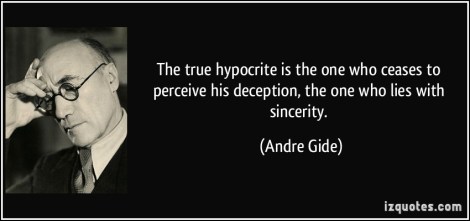 Hypocricy is a common theme in the Bible. We all behave hypocritically at times; it’s human nature. But Jesus and all the prophets admonish us when we do. The thing is, most of us recognize when we are behaving hypocritically and we stop, we apologize to those whom we have offended, and we strive to behave more justly in the future. True hypocrites deceive themselves — they either don’t realize what they are doing, how they are thinking, or they rationalize away their sin. Here is what the Bible has to say about hypocrisy.
I know that I should follow the good advise of a much revered person in my family, my wife’s late father, Popo. Popo used to say, “If you can’t say something nice, keep your mouth shut.” He was right, you know; there are consequences for speaking one’s mind, and I anticipate that this piece will offend a lot of people, some of them my friends. But I have to say it. I have to proclaim the truth as I see it… I call my Evangelicals brothers and sisters, fundamentalist Christians who are on the political right, hypocrites — and I very much doubt that there are many Evangelicals today who are not on the political right. Four-fifths of self-identifying Evangelicals voted for Donald Trump in the last Presidential election.
How can anyone who loves and reveres the teachings of Jesus Christ support and defend someone with the morals demonstrated by Donald Trump: his affairs, his penchant for lying, his hateful, braggadocios, obviously racist comments, his business practices – multiple bankruptcies and legal judgments against him settled out of court? It’s not just his personality, it’s his character. So, there you have it — hypocrisy.
The Evangelical label says something more to me about a person than just the fervor of his or her religious beliefs. It speaks to me about how that person thinks — not just what they believe but how they come to believe what they do. Their thinking is hypocritical — privileged thinking, and it is unvarnished. It’s unvarnished because it’s in plain sight for everyone else to see. They, of course, cannot see it in themselves or in others who share their beliefs. If they could, they would not be true hypocrites. They can’t see their hypocrisy because they suffer from cognitive dissonance. We all suffer from this to some extent. But thinking critically can get us past our biases to recognize truth, or a better version of it.
When confronted with facts that contradict our personal beliefs, ideals, and values, cognitive dissonance causes us to find ways to resolve the contradiction so as to reduce the incongruity, the discomfort that we feel from it. But rather than adjusting, adapting or changing beliefs, Evangelicals and other “conservative” thinkers will ignore or rationalize away the new information to protect the biases that they so strongly hold. Despite verifiable facts, they are sincere and resolute in what they have chosen to believe. Evangelicals can read the Scriptures as well as I or anyone else can. But despite reading and actually saying aloud, “Love your neighbor as yourself,” the message eludes them. It goes right over their heads and bypasses their hearts. They understand that love, as used in this context, is an action word, one compelling us to do as the Prophet Isaiah admonishes us to do. But they choose to blame the poor for their own plights, they shun sojourners, and they support the withholding of tax dollars from social safety net, education and public assistance programs that help lift the disadvantaged out of poverty. They confess how regrettable it is that refugee children have been separated from parents and held in cages. But they say in response to this, “Well, it’s their own fault; the parents brought it upon themselves. They just better stop coming here!”
The Bible and Christian tradition have much to say about loving the stranger, welcoming and caring for refugees and foreigners. Indeed, a strong argument can be made with scriptural support for permeable borders and for a more compassionate approach to immigration, including a pathway to citizenship for young, undocumented persons who were brought here as children. But these arguments would unlikely convince evangelical Christians in America, Christians who are predominately white and who either grew up in the South or were nurtured by the culture that was Jim Crow, a culture which has dispersed throughout the land. Yes, these people, though most of them will deny it, are more likely to hold racist views.
While Evangelicals, those who claim to hold the Bible in highest regard, are more supportive than not of immigration reform, they have more negative views about immigrants than any other religious demographic. This is despite the advocacy efforts of many evangelical organizations and prominent leaders. In fact, the Bible appears to hold little sway on evangelicals when it comes to immigration. A LifeWay Research poll conducted in 2016 found that 90 percent of all Evangelicals say that Scripture has no impact on their views toward immigration reform. They are equally as supportive of measures to strengthen border control — building a wall — as they are for having a pathway to citizenship for undocumented immigrants who are already here. Many Evangelicals call this amnesty, and they are adamantly opposed to it.
Evangelicals, it seems to me, are not basing their views on Scripture or on rational thought. Instead, they are acting out of a powerful, cohesive worldview — an ideology that is at the heart of their religious, cultural and political identities, an ideology that is influenced by conservative media sources and deeply rooted in their own cultural traditions. Rather than love, it seems to me, that fear and hate, xenophobia, homophobia and self-interest are the more motivating emotions.
Let me say here that conservative is a word that I have trouble using in a political context anymore. I have trouble using it because it connotes moderation. Conservatives in today’s political environment, many or most of them, are anything but moderate in my opinion.
The hypocrisy of the religious right even hurts them in their own pocketbooks. But they fail to appreciate the backfire. The reason for this myopia is fear… in this case it’s fear of what they consider to be a “foreign” ideology: socialism. Because of this fear, it is easier for them to believe in “trickle-down” economic theory, which they associate now since the Reagan Revolution, actually consider it to be part and parcel with, capitalism. Trickle-down is the belief that when the rich are rich enough, they will create opportunity. It’s easier for them to believe this and in limited government than it is for them to believe in nurturing human infrastructure — loving our neighbors.
In 1978,” according to Robert Reich, “a typical male worker made $48,302, while the typical top 1 percenter earned $393,663, more than eight times as much. In 2010, even as overall gross domestic product and productivity increased, the average male worker’s wage fell to $33,751. Meanwhile, the average top 1 percenter was making more than $1.1 million — 32 times the average earner.” But while U.S. corporations have been raking it in at the expense of middle America, the religious right in America seems only to care about abolishing Roe vs. Wade, getting prayer back in public schools, and discriminating against people who have gender identities differing from the bodies that they were born to and/or are homosexual.
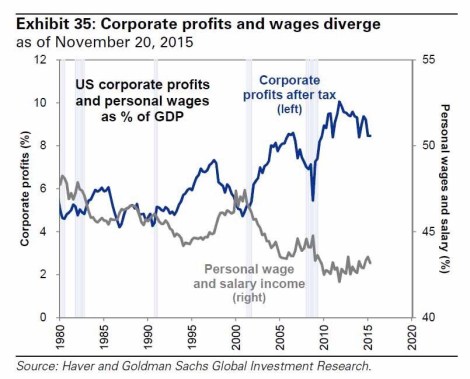
In the 1950s, according to Forbes, a typical corporate CEO made 20 times the salary of his or her average worker. In 2016, CEO pay at a typical S&P 500 Index firm soared to an average of 361 times than the average rank-and-file workers in the same company, or pay of $13,940,000 a year. I can hardly wait to read next year how much this disparity will have increased thanks to this year’s Republican tax cut favoring the rich.
Republican evangelical voters, where is the justice in all this?
One might wonder what happened circa 2001, 2 and 3 that so significantly changed the relationship between corporate profits and average wages. Aside from the fact that large corporations typically surge after the bloodletting that takes place during recessions, consider this: George W. Bush was President during the 2001 recession. It was a short, relatively mild recession compared to the big one at the end of his tenure. But, on the heels of the recession, the Bush administration’s economic footprint was made manifest by significant income tax cuts in 2001 and 2003, the implementation of Medicare Part D in 2003, increased military spending for two wars, a housing bubble due to banking deregulation which contributed to the subprime mortgage crisis of 2007–2008, and the Great Recession…
George Bush embraced a governing philosophy of deregulation. This philosophy trickled down to federal oversight agencies, which in turn eased off on banks and mortgage brokers. Yes, Bush did push early on for tighter controls over Fannie Mae and Freddie Mac, but he failed to move Congress on this. After the Enron scandal, Bush did back and sign the regulatory Sarbanes-Oxley Act. But it was largely toothless — a political, slap-on-the-wrist response. SEC head William Donaldson tried to boost regulation of mutual and hedge funds. But he was blocked by Bush’s advisers at the White House as well as other powerful Republicans. So he gave up trying.
In 2013, the CBPP (Center on Budget and Policy Priorities) estimated that, when the associated interest costs are taken into account, the Bush tax cuts (including those that policymakers later made permanent) would add $5.6 trillion to deficits from 2001 to 2018.
The hypocricy of the religious right plays well into the hands of the political right. Because evangelicals are less prone to be critical thinkers, they are more easily swayed to accept political protestations, talking points rather than historical and scientific facts and statistical evidence on a host of social, environmental and economic matters. Small government (low taxes and lax business regulations) and immigaration are just two of them. Take for example: gun control, climate change, environmental policy, healthcare, and foreign policy. This is why, in my opinion, so many who vote Republican believe what they hear from talk show hosts, politicians and people like Donald Trump rather than scientists and legitimate news agencies.
Please feel free to post a comment or rebuttal.

 The World According to Opa
Very nice job, Kent.
Very thorough article.
I’m so sad that people who claim to love our Lord actually believe in the Hypocrisy of the “so-called president “. And what can you do? Are we going to turn out like the German “Christians” who sat by during Hitler’s reign of terror against humanity?
From one Opa to another: One of my liturgical examples is how conservative churches want to stick to the admittedly lovely but esoteric language of the King James version, because deep down, if it was in plain English, it would make them painfully uncomfortable. For example, “Forgive us our trespasses (debts)” is less pointed than “let our sins be forgiven as we forgive the sins of others” or “let us be judged as generously as we judge others”.
Yes, we Christians are guilty of hearing the words we read as we wish to hear them.